Received 16 December 2014, Revised 12 January 2015, Accepted 27 January 2015
* Corresponding Author Seung-Kyu Park(E-mail:[email protected], Tel:+82-55-213-3634) Department of Electrical Engineering, Changwon National University, Changwon 641-773, Korea
Open Access http://dx.doi.org/10.6109/jkiice.2015.19.4.973 print ISSN: 2234-4772 online ISSN: 2288-4165 This is an Open Access article distributed under the terms of the Creative Commons Attribution Non-Commercial License(http://creativecommons.org/li-censes/
한국정보통신학회논문지(J. Korea Inst. Inf. Commun. Eng.) Vol. 19, No. 4 : 973~983 Apr. 2015
T-S 퍼지 외란 관측기를 이용한 IPMSM의 강인 제어
김민찬 · 이설곤 · 박승규* · 곽군평 · 안호균 · 윤태성
Robust Control of IPMSM Using T-S Fuzzy Disturbance Observer
Min-chan Kim · Xiu-kun Li · Seung-kyu Park* · Gun-pyong Kwak · Ho-kyun Ahn · Tae-sung Yoon Department of Electrical Engineering, Changwon National University, Changwon 641-773, Korea
요 약
본 논문에서는 부하외란이 존재하는 경우에 T-S 퍼지모델을 이용한 비선형 외란 관측기를 제안함으로써
IPMSM(Interior Permanent Magnet Motor)의 제어성능 향상을 도모하였다. T-S퍼지모델은 국부선형모델들의 퍼지
결합으로 비선형계통을 T-S퍼지모델을 구한 다음, 각 국부선형모델의 역함수에 대한 T-S퍼지모델을 구함으로써 비
선형 역함수를 구하는 방법을 제안하였다. 역함수를 이용한 외란관측기의 구성은 선형계통에서와는 달리 비선형 계 통에서는 용이하지 않으나 T-S퍼지 모델을 사용함으로써 이 문제를 해결한 것이다. 제안된 비선형 외란관측기는 T-S퍼지제어기의 대표 격인 PDC 제어기와 함께 사용되었고 시뮬레이션을 통해서 그 유용성을 입증하였다.
ABSTRACT
To improve the control performance of the IPMSM, a novel nonlinear disturbance observer is proposed by using the T-S fuzzy model. A T-S fuzzy model is the combination of local linear models considered at each operating point.
Usually the inverse model is easy to obtain in linear systems but not in nonlinear systems. To design a nonlinear disturbance observer, a nonlinear inverse model is obtained based on nonlinear inverse model which is the fuzzy combination of the local linear inverse models. The proposed DOB is used with a PDC controller which is one of the T-S fuzzy controller, and its performance improvement is shown from the simulation results.
키워드 : 비선형 외란관측기, 몰입형 영구자석형 동기전동기, T-S 퍼지모델, PDC 제어기
Key word : Nonlinear Disturbance Observer, Interior Permanent Magnet Synchronous Motors, T-S Fuzzy Model, PDC Controller
Ⅰ. INTRODUCTION
Permanent magnet synchronous motors(PMSM) are widely used in various applications, such as electric vehicles and spindle motors under the field oriented control technique, with many advantages such as maintenance-free operation, high controllability, robustness against the environment, high efficiency and high power factor operation. There are Surface PMSM(SPMSM) and Interior PMSM(IPMSM)[1].
A SPMSM can be considered as a linear system with the zero d-axis current. However in the case of IPMSM, to obtain the maximum torque per ampere (MTPA)[2], its d-axis current must be controlled as nonzero reference, and this makes it difficult to control[3-6].
With the nonzero d-axis current, the dynamic of IPMSM is nonlinear and nonlinear control methods are required.
One of the effective nonlinear control method is T-S fuzzy control [7-11]. And to improve the robustness by eliminating the effect of disturbances, the use of disturbance observer(DOB) is desirable. The DOB based on the inverse model of the controlled plant have many research results and applications [12-15, 18, 19].
Usually, this kind of DOBs are designed for linear systems since the inverse models are obtained easily from transfer functions[20]. In nonlinear systems, the inverse system can be obtained under the very limited condition.
In this paper, for the robust control of IPMSM, a novel DOB is proposed based on the T-S fuzzy model, which is the convex combination of local linear models in the state space [11]. An inverse system of IPMSM is obtained as a convex combination of the local linear inverse systems[16, 20]. The existence condition of an inverse system in the state space is to have a input direct through matrix D, however most systems including IPMSM have no such a matrix. To overcome this difficulty, a filter, which has a derivative and a low pass filter, is proposed in this paper[19]. A basic T-S fuzzy PDC controller is used with nonlinear DOB and simulation results shows the disturbance decoupling
using the proposed DOB[13, 17].
Ⅱ. BACKGROUND OF INTERIOR
PERMANENT MAGNET SYNCHRONOUS MOTORS
The following IPMSM model is considered.
(1)
where Vd and Vq are d-q axis stator voltages, id and iq are d-q axis stator currents, Ld and Lq are d-q axis stator inductances, R is a stator resistance, Ψf is the rotor magnetic flux, Tl is a load torques, Jm is the moment of inertia, Bm is friction coefficient, and p is the number of poles.
The MTPA can be achieved by differentiating Eq.(1) with respect to q-axis current iq and setting the resulting equation to zero, which gives in [6]:
Ψ
Ψ (2)
Substituting Eq.(2) into Eq.(1), one can get a nonlinear relationship between iq and Te as:
Ψ
Ψ
Ψ (3) In real time, the implementation of the drive system becomes potentially undefined and computationally burdensome with expressions Eq.(2) and Eq.(3).
To address this, the d-axis and q-axis currents are obtained by expanding the square root term of Eq.(2) via a Taylor series expansion about zero.
Ⅲ. TAKAGI-SUGENO FUZZY CONTROLLER FOR IPMSM
The design procedure described in this paper begins with the so-called Takagi-Sugeno fuzzy model, in which local linear models of a nonlinear system are combined by fuzzy IF-THEN rules [7].
The i-th rules of the T-S fuzzy models are of the following form.
Model rule i:
IF
is and…and is
THEN
…… (4) where Mij is the fuzzy set and r is the number of rules; x(t)∈Rn is the state vector, u(t)∈Rm is the input vector, y(t)∈Rq is the output vector, Ai∈Rnxn , Bi∈ Rnxm, and Ci∈Rqxn are the parameters of local linear models, z1(t), … , zp(t). are known premise variables that may be functions of the state variables. We will use z(t) to denote the vector containing all the individual elements z1(t), … , zp(t). It is assumed in this paper that the premise variables are not functions of the input variables u(t). This assumption is needed to avoid a complicated defuzzification process of fuzzy controllers.
Given a pair of (x(t),u(t)), the final T-S fuzzy model is inferred as follows:
{ }
{ } (5)
(6) for all t. The term Mij(zj(t)) is the grade of membership of zj(t) in Mij. Since
≥ ……
(7)
We have
≥ …… for (8)
The stability of T-S fuzzy controller is determined based on the Lyapunov stability which can be applicable for a regulator problem.
To change the tracking problem into a regulator problem, an error model is derived as follows. The reference input is determined from the following steady state equation:
ˍˍ ˍ ˍΨ ˍˍ ˍ
ˍ
ˍ
ˍ (9) Note that variable id and iq are still shown in Eq.(1) and they are also included in the reference voltages.
With the reference input currents, the d-axis and q-axis voltages of error model are determined as: By substituting the above Eq.(9) into Eq.(1) the error model is obtained as:
ˍ
ˍ
(10)
where
_ _ and _ _ (11)
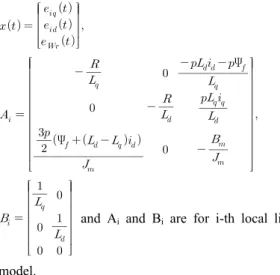
The above dynamics have simple nonlinear terms but difficult to be used for the design of DOB without T-S fuzzy approximation. For some constant values of iq(t), id(t), the system can be linear. If iq(t), id(t) are chosen as the premise variables, the following T-S fuzzy model of IPMSM is obtained:
{ }
(12)
where is a membership function and
Ψ
Ψ
and Ai and Bi are for i-th local linear model.Note that the parameter C can be determined as the desired value since the all states of IPMSM are usually measurable for the field oriented control.
Various type of T-S fuzzy controller can be used with the proposed DOB, however, in this paper, the most basic T-S fuzzy PDC controller, which does not consider any robustness, is used to show the disturbance decoupling of the proposed DOB.
A PDC controller has the following form:
(13)
where Fj are calculated from the LMI.
The known load disturbances can be considered in the reference input, however unknown disturbance must considered by using disturbance observer. In the next section, a novel nonlinear DOB based on T-S fuzzy inverse system is proposed.
Ⅳ. T-S FUZZY DISTURBANCE OBSERVER FOR IPMSM
In this chapter, an inverse nonlinear system is derived and used for the design of a nonlinear DOB.
The inverse systems have been studied by using transfer functions only for linear systems but seldom for the nonlinear systems[14,17].
The following figure shows the basic concept of DOB in linear system using the transfer function.
그림 1. DOB의 블록도
Fig. 1 The block diagram of DOB
In the Fig.1, ur is the input of controller, u is the input after compensation, d is the unknown external disturbance, P(s) is the original plant, Pn-1(s) is the useful inverse system of it.
The inverse system is obtained very easily from the transfer function and the problem is solved using the low pass filter under the condition of low frequency input and disturbances. However this approach is impossible in nonlinear systems. so, the following inverse T-S fuzzy model in the state space is proposed in this paper.
The i-th local linear system is described in the state space as follows:
(14)
Under the assumption of existence of nonsingular D, its inverse system is obtained as follows:
ˍ ˍ
ˍ ˍ
(15)
where
ˍ ,
ˍ ,
ˍ and ˍ
For the above local inverse systems, a T-S fuzzy inverse exists if B=Bi, C=Ci and D=Di. In IPMSM, Bi
and Ci are constant but D does not exist, then the inverse systems cannot be derived.
In this paper, to make an inverse system available, a special filter is proposed for the output.
≠ (16) where Q(s) is the polynomial function of s and its output has the D matrix, and GLPF(s) is a low pass filter.
Suppose inputs and disturbances are low frequency signals and their outputs are not depend on the low-pass filter and the filtered output is considered as follows.
≠ (17) The role of Q(s) is to make as the sum of derivatives of y(t) and change the system to have the nonsingular matrix D in the state space.
In this paper, Q(s) is given as (ps+q) for the IPMSM and its usage is explained as follows: for the inputs and disturbances which are not high frequencies, the low pass filter can be neglected and the yi-new(t) can be described as follows:
ˍ
ˍ
ˍ
(18)
where
ˍ × and
ˍ . The filter must be designed to give nonsingular Di-new.
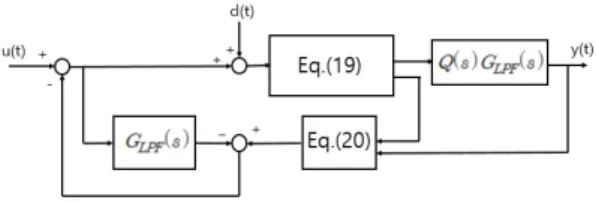
Through the convex combination, the overall T-S fuzzy model is obtained as follows:
{ }
{
ˍ
ˍ }
(19)
As a result, the inverse system of the IPMSM can be derived as follows:
{ ˍ}
ˍ
(20) Now the inverse system is the convex combination of local linear inverse systems and the overall stability is guaranteed by the stability of each local inverse system.
The stability of i-th local inverse system is described as a Hurwitz matrix as follows:
(21) Note that the IPMSM has simple T-S fuzzy model and its inverse system easy to obtain, however, without T-S fuzzy model this kind approach is impossible.
ˍ × and
≠ (22) Combining the DOB system with error system we built, we can get the overall system as a nonlinear DOB using T-S fuzzy model for IPMSM.
그림 2. 비선형 DOB의 블록도
Fig. 2 Block diagram of nonlinear DOB
In next chapter, we will introduce a simulation to illustrate the performance of DOB applied to IPMSM.
Ⅴ. SIMULATION RESULT
In the previous chapters, we mainly proposed a T-S fuzzy control method with the disturbance observer (DOB) based on the inverse system for IPMSM.
Simulation results for IPMSM will be shown with the proposed method.
The parameters of the IPMSM, used in the simulation, are given in the following table.
표 1. IPMSM의 파라미터 Table. 1 Parameters of IPMSM
Pole pair number P 2
d-axis inductance Ld 42.44[mH]
q-axis inductance Lq 79.57[mH]
Stator resistence R 1.93[Ω] Motor inertia Jm 0.003[Kgm]
Friction coefficient Bm 0.001[Nm/rad/sec]
Flux constant Ψf 0.311[Volts/rad/sec]
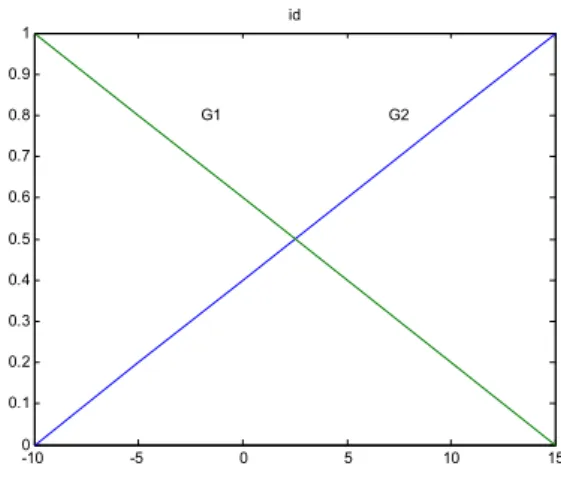
The membership functions are described in the following figures:
0 5 10 15 20 25 30
0 0.1 0.2 0.3 0.4 0.5 0.6 0.7 0.8 0.9 1
iq
E1 E2
그림 3. Iq의 소속함수
Fig. 3 Membership function of Iq
-10 -5 0 5 10 15
0 0.1 0.2 0.3 0.4 0.5 0.6 0.7 0.8 0.9
1 id
G1 G2
그림 4. Id의 소속함수
Fig. 4 Membership function of Id
The parameters of the local linear models:
The PDC controller gains F:
The parameters of the inverse system models:
Two cases will be considered. The first one is control plant without DOB, and The second is with DOB.
Through the comparation between the above two cases, the performance of DOB can be checked apparently.
The simulation results of the first are shown in the following figure.
0 5 10 15 20 25 30
0 50 100 150 200 250 300 350
Time(sec)
wr(rad/s)
그림 5. DOB 적용 전의 IPMSM 속도 응답 Fig. 5 Speed response of IPMSM without DOB
In the speed control, the reference speed is wr-ref = 300rad/sec and some sinusoidal signals will be applied on the plant as the unmeasured disturbance. Due to the disturbance, the output w fluctuates at 280 rad/sec and can not achieve the desired tracking performance.
0 5 10 15 20 25 30
-2 0 2 4 6 8 10
Time(sec)
id(A)
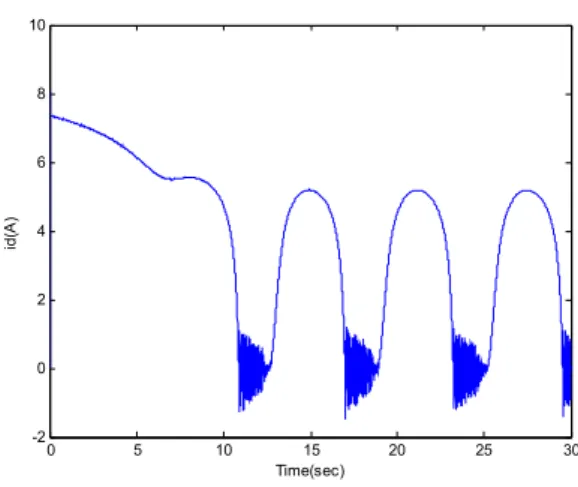
그림 6. 사례 1에서의 d축 전류 id
Fig. 6 d-axis current id under the case 1
With the reference speed wr-ref = 300 rad/sec and some sinusoidal disturbance. As the d-axis current id in Fig. 5 shows, we can tell that disturbance will have a bad effect on id , and id could not tend to the desired steady state value.
0 5 10 15 20 25 30
-2 0 2 4 6 8 10 12 14
Time(sec)
iq(A)
그림 7. 사례 1에서의 q축 전류 iq
Fig. 7 q-axis current iq under the case 1
With the reference speed wr-ref = 300 rad/sec and some sinusoidal disturbance, the q-axis current iq
behaves as the above figure. In the Fig. 7, iq fluctuates periodicly with the period of sinusoidal disturbance.
0 5 10 15 20 25 30 -100
-50 0 50 100 150 200 250 300
Time(sec)
vd(v)
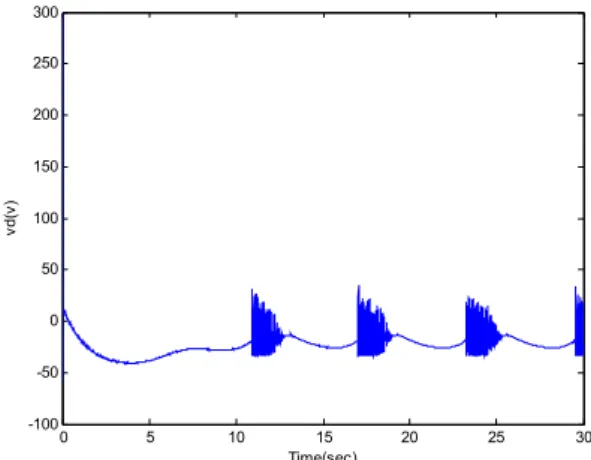
그림 8. 사례 1에서의 LMI 퍼지 제어된 시스템의 vd
Fig. 8 vd of LMI fuzzy controlled system under the case 1
With the reference speed wr-ref = 300 rad/sec and some sinusoidal disturbance, the d-axis voltage vd is changed from 300V to 0V and at 11s the response fluctuates because of the disturbance.
0 5 10 15 20 25 30
-300 -200 -100 0 100 200 300
Time(sec)
vq(v)
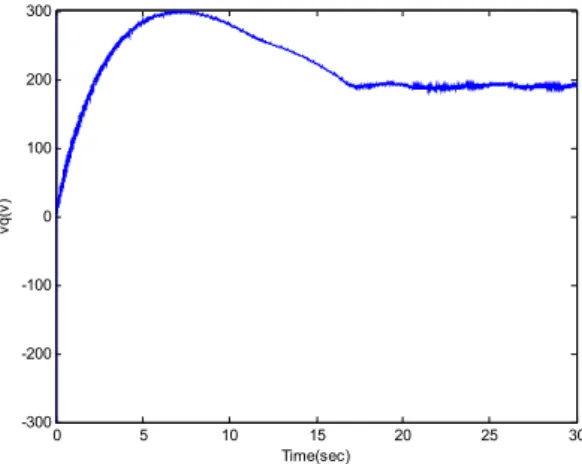
그림 9. 사례 1에서의 LMI 퍼지 제어된 시스템의 vq
Fig. 9 vq of LMI fuzzy controlled system under the case 1
With the reference speed wr-ref = 300 rad/sec and some sinusoidal disturbance, the q-axis current vq is changed from 0V to 200V, but at 11s the waveform fluctuates periodicly with the disturbance.
From the above simulation results, without the DOB, the plant can not have a good performance to against the disturbance and shows the deteriorated
stability and control performances.
The simulation results of the case 2 are shown in the following figure.
0 5 10 15 20 25 30
0 50 100 150 200 250 300
Time(sec)
wr(rad/s)
그림 10. DOB가 적용된 후의 IPMSM 속도 응답
Fig. 10 Speed response of IPMSM after applying a DOB
In order to make a comparation, here we still set the reference speed wr-ref = 300 rad/sec and the same desired sinusoidal signals. We can see even there exists a disturbance, after applying a DOB to the system, the system can realize the tracking performance, the value of w will tend to be steady to 300 rad/sec without any fluctuation as simulation time goes.
0 5 10 15 20 25 30
-1 0 1 2 3 4 5 6 7 8 9
Time(sec)
id(A)
그림 11. 사례 2에서의 d축 전류 id
Fig. 11 d-axis current id under the case 2
With the reference speed wr-ref = 300 rad/sec and some sinusoidal disturbance, the d-axis current id is as the above Fig. 11. We can tell that id tends to be the desired value.
0 5 10 15 20 25 30
0 2 4 6 8 10 12 14
Time(sec)
iq(A)
그림 12. 사례 2에서의 q축 전류 iq
Fig. 12 q-axis current iq under the case 2
With the reference speed wr-ref = 300 rad/sec and some sinusoidal disturbance, the q-axis current iq tends to be desired value.
0 5 10 15 20 25 30
-100 -50 0 50 100 150 200 250 300
Time(sec)
vd(v)
그림 13. 사례 2에서의 LMI 퍼지 제어된 시스템의 vd
Fig. 13 vd of LMI fuzzy controlled system under the case 2
With the reference speed wr-ref = 300 rad/sec and some sinusoidal disturbance, even there still exists disturbance, after we build a DOB, it can make a
compensation to deteriorate the negative effect of disturbance. And the waveform will range from 300 to 0 and finally tend to be a steady state.
0 5 10 15 20 25 30
-300 -200 -100 0 100 200 300
Time(sec)
vq(v)
그림 14. 사례 2에서의 LMI 퍼지 제어된 시스템의 vq
Fig. 14 vq of LMI fuzzy controlled system under the case 2
With the reference speed wr-ref = 300 rad/sec and sinusoidal disturbance, the q-axis voltage vq tends to be steady at 200V shown as the above Fig. 14.
Through the comparisons, the effectiveness of the proposed DOB is shown clearly.
Ⅵ. CONCLUSIONS
The T-S fuzzy inverse model of IPMSM is derived by using the T-S fuzzy model, which is the convex combination of local linear inverse system in the state space. Using the inverse model, the nonlinear DOB is proposed and used with the PDC controller. The effectiveness of the proposed DOB has been shown through the computer simulation comparing the IPMSM system with DOB to the one without DOB.
ACKNOWLEDGMENTS
This research is financially supported by Changwon National University in 2014~2015.
REFERENCES
[ 1 ] THOMAS M. JAHNS, GERALD B. KLIMAN, and THOMAS W. NEUMANN, "Interior Permanent-Magnet Synchronous Motors for Adjustable-Speed Drives,". IEEE Transactions on industry application, vol. IA-22, no. 4, pp.
738-747, Jul./Aug. 1986.
[ 2 ] Casey B. Butt and M. Azizur Rahman, " Intelligent Speed Control of Interior Permanent Magnet Motor Drives Using a Single Untrained Artificial Neuron,". IEEE Transactions on industry application, vol 49, no. 4, pp. 1836-1843, Jul./
Aug. 2013.
[ 3 ] A.G. Aissaoui, M. Abid, A. Tahour and A. C. Megherbi, "A Fuzzy Logic and Variable Structure Control for Permanent Magnet Synchronous Motors," International Journal of Systems Control, vol. 1, Iss. 1, pp. 13-21, 2010.
[ 4 ] M. Nasir Uddin and M. Azizur Rahma, "High-Speed Control of IPMSM Drives Using Improved Fuzzy Logic Algorithms," IEEE Transactions on industrial electronics, vol. 54, no. 1, Feb. 2007.
[ 5 ] Boldea, I., Paicu, M.C., Andreescu, G.D. and Blaabjerg, F.,
"Active flux orientation vector sensorless control of IPMSM," Proc. Of IEEE Optimization of Electrical and Electronic Equipment 2008, pp. 161-168, May 2008.
[ 6 ] Chy. Md. M.I. and Uddin. M.N., "Nonlinear Control of Interior Permanent Magnet Synchronous Motor Incorporating Flux Control," Proc. Of IEEE Electrical and Computer Engineering 2006, pp. 815-818, Canadian, May 2006.
[ 7 ] Tomohiro Takagi, Michio Sugeno, "Fuzzy Identification of Systems and Its Applications to Modeling and Control,"
IEEE Transactions on SMC, vol. 15, pp.116-132, 1985.
[ 8 ] Chung-Hsun Sun, Yin-Tien Wang, and Cheng-Chung Chang, "Design of T-S Fuzzy Controller for Two-wheeled Mobile Robot," Proceedings of 2011 International Conference on System Science and Engineering, Macau, China, Jun. 2011.
[ 9 ] Gwo-Ruey Yu, Heng-Ta Hsieh, " Robust Control of an Underactuated Robot via T-S Fuzzy Region Model,"
Proceedings of the 8th World Congress on Intelligent Control and Automation, Taipei, Taiwan, Jun. 21-25 2011.
[10] Chaoquan Li, Xueshan Gao, Qiang Huang, Fuquan Dai, Jie Shao, Yang Bai, Kejie Li, "A coaxial couplewheeled robot with T-S fuzzy equilibrium control," Industrial robot : An
International Journal, vol:38, iss:3 pp. 292 –300, 2011.
[11] Yew-Wen Liang, Sheng-Dong Xu,Der-Cherng Liaw and Cheng-Chang Chen," A Study of T-S Model-Based SMC Scheme With Application to Robot Control," IEEE Transactions on Industrial Electronics, vol. 55, no. 11, pp.
3964-3971, 2008.
[12] Y.X. Su, C.H. Zheng, and B.Y. Duan, "Automatic disturbances rejection controller for precise motion control of permanent-magnet synchronous motors," IEEE Transactions, Industrial Electronics, vol. 52, no. 3, pp.
814-823, Jun. 2005.
[13] E. Schrijver and J. van Dijk, "Disturbance observers for rigid mechanical systems: Equivalence, stability, and design," Journal of Dynamic Systems, Measurement, and Control, vol. 124, no. 4, pp. 539-548, 2002.
[14] W.-H. Chen and L. Guo, "Analysis of disturbance observer based control for nonlinear systems under disturbances with bounded variation," in Proceedings of Control 2004, UK, Sep. 2004.
[15] G. H. Hostetter and J. Meditch, "On the generalization of observers to systems with unmeasurable, unknown inputs,"
Automatica, vol. 9, pp. 721-724, 1973.
[16] Nam Hoon Jo, Hyungbo Shim, and Young Ik Son,"
Disturbance Observer for Non-minimum Phase Linear Systems," International Journal of Control, Automation, and Systems (2010), vol. 8, no. 5, pp. 994-1002, 2010.
[17] T. Mita, M. Hirata, K. Murata and H. Zhang, "H∞ control versus disturbance-observer-based control," IEEE Transactions on Industrial Electronics, vol. 45, no. 3, pp. 488-495, 1998.
[18] H. Kobayashi, S. Katsura and K. Ohnishi, "An analysis of parameter variations of disturbance observer for motion control," IEEE Transactions on Industrial Electronics, vol.54, no.6, 2007.
[19] Patrick Gerland, Dominic Groß, Horst Schulte, and Andreas Kroll, "Design of Sliding Mode Observers for TS Fuzzy Systems with Application to Disturbance and Actuator Fault Estimation," 49th IEEE Conference on Decision and Control Dec. 15-17, 2010.
[20] DEZHI XU, B IN JIANG, Peng Shi, "NONLINEAR ACTUATOR FAULT ESTIMATION OBSERVER: AN INVERSE SYSTEM APPROACH VIA A T-S FUZZY MODEL," Int. J. Appl. Math. Comput. Sci., vol. 22, no. 1, pp. 183-196, 2012.
김민찬(Min-Chan Kim)
Received the B. S., M. S., and Ph. D. degrees in Electrical Engineering from Changwon National University in 1996, 1998 and 2003, respectively. From 2006 to 2009, he was a research professor under the Brain Korea 21 Project Corps. He worked with the Human resource development center for Offshore and Plant Engineering(HOPE) at Changwon National University as a research professor from 2009 to 2012. He worked with the Department of Electricity at Gyeongnam Provincial Namhae College from 2012 to 2014.
※research interests : H∞ robust control theory, sliding mode control theory, T-S fuzzy control
이설곤(Xiu-Kun Li)
Received the B. S. degrees in automation from jilin Institute of Chemical Technology in 2012. and He received the M. S. degress in Electrical Engineering from Changwon National University in 2014.
※research interests : T-S fuzzy control
박승규(Seung-Kyu Park)
Received the B. S., M. S., and Ph. D. degrees in Electrical Engineering from Korea University in 1984, 1986 and 1990, respectively. He was a visiting professor of Strathclyde University, England from 1995 to 1996. Since 1990, he is currently a professor in the Department of Electrical Engineering at Changwon National University, Changwon, Korea.
※research interests : adaptive control theory, robust control theory and nonlinear control theory
곽군평(Gun-Pyong Kwak)
Received the B. S., M. S., and Ph. D. degrees in Electrical Engineering from Korea University in 1982, 1985 and 1990, respectively. He was a section chief of CNC team, LGIS from 1990 to 1997. Since 1998, he is currently a professor in the Department of Electrical Engineering at Changwon National University, Changwon, Korea.
※research interests : control algorithm and motion controller, sliding mode control
안호균(Ho-Kyun Ahn)
Received the B. S., M. S., and Ph. D. degrees in Electrical Engineering from Korea University in 1980, 1988 and 1992, respectively. He was a chief of Electrical Design Team, Hanshin Construction from 1980 to 1986. Since 1992, he is currently a professor in the Department of Electrical Engineering at Changwon National University, Changwon, Korea.
※research interests : power electronics, power conversion and alternative energy
윤태성(Tae-Sung Yoon)
Received the B. S., M. S., and ph. D. degrees, in Electrical Engineering from Yonsei University, Seoul, Korea, in 1978, 1980 and 1988, respectively. He worked with the Department of Electrical Engineering at the 2nd Naval Academy, Jinhae, Korea, as a member of the teaching staff from 1980 to 1983. He worked with the Department of Electrical Engineering at Vanderbilt University, Nashville, as a Visiting Assistant Professor from 1994 to 1995. Since 1989, he has been with the Department of Electrical Engineering, Changwon National University, Changwon, Korea where he is currently a Professor.
※research interests : robust filtering and mobile robotics