A New Robust Digital Sliding Mode Control with Disturbance Observer for Uncertain
Discrete Time Systems
Jung-Hoon Lee
*★Abstract
In this paper, a new discrete variable structure controller based on a new sliding surface and discrete version of the disturbance observer is suggested for the control of uncertain linear systems. The reaching phase is completely removed by introducing a new proposed sliding surface. The discrete version of the disturbance observer is derived for the effective compensation of the effect of uncertainties and disturbances.
A corresponding control input with the disturbance compensation is selected to guarantee the quasi sliding mode on the predetermined sliding surface for guaranteeing the designed output in the sliding surface from any initial condition to the origin for all the parameter variations and disturbances. By using Lyapunov function, the closed loop stability and the existence condition of the quasi sliding mode is proved. Finally, an illustrative example is presented to show the effectiveness of the algorithm.
Key words: Discrete variable structure system, Digital sliding mode control, Disturbance observer
*ERI, Dept. of Control & Instrum. Eng., Gyeongsang National University
★Corresponding author
Manuscript received June. 2, 2010; revised june. 28, 2011
I. Introduction
The theory of the variable structure system (VSS) or sliding mode control (SMC) can provide the effective means to the problem of controlling uncertain discrete time dynamical systems under parameter variations and external disturbances[5]-[18]. One of its essential advantages is the robustness of the controlled system against variations of parameters and external disturbances in the quasi sliding mode on the predetermined sliding surface, s(k)=0[5][6]. The proper design of the sliding surface can determine the almost output dynamics and its performances. In the SMC for discrete time systems, a few issue is considered in the design of the VSS controller, i.e. the stable design of the sliding surface[10][11], reacheability from a given initial state to the fixed sliding surface[12][15][17], existence of quasi sliding
mode[5][7][8][15] to gather with closed loop stability[6], robustness against uncertainties and disturbance[6][15][16][18], etc.[19]. In 1985, the quasi sliding mode was defined and the condition for the existence of the quasi sliding mode in discrete VSS was presented[5]. The sliding and convergence condition for the control of discrete-time systems is suggested by Sarpturk et. al[7] which is modified from that of Milosavljevic's where an absolute value condition for the reaching and the existence condition of the quasi sliding mode is imposed. In 1990 the design methodology of discrete VSS is proposed by using the transformation matrix and using Lyapunov function the quasi sliding and convergence condition is proposed[8]. Further, the sliding sector concept is introduced to design sliding mode controller for linear single-input discrete-time systems[8]. In [9], the problems of the robust model following control of discrete-time uncertain systems is considered. Using equivalent control of the discrete VSS, the sliding surface is designed in [8]
and [13], both are different. Using a candidate Lyapunov function, the coefficient of the sliding surface is designed[10]. By means of optimal theory
to minimize the cost function, the optimal sliding surface is chosen with selection of the optimal switching gain[11]. The simple sliding mode with the robust stability is designed and the chattering along the sliding mode is reduced[12]. However a counter example showing the instability of the control scheme proposed by Wang et al. was given in [13]. The band of the quasi sliding mode is rigorously defined and a new reaching condition is established in [14]. For multivariable systems, a new condition for the existence of the discrete-time sliding mode is suggested and a design procedure is presented such that the robust stable sliding motion is achieved in [15]. The fixed and adaptive sliding mode control in the presence of an unknown disturbance is presented in [16]. The difference in the requirements for the sliding mode behavior for continuous- and discrete-time systems is compared and the limitations of discrete-time variable structure quasi sliding mode control is discussed[17].
A simple design technique of quasi sliding mode controllers is provided for a class of multi input uncertain discrete-time system with matching conditions[18]. For uncertain nonlinear systems, the discrete-time implementation of a second-order quasi sliding mode control scheme is analyzed in [20].
Until now in most of discrete VSSs, the used sliding surface is linear, i.e, the linear combination of the full state
, and fixed in state space. Because of this, the closed loop system has the reaching phase for the initial state far from the sliding surface and the quasi sliding mode for the robustness is not guaranteed during this phase.In this paper, a new discrete variable structure controller based on a new sliding surface and the discrete version of a disturbance observer is suggested for the control of uncertain linear systems with predetermination/prediction of the output response. The reaching phase is completely removed by introducing the new proposed sliding surface which stems from [21]. The discrete version of the disturbance observer is derived for the effective compensation of uncertainties and disturbances. A corresponding control input with the disturbance observer is selected to guarantee the
quasi sliding mode on the predetermined sliding surface for guaranteeing the designed output in the sliding surface from any initial condition to the origin for all the parameter variations and disturbances. The advantages obtained after removing the reaching phase are discussed. Finally, an illustrative example is presented to show the effectiveness of the algorithm.
II.A Discrete Variable Structure Systems
2.1 Description of plants
Consider an uncertain linear time invariant discrete time plant given in the state space representation by
∆ ∆
(1)
∆ ∆
(2) where
≥ is an integer,
∈is the state,
∈
is its initial condition of the state,
∈
is the input control to be determined,
∈ × and ∈ ×
is the nominal matrix,
∈ ×
is full rank,
∆ and ∆is the
uncertainty,
is the external disturbance, and
is the unknown lumped uncertainty to be estimated.
Assumption:
A1:
is completely controllable
A2: The lumped uncertainty
is piecewise smooth such that
(3) and is bounded and satisfies the matching conditions[18]
2.2 Sliding Surface
To design the sliding surface, a desired model is given as
(4)
(5)
where
∈is the state of the model,
∈
is the control input for the model.
By intuition based on the continuous time case in [21], the following sliding surface to have the exact performance of the model is suggested
(6)
(7) The design parameters in (6) are a nonzero positive element
and feedback gain
or closed system matrix
. If
, then
,
∴ , where
where
is an arbitrary matrix such that the inverse of
exists.
The sliding surface (6) is zero at the initial time
for any initial condition
in state space. Therefore the reaching phase to the sliding surface is removed completely and there is no need of the consideration of the reaching condition in this suggested discrete VSS.
Definition 1: Quasi Sliding Mode [5]
For any real number
, if
for all k is satisfied because of the finite sampling time, then it is called as a quasi sliding mode .
Definition 2: Discrete Ideal Sliding Mode [8][15]
If
≥ is satisfied, then it is called as a discrete ideal sliding mode .
In the discrete ideal sliding mode on the sliding surface (6),
is satisfied by Definition 2[8], the ideal sliding surface of (6) is obtained as the following ideal sliding dynamics
(8)
where
is an arbitrary matrix such that the inverse of
exists. The solution
∈of the ideal sliding dynamics (8) exactly defines the discrete ideal sliding surface
≥
. Therefore, the stable design of the discrete ideal sliding dynamics (8). i.e, choice of stable
is identically the stable design of the proposed sliding surface, i.e., the performance design of the model dynamics or nominal plant dynamics. Substituting (1) in
yields the equivalent control[8][10]
(9)
(10) The closed loop system by equivalent control is obtained as
(11)
which coincides that of (7).
2.3 Control Input
Now, to estimate the lumped uncertainty (2) for compensation by the control input, the discrete disturbance observer is derived as follows:
(12)
(13) From (13), the proposed disturbance observer is obtained as follows:
∴
(14)
Since
and if
, then
∴
(15)
The one step delay nonlinear disturbance
observer for the discrete compensation is
finally obtained, which is identical to that of
[3].
Now to stabilize the (1) with the chosen sliding surface and compensation by means of the disturbance observer, a following discrete control input is presented
(16) where
is the same as in (5), (7), and (8) which is identically determined by the design of the sliding surface,
and satisfies the following condition
′
,
′ ,
(17) The design parameter
is designed such that the closed loop system matrix
is stable, and another design parameter
is selected such that
′ is satisfied. Using the control input (16) with the sliding surface (6) and disturbance observer (15), the existence of the quasi sliding mode and closed loop stability is investigated in text theorem.
Theorem 1: If the sliding surface is designed in the stable condition, i.e. stable design of
, the proposed control input with the disturbance observer can establish the quasi sliding mode on the sliding surface from the initial state to the origin and satisfies the stability in the sense of Lyapunov.
Proof; Take a discrete candidate Lyapunov function as
(18)
then
≅
(19) then
∆
′
(20)
which implies that
(21)
(22)
∆
∆
∆
(23)
(24) as long as
[8][15] and therefore
≤
min′(25) are satisfied where ⋅ is its eigenvalue which completes the proof of Theorem 1.
By the results of Theorem 1, the quasi sliding mode on the sliding surface for all
≥ is guaranteed. the performance designed in the sliding surface is guaranteed almost also.
II. Design Example/Simulation Studies
Consider a position control problem of a following direct drive motor plant with disturbances
(26) where
, and are the position and its speed of the direct drive motor. The sampling time is selected as . The closed loop matrix and linear feedback gain is designed to determine the sliding surface and ideal sliding output as
and
(27) The nonzero element for the sliding surface is designed as . Thus the designed sliding surface is as follows:
(28)An initial condition for (1) and (7) is given as
deg degsec . The ideal sliding dynamics of (27) is as follows:
(29) The solution of (29) is the ideal sliding output
defined by (28). The in the control input is designed as 0.001 to satisfy the condition (17). The simulation is carried out under load variation of disturbance from sec to sec and.
load variation of disturbance from
sec to sec. To compare with the conventional discrete VSS, a typical conventional sliding surface is selected as
(30) and a corresponding control input is designed as
∆ ∆ (31) where is the same as in (26), ∆ and ∆ are as follows
i f if (32a)
if if (32b) (32c)
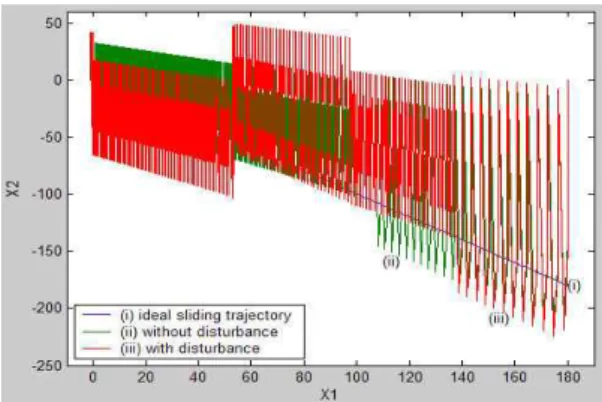
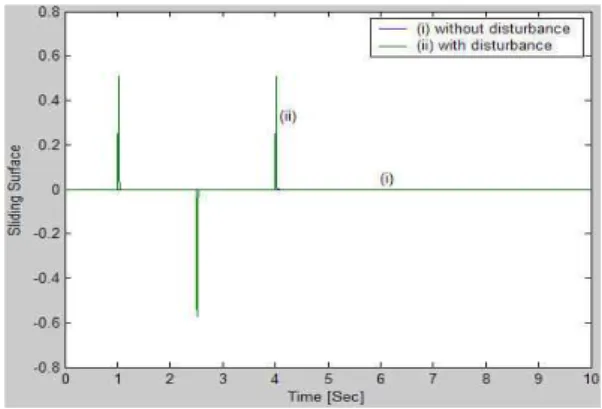
Fig. 1 shows the three position outputs of the motor (i) ideal sliding output, (ii) without disturbance, and (iii) with disturbance by the conventional discrete VSS. The three outputs are different because of the effects of reaching phase and disturbance. The three phase trajectories (i) ideal sliding trajectory, (ii) without disturbance, and (iii) with disturbance are depicted in Fig. 2 The two sliding surfaces (i) without disturbance and (ii) with disturbance are shown in Fig. 3. The two corresponding control inputs (i) without disturbance and (ii) with disturbance are depicted in Fig. 4. Fig. 5 shows three position outputs of the motor (i) ideal sliding output, i.e. solution of (28), (ii) without disturbance, and (iii) with disturbance by the proposed algorithm.
As can be seen, the three output is almost identical.
The phase trajectories for the three cases (i) ideal sliding trajectory, (ii) without disturbance, and (iii) with disturbance are depicted in Fig. 6. There is no reaching phase in these figures. However the phase trajectory under disturbance is disturbed because of one step delay estimation of the disturbance observer and the quasi sliding mode of the discrete VSS, however quickly recovered by the suggested control input. Fig. 7 shows the two sliding surfaces for the two cases (i) without disturbance and (ii) with disturbance. The control inputs for the two cases (i) without disturbance and (ii) with disturbance are depicted in Fig. 8. The load variation of disturbance from sec to sec and its
estimated value by means of the discrete one step delay disturbance observer are shown in Fig. 9.
From the simulation studies, the effectiveness of the proposed discrete VSS is proven.
Fig.1 Three position outputs of motor (i) ideal sliding output (ii) without disturbance, and (iii) with disturbance by conventional discrete VSS
Fig.2 Phase trajectories for the three cases (i) ideal sliding trajectory (ii) without disturbance, and (iii) with disturbance by conventional discrete VSS
Fig. 3 Two sliding surfaces for the two cases (i) without disturbance and (ii) with disturbance
Fig. 4 Control inputs for the two cases (i) without disturbance and (ii) with disturbance by conventional discrete VSS
Fig.5 Three position outputs of motor (i) ideal sliding output (ii) without disturbance, and (iii) with disturbance by proposed discrete VSS
Fig.6 Phase trajectories for the three cases (i) ideal sliding trajectory (ii) without disturbance, and (iii) with disturbance
Fig. 7 Two sliding surfaces for the two cases (i) without disturbance and (ii) with disturbance
Fig. 8 Control inputs for the two cases (i) without disturbance and (ii) with disturbance
Fig. 9 Load variation of disturbance from sec to
sec and its estimated value by means of the discrete one step delay disturbance observer
IV. Conclusions
In this paper, a design of a new robust discrete VSS with the disturbance observer and the new sliding surface is presented for the control of uncertain linear discrete systems under lumped uncertainties. To successfully remove the reaching phase problems, a discrete sliding surface is suggested to define the hyper plane from any given initial condition. For the design of its sliding surface, the ideal sliding dynamics are obtained.
After choosing the desired performance by means of any well developed linear discrete regulator theories, the sliding surface is determined to have exactly that performance from a given initial condition to the origin. The discrete version of disturbance observer is derived to effectively estimate the lumped uncertainties. A corresponding control input with disturbance observer is also designed to almost guarantee the performance pre-determined in the sliding surface. The robustness of the pre-determined output for all the lumped uncertainties is investigated in Theorem 1 together with the existence condition of the quasi sliding mode of the discrete VSS and the stability of the closed loop system in the sense of Lyapunov.
Through simulation studies, the usefulness of the proposed controller is verified.
References
[1]V.I. Utkin,, Sliding Modes and Their Application in Variable Structure Systems. Moscow, 1978.
[2]Decarlo, R.A., Zak, S.H., and Mattews, G.P.,
"Variable Structure Control of Nonlinear Multivariable systems: A Tutorial," Proc. IEEE, 1988, 76, pp.212-232.
[3]Young, K.D., Utkin, V.I., Ozguner, U, "A Control Engineer's Guide to Sliding Mode Control," 1996 IEEE Workshop on Variable Structure Systems, pp.1-14
[4]Drazenovic, B. "The invariance conditions in variable structure systems, Automatica, 1969, (5), pp.287-295.
[5]Milosavljevic, C, "General Conditions for the Existence of a Quasi Sliding Mode on the Switching HyperPlane in Discrete Variable Structure Systems," Automat.
Remote Control, vol. 46, pp.307-314, 1985
[6]Opitz, H. P., "Robustness Properties of Discrete-Variable Structure controllers." Int. J.
Control, 1986 vol. 43, no.3 pp. 1003-1014.
[7]Sarpturk , A. Z., Istefanopulos Y. and Kaynak O., " On the Stability of Discrete-Time Sliding Mode Control Systems," IEEE Trans. Autom. Contr, 1987, AC-32, no. 10, pp.930-932
[8]Furuta, K., "Sliding Mode Control of a Discrete System," System and Control Letter, vol.14, pp.145-152, 1990
[9] W. Chai, N. K. Loh and C. F. Lim, "Unified Design of Robust Discrete-Time Control Systems, 1992 ACC, pp.1091-1095.
[10]S. K. Spurgeon, "Hyperplane Design Technique for Discrete-Time Variable Structure Control Systems." Int. J. Control 1991, vol.55 no.2 pp.445-456.
[11]J.K. Pieper and B. W. Surgenor, "Discrete Sliding control of a Coupled-Drives apparatus with Optimal Sliding Surface and Switching Gain," IEE Proc.-D Vol. 140 no.2 March,1993, pp.70-78
[12]W. J. Wang, G. H. Wu, and D. C. Yang,
"Variable Structure Control Design for Uncertain discrete-Time Systems," IEEE Trans. Autom.
Contr, 1994, vol.AC-39, no. 1, pp.99-102.
[13]P. Myszkorowski and U. Holmberg, "Comments on " Variable Structure Control Design for Uncertain Discrete_time System"", IEEE Trans.
Autom. Contr, 1994, vol.AC-39, no. 11, pp.2366-2367.
[14]W. Gao, Y. Wang, and A. Homaifa, "
Discrete-Time Variable Structure Control Systems," IEEE T. Indust. Electronics, vol.42,
no.2 1995, pp117-122.
[15]A. J. Koshkouei and A. S. I. Zinober, "Sliding Lattice Design for Discrete-time Linear Multivariable systems," 1996 CDC pp.1497-1502.
[16]C. Y. Chan, "Discrete Adaptive Sliding Mode control of a state-space system with Bounded Disturbance," Automatic, vol.34, no.12pp1631-1635, 1998.
[17]S. Hui and S H Zak, "On Discrete-Time Variable Structure Sliding Mode," System &
Control Letters vol.38 pp.283-288, 1999.
[18]C. C. Cheng M. M. lin, and J. M. Hsiao, “ Sliding Mode Controllers Design for Linear Discrete-time Systems with Matching Perturbations," Automatica vol.36 pp1205-1211, 2000.
[19]G. Golo and C. Milosavljevic, "Robust Discrete-Time Chattering Free Sliding Mode Control" System & Control Letters vol. 41, pp.19-28, 2000.
[20]G. Bartolini A. Pisano, E. Usai, " Digital
Second-Order sliding Mode Control for Uncertain Nonlinear Systems," Automatica, vol.37 pp.1371-1377, 2001.
[21]W. J. Cao and J. X. Xu, "Nonlinear Integral-Type Sliding Mode Surface for Both Matched and Unmatched Uncertain Systems, IEEE T. Automatic Control, vol.49,no.8, pp.1355-1360, 2004.
BIOGRAPHY
Lee Jung-Hoon (Member)
1988 : BS degree in Electronics Engineering, KyeongBook National University.
1990 : MS degree in Control &
Power Electronics Engineering, KAIST.
1995 : PhD degree in Control
& Power Electronics Engineering, KAIST.
1995~ present: Professor, Dept. of Control &
Instrum. Eng., Gyeongsang National University.