Research Article
Evaluation of permanent deformation resistance of asphalt concrete by different temperature conditions using MWTT applying railway track structure
Il Ho Na1*, Seung Ho An2 and Kwang Woo Kim3
1Chief Technology Officer, Railway Team, Korea Petroleum Industries Corporation
2Researcher, R&D Center, Korea Petroleum Industries Corporation
3Professor, Department of Infrastructure Engineering, Kangwon National National University
*Corresponding author: Tel. +82-2-799-3126, E-mail. [email protected]
Received: December 18, 2019; Revised: December 26, 2019; Accepted: December 30, 2019
ABSTRACT
Application of asphalt mixture on the railway track is under study in Korea, based on the review of the foreign country's experiences in materials, methods and specifications. The asphalt mixture used in railway track should be strong enough against spot deformation (similar to rutting mechanism). The current methods for evaluating of rut resistance of road pavement uses a pressure wheel, slowly tracking on the asphalt mixture slab to measure a final rut depth and dynamic creep rate.
However, since the deforming mechanism of asphalt pavement under railway crosstie (sleeper) and temperature environment are different from the road pavement, a test method to measure the deformation resistance of asphalt mixture for railroad pavement should be devised in a different concept. The objective of this study is to initiate a feasibility study of developing a test protocol for measuring deformation resistance of asphalt mixture for railroad pavement. The test concept suggested in this study was found to acquire a positive consideration for railway environment.
Keywords: Asphalt, Deformation resistance, Wheel tracking, Railway, Asphalt concrete track
1. Introduction
Asphalt is used widely in construction such as building, road and railway etc. asphalt concrete track has been studied and applied to the fields worldwide (Lee et al., 2017). The surface of asphalt concrete is pressured directly in the road, but the railway is not because of sleeper. Therefore, there is a need that new permanent deformation estimate method should be suggested because of the different condition (Na et al., 2013, Na et al., 2019).
Ⓒ 2019 by Korean Asphalt Institute. This is an Open Access article distributed under the terms of the Creative Commons Attribution Non-Commercial License (http://creativecommons.org/licenses/by-nc/4.0/) which permits unrestricted non-commercial use, distribution, and reproduction in any medium, provided the original work is properly cited.
There is a risk if permanent deformation is caused by temperature increase, because the asphalt binder is used as a compound to increase the cohesion between aggregate in railway (Roberts et al., 1999). Recently, the temperature is continuously increasing due to the abnormal temperature caused by global warming, according to the weather center. The pavement temperature is defined over 60°C depend on Strategic highway research program(SHRP)-A-410 standard due to high temperature 41°C on August, 2018 according to weather center (Na et al., 2019). In other words, the test temperature which is one of the important factor during indoor permanent deformation measurement of asphalt compounds is needed to redefine.
In this study, with two temperature conditions, 60°C and 65°C, the permanent deformation resistance evaluation of asphalt mixture and the optimal temperature condition are suggested by MWTT (Modified wheel tracking test) method for railway.
2. Materials and Methods
2.1 Materials 2.1.1 Asphalt
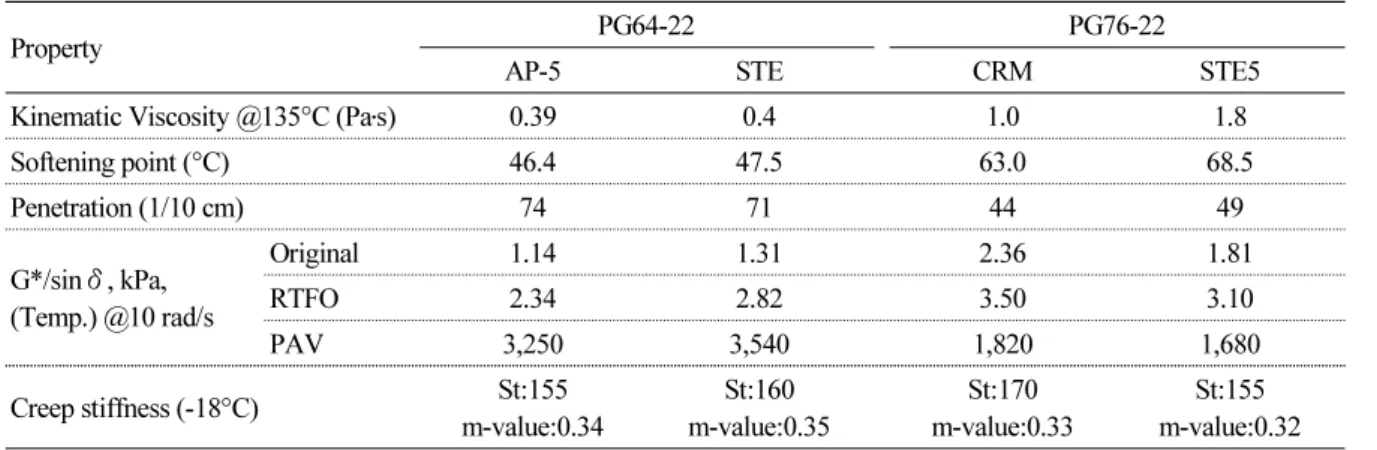
In this study, two types of PG 64-22 grade, AP-5, styrenic thermoplastic elastomer (STE) asphalt binders, and 2 types of PG 76-22 grade, crumb rubber modifier (CRM), and Styrenic Thermoplastic Elastomer (STE5) modified asphalt binders, are used for the study and their properties are shown in Table 1.
Table 1. Asphalt Binder Property
Property PG64-22 PG76-22
AP-5 STE CRM STE5
Kinematic Viscosity @135°C (Pa․s) 0.39 0.4 1.0 1.8
Softening point (°C) 46.4 47.5 63.0 68.5
Penetration (1/10 cm) 74 71 44 49
G*/sinδ, kPa, (Temp.) @10 rad/s
Original 1.14 1.31 2.36 1.81
RTFO 2.34 2.82 3.50 3.10
PAV 3,250 3,540 1,820 1,680
Creep stiffness (-18°C) St:155 m-value:0.34
St:160 m-value:0.35
St:170 m-value:0.33
St:155 m-value:0.32
2.1.2 Aggregate
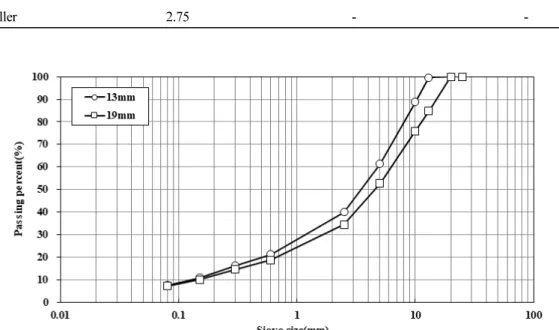
In this study, 13 mm, 19 mm coarse aggregate and fine aggregate which is Granite from Chung-buk are used and limestone is used as a filler. Their properties are measured in accordance with KS (Korean Industrial
Standards) and are shown in Table 2.
The coarse aggregate maximum size used in the asphalt mixture is 19 mm, 13 mm and the density asphalt mixture is made as shown Fig. 1. The air void was set to 1~3% by mix design based on the asphalt concrete track construction standard which is using for Baekwon station.
Table 2. Aggregate Property
Classification Apparent specific gravity (g/cm3) Absorption (%) Abrasion (%)
Specification > 2.5 < 3.0 < 40
19 mm 2.71 1.33 30.7
13 mm 2.65 0.81 19.5
Fine agg. 2.67 1.01 30.7
Mineral filler 2.75 - -
Fig. 1. Gradation Curves of Combined Aggregates
2.2 Methods
In this study, in order to perform the modified wheel tracking test for railway under the conditions presented above, a 305×305×50 mm slab specimen is made using cooper's roller press compactor with a target air void of 1 to 3%.
The slab specimen is used for test after curing at room temperature for 24 hours and 60°C, 65°C for 6 hours.
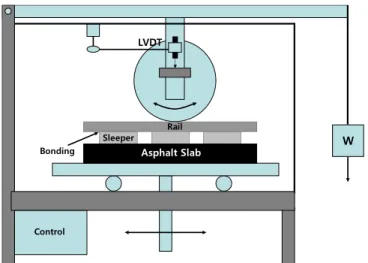
The rut depth was measured by wheel load with the condition of 1,296 N (132 kg) wheel load and 14,400 round for 180 mins (10,800 sec) and the raw data was acquire using linear variable differential transformer (LVDT), illustration of WT is shown in Fig. 2, Fig. 3. The frequency of data acquire is 3Hz, and the depth of
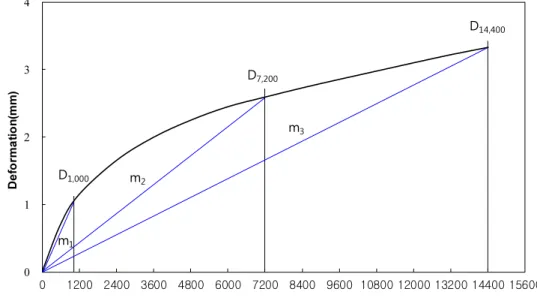
rut depending on the pass is represented on the x-y axis at 60, 90, 120, 180 mins. The dynamic stability was calculated by Equation (1) from the vertical settlement graph shown in Fig. 4.
(1)
Where, D1,000=depth (mm) at 1,000 cycle, D7,200=depth (mm) at 7,200 cycle, D14,400=final depth (mm).
Control
W
Sleeper LVDT
Rail Asphalt Slab Bonding
Fig. 2. Illustration of WT Test Equipment Concept (Na et al., 2019)
Fig. 3. Illustration of Actual Specimen Set Up
0 1 2 3 4
0 1200 2400 3600 4800 6000 7200 8400 9600 10800 12000 13200 14400 15600
Deformation(mm)
No. of Pass m1
m2
m3
D1,000
D7,200
D14,400
Fig. 4. The Dynamic Stability (DS) Concept (Na et al., 2019)
3. Results and Discussions
3.1 Rut depth
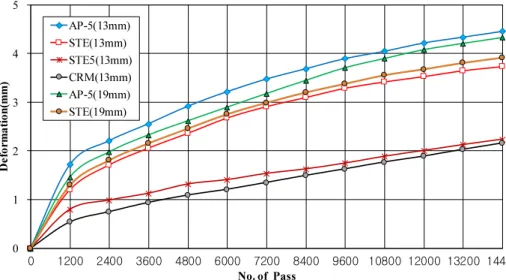
Deformation relations by the wheel tracking pass at 80 pass/min for 6 types of asphalt mixtures (4 types of 13 mm asphalt mixtures and 2 types of 19 mm asphalt mixtures) at 60°C are shown in Fig. 5 and Fig. 6 below.
From the results of 60°C shown in Fig. 5, the rut depth rapidly increased up to 1,200 pass and then slowly increased. It was confirmed that the final rut depth between the mixture of PG64-22 and PG76-22 after wheel tracking 14,400 pass was 4.1 mm and 2.2 mm, resulting in a 1.9 mm difference. CRM and STE5, PG76-22, were 2.16 mm and 2.24 mm, respectively, which were significantly different from PG64-22 asphalt mixture. It can be seen that the asphalt mixture modified with CRM has a low depth, and there is a difference in deformation depending on the type of the mixture. Furthermore, both mixtures showed a sharp graph curve of rut depth up to 1,200 pass, and then showed the gentle slope after that. Both types (PG64-22, PG76-22) showed the similar tendency.
The results from MWTT at 65°C shown in Fig. 6, and the final rut depth of 6 types, 4 types of PG64-22 and 2 types of PG76-22, was compared to the results at 60°C. The results of comparison, similar rut depth was obtained between the same PG grades. The initial rut depth up to 1,200 pass for six mixtures was about 2.4 mm, and the final rut depth was about 3.6 mm. The initial rut depth up to 1,200 pass, 2.4 mm, was 50% higher than 1.2 mm between 1,200 pass and 14,400 pass. In other words, in the case of the measurement at 65°C,
most of the deformation occurred in the range of first 15 mins.
Depending on the type of asphalt mixture, there was a difference by the material, and as in the result at 60°C, PG76-22 had a lower depth than the PG64-22 asphalt mixture at 65°C. In addition, depending on the type of mixture, PG64-22 mixture, AP-5 (13 mm) and AP-5 (19 mm) showed the highest rut depth of 4.4 mm or higher and STE (19 mm), PG64-22, showed the lowest rut depth. The PG64-22 mixture showed a slower curve of increase in rut depth compared to PG76-22, and CRM (13 mm) had a lower rut depth than STE5 (13 mm), indicating good permanent deformation resistance.
0 1 2 3 4 5
0 1200 2400 3600 4800 6000 7200 8400 9600 10800 12000 13200 14400
Deformation(mm)
No. of Pass AP-5(13mm)
STE(13mm) STE5(13mm) CRM(13mm) AP-5(19mm) STE(19mm)
Fig. 5. Graph of Final Deformation to 60°C MWTT (80 pass/min)
0 1 2 3 4 5
0 1200 2400 3600 4800 6000 7200 8400 9600 10800 12000 13200 14400
Deformation(mm)
No. of Pass
AP-5(13mm) STE(13mm) STE5(13mm) CRM(13mm) AP-5(19mm) STE(19mm)
Fig. 6. Graph of Final Deformation to 65°C MWTT (80 pass/min)
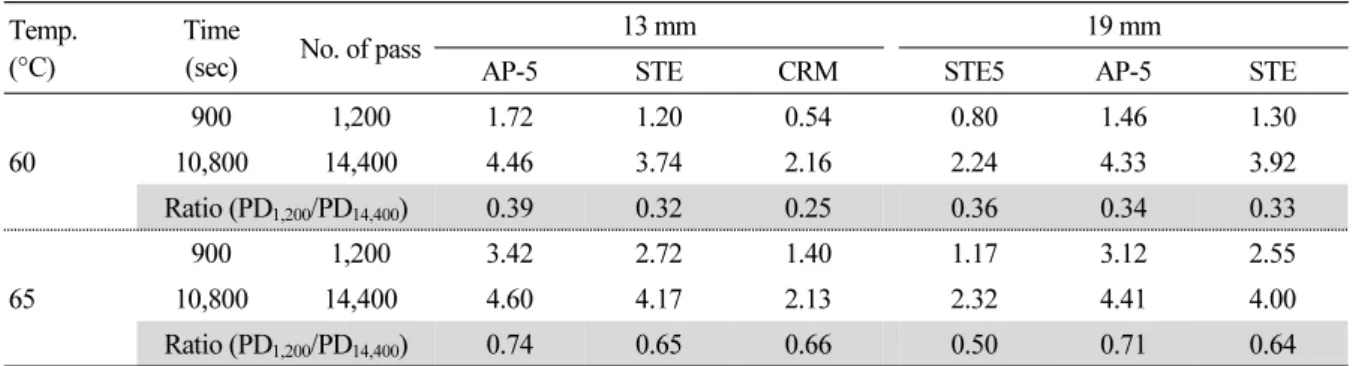
Through the previous experiments, it was found that the tendency of large deformation during the initial 900 sec (15 mins), and to determine this, the initial deformation, the ratio of rut depth at 900 ses (15 mins) and 10,800 sec (180 mins) was compared and shown in Table 3. PD1,200/PD14,400 value with 80 pass/min showed a difference by temperature, and 60°C=0.33 and 65°C=0.65, which resulted in more initial deformation than 60°C.
PD1,200/PD14,400 value depending on maximum size of coarse aggregate in PG64-22 mixture is 13 mm=0.39, 19 mm=0.37 at 60°C, 13 mm=0.67, 19 mm=0.64 at 65°C, and there is no big difference depending on material, but there is a difference depending on temperature.
Table 3. Ratio of Permanent Deformation (PD1,200/PD14,400) Temp.
(°C)
Time
(sec) No. of pass 13 mm 19 mm
AP-5 STE CRM STE5 AP-5 STE
60
900 1,200 1.72 1.20 0.54 0.80 1.46 1.30
10,800 14,400 4.46 3.74 2.16 2.24 4.33 3.92
Ratio (PD1,200/PD14,400) 0.39 0.32 0.25 0.36 0.34 0.33
65
900 1,200 3.42 2.72 1.40 1.17 3.12 2.55
10,800 14,400 4.60 4.17 2.13 2.32 4.41 4.00
Ratio (PD1,200/PD14,400) 0.74 0.65 0.66 0.50 0.71 0.64
3.2 Dynamic stability
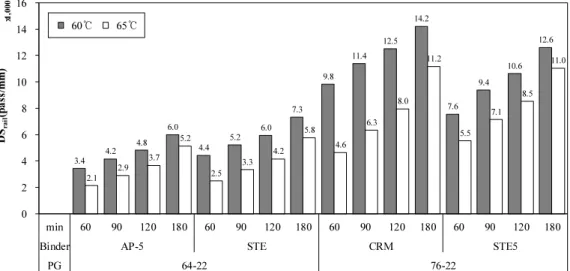
The dynamic stability of the 13 mm asphalt mixture applied to the cyclic loading test by the DSrail formula at two different temperature was compared as shown in Fig. 7. The dynamic stability of 60°C was higher than 65°C, but the tendency to increase was similar.
In addition, the almost same stability and tendency were observed at the two temperatures in the CRM and STE5 mixtures, which are PG76-22, and the same tendency was observed in the PG64-22 mixture. The 19 mm asphalt mixture showed a characteristic of at 60°C higher than at 65°C for DSrail as shown in Fig. 8 and showed a tendency to increase at regular intervals. Furthermore, in terms of difference depending on temperature for DSrail, AP-5 ranged from 1.1 to 1.7 pass/mm and STE showed 1 to 1.6 pass/mm.
3.4 4.2 4.8 6.0
4.4 5.2 6.0 7.3
9.8 11.4
12.5 14.2
7.6 9.4
10.6 12.6
2.1 2.9 3.7 5.2
2.5
3.3 4.2 5.8
4.6 6.3
8.0 11.2
5.5 7.1
8.5 11.0
0 2 4 6 8 10 12 14 16
min 60 90 120 180 60 90 120 180 60 90 120 180 60 90 120 180
Binder AP-5 STE CRM STE5
PG 64-22 76-22
DSrail(pass/mm)1,000ⅹ 60℃ 65℃
Fig. 7. Change of DSrail at 60°C and 65°C (13 mm Asphalt Mixtures)
3.9 4.6
5.2 6.4
4.2 5.0
5.7 7.0
2.2 3.0
3.7 5.3
2.6 3.5
4.4 6.0
0 1 2 3 4 5 6 7 8
min 60 90 120 180 60 90 120 180
Binder AP-5 STE
DSrail(pass/mm)1,000ⅹ
60℃ 65℃
Fig. 8. Change of DSrail at 60°C and 65°C (19 mm Asphalt Mixtures)
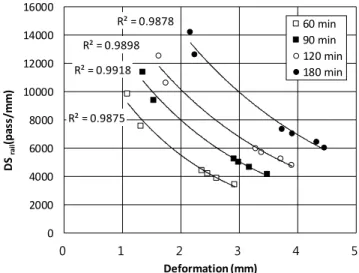
The correlation between deformation and DSrail at 60°C depending on wheel tracking time at 80 pass/ min of MWTT is shown in Fig. 9. Based on the results, DSrail did not show a constant tendency with wheel tracking time, but it had a value of R2>0.98 for 4 different time (60 min, 90 min, 120 min, 180 min). among them, at 90 min R2 is the highest as 0.99. It has been found that DSrail calculation method at 90 min is advantageous for evaluating the asphalt mixture. The correlation between deformation and DSrail at 65°C depending on wheel tracking time at 80 pass/min of MWTT is shown in Fig. 10. it had a value of R2>0.98 for 4 different wheel tracking time (60 min, 90 min, 120 min, 180 min). Dynamic stability calculated from the results of MWTT was high at both 60°C and 65, especially at 65°C.
R² = 0.9875 R² = 0.9918
R² = 0.9898 R² = 0.9878
0 2000 4000 6000 8000 10000 12000 14000 16000
0 1 2 3 4 5
DSrail(pass/mm)
Deformation (mm)
60 min 90 min 120 min 180 min
Fig. 9. Correlation of Each DSrail with Deformation for MWTT at 60°C.
R² = 0.9924 R² = 0.994 R² = 0.9958
R² = 0.9967
0 2000 4000 6000 8000 10000 12000
0 1 2 3 4 5
DSrail(pass/mm)
Deformation (mm)
60 min 90 min 120 min 180 min
Fig. 10. Correlation of Each DSrail with Deformation for MWTT at 65°C.
4. Conclusions
In this study, the result of evaluation of the permanent deformation resistance of the asphalt mixture considering the railroad conditions were obtained. When the temperature was 65°C, the initial rut depth was larger than the temperature of 60°C. In other words, it was confirmed through the lab test results that the increase of temperature is the main factor to cause the initial permanent deformation. In the MWTT test with rails and sleepers, all of the five asphalt mixtures showed a significant change in the rut depth depending on PG grade. Wheel tracking time in MWTT seems to be suitable between 60 and 90 mins in consideration of the
deformation speed and the deformation variation range. Considering the various mixtures, the longest time of 90 min seems to be effective for the relative evaluation between specimens.
References
Na, I. H. (2019). Feasibility study of modified wheel-tracking test protocol for estimating permanent deformation of asphalt concrete roadbed under simulated railway loading system, Department of Regional Infrastructure Engineering, Graduate School, Kangwon National University.
Na, I. H., Park, J. Y., Yang, J. B., Lee, S. H., Lee, J. W. and Kim, K. W. (2007). “Evaluation of test method for deformation resistance of asphalt mixture for railway pavement”, Journal of Korean Society for Railway, KSR2013A079.
Roberts, F. L., Kandhal, P. S., Brown, E. R., Lee, D. Y. and Kennedy, T. W. (1996). Hot mix asphalt materials, mixture design, and construction, NAPA Education Foundation, Lanham, Maryland.
U.S. Department of Transportation (2000). Evaluation of Strategic Highway Research Program (SHRP) products for application to airport pavements, USA.