43(1) : 79∼ 84 (2012)
79
속단, 익모초 및 향부자의 독성평가를 위한 성분분석 및 안정성 시험
배윤호1·허정임2·곽승준3·석지현4·이종권4·강태석4·우미희1·최재수5·민병선1*
1
대구가톨릭대학교 약학대학,2
안전성평가연구소,3
창원대학교 자연대학,4
식품의약품안전청 독성평가연구부,5
부경대학교 식품생명공학부Analysis and Stability Test of the Extracts from Dipsaci Radix, Leonuri Herba and Cyperi Rhizoma for Toxicity Study
Yoon Ho Bae1, Jung Im Huh2, Seung Jun Kwack3, Ji-Hyeon Seok4, Jong-Kwon Lee4, Tae Suk Kang4, Mi Hee Woo1, Jae Sue Choi5 and Byung Sun Min1*
1
College of Pharmacy, Catholic University of Daegu, Gyeongsan, Gyeongbuk 712-702, Korea2
Korea Institute of Toxicology, Daejeon 305-343, Korea3
College of Natural Science, Changwon National University, Kyeongnam 641-773, Korea4
ToxicologicalEvaluation and Research Department, Korea Food & Drug Administration, Chungbuk 363-951, Korea5
Faculty of Food Science and Biotechnology, Pukyoung National University, Busan 608-737, KoreaAbstract − A simple and reliable reverse phase HPLC method was developed to determine pharmacologically active marker compounds of Dipsaci Radix, Leonuri Herba and Cyperi Rhizoma. The stability test of water-extract of three natural medicines were examined for six months. However, no significant change in the content of the marker compounds of each extract observed during the time of investigation.
Key words − Dipsaci Radix, Leonuri Herba, Cyperi Rhizoma, Water-extract, Stability test, HPLC
최근 세계적으로 식물자원을 이용한 고부가치 식, 의약품 의 개발이 활발하게 시도되고 있으며 정부도 천연물신약 연 구개발 촉진법을 통하여 이를 지원하고 있다. 천연물을 이 용한 다양한 외국의 식, 의약품이 이미 건강 보조식품으로 유통되고 있으며 독일, 프랑스 같은 나라에서는 천연물 추 출물 자체 또는 분획물(은행잎, 겨우살이 등)을 이용하여 식, 의약품 개발로 거대한 시장을 창출하고 있다. 우리나라는 전통적으로 사용하는 각종 한약재 외에도 천연물의약품 및 건강기능성식품의 형태로 많은 생약이 사용되고 있다. 규격 을 설정하여 관리하는 생약은 대한약전에 130종과 생약규 격집에 381종으로 총 511종의 한약재가 수재되고 관리되고 있으나 이들의 인체에 대한 안전성 연구는 매우 미흡한 실 정이다.
1)
특히 마두령(Aristolochiae Fructus)은 쥐방울과 (Aristolochiaceae)의 쥐방울덩굴(Aristolchia contorta) 과실 로 뱀독의 해독제나 진통, 소염제 등으로 사용되었던 생약 재이다. 마두령의 주성분은 aristolochic acid으로 알려져 있으며 최근 여러 동물 실험에서 발암성, 유전독성 및 신장독 성이 확인되었고, 사람에게서도 aristolochic acid가 다량 함 유된 다이어트 제재를 장기 복용한 경우 신장독성과 발암 성이 보고되면서 생약재의 독성에 대한 관심이 높아지고 있 어 생약에 대한 과학적이고 체계적인 안전성 평가자료 확 보가 절실히 필요하다.
2-5)
식품의약품안전청에서는 국가의 독성물질 관리사업의 일 환으로 생약의 일반독성시험 및 유전독성시험을 진행 중에 있다. 독성시험 결과와 이에 대한 과학적 근거 확보를 위해 시험물질에 대한 신뢰성 및 재현성 있는 분석결과가 요구 된다. 생약은 산지, 채집시기 등에 따라 원료생약의 유효성 분 함량 및 품질 차이가 있고, 건조상태, 가공법에 따라 지 표성분 등의 차이가 있어 원료생약에 대한 기준규격시험이 필요하며 규격화된 시료를 독성시험에 이용하여야 한다. 또 한 생약은 건강식품, 의약품 보조제 등의 질병 예방을 위해 장기적으로 복용하는 경우, 안정성 확인 시험이 필수이며 안정성이 확보된 시료를 사용하여 독성 시험할 경우 신뢰 할 수 있는 독성자료를 얻을 수 있다.
*교신저자(E-mail):[email protected] (Tel): +82-53-850-3613
속단(Dipsaci Radix)은 천속단(Dipsacus asperoides C. Y.
Chang et T. M. Ai, Dipsacaceae)의 뿌리를 사용하며 saponin계 성분인 akebia saponin D, dipsacus asaponins VI, X and XII 등이 알려져 있다.
6,7)
속단 물 추출물의 주요성 분인 polysaccharide류는 항보체활성 등의 면역조절작용,8)
total saponin 분획물이 amyloid protein 25-35에 대한 neuron 보호 작용,9)
물 추출물은 관절염에 대한 항염증작용 등이10)
알려져 있다. 익모초(Leonuri Herba)는 익모초(Leonurus japonicus Houtt. 혹은 L. heterophyllus Sweet)의 꽃이 피었 을 때 지상부 혹은 지상부를 조경, 이뇨약으로 월경불순, 타 박상, 신장염의 치료제로 사용되고 있다.11)
익모초의 주요성 분으로 alkaloid계 성분 leonurine, stachydrine,12)
flavonoid계 성분으로 rutin, hyperoside, quercetin, apigenin, genkwanin 등이 보고되어 있고,13)
diterpene계 성분으로 heteronone A, heteronone B, prehispanolone, leojaponine, preleoheterin 등 이 분리되었고,14,15)
이들은 간세포, 심장 및 뇌신경세포 보 호작용 등이 연구되어 있다.16-18)
향부자(Cyperi Rhizoma)는 향부자(Cyperrus rotundus, Cyperaceae)의 가는 뿌리를 제거 한 뿌리줄기로 통경, 정혈, 진통약으로 월경부조, 월경통, 신 경통, 위 복통에 사용되는 생약이다.19)
향부자의 주요성분은 sesquiterpene계 화합물로 cyperone, nootkatone, valencene, rotundine 등이 보고되어 있고,20,21)
이들의 성분의 생리활성 은 패혈증억제, 항알러지, 혈소판응집억제작용 등이 보고되 어 있다.22-24)
본 연구는 속단, 익모초 및 향부자의 3종 생약을 대상으 로 HPLC-UV를 이용하여 지표성분의 분석법을 확립하였으 며, 확립된 분석법을 이용해 생약의 표준화된 추출물을 확 보하고 실온과 냉장의 보관조건에서 지표성분의 변화를 확 인함으로써 독성시험에 사용하는 생약 추출물의 안정성을 확인하고자 하였다.
재료 및 방법
실험재료 − 본 연구에 사용한 3종의 생약, 속단, 익모초 및 향부자는 유통되는 생약을 기원별, 산지별로 구입하여 기원, 성상, 색상, 냄새 등을 기준으로 생약감별 자문위원회 (동국대학교, 이제현 교수; 충남대학교, 김영호 교수; 영남대 학교, 나민균 교수; 충남대학교, 배기환 교수; 대구가톨릭대 학교, 민병선 교수)의 감별을 거쳐 선별하였고 선정된 시료 는 대구가톨릭대학교 약학대학 표본실에 보관되어 있다(속 단, CUD-3175-1; 익모초, CUD-2604-1; 향부자, CUD-705- 1). 속단(Dipsaci Radix)는 중국산을 사용하였고, 익모초 (Leonuri Herba) 및 향부자(Cyperi Rhizoma)은 한국산을 사 용하였다. 각 생약은 식품의약품안전청 고시 2003-17, 안전 성 유효성심사규정에 준한 표준탕제 제조법에 따라 열수추 출하고 이를 농축한 후 동결 건조하여 사용하였다.
25)
시약 및 기기 − α-cyperone은 성균관대학교 약학대학 곽 종환 박사님께, sweroside는 대구가톨릭대학교 약학대학 우 미희 교수님께, rutin은 부경대학교 최재수 교수님께 제공받 아 사용하였다. HPLC system은 Gilson사의 306 pump, 811C dynamic mixer, UV/VIS-156 detector, 231 XL sample injector, GILSON UniPoint data 및 Waters사 binary pump controller Waters 1525, 717 auto-sampler, dual λ absorbance detector Waters 2478를 사용하였으며, column은 Agilent Technologies사의 Agilent Eclipse XD8-C18 (5 µm, 4.6 × 150 mm)를 사용하였다. HPLC 용매는 Burdick & Jackson 사의 MeOH 및 acetonitrile을 사용하였고, H
2
O는 Milli-Q로 처리한 물을 사용하였다.표준액 조제 − sweroside, rutin, α-cyperone의 표준품을 정 확하게 측정한 후 70% MeOH로 1 mg/mL 농도로 녹여 4
o
C 에 보관하면서 사용전에 희석하여 표준액으로 사용하였다.분석용 표준액은 membrane filter로 여과한 후 사용하였다.
검액의 조제 − 속단 25 kg, 익모초 35 kg, 향부자 25 kg을 추출 탱크에 넣고, 물을 시료의 10배로 첨가하여 100
o
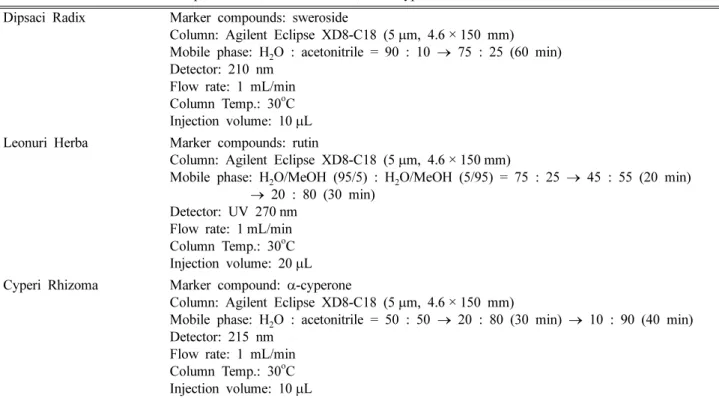
C에 서 2시간 전탕한 후 농축 동결 건조하여 각각 10.5, 5.87, 4.65 kg의 물 추출물을 얻었다. 추출물 100 mg을 정확히 측 정한 후 70% MeOH 10 mL을 넣고 sonicator로 60분 추출 한 후 membrane filter로 여과하여 검액으로 사용하였다.지표물질 정량 − 문헌 등의 자료 및 HPLC 분석 자료를 토대로 지표물질을 선정하였고, Table I과 같은 조건으로 분 석하였다. 각각의 지표성분은 검량선을 작성하여 생약 추출 물의 함량을 평가하였다.
직선성, 검출한계 및 정량한계(Linearity, LOD, LOQ) − sweroside, rutin과 α-cyperone의 검량선은 0.1~40 µg/mL, 1.25~20µg/mL 및 1.25~40 µg/mL로 피크면적에 대하여 각 각 작성하여 계산하였다. 상관계수를 구하여 직선성의 양호 를 판단하였고, LOD (limit of detection, 검출한계)와 LOQ (limit of quantitation, 정량한계)는 신호(signal) 대 잡음 (noise)의 비를 이용하여 각각 4과 10을 기준으로 계산하였다.
추출물 안정성 실험 − 3종의 생약의 열수 추출물을 동결 건조한 분말의 안정성 실험을 위해 시료를 실온과 냉장에 6개월 보관하면서 0, 1, 2, 3, 4, 5, 6 개월에 각각의 시료를 설정된 HPLC 조건에서 분석하였다. 각각의 시료는 일정 양 씩 3개의 EP-tube에 취하고 60분간 sonication 후 membrane filter로 여과한 후 HPLC로 분석하였다.
결과 및 고찰
속단, 익모초, 향부자의 독성실험을 위한 물 추출물을 제 조하고 각각의 추출물의 주요성분 분석과 추출물의 안전성 을 확인하고자 연구를 하였다. 3종의 생약재의 확인을 위한 주요성분 분석과 HPLC peak의 profile을 통한 추출물의 안
정성도 확인을 하였다. 본 연구에서 안정성이 확보된 생약 추출물은 13주 반복투여 독성시험으로 안전성 실험 예정이 다. 독성 시험을 위한 생약재 자체의 동정과 함유성분의 안 정성은 독성 시험 전에 확보되어야 하는 필수요소이다.
생약 추출물 지표성분 정량 − 일반적으로 생약의 분석에 서 지표성분은 그 약리활성을 대표하거나 각 생약의 특이 한 활성을 갖는 성분을 선정하는 것이 원칙이나, 활성성분 이나 특이성분을 설정하기 어려운 경우에는 주성분을 지표 성분으로 한다.
1)
본 연구에서는 3종의 생약에 대표적인 생 리활성을 보이며 주성분으로 속단(Dipsaci Radix)에서는 iridoid glycoside계 화합물 sweroside을 지표성분으로,26)
익 모초(Leonuri Herba)의 주요성분은 alkaloid계 성분 leonurine 과 stachydrine이 있으나27,28)
항산화작용이 있고 HPLC 분 석이 용이한 flavonoid glycoside계 화합물 rutin을 지표성분 으로 설정하였다.29)
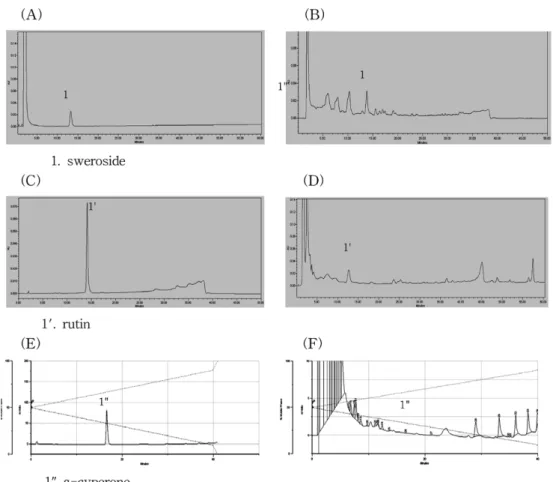
그리고 향부자의 주성분은 sesquiterpene 계 화합물 α-cyperone으로 설정하였으며 각각의 화합물 구 조는 Fig. 1과 같다. 3가지 생약의 지표성분 HPLC 분석은 Table I의 조건으로 분석이 가능하였으며 추출물 분석에 다 른 성분의 peak에 의해 방해를 받지 않았다(Fig. 2). 상기의 분석 조건으로 각 지표성분의 검량선을 작성한 결과 속단 (Dipsaci Radix)의 sweroside 0.1~40 µg/mL 농도에서 직선 성이 0.9999, 익모초(Leonuri Herba)의 rutin은 1.25~20 µg/mL 농도에서 직선성이 0.9994, 향부자(Cyperi Rhizoma)의 α-cyperone은 1.25~40 µg/mL 농도에서 직선성이 0.9986 이 상으로 높은 직선성이 확인되었다(Table II).
열수추출물 안정성시험 − 속단, 익모초, 향부자의 물 추 출물에 대한 안정성 자료를 얻고자, 각각의 추출물을 실온 과 냉장에 보관하고 6개월간 일정 기간 간격 (1, 2, 4, 6 개 월)으로 육안 관찰하고 유효성분 함량평가를 수행하였다. 육 안 관찰에서는 실온과 냉장 장기보관시험 조건에서 색 등 의 변화가 관찰되지 않았으나, 6개월 장기보관에 속단과 익 모초의 추출물은 실온에 저장한 시료가 함습에 의한 굳어 지는 현상이 있었고 향부자 추출물은 외부적인 변화가 관 찰되지 않았다.
Table I. HPLC conditions for Dipsaci Radix, Leonuri Herba, and Cyperi Rhizoma Dipsaci Radix Marker compounds: sweroside
Column: Agilent Eclipse XD8-C18 (5µm, 4.6 × 150 mm) Mobile phase: H
2
O : acetonitrile = 90 : 10 → 75 : 25 (60 min) Detector: 210 nmFlow rate: 1 mL/min Column Temp.: 30
o
C Injection volume: 10µL Leonuri Herba Marker compounds: rutinColumn: Agilent Eclipse XD8-C18 (5µm, 4.6 × 150 mm)
Mobile phase: H
2
O/MeOH (95/5) : H2
O/MeOH (5/95) = 75 : 25 → 45 : 55 (20 min)→ 20 : 80 (30 min) Detector: UV 270 nm
Flow rate: 1 mL/min Column Temp.: 30
o
C Injection volume: 20µL Cyperi Rhizoma Marker compound: α-cyperoneColumn: Agilent Eclipse XD8-C18 (5µm, 4.6 × 150 mm)
Mobile phase: H
2
O : acetonitrile = 50 : 50 → 20 : 80 (30 min) → 10 : 90 (40 min) Detector: 215 nmFlow rate: 1 mL/min Column Temp.: 30
o
C Injection volume: 10µLFig. 1. Chemical structures of maker compounds (sweroside isolated from Dipsaci Radix; rutin isolated from Leonuri Herba; α-cyperone isolated from Cyperi Rhizoma).
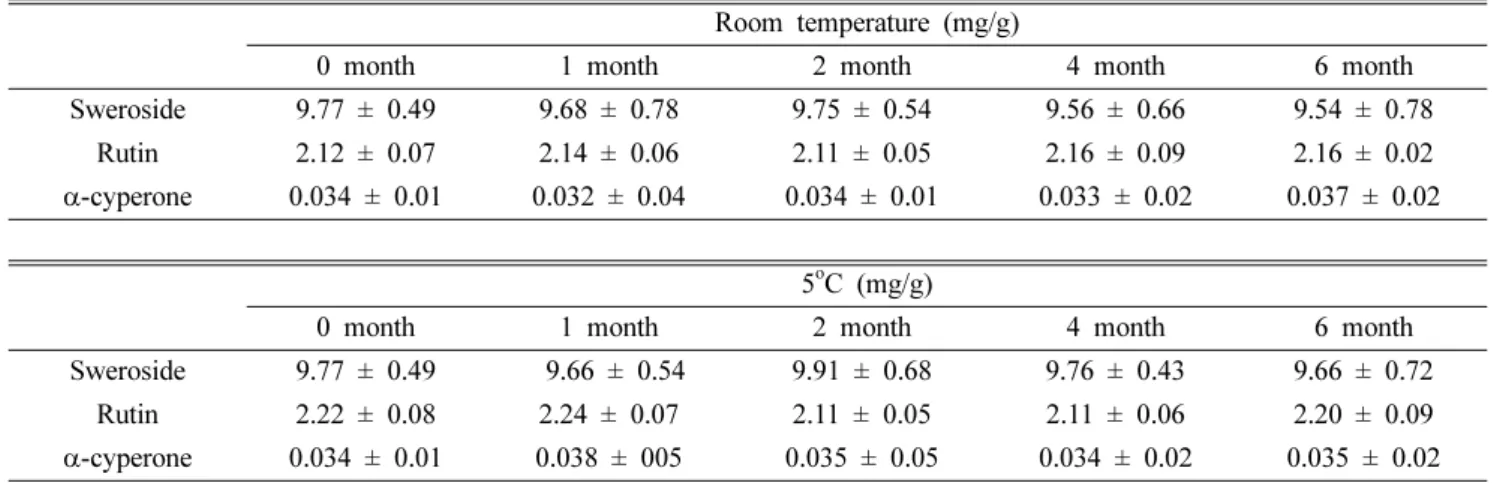
지표성분의 크로마토그램과 함량은 Fig. 2와 Table III과 같으며 속단(Dipsaci Radix)의 열수 추출물 HPLC 분석 결 과 sweroside가 상기의 분석 조건에서 분리가 되었고, HPLC chromatogram과 같이 주성분 중의 하나로 확인 되었다. 생 약규격집에 속단의 지료성분에 대한 함량 규정이 되어 있 지 않으나 sweroside는 지표물질로 좋은 지표물질의 후보임 을 알 수 있다. 속단 추출물을 6개월 동안 실온과 냉장 조 건에서 보관한 시료도 sweroside의 함량에는 차이가 없어 속단의 열수 추출물은 안정함을 확인할 수 있었다. 익모초 (Leonuri Herba)의 추출물 HPLC 분석 결과 rutin은 상기의 분석조건에서 검출되었고, HPLC chromatogram으로 rutin 이 주요성분으로 확인되었다. 6개월 동안 실온과 냉장 조건 에서 보관한 익모초 추출물에 대해 rutin의 함량을 분석한
결과 6개월 동안 보관시료의 rutin 함량에는 차이가 없어, 익모초의 열수 추출물은 안정한 것으로 확인되었다. 향부자 (Cyperi Rhizoma)의 지표물질은 α-cyperone을 선정하였고 Table I의 HPLC 조건에서 분석 가능하였으며 시료에서의 표준물질 함량은 chromatogram과 같이 미량 검출되었다. 향 부자의 주요성분은 정유로 sesquiterpene이 주요 구성물질로 알려져 지표물질로 선정하였으나 향부자를 열수 추출과 동 결건조 과정에서 정유성분이 휘발되었음을 예상할 수 있다.
향부자 추출물 6개월 동안 실온과 냉장 조건에서 보관한 시 료에 대한 분석 결과 α-cyperone의 함량에 변화가 없었으 며 HPLC chromatography상 불순물로 검출되는 피크가 없 어 향부자 열수 추출물의 안정성을 확인할 수 있었다.
Fig. 2. HPLC chromatogram (A) standard compounds of Dipsaci Radix; (B) extract of Dipsaci Radix; (C) standard comounds of Leonuri Herba; (D) extract of Leonuri Herba; (E) standard comound of Cyperi Rhizoma; (F) extract of Cyperi Rhizoma.
Table II. Calibration data of HPLC-UV
Maker compound Linear range
(µg/mL) Correlation
coefficients LOD (ng/mL) LOQ (ng/mL)
Dipsaci Radix Sweroside 0.1 ~ 40 0.9999 14 32
Leonuri Herba Rutin 1.25 ~ 20 0.9994 100 250
Cyperi Rhizoma α-cyperone 1.25 ~ 40 0.9986 100 250
결 론
생약재의 독성실험을 위한 추출물은 식약청고시 2003-17, 표준탕제 제조법에 따라 추출 제조하였다. 추출물의 함량분 석을 위해 속단(Dipsaci Radix)의 지표성분은 sweroside로, 익모초(Leonuri Herba)의 지표성분은 rutin으로 향부자 (Cyperi Rhizoma)는 α-cyperone을 지표물질로 선정하였다.
각각의 성분은 HPLC-UV detector와 RP C-18 column으로 분석이 가능하였다. 추출생약재의 장기보존에 따른 안정성 시험을 위해 시료는 실온과 냉장고에 보관하였고, 실험기간 은 각각 6개월간 HPLC로 분석하여 각각의 peak의 pattern 과 지표물질의 함량으로 3종 생약의 안정성을 확인한 결과 속단, 익모초 및 향부자 추출물은 안정한 것으로 확인되었 다. 이러한 생약 시료의 표준화와 안정성 결과는 독성시험 결과의 신뢰성을 확보하고 생약의 유통과정의 효율적 품질 관리 개선에도 활용이 가능하다고 기대된다.
사 사
본 연구는 2011년도 식품의약품안전평가원 용역연구개발 과제의 연구개발비 지원 (11182독관리557)에 의해 수행 되 었으며 이에 감사드립니다.
인용문헌
1. Kim, S. H., Choi, E. J., Kim, D. H., Lee, K. Y., Lee, M., Baek, S. W., Kwak, S. J., Kang, T. S., Kim, Y. C. and Sung, S. H. (2008) Stability test of the extracts of Cimicifugae Rhi- zoma, Achyranthis Radix, Artemisia Capillaris Herba, Mou- tan Cortex Radicis and Arecae Semen for toxicity study. Kor.
J. Pharmacogn. 39: 241-245.
2. Park, C. H. and Kwack, S. J. (2009) The effects of aris- tolochic acid on reproductive function in female rats. Kor. J.
Pharmacogn. 40: 89-98.
3. Frei, H., Wurgler, F. E., Juon, H., Hall, C. B. and Graf, U.
(1985) Aristolochic acid is mutagenic and recombinogenic in Drosophila genotoxicity tests. Arch. Toxicol. 56: 158-166.
4. Mengs, U. (1987) Acute toxicity of aristolochic acid in rodents.
Arch. Toxicol. 59: 328-331.
5. Arlt, V. M., Annie, P. L., Cosyns, J. P. and Schmeiser, H. H.
(2001) Analyses of DNA adducts formed by ochratoxin A and aristolochic acid in patients with Chinese herbs neph- ropathy. Mutat. Res. 494: 143-150.
6. Tan, H. G., Lin, S., Zhang, Q. W. and Ji, L. (2006) Deter- mination of akebia saponin D in root of Dipacus asperoides by HPLC. Zhongguo. Zgang Yao Za. Zhi 31: 726-727.
7. Liu, J., Guo, B., Huang, W., Xiao, P., Song, H. and Qang, C.
(2011) Determination of saponins in Dipsaci Radix by HILIC-HPLC. Zhongguo. Zgang Yao Za. Zhi. 36: 2367-2371.
8. Zhang, Y., Kiyohara, H., Matsumoto, T. and Yamada, H.
(1997) Fractionation and chemical properties of immuno- modulating polysaccharides from roots of Dipsacus asper- oides. Planta Med. 63: 393-399.
9. Qian, Y. H., Liu, Y., Hu, H. T., Ren, H. M., Chen, X. L. and Xu, J. H. (2002) The effects of the total saponin of Dipsacus asperoides on the damage of cultured neurons induced by beta-amyloid protein 25-35. Anat. Sci. Int. 77: 196-200.
10. Jung, H. W., Jung, J. K., Son, K. H., Lee, D. H., Kang, T. M., Kim, Y. S. and Park, Y. K. (2012) Inhibitory effects of the root extract of Dipsacus asperoides C.Y. Cheng et al T.M.Ai on collagen-induced arthritis in mice. J. Ethnopharmacol.
139: 98-103.
11. Park, J. H. and Do, W. I. (2007) Pharmacognostical Studies on the Ig Mo Cho. Kor. J. Pharmacogn. 38: 148-151.
12. Hong, S. S., Hwang, J. S., Lee, S. A., Hwang, B. Y., Ha, K.
W., Ze, K. R., Seung, R. S., Ro, J. S. and Lee, K. S. (2001) Isolation and quantitative analysis of leonurine from Leonuri Herba. Kor. J. Pharmacogn. 32: 322-326.
13. Cong, Y., Guo, J., Wang, T., Li, M., Wang, J. and Li, O.
Table III. Contents of marker compounds during the period of stability test (n = 3) Room temperature (mg/g)
0 month 1 month 2 month 4 month 6 month
Sweroside 9.77 ± 0.49 9.68 ± 0.78 9.75 ± 0.54 9.56 ± 0.66 9.54 ± 0.78 Rutin 2.12 ± 0.07 2.14 ± 0.06 2.11 ± 0.05 2.16 ± 0.09 2.16 ± 0.02 α-cyperone 0.034 ± 0.01 0.032 ± 0.04 0.034 ± 0.01 0.033 ± 0.02 0.037 ± 0.02
5
o
C (mg/g)0 month 1 month 2 month 4 month 6 month
Sweroside 9.77 ± 0.49 9.66 ± 0.54 9.91 ± 0.68 9.76 ± 0.43 9.66 ± 0.72 Rutin 2.22 ± 0.08 2.24 ± 0.07 2.11 ± 0.05 2.11 ± 0.06 2.20 ± 0.09 α-cyperone 0.034 ± 0.01 0.038 ± 005 0.035 ± 0.05 0.034 ± 0.02 0.035 ± 0.02
(2009) Chemical constituents and antitumor activity on leu- kemia K562 cell of Leonurus heterophyllus. Zhongguo Zhng Yao Za Zhi 34: 1816-1818.
14. Cai, X. H., Che, C. T., Lam, C. K., Mak, T. C. and Wu, L. J.
(2006) A new labdane diterpene from Leonurus heterophyl- lus. J. Asian Nat. Prod. Res. 8: 599-603.
15. Giang, P. M., Son, P. T., Matsunami, K. and Otsuka, H.
(2005) New bis-spirolabdane-type diterpenoids from Leonu- rus heterophyllus Sw. Chem. Pharm. Bull. 53: 1475-1479.
16. Li, Y., Chen, Z., Feng, Z., Yang, Y., Jiang, J., and Zhang, P.
(2011) Hepatoprotective glycosides from Leonurus japonicus Houtt. Carbohydr. Res. in presss.
17. Mnonopi, N., Levendal, R. A., Davies-Coleman, M. T. and Frost, C. L. (2011) The cardioprotective effects of marrubiin, a diterpenoid found in Leonotis leonurus extracts. J. Eth- nopharmacol. 138: 67-75.
18. Liang, H., Liu, P., Wang, Y., Song, S. and Ji, A. (2011) Pro- tective effects of alkaloid extract from Leonurus hetero- phyllus on cerebral ischemia reperfusion injury by middle cerebral ischemic injury (MCAO) in rats. Phytomedicine 18:
811-818.
19. Lee, H. J., Yang, K. S., Lee, D. H. and Kim, T. H. (1985) Pharmacological studies on the Cyperus rotundus. Kor. J.
Pharmacogn. 16: 49-50.
20. Yang, J. L. and Shi, Y. P. (2011) Terpenoids from the Rhi- zomes of Cyperus rotundus L. Planta Medica 78: 59-64.
21. Jeong, S. J., Miyamoto, T., Inaqaki, M., Kim, Y. C. and Higu- chi, R. (2001) Rotundines A-C, three novel sesquiterpene
alkaloids from Cyperus rotundus. J. Nat. Prod. 63: 673-675.
22. Tsoyi, K., Jang, H. J., Lee, Y. S., Kim, H. J., Seo, H. G., Lee, J. H., Kwak. J. H., Lee, D. U. and Chang, K. C. (2011) (+)- Nootkatone and (+)-valencene from rhizomes of Cyperus rotundus increase survival rates in septic mice due to heme oxygenase-1 induction. J. ethnopharmacol. 137: 1311-1317.
23. Jin, J. H., Lee, D. U., Kim, Y. S. and Kim, H. P. (2011) Anti- allergic activity of sesquiterpenes from the rhizomes of Cype- rus rotundus. Arch. Pharm. Res. 34: 223-228.
24. Seo, E. J., Lee, D. U., Kwak, J. H., Lee, S. M., Kim, Y. S. and Jung, Y. S. (2011) Antiplatelet effects of Cyperus rotundus and its component (+)-nootkatone. J. ethnopharmacol. 135:
48-54.
25.식의약청고시 2003-17. 안전성유효성심사규정.
26. Tomita, H. and Mouri, Y. (1996) An iridoid glucoside from Dipsacus asperoides. Phytochemistry 42: 239-240.
27. Chen, Z., Bu, J. B., Liao, X. J., Yang, W. and Song, K. (2010) Development and validation of an UPLC-DAD-MS method for the determination of leonurine in Chinese motherwort (Leonurus japonicus). J. Chromatogr. Sci. 48: 802-806.
28. Chao, Z., Ma, L. L. and Zhou, X. J. (2004) Development and validation of an UPLC-DAD-MS method for the determi- nation of leonurine in Chinese motherwort (Leonurus japoni- cus). Di Yi Jun Yi Da Xue Xue Bao 24: 1223-1226.
29. Cung, Y., Wang, J. H. and Li, X. (2005) A new flavonoside from Leonurus heterophyllus. J. Asian Nat. Prod. Res. 7: 273- 277.
(2012. 2. 4 접수; 2012. 2. 24 심사; 2012. 2. 27 게재확정)