Received: September 15, 2020 Revised: September 24, 2020 Accepted: September 24, 2020 Trauma and InJury
Correspondence to Pil Young Jung, M.D., Ph.D.
Regional Trauma Center, Wonju Severance Christian Hospital, Department of Surgery, Yonsei University Wonju College of Medi- cine, 20 Ilsan-ro, Wonju 26426, Korea Tel: +82-33-741-0573
Fax: +82-33-741-0574
E-mail: [email protected]
an Early Experience of resuscitative Endovascular Balloon occlusion of the aorta (rEBoa) in the republic of Korea: a retrospective multicenter Study
Joonhyeon Park, M.D.
1, Sung Woo Jang, M.D.
1, Byungchul Yu, M.D.
2, Gil Jae Lee, M.D., Ph.D.
2, Sung Wook Chang, M.D.
3, Dong Hun Kim, M.D.
4, Ye Rim Chang, M.D., Ph.D.
4, Pil Young Jung, M.D., Ph.D.
11
Department of Surgery, Trauma Center, Yonsei University Wonju Severance Christian Hospital, Wonju, Korea
2
Department of Surgery, Trauma Center, Gachon University Gil Medical Center, Incheon, Korea
3
Department of Thoracic and Cardiovascular Surgery, Trauma Center, Dankook University Hospital, Cheonan, Korea
4
Department of Surgery, Trauma Center, Dankook University Hospital, Cheonan, Korea
Purpose: This retrospective multicenter study analyzed trauma patients who under- went resuscitative endovascular balloon occlusion of the aorta (REBOA) in the Republic of Korea.
methods: This study was conducted from February 2017 to May 2018 at three regional trauma centers in the Republic of Korea. The patients were divided into two groups (cardiopulmonary resuscitation [CPR] and No-CPR) for comparative analysis based on two criteria (complication and mortality) for logistic regression analysis (LRA).
results: There were significant differences between the CPR and No-CPR groups in mortality (p=0.003) and treatment administered (p=0.016). By LRA for complications, total occlusion has significantly lesser risk than intermittent or partial occlusion in both univariate (odds ratio [OR] 0.06, 95% confidence interval [CI] 0.00-0.36, p=0.01) and multivariate (OR 0.05, 95% CI 0.00-0.38, p=0.01) analyses. The Rescue had a higher risk than the Coda or Reliant in univariate analysis (OR 4.91, 95% CI 1.14-34.25, p=0.05);
however, it was not statistically significant in multivariate analysis (OR 6.98, 95% CI 1.03-74.52, p=0.07). By LRA for mortality, the CPR group was the only variable that had a significantly higher risk of mortality than the No-CPR group in both univariate (OR 17.59, 95% CI 3.05-335.25, p=0.01), and multivariate (OR 24.92, 95% CI 3.77-520.51, p=0.01) analyses.
Conclusions: This study was conducted in the early stages of REBOA implementation in the Republic of Korea and showed conflicting results from studies conducted by mul- tiple institutions. Therefore, additional research with more accumulated data is needed.
Keywords: Balloon occlusion; Aorta; Republic of Korea; Trauma centers
an Early Experience of resuscitative Endovascular Balloon occlusion of the aorta (rEBoa) in the republic of Korea: a retrospective multicenter Study
Joonhyeon Park, M.D.
1, Sung Woo Jang, M.D.
1, Byungchul Yu, M.D.
2, Gil Jae Lee, M.D., Ph.D.
2, Sung Wook Chang, M.D.
3, Dong Hun Kim, M.D.
4, Ye Rim Chang, M.D., Ph.D.
4, Pil Young Jung, M.D., Ph.D.
11
Department of Surgery, Trauma Center, Yonsei University Wonju Severance Christian Hospital, Wonju, Korea
2
Department of Surgery, Trauma Center, Gachon University Gil Medical Center, Incheon, Korea
3
Department of Thoracic and Cardiovascular Surgery, Trauma Center, Dankook University Hospital, Cheonan, Korea
4
Department of Surgery, Trauma Center, Dankook University Hospital, Cheonan, Korea
Purpose: This retrospective multicenter study analyzed trauma patients who under- went resuscitative endovascular balloon occlusion of the aorta (REBOA) in the Republic of Korea.
methods: This study was conducted from February 2017 to May 2018 at three regional trauma centers in the Republic of Korea. The patients were divided into two groups (cardiopulmonary resuscitation [CPR] and No-CPR) for comparative analysis based on two criteria (complication and mortality) for logistic regression analysis (LRA).
results: There were significant differences between the CPR and No-CPR groups in mortality (p=0.003) and treatment administered (p=0.016). By LRA for complications, total occlusion has significantly lesser risk than intermittent or partial occlusion in both univariate (odds ratio [OR] 0.06, 95% confidence interval [CI] 0.00-0.36, p=0.01) and multivariate (OR 0.05, 95% CI 0.00-0.38, p=0.01) analyses. The Rescue had a higher risk than the Coda or Reliant in univariate analysis (OR 4.91, 95% CI 1.14-34.25, p=0.05);
however, it was not statistically significant in multivariate analysis (OR 6.98, 95% CI 1.03-74.52, p=0.07). By LRA for mortality, the CPR group was the only variable that had a significantly higher risk of mortality than the No-CPR group in both univariate (OR 17.59, 95% CI 3.05-335.25, p=0.01), and multivariate (OR 24.92, 95% CI 3.77-520.51, p=0.01) analyses.
Conclusions: This study was conducted in the early stages of REBOA implementation in the Republic of Korea and showed conflicting results from studies conducted by mul- tiple institutions. Therefore, additional research with more accumulated data is needed.
Keywords: Balloon occlusion; Aorta; Republic of Korea; Trauma centers
INTRODUCTION
In trauma patients, hemorrhage is one of the most fatal conditions, and it is the second leading cause of traumatic mortality [1]. A total of 30-40% of traumatic patients have died from hemorrhage [2]. Worldwide, 1,481,700 people die from traumatic hemorrhage yearly, and the years of life lost from traumatic hemorrhage are 74,568,000 years [3].
Resuscitative endovascular balloon occlusion of the aorta (REBOA) has been developed to control hemody- namically unstable hemorrhagic shock patients and to maintain brain and coronary perfusion [4,5]. Emergency resuscitative thoracotomy (ERT), which was previously performed, can be indicated for a single penetrating in- jury; however, for blunt injuries, there are many debates on performing ERT [6]. Some authors argue that REBOA can replace ERT in select cases [4,7]. In places, such as the Republic of Korea, where most traumatic patients experience blunt traumas (90.8%), REBOA is becoming important for hemorrhagic shock patients [8]. However, REBOA has several disadvantages [9]: 1) It is extremely time-dependent. 2) It has limited indications in patients with abdominal or pelvic hemorrhage who have a de- tectable pulse but whose systolic blood pressure remains 80 mmHg or less despite resuscitative efforts [10]. 3) It has many complications, such as distal ischemia and mor- tality. Nevertheless, because REBOA can play an import- ant role in saving the time required to proceed to the next stage of treatment in blunt trauma patients, discussions to find an appropriate indication for REBOA and reduce its complications are under way.
As a result, in this multicenter retrospective study, we analyzed trauma patients who underwent REBOA ac- cording to their mortality, development of complications, and cardiopulmonary resuscitation (CPR). Furthermore, we tried to identify other variables that can affect the risk of complications and mortality. We hypothesized that the type of REBOA and type of catheter used may affect the risk for complications and mortality.
Group for Resuscitative Endovascular and Advanced treatment on Trauma (GREAT)
GREAT is an academic society in the Republic of Korea
that studies endovascular treatment of trauma, including REBOA, and conducts research and education. The first meetings began in December 2016, and the data collec- tion for this study was conducted by GREAT. GREAT has developed an education program for REBOA called ET-REBOA. ET-REBOA was first started in May 2018 and is currently being implemented as a Korean Associa- tion for Research, Procedures, and Education on Trauma (KARPET) education program (http://karpet.or.kr).
METHODS
Population
This was a retrospective multicenter study conducted from February 2017 to May 2018 at three regional trau- ma centers belonging to tertiary medical institutions in the Republic of Korea. We collected data of patients who underwent REBOA using the registry of Yonsei University Wonju Severance Christian Hospital, Dankook Universi- ty Hospital, and Gachon University Gil Medical Center.
The patients were divided into two groups (CPR and No- CPR) for comparative analysis and were divided based on two criteria (survival and mortality, occurrence and nonoccurrence of complication) for logistic regression analysis (LRA). The CPR group comprised patients who received CPR, while the No-CPR group included those who did not receive CPR. The demographic data, injury severity score (ISS), injury type, reason for REBOA, access method (cut down, palpitation, ultrasonography), access site, confirmation of the balloon position, type of cathe- ter, type of REBOA, zone of REBOA, time of occlusion, treatment after REBOA, name of the provider, and infor- mation on development of complications and mortality was obtained from the electronic medical records of the study patients. The mechanisms of injury were classified as blunt or penetrating. The reasons for REBOA were classified as low extremity or pelvis injury, abdomen or chest injury, and multiple injuries. The treatment after REBOA was classified as surgery, angioembolization, both surgery and angioembolization, and no treatment.
REBOA
All patients received REBOA in the hospital. In most
cases, REBOA was performed based on the judgment of the trauma surgeon on duty, but in two cases, it was per- formed by an emergency physician or vascular surgeon.
We used a Coda
®balloon 14 Fr catheter (Cook Medical, Bloomington, USA), Reliant
®balloon 12 Fr catheter (Medtronic, Minneapolis, USA), and Rescue balloon
®7 Fr catheter (Tokai Medical Products, Aichi, Japan). In all cases, the access site was the femoral artery, and we used both the left and right femoral arteries. The REBOA zone was confirmed via radiography, C-arm, and ultrasonogra- phy, but two cases were not confirmed (blind). Total and partial or intermittent occlusion was performed depend- ing on the patient’s condition. The duration of REBOA was measured from the first balloon inflation to the final deflation.
Statistical analysis
All statistical analyses were performed using R Statistical Software (version 3.6.3; R Foundation for Statistical Com- puting, Vienna, Austria). For the comparison of trauma patients who underwent REBOA with or without CPR, the Student’s t-test was used for continuous variables, based on the normal distribution, which was confirmed using the Shapiro-Wilk test, and the Fisher exact test was used to compare categorical variables. Two LRA models were created with mortality and complications as depen- dent variables. All LRA were performed as univariate and multivariate analyses. The independent variables of these models were age, sex, ISS, type of REBOA, type of cath- eter, and CPR. All results of LRA were expressed as odds ratios (ORs) and 95% confidence intervals (CIs). For all statistical analyses, p<0.05 was considered statistically sig- nificant.
RESULTS
Patient selection and characteristics
The flowchart of this study is summarized in Fig 1.
During the study period, 56 patients received REBOA.
Two patients were excluded due to failure; consequently, 54 patients were eligible for this study. Twenty-four pa- tients received CPR. Among them, only one patient sur- vived (4.2%). In the No-CPR group, 18 patients survived
(60.0%). A total of 19 patients survived (35.2%), and 35 patients died (64.8%). Mortality was significantly higher in the CPR group (p=0.003).
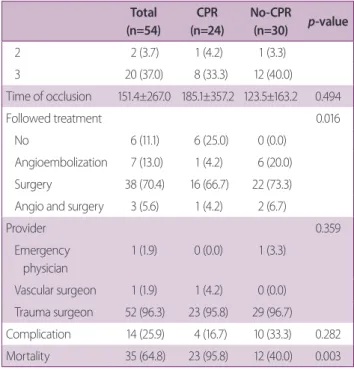
Other characteristics of patients according to the CPR status are summarized in Table 1. There were no significant differences in sex (p=0.729), age (p=0.299), ISS (p=0.755), injury type (p=1.000), multiple injury (p=1.000), low extremity injury (p=0.842), pelvic bone fracture (p=0.520), intra-abdominal injury (p=1.000), intra-chest injury (p=0.842), access method (p=0.652), access site (p=0.927), confirmation of balloon position (p=0.337), type of catheter (p=0.740), type of REBOA (p=0.207), zone (p=0.877), time of occlusion (p=0.494), provider (p=0.359), and occurrence of complications (p=0.282) between the CPR and No-CPR groups. Only one patient received REBOA due to penetrating injury.
REBOA balloons were confirmed by radiography in most cases (90.7%), and there were two cases in which REBOA balloons were placed in Zone 2. On the other hand, there were significant differences in mortality (p=0.003) and following treatment (p=0.016) between the CPR group and the No-CPR group.
Logistic regression analysis for complications
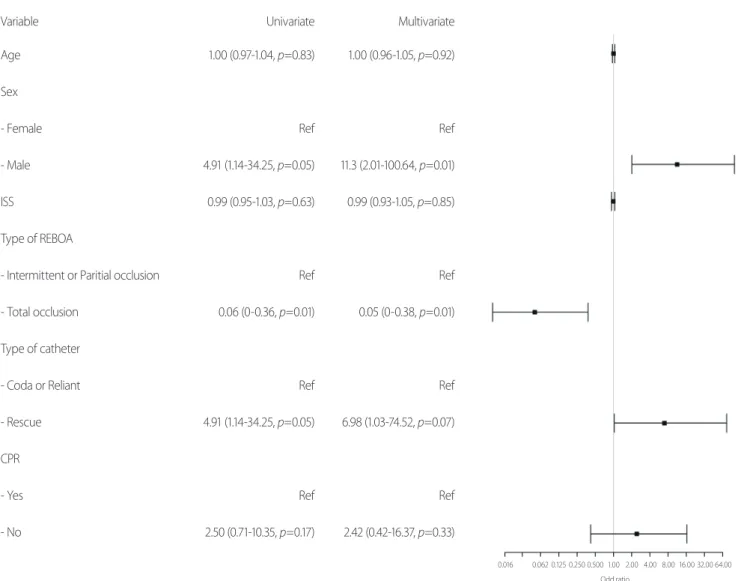
Univariate and multivariate LRA for the occurrence of complications were performed. Age was not statistically significant in both univariate (OR 1.00, 95% CI 0.97-1.04, p=0.83) and multivariate (OR 1.00, 95% CI 0.96-1.05, p=0.92) analyses. Males had a significantly higher risk of complications than females in both univariate (OR 4.91,
Patients who received REBOA during study
(n=56)
REBOA=54
Excluded:
Failure 2
CPR=24 No CPR=30
Survival=1 Death=23 Survival=18 Death=12
Fig. 1. Flowchart of this study. REBOA: resuscitative endovascular
balloon occlusion of the aorta, CPR: cardiopulmonary resuscitation
95% CI 1.14-34.25, p=0.05) and multivariate (OR 11.3, 95% CI 2.01-100.64, p=0.01) analyses, and the effect was reinforced in multivariate analysis. ISS was not statistical- ly significant in both univariate (OR 0.99, 95% CI 0.95- 1.03, p=0.63) and multivariate (OR 0.99, 95% CI 0.93-1.05, p=0.85) analyses. Total occlusion had a significantly lesser risk than intermittent or partial occlusion in both univar- iate (OR 0.06, 95% CI 0.00-0.36, p=0.01) and multivariate (OR 0.05, 95% CI 0.00-0.38, p=0.01) analyses, and the effects were similar between univariate and multivariate analyses. The Rescue had a higher risk than Coda or Re- liant in univariate analysis (OR 4.91, 95% CI 1.14-34.25, p=0.05), but it was not statistically significant in multi- variate analysis (OR 6.98, 95% CI 1.03-74.52, p=0.07).
However, it cannot be easily ignored because 95% CI of multivariate analysis does not include 1. Finally, the No- CPR group was not statistically significant compared to Table 1. Patient characteristics according to CPR status
Total (n=54)
CPR (n=24)
No-CPR
(n=30) p-value
Sex 0.729
Male 34 (63.0) 14 (58.3) 20 (66.7)
Female 20 (37.0) 10 (41.7) 10 (33.3)
Age 50.1±18.7 53.1±18.0 47.8±19.2 0.299
ISS 34.9±15.0 34.2±15.6 35.5±14.7 0.755
Injury type 1.000
Blunt 53 (98.1) 24 (100.0) 29 (96.7) Penetrating 1 (1.9) 0 (0.0) 1 (3.3) Reason of REBOA
aMultiple injury 14 (25.9) 7 (29.2) 7 (23.3) 1.000 Low extremity 3 (5.6) 2 (8.3) 1 (3.3) 0.842 Pelvic bone
fracture
24 (44.4) 9 (37.5) 15 (50.0) 0.520
Intra-abdominal injury
31 (57.4) 14 (58.3) 17 (56.7) 1.000
Intra-chest injury 3 (5.6) 2 (8.3) 1 (3.3) 0.842
Access method 0.652
Cut down 1 (1.9) 0 (0.0) 1 (3.3)
Palpitation 49 (90.7) 22 (91.7) 27 (90.0) Ultrasonography 4 (7.4) 2 (8.3) 2 (6.7)
Access site 0.927
Right femoral artery
30 (55.6) 14 (58.3) 16 (53.3)
Left femoral artery 24 (44.4) 10 (41.7) 14 (46.7) Balloon position
confirm
0.337
Blind 2 (3.7) 2 (8.3) 0 (0.0)
C-arm 1 (1.9) 0 (0.0) 1 (3.3)
Ultrasonography 2 (3.7) 1 (4.2) 1 (3.3)
X-ray 49 (90.7) 21 (87.5) 28 (93.3)
Type of catheter 0.740
CODA
b6 (11.1) 3 (12.5) 3 (10.0)
RELIANT
c14 (25.9) 5 (20.8) 9 (30.0) RESCUE
d34 (63.3) 16 (66.7) 18 (60.0)
Type of REBOA 0.207
Partial or Intermittent
31 (57.4) 11 (45.8) 20 (66.7)
Total occlusion 23 (42.6) 13 (54.2) 10 (33.3)
Zone 0.877
1 32 (59.3) 15 (62.5) 17 (56.7)
Total (n=54)
CPR (n=24)
No-CPR
(n=30) p-value
2 2 (3.7) 1 (4.2) 1 (3.3)
3 20 (37.0) 8 (33.3) 12 (40.0)
Time of occlusion 151.4±267.0 185.1±357.2 123.5±163.2 0.494
Followed treatment 0.016
No 6 (11.1) 6 (25.0) 0 (0.0)
Angioembolization 7 (13.0) 1 (4.2) 6 (20.0) Surgery 38 (70.4) 16 (66.7) 22 (73.3) Angio and surgery 3 (5.6) 1 (4.2) 2 (6.7)
Provider 0.359
Emergency physician
1 (1.9) 0 (0.0) 1 (3.3)
Vascular surgeon 1 (1.9) 1 (4.2) 0 (0.0) Trauma surgeon 52 (96.3) 23 (95.8) 29 (96.7) Complication 14 (25.9) 4 (16.7) 10 (33.3) 0.282 Mortality 35 (64.8) 23 (95.8) 12 (40.0) 0.003 Values are presented as mean±standard deviation or number (%).
CPR: cardiopulmonary resuscitation, ISS: injury severity score, REBOA:
resuscitative endovascular balloon occlusion of the aorta.
a
Duplicated.
b
Coda
®balloon 14 Fr catheter (Cook Medical, Bloomington, USA).
c
Reliant
®balloon 12 Fr catheter (Medtronic, Minneapolis, USA).
d
Rescue balloon
®7 Fr catheter (Tokai Medical Products, Aichi, Japan).
Table 1. Continued
the CPR group in both univariate (OR 2.50, 95% CI 0.71- 10.35, p=0.17), and multivariate (OR 2.43, 95% CI 0.42- 16.37, p=0.33) analyses. The p-value of Hosmer and Le- meshow goodness of fit test for this model was 0.901, and the area under the receiver operating characteristic curve (AUC) was 0.893, which means that this LRA model ex- plains the data of this study well.
Logistic regression analysis for mortality
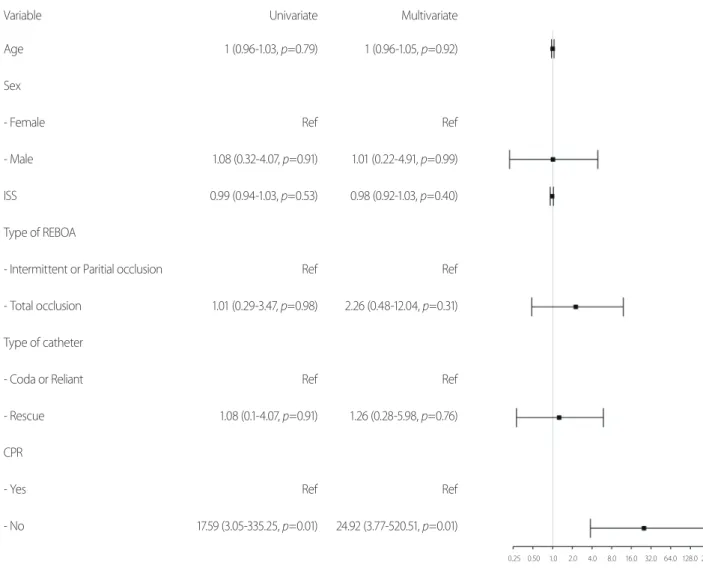
Univariate and multivariate LRA for mortality were also performed. Age was not statistically significant in both univariate (OR 1.00, 95% CI 0.96-1.03, p=0.79) and multivariate (OR 1.00, 95% CI 0.96-1.05, p=0.92) anal- yses. Male sex was not statistically significant compared to female sex in both univariate (OR 1.08, 95% CI 0.31- 4.07, p=0.91) and multivariate (OR 1.01, 95% CI 0.22- 4.91, p=0.99) analyses. ISS was not statistically significant in both univariate (OR 0.99, 95% CI 0.94-1.03, p=0.53) and multivariate (OR 0.98, 95% CI 0.92-1.03, p=0.40) analyses. Total occlusion was not statistically significant compared to intermittent or partial occlusion in both univariate (OR 1.01, 95% CI 0.29-3.47, p=0.98) and mul- tivariate (OR 2.26, 95% CI 0.48-12.04, p=0.31) analyses.
Rescue was not statistically significant compared to Coda or Reliant in both univariate (OR 1.08, 95% CI 0.31-4.07, p=0.91) and multivariate (OR 1.26, 95% CI 0.28-5.98, p=0.76) analyses. The CPR group was the only variable that had a significantly higher risk for mortality than the No-CPR group in both univariate (OR 17.59, 95% CI 3.05-335.25, p=0.01) and multivariate (OR 24.92, 95% CI 3.77-520.51, p=0.01) analyses. The p-value of Hosmer and Lemeshow goodness of fit test for this model was 0.762, and AUC was 0.809. Therefore, the LRA model for mor- tality fits the data of this study.
DISCUSSION
When we compared the CPR and No-CPR groups in trauma patients who underwent REBOA within our study, no variables, except mortality and following treat- ment, showed significant differences between the two groups. Chen et al. [11] reported that only 2.2% of trau- matic cardiac arrest patients survived for at least 30 days,
and ISS above 16 and total resuscitation length above 20 minutes were unfavorable factors for mortality. In our study, the mean ISS was 34.9±15.0. Consequently, CPR is an independent factor influencing mortality. In the CPR group, six patients could not receive the following treatment because the patients had expired. More patients in the No-CPR group received other treatments, such as surgery, angiographic embolization, or both than those in the CPR group.
The main reason for REBOA is intra-abdominal injury (57.4%). However, if we check each injury type, pelvic bone fracture (44.4%) was the most common reason for REBOA, and liver injury was the second most common reason. The injury type distribution by the detailed or-
Table 2. The injured organ of the patients
Injured organ (duplicated) Number
Intra-abdominal organ
Liver 15
Mesentery 11
Kidney 5
Spleen 5
Inferior vena cava 2
Lung 3
Pelvic bone fracture 24
Lower extremity 3
Multiple organ injury 14
Table 3. Description of complication
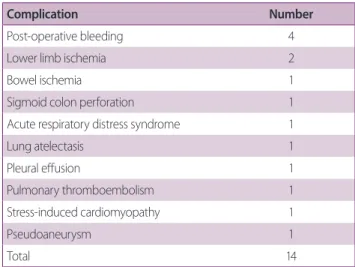
Complication Number
Post-operative bleeding 4
Lower limb ischemia 2
Bowel ischemia 1
Sigmoid colon perforation 1
Acute respiratory distress syndrome 1
Lung atelectasis 1
Pleural effusion 1
Pulmonary thromboembolism 1
Stress-induced cardiomyopathy 1
Pseudoaneurysm 1
Total 14
gan is described in Table 2. Fourteen patients (25.9%) had multiple organ injuries, and there was no significant difference between the CPR and the No-CPR groups (p=1.000). The majority of our cases showed intra-ab- dominal organ injury or pelvic bone fracture. In 3 cases we performed REBOA on patients with lung injury. Two of them had multiple organ (spleen, liver, and lung) in- juries, and the other had solitary lung injury. REBOA is indicated mostly in patients with life-threatening hem- orrhagic injuries below the diaphragm [12], and the performance of REBOA in thoracic trauma patients with
or without other torso injuries has been debated [13].
Ordoñez et al. [14] suggested that the combination of RE- BOA and ERT could be useful in patients with non-com- pressible torso hemorrhage secondary to penetrating chest trauma in their 7-case series report. However, in our study, all patients with lung injury were injured from blunt trauma; therefore, it is better to be careful about implementation of REBOA in patients with thoracic inju- ries.
Fourteen patients developed complications, as described in Table 3. Postoperative bleeding was the highest in four
Logistic regression analysis model for complication (Hosmer & Lemeshow test
atest p=0.901, AUC=0.893)
Variable Univariate Multivariate
Age 1.00 (0.97-1.04, p=0.83) 1.00 (0.96-1.05, p=0.92)
Sex
- Female Ref Ref
- Male 4.91 (1.14-34.25, p=0.05) 11.3 (2.01-100.64, p=0.01)
ISS 0.99 (0.95-1.03, p=0.63) 0.99 (0.93-1.05, p=0.85)
Type of REBOA
- Intermittent or Paritial occlusion Ref Ref
- Total occlusion 0.06 (0-0.36, p=0.01) 0.05 (0-0.38, p=0.01) Type of catheter
- Coda or Reliant Ref Ref
- Rescue 4.91 (1.14-34.25, p=0.05) 6.98 (1.03-74.52, p=0.07) CPR
- Yes Ref Ref
- No 2.50 (0.71-10.35, p=0.17) 2.42 (0.42-16.37, p=0.33)
0.016 0.062 0.125 0.250 0.500 1.00 2.00 4.00 8.00 16.00 32.00 64.00 Odd ratio
Fig. 2. A logistic regression analysis model that the occurrence of the complication is the dependent variable. AUC: area under the receiver operating characteristic curve, ISS: injury severity score, REBOA: resuscitative endovascular balloon occlusion of the aorta, CPR: cardiopulmonary resuscitation.
a
Hosmer and Lemeshow goodness of fit test.
cases, followed by lower limb ischemia in two cases. There was one case each for bowel ischemia, sigmoid colon perforation, acute respiratory distress syndrome, lung at- electasis, pleural effusion, pulmonary thromboembolism, stress-induced cardiomyopathy, and pseudoaneurysm.
There are many complications associated with REBOA.
The reported complications of REBOA included femoral arterial complications (disruption, dissection, pseudo- aneurysm, hematoma, thromboembolism), extremity ischemia, aortoiliac complication (intimal tear, dissection, rupture), and bowel ischemia [12,15]. The conditions in
which complications occur during REBOA implementa- tion are: 1) the physical damage inflicted on the accessing vessel (femoral artery or iliac vessels); and 2) ischemia and inflammation caused by blockage of downstream blood flow [15,16]. Vessels can be injured by the catheter itself or by overinflation of the REBOA balloon. Sadeghi et al.
[16] reported that REBOA could cause severe systemic and intra-abdominal metabolic disturbances, organ dam- age, and inflammatory activation at 30 minutes of occlu- sion in a non-hemorrhagic porcine model.
In this study, we attempted to identify the variables
Logistic regression analysis model for mortality (Hosmer & Lemeshow test
atest p=0.762, AUC=0.809)
Variable Univariate Multivariate
Age 1 (0.96-1.03, p=0.79) 1 (0.96-1.05, p=0.92)
Sex
- Female Ref Ref
- Male 1.08 (0.32-4.07, p=0.91) 1.01 (0.22-4.91, p=0.99)
ISS 0.99 (0.94-1.03, p=0.53) 0.98 (0.92-1.03, p=0.40)
Type of REBOA
- Intermittent or Paritial occlusion Ref Ref
- Total occlusion 1.01 (0.29-3.47, p=0.98) 2.26 (0.48-12.04, p=0.31) Type of catheter
- Coda or Reliant Ref Ref
- Rescue 1.08 (0.1-4.07, p=0.91) 1.26 (0.28-5.98, p=0.76)
CPR
- Yes Ref Ref
- No 17.59 (3.05-335.25, p=0.01) 24.92 (3.77-520.51, p=0.01)
Fig. 3. A logistic regression analysis model that mortality is a dependent variable. AUC: area under the receiver operating characteristic curve, ISS:
injury severity score, REBOA: resuscitative endovascular balloon occlusion of the aorta, CPR: cardiopulmonary resuscitation.
aHosmer and Lemeshow goodness of fit test.
0.25 0.50 1.0 2.0 4.0 8.0 16.0 32.0 64.0 128.0 256.0 512.0 Odd ratio