• 검색 결과가 없습니다.

Resuscitative Endovascular Balloon Occlusion of the Aorta for an Iliac Artery Aneurysm: Case Report

N/A
N/A
Protected

Academic year: 2021

Share "Resuscitative Endovascular Balloon Occlusion of the Aorta for an Iliac Artery Aneurysm: Case Report"

Copied!
4
0
0

로드 중.... (전체 텍스트 보기)

전체 글

(1)

429 http://www.jchestsurg.org

JCS

Journal of Chest Surgery

Case Report

Resuscitative Endovascular Balloon Occlusion of the Aorta for an Iliac Artery Aneurysm: Case Report

Sung Wook Chang, M.D. 1,2 , Sangwook Chun, M.D. 2 , Gyeongho Lee, M.D. 2 , Pil Won Seo, M.D., Ph.D. 2

1

Trauma Center and

2

Department of Thoracic and Cardiovascular Surgery, Dankook University Hospital, Cheonan, Korea

ARTICLE INFO

Received September 25, 2020 Accepted October 22, 2020 Corresponding author Pil Won Seo

Tel 82-41-550-6195 Fax 82-41-550-0039 E-mail [email protected] ORCID

https://orcid.org/0000-0003-0084-1814

Isolated iliac artery aneurysm (IAA) is rare, but can be fatal. Emergency surgery is performed in cases of hemorrhagic shock due to a suddenly ruptured IAA, which may have a high mortality rate because of massive non-compressible torso hemorrhage (NCTH). Recently, resuscitative endovascular balloon occlusion of the aorta (REBOA) has been accepted as an alternative to aortic cross-clamping via open thoracotomy to achieve hemostasis in trauma patients with profound shock due to NCTH and is considered an emerging bridg- ing therapy for damage control. However, there is limited information on the use of REBOA in non-trauma patients with shock. Herein, we describe a patient with impending cardiac arrest due to isolated ruptured IAA, in whom perioperative bleeding was successfully con- trolled by REBOA.

Keywords: Iliac artery, Aneurysm, Rupture, Aorta, Balloon occlusion, Case report

Copyright © 2021, The Korean Society for Thoracic and Cardiovascular Surgery

This is an Open Access article distributed under the terms of the Creative Commons Attribution Non-Commercial License (http://creativecommons.org/licenses/

by-nc/4.0) which permits unrestricted non-commercial use, distribution, and reproduction in any medium, provided the original work is properly cited.

Case report

A 67-year-old woman with hypertension presented to the emergency department with a chief complaint of abdomi- nal pain, which had started 6 hours prior. On arrival, her vital signs were as follows: blood pressure (BP), 156/66 mm Hg; pulse rate, 76 beats/min; respiratory rate, 17 breaths/

min; oxygen saturation, 100%; and body temperature, 36.6°C. Physical examination revealed a mass-like lesion with tenderness in the right lower quadrant of the abdo- men. Contrast-enhanced computed tomography (CT) of

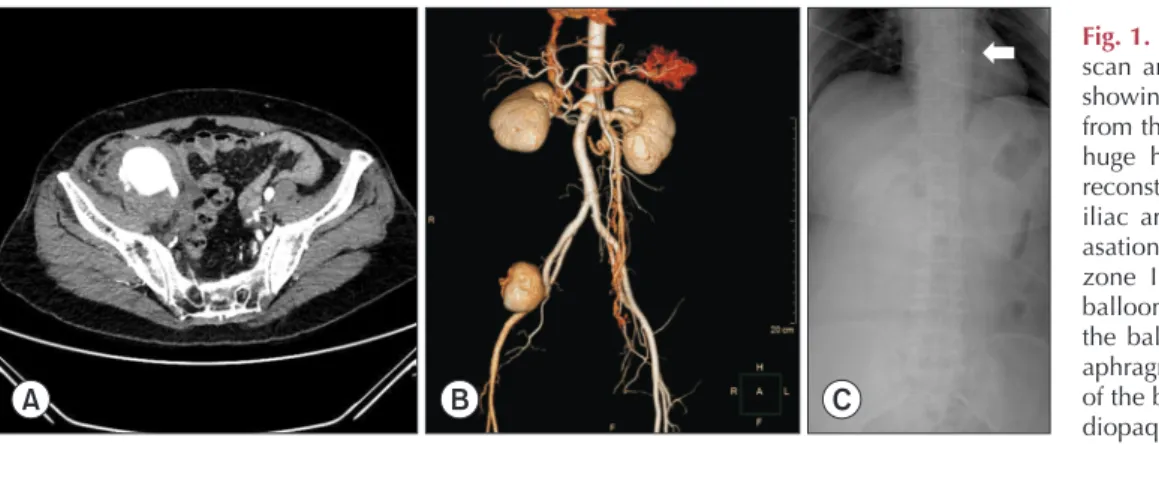
the abdominopelvic region revealed a ruptured external il- iac artery (EIA) aneurysm with extensive active extravasa- tion and a huge retroperitoneal hematoma (Fig. 1A, B). Af- ter the CT scan, the patient’s systolic blood pressure (SBP) decreased to 40 mm Hg. Despite fluid resuscitation and vasopressor support, her SBP reduced further to 30 mm Hg. We decided to perform chest compressions simultane- ously with resuscitative endovascular balloon occlusion of the aorta (REBOA) for damage control in an attempt to mitigate impending cardiac arrest.

Ultrasound-guided vascular access to the left common

A B C

Fig. 1. Computed tomography (CT) scan and radiograph. (A) CT scan showing the site of active bleeding from the external iliac artery and a huge hematoma. (B) CT vascular reconstruction showing the isolated iliac artery aneurysm with extrav- asation. (C) Radiograph showing zone I resuscitative endovascular balloon occlusion of the aorta with the balloon located above the di- aphragm (white arrow: the bottom of the balloon catheter with the ra- diopaque steel marker).

https://doi.org/10.5090/jcs.20.124

pISSN: 2765-1606 eISSN: 2765-1614

J Chest Surg. 2021;54(5):429-432

(2)

430

https://doi.org/10.5090/jcs.20.124

http://www.jchestsurg.org

JCS

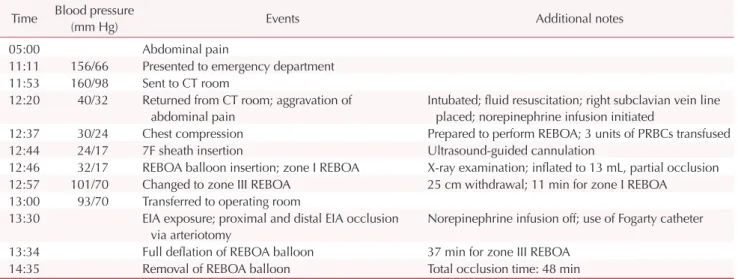
femoral artery was used to place a 7F Radiofocus Introduc- er II (Terumo, Tokyo, Japan) sheath. A 7F RESCUE Bal- loon (Tokai Medical Products, Kasugai, Japan) was de- ployed using the xyphoid process as an external anatomical landmark via the sheath. The length of the inserted bal- loon was 50 cm. Noting no resistance, the balloon was ini- tially inflated to 13 mL for partial occlusion of the de- scending thoracic aorta. After balloon occlusion, the patient’s SBP improved from 30 to 95 mm Hg. The ideal location for zone I REBOA was then confirmed radio- graphically (Fig. 1C). Following transfusion with 3 units of packed red blood cells, SBP was maintained at 100 mm Hg.

To minimize ischemic complications, the balloon catheter was moved 25 cm caudally to change to zone III REBOA with no findings of hemodynamic deterioration. The pa- tient was then transferred to the operating room (Table 1).

A retroperitoneal approach via a Rutherford Morrison incision revealed a huge hematoma, 4 cm in diameter, and a ruptured EIA aneurysm with active bleeding (Fig. 2). Ex- tended arteriotomy of the rupture site and intra-arterial balloon occlusion were performed at the proximal and dis- tal EIA using 5F Fogarty occlusion catheters (Edwards, Ir- vine, CA, USA). Next, the REBOA balloon was slowly de- flated under closed monitoring. Aneurysmectomy and angioplasty with bovine pericardium were then completed.

The total time period of partial aortic occlusion was 48 minutes (11 minutes in zone I REBOA and 37 minutes in zone III REBOA), and the REBOA balloon catheter was re- moved in the operating room. Her vital signs stabilized postoperatively, and she was discharged without any com- plaints 24 days postoperatively.

The study was approved by the Institutional Review Board of Dankook University Hospital (IRB approval no., 2020-10-023). The requirement for informed consent was waived.

Discussion

Iliac artery aneurysms (IAAs) are uncommon and fre- quently occur in conjunction with abdominal aortic aneu- rysms [1,2]. Isolated IAAs are rare, accounting for fewer than 1.9% of all intra-abdominal aneurysms [1,2]. As IAAs are often masked by nonspecific signs and symptoms, early diagnosis and treatment may be difficult. Surgical repair is considered to be the gold standard. Although the mortality rate has been reported to be low in the elective manage- ment of unruptured IAAs, ruptured IAAs are associated with significant operative mortality of up to 50% [3]. With Table 1. Timing of critical events in the patient’s course

Time Blood pressure

(mm Hg) Events Additional notes

05:00 Abdominal pain

11:11 156/66 Presented to emergency department 11:53 160/98 Sent to CT room

12:20 40/32 Returned from CT room; aggravation of abdominal pain

Intubated; fluid resuscitation; right subclavian vein line placed; norepinephrine infusion initiated

12:37 30/24 Chest compression Prepared to perform REBOA; 3 units of PRBCs transfused

12:44 24/17 7F sheath insertion Ultrasound-guided cannulation

12:46 32/17 REBOA balloon insertion; zone I REBOA X-ray examination; inflated to 13 mL, partial occlusion 12:57 101/70 Changed to zone III REBOA 25 cm withdrawal; 11 min for zone I REBOA

13:00 93/70 Transferred to operating room

13:30 EIA exposure; proximal and distal EIA occlusion via arteriotomy

Norepinephrine infusion off; use of Fogarty catheter

13:34 Full deflation of REBOA balloon 37 min for zone III REBOA

14:35 Removal of REBOA balloon Total occlusion time: 48 min

CT, computed tomography; REBOA, resuscitative endovascular balloon occlusion of the aorta; PRBC, packed red blood cell; EIA, external iliac artery.

Fig. 2. Intraoperative findings show a ruptured external iliac artery

aneurysm. No extensive bleeding from the proximal iliac artery

occurred due to partial occlusion by zone III resuscitative endo-

vascular balloon occlusion of the aorta.

(3)

431

Sung Wook Chang, et al. REBOA in Non-Trauma Patients with Shock

http://www.jchestsurg.org

JCS

advances in endovascular technology and techniques, per- cutaneous endovascular stent-graft repair of IAA has the potential to reduce perioperative mortality [4]. However, if endovascular management is not available immediately due to a lack of an appropriate stent graft or if there is no time to prepare for surgery or intervention for patients with impending cardiac arrest, damage control resuscita- tion should be performed regardless of the patient’s loca- tion.

REBOA has been accepted as a technique for preopera- tively reducing hemorrhage and increasing cerebral/coro- nary perfusion in patients with non-compressible torso hemorrhage (NCTH) [5-7]. Recently, its use has expanded beyond just trauma care to encompass other types of bleeding or resuscitation for hemodynamic stabilization [5-8]. In general, different occlusion zones in the aorta could be used to block blood flow to the lower body with the following classification and indications: zone I REBOA (descending thoracic aorta, from the origin of the left sub- clavian artery to the celiac artery) for patients with hemo- peritoneum and/or retroperitoneal hemorrhage and zone III REBOA (infrarenal abdominal aorta, from the renal ar- tery to the aortic bifurcation) for patients with pelvic bleeding. Several reports have suggested that zone I RE- BOA may more optimally elevate proximal BP than zone III REBOA in patients with hemorrhagic shock [9,10].

Therefore, zone I REBOA should be preferentially consid- ered in patients with profound shock regardless of the bleeding focus [9,10]. In this case, despite massive bleeding from a ruptured IAA, zone I REBOA was performed for damage control because the patient’s status rapidly deterio- rated and resulted in impending cardiac arrest.

Perfusion-related complications following REBOA, such as acute kidney injury and leg ischemia, have been report- ed [7,9,10]. Therefore, it is important to perform safeguards to minimize ischemic complications below the site of the occlusion. One safeguard is to find the optimal occlusion level and another is to choose the proper occlusion meth- od. In this case, zone I REBOA was performed to elevate the SBP initially. After stabilizing the patient’s hemody- namics, the REBOA balloon catheter was moved to a zone III occlusion in order to maintain adequate renal and bow- el perfusion. Initial CT showed that the aortic bifurcation was located along the upper margin of the fourth lumbar vertebra. Post-insertion radiography showed that the dis- tance from the bottom of the balloon catheter, with a radi- opaque steel marker, to the fourth lumbar vertebra was 25 cm. Thus, the balloon was withdrawn 25 cm in the caudal direction. Another important step taken in this case was

the use of permissive hypotension as a resuscitative strate- gy. The balloon was initially inflated to 13 mL to occlude the aorta partially, without any resistance, and the distal pulse of the dorsalis pedis artery was palpated after stabi- lizing the patient’s hemodynamics. We believe that the pa- tient did not experience any perfusion-related complica- tions because these principles were followed.

In conclusion, ruptured isolated IAA is rare, but is asso- ciated with a significant risk of operative mortality. If a ruptured IAA with massive hemorrhage is diagnosed, im- mediate treatment such as surgery or a vascular interven- tion is essential to reduce mortality. In this case, in the set- ting of impending cardiac arrest due to ruptured IAA, REBOA was successfully performed as a damage control procedure. Therefore, REBOA could be a useful option to allow adequate time to prepare for surgery and to stabilize hemodynamics in the interim. Timely use of REBOA in cases of non-traumatic IAA rupture could reduce the perioperative mortality rate and may be a life-saving pro- cedure.

Conflict of interest

No potential conflict of interest relevant to this article was reported.

ORCID

Sung Wook Chang: https://orcid.org/0000-0002-2689-3068 Sangwook Chun: https://orcid.org/0000-0003-1561-442X Gyeongho Lee: https://orcid.org/0000-0001-5928-3939 Pil Won Seo: https://orcid.org/0000-0003-0084-1814

References

1. Chaer RA, Barbato JE, Lin SC, Zenati M, Kent KC, McKinsey JF.

Isolated iliac artery aneurysms: a contemporary comparison of endo- vascular and open repair. J Vasc Surg 2008;47:708-13.

2. Kimura F, Ookubo R, Kobayashi D, Harada H, Baba T. Successful endovascular repair of a ruptured isolated iliac artery aneurysm: a case report. Clin Case Rep 2019;7:1880-4.

3. Richardson JW, Greenfield LJ. Natural history and management of iliac aneurysms. J Vasc Surg 1988;8:165-71.

4. Boules TN, Selzer F, Stanziale SF, et al. Endovascular management of isolated iliac artery aneurysms. J Vasc Surg 2006;44:29-37.

5. Cho S, Ryu JW, Chang SW. Resuscitative endovascular balloon oc-

clusion of the aorta for retroperitoneal hemorrhage and shock after

ipsilateral antegrade angioplasty with vascular closure device. Ann

Transl Med 2020;8:404.

(4)

432

https://doi.org/10.5090/jcs.20.124

http://www.jchestsurg.org

JCS

6. Horer T. Resuscitative endovascular balloon occlusion of the aorta (REBOA) and endovascular resuscitation and trauma management (EVTM): a paradigm shift regarding hemodynamic instability. Eur J Trauma Emerg Surg 2018;44:487-9.

7. Kim DH, Chang SW, Matsumoto J. The utilization of resuscitative endovascular balloon occlusion of the aorta: preparation, technique, and the implementation of a novel approach to stabilizing hemor- rhage. J Thorac Dis 2018;10:5550-9.

8. Chang SW, Chang YR, Seon YJ, Park JW, Kim JS. Intraoperative use of resuscitative endovascular balloon occlusion of the aorta for hem-

orrhage control in woman with placenta percreta involving the blad- der. Perinatology 2019;30:175-8.

9. Beyer CA, Johnson MA, Galante JM, DuBose JJ. Zones matter: he- modynamic effects of zone 1 vs zone 3 resuscitative endovascular balloon occlusion of the aorta placement in trauma patients. Injury 2019;50:855-8.

10. Tibbits EM, Hoareau GL, Simon MA, et al. Location is everything:

the hemodynamic effects of REBOA in zone 1 versus zone 3 of the

aorta. J Trauma Acute Care Surg 2018;85:101-7.

수치

Fig. 1. Computed tomography (CT)  scan and radiograph. (A) CT scan  showing the site of active bleeding  from the external iliac artery and a  huge hematoma
Fig. 2. Intraoperative findings show a ruptured external iliac artery  aneurysm. No extensive bleeding from the proximal iliac artery  occurred due to partial occlusion by zone III resuscitative  endo-vascular balloon occlusion of the aorta.

참조

관련 문서

Type: Class D – Metal Fires Pressure Gauge Yes.. Agent: Sodium Chloride, copper,

The “Asset Allocation” portfolio assumes the following weights: 25% in the S&P 500, 10% in the Russell 2000, 15% in the MSCI EAFE, 5% in the MSCI EME, 25% in the

1 John Owen, Justification by Faith Alone, in The Works of John Owen, ed. John Bolt, trans. Scott Clark, "Do This and Live: Christ's Active Obedience as the

Thermal balloon ablation versus endometrial resection for the treatment of abnormal uterine bleeding. Thermal balloon ablation in myoma-induced menorrhagia

Therefore, this study aims to maintain the even saponin content by standardizing balloon flower extract (60ml) to use as tea to maximize the

treat wide wide wide wide necked necked necked necked aneurysms aneurysms aneurysms aneurysms that that that that selection selection selection selection of of

For Kummell’s disease with persistent pain and without neurological symptoms, percutaneous vertebroplasty (VP) or balloon kyphoplasty (KP) has been known to

Recently, metal-assisted chemical etching (MACE) has been widely used for the synthesis of SiNWs, because this technique has advantages such as simplicity, low operating