• 검색 결과가 없습니다.

Beneficial Effects of Fermented Soybean through PPARs Activation in Metabolic Syndrome

N/A
N/A
Protected

Academic year: 2021

Share "Beneficial Effects of Fermented Soybean through PPARs Activation in Metabolic Syndrome"

Copied!
9
0
0

로드 중.... (전체 텍스트 보기)

전체 글

(1)

Yakhak Hoeji Vol. 63, No. 5 DOI 10.17480/psk.2019.63.5.259

Review

Beneficial Effects of Fermented Soybean through PPARs Activation in Metabolic Syndrome

Radha Arulkumar*, EunJin Bang**, Sang-Gyun Noh*, Hee Jin Jung***, Dae Hyun Kim***, Takako Yokozawa****, and Hae Young Chung*

,

**

,

***

,

#

*Interdisciplinary Research Program of Bioinformatics and Longevity Science, Pusan National University

**College of Pharmacy, Pusan National University

***Longevity life Science and Technology Institutes, Pusan National University

****Graduate School of Science and Engineering for Research, University of Toyama

(Received September 17, 2019; Revised October 11, 2019; Accepted October 14, 2019)

Abstract Fermented soybean is an important fermented soybean food in Korea as it has many health benefits. The phytochemicals that are modified and concentrated by fermentation with Bacillus subtilis are isoflavone aglycones, flavonols, and gallic acid, which were produced by the activity of β-glucosidase and esterase. On the other hand, isoflavone glycosides and flavanol gallates were decreased. It possesses various biological activities such as anti-oxidative, anti-microbial, anti-cancer, anti-diabetic and neuroprotective effects. Therefore, recent research has paid great attention to fermented soy food products to improve human health. We performed in silico molecular docking simulation of increased phytochemical components during soybean fermentation for peroxisome proliferator-activated receptors (PPARs), which is a well-known nuclear receptor family for preventive roles in metabolic and inflammatory diseases. The results demonstrated that components such as epicatechin, daidzein, catechin, and genistein showed strong binding affinity with PPARs, suggesting their potential therapeutic effects. In this review, we highlighted the recent studies and possible action mechanisms of phytochemical extracts during the fermentation process of soybean and their potential health benefits to humans, especially for the treatment of the metabolic syndrome.

Keywords Fermented soybean, Bacillus subtilis, phytochemicals, in silico docking simulation, PPARs

Introduction

Soy foods are one of the most common beneficial health foods with an exceptional source of essential nutrients provided in 100 grams, serving high contents of the daily nutrition value, in particular, for protein (36%), dietary fiber (37%), iron (121%), manganese (120%), phosphorus (101%) and several B vitamins, including folate (94%). High contents exist for vitamin K, magnesium, zinc and potassium with several biological properties as it contains various phytochemicals such as isoflavones, saponins, phytic acid, catechins, and trypsin inhibitors.

1-3)

Commercially, fermentation is the enzymatic decomposition process by microbes used to increase biologically active compounds that potentially benefit human health.

4)

Previous reports suggest that microbes can

contribute to enhanced biological properties of fermented soybeans as well as their nutritional contents.

5)

The phytochemicals contests are modified by fermentation by Bacillus subtilis (B. subtilis) converting soybean with greater healthy properties. For example, these fermented soybean products include soybean cake (meju), soybean paste (Cheonggukjang), soybean sauce (kanjang).

6)

Fermented soybean is a popular fermented soybean, which is used as one of the major dietary sources in Korea. Fermented soybean is generally considered to be a healthy consumption product as is rich in sources of vitamins, lipids, protein, hydrolyzed peptides and other diverse nutrients.

7)

It possesses beneficial pharmacological characteristics and exerts anti-oxidative, anti-microbial, anti-cancer and anti-diabetic activities.

3,8)

In addition, it has the capability to modulate cholesterol in the human physiological system. It also has been demonstrated that fermented soybeans consumption significantly correlate with a reduction of the occurrence rate of breast and prostate cancer.

9)

Peroxisome proliferator-activated receptors (PPARs), a nuclear receptor protein family, is well-known to play an important role in lipid and glucose homeostasis.

10)

Therefore, PPARs targeting

#

Corresponding author

Hae Young Chung, Department of Pharmacy, College of Pharmacy, Pusan National University, 2, Busandaehak-ro 63beon-gil, Geumjeong- gu, Busan, 46241, Republic of Korea

Tel: +82-51-510-2814; Fax: +82-51-518-2821

E-mail: [email protected]

(2)

molecules are developed as therapeutic target molecules to treat diseases such as metabolic syndrome and inflammatory diseases.

We performed in silico docking simulation of PPARs for fermented soybean extracts for their potential action mechanism.

And we highlight the nutritional contents and active compounds from fermented soybean and elaborate on possible action mechanisms through PPARs activation for health benefits to human beings.

Roles of PPARs in Diseases

The PPARs are a subfamily of three transcription factors that belong to the superfamily of nuclear hormone receptors.

11)

PPAR subfamily consists of three members: PPARα, PPARβ/δ, and PPARγ.

11)

PPARs regulates the expression of a large number of genes involved in metabolic homeostasis, lipid, glucose, and energy metabolism, adipogenesis, and inflammation.

12-14)

As PPARs regulate a large number of genes and metabolic pathways, its involvement in the pathogenesis is implicated in diseases such as metabolic syndrome, type 2 diabetes mellitus (T2DM), nonalcoholic fatty liver disease (NAFLD), and cardiovascular disease.

15-17)

Therefore, they represent critical molecular targets for the development of new therapeutic drugs to treat these metabolic diseases.

PPARα is activated by ligand and plays a role as a nuclear transcriptional factor.

18,19)

PPARα particularly regulates the expression of genes involved in fatty acid beta-oxidation and acts as an important regulator of energy homeostasis.

20)

PPARγ contributes to the regulation of adipogenesis, lipid and glucose homeostasis and other pathophysiological processes.

21)

Commercial medications such as pioglitazone and rosiglitazone function as insulin sensitizers and enhance insulin action and improve hyperglycemia in patients with T2DM.

22,23)

Likewise, several PPARγ agonists have been shown to effectively lower increased plasma free fatty acid levels, improve excessive lipid accumulation in peripheral tissues such as liver, skeletal muscle, heart, and hyperinsulinemia/insulin resistance and modulate the expression of adipokines and inflammatory cytokines that impact hepatic and muscle metabolism and whole- body insulin sensitivity.

24,25)

In addition, pharmacological modulation of the PPARα/δ nuclear receptors by elafibranor, a dual agonist of PPARα/δ, improved the histological resolution of non-alcoholic steatohepatitis (NASH), and the cardiometabolic risk profile.

26)

Currently, elafibranor is on phase 3 trials in the target population of patients with moderate to severe symptoms. Therefore, PPARs are an important therapeutic target for intervention of age-related diseases such as metabolic disorders.

Biotransformation during Soybean Fermentation

The previous report suggests that phytochemical contents such as isoflavones, flavonols, and phenolic acids are changed during the process of fermentation of soybean by using B. subtilis CS90.

27)

Among phytochemical constituents, 15 isoflavone, flavonols, and phenolic acids either increased or decreased during fermentation.

Specifically, the levels of isoflavone aglycones, and flavonols, and gallic acid increased significantly, while the isoflavone glycosides, malonylglycosides, and flavonol gallates decreased (Table 1). In addition, garlic affected the soybean fermentation by B.

amyloliquefaciens MJ1-4. It altered the total amount of phenolic and 12 isoflavones or isoflavone glycodise, including daidzin, glycitin, genistin, malonyldaidzin, malonylglycitin, acetyldaidzin, malonylgenistin, acetylglycitin, daidzein, glycitein and genistein, which correlated with the higher anti-oxidative activity.

3)

Phytochemicals like isoflavones, flavonols, and phenolic acids have shown many potential health benefits. It is well established that isoflavones have been reported to prevent atherosclerosis, osteoporosis, and postmenopausal syndrome.

28,29)

Flavonols act as excellent antioxidants and chelating agents.

30)

Moreover, phenolic acids, such as the gallic acid and its derivatives are demonstrated to have anti- oxidative and anti-carcinogenic activities and exert various other health benefits.

31,32)

Biological Importance of Fermented Soybean

As previously mentioned, fermented soybean has excellent

health benefits as it is a rich source of proteins, amino acids,

vitamins, minerals, and lipids. Fermented soybean’s characteristic

fibrous texture comes from the release of γ-aminobutyric acid

during fermentation.

33)

It has exhibited various biological activities

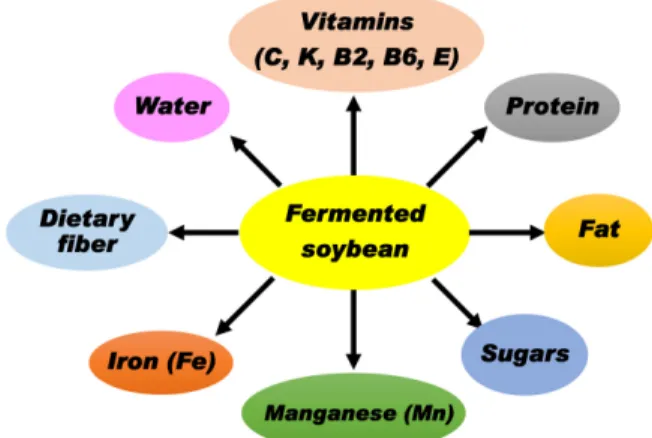
and health benefits (Fig. 1). For example, it showed a potent in

vitro anti-cancer effect by inhibiting cancer cell growth and

inducing apoptosis. Recently, Go et al.

34)

reported that fermented

soybean produced by mixed culture growth of both B. subtilis

MC31 and Lactobacillus sakei 383 has exhibited neuroprotective

effects in trimethyltin (TMT)-induced cognitive defects mice. The

neuroprotective effects of fermented soybean were the result of

inducing the release of nerve growth factor (NGF) and the

promotion of superoxide dismutase (SOD) activity as well as

inhibition of acetylcholinesterase (AChE) activity.

34)

Among

fermented soybean products from B. subtilis from four different

soybean culture settings (Aga 3, Saedanbeck, Pungsannamul, and

(3)

Daewon), Aga 3 had the most notable anti-oxidative activity, phenolic content, isoflavone levels, and composition of free amino acid.

35)

Interestingly, fermented soybean produced using 1% B.

subtilis has demonstrated the most beneficial effect by enhancing the metabolite and nutritional traits, and antioxidant potential of fermented soybean.

36)

More recently, fermented soybean by B.

amyloliquefaciens SCGB1 has significantly ameliorated atopic dermatitis-like skin lesion through the suppression of nuclear factor κB (NF-κB) and mitogen-activated protein kinase (MAPK)

activation, which is a well-known pro-inflammatory pathway for the induction of cytokines production.

37)

In silico Docking Simulations of Fermented Soybean Extract Components for PPARs

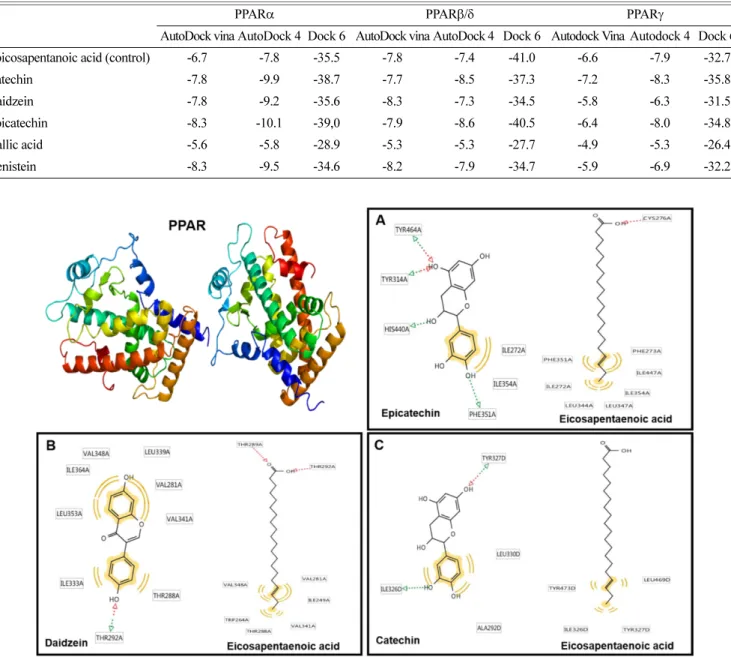
Molecular docking studies are used to determine the interaction between PPARs and soybean fermented extracts including isoflavones, flavanols, and phenolic acids (Table 1). The major derivative components selected for molecular docking simulation were daidzein, genistein, glycitin, acetyldaizin, acetylglycitin, acetylgenistin, malonyldaizin, malonylglycitin, malonyl genistin, catechin, epicatechin, catechin gallate, epicatechin gallate, and gallic acid. In particular, five components, daidzein, geinstein, catechin, epicatechin, and gallic acid were used to perform molecular docking studies for PPARα/γ/δ. Docking scores were obtained using three docking software, including AutoDock vina, AutoDock 4, and Dock 6 programs (Table 2).

To validate docking simulation results, pharmacophore analysis between these phytochemicals and PPARs was performed. The results indicated that epicatechin had a greater number of hydrogen bonds than the control eicosapentaenoic acid (green/red arrow, CYS276) when analyzed for PPARα (green/red arrow, ILE272, Fig. 1. Nutritional and health values of fermented soybean.

Table 1. Biotransformation of phytochemical components during soybean fermentation process and their beneficial effects.

Phytochemicals NF F Health Benefits Reference

Isoflavone

Daidzein - ↑ Inhibit endothelial cell dysfunction and prevent from

cardiovascular disease Yamagata, 2019

49)

Genistein - ↑

Daidzin + ↓ Antidipsotropic effect Keung et al., 2001

50)

Glycitin + ↓ Protect lung tissues from acute lung injury (ALI) Chen et al., 2019

51)

Acetyldaizin - ↑

Anti-photoaging agent for skin care Huang et al., 2010

52)

Acetylglycitin + ↓

Acetylgenistin + ↓

Malonyldaizin + ↓

Accelerate the early stages of cataractogenesis, and prevention and

treatment of diabetes-associated atherosclerosis Kyle et al., 2011

53)

Malonylglycitin + ↓

Malonylgenistin + ↓

Flavanols

Catechin + ↑ Protects against oxidative stress-induced cell death in fibroblasts Tanigawa et al., 2014

54)

Epicatechin + ↑ Potential prophylactic for Alzheimer's disease Cox et al., 2015

55)

Catechin gallate + ↓ Against beta-amyloid-induced toxicity

( reduce age-related neurodegenerative diseases, such as AD) Quan et al., 2009

56)

Epicatechin gallte + ↓ Chemoprevention of fibroid tumors Ozercan et al., 2007

57)

Phenolic acid

Gallic acid + ↓ Therapeutic activities in gastrointestinal, neuropsychological,

metabolic, and cardiovascular disorders Kahkeshani et al., 2019

58)

NF-non-fermented, F-fermented, - not identified, + present, ↑ increase, ↓ decrease

(4)

TYR314, PHE351, ILE354, HIS440, TYR464) (Fig. 2A). This explains the reason for the greater binding affinity between PPARα and epicatechin than the binding affinity between PPARα and the control compound. Daidzein had two hydrogen bonds in its interaction with PPARβ/δ (THR292), in which these two hydrogen bond binding was also observed for the control compound, eicosapentaenoic acid (THR289, THR292). However, the number of hydrophobic interactions between PPARβ/δ and daidzein is greater (VAL281, THR288, ILE333, LEU339, VAL341, VAL348, LEU353, ILE364) than that of control (ILE249, TRP264, VAL281, THR288, VAL341, VAL348), which

indicates that the binding affinity is greater than the binding force with the control (Fig. 2B). In addition, catechin had a total of three hydrogen bonds with PPARγ (ILE326, TYR327), whereas the control eicosapentaenoic acid had no hydrogen bond with PPARγ. For that reason, it is possible to understand why catechin has a higher binding force with PPARγ than control (Fig. 2C).

Furthermore, we evaluated the docking scores of the compounds in Table 2 and performed a pharmacophore analysis between PPARs and compounds that showed higher binding scores than control compounds (Fig. 3). In PPARα, catechin, daidzein, and genistein had higher docking scores than controls Table 2. In silico docking simulation of active components of fermented soybean with PPARα, PPARβ/δ and PPARγ

PPAR α PPAR β/δ PPAR γ

AutoDock vina AutoDock 4 Dock 6 AutoDock vina AutoDock 4 Dock 6 Autodock Vina Autodock 4 Dock 6

Epicosapentanoic acid (control) -6.7 -7.8 -35.5 -7.8 -7.4 -41.0 -6.6 -7.9 -32.7

Catechin -7.8 -9.9 -38.7 -7.7 -8.5 -37.3 -7.2 -8.3 -35.8

Daidzein -7.8 -9.2 -35.6 -8.3 -7.3 -34.5 -5.8 -6.3 -31.5

Epicatechin -8.3 -10.1 -39,0 -7.9 -8.6 -40.5 -6.4 -8.0 -34.8

Gallic acid -5.6 -5.8 -28.9 -5.3 -5.3 -27.7 -4.9 -5.3 -26.4

Genistein -8.3 -9.5 -34.6 -8.2 -7.9 -34.7 -5.9 -6.9 -32.2

Fig. 2. PPARs structures and pharmacophore analysis between PPARs and active components of soybean components. (A) interaction

with PPAR α; (B) interaction with PPARβ/δ; (C) interaction with PPARγ

(5)

(Fig. 3A), and in PPARβ/δ, catechin, epicatechin, and genistein were found to have a higher binding force (Fig. 3B). For PPARγ, catechin, daidzein, and genistein was found to be highly associating compounds (Fig. 3C). PPARα has been shown to have many hydrogen bonds with catechin (GLU269, SER280, TYR314, TYR440, and TYR464), daidzein (TYR314 and PHE351) and genistein (SER280, TYR314, PHE351, and HIS440). In particular, it can be concluded that daidzein has greater binding affinity than control because it has a few hydrogen bonds, but has more hydrophobic interactions than control. On the other hand, PPARβ/δ has three hydrogen bonds with catechin

(CYS285, THR289, and THR292), two with epicatechin (THR289 and TYR473) and one with genistein (THR288). In comparison to the results of PPARα’s pharmacophore analysis, the number of hydrogen bonds in PPARβ/δ was less, but the number of hydrophobic interactions appeared to contribute to greater binding affinity than the control compound (catechin:

THR288, ILE333 and LEU339, epicatechin: PHE282, MET453

and LEU469). Finally, in the case of PPARγ, it was found to

hydrogen bond with catechin (ILE326 and TYR327), but not with

daidzein and genistein. Nevertheless, there are plenty of hydrophobic

interactions in daidzein and genistein (daidzein: ARG288,

Fig. 3. Pharmacophore analysis between active components of fermented soybean and PPARs. (A) interaction with PPAR α; (B)

interaction with PPAR β/δ; (C) interaction with PPARγ

(6)

ALA292, ILE326, LEU330, PHE363, and MET364, genistein:

ARG288, ALA292, and ILE326), especially aromatic interactions (purple arrows, daidzein/genistein: ARG288). Therefore, it is possible to explain catechin, daidzein, epicatechin, and genistein show greater affinity due to the high binding force in comparison to the control for PPARs.

Previous study suggests that catechins from green tea exhibit anti-obesity mechanisms by modulating PPAR signaling pathways.

38)

Catechins increased the PPARγ in subcutaneous white adipose tissue (SWAT) and decreased the PPARγ in visceral white adipose tissue (VWAT). Also, catechins up-regulated the PPARβ/δ in SWAT, VWAT, and brown adipose tissue along with increased expression of genes involved in fatty acid oxidation in brown adipose tissue. Apart from that, epigallocatechin gallate (EGCG) can activate PPARα, thereby increasing the levels heme oxygenase- 1 (HO1), which is oxidative stress-related gene in cultured cancer cells.

39)

Moreover, EGCG mitigates β-Amyloid generation and oxidative stress by upregulation of PPARγ in N2a/APP695 Cells.

40)

In addition, the phytochemicals genistein and daidzein can also induce cell death on colon cancer cells via activation of PPARγ as well as inhibiting the accumulation of lipid droplets.

41)

Another soy compound, gallic acid up-regulates the PPARγ expression and activates Akt that plays a crucial role in the improvement of glucose tolerance and lipid metabolism in the obese mice.

42)

Altogether, PPARs are the important target molecule for the soybean fermented compounds, which plays a pivotal role in metabolic syndrome, and further pre-clinical examination is required for fermented soybean compounds to treat for human metabolic disorders.

Beneficial Effects of Fermented Soybean in Metabolic Syndrome and Inflammatory

Diseases

Health benefits and alternative medicinal effects of fermented soybean extracts on age-related chronic diseases and associated symptoms such as obesity and inflammatory response have been reported. In research by Na et al.,

43)

mice on high-fat diet in the presence of fermented soybean mixture and Chaga mushroom significantly lowered body and epididymal fat weights and serum triglycerides levels. Furthermore, this experimental group suppressed the inflammatory response in the liver and spleen suggesting beneficial effects of fermented soybean in the treatment of obesity-associated inflammatory effects. And anti-inflammatory properties of fermented soybean has been demonstrated, in which isoflavones exerted inhibitory effects on lipid oxidation in adipose tissue. In addition, 60% methanol fraction from fermented soybean improves the insulin-stimulated glucose uptake via PPARγ

Fig. 4. Fermented soybean production and biological activities on metabolic syndrome.

(7)

activation in 3T3-L1 adipocytes.

44)

Fermented soybean suppressed redox-sensitive NF-κB activation in the kidney of rats fed with a high-fat diet. The fermented soybean exhibited anti-oxidative action by maintaining redox regulation and modulates the expression of genes for NF-κB-induced inflammatory molecules such as cyclooxygenase-2 (COX-2), inducible nitric oxide synthase (iNOS), and vascular cell adhesion molecule 1 (VCAM- 1).

45)

Apart from that, one of the bioactive compounds present in fermented soybean, poly-γ-glutamic acid (PGA) enhances apoptosis by modulating the COX-2 and AMP-activated protein kinase (AMPK) signaling pathways in colorectal cancer cells.

46)

Numbers of evidence suggest that fermented soybean has beneficial effects on metabolic syndrome and its supplementation potentially prevents body weight gain, fat mass and serum lipid and suppresses inflammatory response in organs such as the liver, spleen, and kidney.

47-48)

Therefore, fermented soybean could be useful to prevention of a wide range of chronic diseases such as diabetes mellitus, cancer, inflammatory diseases and neuro- degenerative diseases, including Alzheimer’s and Parkinson’s disease (Fig. 4).

Conclusion

Soy foods are the most widely consumed foods in Asia and are known to improve human health. Even though fermented soybean has demonstrated various biological properties, further research is needed to elucidate the molecular mechanisms responsible for those beneficial effects, especially for neurodegenerative pathology such as Parkinson’s disease, Alzheimer’s disease, and Huntington’s disease. Choosing a suitable soybean cultivar and optimum concentration of B. subtilis are some important criteria for the commercial production of fermented soybean that exerts health benefits. During soybean fermentation, isoflavone aglycones and acetylglycosides, flavonols, and gallic acid components were found to increase notably. We performed in silico docking simulation of these components for PPARs. In particular, epicatechin, daidzein, catechin, and genistein have a strong binding affinity for PPARs, suggesting their possible therapeutic effects. Therefore, these active fermented soybean extracts may be considered for phytochemical drug candidates in the future for metabolic disorders.

Acknowledgment

This work was carried out with the support of “Cooperative Research Program for Agricultural Science & Technology Development (Project No. PJ006522132013)” Rural Development

Administration, Republic of Korea. This research was supported by Bio & Medical Technology Development Program of the National Research Foundation of Korea (NRF) funded by the Ministry of Science, ICT & Future Planning (NRF-2015M3A9 B8029074).

Conflict of Interest

The author declares no conflict of interest.

References

1. Anderson, R. L. and Wolf, W. J. : Compositional changes in trypsin inhibitors, phytic acid, saponins and isoflavones related to soybean processing. J. Nutr. 125, 581 (1995).

2. Romani, A. Vignolini, P. Galardi, C. Aroldi, C. Vazzana, C. and Heimler, D. : Polyphenolic content in different plant parts of soy cultivars grown under natural conditions. J. Agric. Food. Chem.

51, 5301 (2003).

3. Kim, J. H., Hwang, C. E., Lee, C. K., Lee, J. H., Kim, G. M., Jeong, S. H., Shin, J. H., Kim, J. S. and Cho, K. M. : Characteristics and antioxidant effect of garlic in the fermentation of Cheonggukjang by Bacillus amyloliquefaciens MJ1-4. J.

Microbiol. Biotechnol. 24, 959 (2014).

4. Hong, H. A., Duc le, H. and Cutting, S. M. : The use of bacterial spore formers as probiotics. FEMS. Microbiol. Rev. 29, 813 (2005).

5. Tamang, J. P., Shin, D. H., Jung, S. J. and Chae, S. W. : Functional Properties of Microorganisms in Fermented Foods.

Front. Microbiol. 7, 578 (2016).

6. Su, C. L., Wu, C. J., Chen, F. N., Wang, B. J., Sheu, S. R. and Won, S. J. : Supernatant of bacterial fermented soybean induces apoptosis of human hepatocellular carcinoma Hep 3B cells via activation of caspase 8 and mitochondria. Food. Chem. Toxicol.

45, 303 (2007).

7. Kim, N. Y., Song, E. J., Kwon, D. Y., Kim, H. P. and Heo, M.

Y. : Antioxidant and antigenotoxic activities of Korean fermented soybean. Food. Chem. Toxicol. 46, 1184 (2008).

8. Omura, K., Hitosugi, M., Zhu, X., Ikeda, M., Maeda, H. and Tokudome, S. : A newly derived protein from Bacillus subtilis natto with both antithrombotic and fibrinolytic effects. J.

Pharmacol. Sci. 99, 247 (2005).

9. D’Adamo, C. R. and Sahin, A. : Soy foods and supplementation: a review of commonly perceived health benefits and risks. Altern.

Ther. Health. Med. 39 (2014).

10. Guan, Y. and Breyer, M. D. : Peroxisome proliferator-activated receptors (PPARs): novel therapeutic targets in renal disease.

Kidney. Int. Jul. 60, 14 (2001).

11. Han, L., Shen, W. J., Bittner, S., Kraemer, F. B. and Azhar, S. : PPARs: regulators of metabolism and as therapeutic targets in cardiovascular disease. Part II: PPAR- β/δ and PPAR-γ. Future.

Cardiol. 13, 279 (2017).

12. Hong, F., Pan, S., Guo, Y., Xu, P. and Zhai, Y. : PPARs as Nuclear Receptors for Nutrient and Energy Metabolism.

Molecules. 24 (2019).

13. Varga, T., Czimmerer, Z. and Nagy, L. : PPARs are a unique set of fatty acid regulated transcription factors controlling both lipid metabolism and inflammation. Biochim. Biophys. Acta. 1812, 1007 (2011).

14. Tyagi, S., Gupta, P., Saini, A. S., Kaushal, C. and Sharma, S. :

The peroxisome proliferator-activated receptor: A family of

(8)

nuclear receptors role in various diseases. J. Adv. Pharm. Technol.

Res. 2, 236 (2011).

15. Liss, K. H. and Finck, B. N. : PPARs and nonalcoholic fatty liver disease. Biochimie. 136, 65 (2017).

16. Kalliora, C., Kyriazis, I. D., Oka, S. I., Lieu, M. J., Yue, Y., Area- Gomez, E., Pol, C. J., Tian, Y., Mizushima, W., Chin, A., Scerbo, D., Schulze, P. C., Civelek, M., Sadoshima, J., Madesh, M., Goldberg, I. J. and Drosatos, K. : Dual peroxisome-proliferator- activated-receptor-alpha/gamma activation inhibits SIRT1-PGC1alpha axis and causes cardiac dysfunction. JCI. Insight. 5 (2019).

17. Jay, M. A. and Ren, J. : Peroxisome proliferator-activated receptor (PPAR) in metabolic syndrome and type 2 diabetes mellitus. Curr.

Diabetes. Rev. 3, 33 (2007).

18. Ahmadian, M., Suh, J. M., Hah, N., Liddle, C., Atkins, A. R., Downes, M. and Evans, R. M. : PPAR γ signaling and metabolism:

the good, the bad and the future. Nat. Med. 19, 557 (2013).

19. Lee, Y. K., Park, J. E., Lee, M. and Hardwick, J. P. : Hepatic lipid homeostasis by peroxisome proliferator-activated receptor gamma 2. Liver. Research. 2, 209 (2018).

20. van Raalte, D. H., Li, M., Pritchard, P. H. and Wasan, K. M. : Peroxisome proliferator-activated receptor (PPAR)-alpha: a pharmacological target with a promising future. Pharm. Res. 21, 1531 (2004).

21. Ahmadian, M., Suh, J. M., Hah, N., Liddle, C., Atkins, A. R., Downes, M. and Evans, R. M. : PPARgamma signaling and metabolism: the good, the bad and the future. Nat. Med. 19, 557 (2013).

22. Alam, F., Islam, M. A., Mohamed, M., Ahmad, I., Kamal, M. A., Donnelly, R., Idris, I. and Gan, S. H. : Efficacy and Safety of Pioglitazone Monotherapy in Type 2 Diabetes Mellitus: A Systematic Review and Meta-Analysis of Randomised Controlled Trials. Sci. Rep. 9, 5389 (2019).

23. Lebovitz, H. E. : Treating hyperglycemia in type 2 diabetes: new goals and strategies. Cleve. Clin. J. Med. 69, 809 (2002).

24. Shiomi, Y., Yamauchi, T., Iwabu, M., Okada-Iwabu, M., Nakayama, R., Orikawa, Y., Yoshioka, Y., Tanaka, K., Ueki, K.

and Kadowaki, T. : A Novel Peroxisome Proliferator-activated Receptor (PPAR)alpha Agonist and PPARgamma Antagonist, Z- 551, Ameliorates High-fat Diet-induced Obesity and Metabolic Disorders in Mice. J. Biol. Chem. 290, 14567 (2015).

25. Khuchua, Z., Glukhov, A. I., Strauss, A. W. and Javadov, S. : Elucidating the Beneficial Role of PPAR Agonists in Cardiac Diseases. Int. J. Mol. Sci. 19, 3464 (2018).

26. Ratziu, V., Harrison, S. A., Francque, S., Bedossa, P., Lehert, P., Serfaty, L., Romero-Gomez, M., Boursier, J., Abdelmalek, M., Caldwell, S., Drenth, J., Anstee, Q. M., Hum, D., Hanf, R., Roudot, A., Megnien, S., Staels, B. and Sanyal, A., GOLDEN-505 Investigator Study Group. : Elafibranor, an Agonist of the Peroxisome Proliferator-Activated Receptor-alpha and -delta, Induces Resolution of Nonalcoholic Steatohepatitis Without Fibrosis Worsening. Gastroenterology. 150, 1147 (2016).

27. Cho, K. M., Lee, J. H., Yun, H. D., Ahn, B. Y., Kim, H. and Seo, W. T. : Changes of phytochemical constituents (isoflavones, flavanols, and phenolic acids) during cheonggukjang soybeans fermentation using potential probiotics Bacillus subtilis CS90. J.

Food. Compost. Anal. 24, 402 (2011).

28. Zubik, L. and Meydani, M. : Bioavailability of soybean isoflavones from aglycone and glucoside forms in American women. Am. J. Clin. Nutr. 77, 1459 (2003).

29. Dillingham, B. L., McVeigh, B. L., Lampe, J. W. and Duncan, A.

M. : Soy protein isolates of varied isoflavone content do not influence serum thyroid hormones in healthy young men. Thyroid.

17, 131 (2007).

30. Medina, I., Gallardo, J. M., Gonzalez, M. J., Lois, S. and Hedges, N. : Effect of molecular structure of phenolic families as

hydroxycinnamic acids and catechins on their antioxidant effectiveness in minced fish muscle. J. Agric. Food. Chem. 55, 3889 (2007).

31. Rozek, A., Achaerandio, I., Almajano, M. P., Guell, C., Lopez, F.

and Ferrando, M. : Solid foodstuff supplemented with phenolics from grape: antioxidant properties and correlation with phenolic profiles. J. Agric. Food. Chem. 55, 5147 (2007).

32. Soobrattee, M. A., Neergheen, V. S., Luximon-Ramma, A., Aruoma, O. I. and Bahorun, T. : Phenolics as potential antioxidant therapeutic agents: mechanism and actions. Mutat. Res. 579, 200 (2005).

33. Yang, S. K., Chang, P. S., Lee, J. H. : Isoflavone Distribution and B-Glucosidase Activity in Cheonggukjang, a Traditional Korean Whole Soybean-Fermented Food. Food. Sci. Biotechnol. 15, 96 (2006).

34. Go, J., Kim, J. E., Kwak, M. H., Koh, E. K., Song, S. H., Sung, J. E., Kim, D. S., Hong, J. T. and Hwang, D. Y. : Neuroprotective effects of fermented soybean products (Cheonggukjang) manufactured by mixed culture of Bacillus subtilis MC31 and Lactobacillus sakei 383 on trimethyltin-induced cognitive defects mice. Nutr.

Neurosci. 19, 247 (2016).

35. Ali, M. W., Kim, I. D., Bilal, S., Shahzad, R., Saeed, M. T., Adhikari, B., Nabi, R. B. S., Kyo, J. R., Shin, D. H. : Effects of Bacterial Fermentation on the Biochemical Constituents and Antioxidant Potential of Fermented and Unfermented Soybeans Using Probiotic Bacillus subtilis (KCTC 13241). Molecules. 22 (2017).

36. Ali, M. W., Shahzad, R., Bilal, S., Adhikari, B., Kim, I. D., Lee, J. D., Lee, I. J., Kim, B. O. and Shin, D. H. : Comparison of antioxidants potential, metabolites, and nutritional profiles of Korean fermented soybean (Cheonggukjang) with Bacillus subtilis KCTC 13241. J. Food. Sci. Technol. 55, 2871 (2018).

37. Cho, B. O., Shin, J. Y., Kim, J. S., Che, D. N., Kang, H. J., Jeong, D. Y. and Jang, S. I. : Soybean Fermented with Bacillus amyloliquefaciens (Cheonggukjang) Ameliorates Atopic Dermatitis-Like Skin Lesion in Mice by Suppressing Infiltration of Mast Cells and Production of IL-31 Cytokine. J. Microbiol.

Biotechnol. 29, 827 (2019).

38. Yan, J., Zhao, Y. and Zhao, B. : Green tea catechins prevent obesity through modulation of peroxisome proliferator-activated receptors. Sci. China. Life. Sci. 56, 804 (2013).

39. Zhang, S., Yang, X., Luo, J., Ge, X., Sun, W., Zhu, H., Zhang, W., Cao, J. and Hou, Y. : PPARalpha activation sensitizes cancer cells to epigallocatechin-3-gallate (EGCG) treatment via suppressing heme oxygenase-1. Nutr. Cancer. 66, 315 (2014).

40. Zhang, Z. X., Li, Y. B. and Zhao, R. P. : Epigallocatechin Gallate Attenuates beta-Amyloid Generation and Oxidative Stress Involvement of PPARgamma in N2a/APP695 Cells. Neurochem.

Res. 42, 468 (2017).

41. Liang, Y. S., Qi, W. T., Guo, W., Wang, C. L., Hu, Z. B. and Li, A. K. : Genistein and daidzein induce apoptosis of colon cancer cells by inhibiting the accumulation of lipid droplets. Food. Nutr.

Res. 262 (2018).

42. Bak, E. J., Kim, J., Jang, S., Woo, G. H., Yoon, H. G., Yoo, Y. J.

and Cha, J. H. : Gallic acid improves glucose tolerance and triglyceride concentration in diet-induced obesity mice. Scand. J.

Clin. Lab. Invest. 73, 607 (2013).

43. Na, H. G., Park, Y., Kim, M. A., Lee, J. W., So, G., Kim, S. H., Jang, K. H., Kim, M. J., Namkoong, S., Koo, H. J., Lee, S. R.

and Sohn, E. H. : Secondary Fermented Extract of Chaga- Cheonggukjang Attenuates the Effects of Obesity and Suppresses Inflammatory Response in the Liver and Spleen of High-Fat Diet- Induced Obese Mice. J. Microbiol. Biotechnol. 29, 739 (2019).

44. Kwon, D. Y., Jang, J. S., Lee, J. E., Kim, Y. S., Shin, D. H. and

Park, S. : The isoflavonoid aglycone-rich fractions of

(9)

Chungkookjang, fermented unsalted soybeans, enhance insulin signaling and peroxisome proliferator-activated receptor-gamma activity in vitro. Biofactors. 26, 245 (2006).

45. Kim, J., Choi, J. N., Kang, D., Son, G. H., Kim, Y. S., Choi, H.

K., Kwon, D. Y. anad Lee, C. H. : Correlation between antioxidative activities and metabolite changes during Cheonggukjang fermentation. Biosci. Biotechnol. Biochem. 75, 732 (2011).

46. Kim, M. J., Bae, G. S., Jo, I. J., Choi, S. B., Kim, D. G., Shin, J.

Y., Lee, S. K., Kim, M. J., Shin, S., Song, H. J. and Park, S. J. : Loganin protects against pancreatitis by inhibiting NF-kappaB activation. Eur. J. Pharmacol. 765, 541 (2015).

47. Choi, J. H., Pichiah, P. B., Kim, M. J. and Cha, Y. S. : Cheonggukjang, a soybean paste fermented with B. licheniformis- 67 prevents weight gain and improves glycemic control in high fat diet induced obese mice. J. Clin. Biochem Nutr. 59, 31(2016).

48. Kim, J., Choi, J. N., Choi, J. H., Cha, Y. S., Muthaiya, M. J. and Lee, C. H. : Effect of fermented soybean product (Cheonggukjang) intake on metabolic parameters in mice fed a high-fat diet. Mol.

Nutr. Food. Res. 57, 1886 (2013).

49. Yamagata, K. : Soy Isoflavones Inhibit Endothelial Cell Dysfunction and Prevent Cardiovascular Disease. J. Cardiovasc. Pharmacol.

74, 201 (2019).

50. Keung, W. M. : Biogenic aldehyde(s) derived from the action of monoamine oxidase may mediate the antidipsotropic effect of daidzin. Chem. Biol. Interact. 131, 919 (2001).

51. Chen, Y., Guo, S., Jiang, K., Wang, Y., Yang, M. and Guo, M. : Glycitin alleviates lipopolysaccharide-induced acute lung injury via inhibiting NF-kappaB and MAPKs pathway activation in mice.

Int. Immunopharmacol. 75, 105749 (2019).

52. Huang, C. C., Hsu, B. Y., Wu, N. L., Tsui, W. H., Lin, T. J., Su,

C. C. and Hung C. F. : Anti-photoaging effects of soy isoflavone extract (aglycone and acetylglucoside form) from soybean cake.

Int. J. Mol. Sci. 11, 4782 (2010).

53. Floyd, K. A., Stella, D. R., Wang, C. C., Laurentz, S., McCabe, G. P., Srivastava, O. P. and Barnes S. : Genistein and genistein- containing dietary supplements accelerate the early stages of cataractogenesis in the male ICR/f rat. Exp. Eye. Res. 92, 120 (2011).

54. Tanigawa, T., Kanazawa, S., Ichibori, R., Fujiwara, T., Magome, T., Shingaki, K., Miyata, S., Hata, Y., Tomita, K., Matsuda, K., Kubo, T., Tohyama, M., Yano, K. and Hosokawa, K. : (+)- Catechin protects dermal fibroblasts against oxidative stress- induced apoptosis. BMC. Complement. Altern. Med. 14, 133 (2014).

55. Cox, C. J., Choudhry, F., Peacey, E., Perkinton, M. S., Richardson, J. C., Howlett, D. R., Lichtenthaler, S. F., Francis, P. T. and Williams, R. J. : Dietary (-)-epicatechin as a potent inhibitor of betagamma-secretase amyloid precursor protein processing.

Neurobiol. Aging. 36, 178 (2015).

56. Quan, J., Yin, X. and Kanazawa, T. : Effect of Soybean Hypocotyl Extract on Lipid Peroxidation in GK Rats. J. Clin. Biochem. Nutr.

44, 212 (2009).

57. Ozercan, I. H., Sahin, N., Akdemir, F., Onderci, M., Seren, S., Sahin, K. and Kucuk, O. : Chemoprevention of fibroid tumors by [-]-epigallocatechin-3-gallate in quail. Nutr. Res. 28, 92 (2008).

58. Kahkeshani, N., Farzaei, F., Fotouhi, M., Alavi, S. S., Bahramsoltani, R., Naseri, R., Momtaz, S., Abbasabadi, Z., Rahimi, R., Farzaei, M. H., Bishayee, A. : Pharmacological effects of gallic acid in health and diseases: A mechanistic review. Iran.

J. Basic. Med. Sci. 22, 225 (2019).

수치

Table 1. Biotransformation of phytochemical components during soybean fermentation process and their beneficial effects.
Fig. 2. PPARs structures and pharmacophore analysis between PPARs and active components of soybean components
Fig. 4. Fermented soybean production and biological activities on metabolic syndrome.

참조

관련 문서

Inhibitory effects of classified methanol extracts of Smilax china L on the COX-2 and iNOS expression of human colorectal cancer cell lines... Inhibitory

Therefore, this study aims to analyze the effects of Soru massage therapy on the following variables: fatigue, stress, and obesity-related indexes including weight, waist girth

Conclusions: Thus, 25-HC induced odontoclast differentiation through the odontoclastogenesis factor-mediated activation of NF-κB and upregulated inflammatory

We analyzed the employment effects of public pre-employment training and the determinants of employment quality by the trainees' individual properties such as

After 20 women put on nutritive cream that contains 3% (v/v) of germinated grains' fermented extracts on one side of their faces and the other nutritive cream that

Effects of Tetrapanax papyriferum Extracts on the KB Human Oral

Season, sex, age, and education as modifiers of the effects of outdoor air pollution on daily mortality in Shanghai, China: The Public Health and Air Pollution in Asia

The purpose of this study was to investigate the effects of 8 weeks trampoline exercise on health promotion (health related fitness, blood lipid) in