http://dx.doi.org/10.7841/ksbbj.2012.27.6.330
연구논문
감태 에탄올 추출물의 Trypsin 저해활성에 대한 열 및 pH의 영향
정희예1, 김꽃봉우리2, 정슬아1, 김현지1, 정다현1, 이가영1, 강보경1, 박시우1, 김태완3, 조영제4, 안동현1*
Effect of Temperature and pH on Trypsin Inhibitory Activity of Ethanol Extracts from Ecklonia cava
Hee-Ye Jeong1, Koth-Bong-Woo-Ri Kim2, Seul-A Jung1, Hyun-Jee Kim1, Da-Hyun Jeong1, Ga-Yeong Lee1, Bo-Kyeong Kang1, Si-Woo Bark1, Tae-Wan Kim3, Young-Je Cho4, and Dong-Hyun Ahn1*
접수: 2012년 10월 10일 / 게재승인: 2012년 12월 26일
© 2012 The Korean Society for Biotechnology and Bioengineering
Abstract:1)This study was performed to investigate the inhibitory activity of ethanol extract from Ecklonia cava (EE-EC) against trypsin and the stability of this activity under various heat and pH conditions. As a results, The EE-EC showed trypsin inhibitory activity of 77, 54, and 32%
at concentrations of 5, 2.5, and 1 mg/mL and was not affected by the heat treatment conditions used in this study. Whereas trypsin inhibitory activity of EE-EC was stable in the pH range of 2-8, but decreased with pH treatment of pH 10 compared with the control. Therefore, the EE-EC could be useful as a natural and functional agent.
Keywords: Ecklonia cava, trypsin inhibitor, ethanol extract, temperature and pH stability
1부경대학교 식품공학과 / 식품연구소
1Department of Food Science and Technology / Institute of Food Science, Pukyong National University, Busan 608-737, Korea Tel: +82-51-629-5831, Fax: +82-51-629-5824
e-mail: [email protected]
2부경대학교 수산과학연구소
2Institute of Fisheries Sciences/Pukyong National University, 474, Ilgwang-ro, Ilgwang-myeon, Gijang-gun, Busan, 619-911, Korea
3안동대학교 식품생명공학과
3Department of Food Science and Biotechnology, Andong National University, Gyeongbuk 760-740, Korea
4경북대학교 식품공학부
4School of Food Science of Biotechnology, Kyungpook National University, Daegu 702-701, Korea
1. 서론
단백질 가수분해 효소인 protease는 촉매부위에 있는 아미노 산 잔기의 특성에 따라 cystein, serine, aspartic 및 metallo protease로 분류되며 [1,2], serine protease는 생체 내에서의 소화, 혈액응고, 섬유소분해, complement activation, 호르몬 의 생성과 분배, 배란과 수정, phagocytosis, kinin system 등 에 관여하지만 [1,3] 효소의 조절이 잘 이루어지지 않으면 세포나 조직의 단백질 성분이 파괴되어 폐기종, 성인의 호흡 곤란증, 췌장염과 같은 질병을 일으킨다 [4]. Polypeptide 사 슬 중의 lysine이나 arginine 잔기에서 유래된 카르복시기를 가진 펩티드를 가수분해하는 효소인 trypsin [EC 3.4.21.4]이 serine protease에 속하며 trypsin inhibitor는 혈액응고, 혈소 판응집, 항발암성 [5,6] 및 혈당감소에 의한 당뇨병 치료 [7]
등 다양한 생리활성이 보고되어 있다. 그러나 trypsin 저해 제에 대한 연구는 보리 [8], 콩과류 [9,10] 등의 육상식물에 관한 연구가 주로 이루어져왔으며 해양식물에 관한 연구는 미흡한 실정이다. 최근 해조류의 다양한 생리활성과 화학적 효과가 검증됨에 따라 해조류에 관한 연구가 활발하게 진행 되고 있다 [11,12]. 해조류는 고압, 저온, 저산소, 고염 등의 환경에서 서식을 하므로 육상식물과는 다른 이차대사 산물 을 생합성하며 [13], 각종 미네랄과 비타민, 섬유소 및 단백질 이 풍부하게 함유되어 있어 항산화 [14], 항균 [15], 항암 [16], 항염증 [17], 항당뇨 [18] 등의 다양한 생리활성을 가지는 것으로 알려져 있다. 그 중 감태 (Ecklonia cava)는 갈조 식물 다시마목 (Laminariales) 미역과에 속하는 식물로, 길 이는 1-2 m이며 줄기는 원기둥 모양이고 밑동은 뿌리모양을 하고 있으며 항산화성, 항암성 [19] 등 여러 가지 기능성이
보고되어 있다. 특히, 감태의 주요성분인 phlorotannin은 phloroglucinol을 기본 구성단위로 하는 polyphenol 화합물 로, 자연계에서는 해양식물 중에서도 주로 갈조류에서 발견 된다. 해조류 phlorotannin의 활성에 관한 연구로는 혈전생 성 저해활성 [20], 항산화 활성 [21,22], 심혈관 보호효과 [23], 항바이러스 [24], 효소저해제 [25,26] 등이 보고되어 있으며 감태에서 여러 가지 phlorotannin의 존재가 분리되어 보고 되어 있다 [27].
이에 본 연구에서는 감태 에탄올 추출물의 trypsin 저해 활성을 측정하고, 이를 실질적으로 식품 가공 공정에 적용 하기 위해 식품에 적용 시 조리 및 살균 목적으로 가장 일반 적으로 행하는 열처리 공정과 식품마다 가지고 있는 고유의 pH 영역에 대하여 trypsin 저해활성의 안정성을 측정하여, 천연 기능성 소재로의 응용 가능성 및 식품소재로의 산업적 이용 가능성에 대해 알아보았다.
2. 재료 및 방법 2.1. 재료 및 시약
실험에 사용한 감태 (Ecklonia cava)는 동해안의 경상북도 울진 앞바다에서 채취하였고 이물질을 제거한 후 담수로 깨 끗이 수세하여 동결건조 한 후 잘게 분쇄하여 -20℃에서 보 관하며 실험하였다.
2.2. 추출
분말상태의 시료에 10배량의 95% 에탄올을 가한 후 실온 에서 24시간 교반하여 추출하였다. 추출물은 원심분리기 (UNION 32R, Hanil Co., Incheon, Korea)로 2,090 × g, 4℃, 10 min의 조건으로 원심분리 한 후 상층액을 취하였고, 잔 사는 이와 동일한 방법으로 2회 반복 추출하였다. 총 3회 추출한 상층액을 여과지 (Advantec 5A, Toyo Roshi Kaisha, Tokyo, Japan)로 여과한 후 rotary evaporator (RE200, Yamato Co., Tokyo, Japan)를 이용하여 농축하고 37℃에서 건조하 였다. 이를 4℃에서 보관하며 실험에 사용하였다.
2.3. pH 측정
추출물의 pH는 1 mg/mL의 농도로 에탄올에 녹인 후 pH meter (HM-30V, Toa, Kobe, Japan)를 사용하여 측정하였다.
2.4. 색도측정
추출물의 색도는 1 mg/mL의 농도로 에탄올에 녹인 후 액체시료용 cell에 10 mL 취하여 색차계 (JC 801 Color technosystem Co., Tokyo, Japan)를 사용하여 각각의 색도를 명도 (lightness, L*), 적색도 (redness, a*), 황색도 (yellowness, b*) 값으로 나타내었다. 이때 사용된 표준백판 값은 L* = 93.73, a* = -0.12, b* = 0.11이었다.
2.5. Trypsin 저해 활성
Trypsin의 저해 활성 측정은 Hummel [28]의 방법을 사용 하여 측정하였다. 감태 에탄올 추출물 20 μL를 procine
pancreatic trypsin (EC 3.4.21.4, Wako, Osaka, Japan) 10 μL 와 혼합 (Enzyme solution)하고 trypsin의 기질인 Tos-Arg- OMe · HCl (TAME, Peptide institute, Inc., Osaka, Japan) 1.5 mL을 Tris-HCl buffer (pH 8.0) 1.5 mL과 혼합 (Substrate solution)하여 30℃ water bath (PCWB-22, Lab Partner Co., Guri, Korea)에서 5분간 반응시킨 후, enzyme solution 6 μL를 substrate solution에 첨가하고 spectrophotometer (GENESYS 10 UV, Rochester, NY, USA)로 247 nm에서 흡광도를 측정하 고 다시 30℃에서 5분간 반응 시킨 후 기질과 반응 후 남은 trypsin 저해 활성을 UV/visible spectrophotometer로 247 nm 에서 흡광도를 측정하였다. 시료의 농도는 추출물의 건조 중량을 기준으로 하여 나타냈으며, trypsin 저해활성 (%)은 다음과 같이 표기하였다.
저해율 (%) = [1 - (B - b)/A] × 100
A: 시료를 첨가하지 않은 흡광도.
B: 시료를 첨가한 흡광도.
b: 효소를 첨가하지 않은 흡광도.
2.6. 열처리
열 안정성은 추출물의 농도를 5 mg/mL로 하여 60℃에서 10, 30 및 60분, 80℃와 100℃에서 각각 10 및 20분, 121℃
에서 15분간 열처리한 후, 이를 급냉하여 4℃에서 보관하여 실험에 사용하였다.
2.7. pH 안정성
추출물 농도를 10 mg/mL로 하여 시료의 pH를 측정한 후, 1 N NaOH와 1 N HCl을 가하여 pH 2, 4, 6, 8 및 10으로 조절하고 실온에서 24시간 방치시킨 후, 본래의 pH로 중화 시켜 최종 5 mg/mL 농도로 희석하여 실험에 사용하였다.
2.8. 통계처리
각 실험에 대한 유의차 검정은 SAS software (SAS Institute Inc., Cary, NC, USA)에서 프로그램 된 general linear procedures, least square 평균값을 분산분석 한 후 p < 0.05 수준에서 Duncan’s multiple range test법에 따라 분석하였다.
3. 결과 및 고찰 3.1. 수율
추출물의 수율은 식품 산업의 적용에 있어 큰 부가가치를 창출하는 중요한 요소이다. 이에 감태 에탄올 추출물을 95%
에탄올로 추출한 뒤 수율을 알아보았다. 그 결과, 감태 95%
에탄올 추출물은 8.22%의 수율을 보였다.
3.2. 색도 및 pH
최근 건강 지향적인 소비자의 욕구로 인해 다양한 생리활성 을 지니는 천연물을 식품 산업에 적용하려는 시도가 활발히 이루어지고 있다 [29]. 천연물은 chlorophyll, carotenoid 및
flavonoid 등 다양한 색소성분을 함유하고 있어 식품에 첨가 시 식품자체의 색에 영향을 주기 때문에 관능적으로 매우 중요한 요소이다 [30,31]. 또한 식품은 그 원료 및 가공의 목적에 의해 다양한 pH 영역을 지니고 있으며, 미생물의 생 육조건에 영향을 미치므로 식품에서 pH 측정은 중요한 요소 이다 [32]. 따라서 감태 에탄올 추출물의 색도 및 pH를 측정 한 결과를 Table 1에 나타내었다. 색도는 명도, 적색도 및 황색도가 각각 81.19, -8.47 및 38.48로 명도가 높고 황색도 가 낮았으며 적색도는 음의 값으로 나타났다. 감태 에탄올 추출물의 pH는 6.01의 값으로 약산성을 나타내었으며 이는 일반적인 식품의 pH가 약산성 또는 중성임을 미루어보아 감태 에탄올 추출물을 식품에 적용 시 큰 문제없이 다양하게 적용 가능할 것으로 사료되어진다 [33].
Table 1. Physicochemical properties of Ecklonia cava ethanol extract Color
L* a* b* pH
Ethanol extract 81.19 ± 0.02 -8.47 ± 0.00 38.48 ± 0.05 6.01 ± 0.00 Concentration: 1 mg/mL.
3.3. 감태 에탄올 추출물의 trypsin 저해활성
감태 에탄올 추출물에 존재하는 trypsin 저해활성을 확인하 기 위해 5, 2.5 및 1 mg/mL의 농도에서 trypsin 저해활성 을 측정한 결과 (Table 2), 각각 77.12, 53.88 및 31.56%의 trypsin 저해활성을 나타내었으며 추출물에 대하여 농도 의존적으로 trypsin 저해활성이 증가함을 확인하였다. Bitou 등 [34]의 연구에 의하면, 해조류는 tannin과 같은 polyphenol 화합물을 함유하고 있으며 이러한 polyphenol 화합물은 phlorotannin 계열의 물질로써 수용성 용매보다 유기용매에 더 잘 용출되는 것으로 보고되어 있다 [35]. 뿐만 아니라 이는 단백질과의 친화력이 뛰어나 효소나 단백질과 소수성 결합 또는 수소결합을 하여 복합체를 형성하여 침전함으로써 효 소의 활성을 저해한다고 보고하였다 [36-38]. 따라서 trypsin 저해활성을 나타내는 감태 에탄올 추출물의 유효성분은 polyphenol 화합물이나 유기용매에서 주로 추출되는 소수 성 물질일 것으로 사료되어지며 trypsin의 active site에 결합하여 복합체를 형성함으로써 효소의 활성을 저해시킨 것으로 판단된다 [39,40]. 따라서 감태 에탄올 추출물이 가지 는 trypsin 저해활성에 대한 연구는 그 가치가 매우 높을 것 으로 사료된다.
Table 2. Trypsin inhibitory activity of Ecklonia cava ethanol extract Concentration (mg/mL)
5 2.5 1
Inhibitory activity (%) 77.12 ± 2.31a1)53.88 ± 1.91b 31.56 ± 1.69c
1)Means in the same column bearing different superscripts are significantly different by Duncan’s multiple range test (p < 0.05).
3.4. 열처리에 의한 trypsin 저해활성 변화
식품의 제조 시 열처리 공정은 식품의 기호성 및 저장성 향 상을 위해 사용된다. 식품의 부패를 유발하는 미생물의 생육
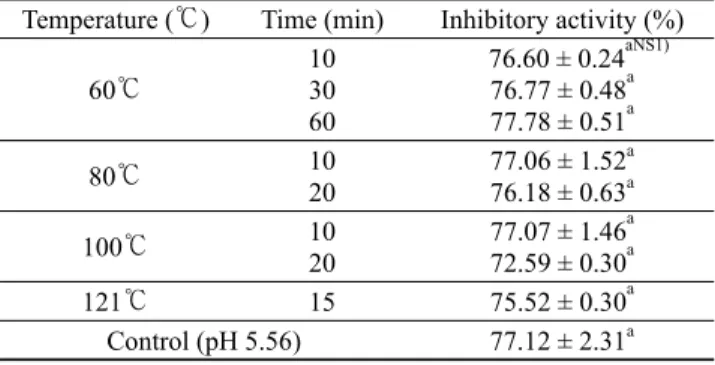
을 억제하기 위하여 살균처리 공정이 반드시 필요하나 그로 인해 식품에 첨가되는 생리활성 물질의 손실 등의 문제점이 대두되고 있어 기능성 성분은 열에 안정해야 한다. 모든 열처 리에서 무처리와 비교 시 유의적인 차이 없이 trypsin 저해 활성이 유지되었으며 이를 통해 감태 에탄올 추출물이 열처 리에 안정함을 확인할 수 있었다 (Table 3). 이는 Klomklao 등 [41]이 보고한 Thai mung bean 추출물의 trypsin 저해 활성에 대한 열 안정성을 측정한 결과, 60, 70, 80, 90 및 100℃에서 각 10분간 처리하였을 때 모든 처리구에서 무 처리보다 다소 증가한 결과를 보여 열처리에 안정함을 확인 하였으며 감태 에탄올 추출물의 lipase 저해활성을 측정한 결과 [42], 60, 80, 100 및 121℃의 열처리에 안정한 것으 로 나타나 본 연구와 유사한 결과를 나타내었다. 이에 반해 jack bean 추출물에 존재하는 trypsin 저해제는 80, 100℃
열처리 시 저해활성이 다소 감소하였으며, winged bean 추출물의 trypsin 저해제 역시 60℃에서는 안정하였으나 80℃에서 5분 처리에서는 25% 이상 활성이 감소하였고 30분 처리 시 45% 이상 활성이 급격하게 감소하는 경향을 보여 감태 에탄올 추출물이 가지는 trypsin 저해물질이 열 안정 성에 우수함을 확인하였다 [43,44]. 따라서 감태 에탄올 추 출물은 trypsin 저해활성이 뛰어날 뿐만 아니라 열에 대해서 도 안정하여 식품 가공 산업의 열처리 공정에 적용이 가능할 것으로 사료된다.
Table 3. Effect of heat treatment on trypsin inhibitory activity of Ecklonia cava ethanol extract
Temperature (℃) Time (min) Inhibitory activity (%) 60℃
10 30 60
76.60 ± 0.24aNS1) 76.77 ± 0.48a 77.78 ± 0.51a
80℃ 10
20
77.06 ± 1.52a 76.18 ± 0.63a
100℃ 10
20 77.07 ± 1.46a
72.59 ± 0.30a
121℃ 15 75.52 ± 0.30a
Control (pH 5.56) 77.12 ± 2.31a Concentration: 5 mg/mL.
1)Not significant.
3.5. pH 처리에 의한 trypsin 저해활성 변화
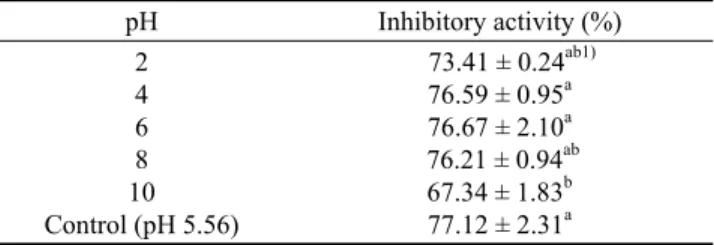
식품은 그 원재료 및 가공의 목적으로 인해 자체가 지니는 고유의 pH가 있으며, 이는 그 식품의 품질 및 고유의 특성 에 중요한 영향을 미친다 [45]. 또한 단백질에 있어서 pH는 단백질 용해도 및 추출율에 영향을 미치며, 효소에 있어서 효소의 활성에 관여한다 [46,47]. 가공식품의 대부분이 pH 처리 과정을 거치므로 식품에 첨가하는 첨가물 또한 가공 공정상에서 안정하게 활성이 유지되어야 한다. 이에 감태 에탄 올 추출물의 pH 안정성을 측정하여 식품산업에 적용 가능성 을 알아보았다. Trypsin에 대한 감태 에탄올 추출물의 저해 활성이 pH 2, 4, 6 및 8에서 각각 73.41, 76.59, 76.67 및 76.21%를 나타내어 무처리구와 비교 시 유의적인 차이를 보이지 않아 감태 에탄올 추출물의 trypsin 저해활성 유
효물질이 산과 약알칼리에서 안정한 것을 확인할 수 있었 다 (Table 4). 그러나, pH 10 조건하에서는 67.34%의 저해활 성으로 무처리구보다 약 10% 낮은 저해활성을 보여 무처리 구에 비해 약간 감소하는 경향을 보였다. 이와 같은 결과로 미루어 보아 감태 에탄올 추출물의 trypsin 저해활성 유효 물질이 강알칼리에서 다소 불안정한 것으로 사료된다. 이는 방선균이 생성하는 trypsin inhibitor가 산성, 중성, 약알칼리 영역에서는 안정하였으나 강알칼리에서는 다소 불안정한 저해활성을 보인 결과와 유사하나 [48], large black soybean 에 존재하는 trypsin inhibitor가 다양한 pH 영역에서 안정 하다는 결과를 보인 것과는 다른 결과를 나타내었다 [49].
이러한 결과로 미루어 보아 trypsin inhibitor는 그 유래에 따라 활성의 안정성을 나타내는 pH 영역이 다른 것으로 사료된다. 일반적인 식품의 pH가 약산성 및 중성임을 고려 해 볼 때 감태 에탄올 추출물은 식품 가공공정 중에도 안정 하게 활성이 유지되어 가공식품의 첨가물로 효과적으로 이용 가능할 것으로 사료된다.
Table 4. Trypsin inhibitory activity of ethanol extract from Ecklonia cava as affected by pH
pH Inhibitory activity (%)
2 4 6 8 10 Control (pH 5.56)
73.41 ± 0.24ab1) 76.59 ± 0.95a 76.67 ± 2.10a 76.21 ± 0.94ab
67.34 ± 1.83b 77.12 ± 2.31a Concentration: 5 mg/mL.
1)Means in the same column bearing different superscripts are significantly different by Duncan’s multiple range test (p < 0.05).
4. 결론
본 연구는 감태 에탄올 추출물의 trypsin 저해활성을 알아 보고 식품가공 공정의 적용 가능성 및 식품첨가물로의 이용 가능성을 확인하기 위해 열 및 pH 안정성을 검토하였다. 감 태 에탄올 추출물은 5, 2.5 및 1 mg/mL의 농도에서 각각 77.12, 53.88 및 31.56%의 trypsin 저해활성을 나타내었 다. 높은 trypsin 저해활성을 보인 감태 에탄올 추출물의 열 안정성을 검토한 결과, 모든 처리구에서 유의적인 차이 없이 안정한 것을 확인하였다. pH 안정성을 검토한 결과, 산성, 중성 및 약알칼리 영역 (pH 2-8)에서는 무처리와 유의적인 차이가 없었으나 강알칼리 영역 (pH 10)에서는 다소 감소 하는 경향을 보였다. 이상의 결과로 감태 에탄올 추출물은 열 및 pH 안정성을 지녀 식품첨가물로 이용 가능하여 식품 가공 공정에 적용 가능할 것으로 사료된다.
감사
본 연구는 지식경제부의 2009년도 지역산업기술개발사업의
지원에 의해 이루어진 것으로 이에 감사드립니다.
References
1. Kassel, B. (1970) Naturally occurring inhibitors of proteolytic enzymes. pp. 839-906. In: G. E. Perlman, and L. Lorand (eds.).
Methods in enzymology (proteolytic enzymes). Academic Press, NY, USA.
2. Park, J. O., K. S. Kim, and K. O. Sunwoo (1995) Purification and characterization of hemagglutinating protein from rhizome of Alisma orientale. J. Korean Soc. Food Nutr. 24: 587-593.
3. Power, J. C. and J. W. Harper (1986) Inhibitors of Serine Proteases in Proteinase Inhibitors. pp. 55-152. In: A. J. Barrett and G. Salvesen (eds.). Research Monographs in Cell and Tissue Physiology 12, Elsevier Science Ltd., Amsterdam, NL.
4. Laskowski, M. J. and I. Kato (1980) Protein inhibitors of proteinases. Annu. Rev. Biochem. 49: 583-626.
5. Kennedy, A. R. (1998) Chemopreventive agents: protease inhibitors. Pharmacol. Therapeut. 78: 167-209.
6. Oliva, M. L. V., J. C. Souza-Pinto, I. F. C. Batista, M. S. Araujo, V. F. Silveira, E. A. Auerswald, R. Mentele, C. Eckerskorn, M. U.
Sampaio, and C. A. M. Sampaio (2000) Leucaena leucocephala serine proteinase inhibitor: primary structure and action on blood coagulation, kinin release and rat paw edema. Biochim.
Biophys. Acta. 1477: 64-74.
7. Lundquist, I., I. Ihse, and B. Amesjo (1976) Carbohydrate metabolism in normal and diabetic rats following long term oral trypsin inhibitor administration. Scand. J. Gastroentero.
11: 369-375.
8. Mikola, J. and E. M. Suolinna (1969) Purification and properties of a trypsin inhibitor from barley. Eur. J. Biochem. 9: 655-560.
9. Birk, Y., A. Gertler, and S. Khalef (1962) A pure trypsin inhibitor from soya beans. Biochem. J. 87: 281-284.
10. Ye, X. Y., T. B. Ng, and P. F. Rao (2001) A bowman-birk-type trypsin-chymotrypsin inhibitor from broad beans. Biochem.
Bioph. Res. Co. 289: 91-96.
11. Kim, S. A., J. Kim, M. K. Woo, C. S. Kwak, and M. S. Lee (2005) Antimutagenic and cytotoxic effects of ethanol extracts from five kinds of seaweeds. J. Korean Soc. Food Sci. Nutr. 34:
451-459.
12. Kwon, M. J. and T. J. Nam (2006) Effects of Mesangi (Capsosiphon fulvecens) power on lipid metabolism in high cholesterol fed rats. J. Korean Soc. Food Sci. Nutr. 35: 530-535.
13. Fenical, W. (1983) Marine Plants: A Unique and Unexplored Resource. pp. 147-153. In Plants: The Potentials for Extracting Protein, Medicines, and Other Useful Chemicals (Workshop Proceedings). DIANE publishing, Washington, DC, USA.
14. Lee, S. J., E. J. Song, S. Y. Lee, K. B. W. R. Kim, S. J. Kim, S. Y. Yoon, C. J. Lee, and D. H. Ahn (2009) Antioxidant activity of leaf, stem and root extracts from Orostachys japonicus and their heat and pH stabilities. J. Korean Soc. Food Sci. Nutr.
38: 1571-1679.
15. Yoon, S. Y., S. Y. Lee, K. B. W. R. Kim, E. J. Song, S. J. Lee, C.
J. Lee, N. B. Park, J. Y. Jung, J. H. Kwak, K. W. Nam, and D. H.
Ahn (2010) Antimicrobial activity of the Sargassum fulvellum ethanol extract and the effect of temperature and pH on their activity. Korean J. Food Sci. Technol. 42: 155-159.
16. Ryu, B. H., D. S. Kim, K. Cho, and D. B. Sin (1989) Antitumor activity of seaweeds toward Sarcoma-180. Korean J. Food Sci.
Technol. 21: 595-600.
17. Kim, J. Y., K. H. Kim, H. S. Suh, and W. C. Choi (1997) Antiinflammatory effects of new chemical compounds, HS-1580 series (HS-1580, HS-1581, HS-1582). J. Life Sci. 16: 1181-1187.
18. Lee, S. H., Y. Li, F. Karadeniz, M. M. Kim, and S. K. Kim (2009) α-Glucosidase and α-amylase inhibitory activities of phloroglucinal derivatives from edible marine brown alga, Ecklonia cava. J. Sci. Food Agr. 89: 1552-1558.
19. Jimenez-Escring, A. and C. I. Goni (1999) Nutritional evaluation and physiological effects of edible seaweeds. Arch. Latinoam.
Nutr. 49: 114-120.
20. Fukuyama, Y., Y. Nakayama, and M. Takahashi (1989) Structure of an anti-plasmin inhibitor, eckol, isolated from the brown alga Ecklonia kurome Okamura and inhibitory activities of its derivatives on plasma plasmin inhibitors. Chem. Pharm. Bull.
37: 349-353.
21. Nakamura, T., K. Nagayama, K. Uchida, and R. Tanaka (1996) Antioxidant activity of phlorotannins isolated from the brown alga Eisenia bicylis. Fisheries Sci. 62: 923-926.
22. Kang, H. S., H. Y. Chung, J. Y. Kim, B. W. Son, H. A. Jung, and J. S. Choi (2004) Inhibitory phlorotannins from the edible brown alga Ecklonia stolonifera on total reactive oxygen species (ROS) generation. Arch. Pharm. Res. 27: 194-198.
23. Kang, K., Y. Park, H. J. Hwang, S. H. Kim, J. G. Lee, and H. C. Shin (2003) Antioxidative properties of brown algae polyphenolics and their perspecctives as chemopreventive agents against vascular risk factors. Arch. Pharm. Res. 26: 286-293.
24. Ahn, M. J., K. D. Yoon, S. Y. Min, J. S. Lee, J. H. Kim, T. G. Kim, S. H. Kim, N. K. Kim, H. Huh, and J. W. Kim (2004) Inhibition of HIV-1 reverse transcriptase and protease by phlorotannins from the brown alga Ecklonia cava. Biol. Pharm. Bull. 27: 544-547.
25. Lee, S. H., M. H. Park, S. J. Heo, S. M. Kang, S. C. Ko, J. S. Han, and Y. J. Jeon (2010) Dieckol isolated from Ecklonia cava inhibits α-glucosidase and α-amylase in vitro and alleviates postprandial hyperglycemia in streptozotocin-induced diabetic mice. Food Chem. Toxicol. 48: 2633-2637.
26. Yoon, N. Y., T. K. Eom, M. M. Kim, and S. K. Kim (2009) Inhibitory effect of phlorotannins isolated from Ecklonia cava on mushroom tyrosinase activity and melanin formation in mouse B16F10 melanoma cells. J. Agr. Food Chem. 57: 4124-4129.
27. Bu, H. J., Y. M. Ham, J. M. Kim, S. J. Lee, J. W. Hyun, and N. H. Lee (2006) Elastase and hyaluronidase inhibition activities of phlorotannins isolated from Ecklonia cava. Korean J. Pharmacogn. 37: 92-96.
28. Hummel, B. C. W. (1959) A modified spectrophotometric determination of chymotrypsin, trypsin, and thrombin. Can.
J. Biochem. Physiol. 37: 1394-1399.
29. Kim, S. J., D. H. Kweon, and J. H. Lee (2006) Investigation of anti-oxidative activity and stability of ethanol extracts of licorice rood (Glycyrrhiza glabra). Korean J. Food Sci. Technol. 38:
584-588.
30. Lim, E. J., Y. H. Lee, C. O. Huh, S. H. Kwon, J. Y. Kim, and Y.
B. Han (2007) Rheological properties of bread dough added with Enteromorpha intenstinalis. Korean J. Food Sci. Technol.
39: 652-657.
31. Jung, S. A., K. B. W. R. Kim, M. J. Kim, D. H. Kim, C. Sunwoo, H. J. Kim, D. H. Jeong, H. Y. Jeong, T. W. Kim, Y. J. Cho, and D. H. Ahn (2012) Trypsin inhibitory activity of water extracts from Ecklonia cava as affected by temperature and pH. J.
Korean Soc. Food Sci. Nutr. 41: 840-845.
32. Jin, S. K., I. S. Kim, K. H. Hah, K. H. Park, I. J. Kim, and J. R. Lee
(2006) Changes of pH, acidity, protease activity and microorganism on sauces using a korean traditional seasoning during cold storage. Korean J. Food Sci. Ani. Resour. 26: 159-165.
33. Kim, K. B. W. R., D. H. Kim, C. Sunwoo, Y. K. Hong, and D. H.
Ahn (2012) Effects of Curcuma aromatica extract and orange rind mixed liquor on the quality of Cypselurus agoo agoo roe treated with electrolyzed water. Korean J. Fish Aquat. Sci.
45: 122-131.
34. Bitou, N., M. Ninomiya, T. Tsujita, and H. Okuda (1999) Screening of lipase inhibitors from marine algae. Lipids 34: 441-445.
35. Ahn, I. S., K. Y. Park, and M. S. Do (2007) Weight control mechanisms and antiobesity functional agents. J. Korean Soc.
Food Sci. Nutr. 36: 503-513.
36. Quiros, A. R. B., S. Frecha-Ferreiro, A. M. Vidal-Perez, and J.
Lopez-Hernandez (2010) Antioxidant compounds in edible brown seaweeds. Eur. Food Res. Technol. 231: 495-498.
37. Deavile, E. R., R. J. Green, I. Muller-Harvey, I. Willoughby, and R. A. Frazier (2007) Hydrolyzable tannin structures influence relative globular and random coil protein binding strengths. J.
Agr. Food Chem. 55: 4554-4561.
38. Kawamoto, H., F. Nakatsubo, and K. Murakami (1996) Stoichiometric studies of tannin-protein co-precipitation.
Phytochemistry 41: 1427-1431.
39. Kim, K. H., S. G. Roh, C. R. Li, C. F. Jin, A. Kim, and W. C. Choi (2008) Anti-diabetic effects of banaba leaf extracts (Lagerstroemia speciosa Pers.) through solvents. J Life Sci. 18: 1305-1311.
40. Losso, J. N. (2008) The biochemical and functional food properties of the Bowman-Birk inhibitor. Crit. Rev. Food Sci. 48: 94-118.
41. Klomklao, S., S. Benjakul, H. Kishimura, and M. Chaijan (2011) Extraction, purification and properties of trypsin inhibitor from Thai mung bean (Vigna radiata (L.) R. Wilczek). Food Chem.
129: 1348-1354.
42. Jung, J. Y., K. B. W. R. Kim, C. J. Lee, J. H. Kwak, M. J. Kim, D.
H. Kim, C. Sunwoo, T. W. Kim, and D. H. Ahn (2011) Inhibitory effect of Ecklonia cava extracts against lipase activity and stability effect of temperature and pH on their activity. J. Korean Soc. Food Sci. Nutr. 40: 969-974.
43. Babar, V. S., J. K. Chavan, and S. S. Kadam (1988) Effect of heat treatments and germination on trypsin inhibitor activity and polyphenols in jack bean (Canavalia ensiformis L.DC). Plant Food Hum. Nutr. 38: 319-324.
44. Kadam, S. S. and R. R. Smithard (1987) Effects of heat treatments on trypsin inhibitor and hemagglutinating activities in winged bean. Plant Food Hum. Nutr. 37: 151-159.
45. Kim, D. H., K. B. W. R. Kim, M. J. Kim, C. Sunwoo, S. A. Jung, H. J. Kim, D. H. Jeong, T. W. Kim, Y. J. Cho, and D. H. Ahn (2012) Effects of heat, pH, and gamma irradiation treatments on lipase inhibitory activity of Sargassum thunbergii ethanol extract. J. Korean Soc. Food Sci. Nutr. 41: 566-570.
46. Kown, H. J., K. H. Lee, J. H. Kim, S. S. Chun, and W. S. Cho (2006) Effects of protease on the extraction and properties of the protein from silkworm pupa. J. Korean Soc. Appl. Biol. Chem.
49: 304-308.
47. Lim, S. I. (2000) Purification and characterization of protease produces by Aspergillus wentii isolated from korean traditional Meju. Korean J. Food Sci. Technol. 32: 161-167.
48. Kim, J. B. (1998) Purification and properties of protease inhibitor from Streptomyces sp. SK-862. Korean J. Food Nutr. 11: 678-682.
49. Ye, X. J. and T. BunNg (2009) Isolation and characterization of a trypsin inhibitor and a lectin from Glycine max cv. large black soybean. Food Sci. Biotechnol. 18: 1173-1179.