권영훈 외 2인 : 간섭이 존재하는 양방향 중계네트워크에서의 사용자 선택을 통한 불능확률 분석 109 (Younghoon Kwon et al.: Outage Probability Analysis for a Two-Way Relay Network with User Selection in the Presence of Interference)
간섭이 존재하는 양방향 중계네트워크에서의 사용자 선택을 통한 불능확률 분석
권 영 훈a), 임 경 래a)‡, 이 재 홍a)
Outage Probability Analysis for a Two-Way Relay Network with User Selection in the Presence of Interference
Younghoon Kwona), Gyeongrae Ima)‡, and Jae Hong Leea)
요 약
본 논문에서는 다수의 간섭자로부터의 간섭 신호가 존재할 때 양방향 중계 네트워크의 불능 확률을 분석하였다. 양방향 중계 네트 워크에서 한사용자는 다른 선택된 사용자와 세 단계로 통신한다. 제안된 네트워크에서 사용자 선택 기준을 제시하였으며 불능 확률을 수식적으로 유도하였다. 컴퓨터 모의 실험을 통해 제안된 분석과 모의실험이 잘 일치함을 확인하였으며 유저 수와 간섭자의 수의 불능 확률에의 영향을 보였다.
Abstract
This paper analyzes the outage performance of a two-way relay network in the presence of interference from multiple interferers.
We investigate a two-way relay network where a single user communicates with a selected other user via a relay during three phases.
We propose a user selection scheme and analyze an outage probability. Numerical results verify our analysis by comparison with computer simulation and show effects of the number of users and the number of interferers on its the outage probability.
Keyword : Two-way, relay, outage probability, interference
Ⅰ.Introduction
In a wireless network, relay communication improves re- liability and coverage [1]-[3]. Recently, there have been growing interests of two-way relay networks in order to im- prove spectral efficiency. In practical environment, the per- formances of relay networks are degraded by interference [4]-[5]. However, Furthermore, the performance analysis of a)서울대학교 전기 정보공학부, 뉴미디어통신공동연구소 (Department of
Electrical and Computer Engineering and INMC, Seoul National Univ.)
‡Corresponding Author : 임경래(Gyeongrae Im) E-mail: [email protected] Tel: +82-2-880-8430
ORCID: http://orcid.org/0000-0002-6497-9081
※이 논문은 2014, 2015년도 정부(미래창조과학부)의 재원으로 한국연구 재단의 지원을 받아 수행된 연구임(No. 2011-0017437, 2009-0083495, 2015R1D1A1A01057563).
・ Manuscript received November 12, 2015; Revised January 25, 2016;
Accepted January 25, 2016.
레터논문 (Letter Paper)
방송공학회논문지 제21권 제1호, 2016년 1월 (JBE Vol. 21, No. 1, January 2016) http://dx.doi.org/10.5909/JBE.2016.21.1.109
ISSN 2287-9137 (Online) ISSN 1226-7953 (Print)
110 방송공학회논문지 제21권 제1호, 2016년 1월 (JBE Vol. 21, No. 1, January 2016)
multiuser two-way relay network in the presence of inter- ference has not been investigated.
In this paper, we investigate a multiuser two-way relay network where both the users and the relay receive interfer- ing signals from multiple interferers and time-divi- sion-broadcast protocol is used. In our model, a multiuser diversity is exploited by user selection which the relay se- lects a user based on signal-to-interference-plus-noise-ratio (SINR). The analysis is verified by the simulation.
This paper is organized as follows. We describe the sys- tem model in section II, and analyze the outage probability in section III. Numerical results are shown in section IV and conclusion is given in section V.
Notation : fX( )× denotes the probability density function (PDF) of a random variable . The complex normal dis- tribution with mean and variance is denoted by
and the gamma distribution with a shape parame- ter and a scale parameter is denoted by .
Ⅱ. System Model
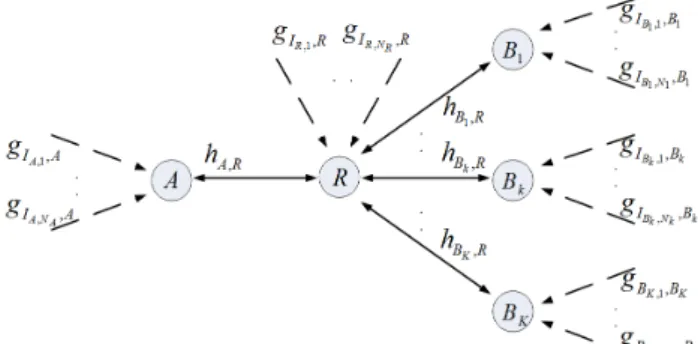
Consider a multiuser two-way decode-and-forward relay network which consists of multiple users ⋯ and a relay as shown in Fig. 1. The user communicates with one among ⋯ via the relay R during three
그림 1. 다중 간섭이 존재하는 다중 유저 양방향 복호 후 전송 릴레이 네트워크 시스템 모델
Fig. 1. System model of a multiuser two-way DF relay network having multiple interferers
phases. Suppose that each terminal has a single antenna and operates in a half-duplex mode. Assume that each terminal is impaired by multiple interferers and each in- terferer has transmit power . Assume that each termi- nal is also impaired by the additive white Gaussian noise (AWGN) with zero mean and unit variance. Assume that there is no direct link between the user and the user
.
Assume that each channel from a terminal to another ter- minal and other each channel from an interferer to a termi- nal are independent. Assume that each channel is reciprocal and has Rayleigh quasi-static fading such that the channel coefficients remain unchanged during three phases. Let
∼Ω denote the independent channel co- efficient from the user to the relay , ∈. Let
,, ~ (0, ,, )
A i A i
I A I A
g CN W ,gIR j,,R~CN(0,WIR j,,R), and gIB im,,Bk~CN(0,WIB mk,,Bk) denote the independent channel coefficient from i -th inter- ferer affecting the user to the user , from j -th inter- ferer affecting the relay to the relay , and from m -th interferer affecting the user to the user , respectively.
In the first phase, the user transmits its signal with transmit power to the relay . The received signal at the relay is given by
, ,
(1) (1) (1)
, ,
1 R
R m R m
N
R A A R A I I R I R
m
y P h x P g x n
=
= +
å
+where ,
(1) IR m
x is transmitted signal from the m -th interferer affecting the relay R in the first phase, nR(1) is the AWGN at the relay R in the first phase, and N is the number R of interferers affecting the relay R.
In the second phase, the user B transmits its signal k xBk with transmit power PBk
to the relay R. The received sig- nal at the relay R is given by
권영훈 외 2인 : 간섭이 존재하는 양방향 중계네트워크에서의 사용자 선택을 통한 불능확률 분석 111 (Younghoon Kwon et al.: Outage Probability Analysis for a Two-Way Relay Network with User Selection in the Presence of Interference)
,
(2) (2) (2)
, , ,
1 R
k k k R m
N
R B B R B I I R R m R
m
y P h x P g x n
=
= +
å
+where is transmitted signal from the -th interferer affecting the relay in the second phase, and is the AWGN at the relay in the second phase.
In the third phase, the relay R broadcasts its signal
R A Bk
x =x Åx
with power P where Å is the XOR R operation. The received signals at the user A and the user
B are given byk
, ,
, , ,
1 A
A i A i
N
A R A R R I I A I A A
i
y P h x P g x n
=
= +
å
+and
, ,
, , ,
1 k
k k Bkj k Bkj k k
N
B R B R R I I B I B B
j
y P h x P g x n
=
= +
å
+respectively, where ,, and , ,
A i j Nk k
I A I B
x x
are transmitted sig- nal from the i -th interferer affecting the user A and the
j -th interferer affecting the user B , respectively, k n and A
Bk
n are the AWGN at the user A and the user B , re-k spectively, and N and A N are the number of interferers k affecting the user A and the user B , respectively. k
The SINR at the relay R in the first phase and the sec- ond phase are given by
, 2 , ,
2 , 1
| |
1 | |
R
R m
A A R
A R N
I I R
m
P h P g g
=
= +
å
and
, 2 , ,
2 , 1
| |
,
1 | |
k k
k R
R m
B B R
B R N
I I R
m
P h
P g g
=
=
+
å
respectively.
The SINRs at the user A and the user B in the third k phase are given by
, 2 , ,
2 , 1
| |
1 | |
A
A i
R A R
R A N
I I A
i
P h P g g
=
= +
å
and
, 2 , ,
2 , 1
| |
,
1 | |
k
k k
Bkj k
R B R
R B N
I I B
j
P h P g g
=
= +
å
respectively.
Assume that perfect channel state information is avail- able at the relay aiming to find one user ∗ who has maximum SINR gR B, k. Let D denote the set of users whose signals are decoded successfully at the relay R in the second phase. The relay R selects the user which has the largest SINR among the users in the set D, that is,
* arg max , .
R Bk
k k D
B g
= Î
III. Outage Probability
For simplicity, assume that PBk =PB,
k B
N =N , and
, ,
B Rk B R
W = W "k,
,, ,
Bki k B
I B I B
W = W "i k,
, and
,, ,
A i A
I A I A
W = W , " , i
, , ,
R m R
I R I R
W = W "m.
The probability that the cardinality of the set D is l is given by
, ,
Pr{| | } Pr{ } (1- Pr{ }) .
k k
l K l
B R th B R th
D l k
l g g g g -
æ ö ç ÷è ø
= = ³ ´ ³
where
! ( )! !
k K
l = K l l - æ öç ÷
è ø .
Outage event occurs if , , , , , , or ,
k k
A R B R R A R B
g g g g is less
than a target SINR threshold gth. The outage probability is given by
1
1 Pr max | |
1 1 1
K
R k
R A
out l th k D k th th
P Y
P X P X
P D l
V g W g Z g
= Î
ì ü
= - í > Ç > Ç > Ç = ý
+ + +
î þ
å
112 방송공학회논문지 제21권 제1호, 2016년 1월 (JBE Vol. 21, No. 1, January 2016)
where
, ,
2 2 2 2
, , , ,
1 1
| | , | | , | | , | | ,
R A
k R m A i
N N
A R k B R I I R I I A
m i
X h Y h Z P g V P g
= =
= = =å =å
and ,
2 , 1
| |
B
Bkj k N
k I I B
j
W P g
=
=
å
and the random
variables ~ ( , , ), ~ ( , , ),
R A
R I I R A I I A
Z G N PW V G N PW
and
~ ( , , )
k B I IBB
W G N P W are Gamma random variables.
IV. Numerical Results
In this section, numerical results verify our analysis by comparison with computer simulation where we suppose that A, R, and B have same transmit power k P and the target SINR threshold gth is 7 dB.
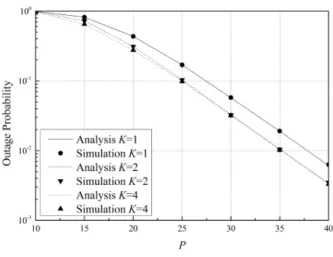
Fig. 2 shows the outage probability versus the transmit power for the number of interferers, N =2 and various the number of users, K. In this figure, the interference transmit power is fixed at 0 dBm. It is shown that the out- age probability decreases as the transmit power increases.
It is shown that outage probability when K =2 is lower than that when K =1. It is also shown that the outage probability when K =4 is slightly lower than that when
2
K = in the low transmit power, and is almost same with that when K =2 in the high transmit power which implies that the outage probability is less affected by the number of multiple users K as K is bigger than 2. This is be- cause the outage performance mainly depends on the link between the user A and the relay R as the transmit power increases.
V. Conclusion
In this paper, we consider the multiuser two-way DF re- lay network where a single user communicates with a se-
그림 2. K가 바뀔 때의 P에 대한 불능확률. N =2
Fig. 2. Outage probability versus P for various K. N =2.
lected other user via a relay. We propose a user se- lection criterion and derive expression of outage probability. Considering the user selection, SINR at the relay in the second phase is just used for the decoding set composition and SINR at the one user who is in- cluded in the decoding set in the third phase is used for final user selection. Analysis is verified by computer simulation.
참 고 문 헌 (References)
[1] J. N. Laneman, D.N. C. Tse, and G. W. Wornell, “Cooperative diver- sity in wireless networks: Efficient protocols and outage behavior,”
IEEE Trans. Inf. Theory, vol. 50, no. 12, pp. 3062-3080, Dec. 2004.
[2] A. Bletsas, H. Shin, and M. Z. Win, “Cooperative communications with outage-optimal opportunistic relaying,” IEEE Trans. Wireless Commun., vol. 6, no. 9, pp. 3450-3460, Sept. 2007.
[3] A. Bletsas, A. Khisti, D. P. Reed, and A. Lippman, “A simple coopera- tive diversity method based on network path selection,” IEEE J. Sel.
Areas Commun., vol. 24, no. 3, pp. 659-672, Mar 2006.
[4] D. Lee and J. H. Lee, “Outage probability of decode-and-forward op- portunistic relaying in a multicell environment,” IEEE Trans. Veh.
Technol, vol. 60, no. 4, pp. 1925-1930, May 2011.
[5] X. Liang, S. Jin, X. Gao, and K. K. Wong, “Outage performance for de- coded-and-forward two-way relay network with multiple interferers and noisy relays,” IEEE Trans. Commun., vol. 61, no. 2, pp. 521-531, Feb. 2013.