하며 국내에서도 농작물 생산의 큰 감수 요인 중 하나이다
(Lee et al. 2010).
난균류(Oomycetes)
에 속하는 역병균은 물 속에서 무성번식체인 유주자낭(sporangium)
을 형성하 고 그 안에 유주자(zoospores)
를 다량으로 형성한다.
유주https://doi.org/10.11626/KJEB.2020.38.4.724
서 론
역병
(Phytophthora blight)
은Phytophthora
속 미생물에 의한 식물 병해로 전 세계적으로 막대한 농업 손실을 초래Note
역병에 대한 Enterobacter asburiae ObRS-5 처리의 유도저항성 발현
김다연, 전용희 1 , 안재형, 안시현, 윤영건, 박인철, 박진우 1, *
국립농업과학원 환경개선미생물연구단,
1
국립농업과학원 농업생물부 농업미생물과Induction of systemic resistance against Phytophthora blight by Enterobacter asburiae ObRS-5 with enhancing defense-related genes expression
Dayeon Kim, Yong Hee Jeon 1 , Jea-Hyung Ahn, Si Hyeon Ahn, Young Gun Yoon, In Cheol Park and Jin Woo Park 1, *
Bioremediation Team, National Institute of Agricultural Sciences, Wanju 55365, Republic of Korea
1 Agricultural Microbiology Division, National Institute of Agricultural Sciences, Wanju 55365, Republic of Korea
Korean J. Environ. Biol.
38(4) : 724-732 (2020) ISSN 1226-9999 (print) ISSN 2287-7851 (online)
* Corresponding author Jin Woo Park
Tel. 063-238-0127
E-mail. [email protected]
Received: 5 December 2020 First Revised: 15 December 2020 Second Revised: 20 December 2020 Revision accepted: 24 December 2020
Abstract: Phytophthora capsici is the organism that causes Phytophthora blight which infects red pepper plants prolifically, ultimately leading to crop loss. A previous study revealed that Enterobacter asburiae ObRS-5 suppresses Phytophthora blight in both red pepper and Ligularia fischeri plants. In order to determine whether the induced systemic resistance (ISR) was triggered by pre-infection with the ObRS-5 strain, we conducted quantitative PCR using primers for PR1, PR4, and PR10, which correlate with systemic resistance in red-pepper plants. In our results, red pepper plants treated with the ObRS- 5 strain demonstrated increased expression of all three systemic resistance genes when compared to controls in the glasshouse seedling assay. In addition, treatment of red peppers with the ObRS-5 strain led to reduced Phytophthora blight symptoms caused by P. capsici, whereas all control seedlings were severely affected. Perhaps most importantly, E. asburiae ObRS-5 was shown to induce the ISR response in red peppers without inhibiting growth. These results support that the defense mechanisms are triggered by ObRS-5 strain prior to infection by P. capsici and ObRS-5 strain-mediated ISR action are linked events for protection to Phytophthora blight.
Keywords: biological control, Enterobacter asburiae ObRS-5, induced systemic
resistance, red pepper plants, Phytophthora capsici
자는 두 개의 편모를 이용하여 물 속에서 능동적으로 이동 하여 기주 식물에 침입하는
1
차 감염원이 된다(Hardham 2005).
역병은 한 번 발병할 경우 포장 전체로 빠르게 진전 되어 심각한 피해를 주며Phytophthora capsici, P. drechsleri, P. infestans, P. nicotianae
등의 역병균이 보고되어 있다(Jee 2000). P. capsici
는 고추에 발생하는 역병의 원인균으로,
정 식기인5
월부터 생육 후기인9
월까지 작기 전반에 걸쳐 발생한다(Park et al. 2012).
고추는 우리나라
5
대 채소 중 하나이며 고추 생산액은2018
년에10,179
억 원으로 전체 농림축산식품 생산액 중9
순위에 해당하였다(KREI 2020; https://krei.re.kr).
그러 나, 2017
년 고추 생산량은 생육 초기 고온과 잦은 강우로 인해 전년보다35%
감소하였고, 2018
년에도 평년보다5%
감소한 바 있다
(KOSTAT 2018; https://kostat.go.kr).
고추 역병의 발생은 작기 중 강우 일수와 밀접하게 관련되어 있 는데,
당해 년도의 기후에 따라 다르지만 연간 최소5%
이 상의 발병주율을 보인다고 보고되었다(Park et al. 2012).
역병 이병주율과 홍고추 수량과의 관계를 분석한 결과
,
이 병주율이1%
증가함에 따라 생체중 기준 약93 kg/10a
수 량 감소가 발생하는 것으로 나타났다(Kang et al. 2011).
고추 역병을 방제하기 위한 방법으로는 저항성 품종의 재배
,
화학살균제를 이용한 화학적 방제,
비기주 작물과의 윤작 재배,
미생물을 이용한 생물적 방제 등이 있다.
효과 적인 저항성 검정 체계 연구와 저항성의 유전에 대한 연구 등 안정된 저항성 품종 육성 방안에 대한 연구가 이루어 졌고, ‘CM334’
등의 역병 저항성 유전자원이 다수 보고된 바 있다(Soh et al. 2012; Kim 2014).
또한 역병 저항성 품종 개발은 주로 종자회사에서 활발하게 이루어졌고 농가에 서 사용되는 고추 품종들은 대부분 역병 저항성을 보유하 여 역병 방제에 크게 기여하고 있지만,
그럼에도 추가적인 역병 방제 수단은 여전히 필요하다(Kim et al. 2010; Kim 2014).
고추 역병 방제를 위한 화학 약제로는metalaxyl
와captafol
등이 사용되고 있으나,
방제 적기를 놓치거나 연 작지의 경우 방제효과가 낮을 수 있다(Soh et al. 2012).
한 편,
화학성분 기반한 농약은 작물,
토양 및 농업 생태계 전 반에 잔류할 것이라는 우려와 독성과 내성 문제가 급격히 증가하면서 유럽과 미국을 비롯한 선진국을 중심으로 관 련 규제가 강화되고 있다. P. capsici
균주를 포함한 다수의 난균류에서metalaxyl
내성이 보고된 바 있으며(Parra and Ristaino 2001). Bünemann et al. (2018)
은 화학농약,
화학비료를 처리한 관행 포장의 토양미생물 생체량
,
토양 유기물 및 총 질소 함량이 유기농 포장보다 낮은 경향을 나타내어 토양 건전도에 부정적인 영향을 끼친다고 하였다.
화학농약과 비료의 대안으로서 유용 미생물에 대한 연 구가 많이 이루어졌다
.
미생물을 이용한 식물병 생물학 적 방제의 장점은 잔류나 환경오염,
인축에 대한 독성 등 의 우려가 없다는 점이다.
미생물제는 식물병 또는 해충 방제에 효과를 나타내는 세균,
진균,
바이러스 등으로 만 든 제품을 일컫는다.
국내에서는 고추 역병에 대한 방제 효과가 있는Paenibacillus polymyxa AC-1
균주가 실용화 된 바 있으며(Hong et al. 2016),
유럽과 미국 등 국외에서 는Bacillus subtilis QST 713, Streptomyces lydicus WYEC 108, Trichoderma atroviride CHS 861, Gliocladium virens GL-21
등 이 역병 방제제로 사용되었다(Elliott et al. 2009).
미생물이 식물 병해를 방제하는 방법으로는 용균작용
,
기생작용,
공간이나 양분 경쟁을 통한 길항작용,
항생물질 생산,
병 저항성 유도 등을 통한‘
생물적 방제 기작’
과 인 산가용화,
질소고정,
식물생장촉진 호르몬 생산 등의‘
생 물비료 기작’
을 통해 식물 생장을 돕는 방법이 알려져 있 다(Mahaffee and Backman 1993; Szczech and Shoda 2006;
Haggag and Timmusk 2008; Park et al. 2010).
역병에 대 한 생물적 방제제로 이용되고 있는 미생물로Trichoderma spp., Streptomyces spp.
및Pseudomonas spp.
는 다양한 이차 대사산물을 생성하여 역병균을 억제하고 식물의 방어 관 련 유전자 발현을 증가시킨다고 알려져 있다(Bae et al.
2016). Pseudomonas spp.
가 생산하는rhamnolipids
와cyclic
lipopeptides
는 역병균의 유주자낭막 생성을 효과적으로억제하는 것으로 보고되었다
(Maleki et al. 2011).
작물 뿌 리에 정착한T. atroviride
는 뿌리로부터 분비되는 삼출물의 탄수화물 조성을 변화시켜 근권 내 공간과 양분 경쟁에서P. cinnamomi
보다 우세해지는 전략으로 역병을 방제한다고 알려져 있다
(Macas-Rodriguez et al. 2018).
한편
,
이전에 수행한 연구에서 선발한Enterobacter
asburiae ObRS-5
균주는P. drechsleri
의 유주자낭과 유주자 형성을 억제하고,
온실 및 포장에서P. drechsleri
에 의한 곰 취(Ligularia fischeri)
역병을 효과적으로 억제하였다(Kim
et al. 2020).
또한E. asburiae ObRS-5
균주를 고추에 처리했 을 때P. capsici
의 발병이 억제되는 것으로 나타났다.
이에,
본 연구에서는 반복적 검정을 통해E. asburiae ObRS-5
의 고추 역병 방제 효과를 확인하고, ObRS-5
균주를 처리한고추 유묘에서 역병균 접종 전
·
후의 식물의 방어 관련 유 전자 발현을qPCR (quantitative polymerase chain reaction)
을 이용한 상대정량 분석하여, ObRS-5
균주의 역병 방제 기작을 구명하고자 하였다.
재료 및 방법
1. 고추 역병의 접종원 준비
역병의 접종원으로서
,
미생물자원센터(KACC; Korean Agricultural Culture Collection)
에서 분양 받은P. capsici KACC 40470
균주의 유주자 현탁액을 제조하였다.
유주 자낭 유도에 필요한 토양추출물은2 mm
체에 거른 토양 과 증류수를1 : 3 (v/v)
비율로 혼합하고CaCO 3 3 g
을 첨가 하여 실온에서20
시간 동안 정치하고,
거즈로 토양을 걸러 낸 여액을 취하여 필터페이퍼로 여과한 후 멸균하여 사용 하였다(Mansoori and Banihashemi 1982). P. capsici
균주를PDA (potato dextrose agar; Difco)
배지에 접종하여25°C
에서5
일간 배양한 후,
직경5 mm
의 균총을V8 juice
배 지(V8 juice (Campbell’s Soup Co., Camden, USA) 330 mL, CaCO 3 1.5 g,
증류수670 mL)
에 접종하여25°C
에서3
일간 배양한 후 멸균수로 배지를 씻어내고 토양추출물을 첨가 하여20°C
에서 광을24
시간/
일으로 조사하면서6
일간 정 치배양하였다.
유주자낭 생성 여부를 실체현미경(M205A, LEICA, Germany)
으로 확인한 후 유주자를 나출시키기 위 해25
분간- 20°C
에서 처리한 후3
시간 동안 실온에 정치 하였다.
균사는 멸균한 거즈로 걸러낸 후 유주자현탁액 농 도를 조절하여 주 당10 mL
씩 토양g
당5.0
×10 5 zoospores
가 되도록 토양 관주 처리하였다.
2. ObRS-5균주의 관주 처리에 의한 고추 역병 방제 효과 검정
이전 연구에서 곰취 역병 방제미생물로 선발된
E. asb
uriae ObRS-5
균주의 고추 역병 방제 효과를 검정하였다
. E. asburiae ObRS-5
균주는TSA
배지에 획선 도말하 여28°C
에서24
시간 동안 배양한 뒤0.1% peptone water
에 현탁하여 농도를1.0
×10 8 cfu mL -1 (OD 600
=0.25)
로 조절하였다.
역병 내병성이 없는 고추 종자(
슈퍼마니따, Nongwoo Bio, Korea)
는 직경10 cm
의 컵포트에 상토(
그린상토
, Seoul Bio, Korea)
를 담아 파종하였다.
고추 파종5
주 후,
준비한ObRS-5
균주 현탁액을 주당50 mL
관주 처리 하고7
일 후 역병균의 유주자현탁액을 주당10 mL
접종하 였다(n
=12). ObRS-5
균주를 처리하지 않은 대조구에는 물을 같은 양으로 처리하였으며,
지상부 시들음 병징이 나 타났을 때 발병률(%)
을 조사하였으며,
실험은3
회 반복하 여 실시하였다.
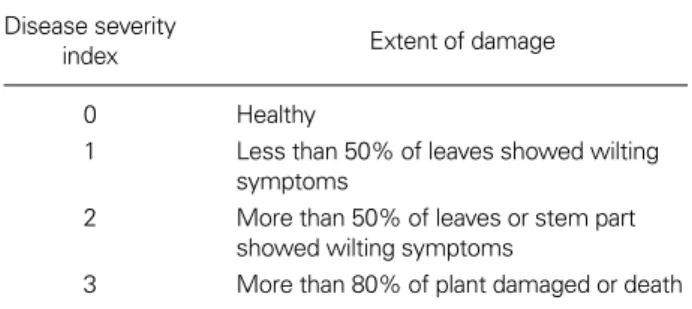
고추 역병의 발병 정도는Table 1
을 기준으 로 병징을0
~3
단계로 나누어 조사하였다.
조사 결과는 아 래Eq. 1
에 의해 결과 값을 발병률(%)
로 환산하였으며 건 강한 식물은0%,
고사한 식물은100%
로 나타내었다.
발병률
(%)
=[
발병지수의 총합/ (
작물 주수×발병지수최대값
)]
×100 (Eq. 1)
3. ObRS-5균주 처리에 의한 식물 면역 증진 효과 검정
ObRS-5
균주를 처리한 고추에서 식물 방어 유전자의발현 패턴이 변화하는지 분석하기 위해
,
상기와 같은 방 법으로 고추에ObRS-5
균주현탁액을 주당50 mL
관주 처 리한 후 역병균 접종1
일 전,
접종 직후와 처리 후1
일 간 격으로5
일째까지 고추 잎을 채취하여 총7
개의 시료를 취하였다.
채취한 시료는 액체 질소를 소량 첨가한 후 분 쇄하여- 70°C
에 보관하였고 시료 채취가 모두 끝난 후Power soil RNA extraction kit (MOBIO, USA)
를 이용하 여 매뉴얼에 따라total RNA
를 추출하였다.
추출한RNA
는nanodrop
으로 농도를 측정한 후, GoScript TM Reverse Transcription System (Promega, USA)
를 이용하여cDNA
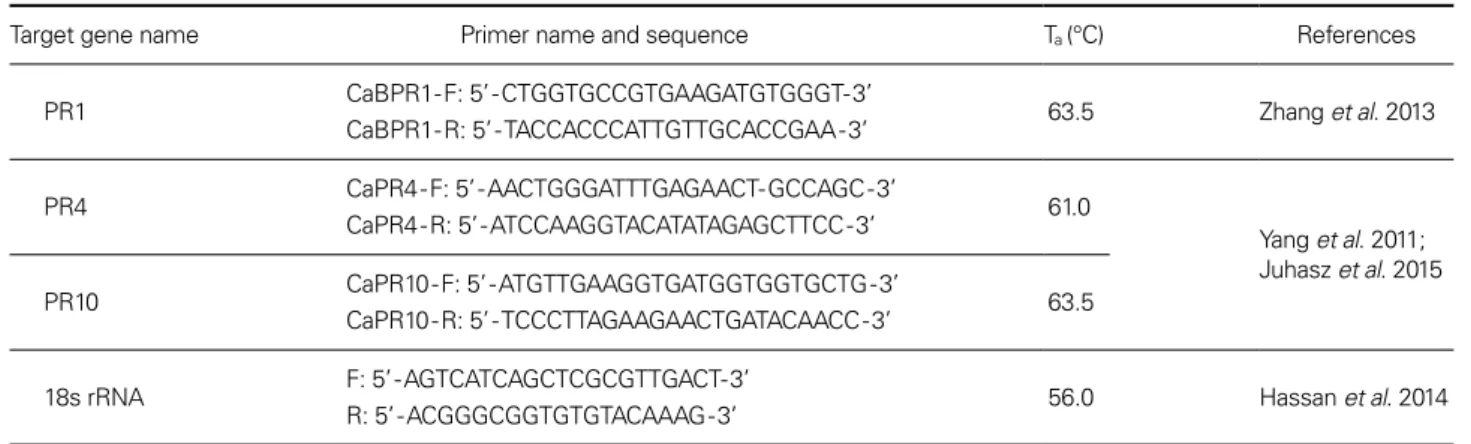
를 합성하였다. Table 2
와 같이 각 유전자에 특이전인 염 기서열을 증폭하기 위한 프라이머를 이용하여qPCR (CFX96 Real-Time PCR Detection System, Biorad, USA)
을 수행하였다. qPCR
반응액은GoTaq qPCR Master Mix 2X
Table 1. Disease severity scale for Phytophthora blight and extent of damage
Disease severity
index Extent of damage
0 Healthy
1 Less than 50% of leaves showed wilting symptoms
2 More than 50% of leaves or stem part showed wilting symptoms
3 More than 80% of plant damaged or death
(Promega, USA) 10 μL, BSA (10 mg mL - 1 ) 2 μL, Dimethyl sulfoxide (Sigma, USA) 1 μL,
프라이머 각각0.5 μL
를 포 함하여 총량20 μL
가 되도록 멸균 증류수를 첨가하였다. qPCR
반응은95°C
에서3
분 동안 열을 가한 후, 95°C 15
초, annealing
온도에서20
초, 72°C 30
초 동안40
회 반복하여 반응시키고,
마지막 단계에서95°C
에서10
초 동안 열을 가하고Ct
값을 측정하였다(Lopez-Gutierrez et al. 2004).
qPCR
결과,
각 유전자의Ct
값은18S rRNA gene
의Ct
값을 이용하여 표준화하였다.
각 유전자 발현의 변화는2-Δ-Δ- Ct
방법에 의해 상대정량화하여 나타내었다(Livak and Schmittgen 2001).
4. ObRS-5균주 처리의 고추 생육 영향 검정
ObRS-5
균주의 처리가 고추 유묘의 생육에 미치는 영향을 검정하기 위해
,
상기와 같은 방법으로 고추 유묘에E.
asburiae ObRS-5
균주의 현탁액을 주당50 mL
관주 처리한 후,
본엽이9
~10
매 전개되었을 때,
초장,
근장 및 생체중을 조사하였다.
5. 통계분석
통계분석은
R
통계 프로그램(ver. 4.0.3)
을 이용하였으 며,
처리구 간 평균의 유의차 검증은α
=0.05
수준에서T-
검정(Student’s t-test)
하고 결과가 유의한 경우, α
=0.05
수 준에서 던칸의 다중 범위 검정법(Duncan’s multiple-range test)
을 실시하였다.
결과 및 고찰
1. E. asburiae ObRS-5 균주의 고추 역병 방제 효과 E. asburiae ObRS-5
균주를 고추에 관주 처리했을 때 평 균 역병 방제가는74.6%
로 역병 방제 효과가 있었다(Fig.
1).
역병 발병률은ObRS-5
균주 처리구에서11.1%,
대조구에서
57.8%
로 나타났으며 통계학적으로 유의한 차이를 나타내었다
. Enterobacter
속 미생물 중 식물병 방제 미생 물로 많이 연구된 균주 중 하나인E. cloacae
는 병원균과의 양분 경쟁과chitinolytic
활성을 통해Pythium
모잘록병과Fusarium
마름병을 효과적으로 방제한다고 알려져 있으나(Chernin et al. 1995), P. capsici
에 대한 방제 효과는 보고된 바 없다. E. asburiae
균주를 이용한 식물병 방제 연구는 거 의 수행된 바 없으나, E. asburiae
균주와 근연관계가 가까 운E. aerogenes
균주는 식물 근권에 정착하여hydroxamate, siderophore,
휘발성 및 비휘발성 길항 물질을 분비하여Phytophthora
역병에 대한 방제 효과가 있다고 보고된 바 있다(Utkhede 1986; Berner et al. 1988).
역병 이외의 병원 균에 대한E. asburiae
미생물 이용 연구로는, E. asburiae
균 주가 애기장대 종자의 종피에 정착함으로써Salmonella enterica
의 정착과 생장을 억제하였으며, E. asburiae
균주 의Lipopolysaccharide
는 상추의 세균성 무름병에 대해 초 기 식물 방어 효소를 유도한다고 보고되었다(Cooley et al.
2003; Jetiyanon and Plianbangchang 2013).
그 외 미생물을 이용한 역병의 생물적 방제 연구는 다 수 보고된 바 있다
.
방제 미생물로 많이 이용되고 있는Bacillus subtilis (Woo et al. 2006)
와Paenibacillus polymyxa
Table 2. Primer information for quantitative qRT-PCR used in this study
Target gene name Primer name and sequence T
a(°C) References
PR1 CaBPR1-F: 5’-CTGGTGCCGTGAAGATGTGGGT-3’
63.5 Zhang et al. 2013
CaBPR1-R: 5’-TACCACCCATTGTTGCACCGAA-3’
PR4 CaPR4-F: 5’-AACTGGGATTTGAGAACT-GCCAGC-3’
61.0
Yang et al. 2011;
Juhasz et al. 2015 CaPR4-R: 5’-ATCCAAGGTACATATAGAGCTTCC-3’
PR10 CaPR10-F: 5’-ATGTTGAAGGTGATGGTGGTGCTG-3’
CaPR10-R: 5’-TCCCTTAGAAGAACTGATACAACC-3’ 63.5
18s rRNA F: 5’-AGTCATCAGCTCGCGTTGACT-3’
56.0 Hassan et al. 2014 R: 5’-ACGGGCGGTGTGTACAAAG-3’
*T
a: annealing temperature
(Lee et al. 2013),
방선균Streptomyces halstedii (Joo 2005),
점액 세균Myxococcus sp. (Kim and Yun 2011),
수지상 근균 근Glomus manihot (Kim and Min 2003)
등 다양한 미생물 을 이용한 고추 역병의 생물적 방제 연구가 수행되었다. Lim et al. (2009)
은 서로 다른 방제 기작을 가진 개별 균주 들의 컨소시엄을 구성했을 때 우수한 역병 방제능뿐만 아 니라 고추 생장촉진능도 동시에 보이는 것을 확인하였다.
이는 미생물 컨소시엄에서 균주들이 상호보완적으로 작 용하여 시너지 효과를 나타냈음을 시사한다.
따라서,
방제 효과를 높이기 위한 방법으로서 개별 균주의 기작별 상호 보완형 컨소시엄의 구성 연구가 추가적으로 필요할 것으 로 사료된다.
예를 들어, Kim and Min (2003)
은 수지상 근 균근으로 잘 알려진Glomus manihot
을 이용하여 고추 역병 피해를 경감시키는 것을 확인하였는데,
균근균은 식물 스 트레스를 감소시키며(Porter et al. 2019)
고추는 균근균 의 존도가 높은 것으로 알려져 있으므로(Baum et al. 2015)
균 근균은 고추에 적용할 수 있는 균주 컨소시엄의 유용한 후 보 미생물로서 이용될 수 있다.
2. ObRS-5균주 처리에 의한 식물 면역 증진 효과
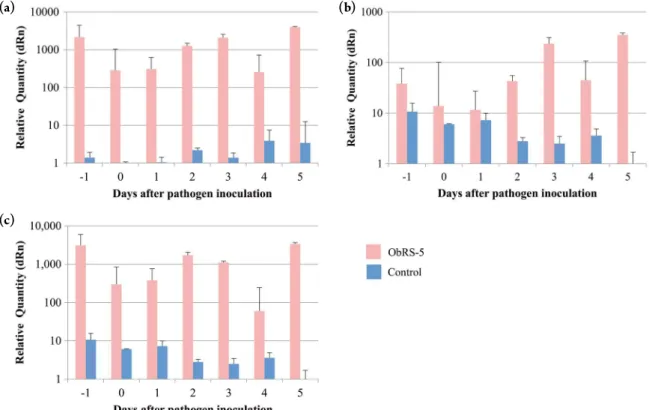
고추에서 식물방어 관련 유전자
PR1, PR4
및PR10
의 발 현을 분석한 결과, E. asburiae ObRS-5
균주를 처리한 고추 잎
(Day-1)
에서 세 유전자의 발현이 대조구에 비해 모두 증가한 것으로 나타났다
(Fig. 2a-c).
식물에 유도되는 전 신 저항성(ISR; induced systemic resistance)
반응에서PR (pathogen-related)
단백질은 식물에 대한 병원균의 침입 에 의해 국소적 및 전신적으로 발현이 증가되어 다량 축적된다고 알려져 있다
(van Loon and van Kammen 1970).
그렇기 때문에
PR
단백질 관련 유전자의 발현은ISR
마커 로 널리 사용되고 있다(Heil and Bostock 2002). Kang et al.
(2017)
의 연구에서Lentinula edodes
의 폐배지 추출물을 고 추에 처리했을 때PR4
와PR10
유전자의 발현이2
일째부 터5
일째까지 증가하였고, 4
일 째에 발현 수준이 가장 높 았다. Kim et al. (2011)
은Peanibacillus polymyxa
균주가 생 산하는fusaridicin
을 고추에 처리했을 때PR1
유전자 발현 은 처리 후24
시간 및48
시간에 증가하였다.
본 연구에서ObRS-5
균주 처리 후6
일째(Day-1)
에PR1, PR4
및PR10
유전자의 발현이 대조구 대비 높은 수준으로 나타난 것은 앞의 연구들과 유사한 결과이며,
처리된 미생물(
또는 물 질)
에 따라 식물에 저항성을 유도하는 기간이 달라지는 것으로 사료된다.
역병균 접종
(Day0)
후ObRS-5
처리구에서PR1, PR4
및PR10
유전자의 발현은 역병균 접종 전과 유사한 수준으로유지되었다
(Day0
~Day5).
반면에 대조구에서는 상기 세 유전자의 발현량이 병원균 접종 전과 후에 큰 차이를 보이 지 않았고, ObRS-5
처리구와 비교했을 때 현저하게 낮았 다.
즉,
대조구에서는 역병균의 침입에 대해 식물의 저항성 반응이 효과적으로 유도되지 못한 것으로 사료된다.
이에반해
ObRS-5
균주 처리구에서 역병균 접종 이후 식물 방어 관련 유전자의 발현이 유지된 것은
,
역병균에 대한 저 항성 반응이 유도된 것으로 해석될 수 있다.
특히,
역병균 접종 후48
시간 및72
시간(Day2, Day3)
에는 고추 잎에서ObRS-5
처리구와 대조구 간 식물 방어 유전자의 상대적발현량 차이가 가장 큰 것으로 나타났다
.
또한ObRS-5
균 주 처리구에서Day5
까지 고추 잎의 시들음 증상을 보이지Fig. 1. Effects of Enterobacter asburiae ObRS-5 pre-infection on Phytophthora blight in red pepper plants. Results of three repetitions
show disease incidence was significantly decreased (p < 0.05, *) in E. asburiae ObRS-5 treated red pepper plants compared to controls.
않으면서 식물 방어 관련 유전자의 발현을 계속 유지한 것 은
E. asburiae ObRS-5
균주 처리에 의해 고추에 저항성이 유도된 것으로 해석할 수 있다. Yang et al. (2015)
의 연구에서는
Bacillus amyloliquefaciens
균주를 처리한 고추에서,
역 병균 접종24
시간 후PR
단백질 관련 유전자 발현이 큰 폭 으로 증가하여ISR
메커니즘으로 고추역병이 제어되었음(a) (b)
(c)
Fig. 2. Expression patterns of defense-related genes in E. asburiae ObRS-5 strain treated plants and controls. qRT-PCR analysis of (a) PR1, (b) PR4, and (c) PR10 in leaves obtained before and 0, 1, 2, 3, 4, and 5 days after pathogen inoculation. All Ct values were normalized with the 18S rRNA gene by performing the delta delta Ct method.
Fig. 3. Effects of Enterobacter asburiae ObRS-5 treatment on the growth of red pepper plants. It present lengths and fresh weights of
shoots and roots treated with the E. asburiae ObRS-5 strain and controls.
을 보고한 바 있다
.
한편, Park et al. (2016)
의 연구에서 배 추 생육을 촉진하는 근권세균Bacillus vallismortis
가 생산하 는 다이펩타이드를 작물에 처리한 직후 식물의PR1
유전 자 발현이 증가하고 병원균 접종 직후 발현이 다소 증가하 는 경향을 보인 것은,
본 연구에서 나타난 식물방어 유전 자 발현과 유사한 패턴을 나타낸 것으로 사료된다.
3. ObRS-5균주 처리의 고추 생육 영향
식물에 저항성을 유도하는 방법은 식물병 방제 전략 중 하나로서 한 번 처리로 장기간 지속되는 방제 효과를 얻 을 수 있다는 장점이 있다
(Kloepper et al. 2004).
그러나,
장기간 유도저항성이 지속될 경우 불필요한 에너지 소모 가 발생함으로써 식물 생육이 감소하고 수확량 감소로 이 어질 수 있다(Heil and Bostock 2002).
따라서, E. asburiae
ObRS-5
균주 처리가 고추 생육에 대한 약해 없이 저항성을 유도하는지 알아보기 위해
, ObRS-5
균주 처리의 고추 생육에 대한 영향을 검정하였다.
그 결과E. asburiae ObRS- 5
균주 처리구는 대조구와 비교할 때 고추 유묘 지상부 생 육에 유의한 차이가 없었으며,
지상부 생체중은ObRS-5
균주 처리구에서 대조구 대비17.8%
의 증가하였으나 통 계적으로 유의하지 않았다.
뿌리 생육의 경우 처리구 간 유의한 차이가 없었으나ObRS-5
균주 처리구에서 대조 구 대비 근장은21.6%
증가하였고 생체중은35%
증가하여ObRS-5
균주 처리에 의한 고추 생육이 다소 증가하는 경향이 나타났다
.
따라서, ObRS-5
의 처리는 고추 생육을 억 제하지 않으면서 식물의ISR
반응을 유도하는 것으로 사 료된다.
적 요
본 연구에서는 기 선발한
Enterobacter asburiae ObRS-5
균주를1
×10 8 cfu mL -1
농도로 고추에 관주 처리했을 때Phytophthora capsici
에 의한 고추역병을74.6%
방제하는 효 과가 있었다. E. asburiae ObRS-5
균주에 의한 고추역병 방 제 메커니즘을 확인하기 위해 고추의PR1, PR4
및PR10
유전자를 특이적으로 증폭하는 프라이머를 이용하여quantitative PCR
을 수행하였다.
그 결과E. asburiae ObRS- 5
균주를 처리한 고추에서 대조구와 비교하여 상기 세 가 지 유전자의 발현이 모두 높은 수준을 유지하였다.
또한E.
asburiae ObRS-5
균주는 고추의 생육을 억제하지 않으면서ISR
반응을 유도하는 것으로 나타났다.
이러한 결과를 통 하여P. capsici
이 침입할 때E. asburiae ObRS-5
균주가 매개 하는ISR
메커니즘을 통해Phytophthora
역병의 제어가 가 능한 것으로 사료된다.
사 사
본 연구는 농촌진흥청 연구사업