• 검색 결과가 없습니다.

Research on the Influence of Transformational Leadership on the Employee's Job Satisfaction and Job Performance

N/A
N/A
Protected

Academic year: 2021

Share "Research on the Influence of Transformational Leadership on the Employee's Job Satisfaction and Job Performance"

Copied!
11
0
0

로드 중.... (전체 텍스트 보기)

전체 글

(1)

Research on the Influence of Transformational Leadership on the Employee’s Job Satisfaction and Job Performance

Nan Li

1

, Gi-Young Chung

2

, Hyung-Ho Kim

3*

1

Professor, Faculty of Management, Jilin Engineering Normal University

2

Professor, Dept. of Business Management, Sehan University

3

Professor, Dept. of Air Transport and Logistics, Sehan University

변혁적 리더십과 직원들의 직무만족도 및 직무성과와의 관계에 관한 연구

이남

1

, 정기영

2

, 김형호

3*

1

길림공정기술사범학원 경영학부 교수,

2

세한대학교 경영학과 교수,

3

세한대학교 항공교통물류학과 교수

Abstract The leader has an indispensable role in the enterprise. This article takes transformational leadership as the research object and introduces job satisfaction and job performance as variables. It is aimed to explore the impact of various dimensions of transformational leadership on employee performance and satisfaction, and to try to find the acting mechanism of the effect of transformational leadership on employee performance. The study used a questionnaire survey method and SPSS23.0 for statistical analysis. Through the analysis of 378 questionnaire surveys, it was found that the four constituent variables of transformational leadership would have different degrees of influence on job performance and satisfaction. Enterprise leaders should put emphasis on the choice of leadership style and pay special attention to the work attitude of employees. This study provides useful enlightenment for companies to carry out human resource management work. However, this study did not verify whether job satisfaction has an intermediary role in between transformational leadership and job performance, which is also an area that needs to be further studied in the future.

Key Words : Leadership style, Transformational leadership, Job satisfaction, Job performance, Influences 요 약 리더는 기업에서 없어서는 안 될 역할을 가지고 있다. 본 논문에서는 변혁적 리더를 검토 대상으로 하여 직원의 직무 만족도와 직무 성과 변수를 도입하였다. 변혁적 리더십이 직원의 직무성과와 직무만족도에 미치는 영향을 탐색하 고, 또한 변혁적 리더십이 종업원의 직무성과에 영향을 미치는 요인을 찾고자 하였다. 본 연구에서는 설문 조사 방법 을 채택하여 378개의 설문결과를 이용, SPSS23.0으로 조사 결과를 분석하였다. 연구결과에 의하면 변혁적 리더의 네 가지 구성변수는 직무성과와 직무만족도에 각각 서로 다른 영향을 미치는 것으로 나타났다. 기업의 리더는 리더십 스타일의 선택에 주의를 기울여야하며 직원의 업무 태도에 각별한 관심을 기울여야 한다. 본 연구는 기업의 인적 자원 관리 업무를 수행하는데 유익한 시사점을 제공한다. 본 연구에서는 직무만족도가 변혁적 리더십과 직무성과 사이의 중개 역할을 하는지는 검증되지 않았으며, 향후 연구에서 보완해야 할 필요가 있다.

주제어 : 리더 스타일, 변혁적 리더십, 직무만족도, 직무성과, 영향

*Corresponding Author : Hyung-Ho Kim([email protected]) Received March 25, 2020

Accepted June 20, 2020 Revised May 29, 2020

Published June 28, 2020

(2)

1. Introduction

Under the background of "new normal", how to motivate employees and push enterprises forward is an important topic for enterprise managers. In the face of severe competition, more and more enterprises begin to realize that excellent managers, as a necessary factor to support the development of enterprises, it can greatly improve the competitiveness of enterprises. As one of the five elements of management activities, almost all managers recognize the importance of leadership to the enterprise[1].

Leadership to build an organization's sustainable and competitive advantage is more important than ever[2].

Leadership style refers to the personalized behavior and management style that leaders form in their daily work[3]. In other words, it is the behavior and handling characteristics that leaders cultivate in their long-term working environment and leadership practice, which are carried out in the operation mechanism of the whole enterprise and have an impact on the distribution, implementation and completion of various jobs in the enterprise. The most widely recognized classification of leadership style is transactional leadership style and transformational leadership style proposed by Burns in leadership.

Leadership is a necessary factor for leaders to drive the development of organizations[4]. As a new type of leadership, transformational leadership has cross-border behaviors, such as analyzing the environment, interacting with external entities, collecting information, insight into opportunities, and choosing the right strategy. The concept of leadership proposed by transformational leadership behavior has a high universality in the world. Although both transformational leadership and transactional leadership are needed, transformational leadership can provide resources to meet the high-level psychological needs of employees,

thus becoming a hot topic and focus in the practical and theoretical circles.

2. Literature review 2.1 Transformational leadership

In the 1970s, Downton first proposed the concept of transformational leadership, and later formed an important leadership theory through the development of Bums and Bass.

Transformational leadership theory focuses on the process by which leaders motivate their followers to accomplish their vision. By making subordinates aware of the importance of the tasks they undertake, leaders can stimulate the high-level needs of subordinates, produce work results beyond expectations. Different researchers have different definitions of transformational leadership. In his classic book leadership published in 1973, Burns as a pioneer of American leadership studies, conceptualized transformational leadership. Bass, the master of transformational leadership, has refined Burns's concept. In his opinion, transformational leadership can achieve the expected goals of the organization. It is a process of changing or transforming people, focusing on people's emotions, values, meeting needs and respecting rights.

In order to make transformational leadership

more applicable to China's social environment,

Chinese experts and scholars have conducted a

lot of research on the dimension of

transformational leadership. In 2005, according

to the unique social and cultural background of

China, C. P. Li & K. Shi included moral norms in

the dimension of transformational leadership and

extended personalized care, not only focusing on

employees' personal work, but also their families

and lives[5]. These four dimensions are

personalized care, moral demonstration, vision

incentive and leader charisma. The questionnaire

(TLQ) prepared for these four dimensions has

(3)

good reliability and validity, which is in line with China's national conditions. Leadership can change the values and attitudes of subordinates and help the organization achieve higher goals[6], R. Li & W. Q. Ling verified the four dimensions of vision incentive, moral demonstration, leader charisma and personalized care of transformational leadership proposed by C. P. Li in the Chinese context[7].

Based on the research of many scholars on transformational leadership, this study defines transformational leadership describes the vision of the organization to his subordinates, inspires and gives personalized care to his subordinates through his own leadership charm, so that the subordinates can give full play to their potential and achieve the organizational goals.

2.2 Job satisfaction

An important variable that can reflect employees' work attitude is job satisfaction.

Employee's job satisfaction refers to the general satisfaction attitude of employees towards their own work, which is relative to the individual's life satisfaction and overall satisfaction, especially the satisfaction of individuals as professionals[8] In 1935, Hoppock first put forward the concept of job satisfaction. Job satisfaction is the satisfaction of employees to work environment factors. Since then, many scholars have put forward their different views based on this idea. D. S. Wang thinks that the analogy between job satisfaction and life satisfaction should be taken into consideration.

As for job satisfaction, it refers to the specific individual's perception[9]. C. X. Huang and others believe that job satisfaction is an induction of the sense of gap[10].

According to the previous literatures, the measurement methods of job satisfaction level are becoming more mature. The Minnesota job satisfaction scale is more commonly used. The scale has two forms: long scale and short scale.

This article adopts a short-form scale with 20 items. The short-form scale divides satisfaction into internal satisfaction and external satisfaction.

2.3 Job performance

Job performance is not only a widely concerned and used concept in the research of human resource management, but also occupies a very important position in the field of organizational psychology. Performance is an assessment of the achievement of the desired goals of the organization. Now, there are many definitions of job performance in academia. One of the major differences is whether job performance is a result variable or a behavior variable. Berlardin proposed in 1984 that performance was a result, and it was the result of completing the prescribed functions and activitie. This understanding is relatively simple, and performance as an outcome is objective and easy to measure, this kind of performance tends to equate performance with the output of the tasks completed. And the representative who thinks performance is behavior is Campbell. He thinks that performance is behavior, which is the behavior that employees can control, help to achieve work goals, and can observe. Based on the view that performance was behavior, Murphy and Jensen define performance as a set of actions related to the goals of the organization or department in which an individual works[11].

Job performance is a concept of multidimensional structure, the academic community generally agrees with this view. Borman & Motowidlo divided job performance into two dimensional models for the first time. The job performance of employees was composed of task performance and relationship performance. Many studies have adopted this classification method.

Previous research was based on the

relationship between transformational leadership,

job satisfaction and job performance, this study

sorted out the relationship between the three,

(4)

which is the innovation of the study.

3. Research Hypothesis and Model 3.1 Research hypothesis

3.1.1 Transformational leadership and job satisfaction

In the field of organizational behavior and psychology, the relationship between transformational leadership and employee job satisfaction has always been a research topic.

Bass puts forward that transformational leaders can draw a beautiful blueprint for the development of the organization from a strategic perspective, set an example, play an exemplary role, pay close attention to the interests of each employee, provide development opportunities and other measures, encourage employees to actively participate in organizational construction and improve job satisfaction. Many studies have demonstrated that transformational leadership has a significant effect on job satisfaction. For example, Tadele takes Ethiopian public middle school teachers as the research object and finds that transformational leadership can directly improve employee attitudes. Wang et al. compared the situation of bank employees in non-us and China, and proved that transformational leadership can positively affect job satisfaction in cross-cultural. Similarly, in the context of Chinese culture, transformational leadership style has a significant impact on subordinates' job satisfaction[12]. Accordingly, hypothesis 1 and 2 are proposed in this paper.

H1: Each dimension of transformational leadership has a positive impact on intrinsic satisfaction.

H1a: Moral demonstration has a positive effect on internal satisfaction;

H1b: Vision incentive has a positive impact on intrinsic satisfaction;

H1c: Personalized care has a positive effect on intrinsic satisfaction;

H1d: Leader charm has a positive effect on intrinsic satisfaction.

H2: Each dimension of transformational leadership has a positive impact on external satisfaction.

H2a: Moral demonstration has a positive effect on external satisfaction;

H2b: Vision incentive has a positive impact on external satisfaction;

H2c: Personalized care has a positive effect on external satisfaction;

H2d: Leader charisma has a positive effect on external satisfaction.

3.1.2 Job satisfaction and job performance In the 1930s, Mayo first proposed in the hawthorne experiment that the degree of job satisfaction would be direct In addition, quite a few scholars have carried out this research. Bernard and Ajay have studied salespeople and found that by increasing their satisfaction, employees will be more willing to learn their job skills and thus increase their sales performance[13]. It can be seen that job satisfaction is positively correlated with job performance. Black and Gregersen found that job satisfaction was related to job performance especially when employees were more engaged, their job performance was more correlated with job satisfaction[14]. Many studies have found that job satisfaction had a significant impact on the research performance of researchers. In view of this, hypothesis 3 and 4 are proposed:

H3: Intrinsic satisfaction has a significant positive effect on job performance.

H4: External satisfaction has a significant positive effect on job performance.

3.1.3 Transformational leadership and job

performance

(5)

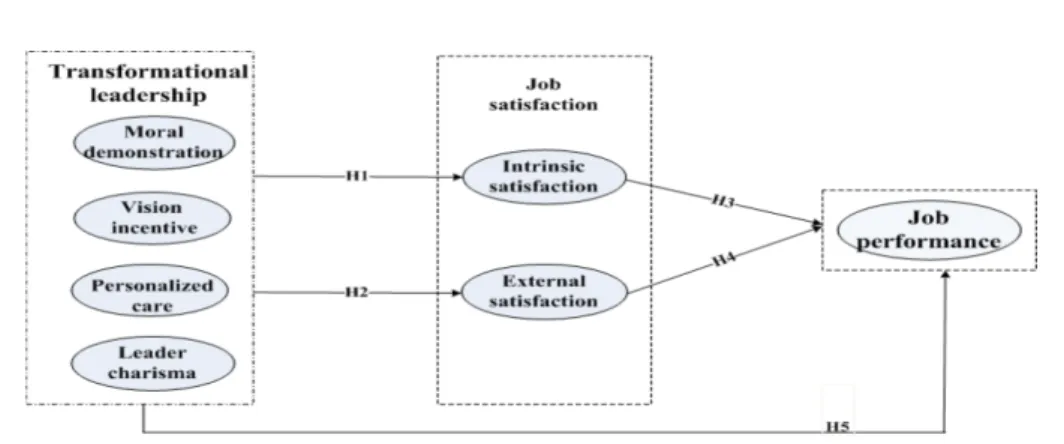
Fig. 1. Research Model

Research on transformational leadership behavior and job performance has been relatively mature so far. A series of studies have been carried out by scholars around the world.

Bass believes that transformational leadership behavior is related to the performance of subordinates and also to their maximum potential. Spangler and Braiotta, Yammarno and Dubinsky found that transformational leadership behavior had a positive impact on job performance[15].

Z. M. Wu & X. Wu verified the positive relationship between transformational leadership behavior and team performance of high-tech team leaders[16]. Based on the above viewpoints, hypothesis 5 is proposed:

H5: Each dimension of transformational leadership has a significant positive impact on job performance.

H5a: Moral demonstration has a positive effect on job performance;

H5b: Vision incentive has a positive impact on job performance;

H5c: Personalized care has a positive effect on job performance;

H5d: Leader charisma has a positive effect on job performance.

3.2 Research model

Based on the above induction and analysis of existing theories and researches, and combined

with the hypotheses proposed in this paper, the conceptual research model is established as shown in Fig. 1.

The questionnaire in this study is divided into four parts: transformational leadership behavior, job satisfaction, job performance, and basic information of the respondent. There are 56 questions in the questionnaire. Likert 5-point scale was used to score all questionnaires in this study.

The transformational leadership scale was developed by C. P. Li & K. SHi. it has a total of 26 items and four dimensions, including moral demonstration, vision incentive, personalized care and leader charisma. The Job Satisfaction Scale refers to the Minsunida job Satisfaction Questionnaire, which is divided into two dimensions: internal satisfaction and external satisfaction, and contains 20 questions. The job performance scale adopts a job performance scale of 10 items compiled by M. Wang.

4. Research results 4.1 Demographic variable analysis

In this study, online questionnaires were used

to collect data from the samples of employees of

selected companies. 398 questionnaires were

distributed, after excluding invalid

questionnaires, 378 valid questionnaires were

(6)

Project Style Number percent

(%) Project Style Number percent

(%)

Gender male 178 47.1

Age

<20years 14 3.70

female 200 52.9 21-30years 132 34.92

marriage unmarried 145 38.35 31-40years 161 42.59

married 228 60.33 41-50years 65 17.20

other 5 1.32 >50 years 4 1.59

Working time with leaders

<1year 90 23.81

Educational background

Below High School 25 6.61

1-5 years 214 56.61 Junior-college 43 11.38

6-10years 34 8.99 Undergraduate

course 126 33.33

>10 years 40 10.59 master 147 38.89

Enterprise nature

state-owned 76 20.11 doctor 37 9.79

private 91 24.07

Working years

<1year 13 3.44

foreign

investment 80 21.64 1-5 years 142 37.57

joint venture 43 11.38 6-10years 60 15.87

government-spon

sored institution 79 20.90 11-20years 103 27.25

other 9 2.38 >20 years 58 15.34

total 378 total 378

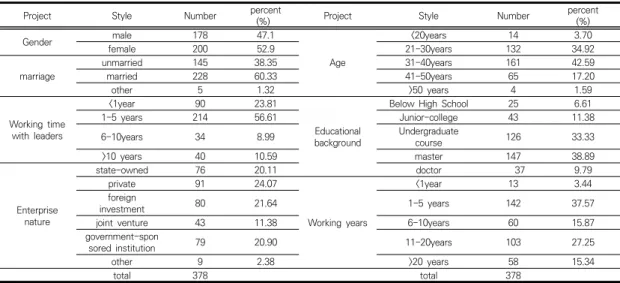
Table 1. Descriptive statistics for official samples recovered, the return rate was 94.97%.

The 378 questionnaires are used for further analysis. The results are shown in Table 1. The proportion of men and women taking part in the survey was appropriately distributed, accounting for 47.1% and 52.9% respectively. In terms of marital status, there were 145 unmarried people (38.35%), 228 married people (60.33%) and 5 other people (1.32%). The age distribution of the sample, the largest number of people were aged between 21-40, accounting for 77.51% and became the main respondents, while other age groups accounted for 22.49%. In terms of educational level, there are a total of 273 undergraduates and masters, accounting for 72.22%, high school and below, junior-college and doctorate account for 6.61%, 11.38% and 9.79%. In terms of working years, 13 people with less than 1 year,142 people with 1-5 years, 60 people with 6-10 years, 103 people with 11-20 years, 58 people with more than 20 years. In terms of working time with leaders, the largest number of people in 1-5 years is 214, accounting for 56.61%. In terms of enterprise nature, the proportion of state-owned enterprises, private enterprises, foreign investment, joint ventures, government-sponsored institution and other

enterprises account for 20.11%, 24.07%, 21.64%, 11.38%, 20.90% and 2.38%.

Based on the above analysis, we believe that the demographic analysis data of the survey results meet the needs of the survey.

4.2 Reliability and validity test

After a demographic analysis of the questionnaire, the accuracy and stability of the questionnaire need to be checked, therefore, it is necessary to test the reliability and validity of the research questionnaire in the social sciences.

The parameters used in reliability analysis are Cronbach ’s α and CITC values, In general, Cronbach ’s α> 0.7, CITC> 0.5.The validity of the questionnaire is mainly measured by the KMO value and the Bartlett spherical test result. the standard value of KMO is 1, the closer to 1, the better the validity of the questionnaire, the standard value of the Bartlett sphere test is generally 0.01, when the value is less than 0.01, it indicates that the questionnaire data has a good significance level, The parameter value Sig

<1%, which means that it meets the requirements

and is suitable for research, otherwise it is not

suitable for research. The reliability and validity

test results of transformational leadership scale

(7)

Measurement Items ƛ CITC EV VE α

Moral demonstration

He is upright .695 .677

12.286 47.256 .932

He can set an example in the face of difficulties .789 .796 He doesn't care about his personal gains and losses and works hard .847 .821 He can sacrifice personal interests for the benefit of department units .698 .675 He can put his own personal interests last .754 .655 He won't take the fruits of others' labor as his own .755 .638

He can share hardships with his employees .675 .596

He won't use his powers to make things difficult for employees .837 .763

Vision incentive

He can let employees understand the development prospects of the

unit department .762 .697

3.125 12.018 .924

He can let employees understand the business philosophy and

development goals of their unit .718 .709

He explains to employees the long-term significance of the work done .826 .739

He described the yearning for everyone .766 .714

He can point out the goal and direction of the employees .717 .742 He often analyzes the impact of his work on the overall goals of the

unit department together with his employees .851 .811

Personalized care

In the process of dealing with employees, he will consider the actual

situation of employees .621 .539

1.859 7.148 .886

He is willing to help employees solve problems in life and family .653 .617 He often communicates with employees to understand their work, life

and family situation. .681 .672

He patiently teaches employees and answers questions for

employees. .794 .748

He cares about the work, life and growth of his employees and

sincerely advises them on their development .694 .625

He focuses on creating conditions for employees to develop their own

strengths .806 .764

Leader charisma

His business ability is excellent .769 .803

1.337 5.143 .930

He is open-minded and has a strong sense of innovation .773 .802 He loves his work and has a strong sense of professionalism and

enterprising .663 .719

He is very committed to his work and always maintains a high degree

of enthusiasm .630 .743

He can continue to learn to enrich himself .702 .724 He is good at dealing with difficult problems .776 .816 KMO: 0.944 Bartlett’s test of sphericity=8121.830(p<.001), df=325, Total variance explained:71.565

※notes:CITC(Corrected Item-Total Correlation), EV(Eigenvalue), VE(Variance Explained) Table 2. Transformational Leadership Scale

are shown in Table 2. The reliability and validity test results of the job satisfaction scale are shown in Table 3. The results of reliability and validity test of job performance scale are shown in Table 4.

From the table, we can see that all parameter values indicate that the measurement factor analysis meets the reliability and validity test requirements, and all scales are suitable for research.

4.3 Correlation analysis

Correlation analysis is to discover the close

degree of the relationship between various

variables, which can reflect the change of

another variable caused by the change of one

variable, it is the premise of multiple regression,

Pearson coefficients are usually used. The

Pearson correlation analysis results of the four

dimensions of transformational leadership, the

two dimensions of satisfaction and the two

(8)

Measurement Items λ CITC EV VE α performance Task

My working time utilization rate is high .749 .798

6.180 61.802 .841

I am able to complete the work goal accurately .798 .818

I am able to complete work tasks on time .738 .790

The quality of my work can meet the requirements of superiors .768 .604

Relationship performance

I can take a proactive and enthusiastic approach to work .839 .769

1.433 14.325 .941

I respect and maintain the interests and image of the organization .833 .739 I obey the work instructions and task arrangement of the superior .862 .814 I am willing to undertake extra work and necessary overtime .841 .755 I fully support my colleagues and assist other departments .821 .692 I can strictly follow professional ethics and standards .895 .834 KMO: 0.914 Bartlett’s test of sphericity=3165.899(p<.001), df=45, Total variance explained:76.128

※notes:CITC(Corrected Item-Total Correlation), EV(Eigenvalue), VE(Variance Explained) Table 3. Reliability and validity test of job satisfaction scale

Measurement Items λ CITC EV VE α

performance Task

My working time utilization rate is high .749 .798

6.180 61.802 .841

I am able to complete the work goal accurately .798 .818

I am able to complete work tasks on time .738 .790

The quality of my work can meet the requirements of superiors .768 .604

Relationship performance

I can take a proactive and enthusiastic approach to work .839 .769

1.433 14.325 .941

I respect and maintain the interests and image of the organization .833 .739 I obey the work instructions and task arrangement of the superior .862 .814 I am willing to undertake extra work and necessary overtime .841 .755 I fully support my colleagues and assist other departments .821 .692 I can strictly follow professional ethics and standards .895 .834 KMO: 0.914 Bartlett’s test of sphericity=3165.899(p<.001), df=45, Total variance explained:76.128

※notes:CITC(Corrected Item-Total Correlation), EV(Eigenvalue), VE(Variance Explained) Table 4. Reliability and Validity Test of Job Performance Scale

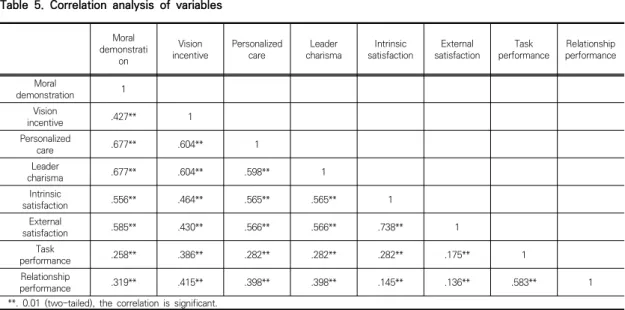
dimensions of job performance in this study are shown in Table 5.

It can be understood from the statistical data in the table that the correlation between the variables studied in this paper is significant, and the next regression analysis can be performed.

4.4 Regression analysis to test hypotheses Based on relevant theoretical basis, research hypothesis and established research model, this study empirically demonstrated the influence relationship between transformational leadership, job satisfaction and job performance, conducted multiple regression analysis and single regression analysis, In Table 6, we show the analysis results.

H1 Hypothesis: the results of regression analysis of the impact of each dimension of

transformational leadership on intrinsic satisfaction show that the first regression modle is statistically significant at p<.05 level, the four dimensions of transformational leadership have a significant impact on intrinsic satisfaction. H1 was verified and the hypothesis was supported.

H2 Hypothesis: The results of regression

between four dimensions of transformational

leadership and external satisfaction show that in

the regression results of external satisfaction of

vision incentive, p=.210>05. it can be seen that

vision incentive has no significant influence on

external satisfaction, so H2b was not supported,

other dimensions have significant influence, H2a,

H2c and H2d were supported. In the regression

of intrinsic satisfaction on job performance

(p=.162, t=3.179, p<.005), there was a significant

(9)

Moral demonstrati

on

Vision

incentive Personalized

care Leader

charisma Intrinsic

satisfaction External

satisfaction Task

performance Relationship performance Moral

demonstration 1

Vision

incentive .427** 1

Personalized

care .677** .604** 1

Leader

charisma .677** .604** .598** 1

Intrinsic

satisfaction .556** .464** .565** .565** 1

External

satisfaction .585** .430** .566** .566** .738** 1

performance Task .258** .386** .282** .282** .282** .175** 1

Relationship

performance .319** .415** .398** .398** .145** .136** .583** 1

**. 0.01 (two-tailed), the correlation is significant.

Table 5. Correlation analysis of variables

Hypothesis

Model Unstandardized

coefficients Standardized coefficients

t-value Sig Independent

variable Dependent variable β Std. error β

H1

Moral demonstration

Intrinsic satisfaction

.294 .056 .294 5.255 .000

Vision incentive .136 .055 .136 2.470 .014

Personalized care .107 .055 .107 1.935 .034

Leader charisma .221 .062 .221 3.546 .000

F=62.704(p<0.001), R 

=.402, Adj.R 

=.396

H2

Moral demonstration

External satisfaction

.335 .055 .335 6.052 .000

Vision incentive .069 .055 .069 1.256 .210

Personalized care .140 .055 .140 2.563 .011

Leader charisma .218 .062 .218 3.551 .000

F=66.613(p<0.001), R 

=.417, Adj.R 

=.410

H3 Intrinsic satisfaction Job

performance .162 .051 .162 3.179 .002

F=10.104(p<0.001), R 

=.026, Adj.R 

=.240

H4 External satisfaction Job

performance .136 0.051 .136 2.671 .008

F=7.135(p<0.001), R 

=.019 Adj.R 

=.016 H5

Moral demonstration Vision incentive Personalized care

Leader charisma

performance Job

.012 .203 .308 .087

.061 .061 .061 .068

.012 .203 .308 .087

3.355 .197 5.089 1.278

.844 .001 .000 .202 F=36.372(p<0.001), R 

=.281, Adj.R 

=.273 Table 6. Results of regression analysis

influence, H3 was verified, and the hypothesis 3 was supported. H4 Hypothesis: The external satisfaction has a significant impact on the regression of job performance(β=.136, t=2.671, p<.01), H4 has been verified, and the hypothesis 4 was supported. H5 Hypothesis: From the

specific results, the four dimensions of transformational leadership are related to job performance , but not all of them are significant.

In the specific regression results, vision incentive

and personalized care were significant at p=0.05

level, while the other two items were not

(10)

significant. So, H5a and H5d were not supported, H5b and H5c were supported, so the H5 hypothesis was not completely supported.

5. Discussion and Implications

The four dimensions of transformational leadership style can predict the internal satisfaction of employees, while for the prediction of external satisfaction, the influence of vision incentive is not significant. The other three dimensions have a good prediction effect.

Among the four dimensions of transformational leadership style, the prediction effect of personalized care is the most significant, followed by vision incentive, while the prediction effect of virtue and leadership charisma on job performance is not significant. In terms of the prediction of job satisfaction to job performance, both internal satisfaction and external satisfaction have significant predictive effects.

There are some limitations in this study. First, although the scales involved in this study are relatively mature and authoritative scales, each scale is evaluated by employees themselves, and the data source may be homologous deviation.

Second, the study only verified the pairwise relationship between transformational leadership, job satisfaction and job performance, but did not verify whether job satisfaction plays an intermediary role between transformational leadership and job performance, which is also an area to be improved in future research.

Through the research of this paper, we can get the implications for theory and practice: In theory, it can enrich the relevant research of transformational leadership. In practice, we should pay attention to improving employees' job satisfaction and sense of belonging to the organization, which is conducive to improving employees' job performance and thus improving organizational performance. Enterprise leaders

focus on cultivating and shaping their own transformational leadership style, implement the

"people-oriented" management philosophy, pay attention to employees, and ultimately achieve the purpose of improving the performance and satisfaction of subordinates and enhancing organizational cohesion.

REFERENCES

[1] M. K. Hu & W. Wu. (2019). Research on the status quo of transformational leadership in enterprises.

Knowledge Economy, 2019(27), 35-37.

DOI : 10.15880/j.cnki.zsjj.2019.27.017

[2] C. C. Lv, J. J. Yang & M. X. Li. (2018). Research on the Effect of Leadership Style and Knowledge Sharing on Radical Innovation. Soft Science, 32(12), 71-74.

DOI : 10.13956/j.ss.1001-8409.2018.12.15

[3] B. G. Park. (2015). A Convergence Study of Transformational Leadership on Organizational Devotion and Team Performance - Moderating Effects of Authenticity -, Journal of Digital Convergence, 13(7), 117-124.

DOI : 10.14400/JDC.2015.13.7.117

[4] J. B. Kim. (2018). Effects of Leadership, Organizational Justice and Psychological Empowerment on Job Performance. Journal of the Korea Convergence Society, 9(12), 265-272.

DOI : 10.15207/JKCS.2018.9.12.265

[5] C. P. Li & K. SHi. (2005). The Structure and Measurement of Transformational Leadership in China, Acta Psychologica Sinica, 37(6), 803-811.

http://journal.psych.ac.cn/xlxb/CN/

[6] J. G. Lee & K. H. Lee. (2016). The Effect of Transformational Leadership on Job Satisfaction : The Moderating Effect of Job Autonomy. Journal of Digital Convergence, 14(10), 217-224.

DOI : 10.14400/JDC.2016.14.10.217

[7] R. Li & W. Q. Ling. (2007). A Review of the Research on Trans for mational Leadership. Scientific Management Research. 2007(06), 85-89.

DOI : 10.19445/j.cnki.15-1103/g3.2007.06.024 [8] R. L. Zhang. (2019). Research on strategies to improve

job satisfaction of knowledge workers based on emotion management, Modern Business, 2019(24), 62-64.

DOI : 10.14097/j.cnki.5392/2019.24.028

[9] D. S. Wang. (2000). Focus on employee satisfaction, Enterprise Vitality, 2000(01), 44-45.

DOI : 10.14017/j.cnki.2095-5766.2000.01.017

[10] C. X. Huang & Y. Q. Xing. (2002). Design and analysis

(11)

of employee satisfaction questionnaire. Enterprise economic, 2002(04), 93-94.

DOI : 10.13956/j.ss.1001-8409.2018.12.15

[11] M. C. Jensen & K. J. Murphy. (1990). Performance pay and top-management incentives. Journal of Political Economy, 98(2), 225-264.

DOI : 10.1086/261677

[12] M. Song, Y. S. Chen & D. N. Qin. (2014). Leader Gender Role, Transformational Leadership and Follower Job Satisfaction. Human Resources Development of China, 2014 (07), 18-24.

DOI : 10.16471/j.cnki.11-2822/c.2014.07.010 [13] B. J. Jaworski & A. K. Kohli. (1991). Supervisory

feedback: alternative types and their impact on salespeople's performance and satisfaction. Journal of Marketing Research, 28(2), 190-201.

DOI : 10.1177/002224379102800206

[14] J. S. Black & H. B. Gregersen. (1997). Participative decision-making: an integration of multiple dimensions. Human Relations, 50(7), 859-878.

DOI : 10.1023/a:1016968625470

[15] F. J. Yammarino & A. J. Dubinsky. (1994).

Transformational leadership theory: using levels of analysis to determine boundary conditions. Personnel Psychology, 47(4), 787-811.

DOI : 10.1111/j.1744-6570.1994.tb01576.x

[16] Z. M. Wu & X. Wu. (2006). An empirical study on the relationship among transformational leadership, organizational citizenship behavior and team effectiveness in high-tech work teams. Science Research Management, (06), 74-79.

DOI : 10.19571/j.cnki.1000-2995.2006.06.011

이 남(Nan Li) [정회원]

․ 2003년 7월 : 길림공정기술사범학원 마케팅학과(관리학사)

․ 2008년 12월 : 길림대학교 (기업 관리 석사)

․ 2018년 5월 ~ 현재 : 세한대학교 경영 대학원 박사과정

․ 2003년 9월 ~ 현재 : 길림공정기술사 범학원 공상관리학부 교수

․ 관심분야 : 마케팅, 산업디자인

․ E-Mail : [email protected]

정 기 영(Gi-Young Chung) [정회원]

․ 1984년 2월 : 조선대학교 공과대학(공 학사)

․ 1986년 8월 : 명지대학교 대학원 무역 학과(경영학석사)

․ 1990년 5월 : University of Bridgeport (경영학석사)

․ 1993년 5월 : Golden Gate University (경영학박사)

․ 1997년 3월 ~ 현재 : 세한대학교 경영학과 교수

․ 관심분야 : 고객관계관리, 장소마케팅

․ E-Mail : [email protected]

김 형 호(Hyung-Ho Kim) [정회원]

․ 1989년 2월 : 경희대학교 전자계산공 학과(공학사)

․ 1992년 8월 : 경희대학교 전자계산공 학과(공학석사)

․ 2018년 2월 : 인천대학교 동북아물류 대학원(물류학박사)

․ 1998년 3월 ~ 현재 : 세한대학교 항공 교통물류학과 교수

․ 관심분야 : 신경회로망, 항공운송, System Dynamics

․ E-Mail : [email protected]

수치

Fig.  1.  Research  Model
Table  1.  Descriptive  statistics  for  official  samplesrecovered,  the  return  rate  was  94.97%
Table  5.  Correlation  analysis  of  variables

참조

관련 문서

As a result of multi-regression analysis based on the data of 384 employees in 5 public hospitals in Korea, transformational leadership positively affected

This study attempt to test not only the impact of leadership(second-level supervisor’s ethical leadership, immediate supervisor’s transformational leadership)

For instance, transformational leadership style improves employee dedication, social behavior, role clarity, and satisfaction (Gill &amp; Mathur, 2007). However,

Transformational Leadership, Transactional Leadership, Locus of Control, and Support for Innovation : Key Predictors of Consolidated Business Unit Performance, Journal

The Influence of Transformational Leadership on Employees’ Innovation in Universities of UAE: Mediating Effect of Technological Diversity.. Tariq Humaid ALMASKARI 1 , Effendi

After statistical analysis it was found that transformational leadership does not affect self-efficacy, procedural justice does not affect on self-efficacy, training has

The results showed that the transformational leadership style includes such factors as: idealized influence (attributed and behavior), inspirational

Bratt, M. Influence of stress and nursing leadership on job satisfaction of pediatric care unit nurses. Outcomes of nurses' job satisfaction. A work- nonwork