Korean J Environ Agric (2011) Online ISSN: 2233-4173 Vol. 30, No. 3, pp. 234-242 http://dx.doi.org/10.5338/KJEA.2011.30.3.234 Print ISSN: 1225-3537
Comparison of Carbon Sequestration Potential of Winter Cover Crop Cultivation in Rice Paddy Soil
Seul Bi Lee,
1†Mozammel Haque,
2†Prabhat Pramanik,
3Sang Yoon Kim
2and Pil Joo Kim
2,3*1National Academy of Agricultural Science and Technology, 249 Seodun-dong, Gwonsun-Gu, Suwon, Korea,
2Division of Applied Life Science (BK 21 Program), Gyeongsang National University, Jinju, 660-701, South Korea,
3Institute of Agriculture and Life Science, Gyeongsang National University, Jinju, 660-701, South Korea
Received: 14 September 2011 / Accepted: 23 September 2011
ⓒ 2011 The Korean Society of Environmental Agriculture
*Corresponding author,
Phone: +82-55-772-1966; Fax: +82-55-772-1969;
E-mail: [email protected]
†These authors contributed equally to this work.
234
Abstract
BACKGROUND: Cultivation of winter cover crops is strongly recommended to increase land utilization efficiency, animal feeding material self-production, and to improve soil and environmental quality.
METHODS AND RESULTS: Four major winter crops (barley, Chinese milk vetch, hairy vetch, and rye) having different C/N ratio were seeded in silt loam paddy soil in the November 2007 and the aboveground biomass was harvested on the late May 2008 to evaluate its effectiveness as green manure, and root biomass distribution was characterized at the different depth (0-60 cm) to study its effect on physical properties and carbon sequestration in soil. During this experiment, the naturally growing weed in the rice paddy soil in Korea, short awn foxtail (Alopecurus aequalis Sobol), was considered as control treatment.
Above-ground biomass of all cover crops selected was significantly higher than that of the control treatment (2.8 Mg/ha). Comparatively higher above-ground biomass productivity of rye and barley (15.8 and 13.5 Mg/ha, respectively) suggested that these cover crops possibly had the highest potential as a green manure and animal feeding material. Root biomass production of different cover crops followed the same trend as that for their above ground
biomass. Rye (Secale cereal) might have the highest potential for soil C accumulation (7893 C kg/ha) by root biomass development, and then followed by barley (6985 C kg/ha), hairy vetch (6467 C kg/ha), Chinese milk vetch (6671 C kg/ha), and control (5791 C kg/ha).
CONCLUSION(s): Cover crops like rye and barley having high biomass productivity might be the most effective winter cover crops to increase organic carbon distribution in different soil aggregates which might be beneficial to improve soil structure, aeration etc. and C sequestration.
Key Words: Barley, Carbon sequestration, Paddy soil, Rye, Vetch, Winter cover crop
Introduction
Soil is the largest terrestrial carbon pool, constitutes
2500 Pg total carbon within one meter depth (Lal, 2000)
and it is twice the atmospheric pool and three times
higher than the biotic pool (Lal et al ., 1997; Schlesinger,
2000). Land used for crop production releases carbon
dioxide (CO
2) to the atmosphere. Schlesinger (1997)
proposed that the decrease of soil organic carbon
content in cultivated land is much higher than that for
forests and grasslands. Therefore, agriculture could be
considered as source and potential sink for greenhouse
gases such as CO
2, and modification of agricultural
practices may be expected to play a role to limit the
magnitude or rate of global warming. Only in North
America, 5.5Pg C from total carbon pool of soil was lost
since land opened for agriculture and could regain some of that pool if agricultural practices those favour carbon sequestration are adapted (Bruce et al ., 1998).
Soil carbon sequestration by terrestrial vegetation, as one of the most important options for greenhouse gas mitigation, has long been identified by the intergovernmental Panel on climate change (Watson et al ., 2000). Different agricultural practices like tillage, increased crop rotation, using cover crops, livestock waste disposal and other practices influence the level of carbon in arable soils. Among these practices, cover crop cultivation may play an important role in carbon sequestering and to reduce global warming. It also contributes in reduction of nutrient leaching and also improves structure and buffering capacity of soil (Patrick et al ., 1957). Cover crops provide an effective practice to enhance soil organic carbon in addition to their role in improving soil and water conservation (Wang et al ., 2005; Sainju et al ., 2006).
Rice, the most important staple food for one third of world population, constitutes a major source of farmer’s income in Korea. Cultivation of cover crops in fallow season during winter season contributes to carbon sequestration in soil. Short awn foxtail ( Alopecurus aequalis Sobol ) is a naturally growing weed in Korean paddy soil. In spite of very low temperature during winter season, some leguminous (Chinese milk vetch, hairy vetch), and non- leguminous (rye, barley etc.) crops had rapid growth as compared to other cover crops in Korea. These four plants were selected as cover crops in rice paddy soil and their effects on carbon sequestration were compared with that of native weed (short awn foxtail). Above- ground portions of cover crops are generally harvested to fulfill the huge demand of livestock feeding in Korea. Therefore, root biomass and root distribution pattern of these cover crops are very important for carbon supplement in soil. But the detail studies on root distribution pattern of different cover crops and their comparative effect on carbon status, C/N ratio and aggregate stability of soil and carbon sequestration in soil are yet to perform. The objects of this experiment were to (1) compare the above ground biomass of different cover crops, used as green manure or feeding materials for livestock, (2) study the variation in total carbon and nitrogen content and aggregate distribution at different soil depth as affected by root distribution of different cover crops and (3) evaluate the best winter cover crop for rice field soil in Korea.
Materials and Methods
Experimental design
The experiment was conducted in agricultural farm (36º 50'N and 128º 26
'E) of Gyeongsang National University, Jinju, Korea from November 2007 to May 2008 and barley ( Hordium vulgare L ), Chinese milk vetch ( Astragalus sinicus L), hairy vetch ( Vicia villosa Roth), and rye ( Secale cereal ) were cultivated as winter cover crops along with control (short awn foxtail) during this study. The texture of that soil was silt loam in nature having partially impeded drainage.
Treatments were arranged in plots (2 m 3 m) with three replications following randomized block design.
The moisture content of the soil was maintained near field capacity by irrigated as and when required.
After cultivation, above-ground portion was totally harvested and separate studies were performed with root and shoot portions of the cover crops.
Plant above-ground biomass assay
Above ground portion of different cover crops was harvested and fresh weight was taken to estimate total plant biomass (per hectare basis) of different winter cover crops. One portion (fixed weight) of the plant biomass was dried at 60
oC over night to measure dry weight of plant biomass. Remaining portion of plant was use to measure total carbon and total nitrogen concentrations and C and N uptake by using C-N analyzer (Nelson and Sommer, 1982).
Plant root study
Root samples were collected from different soil depths at 10 cm interval up to 60 cm to perform their physical and chemical characterization. Fresh samples from each soil layer were separated from rhizospheric soil and root biomass was estimated. Total carbon and total nitrogen content of root samples were determined according to Nelson and Sommers (1982) using a Carbon Analyzer, (LECO1 CN-2000), respectively.
Soil sample analysis
Soil samples were collected from different soil
depth of each cover crop cultivated plot. Bulk density
and organic carbon content of soil samples at different
soil depth were estimated and compared with those of
control soil. Carbon sequestration in soil as affected by
different cover crops cultivation was calculated
subtracting soil carbon accumulation of control plot
from that of corresponding treatment plots.
Soil physical properties
A portion of the fresh moist soil sample was dried at 105
oC for 24 hours to measure field moisture content and bulk density (Blake and Hartge, 1986).
Soil aggregate size distribution was measured by a wet-sieving following the method of Yoder (Yoder, 1936). One hundred grams of soil was adsorbed in water on a nest of sieves having pore size (2, 1, 0.5, 0.25 mm) for 10 min before the start of wet-sieving action. The sieve nest was then clamped and transferred to the drum securely. Sieve assembly was oscillated up and down by a pulley arrangement for 20 min at a frequency of 30-35 cycles/min with a stroke length of 4 cm in salt free water inside the drum. The water stable aggregates retained on sieves were then backwashed into pre-weighed containers, oven dried at 50
oC for 2-3 days and weighed.
Soil chemical properties
Total organic carbon of the collected soil sample was determined by the wet-oxidation method following Walkley and Black (Walkley, 1947). One gram soil along with 10 ml of 1N potassium dichromate (K
2Cr
2O
7) solution and 20 ml of concentration H
2SO
4were taken in a 500 ml conical flask and kept at dark.
After 30 minutes incubation in dark, 200 ml distilled water was added followed by addition of 10ml of H
3PO
4and 2 ml of diphenylamine indicator. The soil water suspension was then titrated against 0.5M ferrous ammonium sulfate solution until purplish blue colour turned to brilliant green.
Statistical analysis
Fisher’s protected least significant difference (LSD) was used to study the means of significantly different treatments. Statistical analysis of different parameters was performed using SPSS statistical software.
Results and discussion
Biomass productivity and Chemical properties of cover crops
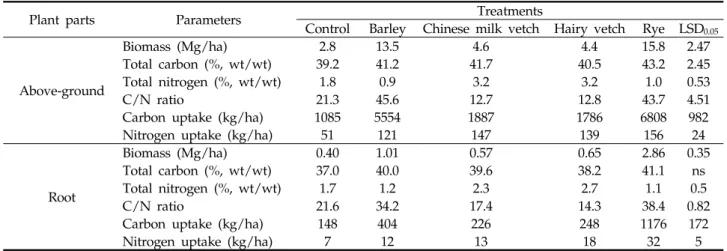
In our experiment, all the tested cover crops recorded higher biomass productivity as compared to control (short awn foxtail). Among four cover crops, both above-ground and root biomass productivity of non-leguminous plants were significantly (P < 0.05)
higher than that of legumes (Table 1). The highest biomass productivity was observed in rye. The results of this experiment contradicted with the findings of Wang et al . (2008), who proposed that the biomass productivity of legumes were comparatively higher than that of non-leguminous cover crops. This difference might be attributed to the differences in agro-ecosystem of these two studies. The previous study was conducted in onion field, while in our experiment these plants were cultivated as winter cover crop in the paddy field. Total biomass of cover crop is one of the most important factors for carbon supplement in soil. Total above-ground and root biomass of cover crops possibly varied with changes in agro ecosystems and due to high biomass production during rye cultivation as winter cover crop might be the best option for improving carbon status in paddy field as well as to supply animal feeding materials in temperate region like Korea.
Total carbon (TC) content of all the tested cover crops was higher than that of short awn foxtail (control). Rye (43.2%) had higher TC content than that of leguminous plants, and the TC content values of barley, Chinese milk vetch and hairy vetch did not differ significantly. In comparison, total nitrogen content of leguminous plants were significantly higher than that of non- legumes and that in turn leads to the wide variation among the C/N ratios of these two groups of cover crops (Table 1). Kuo et al.
(1997) and Sainju et al . (2002) also reported that the
carbon content in various winter cover crops
remained almost constant, but nitrogen concentration
differed among cover crops. Higher C/N ratios of
non-leguminous plants might be attributed to
comparatively slower decomposition of their biomass
than legume plants. Their higher biomass productively
and slower decomposition rate favour more carbon
accumulation in soil than by legume plants. That again
indicated that non-leguminous plants like rye and
barley possibly have the higher potential as winter
cover crops for rice field of temperate zone. In the
contrary, lower C/N ratio of legume biomass could
be beneficial to supply nutrients in inorganic form
through rapid mineralization. However, the final
selection of winter cover crops depends solely on the
agronomic purpose of cover crop cultivation.
Plant parts Parameters Treatments
Control Barley Chinese milk vetch Hairy vetch Rye LSD0.05
Above-ground
Biomass (Mg/ha) 2.8 13.5 4.6 4.4 15.8 2.47
Total carbon (%, wt/wt) 39.2 41.2 41.7 40.5 43.2 2.45
Total nitrogen (%, wt/wt) 1.8 0.9 3.2 3.2 1.0 0.53
C/N ratio 21.3 45.6 12.7 12.8 43.7 4.51
Carbon uptake (kg/ha) 1085 5554 1887 1786 6808 982
Nitrogen uptake (kg/ha) 51 121 147 139 156 24
Root
Biomass (Mg/ha) 0.40 1.01 0.57 0.65 2.86 0.35
Total carbon (%, wt/wt) 37.0 40.0 39.6 38.2 41.1 ns
Total nitrogen (%, wt/wt) 1.7 1.2 2.3 2.7 1.1 0.5
C/N ratio 21.6 34.2 17.4 14.3 38.4 0.82
Carbon uptake (kg/ha) 148 404 226 248 1176 172
Nitrogen uptake (kg/ha) 7 12 13 18 32 5
* Note: LSD0.05 indicates least significant difference at 5% level. ns means ‘not significant’.
Table 1. Comparison of biomass yields and C and N uptakes of different parts of the selected winter cover crops in paddy soil
Carbon and Nitrogen uptake by cover crops were calculated by multiplying crop productivity with their total carbon and nitrogen content, respectively. Total carbon and nitrogen uptake by both above-ground and root portion of the tested cover crops were significantly (P < 0.05) higher than that of control (Table 1). Irrespective of plant parts, carbon uptake by non-leguminous plants was significantly (P < 0.05) higher than that of legumes like Chinese milk vetch and hairy vetch. During photosynthesis, plants utilize atmospheric CO
2to produce carbohydrates and that are used to increase plant biomass. Therefore, higher carbon uptake by non-leguminous plants indicates the more consumption of atmospheric CO
2which directly influences reduction in global warming and incorporation of these plant biomass leads to comparatively more increase in soil carbon reservoir.
Cover crop root distribution and carbon-nitrogen accumulation in soil
Root dry weights of tested cover crops were varied at different soil depth (Fig.1), especially within plough layer (up to 20 cm). The dried root weight of leguminous plants did not vary significantly from that of control, though root weights of rye and barley were significantly (P < 0.05) higher than that of other plants within top 20 cm soil depth. Among non-leguminous cover crops, root weight (dried) of rye was significantly (P < 0.05) higher than that of barley. The highest root density of rye throughout the soil profile also confirmed that it could be used as a potent cover crop for improving carbon reservoir of rice paddy soil.
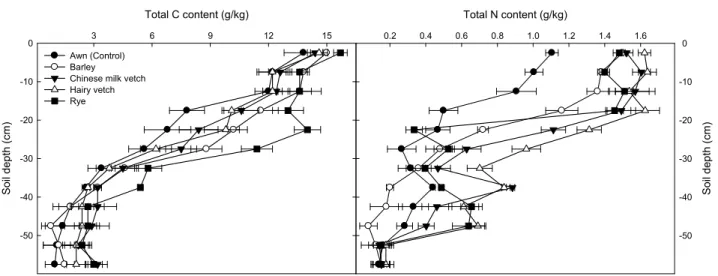
Chemical analysis of soil indicated that total carbon
and nitrogen content in soil was gradually decreased
with increasing soil depth (Fig. 2). Carbon accumulation
due to cover crop cultivation was higher than that of
control treatment. The carbon accumulation at different
depth of soil profile had shown good correlation with
the dried root weight of cover crops. Results indicated
that non-leguminous crops recorded comparatively
higher soil organic carbon and rye cultivation had
shown the highest potential for carbon accumulation
in soil (Fig. 2a). Total biomass productivity and C/N
ratio of applied cover crops play very important role
for carbon accumulation in soil. These two parameters
determine the amount of total carbon incorporated
through cover crop in soil. The C/N ratio of cover
crops also influenced the rate of their mineralization
in soil. Higher C/N ration of non-leguminous cover
crops not only indicated the presence of comparatively
higher organic carbon but also negatively influenced
the rate of mineralization. These possibly were responsible
for higher carbon accumulation in rye and barley
treated soils. Total carbon concentration in soil was
significantly (P < 0.05) increased over control due to
cultivation of selected cover crops and the increase in
total carbon content due to leguminous cover crop
cultivation (16-20%) was much lower than that due to
rye and barley cultivation (37-43%). Therefore, it
could be concluded that root distribution of different
cover crops could play an important role in organic
carbon supplement to the soil and non-leguminous
cover crops, having comparatively higher carbon uptake
and root density, could be the most potent green
manure for increasing organic carbon reservoir of soil.
Cultivation of tested cover crops also significantly increased total nitrogen content of soil as compared to control (short awn foxtail) treatment (Fig. 2b). The nitrogen content of soil at different depth did not follow any specific trend among treatments. Nitrogen content of leguminous crops applied soils, however, was comparatively higher that of rye and barley treated soils. Sole chemical fertilizer application deteriorates soil properties which might be unfavorable for carbon and nitrogen accumulation in soil (Li et al ., 2007). But continuous application nitrogen rich organic amendments steadily increased total nitrogen status of soil. Significant linear correlations (P < 0.01) between soil organic carbon and total nitrogen accumulation in different terrestrial agro-ecosystems had already been reported (Brenner et al ., 2006; Jagadamma et al ., 2007) and in presence of adequate organic amendment, soils had shown tendency to maintain its C/N ratio, in spite of continuous crop cultivation. This phenomenon in soil is known as carbon and nitrogen coupling cycles.
Therefore, it could be concluded that long-term
application of non-leguminous cover crops in rice field could also be effective for soil nitrogen sequestration due to carbon and nitrogen coupling cycles, though soil nitrogen content of rye and barley treated soils after one year was comparatively lower than that of leguminous cover crop treated plots.
Dried root weight (kg/ha)
150 300 450 600 750
Soil depth (cm)
0 5 10 15 20 25 30 35
Awn (Control) Barley Chinese milk vetch Hairy vetch Rye
Fig. 1. Root distribution patterns of the selected winter crops in paddy soil.
Total N content (g/kg)
0.2 0.4 0.6 0.8 1.0 1.2 1.4 1.6
Soil depth (cm)
-50 -40 -30 -20 -10 0 Total C content (g/kg)
3 6 9 12 15
Soil depth (cm)
-50 -40 -30 -20 -10 0
Awn (Control) Barley Chinese milk vetch Hairy vetch Rye
Fig. 2. Total carbon and nitrogen accumulation patterns of the selected winter crops in paddy soil.
Bulk density (g/cm3)
1.2 1.3 1.4 1.5 1.6
Soil depth (cm)
-40 -30 -20 -10 0
Awn (control) Barly
Chinese milk vetch Hairyvetch Rye
Porosity (%)
39 42 45 48 51 54
Soil depth (cm)
-40 -30 -20 -10 0
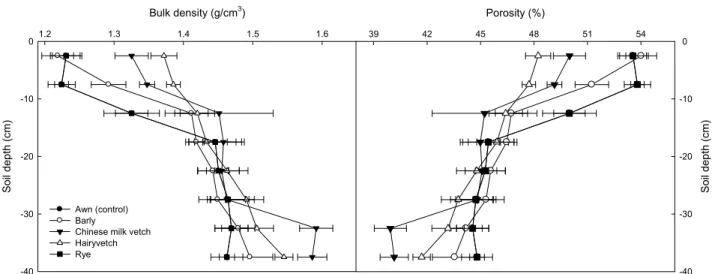
Fig. 3. Characteristics of bulk density and porosity of the selected winter crops in paddy soil.
Bulk density and porosity of cover crop treated soils Application of cover crops influenced bulk density and porosity of soils. Since organic matter is lighter than soil particles, increased soil TC content due to cover crop cultivation proportionately lowered bulk density of soils especially in the top 15-20 cm soil depth (Fig. 3a). Higher root density of cover crops (mainly non-leguminous cover crops) might be attributed to the significantly (P < 0.05) higher pore space of non-leguminous rye and barley treated soils (Fig. 3b).
Comparison revealed that soil porosity had negative linear regression with bulk density of cover crop treated soils. Higher pore space in soil is expected to improve air and water movement in soil and that in turn will promote microbial and plant growth by supplying required nutrients and oxygen.
Carbon and nitrogen accumulation in soil
Cultivation of selected cover crops significantly (P
< 0.05) increased accumulation of carbon and nitrogen over control (Fig. 4). Total carbon accumulation in rye and barley cultivated plots were significantly (P <
0.05) higher than that of leguminous cover crop cultivated plots. The higher nitrogen accumulation was recorded in hairy vetch cultivated soils followed by Chinese milk vetch and non-leguminous cover crops. The nitrogen accumulation values of rye and barley cultivated soils, however, did not vary significantly.
The carbon accumulation in soil was influenced by the total carbon assimilation by cover crops and their root biomass, while the nitrogen accumulation in soil was affected by nitrogen content (%) and C/ N ratio
Accmulation (Mg/ha)
0 3 6 40 60
Total C Total N
D
B
C C
A
d
b a c c
Awn (control) Barley Chinese Hairy vetch Rye milk vetch
Treatment
Fig. 4. Characteristics of total C and N accumulation of the selected winter crops in paddy soil within 60 cm with depth.
rather than total nitrogen uptake by applied winter cover crops. Due to higher C/N ratio and comparatively lower nitrogen concentration in non-leguminous cover crops, application of these organic substrates are expected to cause more immobilization by soil microorganisms and hence application of rye and barley recorded lower nitrogen accumulation in soil as compared to leguminous cover crop treated plots.
Carbon distribution in different size soil aggregates
Incorporation of non-leguminous cover crops like
rye and barley not only increased total carbon
accumulation in soil, but also evenly distributed that
carbon in different size soil aggregates. The differences
in carbon accumulation in various soil aggregates
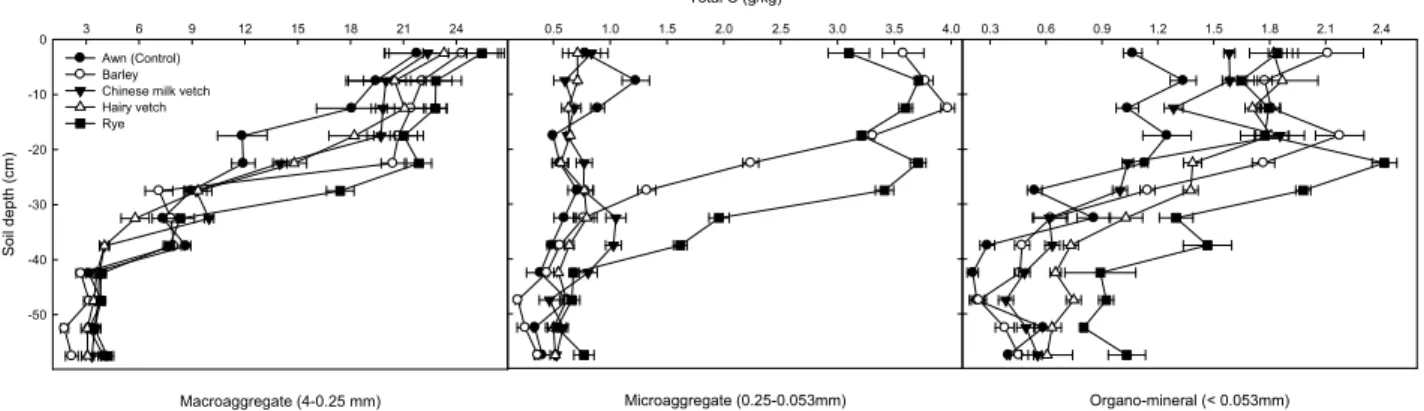
among leguminous and non-leguminous cover crop treated plots were more prominent within top 30 cm soil depth (Fig. 5). Carbon present in soil macroaggregates is the moat labile form of carbon and is physically unprotected in soil. Bremer et al . (1994) concluded that this fraction is the most robust indicator of management-induced changes in soil organic matter and correlated carbon concentration of soil macroaggregates with the rate of organic matter mineralization. Higher physically unprotected carbon in rye and barley treated soils indicated that there was comparatively more mineralizeable organic substrates having potential to supply nutrients through decomposition.
Organic carbon in microaggregates consists of long-chain carbon compounds such as fatty acids, lipids, cutin acids, proteins etc. and/or humic substrates and this fraction of soil organic carbon is physically and biochemically protected. Angers et al . (1997) proposed that carbon accumulation in microaggregates is important to control plant nutrient supply in soil and increase in carbon content of microaggregates effectively determines carbon sequestration (Six et al ., 2002). Fig. 4 suggested that cultivation of rye and barley significantly increased total carbon content in soil microaggregates up to 30cm depth and that might be responsible for proportionately increasing carbon sequestration in soil (Six et al ., 2002). Organo- mineral fraction of soil organic carbon was chemically stabilized and was protected by silt and clay fraction of soil (Feller and Beare, 1997). Several compounds of
microbial origin e.g., glucosamine, muramic acid etc.
form complexes with silt and clay of soil to generate organo-mineral compounds in soil. Hassink (1997) proposed that this carbon fraction was highly influenced by soil management practices. Cultivation in soil decreases carbon content in this fraction due to supplying carbon to the rhizospheric microorganisms for their proliferation (Guggenberger et al ., 1999;
Puget et al ., 1999).
The highest carbon distribution in all the soil aggregates suggested that cultivation of non-leguminous cover crops like barley and rye not only increased carbon sequestration, but also had potential to improve physical, chemical and microbiological properties of soil. Based on findings of this experiment, it could be concluded that rye probably had the highest potential as a winter cover crop for rice field of temperate region like Korea. However, non-leguminous cover crops show rapid accumulation of carbon especially in recalcitrant polymer form. In this physiological condition, rye will be decomposed very slowly and that in turn will leads to the lower carbon accumulation in soil. Therefore, optimum growth stage is important to obtain maximum benefit from these winter cover crops. In future study, we are expected to standardize the optimum application dose of different winter cover crops in rice paddy soil to obtain less greenhouse gas emission with maximum grain yield.
Microaggregate (0.25-0.053mm) Total C (g/kg)
0.5 1.0 1.5 2.0 2.5 3.0 3.5 4.0
Macroaggregate (4-0.25 mm)
3 6 9 12 15 18 21 24
Soil depth (cm)
-50 -40 -30 -20 -10 0
Awn (Control) Barley Chinese milk vetch Hairy vetch Rye
Organo-mineral (< 0.053mm)
0.3 0.6 0.9 1.2 1.5 1.8 2.1 2.4
Fig. 5. Distribution patterns of total carbon content in different size of aggregates of the selected winter crops in paddy soil.