The cultural value effects on social media eWOM in the hospitality industry
-A cross cultural study of comparison among China, Korea, and the USA- Kang, Sun-Goo
*․Oh, Chang-Ho
**Electronic word-of-mouth (eWOM) in social media has been recognized as one of the most influential marketing tools across various businesses. Understanding eWOM in social media is critical to reach potential global consumers easily and quickly in the hospitality industry. However, few empirical studies in hospitality attempted to evaluate the effectiveness of eWOM in social media from a global perspective.
Given the competitive climate of the hospitality market, it is meaningful for hospitality marketers to evaluate the effectiveness of eWOM in social media and the influence of cultural factors to promote customers and increase profitability globally. The main purpose of this study was to examine the influence of cultural values on social media eWOM in the hospitality industry in China, Korea, and the USA. The result of this study indicates Chinese and American people engage more than Korean people when they try to purchase hospitality product and service This study particularly provided a cross-cultural study of comparison among these countries and t he findings of this study are expected to provide important practical assistance for global marketing strategies in social media.
Key Words: eWOM, social media, cross-cultural, hospitality industry, cultural dimensions
논문접수일: 2015년 01월 23일 수정일: 2015년 03월 04일 게재확정일: 2015년 03월 26일
* Visiting Professor, College of Hotel & Tourism Management, Youngsan University, [email protected]
** Professor, Dept. of Tourism & Convention, Youngsan University, [email protected]
<Abstract>
Ⅰ. Introduction
Hospitality industry has changed along with the progress of information and communication technologies(ICTs) over the years. ICTs have played an instrumental role as a competitive advantage in the hospitality industry(Leung, Law, Hoof, & Buhalis, 2013). By adapting ICTs, hospitality businesses have been able to improve service quality, reduce costs, enhance operational efficiency, and expand their market globally(Law, Leung, & Buhalis, 2009).
With the rapid growth of the Internet and E-commerce, electronic word-of-mouth (eWOM) has emerged. eWOM has no limit of time, amount of information, and geographical constraints compared to traditional WOM(Han, 2008). eWOM activities can be generated in diverse ways such as emails, websites, blogs, virtual communities, chatrooms, product review sites, and social networking sites(Litvin, Goldsmith, & Pan, 2008). Thus, travelers today actively can share travel information using the Internet(Sparks & Browning, 2011).
With the distinctively increasing popularity, social media is regarded as an important tool in the hospitality industry to engage potential customers and retain existing customers(Wang
& Fesenmaier, 2004). Many businesses and marketing researchers have examined the impact of eWOM in social media on consumers’ purchase decision and recognized eWOM in social media as a new marketing tool(Litvin et al., 2008).
Culture is a crucial factor for understanding consumers’ behavior(Kralisch & Berendt, 2004).
The lack of empirical research examining the influence of social media eWOM from a global perspective is the underlying motivation for this research.
The purpose of this research is to examine whether there is a cultural value effect on social media eWOM in the hospitality industry in China, Korea, and the USA. The key research question is whether the cultural value influence on social media eWOM will differ among countries. This study focuses on five cultural dimensions: Power distance(PDI), Uncertainty Avoidance(UAI), Individualism (IDV), Masculinity(MAS), Long-term Orientation (LTO) that are most widely used and accepted in cross-cultural research(Jobs, & Gilfoil, 2012).
Previous cross-cultural studies on social media eWOM in the hospitality industry focused on limited countries and cultural factors. This study specifically provides a cross-cultural study of comparison between the USA, which shows the highest Internet penetration rate, and Asia, which shows the biggest Internet user population in the world (Internet World Stats, 2014).
Ⅱ. LITERATURE REVIEW
1. The Impact and Importance of Information and Communication Technologies (ICTs) in Hospitality
Information and Communication Technology
(ICT) is defined as ‘the convergence of computers and digital communication to enable access to information and other resources and to facilitate communication and collaboration (Penny, 2010). ICTs have transformed not only how businesses are conducted but also how consumers communicate within the hospitality and tourism industries(Buhalis & Law, 2008;
Ip, Leung, & Law, 2011).
Through the development of ICTs, more consumers can use search engines that transmit capacity and speed of information networks for planning and experiencing travels.
Consumers who utilize search engines tend to find relevant information to their requirements and needs, thus, they have the ability to choose customized hospitality and tourism products based on the information(Buhalis &
Law, 2008). Therefore, well-informed consumers can mitigate the perceived risks as well as being provided with the enhanced quality of travels(Fodness & Murray, 1997).
Moreover, consumers can reduce their travel costs comparing products on different travel websites. They can choose particular travel products that meet their tastes and needs(Buhalis & Law, 2008).
2. The Importance of Social Media in Hospitality
Social media generally refers to ‘a second generation of Web development and design that people are able to communicate with each other, share and interchange secures information, and collaborate on the World Wide
Web’(Paris, Lee, & Seery, 2010). In short, it is considered as an Internet-based application that delivers consumer-generated content (Blackshaw, 2006). Consumer-generated content is defined as ‘a mixture of fact and opinion, impression and sentiment, founded and unfounded tidbits, experiences, and even rumor’(Blackshaw & Nazzaro, 2004).
Social media includes diverse online information-sharing formats as the following:
social networking sites(SNSs) (e.g. Facebook, MySpace, Cyworld, and Friendster), user-generated content sharing sites(e.g.
YouTube, Flickr), blogs, collaborative websites(e.g. Wikipedia) and microblogging sites(e.g. Twitter)(Kaplan & Haenlein, 2010).
Social media sites are ideal tools for consumers who desire to communicate and share their common interests and activities to form online communities(Bolotaeva & Cata, 2010). Companies are able to build strong relationships with consumers and new business models through online communities(Bolotaeva
& Cata, 2010). Moreover, companies can obtain competitive advantage by understanding customers’ needs more in depth by monitoring customer-generated contents(Kang, 2011).
Ultimately, companies expect to produce well-customized products/services and effectively advertise them to targeted customers(Chu & Kim, 2011). This increase is symptomatic of a long-term trend toward the use of social media among companies becoming the norm(Okazaki & Taylor, 2013).
Kang(2011) found that hotel brands perceive
social media as an innovative tool because it
enables them to be proactive in terms of managing brand relationships with their consumers. Hotels can categorize attributes of their brands in order of importance by analyzing consumer-generated contents on their websites(Kang, 2011). Xiang and Gretzel(2010) found that social media plays a significant role in information search behavior for travelers as well. Volo(2010) suggested that social media impacts the decision-making process of prospective tourists representing comments and recommendations from blogs are influential factors for future intentions to travel.
3. Electronic Word-Of-Mouth (eWOM)
The invention of the Internet allows consumers to communicate with each other more quickly and efficiently and lead to a new form of Word-of-mouth(WOM) known as electronic word-of-mouth(eWOM)(Chu, 2009).
eWOM is defined as ‘any positive or negative statement made by potential, actual, or former customers about a product or company, which is made available to a multitude of people and institutions via the Internet’(Hennig-Thurau, Gwinner, Walsh, &
Gremler, 2004). eWOM can be considered as the extension of traditional interpersonal communication into Web 2.0(Cheung, Lee, &
Rabjohn. 2008). However, eWOM has different characteristics that make it more distinctive from traditional WOM: no limit of time,
amount of information, and geographical constraints(Han, 2008). Besides, it can be anonymously generated. Thus, consumers can avoid social pressure or restrictions that can exist in face-to-face communication(Gelb &
Sundaram, 2002). Therefore, eWOM is widely perceived to have higher credibility, more relevance, and greater ability to stimulate a consumer’s interest. eWOM became a more persuasive information source to customers than the marketer-generated information on the Web(Bickart & Schindler, 2001).
Social media helps creation of new customers and it has been a driving force for eWOM marketing strategies(Trusov, Buckliin,
& Pauwels, 2009). eWOM branding via social networking sites(SNSs) is seen as an essential element in the promotional mix(Chu & Kim, 2011) due to its great influence on customers’
purchasing decision(Yoon, 2008). Consequently, business marketers have been making efforts to make better use of WOM marketing strategies through social media(Kozinets, De Valck, Wojnicki, & Wilner, 2010).
It is important to adopt the constantly
changing technologies for hospitality
businesses and eWOM plays a crucial role in
fast-transferring businesses’ both positive and
negative information. Therefore, managers
should be proactive to encourage positive
reviews, and be responsive to negative reviews
to counteract its impact on potential
customers(Litvin & Hoffman, 2012).
4. Cultural Influence
4.1 Cultural Influences
Hofstede(1980, p. 25) defined culture as ‘the collective programming of the mind, which distinguishes the members of one human group from another’. The definition suggests that consumers’ culture arises from their society or group of affiliation(Lam et al., 2009).
Consumers’ patterns of thinking, feeling, and potential acting are learned from their life within their social environment by country(Yoon, 2007). Also, culture impacts on communication style tremendously(Koester &
Lustig, 2012).
Cultural models have been developed from several key researchers. However, Hofstede’s framework is most widely accepted and used among the different cultural models(Lam et al., 2009). Hofstede’s dimensions were developed to distinguish national characteristics rather than individual characteristics and focus human values instead of general practices or beliefs (Hofstedde, 1983).
4.2 Hofstede's five cultural dimensions Hofstede revealed five dimensions of differences between national value systems: (1) power distance(large vs. small), (2) individualism vs. collectivism, (3) masculinity vs. femininity, (4) uncertainty avoidance (strong vs. weak), and (5) long-term orientation vs. short-term orientation (Jobs &
Gilfoil, 2012).
Hofstede’s(1980a) work has been criticized for: limiting the sample to a single multi-
national corporation; failing to capture the variability of culture in a long-term per- spective; limiting culture to a too simplistic five dimension conceptualization; and disre- garding within-country cultural heterogeneity (Kirkman, Lowe, & Gibson, 2006). In spite of all the criticism, many researchers have favored Hofstede’s framework due to its clarity, parsimony, and resonance with managers(Kirkman et al., 2006) and it has been accepted and tested in cross-cultural research most widely(Zakour, 2003). Earlier studies revealed that a national culture perspective is useful to all areas of IT-research(Gaspay, Dardan, & Legorreta, 2008). For example, Yoo and Torrey(2002) studied national culture and knowledge management using the Hofstede’s cultural dimensions. Hermeking(2005) examined influences of culture on the global consumption of the Internet and its World Wide Web based on the Hofstede’s cultural dimensions.
Nevertheless, only few empirical studies have focused on the impact of culture on the network of communicating WOM(Lam, Lee, &
Mizerski, 2009).
Ⅲ. RESEARCH METHODS AND DATA ANALYSIS
1. Research Hypothesis
Despite the globalization, electronic com-
munication does not change users’ value
systems and capacity to absorb the information while it increases the amount of accessible information(Hofstede & Hofstede, 2005). People from different cultures have different perceptions and attitude toward the Internet(Chau, Patrick, Col, Massey, Montoya- Weiss, & O’Keefe, 2002). Culture is a crucial factor for understanding consumers’ behavior and it is one of the most important aspects of a consumers’ personal context (Kralisch &
Berendt, 2004). Consequently, it is expected that cultural values influence social media eWOM, which leads to following hypothesis:
H1: The cultural values will differ among countries.
H1a: Power distance effect on social media eWOM will differ among countries.
H1b: Individualism effect on social media eWOM will differ among countries.
H1c: Masculinity effect on social media
eWOM will differ among countries.
H1d: Uncertainty effect avoidance on social media eWOM will differ among countries.
H1e: Long-term orientation effect on social media eWOM will differ among countries.
2. Sample and Data Collection
This study developed and utilized an online survey questionnaire for data collection. The original questionnaire was developed in English and translated in each country’s language. The questionnaire consisted of three parts based on previous studies: cultural dimension, eWOM in social media, and demographics.
The sections of cultural dimension and eWOM in social media were measured by a 7-point Likert scale ranging from one(strongly disagree or very unimportant) to seven (strongly agree or very important).
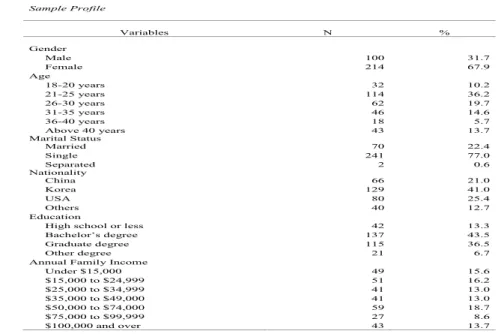
Table 1 Sample Profile
Variables N %
Gender
Male 100 31.7
Female 214 67.9
Age
18-20 years 32 10.2
21-25 years 114 36.2
26-30 years 62 19.7
31-35 years 46 14.6
36-40 years 18 5.7
Above 40 years 43 13.7
Marital Status
Married 70 22.4
Single 241 77.0
Separated 2 0.6
Nationality
China 66 21.0
Korea 129 41.0
USA 80 25.4
Others 40 12.7
Education
High school or less 42 13.3
Bachelor’s degree 137 43.5
Graduate degree 115 36.5
Other degree 21 6.7
Annual Family Income
Under $15,000 49 15.6
$15,000 to $24,999 51 16.2
$25,000 to $34,999 41 13.0
$35,000 to $49,000 41 13.0
$50,000 to $74,000 59 18.7
$75,000 to $99,999 27 8.6
$100,000 and over 43 13.7
This study used the convenience sampling method to collect data. The online survey questionnaires were distributed to students at Florida International University(FIU) using the FIU’s listserv. Additionally, the researcher distributed the online survey link to other university faculty members with personal connections in each country.
Finally, the online survey link was posted on the researcher’s personal Facebook account.
The data was collected from October 1, 2014 to December 18, 2014. Table 1 describes the profile of the sample data. Overall, the final data included a total of 315 respondents
3. Data Measurement
3.1 Dependent Variables
This study used eWOM engagement measures as the dependent variable in order to test the hypotheses. The questionnaire for eWOM section was adopted from previous studies of Bambauer-Sachse and Mangold (2011) and Jalilvand and Samiei (2012) as following:
eWOM engagement
(1) I often read other consumers’ online product/service reviews to know what products/services make good impressions on others
(2) To make sure I make the right decision, I often read other consumers’ online product/service reviews
(3) I often consult other consumers’ online product/service reviews to help choose the right decision
(4) I frequently gather information from online consumers’ product/service reviews before I make a certain decision
(5) If I don’t read consumers’ online reviews when I buy a product/service, I worry about my decision
(6) When I buy a product/service, consumers’ online reviews make me confident in purchasing the product/service
3.2 Independent Variables
This study used Hofstede’s five national cultural dimensions and nationality as the independent variables. The questionnaire for four dimensions of PDI, UAI, IDV, and MAS was adopted from previous studies of Dorfman and Howell (1988) and Lam, Lee, and Mizerski (2009) as following:
Power Distance :
(1) Inequalities among people are both expected and desired.
(2) Less powerful people should be dependent on the more powerful.
(3) Inequalities among people should be minimized.
(4) There should be, and there is to be some extent, interdependencies between less and more powerful people.
Individualism vs. Collectivism:
(1) Everyone grows up to look after him/herself and his/her immediate family only.
(2) People are identified independently of the group they belong to.
(3) An extended family member should be
protected by other member in exchange for
loyalty.
(4) People are identified by their position in the social networks to which they belong.
Masculinity vs. Femininity:
(1) Money and material things are important.
(2) Men are supposed to be assertive, ambitious and tough.
(3) Dominant values in society are caring for others and preservation.
(4) Both men and woman are allowed to be tender and to be concerned with relationships.
Uncertainty Avoidance:
(1) Uncertainty is a normal feature of life and each day is accepted as it comes.
(2) Emotions should not be shown.
(3) High stress and subjective feelings of anxiety are frequent among people.
(4) Fear of ambiguous situations and of unfamiliar risks is normal.
The questionnaire for the dimension of LTO was adopted from Yoon (2007)’s study. Yoon adopted four questions from Hofstede’s original Value Survey Module (VSM). Short-term orientation stands for (1) Personal steadiness and stability and (2) Respect for Tradition.
Long-term orientation stands for (3) Thrift and (4) Persistence (perseverance).
Long vs. Short Term Orientation:
(1) Personal steadiness and stability.
(2) Tradition.
(3) Thrift.
(4) Persistence (perseverance)
4. Data Analysis
The questionnaire of this study was adopted
from previous studies of Bambauer-Sachse and Mangold(2011), Jalilvand and Samiei(2012), Dorfman and Howell(1988), Lam, Lee, and Mizerski(2009), and Yoon(2007). The data was entered into SPSS 20.0 for data analysis.
Descriptive analysis was used to find out the respondents’ demographic and general characteristics. Instead of a series of one-at-a- time univariate analysis of variance (ANOVA), multivariate analysis of variance (MANOVA) was used to test the relationships among variables and to test hypotheses that one or more independent variables have an influence on a set of two or more dependent variables.
None of the individual ANOVAs may produce a significant main effect on the DV but it can be meaningful in combination. MANOVA is assumed to be a comparatively robust test but assumptions include normal distribution, linear relationship among homogeneity of the covari- ance matrices, independence of observation, and all sets of dependent variables. These assump- tions were checked and missing data was removed. Finally, univariate main effects were examined only on the significant variables and Post-hoc comparisons with Tukey test was performed to know the specific differences among the DVs.
Ⅳ. RESULT
1. Testing of Hypotheses
First, one-way multivariate analysis of
variance(MANOVA) was performed to check if
there are cultural differences among the countries, and then, two-way MANOVA was performed five times to check each of the cultural dimensions(PDI, IDV, MAS, UAI, and LTO). One way MANOVA was performed using cultural dimensions as the dependent variables and nationality as the independent variable and it revealed a statistically significant main effect for nationality on cultural dimensions, Wilks’ λ = .603, F (15, 847.893) = 15.000, p < .001, with partial η² = .155, indicating a strong association between cultural dimensions and the nationality.
Checking out the Box’s M test, there are significant differences among the countries in the covariance matrices. However, it wouldn’t be a problem since the power to detect the maine effect is 1.000 and the confidence level was set at 0.001 to decrease the possibility of type 1 error. Thus hypothesis 1 was confirmed.
Given the significance of the overall test, the univariate main effects were examined using cultural dimensions as the dependent variables and nationality as the independent variables to find out whether each cultural dimension variable is influenced by nationality. Significant univariate main effects for nationality were obtained for as following: IDV, F(3, 311)=19.130, p<.001, partial η²=.156; UAI, F(3, 311)=3.245, p<.022, partial η²=.030; MAS, F (3, 311)=26.489, p<.001, partial η²=.204; PDI, F(3, 311)=.3.774, p<.011, partial η²=.035; LTO, F(3, 311)=3.357, p<.019, partial η²=.031.
The Levene’s statistics for the dependent variables, which had significant univariate
ANOVAs were all non-significiant, meaning that the group variances were equal. Thus, the Tukey tests were employed for the post hoc tests to observe pairwise difference. Significant national pairwise differences in the dimension of IDV was obtained between (1) Korea(M=3.512) and China(M=4.682) and (2) Korea(M=3.512) and the USA(M=4.900); the dimension of UAI was obtained between China(M=5.621) and the USA(M=6.175); the dimension of MAS was obtained between (1) Korea(M=3.930) and the USA(M=2.625) and (2) China (M=3.985) and the USA(M=2.625); the dimension of LTO was obtained China (M=5.273) and the USA(M=5.725).
Next, the first two-way MANOVA was performed using eWOM engagement as the dependent variables and PDI and nationality as the independent variables and it didn’t revealed a statistically significant main effect for PDI dimension on eWOM engagement, Wilks’ λ
=.863, F(36, 1245.501)=1.183, p<.214, with partial η²=.024, Thus hypothesis 1b was not supported. Table 7 shows the summary of the multivariate main effect for PDI dimension.
The second two-way MANOVA was performed using eWOM engagement as the dependent variables and IDV and nationality as the independent variables and it didn’t reveal a statistically significant main effect for IDV dimension on eWOM engagement, Wilks’ λ
=.902, F(36, 1232.327) = .814, p<.775, with partial η²=.017. Thus hypothesis 1b was not supported.
The third two-way MANOVA was
performed using eWOM engagement as the
dependent variables and MAS and nationality as the independent variables and it didn’t reveal a statistically significant main effect for MAS dimension on eWOM engagement, Wilks’
λ =.853, F(36, 1236.718)=1.263, p>.138, with partial η²=.026. Thus hypothesis 1c was not supported. Table 8 shows the summary of the multivariate main effect for MAS dimension.
The fourth two-way MANOVA was
performed using eWOM engagement as the dependent variables and UAI and nationality as the independent variables and it revealed a statistically significant main effect for UAI dimension on eWOM engagement, Wilks’ λ
=.752, F(36, 1245.501)=2.317, p<.001, with partial η²=.046. Thus hypothesis 1d was confirmed. Table 2 shows the summary of the multivariate main effect for UAI.
Table 2
Summary of the multivariate main effect for UAI dimension
Independent Variables Wilks’ λ F Sig. η²
Nationality UAI
0.855 0.752
2.527 2.317
0.001 0.001
0.051 0.046
Table 3
Summary of the univariate main effects for UAI dimension
Dependent Variables F Sig. η²
eWOM engagement
(eWOM1). I often read other consumers’ online product/service reviews to know what
products/services make good impressions on others.
5.731 0.000 0.107
(eWOM2). To make sure I make the right decision, I often read other consumers’ online product/service reviews
6.392 0.000 0.118
(eWOM3). I often consult other consumers’
online product/service reviews to help choose the right decision
0.718 0.636 0.015
(eWOM4). I frequently gather information from online consumers’ product/service reviews before I make a certain decision
3.499 0.002 0.068
(eWOM5). If I don’t read consumers’ online reviews when I buy a product/service, I worry about my decision
0.770 0.594 0.016
(eWOM6). When I buy a product/service, consumers’ online reviews make me confident in purchasing the product/service
3.968 0.001 0.076
Given the significance of the overall test, the univariate main effects were examined using eWOM engagement as the dependent variables and UAI cultural dimension and nationality as the independent variables to find out whether each eWOM engagement variable
is influenced by UAI cultural dimension.
Significant univariate main effects for UAI dimension were obtained for as following:
eWOM1, F(6, 288)=5.731, p<.001, partial η
²=.107; eWOM2, F(6, 288) = 6.392, p<.001,
partial η²=.118; eWOM4, F(6, 288)=3.499,
p<.002, partial η ²=.068; eWOM6, F(6, 288)=3.968, p<.001, partial η²=.076. The table 3 shows the summary of the univariate main effects for UAI dimension.
The Levene’s statistics for the dependent variables, which had significant univariate ANOVAs were all non-significiant, meaning that the group variances were equal. Thus, the Tukey tests were employed for the post hoc tests to observe pairwise difference. Significant national pairwise differences in the dimension of eWOM1 was obtained between (1) Korea(M= 4.9690) and China(M=5.4923) and (2) Korea(M=4.9690) and the USA(M=5.7089);
the dimension of eWOM2 was obtained between Korea(M=5.0000) and the USA (M=5.7722); the dimension of eWOM4 was obtained between Korea(M=5.0388) and the USA(M=5.5696); the dimension of eWOM6 was obtained between (1) Korea(M=4.5349) and China(M=5.1077) and (2) Korea(M=4.5349) and the USA(M=5.4937). Thus, this result indicates that people from China and the USA are more likely tend to engage in social media eWOM than people from Korea in the aspect of uncertainty avoidance dimension.
The fifth two-way MANOVA was performed using eWOM engagement as the dependent variables and LTO and nationality as the independent variables and it didn’t reveal a statistically significant main effect for LTO dimension on eWOM engagement, Wilks’
λ =.866, F(30, 1146.000)=1.398, p<.076, with partial η²=.028. Thus hypothesis 1d was not confirmed.
Ⅴ. DISCUSSION AND CONCLUSION 1. Discussion of Results
The objective of this study was concerned with determining whether there is a cultural value effect on electronic word-of-mouth (eWOM) engagement in social media in the hospitality industry. The study hypotheses were partially supported and indicated that there is a significant influence of cultural value on eWOM engagement. The cultural values on social media eWOM that showed a significant difference among countries was uncertainty avoidance(UAI) dimensions. On the other hand, power distance(PDI), individualism (IDV), masculinity(MAS) and long-term orientation(LTO) dimensions indicated no significant influence on social media eWOM.
Cultural difference on social media eWOM can be inferred from uncertainty avoidance.
Hofstede (1980) argued that differences in uncertainty avoidance are potentially the most significant cultural dimension in comparison among different countries due to its relationship to tolerances for risk which is a major concern for international travelers. The result of this study indicates that people from the USA and China read other consumers’
online product/service reviews more often than Korean to know what products/services make good impression on others and to make sure they make the right decision regarding the hospitality products.
In conclusion, the main study hypothesis
was supported in this study. Thus, cultural values do play a role in determining the level of eWOM engagement in social media. Despite the globalization, cultural differences still exist when consumers using social media eWOM in the hospitality industry.
This study contributes to the theoretical foundation by attempting to provide a framework for analyzing cultural differences in social media eWOM in the hospitality industry.
This study argued for the need to take account of national culture in social media eWOM and called for developing culture-oriented eWOM tactics. Moreover, this study discovered that the Hofstede’s dimensions of uncertainty avoidance can be applied to determining cultural differences in social media eWOM. Since there are so many cultural dimensions measuring cultural differences, there have not been preceding studies in academia that suggest proper cultural dimensions determining cultural differences in social media eWOM engagement in the hospitality and tourism industry. It is expected that this attempt will contribute to the hospitality and tourism literature review.
Also, this study results add practical contribution by alerting hospitality marketers to revisit their global eWOM marketing strategies in social media. This study suggested that hospitality marketers engaging in social media should use culturally customized eWOM strategies to better engage with customers’ needs and attract global customers in the way they intend.
2. Implications for management
Due to the rapidly increasing usage of the Internet and social media, it is essential for hospitality marketers to better understand the cultural value effect on social media eWOM in the global hospitality and tourism industry.
The findings of this study are expected to provide important practical assistance for global marketing strategies in social media.
The results from this study revealed cultural influences on social media eWOM and UAI cultural dimension is more influential than other dimensions on consumers’ eWOM engagement when they are considering a purchase of hospitality products and service. It is possible that consumers’ eWOM engagement could be changed depending on the types of products and service being discussed.
Taken together, the findings of this study
reaffirm the effectiveness of cultural values on
social media eWOM in the global hospitality
industry. With the increasing usage of social
media and level of reliance on eWOM among
hospitality consumers, hospitality businesses
should consider cultural differences to better
engage in eWOM strategies. The researchers
of this study suggest that international
marketers should customize eWOM platform
services. For example, marketers in high
uncertainty avoidance cultures should make
sure customers can view overall reputation of
product or service quality and easily compare
details of different products or service so that
they can be more motivated by the risk
reduction. Comprehending the trait of social media interaction and the meaning of cultural norms and distinction should be done to know how the eWOM process shapes and develop eWOM marketing tactics in the global hospitality market.
3. Limitations and Recommendations
As with any empirical research, the present study has a few limitations that should be addressed toward direction for future studies.
First of all, findings from this study cannot be generalized since the data was obtained mainly from college students. Although college students represent the largest portion of social media users, young generations show dynamic cultural characteristics. Therefore, future studies should collect a more representative and divers samples covering other age groups.
Second, cultural dimensions in this study were
limited to Hofstede’s work. Even though this
study confirmed the Hofstede’s UAI dimension,
future research should also test diverse other
researcher’s cultural dimensions. Third, this
study used only limited six eWOM variables
which characterize general eWOM behaviors
were adapted from previous studies. As many
different platforms of social media are
emerging, revolutionized eWOM variables
measuring accurate level of engagement should
be used in future research. Finally, this study
only revealed cultural differences on a
particular setting which can be applied to
limited area. Future studies should focus on
more comprehensive and diverse setting and
compare the cultural differences among
different products or services in many diverse
settings.
APPENDIX A
Questionnaire Components
Construct/ Indicators Power
distance
1. Those in charge should make most decisions without consulting those who are not.
2. Those in charge should not delegate important tasks to those who are not.
3. Those not in charge should not disagree with the decisions of those in charge.
4. My life is chiefly controlled by powerful others.
5. I feel like what happens in my life is determined by powerful people.
Individualism 1. Group welfare is more important than individual rewards.
2. Group success is more important than individual success.
Masculinity 1. Meetings are usually run more effectively when they are chaired by a man.
2. Solving difficult problems usually requires an active forcible approach which is typical of men.
3. It is more important for men to have a professional career than it is for women.
4. It is preferable to have a man in a high level position than a woman.
5. Men solve problems with logical analysis, women solve problems with intuition.
Uncertainty Avoidance
1. Rules and regulations are important because they inform those who are working what the organization expects of them.
2. Standard operating procedures are helpful to those on the job.
3. Instructions for operations are important for those on the job.
4. Team managers expect their members to closely follow instructions and procedures.
Long/short term orientation
1. Personal steadiness and stability 2. Tradition
3. Thrift
4. Persistence (perseverance)
eWOM 1. I often read other consumers’ online product/service reviews to know what products/services make good impressions on others
2. To make sure I make the right decision, I often read other consumers’ online product/service reviews
3. I often consult other consumers’ online product/service reviews to help choose the right decision
4. I frequently gather information from online consumers’ product/service reviews before I make a certain decision
5. If I don’t read consumers’ online reviews when I buy a product/service, I worry about my decision
6. When I buy a product/service, consumers’ online reviews make me confident in purchasing the product/service
Note: *Measured with a 7-points Likert-type scale from strongly Disagree to Strongly Agree
References
1. Bambauer-Sachse, S., and Mangold, S.(201 1). “Brand equity dilution through negative online word-of-mouth communication.” Jour nal of Retailing and Consumer Services, 18 (1), 38-45.
2. Bickart, B., and Schindler, R.M.(2001). “Inter net forums as influential sources of consum er information,” Journal of Interactive Mark eting , 15(3), 31-52.
3. Blackshaw, P., and Nazzaro, M.(2004). “Con sumer-generated media (CGM) 101: Word-o f-mouth in the age of the web-fortified con sumer.” Retrieved July, 25, 2008.
4. Blackshaw, P.(2006). The consumer-controlle d surveillance culture. AvaiIable/Verfügbaru nter:http://www.clickz.com/3576076, Abfrage datum, 20, 2010.
5. Bolotaeva, V., and Cata, T.(2010). “Marketin g opportunities with social networks.” Journ al of Internet Social Networking and Virtua l Communities , 1-8.
6. Buhalis, D., and Law, R.(2008). “Progress in information technology and tourism manage ment: 20 years on and 10 years after the In ternet”, The state of eTourism research. To urism Management, 60, 9-15.
7. Chau, Patrick, Y. K., Cole, M., Massey, A.
P., Montoya-Weiss, M., and O’ Keefe, R. M.
(2002). “Cultural differences in the online be havior of consumers. Communications of the ACM”, 45(10), 138-143.
8. Cheung, C. M., Lee, M. K., and Rabjohn, N.
(2008). “The impact of electronic word-of-m
outh: The adoption of online opinions in onli ne customer communities”. Internet Researc h, 18(3), 229-247.
9. Chu, S., and Kim, Y.(2011) “Determinants of consumer engagement in electronic word-of -mouth (eWOM) in social networking site s.” International Journal of Advertising, 30 (1), 47-75.
10. Dorfman, P. W., and Howell, J. P.(1988).
“Dimensions of national culture and effecti ve leadership patterns: Hofstede revisited.”
Advances in international comparative man agement , 3, 127-150.
11. Fodness, D., and Murray, B.(1997). “Touris t information search.” Annual of Tourism Research , 24(3), 503-523.
12. Gaspay, A., Dardan, S., and Legorreta, L.(2 008). “Software of the mind - a review of applications of hofstede's theory to it resea rch.” Journal of Information Technology Th eory and Application , 9(3), 1-37.
13. Gelb, B. D., and Sundaram, S.(2002). “Adap ting to word of mouse.” Business Horizon s , 45(4), 21-25.
14. Han, S. M.(2008). “Motivations for providin g and seeking eWOM: A cross cultural co mparison of U.S. and Korean college stude nts”. Michigan State University). Pro Ques t Dissertations and Theses, 80.
15. Hennig-Thurau, T., Gwinner, K.P., Walsh,
G. and Gremler, D.D.(2004), “Electronic wo
rd-of-mouth via consumer-opinion platform
s: what motivates consumers to articulate
themselves on the Internet?,” Journal of In teractive Marketing, 18(1),38-52.
16. Hermeking, M.(2005). “Culture and Internet consumption: Contributions from cross-cult ural marketing and advertising research.” J ournal of Computer-Mediated Communicat ion, 11(1).
17. Hofstede, G.(1980a) Culture'sConsequences:I nternational Differences in Work Related V alues. Sage: BeverlyHills, CA: Sage Publica tions.
18. Hofstede, G.(1980b) “Motivation, Leadershi p, and Organization: do American theories apply abroad?,” Organizational Dynamics , 9(1), 42-63.
19. Hofstede, G.(1983). “National cultures in fo ur dimensions-A research-based theory of cultural differences among nations.” I nterna tional Studies of Management and Organiz ation , 13(1-2), 46-74.
20. Internet World Stats (2014). World Internet users and 2014 population stats. Retrieved from
21. Ip, C., Leung, R., and Law, R.(2011). “Prog ress and development of information and c ommunication technologies in hospitality.” I nternational Journal of Contemporary Hos pitality Manage Jalilv and , M. R. and Sam iei, N. (2012). “The effect of word of mout h on inbound tourists' decision for travelin g to Islamic destinations (the case of Isfah an as a tourist destination in Iran).” Journ al of Islamic Marketin g, 3(1), 12-21 .ment, 23(4), 533-551.
22. Jeng, J., and Fesenmaier, D. R.(2002). “Con ceptualizing the travel decision-making hier
archy: A review of recent developments”.
Tourism Analysis, 7(1), 15-32.
23. Jobs, C., and Gilfoil, D.(2012). “Less is Mor e for Online MARCOM in Emerging Mark ets: Linking Hofstede’s Cultural Dimensions and Higher Relative Preferences for Micro blogging in Developing Nations”. Academy of Marketing Studies Journal, 16(2),79-96.
24. Kang, J.(2011). Social media marketing in t he hospitality industry: The role of benefit s in increasing brand community participati on and the impact of participation on cons umer trust and commitment toward hotel a nd restaurant brands. Iowa State Universit y). ProQuest Dissertations and Theses, ,17 1.Retrieved from http://ezproxy.fiu.edu/logi n?url=http://search.proquest.com/docview/91 9703655?accountid=10901.(919703655).
25. Kaplan, A. M., and Haenlein, M.(2010). “Us ers of the world, unite! The challenges and opportunities of Social Media”. Business ho rizons, 53(1),59-68.
26. Kirkman, B. L., Lowe, K. B., and Gibson, C. B.(2006). “A quarter century of culture' s consequences: A review of empirical rese arch incorporating hofstede's cultural value s framework”. Journal of International Bus iness Studies, 37(3), 285-320.
27. Koester, J., and Lustig, M.(2012). Intercultu ral competence: Interpersonal communicatio n across cultures. Pearson Prentice Hall.
28. Kozinets, R. V., De Valck, K., Wojnicki, A.
C., and Wilner, S. J.(2010). “Networked nar
ratives: Understanding word-of-mouth mar
keting in online communities”. Journal of
marketing , 74(2), 71-89.
29. Kralisch, A., and Berendt, B.(2004). “Cultur al determinants of search behaviour on we b sites. In Proceedings of the IWIPS2004 Conference on culture,” t rust, and design i nnovation , 61-74.
30. Lam, D., Lee, A., and Mizerski, R.(2009).
“The Effects of Cultural Values in Word-o f-Mouth Communication”. Journal of Intern ational Marketing, 17(3), 55-70.
31. Law, R., Leung, R., and Buhalis, D.(2009).
“Information technology applications in hos pitality and tourism: a review of publicatio ns from 2005-2007”. Journal of Travel &
Tourism Marketing, 599-623.
32. Leung, D., Law, R., van Hoof, H., and Buh alis, D.(2013). “Social Media in Tourism an d Hospitality: A Literature Review”. Journ al of Travel & Tourism Marketing , 30(1- 2), 3-22.
33. Litvin, S.W., Goldsmith, R.E., and Pan. B.(2 008). “Electronic Word-of-Mouth in Hospit ality and Tourism Management”. Tourism Management, 29(2),458-468.
34. Litvin, S. W., and Hoffman, L. M.(2012).
“Responses to consumer-generated media i n the hospitality marketplace An empirical study”. Journal of Vacation Marketing, 18 (2),135-145.
35. Okazaki, S., and Taylor, C. R.(2013). “Socia l media and international advertising: theor etical challenges and future directions”. Int ernational Marketing Review, 30(1), 56-71.
36. Paris, C. M., Lee, W., and Seery, P.(2010).
“The role of social media in promoting spe cial events: acceptance of Facebook Event s”. Information and Communication Techno
logiesin Tourism, 14, 531-541.
37. Penney, G.(2010). Executive fire officers' st rategic thinking capabilities and the irrelati onship with information and communication technology. Florida Atlantic University). Pr o Quest Dissertations and Theses, ,162. R etrieved from http://ezproxy.fiu.edu/login?ur l=http://search.proquest.com/docview/747045 165?accountid=10901.(747045165).
38. Trusov, M., Bucklin, R.E. and Pauwels, K.
(2009). “Effects of Word-of-Mouth Versus Traditional Marketing: Findings from an In ternet Social Networking Site”. Journal of Marketing , 73(3),90-102.
39. Volo, S.(2010). “Bloggers’ reported tourist e xperiences: Their utility as a tourism data source and their effect on prospective touri sts”. Journal of Vacation Marketing, 16(4), 297-311.
40. Wang, Y., and Fesenmaier, D. R.(2004). “M odeling participation in an online travel co mmunity”. Journal of Travel Research, 42 (3), 261-270.
41. Xiang, Z., and Gretzel, U. (2010). “Role of social media in online travel information se arch”. Tourism Management, 31(2), 179-18 8.
42. Yoo, Y and B. Torrey.(2002). National Cult ure and Knowledge Management in a Glob al Learning Organization. C. W. Choo & N.
Bontis (Eds.). The Strategic Management o f Intellectual Capital and Organizational Kn owledge(421-434).NewYork,NY:OxfordUnive rsityPress.
43. Yoon, M.(2007). “An experimental study of
consumer's attitudes toward the web: Cros
s-cultural analysis of cultural value sand o nline consumer behavior”. University of Mi ssouri Columbia). Pro Quest Dissertation s and Theses, ,139.Retrieved from http://ezpr oxy.fiu.edu/login?url=http://search.proquest.c om/docview/304828409accountid=10901.(3048 28409).
44. Yoon, S. N.(2008). “The effects of electroni c word-of-mouth systems(EWOMS) on th e acceptance of recommendation”. THE UN IVERSITY OF NEBRASKA-LINCOLN.
45. Zakour, A. B. (2003). “Cultural Differences
and information Technology Acceptance,” P
roceedings of the 7th Annual Conference of
the Southern Association for Information S
ystems, Available at :http://sais.aisnet.org/2
004/.%5CZa kour. pdf, last accessed Dec.1,2
006.
초 록
환대산업에서 문화적 가치의 Social Media를 통한 Electronic word-of-mouth (eWOM)에 대한 영향
†-중국, 한국, 미국 간의 문화 비교 연구-
*
Kang, Sun-Goo
*․Oh, Chang-Ho
**Social Media 상의 Electronic word-of-mouth(eWOM)는 다양한 사업 경영에 있어서 핵심적인 마케 팅 도구로 인식되고 있다. 환대산업에서는 이 Social Media eWOM를 이해하는 것은 잠재적 고객들에 게 국제적으로 쉽고 빠르게 다가가는 핵심요인이라 볼 수 있다. 그러나 환대산업분야에서의 Social Media eWOM의 효율성을 국제적 관점에서 평가하는 실증 연구는 아주 부족한 실정이다. 환대산업시 장의 경쟁적인 특성을 고려하면, 마케팅 종사자들은 Social Media eWOM의 효율성의 평가는 물론, 외 국인 고객을 촉진하고 수익성을 증대하기 위한 문화적 요소에 의한 효과의 평가하여야 한다. 본 연구 의 핵심 목적은 환대산업에서 Social Media eWOM가 문화적 가치에 영향력을 검증하는 것이다. 본 연 구는 중국, 한국, 미국의 세 나라를 비교 하여 나라마다 Social Media eWOM에 관여하는 정도의 차이 의 존재를 실증하였다. 본 연구는 환대산업 마케터에게 국제적 Social Media 마케팅 전략에 중요한 의 미를 제공할 것이라 기대된다.
핵심주제어: eWOM, social media, cross-cultural, hospitality industry, cultural dimensions
* 영산대학교 호텔관광대학 초빙교수, [email protected]
** 영산대학교 관광컨벤션학과 교수, [email protected]