495
and Safety
Available online at http://www.foodhygiene.or.kr
https://doi.org/10.13103/JFHS.2018.33.6.495
후춧가루에 인위접종된 Escherichia coli O157:H7,
Salmonella Typhimurium 에 대한 UV-C와 mild heat의 살균 효과
곽승해·김진희·오세욱*
국민대학교 식품영양학과
Combination Effect of UV-C and Mild Heat Treatment Against Artificially Inoculated Escherichia coli O157:H7,
Salmonella Typhimurium on Black Pepper Powder
Seung-Hae Gwak, Jin-Hee Kim, and Se-Wook Oh* Department of Food and Nutrition, Kookmin University, Seoul, Korea
(Received September 6, 2018/Revised September 24, 2018/Accepted November 12, 2018)
ABSTRACT - The reduction effect of UV-C irradiation and mild heat treatment was examined against Escheri- chia coli O157:H7 and Salmonella Typhimurium on black pepper powder. E. coli O157:H7 (ATCC 35150) and S.
Typhimurium (ATCC 19585) were inoculated onto black pepper powder at approximately 107 and 106 CFU/g, respec- tively. E. coli O157:H7 and S. Typhimurium were treated with UV-C and mild heat at 60oC. A UV-C intensity (2.32 W/cm2) was used for 10 min to 70 min at 60oC. After UV-C and heat treatment at 60oC, microbial analysis and color change of black pepper powder was conducted. E. coli O157:H7 and S. Typhimurium were reduced by a level of 1.89 and 2.24 log CFU/g, respectively, when treated with UV-C alone for 70 min. And E. coli O157:H7 and S. Typhimu- rium were reduced by 2.22 and 5.10 log CFU/g, respectively, when treated with mild heat treatment at 60oC alone for 70 min. But when combined with UV-C and mild heat, it showed higher levels of reduction by 2.46 and 5.70 log CFU/
g. S. Typhimurium was more easily reduced than E. coli O157:H7. Color values were not significantly (p > 0.05) dif- ferent in all treated samples. Therefore, these results suggest that the combined treatment with UV-C and mild heat was effective to inactivate the food pathogens in black pepper powder and can be used as a food industrial microbial intervention method.
Key words: Black pepper powder, UV-C irradiation, Mild heat, Sterilization, E. coli O157:H7, S. Typhimurium
향신료(Spices)는 스파이스(spices)와 향료식물(herbs)의 총칭으로 식품에 맛, 색, 향을 변화시켜 풍미를 주어 식욕 을 증진시키고 소화흡수를 돕는 기능이 있으며 생선의 이 취를 제거하는데 효과적이다1-3). 후추는 후추과(Piperaceae) 의 열대성 식물인 Pirernigrum L.의 열매를 건조한 것으로 식품공장 및 가정에서 향신료로 많이 사용되고 있다4). 후 추의 주성분 중 하나인 Piperine은 위액 분비를 촉진시켜 소화흡수를 돕는 기능이 있으며, 항염, 항산화 작용이 있 다는 보고도 있다4).
후춧가루는 수확 후 세척하여 건조, 분쇄 과정을 거치
는 가공 특성상 가공처리 중 다양한 곰팡이류, 세균 및 내 열성 포자 형성균 등에 오염될 수 있으며 가공 처리를 한 후에도 식중독 균에 오염될 가능성이 있다5). 또한 Salmonella spp., Bacillus cereus, Escherichia coli, Clostridium 등의 미 생물들이 후추에서 검출되었다는 보고가 있어 효과적인 살균 기술이 필요한 실정이다6). 일반적으로 향신료에 사 용되는 식품 살균처리 기술에는 감마선 조사, 오존수 처 리, microwave 처리, ethylene oxide를 이용한 훈증제 처 리 등이 있다7,8). 그러나 감마선 조사는 시설의 초기 설비 비용이 많이 들고 방사선 식품 표시의무로 인해 소비자의 인식이 부정적이며9), 오존수 처리는 시간이 많이 소요되 고 휘발성 화학물질이 발생하여 품질을 저하시킬 수 있으 며10), microwave 처리는 살균 효과가 미미하며 훈증제 처 리는 유해한 독성물질의 생성으로 인한 발암가능성이 있
*Correspondence to: Se-Wook Oh, Department of Food and Nutrition, Kookmin University, Seoul 02727, Korea
Tel: 82-2-910-5778, Fax: 82-2-910-5249 E-mail: [email protected]
어 사용이 금지되었다. 이외에도 처리 후 풍미 및 품질 변 화, 영양 손실, 2차 오염 가능성, 부산물의 잔류 등 많은 문제점을 내포하고 있다11,12).
Ultraviolet (UV)는 물리적인 비가열 처리기술로써 파장 의 범위에 따라 UV-A, UV-B, UV-C로 구분되는데, 그 중 UV-C가 일반적으로 식품 살균에 쓰이는 파장이다13). 특히 UV-C인 253.7 nm의 파장이 식품 살균에 주로 사용되는데, DNA base에 손상을 일으켜 pyrimidine dimer를 생성하고 DNA 전사와 복제를 방해하여 미생물을 사멸 시킨다고 알 려져 있다14). 열을 적게 발생시키는 물리적 처리 방법으로 식품의 품질 변화가 적고 화학적 위해 요소 생성이 없으 며 또한 온도와 수분의 영향을 크게 받지 않는다. 이러한 장점 때문에 유통기한 연장을 위한 식품 표면의 살균 기 술로써 FDA에서 사용이 승인된 기술이다15,16). 그러나 UV- C는 식품 내부 깊숙이 침투하기 어려워 높은 효율의 미생 물 살균은 어렵다는 단점이 있어 다른 살균 기술과 병합 하여 사용되기도 하였다17).
전통적으로 행하여져 왔던 열처리 방법은 곰팡이 및 식 품에 부패를 일으키는 미생물을 저해하는 효과적인 방법 이지만 너무 높은 온도로 처리할 경우 식품의 관능적 품 질을 저하시킬 수 있다18,19).
현재 국내에서 UV-C 조사와 mild heat을 병합 처리하여 후춧가루의 미생물적 안전성을 파악한 연구는 미흡한 실 정이다. 따라서 본 연구에서는 후춧가루의 안전성과 저장 성을 확보하기 위해 물리적인 방법인 UV-C와 mild heat 을 단일 처리 및 병합 처리하여 이에 의한 미생물 사멸 효과 및 관능적 품질 변화를 조사하였다.
Materials and Methods
사용 균주 및 활성화
Escherichia coli O157:H7 (ATCC 35150)와 Salmonella Typhimurium (ATCC 19585)는 한국미생물자원센터(Korean Collection for Type Cultures, KCTC, Jeollabukdo, Korea) 에서 분양 받은 후 −80oC 초저온 냉동고에서 50% glycerol stock (v/v)에 보관하여 사용하였다. 모든 균주는 tryptic soy broth (Difco, Franklin Lakes, New Jersey, USA) 10 mL 에 50% glycerol stock (v/v)을 0.1 mL 접종하여 37oC에서 7시간 동안 1차 배양한 뒤, 16시간 동안 2차 배양하여 균 주를 활성화한 후 실험에 사용하였다.
시료 준비 및 미생물 접종
후춧가루는 서울시 성북구에 위치한 대형마트에서 구매 하여 사용하였다. 후춧가루에 균을 접종하기 위하여 후추 를 120 g씩 멸균 비닐백(Whirl-pak, 19 × 30 cm; Nasco, Fort Atkinson, WI, USA)에 넣고 109CFU/mL 수준으로 배양한 E. coli O157:H7와 S. Typhimurium 배양액을 각각
12 mL씩 접종하여 2분간 마사지한 뒤 1시간 동안 clean bench에서 건조시켰다. 결과적으로 S. Typhimurium와 E.
coli O157:H7이 각각 106, 107CFU/g 수준이 되도록 접종 하였다.
UV-C와 mild heat 병합 처리 방법
후춧가루에 대한 UV 조사와 mild heat 처리는 자체 제 작한 UV incubator를 사용하여 진행되었다. UV incubator 에 2개의 UV lamp (58W, SANTO-UV, Incheon, Korea)와 roaster (MK-300, JC Company, Foshan, China)을 설치하 였다. 후춧가루는 UV incubator 안에 roaster (diameter 24 cm, depth 3.5 cm)에 둔 뒤 UV-C를 조사하고 이 후 mild heat 처리하였다. 시료와 UV lamp 사이의 거리는 5 cm로 조정하였고, UV-C가 후춧가루에 고르게 조사되도록 하기 위해 roaster를 이용하여 균일하게 혼합되도록 하였다. UV- emitting lamp (length 510 mm, lamp diameter 19 mm)의 파장은 253.7 nm이었고, 조사선량은 2.32 W/cm2이었다.
Incubator 내부 온도는 30oC와 60oC로 설정한 후, UV-C와 mild heat 처리를 단독 또는 병합하여 0, 10, 20, 30, 40, 50, 60, 70분 동안 처리하였다.
생균수 측정
후춧가루에 존재하는 미생물을 분석하기 위해 후춧가루 10 g에 90 mL의 멸균한 0.85% saline을 첨가하여 stomacher (Laboratory Blender Stomacher 400; Seward, MO, USA)로 2분간 균질화하였다. 그 후, 0.85% 생리식염수를 사용하 여 십진 희석하였다. 이 후 S. Typhimurium와 E. coli O157:
H7은 각각 선택배지인 xylose-lysine-deoxycholate agar (XLD, Oxoid, Hampshire, UK)와 Eosin methylene blue agar (EMB agar, Oxoid, Hampshire, UK)에 도말하였다.
도말 후 37oC에서 24-48 시간 배양하고 형성된 집락 수를 계수하였다.
색도 측정
UV-C와 mild heat 처리에 따른 후춧가루의 색도 변화를 파악하기 위해 각 시간 별로 처리 후, 2 g의 후추를 petri dish에 소분한 뒤 colorimeter (CR-400 Chroma Meter, Konica Minolta Sensing, Inc., Japan)를 이용하여 명도(light- ness, L-value), 적색도(redness, a-value), 및 황색도(yellow- ness, b-value)를 측정하였다.
통계적 처리 분석
모든 실험 결과의 유의성 검정은 각 3회 반복 측정하여 IBM SPSS statistics program (version 23, IBM Corp., New York, USA)을 사용하여 통계처리 하였다. One Way ANOVA와 Duncan’s multiple range test 방법을 사용하여 p < 0.05 범위 내에서 실험 데이터의 유의성을 검증하였다.
Results and Discussion
UV-C와 mild heat 병합 처리에 의한 살균 효과
후춧가루에 인위 접종한 존재하는 식중독 세균에 대한 UV-와 mild heat 병합 처리 후 살균 효과를 Fig. 1과 Fig.
2에 나타내었다. Fig. 1은 S. Typhimurium에 대한 효과를 나타내었다. 후춧가루에 S. Typhimurium의 초기 농도가 6.73 log CFU/g이 되도록 접종하였다.
Mild heat 처리 없이 30oC에서 2.32 W/cm2의 조사선량 으로 UV-C를 단독으로 조사했을 때, 20분 동안 S.
Typhimurium을 0.84 log CFU/g 정도 저감하였으며, 70분 동안 처리하였을 때 약 2.24 log CFU/g 수준의 살균 효과 를 나타내었다. 60oC에서 20분 동안 처리했을 때 2.01 log CFU/g 정도로 저감되었고, 70분 동안 처리했을 때에는 약 5.10 log CFU/g으로 저감되었다. UV-C와 mild heat 병행 처리를 70분 이상 처리했을 때, 약 5.70 log CFU/g 이상의 저감 효과를 나타내었다. UV-C와 60oC 병행 처리는 UV- C 단독 처리보다 유의적인(p < 0.05) 차이가 있었다. 결과 적으로 UV-C와 60oC를 병합 처리했을 때, 후춧가루에 인 위 접종한 식중독 균에 대한 가장 큰 살균효과가 있었으 며 UV-C와 60oC 단독 처리에 비하여 유의적 차이(p < 0.05) 가 있었다.
S. Typhimurium에 대하여 각 처리구의 살균 효과를 비 교하였을 경우, UV-C와 60oC 병합 처리, 60oC 단독 처리, UV-C 단독 처리 순으로 효과가 크게 나타났으며 각 처리 구 간에 유의적 차이(p < 0.05)가 있었다.
E. coli O157:H7에 대한 UV-C와 mild heat 병행 처리에 대한 저감효과를 Fig. 2에 나타내었다. 후춧가루에 인위적 으로 접종된 E. coli O157:H7의 초기 농도는 약 7.78 log CFU/g 수준이었다.
Mild heat 없이 UV-C를 단독으로 처리했을 때, 30분 동 안 E. coli O157:H7을 0.59 log CFU/g 정도 저감하였으며, 70분 동안 처리했을 때 약 1.89 log CFU/g 정도 살균 효과 를 나타내었다. 60oC에서 30분 동안 처리했을 때에는 1.51 log CFU/g 정도로 저감 효과가 나타났고 70분 동안 처리 했을 때는 약 2.22 log CFU/g 정도로 효과가 나타났다. UV- C와 mild heat 병행 처리를 70분 이상 처리했을 때, 약 2.46 log CFU/g 이상의 저감 효과를 나타내었다. UV-C와 60oC 병합 처리는 UV-C 단독처리보다 유의적인(p < 0.05) 차이가 있었으나 60oC 단독처리구와 유의적인(p > 0.05) 차 이가 없었다. UV-C와 60oC 병합 처리했을 때, 식중독 균 저감 효과가 가장 크게 나타났으며, UV-C의 단독 처리 효 과와 비교하였을 때 유의적 차이(p < 0.05)를 나타내었다.
E. coli O157:H7에 대해 각 처리구의 살균 효과를 비교 하면, S. Typhimurium에 대한 효과와 같이 UV-C와 60oC 병합 처리, 60oC 단독 처리, UV-C 단독 처리 순으로 효 과가 큰 것으로 나타났다. UV-C와 60oC의 병합 처리와 UV-C 단독 처리 사이에는 유의적인(p < 0.05) 차이가 나타 났지만 열 단독 처리에는 유의적인(p > 0.05) 차이가 없었 다. Gabriel 등20)은 S. Typhimurium이 E.coli O157:H7과 L.
monocytogenes 보다 UV에 대한 저항성이 낮다고 보고하 고 있다. 마찬가지로 실험 결과에서 E. coli O157:H7 보 다는 S. Typhimurium의 저감효과가 더 큰 것으로 판단되 었다.
UV-C는 DNA base에 돌연변이를 일으켜 광화학적 산화 Fig. 2. Effect of UV-C and mild heat treatment against E. coli
O157:H7 inoculated on black pepper powder The date are ex- pressed at the mean value ± standard deviation of three individual experiments. Each experiment was conducted in duplicated.
Different capital letters indicate significant differences (p < 0.05) among treatments for each time
Fig. 1. Effect of UV-C and mild heat treatment against S. Typh- imurium inoculated on black pepper powder. The date are ex- pressed at the mean value ± standard deviation of three individual experiments. Each experiment was conducted in duplicated.
Different capital letters indicate significant differences (p < 0.05) among treatments for each time
반응을 일으켜 pyrimidine dimer를 생성하여 DNA 전사와 복제를 방해함으로써 미생물을 사멸시킨다14). 그리고 UV- C를 이용한 살균효과는 UV lamp 사이의 거리, UV-C 조 사선량, 조사 시간에 따라 달라진다21). 이러한 조건들을 조 정하면 미생물 살균 효과가 커지지만 본 실험 결과에선 후춧가루를 UV-C 단독 처리 했을 때 큰 효과가 나타나지 않았다. Todo 등22)은 UV-C가 균에 손상을 입히고 열처리 에 따라 세포막의 유동성이 커지며 이에 따라 UV-C에 따 른 효과가 커진다는 연구 결과가 있다. 이러한 결과를 통 하여 후춧가루에 오염된 식중독 균을 살균시키는 데에 mild heat과 UV-C 조사를 병합 처리한 것이 효과가 있다 고 판단하였다.
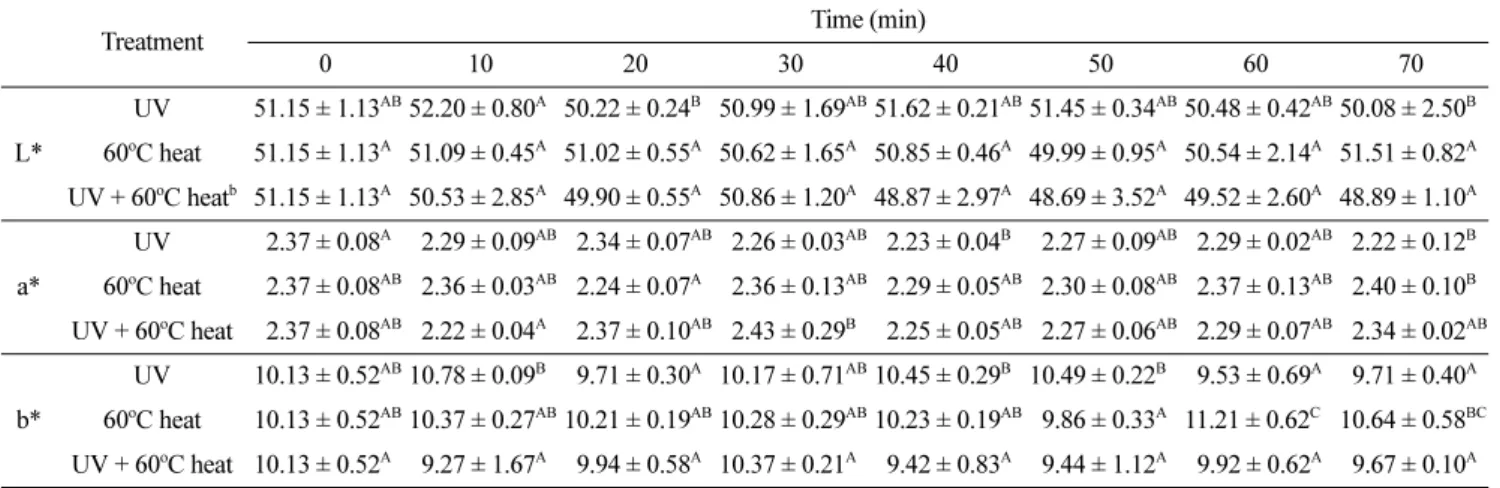
UV-C와 mild heat 병합처리에 따른 후추 색도 변화 후춧가루에 UV-C와 mild heat를 처리한 후, colorimeter 로 측정한 색의 변화는 Table 1에 나타내었다. 처리 전 후 춧가루의 L*, a*, b* 값은 각각 51.15 ± 1.13, 2.37 ± 0.08, 10.13 ± 0.52로 측정되었다. 후추에 UV-C와 mild heat 을 70분간 처리 후 측정한 L*, a*, b* 값은 각각 48.89 ± 1.10, 2.34 ± 0.02, 9.67 ± 0.10 이었다. Jaczynski 등23)은 가열 및 전자선 조사에 따라 후춧가루의 색변화가 거의 없다고 보 고한 바 있다. 60oC 열 단독 처리에서는 b* 값에 유의적 인(p < 0.05) 차이가 있었지만 이는 시료 간의 차이라고 판 단되었다. 전체적으로 L*, a*, b* 값에 유의적인(p > 0.05) 차이가 없었다. 이를 종합하여 판단하여 볼 때 UV-C와 mild heat 단독처리 뿐만 아니라 UV-C와 mild heat 병합 처리가 후춧가루의 색 품질변화에 영향을 미치지 않으며 후춧가루에 대한 상업적 살균 기술로 이용이 가능할 것으 로 판단되었다.
국문요약
후춧가루에 존재하는 식중독 균을 저감화시키기 위한 방 법으로 UV-C와 mild heat를 병합 처리 가능성을 타진하 였다. Escherichia coli O157:H7 (ATCC 35150)와 Salmonella Typhimurium (ATCC 19585)를 후춧가루에 각각 106, 107 CFU/g 수준으로 인위접종하여 2.32 W/cm2의 UV-C와 60oC 의 mild heat을 10분에서 70분 동안 처리하였다. 그 후 미 생물 분석 및 후춧가루의 품질변화를 측정하였다. UV-C 를 단독으로 70분 동안 처리했을 때 E. coli O157:H7과 S. Typhimurium는 각각 1.89, 2.24 log CFU/g 수준으로 감 소하였지만, UV-C와 mild heat을 70분 동안 병합처리 했 을 때는 각각 2.46, 5.70 log CFU/g으로 감소하였다. E. coli O157:H7 보다는 S. Typhimurium의 저감효과가 더 컸다.
색도는 모든 처리구에서 유의적인 차이가 없는 것으로 나 타났다. 따라서 UV-C와 mild heat 병합처리는 후춧가루에 존재하는 식중독 균을 사멸시키는 데 효과적이기 때문에 산업적인 살균처리 기술로 활용될 수 있을 것으로 판단되 었다.
Acknowledgments
본 연구는 농림축산식품부의 재원으로 고부가가치 식품 개발사업(과제번호 농축2017300496호)의 연구비 지원에 의해 수행되었으며 이에 감사드립니다.
Reference
1. Kim, M.L.: Function of spice and herbs. J. East Asian Soc.
Dietary Life., 12, 431-453 (2002).
Table 1. Changes in color values of black pepper powder treated with UV-C and mild heat in alone or combination according to treat- ment time
Treatment Time (min)
0 10 20 30 40 50 60 70
L*
UV 51.15 ± 1.13AB52.20 ± 0.80A 50.22 ± 0.24B 50.99 ± 1.69AB51.62 ± 0.21AB51.45 ± 0.34AB50.48 ± 0.42AB50.08 ± 2.50B 60oC heat 51.15 ± 1.13A 51.09 ± 0.45A 51.02 ± 0.55A 50.62 ± 1.65A 50.85 ± 0.46A 49.99 ± 0.95A 50.54 ± 2.14A 51.51 ± 0.82A UV + 60oC heatb 51.15 ± 1.13A 50.53 ± 2.85A 49.90 ± 0.55A 50.86 ± 1.20A 48.87 ± 2.97A 48.69 ± 3.52A 49.52 ± 2.60A 48.89 ± 1.10A
a*
UV 02.37 ± 0.08A 02.29 ± 0.09AB02.34 ± 0.07AB02.26 ± 0.03AB02.23 ± 0.04B 02.27 ± 0.09AB02.29 ± 0.02AB02.22 ± 0.12B 60oC heat 02.37 ± 0.08AB02.36 ± 0.03AB02.24 ± 0.07A 02.36 ± 0.13AB02.29 ± 0.05AB02.30 ± 0.08AB02.37 ± 0.13AB02.40 ± 0.10B UV + 60oC heat 02.37 ± 0.08AB02.22 ± 0.04A 02.37 ± 0.10AB02.43 ± 0.29B 02.25 ± 0.05AB02.27 ± 0.06AB02.29 ± 0.07AB02.34 ± 0.02AB
b*
UV 10.13 ± 0.52AB10.78 ± 0.09B 09.71 ± 0.30A 10.17 ± 0.71AB10.45 ± 0.29B 10.49 ± 0.22B 09.53 ± 0.69A 09.71 ± 0.40A 60oC heat 10.13 ± 0.52AB10.37 ± 0.27AB10.21 ± 0.19AB10.28 ± 0.29AB10.23 ± 0.19AB09.86 ± 0.33A 11.21 ± 0.62C 10.64 ± 0.58BC UV + 60oC heat 10.13 ± 0.52A 09.27 ± 1.67A 09.94 ± 0.58A 10.37 ± 0.21A 09.42 ± 0.83A 09.44 ± 1.12A 09.92 ± 0.62A 09.67 ± 0.10A Means ± standard deviation obtained from two repected experiments
Different capital letters indicate significant differences (p < 0.05) among each time for treatments
2. Kim, M.L., Choi, K.H., Park, C.S.: Antibacterial activity of powdered spice against Escherichia coli and Staphylococcus aureus. Korean J. Postharvest Sci. Technol., 7, 124-131 (2000).
3. Park, J.H.: Sterilization effect of microorganism on black and white pepper using intense pulsed light. MS thesis, Jeonju University, Jeonju, Korea (2016).
4. Pursglove, J.W., Brown, E.G., Green, C.L., Robbins, S.R.J.:
Spices. Vol. 2. Longman, London, UK (1981).
5. Banerjee, M., Sarkar, P.S.: Growth and enterotoxin produc- tion by sporeforming bacterial pathogens from spices. Food Control., 15, 491-496 (2004).
6. Sofia, M.S.F., Joseph, F.F.: Challenges in the control of food- borne pathogens in low-water activity foods and spices. In:
The Microbiological Safety of Low Water Activity Foods and Spices. Gurtler JB, Doyle MP, Kornacki JL (eds.) Springer-Verlag, New-York, NY, USA. pp 15-34 (2014).
7. Byun, M.W., Lee, J.W.: Application of irradiation technol- ogy for food safety and security. Food Sci. Indus., 36, 25-41 (2003).
8. Wang, J., Yang, J.S.: The effect of gamma-ray irradiation on the drying characteristics and final quality of dried potato slices. Int. J. Food Sci. Technol., 40, 75-82 (2005).
9. Yi, S.D., Oh, M.J., Yang, J.S.: Detection capability by change of amylograph characteristics of irradiated black pepper.
Korean J. Food Sci. Technol., 33, 195-199 (2001).
10. Zhao, J., Cranston, P.M.: Microbial decontamination of black pepper by ozone and the effect of the treatment on volatile oil constituents of the spice. J. Sci. Food Agric., 68, 11-18 (1995).
11. Choi, S.G.: Food and spice. J. East Asian Soc. Dietary Life, 12, 461-470 (2002).
12. Kim, B.H., Kim, H.J., Yoon, Y.H., Shin, M.G., Lee, J.W.:
Comparison of the effects of gamma ray and electron beam irradiation to improve safety of spices for meat processing.
Korean J. Food Sci. Ani. Resour., 30, 124-132 (2010).
13. Schenk, M., Raffellini, S., Guerrero, S., Blanco, G.A., Alzamora, S.M.: Inactivation of Escherichia coli, Listeria innocua and Saccharomyces cerevisiae by UV-C light: study
of cell injury by flow cytometry. LWT-Food Sci. Technol., 44, 191-198 (2011).
14. Allende, A., Art s, F.: UV-C radiation as a novel technique for keeping quality of fresh processed ‘Lollo Rosso’ lettuce.
Food Res. Int., 36, 739-746 (2003).
15. Artes-Hernandez, F., Robles, P.A., Gomez, P.A., Tomas- Callejas, A., Artes, F.: Low UV-C illumination for keeping overall quality of freshcut watermelon. Postharv. Biol. Tech- nol., 55, 114-120 (2010).
16. FDA.: Ultraviolet radiation for the processing and treatment of food. Code of Federal Regulations., 21, Part 179.39 (2002).
17. Bintsis, T., Litopoulou-Tzanetaki, E., Robinson, R.K.: Exist- ing and potential applications of ultraviolet light in the food industry-a critical review. J. Sci. Food Agric., 80, 637-645 (2000).
18. Nissen, E., Koenig, P., Feinstone, S., Pauli, G.: Inactivation of hepatitis A and other enteroviruses during heat treatment (pasteurization). Biologicals., 24, 339-341 (1996).
19. Wilbey, R.A., Brennan, J.G.: Water and waste treatment, Food processing handbook. Weinheim, Wiley-VCH Verlag GmbH & Co., KGaA, Germany. pp. 399-428 (2006).
20. Gabriel, A.A., Nakano, H.: Inactivation of Salmonella, E.
coli and Listeria monocytogenes in phosphate-buffered saline and apple juice by ultraviolet and heat treatments.
Food Control., 20, 443-446 (2009).
21. Allende, A., McEvoy, J. L., Luo, Y., Artes, F., &Wang, C. Y.:
Effectiveness of twosided UV-C treatments in inhibiting nat- ural microflora and extending the shelflife of minimally pro- cessed ‘Red Oak Leaf’ lettuce. Food Microbiology., 23, 241- 249 (2006).
22. Todo, T., Yonei, S., Kato, M.: The modulating influence of the fluidity of cellmembrane of excision repiar of DNA in UV-irradiated Escherichia coli. Biochem. Biophys. Res.
Commun., 110, 609-615 (1983).
23. Janczynski, J., Park, J.W.: Physicochemical properties of surimi seafood as affected by electron beam and heat. J.
Food Sci., 68, 1626-1630 (2003).
e·