• 검색 결과가 없습니다.

Celebrity Endorser and Purchase Intention: The Mediating Role of Resonance-Based Self-Attitude and Brand Credibility

N/A
N/A
Protected

Academic year: 2021

Share "Celebrity Endorser and Purchase Intention: The Mediating Role of Resonance-Based Self-Attitude and Brand Credibility"

Copied!
9
0
0

로드 중.... (전체 텍스트 보기)

전체 글

(1)

Print ISSN: 2288-4637 / Online ISSN 2288-4645 doi:10.13106/jafeb.2021.vol8.no7.0603

Celebrity Endorser and Purchase Intention: The Mediating Role of Resonance-Based Self-Attitude and Brand Credibility

Stephanie Angelina GUNAWAN

1

, Asep HERMAWAN

2

, Anton Wachidin WIDJAJA

3

, Innocentius BERNARTO

4

Received: March 30, 2021 Revised: June 07, 2021 Accepted: June 17, 2021

Abstract

This study aims to analyze the mediating influences of resonance-based self-attitude and brand credibility in a relationship between celebrity endorser credibility and celebrity endorser congruity toward brand purchase intention in the current dynamic business environment. It employs a quantitative research method and reports on a survey, using a questionnaire, including the population of consumers of various instant coffee brands in several cities in Indonesia. The number of respondents in this study was 432 people. The analysis was performed using Partial Least Square Structural Equation Modeling and SmartPLS software. The analysis consisted of descriptive statistics, evaluation of the measurement model, evaluation of the structural model, and hypothesis testing. The results partially support the model developed. The findings suggest that the instant coffee product advertising in Indonesia needs to create brand messages focusing on the formation of resonance-based self-attitude from consumers to increase the influence of celebrity endorser credibility and celebrity endorser congruity, as well as the brand credibility towards the brand purchase intention. This study contributes to the marketing literature and the theory of planned behavior by providing empirical evidence on the relationship between celebrity endorser credibility, celebrity endorser congruity, resonance-based self-attitude, brand credibility, and brand purchase intention.

Keywords: Celebrity Endorser Credibility, Celebrity Endorser Congruity, Resonance-Based Self-Attitude, Brand Credibility, Brand Purchase Intention

JEL Classification Code: C39, L19, L29, M31, M37

Baker, & Tagg, 2001), 45% in Taiwan (Solomon, 2006), 60% in South Korea (Choi, Lee, & Kim, 2005), and 70%

in Japan (Temperley & Tangen, 2006) have used this strategy. Based on Nielsen (2020), the contribution of instant coffee sales in Indonesia is around IDR18.3 trillion per year of the total fast-moving consumer goods category.

Luwak White Koffie is one of the instant coffee brands in Indonesia that uses celebrity endorser Lee Min Ho with a contract valued at more than IDR22 billion (DetikNews, 2016). In 2020, its market share reached 15.9% and was in the third position of the top 10 brands of instant coffee in Indonesia (Nielsen, 2020).

For some companies, involving the celebrity endorsers in their marketing strategy can have negative effects that can harm the brand credibility, and even the consumers’ purchase intention because they might be involved in controversial or legal matters. Sometimes, they can also overpower the brand identity or distract the consumer’s attention (Campbell &

Warren, 2012; White, Goddard, & Wilbur, 2009). Previous studies have only examined the relationship between celebrity endorsers and consumers’ purchase intention. However,

1

First Author and Corresponding Author. Graduate School of Management, Universitas Pelita Harapan, Tangerang, Indonesia [Postal Address: Taman Alfa Indah, DKI Jakarta, Jakarta Selatan, 12260, Indonesia] Email: [email protected]

2

Faculty Member, Faculty of Economics, Universitas Trisakti, Jakarta, Indonesia. Email: [email protected]

3

Faculty Member, Faculty of Business, President University, Bekasi, Indonesia. Email: [email protected]

4
Faculty Member, Faculty of Economics and Business, Universitas Pelita Harapan, Tangerang, Indonesia. Email: [email protected]

© Copyright: The Author(s)

This is an Open Access article distributed under the terms of the Creative Commons Attribution Non-Commercial License (https://creativecommons.org/licenses/by-nc/4.0/) which permits unrestricted non-commercial use, distribution, and reproduction in any medium, provided the original work is properly cited.

1. Introduction

The use of celebrity endorsers in a marketing strategy has become one of the interesting topics to be investigated (Chin, Isa, & Alodin, 2019; Osei-Frimpong, Donkor, &

Owusu-Frimpong, 2019). Data shows that 14% to 19% of

advertisements in US (Plank, 2012), 20% in UK (Erdogan,

(2)

there is only limited research, which had examined how well the celebrity endorsers could create the relationship between the brand and consumers to increase the brand credibility to generate the consumers’ purchase intention. Therefore, this study attempts to discuss the value and practical significance from the mediating influences of resonance- based self-attitude and brand credibility in the relationship between celebrity endorser credibility and celebrity endorser congruity towards brand purchase intention.

2. Literature Review and Hypothesis Development

2.1. Celebrity Endorser’s Respect, Resonance- Based Self-Attitude, and Brand Credibility Respect is a perception gained as a result of celebrities receiving awards or achieving achievements. It also comes from how the celebrities respond or treat their fans (Mansour & Diab, 2016). The celebrities who always value public opinion and behave politely in public can generally build a positive image and good relations with their fans.

Those with this kind of credibility are considered as highly effective endorsers in supporting the process of forming the consumer attitude, which become one with brand, and will simultaneously increase the credibility of the brands it represents (Erdem & Swait, 2004; Kensinger & Corkin, 2003). Hence:

H1: Celebrity endorser’s respect has an influence on resonance-based self-attitude.

H2: Celebrity endorser’s respect has an influence on brand credibility.

2.2. Celebrity Endorser’s Attractiveness, Resonance-Based Self-Attitude, and Brand Credibility

Attractiveness is something that celebrities have that can be seen immediately, not only limited to physical form, but includes unique hobbies or talents, prominent personalities, and an unusual lifestyle of people in general (Wang &

Scheinbaum, 2017). Attractive celebrities have a positive and persuasive to spread word-of-mouth (WOM), which also plays a role in fostering the brand resonance, including how much psychological bond the consumers have towards the brand as seen from their willingness to seek information about the brand and followed by the willingness to buy the brand (Keller, 2009). Hence:

H3: Celebrity endorser’s attractiveness has an influence on resonance-based self-attitude.

H4: Celebrity endorser’s attractiveness has an influence on brand credibility.

2.3. Celebrity Endorser’s Trustworthiness, Resonance-Based Self-Attitude, and Brand Credibility

Trustworthiness is formed because the celebrities can convey information objectively, and essentially refers to the commitment and integrity possessed by the celebrities.

Trustworthy celebrities are able to create positive information on the brand features they represent (Thomas &

Johnson, 2019; Wang & Scheinbaum, 2017). The celebrities as endorsers of a brand can help the consumers to accept the brand messages as their own through the brand advertising, where the company’s next task is to realize these brand messages in order to create the consumer attitudes that are become one with the brand and to maintain brand credibility (Erdem & Swait, 2004; Oh & Park, 2020). Hence:

H5: Celebrity endorser’s trustworthiness has an influence on resonance-based self-attitude.

H6: Celebrity endorser’s trustworthiness has an influence on brand credibility.

2.4. Celebrity Endorser’s Expertise, Resonance- Based Self-Attitude, and Brand Credibility Expertise is formed based on the knowledge and skills possessed and developed by the celebrities. Those who have relevant expertise can provide valid statements and highly persuasive in conveying the information related to the brand attributes (Siemens, Smith, Fisher, & Jensen, 2008).

Collaborating with an expert celebrity as an endorser can help a company creating a unique selling proposition that can meet a range of consumer needs that the competing brands cannot meet (Gupta & Dang, 2009). This situation will create a brand resonance that fosters the consumer attitude to become one with the brand, which also plays an important role in creating the brand credibility (Erdem &

Swait, 2004). Hence:

H7: Celebrity endorser’s expertise has an influence on resonance-based self-attitude.

H8: Celebrity endorser’s expertise has an influence on brand credibility.

2.5. Celebrity–Brand Personality Congruence, Resonance-Based Self-Attitude, and Brand Credibility

Brand personality is described as a set of human

characteristics associated with a brand, such as gender,

(3)

socioeconomic class, and human personality traits. Brand image tends to be symbolic and is a consumer’s self- expression (Freling & Forbes, 2013). The process of forming a personal relationship between a brand and a consumer is a process that occurs when a celebrity’s personality is transferred to the personality of the brand it represents (Malodia, Singh, Goyal, & Sengupta, 2017). The congruence between the celebrity personality and brand personality will shape the consumer attitude so that they can become one with the brand used, which is also formed based on the brand credibility - an accumulation of promotional strategies consistently maintained and realized by the company (Erdem

& Swait, 2004; Govers & Schoormans, 2005). Hence:

H9: Celebrity–brand personality congruence has an influence on resonance-based self-attitude.

H10: Celebrity–brand personality congruence has an influence on brand credibility.

2.6. Celebrity–User Personality Congruence, Resonance-Based Self-Attitude, and Brand Credibility

In daily life, the consumers tend to use the brands tailored to their personalities, and the brands consumed will reflect the actual self-image as well as the ideal image that the consumers want to present (Escalas & Bettman, 2003). The process of shaping the consumer’s personality often adopts the personality of the celebrities they admire.

In this case, the celebrities act as inspirational figures who can influence the consumer attitude in determining, which brands to consume (Yoon & Kim, 2015). The congruence between the celebrities’ and consumers’ personalities will shape the consumer attitudes to become one with the brand and increase the brand credibility supported by these celebrities (Dwivedi, Johnson, & McDonald, 2015; Erdem

& Swait, 2004). Hence:

H11: Celebrity–user personality congruence has an influence on resonance-based self-attitude.

H12: Celebrity–user personality congruence has an influence on brand credibility.

2.7. Celebrity–User Gender Congruence, Resonance-Based Self-Attitude, and Brand Credibility

At the cognitive level, gender differences will provide a perspective where men and women use different modes of information processing. Men are said to be “selective processors” who pay more attention to salient cues than detailed message elaboration, while women are

“comprehensive processors” who access and capture all

information prior to conducting an assessment (Sun, Lim, Jiang, Peng, & Chen, 2010). It was found that female consumers are more receptive to claims from female celebrities. Conversely, male consumers are easier to accept claims from male celebrities. Therefore, the celebrity- consumer gender congruence will shape the consumer attitude that become one with the brand, manifested through the brand messages in order to maintain the brand credibility (Erdem & Swait, 2004; Nguyen, 2020). Hence:

H13: Celebrity–user gender congruence has an influence on resonance-based self-attitude.

H14: Celebrity–user gender congruence has an influence on brand credibility.

2.8. Resonance-Based Self-Attitude, Brand Credibility, and Brand Purchase Intention

The role of celebrities in influencing the consumers’

opinion can foster attachment, a sense of togetherness, and active involvement between the consumers and brands, which are strongly influenced by the consumers’ experiences and socio-cultural backgrounds that emerge deeply from their emotions and cognition (Keller, 2009; Malär, Krohmer, Hoyer, & Nyffenegger, 2011). The celebrities as endorsers are found to be able to make the unknown or less popular brands to be transformed into the brands preferred by consumers (Singh & Banerjee, 2018). The attitude of consumers who become one with the brand is influenced by the credibility of the brands they consume. This can also increase the consumers’ expectations about the brand benefits, which in turn will increase the consumer purchase intention (Ajzen, 2001; Maharani, Helmi, Mulyana, &

Hasan, 2020; Nguyen, 2021). Hence:

H15: Brand credibility has an influence on resonance- based self-attitude.

H16: Resonance-based self-attitude has an influence on brand purchase intention.

H17: Brand credibility has an influence on brand purchase intention.

3. Research Methods

Online questionnaires were distributed to examine

the hypotheses in this study. The target population was

consumers of various instant coffee brands in several cities

in Indonesia. A total of 465 questionnaires were returned,

yet only 432 were eligible for further analysis. In the

questionnaire, the respondents were asked to rate all five

variables of CER, CEA, CET, CEE, CBPC, CUPC, CUGC,

RBSA, BC, and BPI using a five-point Likert scale. Further,

(4)

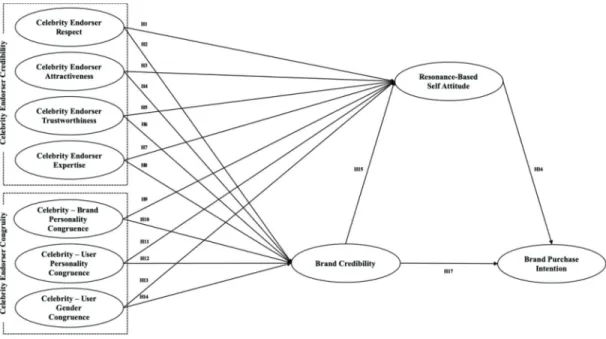
the data was analyzed using Partial Least Square Structural Equation Modeling and SmartPLS software. The research model is as shown in Figure 1.

4. Results and Discussion 4.1. Sample Characteristics

The respondents are 78% male and 22% female.

Meanwhile, only 2% are under 20 years old, 43% are 21–30 years old, 33% are 31–40 years old, 22% are 41–50 years old, and 1% is older than 30 years old. Most of the respondents (73%) work as employee, while the rest (21%) work as businessman, 4% are school students and college students, and 1% is a lecturer. Based on their educational background, 3% have diploma degree, 20% have associate degree, 68% have undergraduate degree, 7% have master’s degree, and 2% have doctoral degree.

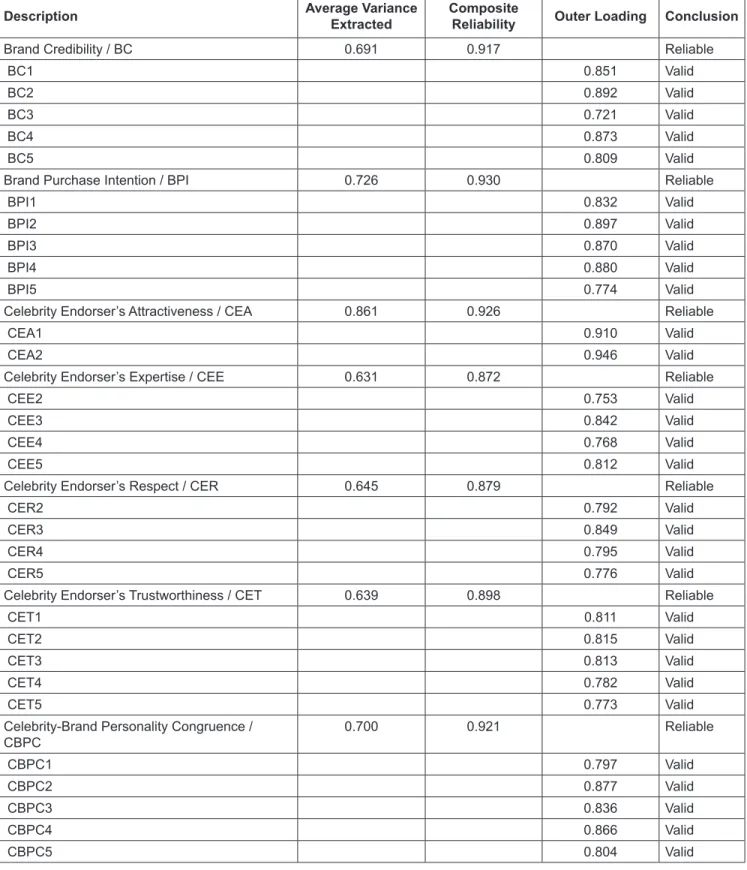
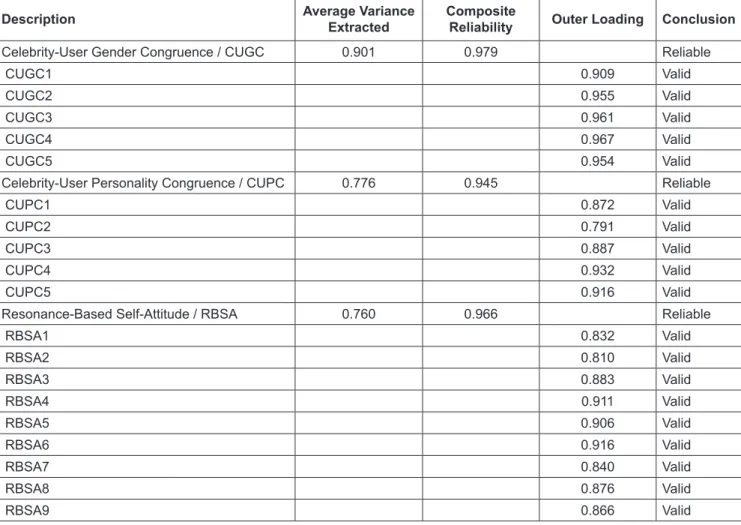
4.2. Evaluation of Measurement Model

The validity test consisted of convergent and discrimi- nant validity. The convergent validity test was done by considering the average variance extracted (AVE) whose value must be greater than 0.5 for each variable. Furthermore, the outer loading value for each item must be greater than 0.7 (Hair, Hult, Ringle, & Sarstedt, 2017). Table 1 shows that the result of measurement value is reliable and valid. Meanwhile, the discriminant validity test was performed using Fornell- Larcker and cross-loading criteria. The Fornell-Larcker

criteria aims to see the validity of discriminant at the construct-level, while at the indicator-level, they use the cross-loading value. Below, Table 2 shows that all AVE values of the square root of each variable have a higher value than the correlation value between the variables.

4.3. Evaluation of Structural Model

In this stage, the R

2

value of brand credibility is 77.2%, 79.5% on the brand purchase intention, and 82.6% on the resonance-based self-attitude. Note that the higher the R

2

, the better prediction against the endogeneous construct (Hair et al., 2017). The construct of BC could be explained by CER, CEA, CET, CEE, CBPC, CUPC, and CUGC by 77.2%, while the rest (22.8%) could be explained by other constructs not involved in the model. Similarly, the BPI construct could be explained by the RBSA and BC by 79.5%, while the rest (20.5%) could be explained by other constructs not included in the model. Lastly, the RBSA could be explained by CER, CEA, CET, CEE, CBPC, CUPC, CUGC, and BC by 82.6%, and the rest (17.4%) could be explained by other constructs not included in the model.

4.4. Hypothesis Testing

Testing the hypotheses was done by observing whether the ρ-value was lower than 0.05 (significance level = 5% or α = 5%) or not. If the p-value was lower than 0.05, then it could be concluded that the hypothesis was supported and vice versa. Determining the strength of the relationship or

Figure 1: Research Model

(5)

Table 1: Reliability and Convergent Validity

Description Average Variance

Extracted Composite

Reliability Outer Loading Conclusion

Brand Credibility / BC 0.691 0.917 Reliable

BC1 0.851 Valid

BC2 0.892 Valid

BC3 0.721 Valid

BC4 0.873 Valid

BC5 0.809 Valid

Brand Purchase Intention / BPI 0.726 0.930 Reliable

BPI1 0.832 Valid

BPI2 0.897 Valid

BPI3 0.870 Valid

BPI4 0.880 Valid

BPI5 0.774 Valid

Celebrity Endorser’s Attractiveness / CEA 0.861 0.926 Reliable

CEA1 0.910 Valid

CEA2 0.946 Valid

Celebrity Endorser’s Expertise / CEE 0.631 0.872 Reliable

CEE2 0.753 Valid

CEE3 0.842 Valid

CEE4 0.768 Valid

CEE5 0.812 Valid

Celebrity Endorser’s Respect / CER 0.645 0.879 Reliable

CER2 0.792 Valid

CER3 0.849 Valid

CER4 0.795 Valid

CER5 0.776 Valid

Celebrity Endorser’s Trustworthiness / CET 0.639 0.898 Reliable

CET1 0.811 Valid

CET2 0.815 Valid

CET3 0.813 Valid

CET4 0.782 Valid

CET5 0.773 Valid

Celebrity-Brand Personality Congruence /

CBPC 0.700 0.921 Reliable

CBPC1 0.797 Valid

CBPC2 0.877 Valid

CBPC3 0.836 Valid

CBPC4 0.866 Valid

CBPC5 0.804 Valid

(6)

Description Average Variance

Extracted Composite

Reliability Outer Loading Conclusion

Celebrity-User Gender Congruence / CUGC 0.901 0.979 Reliable

CUGC1 0.909 Valid

CUGC2 0.955 Valid

CUGC3 0.961 Valid

CUGC4 0.967 Valid

CUGC5 0.954 Valid

Celebrity-User Personality Congruence / CUPC 0.776 0.945 Reliable

CUPC1 0.872 Valid

CUPC2 0.791 Valid

CUPC3 0.887 Valid

CUPC4 0.932 Valid

CUPC5 0.916 Valid

Resonance-Based Self-Attitude / RBSA 0.760 0.966 Reliable

RBSA1 0.832 Valid

RBSA2 0.810 Valid

RBSA3 0.883 Valid

RBSA4 0.911 Valid

RBSA5 0.906 Valid

RBSA6 0.916 Valid

RBSA7 0.840 Valid

RBSA8 0.876 Valid

RBSA9 0.866 Valid

Table 1: Continued

Table 2: Discriminant Validity

Construct BC BPI CEA CEE CER CET CBPC CUGC CUPC RBSA

BC 0.856

BPI 0.831 0.860

CEA 0.607 0.561 0.928

CEE 0.499 0.506 0.319 0.795

CER 0.569 0.609 0.439 0.621 0.803

CET 0.440 0.575 0.188 0.684 0.605 0.799

CBPC 0.695 0.633 0.300 0.648 0.679 0.593 0.837

CUGC 0.761 0.770 0.610 0.359 0.533 0.367 0.453 0.949

CUPC 0.756 0.750 0.474 0.531 0.717 0.542 0.826 0.633 0.881

RBSA 0.852 0.850 0.611 0.404 0.537 0.450 0.503 0.827 0.654 0.872

(7)

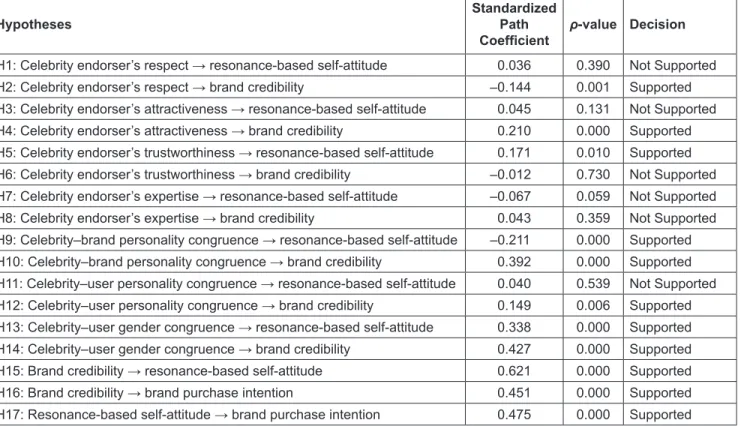
correlation between the independent and dependent variable could be seen from the standardized-path coefficient value that ranges from −1 to +1. The closer the path coefficient value to 1, the stronger the latent effect or construct relationship (Hair et al., 2017). Table 3 shows that 11 out of 17 hypotheses are empirically supported or significant.

4.5. Discussion

By using sample data from 432 consumers of various instant coffee brands in several cities in Indonesia, this study produces some significant findings. First, only 1 out of 4 celebrity endorser’s credibility has a positive relationship with resonance-based self-attitude. The results of this study show that H1, H3, and H7 are not supported, meanwhile H5 is supported. Second, 2 out of 4 celebrity endorser’s credibility has a positive relationship with brand credibility.

The results of this study show that H2 and H4 are supported, meanwhile H6 and H8 are not supported. Third, 2 out of 3 celebrity endorser’s congruence has a positive relationship with resonance-based self-attitude. The results of this study show that H9 and H13 are supported, meanwhile H11 is not supported. Fourth, celebrity endorser’s congruence has a positive relationship with brand credibility. The results of this study show that H10, H12, and H14 are supported.

Fifth, brand credibility has a positive relationship with

resonance-based self-attitude. The results of this study show that H15 is supported. Sixth, resonance-based self-attitude has a positive relationship with brand purchase intention.

The results of this study show that H16 is supported.

Seventh, brand credibility has a positive relationship with brand purchase intention. The results of this study show that H17 is supported.

The results partially support the model developed, 11 out of 17 hypotheses are empirically supported or significant.

This study found that resonance-based self-attitude and brand credibility are partially supported by celebrity endorser’s credibility (Mansour & Diab, 2016; Wang &

Scheinbaum, 2017) and celebrity endorser’s congruence (Malodia et al., 2017; Siemens et al., 2008; Thomas &

Johnson, 2019). It is also found that resonance-based self- attitude and brand credibility are simultaneously increasing brand purchase intention of instant coffee product (Chin et al., 2019; Yoon & Kim, 2015). The findings suggest that the instant coffee product advertising in Indonesia needs to create brand messages focusing on the formation of resonance-based self-attitude from consumers to increase the influence of celebrity endorser credibility and celebrity endorser congruity, as well as the brand credibility toward the brand purchase intention (Chin et al., 2019; Keller, 2009; Maharani et al., 2020; Osei-Frimpong et al., 2019;

Singh & Banerjee, 2018).

Table 3: Results of Hypotheses Testing

Hypotheses Standardized

Path

Coefficient ρ-value Decision H1: Celebrity endorser’s respect → resonance-based self-attitude 0.036 0.390 Not Supported

H2: Celebrity endorser’s respect → brand credibility –0.144 0.001 Supported

H3: Celebrity endorser’s attractiveness → resonance-based self-attitude 0.045 0.131 Not Supported H4: Celebrity endorser’s attractiveness → brand credibility 0.210 0.000 Supported H5: Celebrity endorser’s trustworthiness → resonance-based self-attitude 0.171 0.010 Supported H6: Celebrity endorser’s trustworthiness → brand credibility –0.012 0.730 Not Supported H7: Celebrity endorser’s expertise → resonance-based self-attitude –0.067 0.059 Not Supported H8: Celebrity endorser’s expertise → brand credibility 0.043 0.359 Not Supported H9: Celebrity–brand personality congruence → resonance-based self-attitude –0.211 0.000 Supported H10: Celebrity–brand personality congruence → brand credibility 0.392 0.000 Supported H11: Celebrity–user personality congruence → resonance-based self-attitude 0.040 0.539 Not Supported H12: Celebrity–user personality congruence → brand credibility 0.149 0.006 Supported H13: Celebrity–user gender congruence → resonance-based self-attitude 0.338 0.000 Supported H14: Celebrity–user gender congruence → brand credibility 0.427 0.000 Supported

H15: Brand credibility → resonance-based self-attitude 0.621 0.000 Supported

H16: Brand credibility → brand purchase intention 0.451 0.000 Supported

H17: Resonance-based self-attitude → brand purchase intention 0.475 0.000 Supported

(8)

5. Conclusion

This research implies that, in order for a company to succeed, the management should focus on creating the brand messages focusing on the formation of resonance-based self- attitude from consumers to increase the influence of celebrity endorser’s credibility and celebrity endorser’s congruence, as well as the brand credibility, which will ultimately result in the brand purchase intention. However, this research still has several limitations. First, the research design used is quantitative. Future research should use qualitative research designs to explore the ins and outs of each relationship proposed in the research model. Future studies can also replicate this research model to measure the influence of non-celebrity endorsers. It is also recommended to separate the consumer’s self-image (actual self-image and ideal self- image) and add types of media used (conventional media and digital media). Further, future research should also focus on one brand of instant coffee with one celebrity endorser to avoid biased results.

References

Ajzen, I. (2001). Nature and operation of attitudes. Annual Review of Psychology, 52(1), 27–58.

Campbell, M. C., & Warren, C. (2012). A risk of meaning transfer:

are negative associations more likely to transfer than positive associations? Social Influence, 7(3), 172–192.

Chin, P. N., Isa, S. M., & Alodin, Y. (2019). The impact of endorser and brand credibility on consumers’ purchase intention: the mediating effect of attitude towards brand and brand credibility.

Journal of Marketing Communications, 4, 896–912.

Choi, S. M., Lee, W. N., & Kim, H. J. (2005). Lessons from the rich and famous: A cross-cultural comparison of celebrity endorsement in advertising. Journal of Advertising, 34, 85–98.

Detiknews. (2016). Jadi Bintang Iklan Luwak White Koffie, Berapa Bayaran Lee Min Ho? Retrieved May 15, 2020 from https://

news.detik.com/adv-nhl-detikcom/d-3111222/jadi-bintang- iklan-luwak-white-koffie-berapa-bayaran-lee-min-ho

Dwivedi, A., Johnson, L. W., & McDonald, R. E. (2015). Celebrity endorsement, self-brand connection and consumer-based brand equity. Journal of Product & Brand Management, 24(5), 449–461.

Erdem, T., & Swait, J. (2004). Brand credibility, brand consi- deration, and choice. The Journal of Consumer Research, 31(1), 191–198.

Erdogan, B. Z., Baker, M. J., & Tagg, S. (2001). Selecting celebrity endorsers: The practitioner’s perspective. Journal of Advertising Research, 41(3), 39–48.

Escalas, J. E., & Bettman, J. R. (2003). You are what they eat: The influence of reference groups on consumers’ connections to brands. Journal of Consumer Psychology, 13, 339–348.

Freling, T. H., & Forbes, L. P. (2013). An empirical analysis of the brand personality effect. Journal of Product & Brand Management, 14(7), 404–413.

Govers, P., & Schoormans, J. (2005). Product Personality and its Influence on Consumer Preference. Journal of Consumer Marketing, 22(4), 189–197.

Gupta, M. A., & Dang, P. J. (2009). Examining celebrity expertise and advertising effectiveness in India. South Asian Journal of Management, 16(2), 61–75.

Hair, J. F., Hult, G. T. M., Ringle, C. M., & Sarstedt, M. (2017).

A Primer on Partial Least Squares Structural Equation Modeling (PLS-SEM) (2

nd

ed.). Thousand Oaks, CA: Sage Publication, Inc.

Keller, K. L. (2009). Building strong brands in a modern marketing communications environment. Journal of Marketing Communications, 15(2–3), 139–155.

Kensinger, E. A., & Corkin, S. (2003). Effect of negative emotional content on working memory and long-term memory. Emotion, 3, 378–393.

Maharani, N., Helmi, A., Mulyana, A., & Hasan, M. (2020). Factors Influencing Purchase Intention on Private Label Products.

Journal of Asian Finance, Economics and Business, 7(11), 939–945. https://doi.org/10.13106/jafeb.2020.vol7.no11.939 Malär, L., Krohmer, H., Hoyer, W. D., & Nyffenegger, B. (2011).

Emotional brand attachment and brand personality: The relative importance of the actual and the ideal self. Journal of Marketing, 75(4), 35–52.

Malodia, S., Singh, P., Goyal, V., & Sengupta, A. (2017). Measuring the Impact of Brand-Celebrity Personality Congruence on Purchase Intention. Journal of Marketing Communications, 23(5), 493–512.

Mansour, I. H. F., & Diab, D. M. E. (2016). The relationship between celebrities’ credibility and advertising effectiveness:

The mediation role of religiosity. Journal of Islamic Marketing, 7(2), 148–166.

Nguyen, N.-T. (2021). The Influence of Celebrity Endorsement on Young Vietnamese Consumers’ Purchasing Intention. Journal of Asian Finance, Economics and Business, 8(1), 951–960.

https://doi.org/10.13106/jafeb.2021.vol8.no1.951

Nguyen, T. T. N. (2020). Gender Differences in Determinants of Customer Satisfaction in Beauty and Cosmetic E-commerce.

Journal of Asian Finance, Economics and Business, 7(10), 811–822. https://doi.org/10.13106/jafeb.2020.vol7.no10.811 Nielsen. (2020). Nielsen Retail Audit. Nielsen Insights. Nielsen

Global Connect.

Oh, A. H., & Park, H. Y. (2020). The Effect of Airline’s Professional Models on Brand Loyalty: Focusing on Mediating Effect of Brand Attitude. Journal of Asian Finance, Economics and Business, 7(5), 155–166. https://doi.org/10.13106/jafeb.2020.

vol7.no5.155

Osei-Frimpong, K., Donkor, G., & Owusu-Frimpong, N. (2019).

The Impact of Celebrity Endorsement on Consumer Purchase

(9)

Intention: An Emerging Market Perspective. Journal of Marketing Theory and Practice, 27(1), 103–121.

Plank, K. (2012). Under Armour’s Founder on Learning to Leverage Celebrity Endorsements. Harvard Business Review, 90(5), 45–48.

Siemens, J. C., Smith, S., Fisher, D., & Jensen, T. D. (2008). Product expertise versus professional expertise: congruency between an endorser’s chosen profession and the endorsed product.

Journal of Targeting, Measurement & Analysis for Marketing, 16(3), 159–168.

Singh, R. P., & Banerjee, N. (2018). Exploring the Influence of Celebrity Credibility on Brand Attitude, Advertisement Attitude and Purchase Intention. Global Business Review, 19(6) 1–18.

Solomon, M. R. (2006). Consumer behavior: Buying, having, and being. Upper Saddle River, NJ: Prentice Hall.

Sun, Y., Lim, K. H., Jiang, C., Peng, J. Z., & Chen, X. (2010).

Do males and females think in the same way? An empirical investigation on the gender differences in web advertising evaluation. Computers in Human Behavior, 26(6), 1614–1624.

Temperley, J., & Tangen, D. (2006). The Pinocchio factor in consumer attitudes towards celebrity endorsement: Celebrity endorsement, the reebok brand, and an examination of a recent campaign. Innovative Marketing, 2(3), 97–111.

Thomas, T., & Johnson, J. (2019). The Effect of Celebrity Trustworthiness on Endorsement Effectiveness: A Comparison of Congruence and Hybrid Model. Vision – The Journal of Business Perspective, 23(3), 1–12.

Wang, S. W., & Scheinbaum, A. C. (2017). Trustworthiness Trumps Attractiveness and Expertise: Enhancing Brand Credibility Through Celebrity Endorsement. Journal of Advertising Research, 58(1), JAR-2017-042.

White, D. W., Goddard, L., & Wilbur, N. (2009). The effects of negative information transference in the celebrity endorsement relationship. International Journal of Retail & Distribution Management, 37(4), 322–335.

Yoon, D., & Kim, Y. K. (2015). Effects of Self-Congruity and

Source Credibility on Consumer Responses to Coffeehouse

Advertising. Journal of Hospitality Marketing & Management,

6, 1–30.

수치

Figure 1: Research Model
Table 1: Reliability and Convergent Validity
Table 2: Discriminant Validity
Table 3: Results of Hypotheses Testing

참조

관련 문서