INTRODUCTION
Consumers' corporate association about a com- pany is the company's strategic asset as well as a very important advantage in terms of competitive edge(Park BD 2011). Therefore, companies invest as- tronomical amount of money annually in advertise- ment and promotion in order to have positive associ- ation in the perception of consumers(Kim YG 2014).
Consumers who became careful in consumption as the economic downturn continued tend to purchase products of companies with reliable reputation and positive association (Nam JH 2014). In particular, when consumers evaluate certain companies and are lacking in relevant knowledge, they utilize informa-
tion such as association or reputation as external clues in order to reduce the risk of selection(Ozanne JL et al 1992). Aaker DA(1991) also noted that as competition among companies became fierce, dis- crimination among products decreased and consu- mers tended to select a certain company depending on their perception.
A concept of corporate image has been mainly re- garded as the single dimension in the meantime.
However, a research is being carried out recently that tries to approach by dividing it into the ability associ- ation and social responsibility association(Park JC, Ryu GS 2012). Most research which divided corporate association into ability association and social respon- sibility association observed that corporate associa- Culinary Science and Hospitality Research (October 2015)
Vol. 21, No. 5, pp. 1-13
The Effects of Consumer's Corporate Association on Self- image Congruence, and Satisfaction in Food Company:
Moderating Role of Consumer’s Trust
Hyo Sun Jung, Yu Hyun Hwang and Hye Hyun Yoon¶ Dept. of Culinary and Service Management, Kyung Hee University
ABSTRACT: The purpose of this study is to investigate the moderating effects of consumer’s trust on the relationships among consumer’s corporate association, self image congruence and satisfaction in the food companies. The survey was administerd to 215 consumers living for Seoul in Korea. The results in- dicated that the proposed model fit to the data well(χ2(df=113)=221.565, GFI=.889, CFI=.960, RMSEA=067).
The finding showed that consumer’s corporate ability(β=.323) and corporate social responsibility(β=.454) among corporate association have a significantly positive effect on their self image congruence and self image congruence significantly positive effect on consumer satisfaction(β=.339). In addition, consumer’s corporate ability was significantly positive effect on their satisfaction(β=.373). Also, this study found moder- ating effects of consumer’s trust on the relationship between corporate association and consumer sa- tisfaction, the results indicated that significant relationships varied to consumer’s trust level. Limitations and future research directions are also discussed.
Keywords: corporate association, self image congruence, satisfaction, consumer, food company
¶ Corresponding Author: Hye Hyun Yoon, Department of Culinary and Food Service Management, Kyung Hee University, 1 Hoeigi-dong, Dongdaemoon-gu, Seoul 130-701, Korea, Tel : +82-2-961-9403, Fax : +82-2-964-2537, E-mail: [email protected]
tion was equipped with general characteristics en- compassing other dimensions and presented a useful alternative as a company's marketing strategies(Kim DT, Kim JI 2008). The researches so far have men- tioned that the ability association has positive influ- ence upon corporate performance rather than the social responsibility association(Berens G et al 2005), and asserted that a consumer's coming to have fa- vorable association to a corporation leads to re- sponding friendly even to product and service, re- sulting in causing the positive performance(Keller KL 1998).
In addition, concepts like image congruence have developed as an important factor associated with consumers' perception about product quality and as- sociation about a certain company and its image congruence were very closely related (Han SL et al 2010). In particular, whether one's self images are in agreement is an individual's emotional and psycho- logical condition and therefore is more related to emotional immersion than continuous immersion and has more important meaning(Kim HN 2008).
Resultantly, discussion on the effects of company as- sociation on consumers' degree of satisfaction will be able to provide a strategic suggestive point about the meaning of company association and which as- pects of business association should be strengthened to business managers. For example, strategies to as- sociate a given company's capabilities or expertise may be established or strategies related to social re- sponsibility may be brought into relief by dealing with important social issues.
However, research thus far emphasized relational aspects between companies selling ordinary goods and consumers and food companies' performance in terms of association has not been considered. A rea- son of selecting a food company as the subject of this study is because a food company needs to be further emphasized a manager's ability or social re- sponsibility owing to manufacturing and selling eat- able food, and is existed diverse competing forms depending on brand awareness and marketing in comparison with other industries(Kwon KD et al 2010). As a result, various cases on social responsi- bility activities within food companies have been re- ported(Park JS 2014) but there was no research that such activities provided consumers with positive as-
sociation and therefore increased companies' perfor- mance. This study aimed to suggest that the relation- ship between corporate association, self image con- gruence, and how these influence consumer’s pos- itive attitude(satisfaction) in the food industry, and that different influence is shown depending on con- sumer’s trust level in this causality.
BACKGROUND AND HYPOTHESES
Corporate Association and Self Image Congru- ence
Corporate association(Aaker DA 1991) is a set of memories or thoughts about a certain company and a condition where all information about a certain company is activated in memories of people(Brown TJ, Dacin PA 1997). Self image is the whole of thoughts and emotions felt by one's regarding one- self as an object(Rosenberg M 1979) and defined as the degree of congruence between a company and its self image(Sirgy et al 1997). Mittal B et al(1990) noted that consumers intended to express one's self, personality, status, or social position through pro- ducts and therefore when they had positive associa- tion about a certain company, they wanted to make their images congruent to the company. In addition, Brown TJ, Dacin PA(1997) suggested that images of certain companies formed through association may have positive influence on product evaluation when one's self image is the same as that of the company and Ahn KH, Lee GH(2004) asserted that reliability and reputation about a certain company were high, identifying a company and the consumers increased.
Ahearne M, Bhattacharya CB(2005) noted that dis- criminative association related to a company was used by consumers as a tool of self-expression to dif- ferentiate them from other people. Kim DT, Kim JI(2008) observed consumers' association about com- panies positively affected corporate identity attrac- tiveness, which in turn positively influenced consu- mer-corporate identification, clarifying indirect rela- tionship between corporate association and image congruence. Choi NH et al(2009) reported that when consumers associated businesses positively and formed their images, consumers expressed them- selves by consuming products with positive images.
On The basis the following hypothesis was offered:
Hypothesis 1: Corporate association(corporate abilitya and corporate social responsibilityb) has a positive effect on consumer’s self ima- ge congruence.
Self Image Congruence and Consumer Satisfac- tion
Consumer satisfaction is a psychological condition which occurs in the experience of consumption (Oliver RL 1981) and is determined by difference be- tween perceived performance and expectation (Kot- ler P 2000). Most research on consumers' self image congruence and satisfaction shows that self image congruence affects their selection of companies and satisfaction centered on corporate image providing services and products(Chon KS 1992). In addition, self image identification is connected with self-consis- tency or self-esteem and does not stop with one time evaluation or satisfaction and provides motives for consumers to maintain them and therefore some- times means greater loyalty than satisfaction. Be- llenger DN et al(1976) observed that consumers whose corporate and self images were in agreement showed high degree of loyalty to the company and efforts to make corporate image and self image con- gruent were a method to increase consumers' lo- yalty. Graffe TR(1996) reported that the higher the degree of congruence between corporate images and self images was, the more favorable consumers' brand evaluation was; The reason was that such con- gruence provided more value to consumers and Yi YJ, La SA(2002) also said that congruence through identification positively affected satisfaction. Park SY, Lee YK(2006) as well asserted that self image con- gruence about a certain brand increased consumer satisfaction and Yim CK et al(2007) reported that self image congruence about a company positively af- fected satisfaction and immersion. Kwak DH, Kang JH(2009) observed that the more closely consumers perceived the standardized image of users who used a product and the self, the more positively the con- sumer evaluated the product and Kim TH et al(2009) also suggested that consumers with high self image identification toward Starbucks formed more positive attitude toward the company and became more sa- tisfied with it. Jung HS, Yoon HH(2011) mentioned that self-image congruence has significant upon con-
sumer satisfaction in the family restaurants. In view of the empirical evidence, the following hypothesis was formulated:
Hypothesis 2: Consumer’s self image congru- ence has a positive effect on satisfaction.
Corporate Association and Consumer Satisfac- tion
Andreassen TW, Lindestad B(1998) asserted that positive images about a certain company affected consumers' satisfaction and Thang D, Tan B(2003) mentioned that when corporate association was con- sidered a set of memories or thoughts related to a company and association like accessibility, reputa- tion, service, and environment related to retail stores' functional images had favorable effect on preference to or satisfaction with certain companies. Hwang BI(2004) as well suggested that consumers' intention to maintain relationship with a certain company through corporate association increased and Helm S(2007) noted corporate reputation as an opposite concept to corporate association and said that when consumers perceived corruption, their satisfaction decreased. Yoon SH(2012) reported that corporate association positively influenced loyalty via trust and the factor which influenced trust was ability associa- tion rather than association of CSR. In addition, Walsh G, Bartikowski B(2013) divided corporate asso- ciation into service quality and CSR and in a study on American and German consumers, corporate as- sociation positively affected satisfaction and Jung HS, Yoon HH(2014) also reported that association about restaurants significantly affected consumers' satis- faction. Consistent with the foregoing discussion, the following hypothesis was made:
Hypothesis 3: Corporate association(corporate abilitya and corporate social responsibilityb) has a positive effect on consumer satisfac- tion.
Moderating Roles of Consumers’ Trust
According to Goldsmith RE et al(2000), consumers had low perceived risk of companies with high reli- ability and therefore had a high possibility to define the degree of reliability of a certain company as their
Figure 1. A proposed model of the corporate association, self-image congruence, trust, and consumer satisfaction.
social identity and assume the degree of reliability as a standard to judge in determining identification with the company. Park JC, Ryu GS(2012) noted that corporate ability association and social responsibility association were very closely related to trust, and as- sociation of a certain company based on trust fo- rmed positive consumer attitudes. Jung HS, Yoon HH(2014) also observed that a restaurant company's association was an important element to determine trust. Based on this outcome, this study established the following hypothesis with presuming that cau- sality will be different among corporate association, self image congruence, and consumer satisfaction according to consumer’s trust. These arguments led to the establishment of the following hypothesis(See Figure 1):
Hypothesis 4: Comsumer’s trust moderates in the links between corporate association, self image congruence and consumer satisfac- tion.
METHODOLOGY
Sample and Data Collection
The convenience sampling method was used to select subjects of this study. Self-administered ques-
tionnaires were distributed to 300 consumers of food company in Seoul the capital of Korea. Respondents were asked voluntarily to fill out survey ques- tionnaires and to return them directly to the survey administrators. A pilot test (2-5 January, 2015) using 30 consumers was conducted to ensure the reliability of the scales, and several modifications were made based on feedback. The data collection was carried out over the period from 10-30 January, 2015. A total of 300 questionnaires were distributed to consumers of food company. By the cut-off date for data collec- tion, 215 usable surveys were personally retrieved from the respondents for a response rate of 71.66%.
Measurement Development
The measures for all items in this study were drawn from previous study. Corporate association were measured by 8 items on a 7-point scale(1:
strongly disagree to 7: strongly agree), based on Brown TJ, Dacin PA(1997), and Berens C et al(2005).
The dimensions were corporate ability and corporate social responsibility. Self image congruence were measured by 5 items adapted from Chon KS(1992), and Sirgy M et al(1997). Consumer satisfaction were measured by 5 items, adopted on Howard JA, Sheth JN(1969), and Spreng RA et al(1996). Also, consumer trust(moderate variable) were adapted by 5 items,
based on Sirdeshmukh D et al(2002) and Vlachos PA et al(2010). The data were analyzed with the SPSS version 21.0 and the AMOS version 19.0. Descriptive statistics were used to describe the respondents’
demographic profiles, and Structural Equation Mode- ling(SEM) was conducted to test the proposed re- search hypotheses.
RESULTS
Descriptive Statistics of Respondent
The respondents were 33.0% male and 67.0%
female, and the majority of respondents(61.9%) be- longed to the age group between 20 and 29.
Approximately 75.3% of consumers were single; the remaining 24.9% were married. Also, 85.5% of res- pondents had university degree, and 46.5% repor-
Demographic information Purchase behavior-related information
Classification N % Classification N %
Gender
Male 71 33.0
Purchase frequency
2~3 times/week 104 48.4
Female 144 67.0 1 time/week 68 31.6
Age (yr)
20~29 133 61.9 1 time/2 weeks 20 9.2
30~39 52 24.2 1 time/1 month 23 10.8
40~49 17 7.9
Purchase information
Broadcast 60 27.9
50~ 13 6.0 Internet 54 25.1
Marital status
Married 53 24.7 SNS 25 11.6
Non-married 162 75.3 Recommend 39 18.1
Education level
High school 7 3.3 Others 37 17.3
College 24 11.2
Purchase food
Farm products 27 12.6
University 118 54.9 Animal products 6 2.8
Graduate school 66 30.6 General products 154 71.6
Job
Student 100 46.5 Others 28 13.0
Housewife 17 7.9
Purchase place
Supermarket 46 21.3
Professional 14 6.5 Hypermarket 100 46.5
Office 56 26.1 Convenience 52 24.2
Service 15 7.0 Online-market 15 7.0
Others 13 6.0 Others 2 1.0
Table 1. General characteristics of respondents (n=215)
ted that they held students, 26.1% were office em- ployee, 7.9% were housewives. Consumers purchas- ing food from food companies once or more were most accounting for 80 percent, and the 64.6% of in- formation on the purchase of foods was obtained from mass media such as broadcasting, the Internet, and social network services. Foods largely purchased were ordinary processing foods at 71.6%. The most frequently used place to purchase foods was a large mart at 4.65%.
Measurement Model
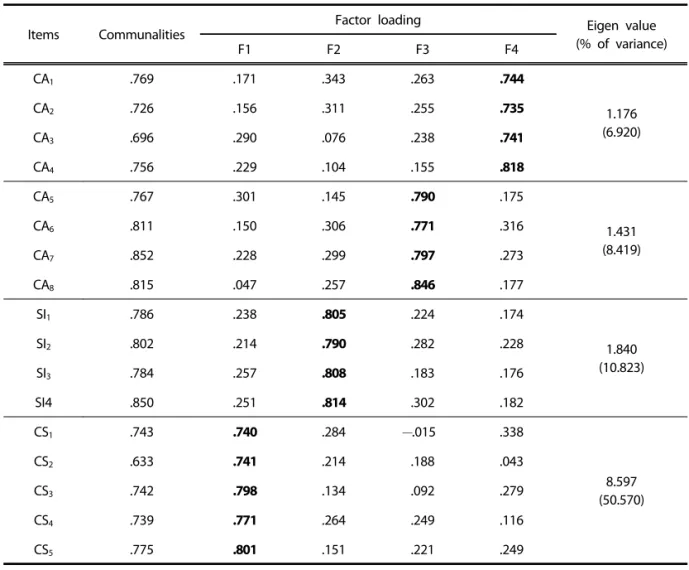
Exploratory and confirmatory factor analysis were used to judge the scale’s dimensionality and re- liability. As a result of the exploratory factor analysis, 4-factors solution explained 76.731% of the total va- riance and all the item-factor loadings, were above
Items Communalities
Factor loading Eigen value
(% of variance)
F1 F2 F3 F4
CA1 .769 .171 .343 .263 .744
1.176 (6.920)
CA2 .726 .156 .311 .255 .735
CA3 .696 .290 .076 .238 .741
CA4 .756 .229 .104 .155 .818
CA5 .767 .301 .145 .790 .175
1.431 (8.419)
CA6 .811 .150 .306 .771 .316
CA7 .852 .228 .299 .797 .273
CA8 .815 .047 .257 .846 .177
SI1 .786 .238 .805 .224 .174
1.840 (10.823)
SI2 .802 .214 .790 .282 .228
SI3 .784 .257 .808 .183 .176
SI4 .850 .251 .814 .302 .182
CS1 .743 .740 .284 —.015 .338
8.597 (50.570)
CS2 .633 .741 .214 .188 .043
CS3 .742 .798 .134 .092 .279
CS4 .739 .771 .264 .249 .116
CS5 .775 .801 .151 .221 .249
Note: Extraction method: principal component analysis; Rotation method=Varimax rotation; Cumulative =76.731%;
CA=corporate association; SI=self image congruence; CS=consumer satisfaction.
Table 2. Exploratory factor analysis
0.735(See Table 2). A four-dimension solution re- tained in the following factor labels such as ‘consu- mer satisfaction’(factor 1), ‘self image congruence’
(factor 2), ‘corporate social responsibility’(factor 3), and ‘corporate ability’(factor 4), respectively.
Also, based on confirmatory factor analysis results, we analyzed convergent validity, discriminant validity and reliability of all the multi-items, following the guidelines from previous research(Anderson JC, Ger- bing DW 1988; Hair JR et al 2006). The measurement properties are reported in Table 3. Cronbach’s alpha coefficients of the ‘corporate ability’, ‘corporate social responsibility’, ‘self image congruence’, and ‘consu- mer satisfaction’ factors appear to have good internal consistency, 0.871, 0.916, 0.920 and 0.894, respec-
tively. Also, the average variance extracted(AVE) for these scales were 0.629~0.744, and composite con- struct reliability(CCR) for these scales were 0.813~
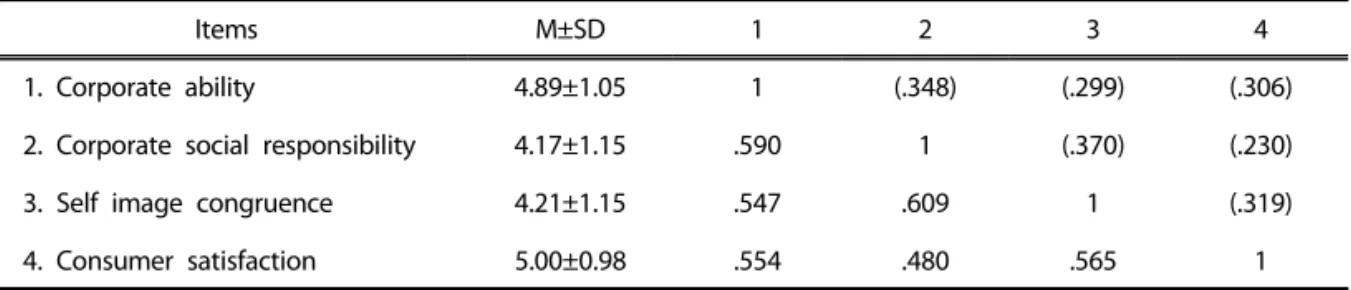
0.875. Results of the squared correlations among the study variables also fall into the accept-able range (See Table 4). To study an acceptable fit for the measurement model, each of the constructs was ex- amined by analyzing the statistical significance of each estimated loading, and the overall model fit in- dices were then evaluated. All loadings exceeded .70(except CS2), and each indicator t-value surpassed 10.666. Also, Table 4 presented the correlations anal- ysis for the items. The items used to assess corporate ability, corporate social responsibility, and self image congruence were positively related to the items
Items Estimate Standardized
estimate t value Cronbach's α CCR AVE
• Corporate ability
.871 .813 .629
CA1 1.000 .756 Fixed
CA2 1.057 .738 10.755***
CA3 1.089 .818 12.016***
CA4 1.103 .856 12.575***
• Corporate social responsibility
.916 .872 .733
CA5 1.000 .822 Fixed
CA6 1.192 .935 17.317***
CA7 1.090 .882 15.943***
CA8 0.918 .781 13.265***
• Self image congruence
.920 .875 .744
SI1 1.000 .847 Fixed
SI2 1.082 .862 16.085***
SI3 1.069 .826 14.985***
SI4 1.118 .916 17.800***
• Consumer satisfaction
.894 .861 .631
CS1 1.000 .791 Fixed
CS2 0.978 .696 10.666***
CS3 1.080 .796 12.585***
CS4 1.128 .824 13.139***
CS5 1.146 .860 13.847***
Note: CCR=composite construct reliability; AVE=average variance extracted; χ2=221.565(df=113); p<0.001; χ2/ df=1.961; GFI=.889; NFI=.922; IFI=.960; CFI=.960; RMR=.067; RMSEA=.067; *** p<.001.
Table 3. Confirmatory factor analysis and reliability analysis
Items M±SD 1 2 3 4
1. Corporate ability 4.89±1.05 1 (.348) (.299) (.306)
2. Corporate social responsibility 4.17±1.15 .590 1 (.370) (.230)
3. Self image congruence 4.21±1.15 .547 .609 1 (.319)
4. Consumer satisfaction 5.00±0.98 .554 .480 .565 1
Note: Pearson correlation coefficient; (parenthesis)=squared correlations; *** p<.001(2-tailed).
Table 4. Correlation analysis
associated with consumer satisfaction.
Structural Equation Models and Hypothesis Test
1) Overall Model Test
The structural model achieved a good level of fit:
χ2(df=113)=221.565, GFI=.889, CFI=.960, RMSEA=
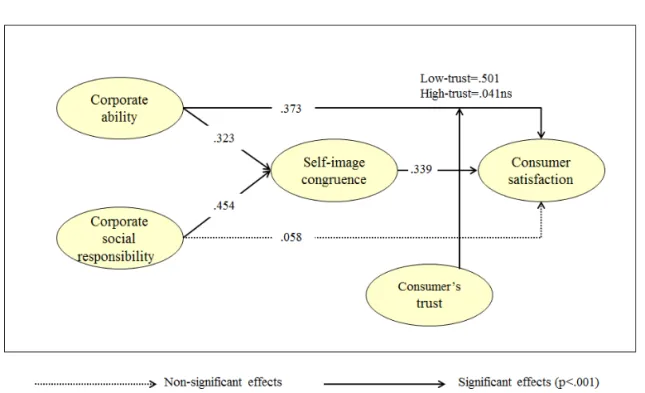
067. In Table 5, we present the resulting standar- dized parameter estimates. Hypothesis 1 predict that corporate association has a positive impact on con- sumer’s self image congruence. H1a, which hypothe- sized a positive relationship between corporate abil- ity and consumer’s self image congruence(β= .323;
t=3.808; p<.001) was supported. Moreover, as pro- posed by Hlb, employees' corporate social re- sponsi- bility had a significant positive effect on consu-
Hypothesized relationship Standardized
estimate t-value
H1
H1a Corporate ability → Self image congruence .323 3.808***
H1b Corporate social responsibility → Self image congruence .454 5.386***
H2 H2 Self image congruence → Consumer satisfaction .339 3.746***
H3
H3a Corporate ability → Consumer satisfaction .373 3.885***
H3b Corporate social responsibility → Consumer satisfaction .058 .619 Note: χ2=221.565(df=113); χ2/df=1.961; GFI=.889; AFGI=.850; NFI=.922; IFI=.960; CFI=.960; RMSEA=.067; RMR=.067;
*** p<.001.
Table 5. Structural equation model results
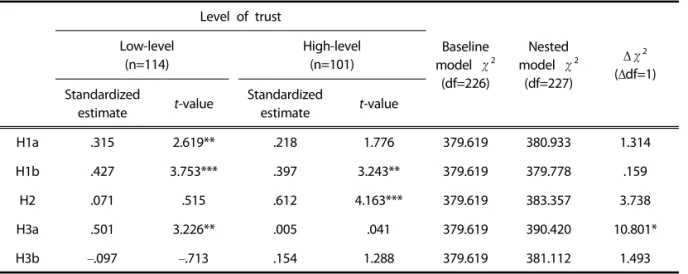
Level of trust
Baseline model χ2
(df=226)
Nested model χ2
(df=227)
∆χ2 (∆df=1) Low-level
(n=114)
High-level (n=101) Standardized
estimate t-value Standardized
estimate t-value
H1a .315 2.619** .218 1.776 379.619 380.933 1.314
H1b .427 3.753*** .397 3.243** 379.619 379.778 .159
H2 .071 .515 .612 4.163*** 379.619 383.357 3.738
H3a .501 3.226** .005 .041 379.619 390.420 10.801*
H3b –.097 –.713 .154 1.288 379.619 381.112 1.493
Note : χ2/df=1.680; GFI .830; NFI .837; CFI .926; RMSEA .056; * p<.05, ** p<.01, *** p<.001.
Table 6. Moderating effect of the consumers’ trust
mer’s self image congruence(β=.454; t=5.386; p<
.001). Therefore hypothesis 1b was supported. Also, H2 that consumer’s self image congruence would have significant positive effect on consumer satis- faction(β=.339; t=3.746; p<.001) was supported. The set of H3 address the relationship between corporate association and consumer satisfaction. H3 was par- tially supported as it was indicated that, although corporate association(β=.373; t=3.885; p<.001) sig- nificantly affected consumer satisfaction.(H3a), but corporate social responsibility(β=.058; t=.619; p>.05) did not.
2) Moderating Test
In order to test the moderation effect of the con- sumer’s trust level between corporate association,
Figure 2. Structural equation model with parameter estimates.
self image congruence and consumer satisfaction based on a multi-group approach. The results of the moderating effect of the consumer’s trust are shown in Table 6. It was used in analysis by being divided into high trust-level(N=101) and low trust-level (N=114) based on the mean value of confidence. The baseline model showed a good fit to the data(χ
2=379.619; df=226; GFI .830; NFI .837; CFI .926;
RMSEA .056). As for the link between corporate abili- ty and consumer satisfaction, statistically significant group differences were detected based on the χ2 between the baseline model and nested model(∆χ2
=10.801>χ2(df=1)=3.84). This implies that the influ- ence of consumer's corporate ability upon satisfac- tion was significantly higher in a group with low trust-level than a group with high trust-level. This means that the lower the trust toward a certain com- pany, the greater the effect of ability association on satisfaction (low β=.501; high β=.005); The lower the trust, consumer determine the degree of satisfaction by depending on association. In other routes, sig- nificant moderating effects were not found. In con- clusion, Hypotheses 4 was partially supported.
CONCLUSION AND LIMITATION
This study was to considered the effects of the
consumer’s corporate association, self image con- gruence, and satisfaction in the food company, and to investigate the moderating effects of consumer's trust. The major findings are as follows.
First, the consumer’s corporate ability(β=.323) and corporate social responsibility(β=.454) have positive effect on self image congruence. This means among corporate association, the higher corporate ability as- sociation and corporate social responsibility associa- tion, the more increased self image congruence; the more positive image consumers have on a certain company, they reconcile such image with their own image. This showed the result that is consistent with previous studies(Mittal B et al 1990; Kim DT, Kim JI 2008; Choi NH et al 2009), which verified positive causality with corporate association and self image congruence.
Second, the consumer’s self image congruence have positive effect of consumer satisfaction. This means that as consumers perceive their image is in agreement with a certain company, the greater the degree of satisfaction. Previous studies have also demonstrated a positive relationship between self image congruence and consumer satisfaction(Graffe TR 1996; Yi YJ, La SA 2002; Yim CK et al 2007; Kim TH et al 2009).
Third, the consumer’s corporate ability(β=.373) ha- ve positive effect on consumer satisfaction. However, corporate social responsibility association did not have significant effect on satisfaction, which was consistent with the result of a study by Thang D, Tan B(2003) that functional image on a certain company played an important role in determining preference or satisfaction and which was similar to the result of a study by Jung HS, Yoon HH(2014) that ability asso- ciation had a greater influence on trust.
Fourth, the influence of consumer’s corporate abi- lity upon satisfaction was indicated to be signifi- cantly greater in low-trust(β=.501) than high-trust(β
=.005). This means that the lower trust toward a cer- tain company, consumers depend on ability associa- tion and therefore it has great influence on satis- faction.
With the purpose of exploring the impact that cor- porate association may function on consumer sat- isfaction within the Korea’s food companies, the cur- rent study intends to benefit both academics and practitioners alike. At this point of time, this study has significance in a regard of being an original re- search of having analyzed a fact that the self-image congruence and the consumer satisfaction are varied depending on a type of the corporate association targeting food companies. Ability association is esti- mated to form a positive influential relationship be- cause informational perception felt by consumers is abundant and experiences on a certain company form positive influential relationship on satisfaction because of direct response. However, in this study, the variable with more influence on self image iden- tification was social responsibility association; The more excellent social responsibility association a company had, consumers felt that they were the same as their images and had a higher possibility to perceive that they also performed social respon- sibility. Therefore, food companies should not ignore consumers' association affects their performance and the more positive association a consumer have on a certain company, the connection between the con- sumer and the business should be made close. In other words, motivation or opportunities should be provided so that consumers' experiences on a certain company may be induced abundantly. In other words, when a consumer's knowledge about a cer-
tain company is lacking, he or she evaluates the company through information on the company, so that the consumer can be aware of such knowledge more easily and clearly, unique association and dis- criminative strategies in comparison with other com- panies should be conducted.
The limit of this study and future work are as follows. The first limitation result from the targeted consumers were limited to Seoul in Korea. Second, this study went through modification and verification process through pilot test, but it is estimated that there are still some measurement errors. Third, data were collected from one source(consumer) which lesson problems with Common Method Bias(CMB).
Fourth, given that famous food companies in Korea were selected , the results of our study cannot be generalized to other types of companies. Finally, this study did set limits of final dependent variable only to consumer satisfaction. However, a follow-up re- search will be desirable to analyze by adding more specific performance variables such as purchase in- tent and loyalty.
REFERENCES
Aaker DA (1991). Managing Brand Equity. The Free Press. NY.
Ahearne M, Bhattacharya CB (2005). Antecedents and consequences of customer-company identifica- tion: expanding the role of relationship. Market- ing J Applied Psychology 90(3):574-585.
Ahn GH, Lee GH (2004). The study of the effect of consumer: company identification on consum- er`s evaluation of company products and behav- ioral responses. J Korean Marketing 19(4):55-77.
Anderson JC, Gerbing DW (1988). Structural equation modeling in practice: a review and recommen- ded two-step approach. Psychological Bulletin 103(3):411-423.
Andreassen TW, Lindestad B (1998). Customer loyalty and complex services: the impact of corporate image on quality, customer satisfaction and loy- alty for customers with varying degrees of serv- ice expertise. International J Service Industry Management 9(1):7-23.
Bellenger DN, Steinberg E, Stanton WW (1976). The congruence of store image and self image: as it
relates to store loyalty. J Retailing 52(1):17-32.
Berens G, Riel CBM, Bruggen GH (2005). Corporate associations and consumer product responses:
the moderating role of corporate brand do- minance. J Marketing 69(3):35-48.
Brown TJ, Dacin PA( 1997). The company and the product: corporate associations and consumer product responses. J Marketing 61(Jan):68-84.
Choi NH, Park DS, Na KJ (2009). The role of self-ex- pressive need fulfillment and consumer-corpo- rate product identification on the effects of cor- porate associations on positive behavior. Korea Marketing Management 14(4):233-256.
Chon KS (1992). Self-image/destination image con- gruity. Annuals of Tourism Research 19(2):360-363.
Goldsmith RE, Lafferty BA, Newell SJ (2000). The im- pact of corporate credibility and celebrity on consumer reaction to advertisements and br- ands. J Advertising 29(3):43-54.
Graeff TR (1996). Using promotional messages to manage the effects of brands and self-image on brand evaluation. J Consumer Marketing 13(3):
4-18.
Hair JF, Black WC, Babin BJ, Anderson RE, Tatham RL (2006). Multivariate Data Analysis. Hall Upper Saddle River. NJ.
Han SL, Hong ST, Lee SH (2010). The effect of re- tailer-self image congruence on retailer equity and repatronage intention. Kora Distribution Asso- ciation 17(2):29-62.
Helm S (2007). The role of corporate reputation in determining investor satisfaction and loyalty. Cor- porate Reputation Review 10:22-37.
Howard JA, Sheth JN (1969). The Theory of Buyer Behavior. John Wiley & Sons. NY.
Hwang BI (2004). The role of corporate association in attitude toward brand and customers’ relation- ship retention intention. The Korean J Advertising 15(4):297-322.
Jung HS, Yoon HH (2014). The role of corporate asso- ciations in customers' trust, loyalty, revisit, and switching intention to a foodservice company:
focused on corporate ability and corporate social responsibility associations. Korean J Culinary Re- search 21(1):38-54.
Keller KL (1998). Strategic Brand Management: Bui- lding, Measuring, and Managing Brand Equity.
Prentice-Hall, Upper Saddle River. NJ.
Kim DT, Kim JI (2008). Dual path model between cor- porate associations and brand loyalty J Korean Marketing 23(3):141-162.
Kim HN (2008). The effect of self-image congruity and alternative attractiveness on commitment and store loyalty. Korea Marketing Management 10(3):1-30.
Kim TH, Son BR, Son EY (2009). A study on the effec- tiveness for the consentaneity of brand image and self image in the brand attitude and choice intention: focused on the coffee brand. Korean Academic Society of Hospitality Administration 18 (1):171-185.
Kim YG (2014). The effect of corporate ability and corporate social responsibility associations on the attitude on ethical products: the moderating role of ethical image dominance and purchase conditions. Master Theory, Chonam National Uni- versity. pp. 1-72.
Kotler P (2000). Marketing Management: The Mille- nnium Edition. Prentice-Hall. Upper Saddle River.
NJ.
Kwak DH, Kang JH (2009). Symbolic purchase in sport: the roles of self-image congruence and perceived quality. Management Decision 47(1):85- 99.
Kwon KD, Kim SA, Kim JW (2010). An exploratory study of effects on environment factors, collabo- ration patterns and Korean Cheong to longterm orientation in food industries. Korean Economic and Business Association 28(1):195-214.
Mittal B, Ratchford B, Prabhakar P (1990). Functional and expressive attributes as determinants of brand-attitude. Research in Marketing 10:135-155.
Nam JH (2014). Study on effects of corporate associa- tions on brand credibility: with premium brand as parameter, Master Theory, Hongik University.
pp. 1-78.
Oliver RL (1981). Measurement and evaluation of sat- isfaction process in retail setting. J Retailing 57 (Fall):25-48.
Ozanne JL, Brucks M, Grewal D (1992). A study of in- formation search behavior during the catego- rization of new products. J Consumer Research 452-463.
Park BD (2011). A study on the effect of corporate
association on service quality awareness. Master Theory, Catholic University. pp. 1-142.
Park JC, Ryu GS (2012). Effects of corporate ability and social responsibility associations on custom- er attitudes, J Korean Marketing 27(1):1-25.
Park JS (2014) Effects of food company’s recognition and consumer’s purchasing intention based on corporate social responsibility according to pur- chasing attributes. Master Theory, Sookmyung Women’s University. pp. 1-93.
Park SY, Lee YK (2006). Effect of the congruence be- tween brand personality and self-image on cus- tomer satisfaction, consumer-brand relationship and brand loyalty in Korean culture. The Korean J Advertising 17(1):7-24.
Rosenberg M (1979). Conceiving the Self. Basic Books. NY.
Sirdeshmukh D, Singh J, Sabol B (2002). Consumer trust, value, and loyalty in relational exchanges.
J Marketing 66(1):5-37.
Sirgy MJ, Grewal D, Mangleburg TF, Park JO, Chon KS, Claiborne CB, Johar JS, Berkman H (1997).
Assessing the predictive validity of two methods of measuring self-image congruity. J Academy of Marketing Science 25(3):229-241.
Spreng RA, MacKenzie SB, Olshavsky RW (1996). A re- examination of the determinants of consumer
satisfaction. J Marketing 60(1):15-32.
Thang D, Tan B (2002). Linking consumer perception to preference of retail stores: an empirical assess- ment of the multi-attributes of store image. J Retailing and Consumer Service 10(4):193-200.
Vlachos PA, Theotokis A, Panagopoulos NG (2010).
Sales force reactions to corporate social responsi- bility: attributions, outcomes, and the mediating role of organizational trust. Industrial Marketing Management 39(7):1207-1218.
Walsh G, Bartikoeski B (2013). Exploring corporate ability and social responsibility associations as antecedents of customer satisfaction cross-cul- turally. J Business Research 66(8):989-995.
Yi YJ, La SA (2002). Brand personality-brand identi- fication-brand equity model: an exploratory stu- dy on the difference between users vs. non- users. J Korean Marketing 17(3):1-34.
Yim CK, Chan KW, Hung K (2007). Multiple reference effects in service evaluations: roles of alternative attractiveness and self-image congruity. J Retai- ling 83(1):147-157.
Yoon SH (2012). The effects of Chinese consumers’
corporate association of Korean companies in China on consumer loyalty. China Research 56:
149-177.
Received: 19 August, 2015 Revised: 11 September, 2015
Accepted: 10 October, 2015
식품기업에 대한 소비자의 기업연상이 자아이미지 일치성 및 만족도에 미치는 영향
: 신뢰의 조절효과를 중심으로
정효선 황유현 윤혜현
¶경희대학교 조리서비스경영학과
국문초록
본 연구는 국내 식품기업을 대상으로 소비자가 인지하는 기업연상이 자아이미지 일치성과 만족도에 미치는 영향을 고찰하고, 이러한 인과관계에서 소비자의 신뢰에 따른 조절효과를 검증하고자 하였다. 서울 지역에 거주하는 20세 이상 소비자 215명의 표본을 바탕으로, 구조방정식을 사용하여 가설을 검증하였다. 최종 연구 모형의 적합도는 χ2 (df=113)=221.565, GFI=.889, CFI=.960, RMSEA=.067 등으로 나타나, 비교적 우수한 것으로 조사되었다. 연구 결과, 국내 식품기업에 대한 소비자의 연상 중 능력연상(β=.323; t=3.808; p<.001)과 사회적 책임 연상(β=.454;
t=5.386; p<.001)은 소비자의 자아이미지 일치성에 유의한 정(+)의 영향을 주었으며, 자아이미지 일치성(β=.339;
t=3.746; p<.001)은 소비자만족도에 유의한 정(+)의 영향을 주는 것으로 나타났다. 또한 기업연상이 소비자 만족도 에 미치는 영향력에 있어서 능력연상(β=.373; t=3.885; p<.001)은 소비자만족도에 유의한 정(+)의 영향을 주었지 만, 사회적 책임연상(β=.058; t=.619; p>.05)은 유의하지 않았다. 신뢰의 조절적 역할에 있어서는 능력연상이 소비자 만족도에 미치는 영향력에 있어서 저신뢰 집단(β=.501; t=3.226; p<.001)의 영향력이 고신뢰 집단(β=.005; t=.041;
p>.05)보다 높은 것으로 나타나, 유의미한 조절적 역할을 하는 것으로 조사되었다.
주제어: 기업연상, 자아이미지일치성, 고객만족도, 식품기업