ISSN:1226-7244 (Print)
ISSN:2288-243X (Online) j.inst.Korean.electr.electron.eng.Vol.22,No.2,518∼521,June 2018 논문번호 18-02-44 http://dx.doi.org/10.7471/ikeee.2018.22.2.518 292
(518)
차량 내 네트워크 기술
In-Vehicle Network Technologies
이 성 수
* ★
Seongsoo Lee* ★
Abstract
IVN (in-vehicle network) connects various electronic modules in the vehicles. It requires real-time, low noise, high reliability, and high flexibility. It includes CAN (controller area network), CAN-FD (CAN flexible data rate), FlexRay, LIN (local interconnect network), SENT (single edge nibble transmission), and PSI5 (peripheral sensor interface 5). In this paper, their operation priciples, target applications, and pros and cons are explained
요 약
차량 내부의 다양한 전자장치를 연결하는 차량 내 통신(IVN: in-vehicle network)은 실시간성, 저잡음성, 고신뢰 성, 고유연성 등이 필요하며 CAN(controller area network), CAN-FD(CAN flexible data rate), FlexRay, LIN(local interconnect network), SENT(single edge nibble transmission), PSI5(peripheral sensor interface 5) 등 다양한 기술 이 있다. 본 논문에서는 이들 기술의 동작 원리에 대해 살펴보고 각 기술의 적용 대상과 장단점에 대해 설명한다.
Key words :Automotive, In-Vehicle Network, Controller Area Network, Local Interconnect Network, FlexRay
* School of Electronic Engineering and Research Institute of Future Automobile, Soongsil University
★
Corresponding author
E-mail: [email protected], Tel: +82-2-820-0692)
※ Acknowledgment
“This research was supported by the MOTIE(Ministry of Trade, Industry & Energy) (10080649) and KSRC(Korea Semiconductor Research Consortium) support program for the development of the future semiconductor device.”
Manuscript received Apr. 30, 2018; revised May. 24, 2018; Accepted May. 29, 2018
This is an Open-Access article distributed under the terms of the Creative Commons Attribution Non-Commercial License (http://creativecommons.org/licenses/by-nc/3.0) which permits unrestricted non-commercial use, distribution, and reproduction in any medium, provided the original work is properly cited.
Ⅰ. 서론
최근 ESC(electronic stability control) 등 다수 의 전자 장치가 연동하여 차량을 제어하면서 차 량 내 네트워크(IVN: in-vehicle network)이 필요 해졌다. 이에 따라 CAN(controller area network) [1],[2]이 개발되어 CAN-FD(CAN flexible data rate)[1],[3],[4]로 개량되었다. 고성능 버스로는 FlexRay[5][6], MOST(media oriented systems transport)[7], 차량용 이더넷[8] 등이, 저비용 버스
로는 LIN(local interconnect network) [9],[10], SENT(single edge nibble transmission)[11],[12], PSI5(peripheral sensor interface 5)[13] 등이 개발 되었다. 본 논문에서는 이들 기술의 동작 원리, 적용 대상, 장단점에 대해 설명한다.
Ⅱ. 차량 내 네트워크 기술의 종류
그림 1은 IVN의 차량 내 적용 사례로 백본과
파워트레인에 FlexRay를, 모듈 간 연결에 CAN과
CAN-FD를, 모듈 내 연결에 LIN을 계층적으로
In-Vehicle Network Technologies 293
(519) Fig. 1. Example of IVN technologies in a car
그림 1. IVN 기술의 차량 내 적용 사례
Table 1. Comparisons of various IVN technologies 표 1. 다양한 IVN 기술의 비교
Features LIN CAN CAN-FD FlexRay MOST Ethernet
Standard released 2002 1986 2012 2000 2000 2011
Max data rate 20kbps 1Mbps 8Mbps 10Mbps 50/150Mbps 100/1000Mbps
Max payload length 8 bytes 8 bytes 64 bytes 254 bytes 117/370 bytes 1500 bytes Real-time no soft real-time soft real-time hard real-time hard real-time hard real-time Physical layer single wire
single-ended UTP
differential UTP
differential UTP
differential UTP/POF
single/differential UTP differential
Data link layer master-slave CSMA-CR CSMA-CR TDMA TDMA CSMA-CD
Bit coding NRZ NRZ NRZ NRZ NRZ/Manchester PAM3
Major applications body chassis powertrain powertrain infotainment ADAS 사용하였다. 그림 2를 살펴보면 ADAS (advanced
driver assistance systems)와 인포테인먼트에는 이더넷, MOST, 파워트레인과 샤시에는 FlexRay, CAN, CAN-FD, 바디와 센서에는 LIN, SENT, PSI5를 속도와 비용에 따라 구분해 사용한다.
IVN의 주요 특징은 고신뢰성과 실시간성이다.
대부분의 IVN 기술은 EMC (electromagnetic compatibility)를 위해 표 1과 같이 연선 케이블 (twisted pair cable), 차동 신호(differential signal), NRZ(non-return-to-zero)를 사용하고, FlexRay,
MOST 등 고속 IVN은 실시간성을 위해
TDMA(time division multiple access)를 사용한다.
Ⅱ. CAN 및 CAN-FD 기술
가장 많이 사용되는 IVN인 CAN은 그림 3과 같이 CAN_H, CAN_L의 연선 케이블을 사용하며
차동 신호를 사용하여 디지털 0(dominant), 디지털 1(recessive)의 두 가지 상태를 가진다. 2개 이상의 노드가 동시에 신호를 보낼 때 디지털 0과 1이 경합하면 버스 값은 디지털 0이 된다.
CAN 프레임 선두에는 메시지 식별자(message identifier)가 있어서 2개 이상의 노드가 동시에 프레임을 보낼 때 메시지 식별자가 비트별로 경합 하여 그 값이 가장 낮은 프레임이 끝까지 남아서 데이터를 전송하고 나머지는 전송이 취소된다.
따라서 우선권이 높은 메시지를 먼저 전송할 수 있어서 연성 실시간성(soft real-time)을 가진다.
CAN-FD는 CAN과 거의 비슷하지만 프레임
앞과 뒤에서는 1Mbps로 전송하고 데이터 부분은
10Mbps로 전송한다. 이를 통해 CAN과 호환성을
최대로 유지하고 하드웨어 공유가 용이하면서도
전송 속도를 높일 수 있다.
294 j.inst.Korean.electr.electron.eng.Vol.22,No.2,518∼521,June 2018
(520) Fig. 2. Speed and cost of IVN technologies
그림 2. IVN 기술의 속도와 비용
Fig. 3. CAN bus architecture, signaling, and arbitration 그림 3. CAN 버스 구조, 시그널링, 중재
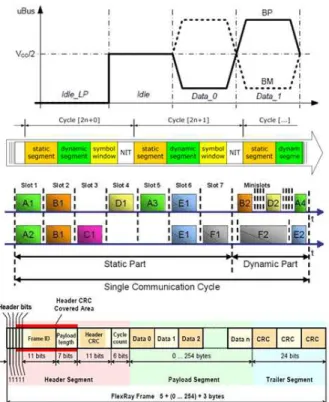
Fig. 4. FlexRay signaling, segment, and frame structure 그림 4. FlexRay 시그널링, 세그먼트 및 프레임 구조
Fig. 5. Automotive ethernet physical layer 그림 5. 차량용 이더넷 물리 계층
Fig. 6. LIN frame structure 그림 6. LIN 프레임 구조
Fig. 7. PSI5 bus architecture and signaling 그림 7. PSI5 버스 구조 및 시그널링
Ⅲ. 고속 IVN 기술
고속 IVN은 주로 데이터 백본과 전기식 제어 (X-by-wire)에 사용되며 모듈 간 연결도 점차 CAN, CAN-FD에서 고속 IVN으로 대체되고 있다.
FlexRay는 그림 4와 같이 Vcc/2를 중심으로
하는 차동 신호를 사용하며 정적 세그먼트(static
segment) 내의 타임슬롯(timeslot)을 특정 메시지
에 전용 할당함으로서 실시간성을 보장한다. 페이
로드(payload)도 254 바이트로 CAN보다 길어
전송 효율도 높으며 2선 또는 4선으로 구성되어
채널을 최대 2개까지 사용할 수 있다.
In-Vehicle Network Technologies 295
(521) MOST는 차량 내 멀티미디어 시스템을 위해 개발되었으며 UTP(unshielded twisted cable)와 POF(plastic optical fiber)를 모두 지원한다. 다른 IVN 기술과 달리 물리 계층(physical layer)을 별 도로 규정하지 않아서 다양한 물리 계층을 사용 할 수 있으나 링 토폴로지이기 때문에 연결된 디바이스가 많으면 효율이 떨어진다.
이더넷은 실시간성과 신뢰성 문제로 차량에는 잘 사용하지 않았지만 최근 이런 문제를 해결하 여 다른 IVN을 빠르게 대치해 나가고 있다. 차량 용 이더넷은 그림 5와 같이 물리 계층을 제외하 면 일반 이더넷과 동일하다. 최근 IEEE에서 발표 한 1000Base-T1은 1Gbps까지 전송이 가능하며 향후 고속 IVN 시장을 주도할 것으로 보인다.
Ⅳ. 저속 IVN 기술
LIN, PSI5, SENT 등의 저속 IVN은 주로 모듈 내에서 ECU(electronic control unit), 센서, 액츄 에이터를 연결하며 가격에 매우 민감한 편이다.
LIN은 미러, 윈도우, 도어, 공조, 시트, 와이퍼 등 대부분의 바디 어플리케이션에 사용되며 최대 전송 속도는 20kbps이다. CAN 노드와 LIN 마스 터 노드를 통합하여 그림 1처럼 CAN의 서브넷으 로 사용하는 경우가 많다. 그림 6처럼 마스터 노 드가 헤더를 전송한 후 헤더의 메시지 식별자가 지정하는 슬레이브 노드끼리 데이터를 주고받기 때문에 마스터 노드도 슬레이브 기능을 포함한다.
PSI5는 에어백 등 각종 센서에서 많이 사용된
다. 클록 동기화가 쉽도록 맨체스터 코드
(Manchester code)를 사용하며 그림 7과 같이 슬 레이브 노드가 전송을 마치면 다음 슬레이브 노드가 전송을 시작한다. 전송 속도는 125kbps 고정 속도로 LIN보다 빠르지만 신뢰성이 나쁘다.
SENT는 아날로그 시그널링이 없으며 5V 디지 털 출력만 사용하기 때문에 디지털 로직만으로 구현할 수 있어 가격이 저렴하고 ECU에 내장하기 쉽다. 데이터는 4비트인 니블(nibble) 단위로 나누 어 전송하며 보통 12비트 데이터 2개를 총 6개의 니블로 전송한다. 데이터 값은 폴링 에지 사이의 시간으로 표현되는데, 시간이 12틱일 때가 데이터 0이며 데이터 값이 1씩 증가할 때마다 시간이 1틱 씩 증가한다. 최대 전송 속도는 40kbps이다.
Ⅴ. 결론
본 논문에서는 최근 사용되고 있는 다양한 IVN
기술에 대해 살펴보았다. 스마트 카와 자율주행 기술의 발달에 따라 IVN은 더욱 중요해지고 있으 며 전장 시스템의 핵심 기술이 될 것으로 보인다.
References