• 검색 결과가 없습니다.

The Effect of Choice Attributes of Internet primary bank on Satisfaction and Behavioral Intention

N/A
N/A
Protected

Academic year: 2021

Share "The Effect of Choice Attributes of Internet primary bank on Satisfaction and Behavioral Intention"

Copied!
8
0
0

로드 중.... (전체 텍스트 보기)

전체 글

(1)

The Effect of Choice Attributes of Internet primary bank on Satisfaction and Behavioral Intention

1)

Ji-Hee Jung*, Jae-Ik Shin*

Abstract

In recent years, interest in internet primary bank has increased in South Korea, and marketing strategies for the success of the bank are needed. The purpose of this study is to analyze the effect of bank choice attributes on satisfaction and behavioral intention of Internet primary bank users. A convenience sampling was used and a structural equation of AMOS 20.0 was used for hypothesis testing. The results of the study are as follows. First, information, transaction, and communication of the choice attributes have positive effects on satisfaction. Second, information, transaction, and communication of the choice attributes have positive effects on behavioral intention. Third, satisfaction has a positive effect on behavioral intention. The theoretical and practical implications and limitations of the research are presented in the conclusion.

▸Keyword: Internet primary bank, Choice Attribute, Information, Transaction, Communication, Satisfaction, Behavioral Intention

I. Introduction

Fin-Tech is one of the most popular global financial markets in recent years. Government deregulation policy to activate simple payment system, such as the allowance of credit card information to be stored by a qualified Payment Gateway (PG) and abolition of the use of official certificate, makes it easier for Internet primary banks to enter the market[1].

Korea's Internet primary banking began operations of K-bank in April, 2017, and Kakao Bank started operations in July. Because of the gust of Internet primary bank, commercial banks are watching the growth of Internet primary banks and they are responding swiftly in various fields such as FinTech capacity building, price competition, and organization channel maintenance. As of October 2017, K-Bank had about 4.35 million subscribers and as of November 2017, Kakao Bank reached 590,000 subscribers[2].

According to Mckinsey Global Banking Annual Review[3], in the next 10 years, as Fin-Tech companies enter into the existing financial market, competition for financial consumers will become more intense. Especially, 58-78% of customers in advanced Asian countries such as Japan, Korea, Taiwan, Australia, Hong Kong and Singapore have purchased financial products online and more than half of the customers will do business with these financial firms if they have a distinct advantage over online financing services of Fin-Tech. Korea's Internet primary banks are aggressively attracting potential customers with easy-to-use features such as favorable interest rates, easy credit lending procedures, and maximum expansion, while the product composition is simple as a basic loan and saving product.

The recently launched Internet banking companies,

∙First Author: Ji-Hee Jung, Corresponding Author: Jae-Ik Shin

*Ji-Hee Jung ([email protected]), Dept. of Distribution, Gyeongnam National University of Science and Technology

*Jae-Ik Shin ([email protected]), Dept. of Distribution, Gyeongnam National University of Science and Technology

∙Received: 2019. 08. 07, Revised: 2019. 09. 11, Accepted: 2019. 09. 16.

(2)

K-Bank and Kakao Bank, are receiving great attention from financial consumers in South Korea. Financial innovation and financial consumer welfare are expected to increase, especially using FinTech. In the future, in order for Internet primary banks to successfully settle down and grow steadily, they need to build differentiated business models such as customized products that utilize technology innovation by moving away from profit-oriented structure[4].

Shinhan Bank recently signed a contract with Toss of Fin-Tech to apply for a third-party Internet primary bank.

Toss will have 10 million subscribers through simple payment and remittance services, which will further intensify competition with current Internet primary banks.

Other existing banks will participate in competition with Internet primary banks by introducing Pin-Tech technology.

In order to survive and succeed of Internet primary banks in the changing financial market environment, it is necessary to provide excellent value to financial customers. In addition, as the market grows, competition is intensifying. Efforts should be made to maintain existing customers, attract new customers, and develop successful marketing strategies. Thus, the purpose of this study is to analyze the effects of the choice attributes of Internet primary bank based on FinTech technology on satisfaction and behavioral intention, and to suggest some implications.

II. Theoretcal Background and Hypothesis

1. Choice Attribute

An attribute is properties that product and intangible service have. A product or service can be viewed as a bundle of attributes[5]. In addition, among the many attributes possessed by products, trademarks, and stores, it is a choice attribute that affects consumer behavior such as consumer preference, actual purchase decision, and store visit[6].

Choice attributes are the source of consumers’

purchase and their buying behavior is highly correlated with choice factors. It is also a fundamental approach to analyze consumer behavior in that a choice attribute can meet the needs and expectations of a decision[7]. A

choice attribute is crucial to effective marketing because it has a decisive influence on consumers' purchase of product or brand[8].

Unlike traditional service quality, e-service quality measures the quality of services offered online. With the development of information and communication and the universalization of the Internet, new services such as e-commerce emerged and online services were also introduced in various industrial sectors. This led to controversy among researchers over the use of a traditional measurement of service quality to measure the quality of services offered online[9].

Research on the choice attributes of Internet shopping malls or online shopping mall websites has been very active.

Lee(2002) presented "five factors: information, transaction, website design, communication, and safety" as a service quality factor for Internet shopping malls through an empirical research which summarized SERVQUAL and the evaluation criteria of existing online services[10].

As a measure of eSERVQUAL has been developed, it has been used to establish marketing strategies for Internet services, especially Internet shopping malls. In other words, companies are strategically using e-SERVQUAL in constructing website choice attributes.

In this study, based on the previous research, the choice attributes of Internet primary banks are organized into three dimensions and summarized as follows. First, information means the latest and correctness of product information, product assortment, and so on.

Therefore, in the case of an Internet primary bank, the proportion of financial product information is high, and it can be applied to other financial products such as inquiry, transfer, loan application, and card use. Second, transactions include the procedures and functional convenience required by users in the process of using financial services through Internet primary banks. It also includes the establishment and use of the Internet primary banking system and the handling of complaints. Third, communication refers to the communication and transactional inconveniences of Internet primary banks.

In the case of Kakao Bank, it provides customer service such as phone inquiry, Katok inquiry, and 1: 1 inquiry through application center and guide.

2. Satisfaction

Today's customers have improved their education

levels as industries evolves. By making it easier to obtain

(3)

more information as information technology evolves, consumers can easily compare which products or services deliver more value to them and choose the best alternative. Therefore, companies can achieve customer satisfaction only if the products or services provided by them meet their customers' heightened expectations[11].

Since satisfaction reduces the cost of attracting new customers and converts them into loyal customers, it can be defined as a key element to generate long-term profits[12]. Satisfaction is directly related to the satisfaction of goods and services, and it is a relative concept compared to expectation. In other words, satisfaction or dissatisfaction can be measured as the perceived difference between expectation before consumption and perceived performance after[13].

Satisfaction means the degree to which a user believes that the results obtained through prior expectation and information utilization are useful. Satisfaction with information is directly related to re-use intention according to its level, because it is expressed through expectation before information utilization and actual performance after[14].

The main influence factors for customer satisfaction and behavioral intention of hotel comparison sites are information attributes and they have a significant impact on overall benefit, satisfaction, recommendation intention, repurchase intention[15]. Thus, the following hypotheses are provided to identify how the choice attributes of Internet primary banks (information, transaction, and communication) affect satisfaction.

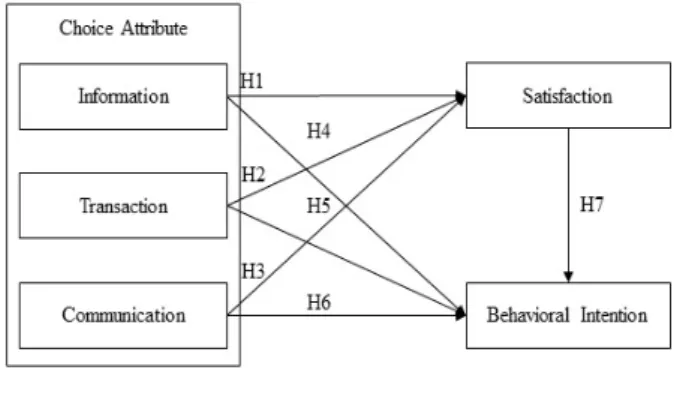
H1: Information of the choice attribute has a positive influence on satisfaction.

H2: Transaction of the choice attribute has a positive influence on satisfaction.

H3: Communication of the choice attribute has a positive influence on satisfaction.

3. Behavioral Intention

Behavioral intention can be defined as the will and belief that consumers will express as a specific future action after they have formed an attitude toward the object[16]. Service firms need to drive consumers’

behavioral intention for continuous loyalty through customer-oriented service quality strategy[17-18].

Repurchase intention, positive word of mouth (WOM) intention, and loyalty are collectively defined as behavioral intentions. They are positive or negative

responses by consumers who are satisfied or dissatisfied after experiencing a product or service[19] and an individual's willingness to show specific actions after purchase[20].

Behavioral intention refers to an individual's will and belief in a particular future action after a consumer has formed his/her attitude toward an object. Behavioral intention is also treated as a purchase decision factor or a result variable of consumer satisfaction and is measured as intentions to repurchase and recommend[21].

Lu(2019) suggested that consumption trend has a positive effect on the choice attributes of mobile payment services and the attributes have a positive impact on behavioral intention.[22].

Despite a variety of recent marketing opportunities, WOM communication is still the most powerful means of communication and Internet technologies such as blogs are increasing their impact[23]. Some customers set up their own websites to target famous brands and spread complaints. Businesses should be interested in the level of customer satisfaction because consumers can quickly spread positive and negative WOM through the Internet[11]. This shows that the level of satisfaction with the choice attribute of an Internet primary bank may affect a positive or negative WOM. It has been confirmed that the Internet primary bank choice attribute is a major factor that can affect satisfaction and behavior intention, thus the following hypotheses are provided to investigate the relationship between an Internet primary bank's choice attributes, customer satisfaction, and behavior intention.

H4: Information of the choice attribute has a positive influence on behavior intention.

H5: Transaction of the choice attribute has a positive influence on behavior intention.

H6: Communication of the choice attribute has a positive influence on behavior intention.

H7: Satisfaction with an Internet primary bank has a positive influence on behavior intention.

III. Research Method

1. Research Model

Based on previous researches, this study targets users

of Internet primary banks and presents the research

(4)

Constructs Items

Information

I1. It has various kinds of Internet primary bank products.

I2. It provides accurate information on Internet primary banking products.

I3. It provides sufficient information on Internet primary bank products.

I4. The delivery of information on Internet primary bank products is clear and persuasive, making it easy to understand.

Transaction

T1. The process is simple, from finding, opening and using financial instruments.

T2. The opening and use of the desired financial instrument can be used precisely in a short period of time.

T3. It is easy to solve various problems arising from the use of Internet primary banks.

T4. The information on the goods and services traded is no different from advertised content.

Communication

C1. It provides customized services that meet users' preferences.

C2. It is easy for users to get the information they want.

C3. Users can raise their opinions in a variety of ways.

C4. Respond appropriately to the user's complaint.

Satisfaction S1. I am satisfied with the use of this Internet Table 1. Measure scales

primary bank.

S2. The choice for this Internet primary bank was excellent.

S3. My feelings about this Internet primary bank are pleasant.

S4. I think the decision to use this Internet primary bank was a good thing.

Behavioral intention

BI1. I will continue to use this Internet primary bank.

B2. The use of this Internet primary bank will be considered first for the next financial transaction.

BI3. The Internet primary bank will be positively informed to others by word of mouth or SNS.

BI4. I will recommend the use of this Internet primary bank to my acquaintances.

model shown in Figure 1 to investigate the relationship between the choice attribute of the banks, satisfaction, and behavioral intention. This model’s constructs were developed from related previous studies.

Fig. 1. Research model

2. Operational Definition of Construct

The operational definitions of questionnaire items and constructs are presented as Table 1. The measurement of the choice attribute (information, transaction, and communication), satisfaction, and behavioral intention of Internet primary banks used a seven-point Likert scale.

The measurement scale for each variable used in this study has been modified and supplemented to suit Internet primary banks using items that have been tested for reliability and validity.

IV. Data Analysis and Findings

1. Characteristics of the Sample

The questionnaire survey in this study was conducted from August to November 2018 on users of the Internet primary bank (Kakao Bank). Of the 220 questionnaires collected, 190 were finally used for the hypothesis test.

Seven-point Likert-type scales ranging from strongly disagree (1) to strongly agree (7) were used to measure the constructs. SPSS 25.0 and AMOS 21.0 were used to analyze the collected data.

The characteristics of the sample used in the final analysis are as Table 2. Among the demographic characteristics, gender was 115 (60.5%) for men and 75 (39.5%) for women. The number of people in their 20s and 30s who actively use financial applications with smartphones was 54 (28.4 percent) and 82 (43.2 percent), respectively. The number of workers was 88 (46.3 percent). In addition, the main types of transactions were duplicate responses (n=312), followed by inquiry/transfer with 155 people (49.7%) and credit cards with 68 (21.8%).

Characteristics Categories n(%)

Gender Male 115(60.5)

Female 75(39.5)

Age

Twenties 54(28.4)

Thirties 82(43.2)

Above Forties 549(28.4)

Occupation

University student 25(13.2) Postgraduate student 32(16.8)

Office workers 88(46.3)

Small business person 30(15.8) Other occupations 15(7.9)

Mainly used transaction type (Overlap answer)

Account check / transfer 155(49.7) Deposit. / Installment savings

account 58(18.6)

Loan 30(9.6)

Overseas remittance 18(5.8)

Credit card 68(21.8)

Table 2. Demographic Characteristics

(5)

Path Factor loadings S.E. t-value p-value Results

H1 Information → Satisfaction 0.240 0.076 3.169 0.002 Supported

H2 Transaction → Satisfaction 0.279 0.085 3.305 0.000 Supported

H3 Communication → Satisfaction 0.204 0.078 2.608 0.009 Supported

H4 Information → Behavioral intention 0.193 0.063 3.050 0.002 Supported

H5 Transaction → Behavioral intention 0.257 0.072 3.568 0.000 Supported

H6 Communication → Behavioral intention 0.223 0.066 3.366 0.000 Supported

H7 Satisfaction → Behavioral intention 0.306 0.070 4.388 0.000 Supported

χ2 =118.493, df=75, p=0.000, GFI=0.926, AGFI=0.881, RMR=0.043, TLI=0.964, CFI=0.975, RMSEA=0.055 Table 5. The results of hypotheses testing

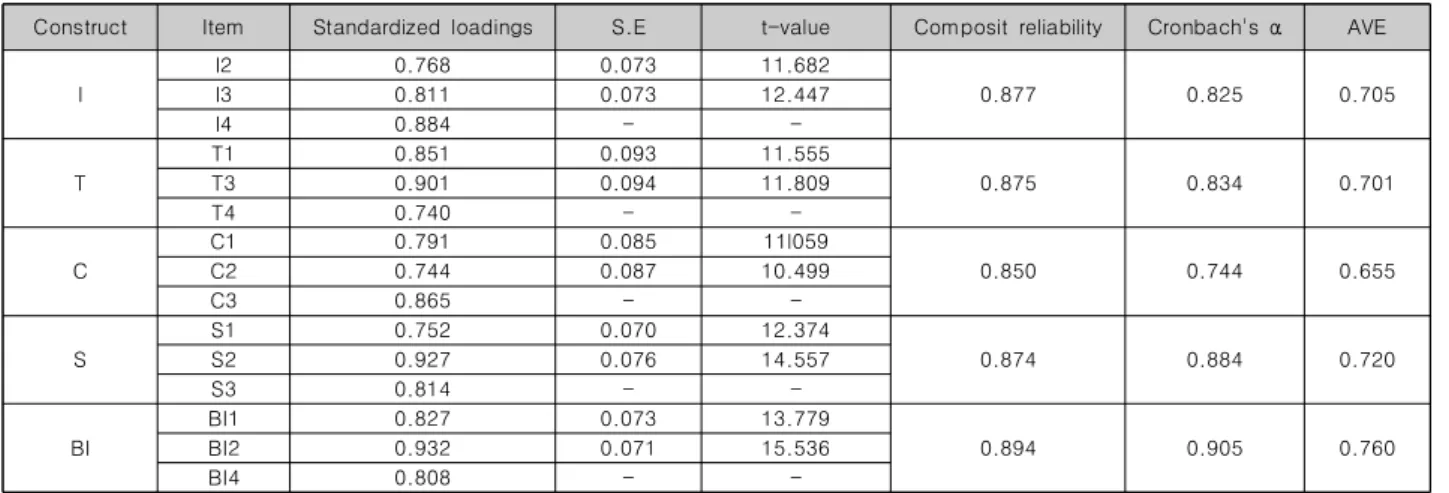
Construct Item Standardized loadings S.E t-value Composit reliability Cronbach's α AVE

I

I2 0.768 0.073 11.682

0.877 0.825 0.705

I3 0.811 0.073 12.447

I4 0.884 - -

T

T1 0.851 0.093 11.555

0.875 0.834 0.701

T3 0.901 0.094 11.809

T4 0.740 - -

C

C1 0.791 0.085 11l059

0.850 0.744 0.655

C2 0.744 0.087 10.499

C3 0.865 - -

S

S1 0.752 0.070 12.374

0.874 0.884 0.720

S2 0.927 0.076 14.557

S3 0.814 - -

BI

BI1 0.827 0.073 13.779

0.894 0.905 0.760

BI2 0.932 0.071 15.536

BI4 0.808 - -

χ2 =129.986, df=76, p=0.000, GFI=0.920, AGFI=0.873, RMR=0.044, TLI=0.956, CFI=0.969, RMSEA=0.061 Table 3. Convergent Validity and Reliability

2. Confirmatory Factor Analysis

Based on the theoretical background, confirmatory factor analysis was conducted to identify rigorous convergent validity between the constructs, and the results are shown in Table 3. χ 2 =129.986, df=76, p=0.000, χ 2 /df=1.710, GFI=0.920, AGFI=0.944, TLI=0.956, CFI=0.969, and RMSEA=0.061, which means that the measurement model is suitable overall. All composite reliability is shown to be above the reference value of 0.7, indicating that the measurement model has the good reliability of the variables[24].

Average variance extraction value (AVE) above the reference value of 0.5 indicates that the measurement model has convergent validity[25].

3. Correlation Analysis

Since the value of AVE square root is greater than 0.7 and appears higher than the correlation values, and discriminant validity of the measurement model are satisfied (see Table 4).

(1) (2) (3) (4) (5)

(1)Information 0.839

(2)Transaction 0.313 0.838 (3)Communication 0.244 0.232 0.809 (4)Satisfaction 0.383 0.388 0.286 0.848 (5)Behavioral intention 0.439 0.481 0.394 0.561 0.872 The diagonal bold is the value of the square root of AVE.

Table 4. Discriminant Validity

4. Structural Model

In this study, structural equation model was used for hypothesis testing. The fit of the path model was χ 2 = 118.493, df = 75, p = 0.000, χ 2 / df = 1.580, GFI = 0.926, AGFI = 0.881, RMR = 0.043, TLI = 0.964, CFI = 0.975, RMSEA = 0.055, meaning that there is no problem in the analysis for the hypothesis test because it satisfies the fitness standard of the model. The results of this study are shown in Table 6.

First, information of the choice attribute has a positive

influence on satisfaction (β = 0.240 and t = 3.169) and

(6)

thus H1 is supported. This shows that the information provided by Internet primary banks can lead to a high level of satisfaction if it is detailed, accurate and sufficient.

Second, transaction of the choice attribute has a positive influence on satisfaction (β = 0.279 and t = 3.305) and thus H2 is supported.

Third, communication of the choice attribute has a positive influence on satisfaction (β = 0.204 and t = 2.608) and thus H3 is supported. This suggests that the higher the level of smooth information provision and customer response service, the more likely it will lead to customer satisfaction. Fourth, information of the choice attribute has a positive influence on behavioral intention

(β = 0.193 and t = 3.050) and thus H4 is supported.

This shows that information provided by Internet primary banks can lead to positive behavior if it is detailed, accurate and sufficient. Fifth, transaction of the choice attribute has a positive influence on behavioral intention (β = 0.257 and t = 3.568) and thus H5 is supported. Sixth, communication of the choice attribute has a positive influence on behavioral intention (β = 0.223 and t = 3.366) and thus H6 is supported. This shows that Internet primary banks' smooth communication, customer service, and resolution of inconveniences can lead to positive behavior such as maintaining the relationships and recommending them. Seventh, satisfaction with an Internet primary bank has a positive influence on behavioral intention (β = 0.306 and t =4.388) and thus H7 is supported. It is confirmed that the positive relationship between satisfaction and behavioral intention is also important in the Internet primary bank sector.

V. Conclusion

Based on the empirical analysis results of this study, the implications for the success of the Internet primary bank are as follows. It is confirmed that the choice attributes play an important role in the satisfaction and behavior of Internet primary bank users. If information, transactions, and communication of the choice attributes are positively assessed by Internet primary bank users, the level of satisfaction has increased and behavioral intention has been shown to be positive.

First, Internet primary bank choice attributes have a

positive impact on satisfaction and behavior, which can be seen as consistent with the role of the attributes in purchasing products and services in previous research[5-6]. Due to the nature of the service industry, where price competition is fierce, the areas where differentiation can be made can be offer, delivery, and image, and Internet primary bank choice attributes may be the means of differentiation.

Second, transaction of the choice attributes has the most effect on satisfaction and behavioral intention. This shows that consumers value the convenience of procedures and functions in transactions of financial instruments by Internet primary banks. Interestingly, communication of the choice attributes affects behavioral intention more than information does. On the other hand, information of the choice attributes affects satisfaction more than communication does.

And satisfaction with Internet primary banks is identified as the most important factor in improving behavioral intention. Thus, the research model of choice attribute, satisfaction, and behavioral intention in Internet primary banks used in this study can be considered appropriate.

Third, in this study, the success of an Internet primary bank is explained as the higher the user's satisfaction and behavioral intention, the more likely it is. For this, the marketers of Internet primary banks should develop and manage the choice attributes from a consumer’s perspective.

The theoretical and practical implications of this study are as follows. By utilizing the choice attributes of Internet primary banks in Korea, the banks can enhance their competitiveness. It will also provide a theoretical background for follow-up studies on Internet primary banks and choice attributes, satisfaction and behavioral intention. Finally, it will be able to contribute to the expansion of the latest Fin-Tech research other than the Internet primary bank.

Expanded information, communication, and mobility enable customers to make better choices and share their preferences and opinions with others. Consumers are willing to move to another Internet primary bank if they think they are not being treated right. Thus, Internet primary banks will have to focus on improving their choice attributes to win the competition with existing banks.

Although the implications were presented based on the

analysis results, the following limitations would have to

(7)

be addressed in a variety of aspects in future studies.

First, in this study, data collection has been done only once and there is some difficulty in generalizing the number of questionnaires used for empirical analysis.

Further surveys and analyses are needed for a more specific and better outcome in the future. Second, the variables used in this study could be applied to products or services other than Internet primary banks by developing various constructs. Finally, the study may be further expanded through additional analysis to identify differences in demographic characteristics(gender, age, etc.) of this study.

REFERENCES

[1] Jung, H. J. and Lee, J. H., “A Study on the Impact of Korean Internet Primary Banks. Financial Planning Review,” vol. 9, No. 3, pp. 1-22, 2016.

[2] Financial Services Commission, “ Recent trends in Internet primary banking and financial sector's response movement, ” Press Releases (in Korean), 2017.

[3] McKinsey Global Banking Annual Review, “ The Fight for the Customer, ” McKinsey & Company, 2015.

[4] Lee, D. G., “Expectations and challenges,” Financial Briefs, Vol. 26, No. 18, pp. 1-8, 2017.

[5] Kotler, P., Bowen, J., and Makens, J. C., “ Marketing for Hospitality and Tourism (3rd ed.), ” Upper addle River, NJ, Prentice Hall, 2003.

[6] Lewis, R. C., “The Basic of Hotel Selection,” The Cornell H. R. A Quarterly, Vol, 25, pp. 54-69, 1984.

[7] Fodeness, D., “Measuring Tourism Motivation,” Annuals of Tourism Research. Vol. 21, No. 3, pp. 555-581, 1994.

[8] Oh, M. J., Han, J. H., Ryu, J. S., and Cheon, S. D.,

“Segmentation of Shopping Choice Attribute by Shopping Site and Satisfaction,” Journal of Tourism and Leisure Research, Vol. 24, No. 4, pp. 461-478, 2012.

[9] A. Parasuraman, V. A. Zeithaml and A. Malhotra,

“E-S-QUAL: A Multiple-Item Scale for Assessing Electronic Service Quality,” Journal of Service Research, Vol. 7, No. 3, pp. 1-21, 2005.

[10] Lee, M. K., “SERVQUAL: A Scale for Measuring Consumer Evaluations of Internet Service Quality,”

Journal of Korean Marketing Association. Vol. 17, No.

1, pp. 73-95, 2002.

[11] Kotler, P., Keller, K. L., “ Marketing Management (15th ed.), ” NJ: Pearson, 2016.

[12] Bolton, L. L. and Alba, W. J., “Consumer Perceptions

of Price (Un) Fairness,” Journal of Consumer Research.

vol. 29, No. 4, pp. 474-449, 2003.

[13] Baker D. A. and Crompton J. L., “Quality, Satisfaction and Behavioral intentions,” Annals of Tourism Research, Vol. 27, No. 3, pp. 785-804, 2000.

[14] Ha, S. B. and Kang, S. M., “Inquiry on the Socio-Cultural Meaning of the Using Form and Environment of Smart Phone: Focused on the Viewpoint of Media-ecology Studies,” Journal of the Korea Contents Association. Vol.

11, No. 7, pp. 89-99, 2011.

[15] Jung, J. H. and Shin, J. I., “The Effect of Selection Attributes in a Hotel Comparison Site on Customer Satisfaction and Behavioral Intentions,” The Journal of Internet Electronic Commerce Resarch, Vol. 18, No.

6, pp. 105-117, 2018.

[16] Joo, S., “The influence of the service quality of the airline's website on e-brand image and behavioral intention,” Journal of Tourism Management Research, Vol. 20, No. 6, pp. 459-476, 2016.

[17] Kim, Y. J., Kim, G. W., Kim, H. S. and Jung, Y. J., “Effects of the marina facility's attractive attribute, service quality and customer satisfaction on the loyalty,” Journal of the Korean Data Analysis Society, Vol. 17, No. 1, pp.

321-332, 2015.

[18] Ma, Z. and Zhao, J., “Evidence on e-banking customer satisfaction in the China commercial bank sector,”

Journal of Software, Vol. 7, No. 4, pp. 927-933, 2012.

[19] Bitner, M. J., “Service Scapes: The Impact of Physical Surroundings on Customers and Employees,” Journal of Marketing, Vol. 56, pp. 57-71, 1992.

[20] Zeithaml V. A., “Service Quality, Profitability, and the Economic Worth of Customers: What We Know and What We Need to Learn,” Journal of the Academy of Marketing Science. Vol. 28, No. 1, pp. 67-85, 2000.

[21] Lee, H. J. and Lee, M. Y., “The Effect of Visitor’s Service Quality Perception on Satisfaction and Behavior Intention: Focusing on the 10th Gwangju Biennale,”

Korean association of arts management, Vol, 34, No.

5, pp. 91-114, 2015.

[22] LU, L., “An Empirical Study on Consumption Propensity, Selective Attribute of Mobile Payment Services and Behavior Intention: focusing on Chinese Consumers,”

The e-Business Studies, Vol. 20, No.2, pp. 3-17, 2019.

[23] Baker, B., “ Destination Branding for Small Cities, ” Portland: Creative Leap Books, 2007.

[24] Nunnally, I. C. and Bernstin, I. H., “ Psychometric Theory (3rd ed.), ” NY: McGraw-Hill, 1994.

[25] Hair, J. F., Anderson, R., Tatham, R., and Black, W.,

“ Multivariate Data Analysis (5th ed.), ” Upper Saddle

River, NJ: Prentice-Hall, 1998.

(8)

Authors

Ji-Hee Jung, is a lecturer of Gyeongnam National University of Science and Technology and University of Ulsan, South Korea. She received PhD in Management from Gyeongsang National University, South Korea, in 2015. She is interested in E-business, M-commerce, services marketing, and consumer behavior.

Jae-Ik Shin, is a professor of Department

of Distribution, Gyeongnam National

University of Science and Technology,

South Korea. He received PhD in

Management from Gyeongsang National

University, South Korea. He has published

papers in journals such as International Journal of

Information Management, Asia Pacific Journal of Marketing

and Logistics, ICIC Express Letters Part B: Applications,

Journal of Electronic Commerce in Organizations, and The

Journal of Internet Electronic Commerce Research. His

current research interests include internet marketing,

tourism marketing, CSR, and services marketing.

수치

Table  2.  Demographic  Characteristics
Table  4.  Discriminant  Validity

참조

관련 문서

Since it is found that the self-regulation counseling program has an positive effect on the reduction of addiction in psychological factor, behavior․social

As a result of the study, it was confirmed that only human resource competency had a positive(+) effect on the intercompany cooperation method of IT SMEs,

The purpose of this study is to investigate the effect of the “problem solving and programming” area of ​​information subject on perception and

Second, based on the relationship between technical competence, creative competence, and entrepreneurial behavior, it is confirmed that young aspiring

An Empirical Study on the Influence on Entrepreneurship Education Quality and Career Choice Reasons to University Student’s Entrepreneurial Intention..

In this study, it can be interpreted that the combined increase of the trust and the alternative attraction makes the intention of conversion higher rather

In order to verify whether the museum exhibition of intangible cultural heritage has a significant influence on the visitor's behavioral intention, a

The purpose of this study is to analyze the effects of service quality on customer satisfaction and revisit intention perceived by Chinese golf range