• 검색 결과가 없습니다.

[연구실 소개] Friedrich-Alexander-University of Erlangen Nurnberg (FAU), Busan Campus / Christoph Lindenberger, Marco Haumann, Antonio Delgado, Hui-Chih Wang

N/A
N/A
Protected

Academic year: 2021

Share "[연구실 소개] Friedrich-Alexander-University of Erlangen Nurnberg (FAU), Busan Campus / Christoph Lindenberger, Marco Haumann, Antonio Delgado, Hui-Chih Wang"

Copied!
15
0
0

로드 중.... (전체 텍스트 보기)

전체 글

(1)

FAU Busan Campus - The Concept

This first German University in Korea is a challenging project of Friedrich-Alexander University Erlangen-Nuremberg (FAU) which considers the growing tendency in globalization of academic education. Our goal is to bring the best traditions and skills of German teaching, engineering and research to Korea as a place which has developed to a leading, highly industrialized country. Cooperation with Korean universities, and of Korean and German companies with FAU Busan will enhance the technological level of both countries.

The FAU Busan Branch is combined with a Research Center which is directly connected with the Graduate School. The scientific staff will be involved in both, research and teaching within the Graduate School program. Beginning with the first semester the students will participate in the research work and, by student exchange with the mother university at Erlangen, will gain experience in international team working.

FAU Busan Campus - The Research Center The FAU intends the Research Center to be a platform for exchange between industrial companies and research organizations in both, Germany and Korea. The Research Center aims to provide expertise for the East Asian branches of FAU’s German industrial partner companies, as well as for Korean companies with ideal conditions for mutual research projects. Located in the Busan Techno Park within the Busan Jinhae Free Economic Zone (BJFEZ) and n close proximity to Gimhae International Airport, the Research Center offers excellent laboratory infrastructure and cutting edge experimental equipment.

FAU Busan and CBI Erlangen

FAU Busan Campus consists of an academic and an administrative section. The ADMINISTRATIVE SECTION is responsible for the operation of the Branch Campus and Research Center. The ACADEMIC SECTION, headed by the FAU Branch

Friedrich-Alexander-University of Erlangen Nürnberg (FAU), Busan Campus

-The Research Center-

Dr. Christoph Lindenberger Institute of Bioprocess Engineering (BVT), [email protected] Dr. Marco Haumann Institute of Chemical Reaction Engineering (CRT), [email protected]

Prof. Dr. Antonio Delgado Institute of Fluid Mechanics and Mechanical Engineering (LSTM), [email protected]

Hui-Chih Wang

Research Coordinator, [email protected]

(2)

Campus President Prof. Dr. Rainer Buchholz, is responsible for teaching and research activities within FAU Busan. It is organized into six institutes, resembling the structure of the DEPARTMENT OF CHEMICAL-AND BIO-ENGINEERING (CBI) in Germany.

The CBI consists of ten chairs, linked in pairs of two institutes:

·Technical Chemistry (Institute of Chemical Reaction Engineering, Institute of Separation Science and Technology)

·Biotechnology (Institute of Bioprocess Engineering, Institute of Medical Biotechnology with a research group on Environmental Process Engineering and Recycling)

·Energy and Plant Technology (Institute of Energy Process Engineering, Institute of Process Technology and Machinery)

·Interfaces (Institute of Particle Technology, Institute of Multi-scale Simulation)

·Fluidics (Institute of Fluid Mechanics, Institute of Engineering Thermodynamics).

In 1965, the installation of the first chair of the CBI, the Technical Chemistry I (Prof. H. Hofmann) initiated the foundation of chemical engineering studies in Germany. Building on their specific know-how ever since, the chairs of the CBI are competent and well equipped PARTNERS FOR COOPERATIVE

RESEARCH in all areas of chemical and biological process technology. The basis of the RESEARCH STRUCTURE is provided by the five building blocks of Chemical and Bioengineering which ensure a balanced relationship between chemical, biological and physical methods. The research is characterized by its diversity and breadth, by extensive national and international contacts and by an income from third party funding which holds a LEADING POSITION among the German universities

Institute of Chemical Reaction Engineering (CRT)

The CRT mission

The institute of Chemical Reaction Engineering (CRT) at FAU Erlangen, founded in 1965, has been the first institute of the new Faculty of Engineering and has substantially contributed to the education of chemical engineers in Germany. The institute in its current form is headed by Prof. Dr. Peter Wasserscheid, a leading expert in the field of ionic liquids and renewable energy storage, and constitutes six different fields of research, all among the general topic of advanced material development for improved and energy efficient processes. Prof. Wasserscheid is the founding director of the new Helmholtz Institute for Renewable Energy (HIERN) and initiator of the Bavarian Hydrogen Center (BHC). Additionally, the institute is participating in the Erlangen Catalysis Resource Center, a joint institution of the Department of Chemistry and Pharmacy and the Department of Chemical and Bioengineering. Within the Cluster of Excellence Engineering of Advanced Materials (EAM) Prof. Wasserscheid is the coordinator for the section catalytic materials .

The Chemical Reaction Engineering laboratory at

FAU Busan, established in 2010, is a branch of the

CRT institute in Erlangen. The aim of the laboratory is

(3)

to develop a platform for exchange between industrial companies and research organizations in both Germany and Korea in form of mutual research projects.

According to Humboldt’s principle of the unity of research and education, the academic and scientific staff members actively participate in the student education within the graduate school in Chemical and Bioprocess Engineering.

Research at FAU Busan IIoon niicc lliiq quuiid dss a ass een ng giin neeeerriin ng g fflluuiid dss

Ionic liquids (ILs) are substances consisting of ions only, but this definition is different from the classic definition of a molten salt. The latter is a high-melting, highly viscous and highly corrosive liquid, while an ionic liquid due to the lower symmetry and larger size of the ions is liquid at a much lower temperature (per definition < 100 ) and has a lower viscosity.

Ionic liquids are considered as environmentally substitutes for volatile organic solvents, not only because of their low vapor pressures but more importantly because their ability to act as catalysts.

Other attractive properties of ionic liquids include chemical and thermal stability, non-flammability, high ionic conductivity as well as a wide electro-chemical

potential window. The ability to tailor the combination of cation and anion of the ionic liquid to match specific task make the ionic liquid also called the designer solvent . Some authors speak as high as 1018 possible cation/anion combinations with more than 1,000 ILs are described in the literature and several hundred ILs are now commercially available. Research at CRT in FAU Busan focuses on applications of ionic liquids in solvents for catalysis for enhancing the system performance.

M

Muullttiip ph ha assee cca atta allyyssiiss

In homogeneous catalysis, due to the absence of phase boundaries, all catalyst molecules take part in the reaction, resulting in high reaction rates as well as high selectivity. Even coupled with mild reaction conditions and low diffusion problems, only 15% of all catalyzed reactions in industrial scale are using homogeneous catalyst. This is especially caused by the complexity of catalyst recycling. The homogeneous catalysis research at CRT at FAU Busan comprises the synthesis and characterization of transition metal complexes followed by screening with respect to the activity and selectivity in classical solvent system carried out in standard test reactors include glassware (Schlenk-tubes) and batch autoclaves (50 mL to 1,000 mL). Promising complexes are tested in ionic liquid biphasic systems in order to

Figure 1. Triphasic system consisting of cyclohexane (top phase), water (middle phase, plus dye) and ionic liquid [C

4

MIM][NTf

2

] (bottom phase)

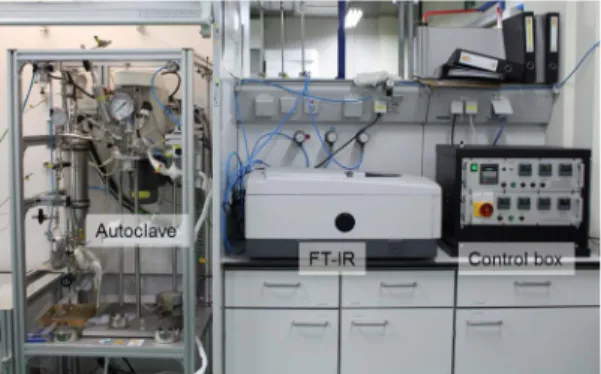
Figure 2. Operando FT-IR high pressure reactor setup for studying

homogeneous catalytic processes

(4)

further increase the catalyst performance and facilitating the product separation and catalyst recovery. The best systems are then investigated with respect of their kinetics and catalyst recycling using e.g. operando FT- IR spectroscopy (see Figure 2).

A

Ad dvva an ncceed d S SIIL LP P a an nd d S SC CIIL LL L m ma atteerriia allss

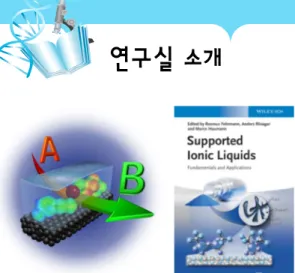
Future development of more efficient catalysts in chemical processes will depend on the design of solid surfaces that allow all surface atoms to be most effective. At the same time, new technologies are required that will lead to the design of completely new surface properties within solids. One possible way to achieve a uniform surface is the coating of the solid support material with a thin ionic liquid film, thereby defining the material properties by the uniform liquid s properties as shown in Figure 3.

If the support is catalytically active itself, so called Solid Catalyst with Ionic Liquid Layer (SCILL) materials are obtained.

The immobilization of homogeneous catalysts by Supported Ionic Liquid Phase (SILP) materials is one possible approach to overcome the major drawback of homogeneous catalysis (separation and recycling problem). SILP catalysts have found wide application (e.g. hydroformylation, carbonylation, hydrogenation, Heck reactions, hydroaminations, epoxidation and

metathesis). The research at CRT in FAU Busan is focused on the development of novel SILP materials for catalysis and separation, their reaction engineering and the optimization and fine tuning of these attractive systems for industrial using mini-plant reactor setups (see Figure 4).

For catalytic SILP materials, important selection criteria for the applied IL are catalyst complex, substrate and product solubility, wettability to ensure an even film distribution as well as an appropriate solvent nucleophilicity to stabilize the dissolve catalyst complex without deactivation. In the SCILL concept the selection criteria for the IL selection are surface wettability, specific IL-catalyst interactions and product solubility. Both methodologies, SILP and SCILL constitute attractive ways to circumvent the lack of uniformity of solids in traditional heterogeneous catalysis. Additionally, both approaches provide great potential to create materials with new surface properties, as the transfer of specific ionic liquid properties to the solid surface may result in designer surfaces having properties which are impossible to realize with any other synthetic approach.

S

Syyn ntth heessiiss ooff w weellll--d deeffiin need d n na an noop pa arrttiicclleess

Despite the fact that metallic gold is a relatively inert metal, research found that the reactivity of gold Figure 3. Schematic representation of surface coating with thin

films of ionic liquid (left) and cover of the first book on supported ionic liquids (right) ISBN 978-3-527-32429-3.

Figure 4. Continuous gas-phase reactor setup including two

tubular fixed-bed reactors and a gradient-free gas-loop

reactor

(5)

increases when formed in the nanoparticle size range.

Since then, research has been concentrated on investigating gold nanoparticles as an active catalyst system in a wide range of reactions (oxidation, H2O2 synthesis, C-C coupling reaction, hydrogenation etc.).

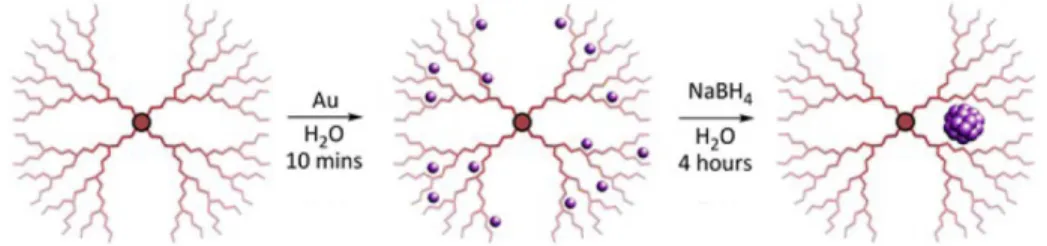
Of particular importance is the preparation of nanoparticles with a narrow size distribution. One way the research group achieves this is utilising highly branched macromolecular polymers referred to as dendrimers to serve as templates for nanoparticle preparation (Scheme 1).

Considering the versatility of gold nanoparticles in oxidation reactions and the given precedent for good activity as oxidation catalysts, they prove to be the perfect candidate for evaluation as SCILL systems in oxidation reactions. By investigating the influence of ionic liquids on existing gold catalysts there is the potential for enhancing catalytic performance in both activity and the selectivity towards desirable chemical compounds. In this way, research at FAU Busan is conducted to possibly expand the existing capability of gold nanoparticles as catalysts in various industrially relevant transformations (e.g. alcohol oxidation).

S

Soolluub biilliittyy a an nd d ttrra an nssp poorrtt p prroop peerrttiieess

The possibility to adjust solubility properties of ionic liquid especially in biphasic system using ionic liquid is of great importance. This can only be realized if the ionic liquid is able to dissolve the catalyst and at the same time displays a high solubility with the substrates and poor solubility for the products. This way, the product phase can be isolated from the ionic liquid/catalyst phase can be separated by simple phase decantation and the ionic liquid phase containing the dissolved catalyst can be recycled.

However with the possibility of having 1018 combination of cation/anion for ionic liquid, screening of all ionic liquid is literally impossible. In order to overcome this problem, suitable ionic liquids are pre- screened in advance using e.g. COSMO-RS software (see Figure 5).

The suitable ionic liquid should display high substrate solubility to ensure high reaction rates while the product solubility should be low in order to extract the product in situ and avoid consecutive reactions. The good candidates among few ionic liquids will then be tested using magnetic scale balance (Rubotherm, Germany) (Figure 6).

Scheme 1. General scheme for dendrimer templated Au nanoparticle preparation.

Figure 5. Calculation of activity coefficient from molecular structures using the COSMO-RS software tool.

(6)

For the measurement of liquid-liquid solubility a dedicated headspace GC-MS is available.

Team and mission

The research staff of the CRT laboratory is very international, resembling experts from Germany, UK, South Africa and Indonesia as well as highly dedicated Korean master students from the graduate school at FAU Busan.

Aiming to bring the best traditions and skills of German teaching, engineering and research to Korea, we, in accordance with FAU’s motto, strive to advance through networks” in Korea, by seeking to establish mutual cooperation with Korean as well as international research institutions and companies.

Contact Dr. Marco Haumann, [email protected] Dr. Soebiakto Loekman, [email protected] Institute of Bioprocess Engineering (BVT)

Research Subjects BVT

Bioengineering and bioprocess engineering are multi- faceted disciplines, ranging from micro processes (drug development, stem cell research, micro reactor design etc.) to small - middle scale processes (protein production, process optimization, bio-pesticides or - insecticides production, etc.) for developing large-scale plants and reactors (therapeutic production, waste-

water-treatment, etc.). In our daily life all of us are in contact with biotechnological products, not only by using pharmaceuticals. Fermented food (like beer, 막걸 리 or 김치) belong - strictly spoken - to the field of bioprocess engineering and many products like pregnancy test (immunological assays) or strawberry flavour (bio transformations) have their origin in bioengineering.

All of those fields and processes have one thing in common: the combination of the general art of engineering with biological knowledge and aspects.

The Institute of Bioprocess Engineering of Friedrich- Alexander University of Erlangen-Nürnberg Campus Busan has established several different fields from cell cultures over marine biotechnology and plants towards analytic and downstream processing.

C

Ceellll ccuullttuurree tteecch hn noolloog gyy

In the field of cell culture technology we are focusing

on virus expression and virus dynamics. Cell cultures

are the first step in most screenings for antiviral

substances. For consistent virus infection kinetics a

strong focus has to be laid the infection quality. The

main tools are MOI, TOI and TOH, which - when

being optimized - guarantee a high virus-titer with a

high virus quality to avoid defect particles. Those stock

solutions are the minimum requirement for reproducible

virus infections and spreading. Having stable infection

protocols allows research with those systems into

Figure 6. Magnetic suspension balance (left) and headspace GC-MS (right).

(7)

different directions. Combining growth behaviour of the cells, infection probabilities and virus replication kinetics allows simulations of the virus spread in vitro, which leads to hypothetical understanding of the mechanism of a virus (Figure 7).

Different substances can influence the interaction between virus and host cell on various ways. Adapting of the model to the new results of the virus dynamics can give a hint on the mechanism of the substance.

Those hypnotised mechanisms can be cross investigated by the expression of typical gens of the virus cycle on mRNA basis. Those methods are the connection between cell culture and marine biotechnology where the substances originate.

M

Ma arriin nee b biiootteecch hn noolloog gyy

Located from the middle of Europe to Korea, marine biotechnology has one big advantage - coastal areas.

Within the last years, FAU Busan has, together with cooperation partners, self-isolated and identified over 140 algae from marine and fresh water environments.

This culture stock is the basis for several screenings for the key-word bio refinery. The principle of an ecologically worthwhile product cascade is nothing new in the basics of chemical process engineering and has recently entered the bio engineering sciences. Mainly the products of algae are, due to their cheap media compositions and sustainable energy usage, in the focus of process engineers. Beside the process development, one of the focuses is the screening of algae for multiple products and their characteristics, as for example, antiviral substance, pigments, fatty acids etc. One of the keys is a downstream cascade that allows cheaply and quantitatively extraction and purification of several products gained out of one cultivation.

The cultivation systems for phototrophic organisms are a very special field in bioprocess engineering. This is one of the first fields, where it is not only “re- engineering” reactors, which were developed in chemical reaction engineering, and where optimization of the reaction efficiency could be done regarding mass transfer and mixing. Light is - until now - not dispersible in watery systems, and therefore the input is surface dependent. This problem led to many different designs for micro algae cultivation systems, which all Figure 7. Infection cycle with a possible numerical approach of

simulating virus spread of a budding virus.

Different substances can influence the interaction between virus and host cell on various ways. Adapting of the model to the new results of the virus dynamics can give a hint on the mechanism of the substance. Those hypnotised mechanisms can be cross investigated by the expression of typical gens of the virus cycle on mRNA basis. Those methods are the connection between cell culture and marine biotechnology where the substances originate.

Figure 8. Different reactor types (bubble column and stirred tank

reactor) equipped with the wireless-LED technology.

(8)

have their advantages and drawbacks.

Combining bioprocess engineering with electrical engineering allowed creating systems, where the light source is evenly suspended in the reactor with a wireless supply of energy, which allows internal illumination with a minimal influence of the flow regimes of the reactor (Figure 8). This key technology now allows reactor/process optimization with the well- established engineering tools.

Beside the high tech bioreactors, one trend in the field of marine biotechnology are low-budget disposable reactors. Here, the engineering at FAU Busan tries developing hybrids, which combine cheapness with the possibility of total process control.

T

Th hiiss a an nd d tth ha att

Beside the main research interests several small projects are running on different fields. From expressing virus based building blocks for nanotechnology and biological flow tracers micro fluid mechanics all the way to establishing analytical tools used in bioscience. Several analytical tools for single cell analysis can be used to compare data semi- quantitatively, but, due to missing calibration, a quantitative statement is most of the time questionable.

Micro emulations can be filled with various substances and can be used as artificial cells for calibration issues.

T

Teea am m a an nd d m miissssiioon n

The team at in the bioprocess engineering laboratory of FAU Busan is strongly webbed into international co- operations with universities and industrial partners. Our goal is focussing on the applied aspects of engineering and we therefore educate our students to become R&D- scientists, which can be placed in industry as well as in academic career.

Contact Prof. Dr. Rainer Buchholz, [email protected]

Dr. Christoph Lindenberger, [email protected]

Institute of Mechanical Engineering and Fluid Mechanics (LSTM)

Introduction

The Institute of Fluid Mechanics (LSTM) at the Technical Faculty of the Friedrich-Alexander- Universität Erlangen-Nürnberg is an academic unit of the Department of Chemical and Biological Engineering with research and educational focus on mass, momentum and energy transport in natural and technical processes.

LSTM interprets fluid mechanics as cross- disciplinary field between natural and engineering sciences, including applied mathematics and informatics. We are particularly interested in its applications to mechanical engineering but also to medicine and human biology. Accordingly, we offer more than 40 Bachelor and Master courses in the following programs: Chemical and Biological Engineering, Life Sciences Engineering, Chemical Engineering, Mechanical Engineering, Energy Technology, Advanced Materials and Processes, Computational Engineering and Medical Engineering.

Our courses range from elementary topics in Fluid Mechanics to its applications across disciplines.

Highly educated Professors, Postdocs (Habilitands), PhD Students as well Master and Bachelor students belong to our institutes in both, Busan and Germany. In addition we have well equipped mechanical and electronic workshops. Our staff consists of more than 75 persons with about 60 researchers engaged in 10 different groups. In addition, more than 50 student assistants are working in our teams.

The team in Busan

Apart from participating in research and education

activities within the Master’s program in Chemical and

(9)

Biological engineering, our institute in Busan is responsible for the pure Korean Education Program (BB 21, supported by Busan Metropolitan City) that aims at providing a world class education on the field of Wind Energy to selected high-talented Korean students.

We also collaborate with leading companies as SAMSUNG Heavy Industry Co. or Daewoo Shipbuilding & Marine Engineering Co. Ltd. within the framework of an EDRC project (Energy and Development Research Center). Further, we take part of the research and innovation program World Class 300 together with industrial partners as OCEANUS and other universities as Inha University or Korea Maritime and Ocean University. In response, a multicultural group is formed by highly skilled researchers from Korea, Germany, Italy, Iraq or Spain to assist all these challenges. The team is complemented with Master and Bachelor students from Korea, Germany, Canada and Czech Republic.

Research fields at FAU Busan M

Meetth ha an nee H Hyyd drra attee a ass ffuueell p pa arra ad dooxx:: E En neerrg gyy rreessoouurrccee a

an nd d p pootteen nttiia all g geeooh ha azza arrd d

Methane hydrates (MH) are clathrate solids consisting of methane molecules enclosed in frozen water. MH have a complex three-dimensional structure where the “host” molecules, i.e. water, form a cage and the “guest” or “former” molecules, methane, are trapped on the cage. There is no bonding between frozen water and methane molecules: methane is free to rotate inside the frozen water cage and the stabilization resulting from methane molecule is supposed to be due to van der Waals forces (attraction forces between molecules) and hydrogen bonds. The formation of Methane Hydrate requires the proper combination of temperature and pressure, gas saturation and local chemical conditions which combine to make it stable.

Methane Hydrates are usually found at low temperature and high pressure as for instance below water depths of

about 500 meters off the coasts of continents, in seafloor sediments or in arctic permafrost.

There are enormous deposits of MH under the ocean and beneath Arctic permafrost. They represent an estimated more than 50% of all carbonaceous fuel reserves on Earth. On the other hand, Methane hydrates contain highly concentrated methane: 1 m of methane hydrate dissociates to approximately 160 - 170 m of methane at normal conditions (0 C and 1 atmosphere). Further, direct combustion of methane provides high energy density per weight, but also contributes minimum emission of CO

2

as by-product (30 times less than gasoline and 60 times less than coal).

For all of these reasons, methane hydrates are considered as one of the world s largest untapped reservoirs of energy. They are potentially one of the most important energy resources on the future. South Korea has large methane hydrate deposits that can contribute decisively to reduce the available strong dependency from energy carrier import. Ulleung Basin Gas Hydrate expeditions in 2007 (UBGH 1) and 2011 (UBGH 2) corroborated the existence of Methane hydrate deposits within a maximum saturation up to 90%.

The low thermodynamic stability of MH, however,

makes the exploitation of MH oceanic deposits a

potential geohazard. The release of large quantities of

methane from deep oceans into the atmosphere has

been suggested as a possible cause of global climate

change. Latest research also reveals its possible

implication for the formation of tsunamis and

continental slope failures. Although MH has been

studied a lot over the last years, a lack of a rigorous

study of transport phenomena involved on the physic-

chemical and microbiological process taking place in

natural ocean deposits, is found in Literature. This is,

however, of vital importance to ensure a safe and

ecological extraction of MH.

(10)

We have installed at the FAU Busan campus a high pressure vessel which mimics the submarine conditions of MH deep oceanic deposits. The vessel allows maximum pressures up to 150 bars, minimum temperatures of 3-4 , and the seawater volumes of 475 liters. The design of this simulator includes 8 sapphire windows that ensure best optical accessibility and, thus, the use of non-invasive optical methods as Particle Image Velocimetry (PIV) or Digital Liquid Crystal Thermography among others (see Figure 9). We experimentally study how fluctuations in the MH environment, as for instance, caused by changes in pressure, water temperature, flow velocity, sediment bed properties, salinity, or pH, affect the methane hydrate stability inside the pressure reactor.

Besides, we studied the impact of geometrical properties of the porous sediment bed in MH nucleation. The formation and disassociation of MH within the porous sediment bed is of vital importance to approach the real phenomena occurring in Mother Nature. For this purpose, MH is synthesized in a batch vessel made of stainless steel with a total volume of 93.4 cm

3

. The vessel is filled with water and with a known amount of sediments with different geometrical properties. Optimal conditions for MH nucleation around the bed of sediments are achieved inside the reactor. We indirectly measure the MH formation via pressure drop on the vessel (see Figure 10). Further, MH nucleation inside sediment pores is studied using a high pressure vessel specially designed for microscopic observation. The steel vessel, designed for pressures up to 3,000 bar, contains two sapphire glass windows which also permit the use of non-invasive methods (see Figure 11).

W

Wiin nd d E En neerrg gyy:: O Op pttiim miizza attiioon n ooff vva arriia ab bllee a aiirrffooiill b blla ad dee ooff w

wiin nd d ttuurrb biin neess ((B BB B2211 P Prroog grra am m))

The conversion of mechanical into electrical energy in the first part of the last century initiated a new era of wind energy employment. However, since this time the performance of wind converter has been depending not only of the mechanical but also on the electrical components. In particular, the functionality of the generator determines essentially the global performance of wind converters. Thus, nowadays wind converters Figure 9. High pressure reactor (a)-(b)-(c) with dimensions in

cm and sketch of the optical system (d) [J.R. Agudo et al., Proceeding of the 22

th

Fachtagung Lasermethoden in der Strö mungsmesstechnik 2014]

Figure 10. Experimental equipment for synthesis and disassociation of MH (a). MH samples synthesized at FAU Busan (b)-(c).

Figure 11. Snapshots taken under microscope during

spontaneous nucleation of MH within a pore on the high

pressure vessel at 300 bar and 10℃.

(11)

are considered as an integrated dynamical system. On one hand, the rotor has to be optimized regarding its aerodynamics in such a way that its performance matches the best performance of the generator. On the other hand, the control of the wind converter in the sense of control theory requires actoric measures.

With respect to fluid mechanics, the most relevant aspects are scaling up of models developed in a lab environment to large-scale converters and the influence of turbulence. How to include the peculiarities of a specific operational environment, however, remains still as an open question. Which is the most promising way to take into consideration the weather of the specific location of the wind park? And how to find the most suitable position of a single wind converter within the wind park? This and other questions are subject of very intensive research at present. One of the present studies in this field at FAU Busan is to find the optimized airfoil shape by using Genetic Algorithm.

G

Grra an nuulla arr m moottiioon n iin n fflluuiid d fflloow wss:: IIn ncciip piieen ntt p pa arrttiiccllee m moottiioon n oon n rreeg guulla arr ssuub bssttrra atteess

Granular motion induced by a shear flow is very important in natural situations like sediment transport in rivers, bed erosion or dune formation. This also finds applications in a wide variety of industrial operations including cleaning of surfaces, e.g. production facilities

in food and pharmaceutical industries, oil extraction or pneumatic conveying. In further applications such as heavy oil transportation in pipes, the internal mechanism involved in filtration processes or microfluidics, the particle motion is also encountered at low Reynolds numbers.

The actual status of research is characterized by the study of granular motion using an irregularly arranged granular bed and mostly under turbulent conditions.

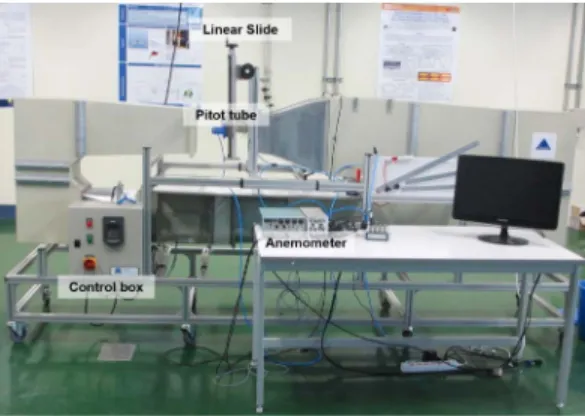
This yields in a description of the phenomenon without taking into account the geometrical properties of the particle bed. In order to characterize the role of the local grain arrangement on the particle motion, we study experimentally the motion on regular substrates, and Figure 12. Lab-scale wind-tunnel at FAU Busan

Figure 13. Microscopic top view of the substrates of identical and regularly arranged spherical glass beads of (405.9 ± 8.7) µm diameter. Triangular configuration (a) and quadratic configuration with a particle spacing of 14 µm (b) [J.R. Agudo et al., Phys. Fluids. 2014].

Figure 14. Experimental set-up for studying granular motion under laminar conditions (a)-(c). Sketch of the container in which the regular substrates are placed (b) [J.R. Agudo and A.

Wierschem, Phys. Fluids. 2012].

(12)

under laminar flow conditions.

The experiments are performed using a rotational rheometer. A laminar shear flow is produced using a parallel-disk configuration with a rotating glass plate.

The substrates are built from spherical soda-lime glass beads of (405.9 8.7) m diameter which are regularly arranged according to triangular and quadratic configurations (see Figure 13). The granular incipient motion is detected by increasing the speed on the rotating plate in small steps of less than 0.5% until the particle starts to move crossing the separatrix to the neighboring equilibrium position. The particle location is tracked optically and evaluated with image processing software. The complete setup is sketched in Figure 14.

Mechanical Process Engineering:

V

Viirrttuua all a an na allyyssiiss ooff tth hee m meecch ha an niicca all ssttrruuccttuurree ooff a a ssiin ng gllee p pooiin ntt m moooorriin ng g ((W Woorrlld d cclla assss 330000 p prroog grra am m))

A single point mooring (SPM) is a loading buoy anchored offshore, that serve as a mooring point and interconnect for tankers loading or offloading gas or liquid products. Mechanical loads affecting SPM structures are assumed to be mostly due to hydrodynamic waves and wind. It is well known that hydrodynamic wave loading significantly affects areas like coastal protection, harbour design, offshore construction and mooring systems. For instance, the hurricanes Ivan, Kathrina and Rita in the Gulf of Mexico showed destructive consequences on coastal systems and offshore structures.

Waves and currents generate strong forces on hydraulic structures. Those structures have to resist the forces that arise, for instance during a severe storm, or they must be able to withstand run-up or overtopping phenomena. Those phenomena are largely studied experimentally, but less numerically. We currently develop at FAU Busan a virtual analysis based on

numerical simulations which is capable of the prediction of the hydrodynamic load on structures due to waves and currents. The structural mechanics model is coupled to a marine growth and a corrosion modelling to close a complete Virtual Engineering Approach. This permit us to study how all these factors affect the structural design of SPM in marine environments.

D

Deetteeccttiin ng g ooiill--w wa atteerr sseep pa arra attiioon n eeffffiicciieen nccyy iin n a a h hyyd drroo-- ccyycclloon nee ((E ED DR RC C P Prroog grra am m))

In a large number of technical processes, amongst others in the recovery of energy carriers, the content of oil in process or surrounding water represents an important issue regarding process control and green engineering. One of the method to separate the dispersed oil droplets from water is using a hydro- cyclone. Here, a measuring/ monitoring technique to characterize the hydro-cyclone efficiency remains as a key aspect for the subsequent optimization design. This topic has been suggested by our partner SAMSUNG Heavy Industry Co. within the framework of the EDRC (Engineering Development Research Center) program.

Here, a methodology to determine the residence time,

the concentration and the size distribution of the

dispersed phase upstream and downstream of a lab

Figure 14. Lab scale hydro-cyclone at FAU Busan

(13)

scale hydro-cyclone is developed. Therefore, experimental studies including non-invasive techniques to quantify the concentration and the particle size distribution as well as numerical analysis to calculate the residence time are being carried out in our lab facilities.

M

Ma ap pp piin ng g ooff g ga ass d deetteeccttoorr ((E ED DR RC C P Prroog grra am m))

Accidental release of flammable gas is considered the primary cause of fire and explosions on industrial plants and in particular in offshore hydrocarbon plants. In such applications the fire and gas detection is essential for providing a dependable early warning of gas hazards.

Dilution and transport away of the gases by natural or forced ventilation can help to reduce this kind of accident but the fire and gas system (FGS) plays a key role in reducing the risks interlink to fire and gas releases. Therefore, Daewoo Shipbuilding & Marine Engineering Co., LTD (herein after DSME) asked LSTM to develop a computer based modelling procedure for F&G mapping. In analogy to the most crucial international trends, DSME has recognized that systematic, computer based F&G mapping provides an essential tool for optimizing the number and position of detectors in offshore installations.

The primary objective of the present work is directly deduced from this demand of DSME. More in detail, the primary objective is to create a novel modelling strategy for a computer based FGS design that permits to perform mapping studies systematically and automatically. This helps to reduce the well-known discrepancies of classical design procedure, by making use of up-to-date knowledge based methods. They permit to improve coverage using fewer detectors, prevent from spurious trips, allow alteration and optimization of the design for lowering capital expenditure, maintenance costs and operations costs, improve safety and protect effectively and efficiently the personal staff and the equipment.

N

Nuum meerriicca all ssiim muulla attiioon n::

b

buub bb bllee fflloow w iin n ccyylliin nd drriicca all b biioo--rreea accttoorrss a an nd d lliig gh htt d

diissttrriib buuttiioon n m mood deellss ((A AL LB BIIR RA A p prroojjeecctt))

The design of large scale bio-reactors for the cultivation of algae suffers from inadequate scale up of technical parameters from lab to large scale, and from lack of information about fluid-mechanic quantities which influence the growth and the concentration of algae. Thus, simulations of processes have to be carried out both experimentally in small-scale bio-reactors and numerically in order to optimize the processes and reduce the costs. A perfectly cylindrical bio-reactor has been modelled.

The reactor consists of a cylinder with a small inlet:

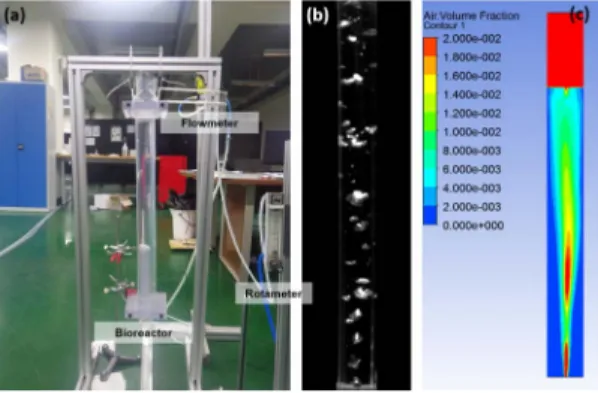
the length of the cylinder is approximately 65cm and its diameter is 6.5 cm. The diameter of the small inlet is 4 mm. The geometry and the mesh have been created with the aid of the commercial software ANSYS ICEM , while the complex multiphase problem is solved with the aid of ANSYS CFX . Videos of few seconds of bubble column rising through the reactor have been recoded. Image processing codes written in MATLAB have been used to quantify the mean bubble diameter.

Very accurate measurements of bubble diameters are not required, but just an approximate estimation of the mean value is needed. Results concerning a contour of

Figure 15 a) Experimental set-up, b) screenshot of a video record

of a bubble column rising through a reactor, when the bubble

plume oscillates to the front side, c) Air Volume Fraction on an

x-y plane at z=0 at 17.3 s.

(14)

air volume fraction on an x-y plane which symmetrically cuts the bio-reactor in the z-direction is presented below for one time steps of a simulations, i.e.

t=17. 3 s.

The growth of alge is mainly determined by the light distribution inside a bioreactor. Thus, a novel light distribution model is under development. The new model considers a discretized light source, from which light rays come, and single algae as randomly distributed cells. Cells positions play important roles, since they create shaded area by blocking light rays, and become new light sources with absorption, reflection and refraction of light rays. The main advantage of this new model is that it takes into account the interaction among cells, due to absorption, reflection and transmission of light rays.

Considering a planar domain, cell positions are determined by cell density, domain size and randomly assigned depth coordinates, see Figure 16 where a simulation of light distribution is shown . The domain is discretized by 101 nodes along the x and the y-axis, and each node on x-axis represents a discretized light source which has the total intensity of 1[W/m

2

]. The intensity

field at every node of the domain is calculated by checking whether a node lies within a shaded area.

Furthermore, light is treated as diffusive. It means that several light rays come from a discretized light source, and they have certain direction with allocated intensity.

In this simulation, five rays come from each light source, and the total intensity is summed on the same node to give the value of 1[W/m

2

].

D

Drra aw wiin ng g p prroocceessss ooff P Ph hoottoon niicc C Crryysstta all F Fiib beerrss ((P PC CF Fss)) Microstructured optical fibers (so called “photonic crystal” or “holey” fibers) nowadays arouse great interest, due to the many optical effects they permit to achieve. The hole-pattern allows the light guidance within a solid or hollow core. These novel types of fibers may represent the future in telecommunications, optics, gas-laser devices and precision sensing applications. Such fibers consist of air holes arranged around a solid or hollow core. They are manufactured by heating and drawing down an initial preform in several steps. During drawing, when the glass is molten, the size of the external and the internal hole-diameters is greatly reduced. Several parameters have great influence on the fabrication process like, for instance, the feed and the draw speed, the internal hole- pressurization and the surface tension. A 3D six-hole geometry, whose dimensions are shown in Figure 17a), has been modelled numerically. The commercial software ANSYS Gambit has been employed to create the geometry and the mesh, while the commercial software ANSYS Polyflow has been used to numerically solve the N.-St. equations. The numerical results are found to be in good agreement with experiments, see Figure 17b) where the experimental final fiber cross-section has been overlapped to the numerical one, for the case in which the internal pressure has not been considered. In this study, thermal equilibrium among the furnace gas, the fiber glass and the pressure gas has been assumed by guessing Figure 16. Light distribution in a planar domain of 10

-3

x 10

-3

m

2

, with five light rays coming from each source.

(15)

temperature profiles, which are found to be suitable to represent the temperature distribution inside the furnace.

Contact

Prof. Dr. Antonio Delgado, [email protected]

Prof. Dr. Andreas Wierschem,

[email protected]

Prof. Dr. Cornelia Rauh, [email protected]

Figure 17: a) Optical microscope image of a micro-structured silica preform used in fiber drawing experiments b) Comparison of

the SEM images of the final fiber cross-sections (grey-scale background) with numerical simulations (blue overlaid contours) in

case of absence of internal pressure [G. Luzi and A. Delgado in Journal of Lightwave technology 2012].

수치

Figure 2. Operando FT-IR high pressure reactor setup for studying homogeneous catalytic processes
Figure 4. Continuous gas-phase reactor setup including two tubular  fixed-bed  reactors  and  a  gradient-free  gas-loop reactor
Figure 5. Calculation of activity coefficient from molecular structures using the COSMO-RS software tool.
Figure 8. Different reactor types (bubble column and stirred tank reactor) equipped with the wireless-LED technology.
+4

참조

관련 문서

Nonlinear Optics Lab...

웹 표준을 지원하는 플랫폼에서 큰 수정없이 실행 가능함 패키징을 통해 다양한 기기를 위한 앱을 작성할 수 있음 네이티브 앱과

이하선의 실질 속에서 하악경의 후내측에서 나와 하악지의 내측면을 따라 앞으로 간다. (귀밑샘 부위에서 갈라져 나와

▶ Should you not be able to submit the document(s) (Apostille, academic certificate by Chinese Ministry of Education, certificate by a Korean consulate, bank statement with

1 John Owen, Justification by Faith Alone, in The Works of John Owen, ed. John Bolt, trans. Scott Clark, &#34;Do This and Live: Christ's Active Obedience as the

The fulcrum of the development of teaching and research on Southeast at the University of Malaya comprised the Departments of History and Geography which also introduced

The KMA consists of its headquarters in Seoul, five regional ad- ministrations in Busan, Gwangju, Gangwon, Daejeon and Jeju, 45 local offices, the National Institute

The KMA consists of its headquarters in Seoul, five regional administrations in Busan, Gwangju, Gangwon, Daejeon and Jeju, 45 local offices, the National Institute