http://dx.doi.org/10.7585/kjps.2014.18.3.123 Open Access
123
참외(Cucumis melon var. makuwa)에 대한 Buprofezin 및 Penthiopyrad의 생산단계 잔류허용기준 설정
김해나·김성범·최 은·우민지·김지윤·Manoharan Saravanan·허장현*
강원대학교 농업생명과학대학 바이오자원환경학과
Establishment of Pre-Harvest Residue Limit for Buprofezin and Penthiopyrad during Cultivation of Oriental melon
( Cucumis melon var. makuwa)
Kim Hea Na, Seong Beom Kim, Eun Choi, Min Ji Woo, Ji Yoon Kim, Manoharan Saravanan and Jang Hyun Hur *
Department of Biological Environment, College of Agriculture and Life Sciences, Kangwon National University, Chuncheon 200-701, Korea
(Received on September 2, 2014. Revised on September 12, 2014. Accepted on September 20, 2014)
Abstract The present work was aimed to determine the pre-harvest residue limits (PHRLs) and the safety management of commonly used pesticides namely buprofezin and penthiopyrad on oriental melon (Cucumis melon var. makuwa). In this study, the buprofezin (diluted two thousand fold) and penthiopyrad (diluted four thousand fold) were sprayed single time on oriental melon in the cultivation areas Sangju (site 1) and Sungju (site 2).
Oriental melon were randomly collected from the both areas at the end of 0 (2 hours after pesticides spaying), 1, 2, 3, 5, 7, 9 and 10 days. For analysis, each samples were partitioned twice (80 and 70 mL) with dichloromethane and purified by florisil SPE cartridge. Finally, the residual amounts of both pesticides in all samples were analyzed using gas chromatography/nitrogen phosphorus detector (GC/NPD). In this study, the method limit of quantification (MLOQ) for both buprofezin and penthiopyrad in oriental melon was found to be 0.01 mg kg
−1and their recovery levels were 91.1~98.6% and 90.0~104.6%, respectively. Further, the calculated biological half-life for buprofezin and penthiopyrad in oriental melon were 3.9 and 3.5, and 3.0 and 2.7 days in site 1 and 2, respectively. The results of this study found that the PHRLs for buprofezin and penthiopyrad were 4.24 and 2.31 mg kg
−1, respectively at 10 days before harvest. Consequently, the present study suggest that the residual amounts of both pesticides will be lower than the maximum residue limits (MRLs) when oriental melon is harvested.
Key words Buprofezin, Maximum Residue Limit, Oriental melon, Penthiopyrad, Pre-Harvest Residue Limit
서 론
농약은 병·해충 및 잡초를 방제하여 농산물의 품질 향상 및 수량 증대, 노동력 절감 등에 사용되는 현대 농업의 필수 적인 농업자재이다(Lee et al., 2008; Hong et al., 2011). 이 러한 농약은 작물에 살포 된 후에 농약의 이화학적 특성이
나 환경조건 등에 의하여 분해 또는 소실되나, 일부는 작물, 토양 및 수질 환경에 잔류되는 경우가 발생한다(Hwang et al., 2012; Kim et al., 2013). 잔류된 농약은 자연 생태계에 영향을 줄 뿐만 아니라 인간들에게 노출될 가능성이 있어 소비자들은 농산물의 농약오염에 대해 불안해하고 있다 (Satistics Korea, 2012).
이에 우리나라에서는 소비자들에게 안전한 농산물을 공급 하기 위해 1999년부터 국립농산물품질관리원(National Agri- cultural Products Quality Management Service, NAQS)을 통해 매년 생산단계 및 유통판매단계 농산물의 잔류농약에
*Corresponding author
Tel: +82-33-257-6441, Fax: +82-33-241-6640 E-mail: [email protected]
ORIGINAL ARTICLES / RESIDUE
대한 안전성 조사를 수행하고 있다(Cho et al., 2013). 이미 유통된 농산물이 잔류허용기준을 초과하였을 경우 소비자의 건강 위해성 문제를 초래할 가능성이 있을 뿐 만 아니라 부 적합 농산물의 출하 연기, 용도 전환, 폐기 등의 조치가 이 루어짐으로서 생산자에게 경제적 손실을 유발할 수 있다 (Hong et al., 2011). 이를 보완하기 위하여 수확 전 생산단 계 농산물에 대한 적절한 출하시기를 산정하는 생산단계 안 전성 조사가 수행되고 있다. 생산단계 안전성 조사는 농산 물의 품목별 및 농약별로 잔류량 감소추이를 이용하여, 생 물학적 반감기(biological half-life)를 산출하고 식품의약품 안전처 고시에 따라 출하 10일전부터 출하일 까지의 잔류허 용기준을 설정하여 농산물의 적절한 출하시기를 산정한다 (Cho et al., 2013; Hwang et al., 2012). 생산단계 잔류허용 기준(Pre-Harvest Residue Limit, PHRL)이 설정되어짐에 따 라 부적합 농산물의 시중 유통을 차단하고 안전한 농산물의 공급이 가능해지며 품질경쟁력 향상과 농가 소득증대에 기 여하고 있다(Ministry of Food and Drug Safety, 2013).
2014 년 현재 47개 항목, 124개 성분에 대하여 총 774개의 생산단계 잔류허용기준이 설정되어 있다. 그 중 참외에는 18 성분이 설정되어 있으나, 이는 참외의 생산단계 잔류허용 기준 필요량의 약 14.6%이므로 적용 농약 품목 및 농작물 의 확대가 필요한 실정이다.
본 연구는 생산단계 참외에 buprofezin 및 penthiopyrad를 사용하여 최종 농약 살포일로부터 수확 일까지의 농약의 잔 류량을 조사하고, 농약 잔류감소 회귀식을 산출하였으며, 이 를 이용하여 생산단계 잔류허용기준 설정을 위한 기초자료 로 활용하고자 수행하였다.
재료 및 방법
시험농약
본 연구에 사용된 buprofezin (99.0%) 및 penthiopyrad
(98.2%)의 표준품은 Dr. Ehrenstorfer GmbH사(Germany)에 서 구입하여 사용하였으며, 살포용 농약 buprofezin 8% 액 상수화제(상표명: 백승, 바이엘 크롭사이언스(주)) 및 pen- thiopyrad 20% 유제(상표명: 크린캡, (주)경농)는 시중 농약 상에서 구입하여 사용하였다. 두 약제의 화학구조식과 이화 학적 성질은 Table 1과 같다(Clive Tomlin, 2009).
시약, 재료 및 기구
잔류농약의 분석을 위해 사용한 acetone은 Merck사 (Germany)로부터 구입하여 사용하였고, dichloromethane, acetonitrile 및 ethyl acetate는 Junsei Chemical과 Kanto Chemical 사(Japan)에서 GR급을 구입하여 사용하였으며, sodium sulfate anhydrous, sodium chloride는 DAE JUNG 사(Korea)의 제품을 사용하였다. 정제를 위해 사용 된 flo- risil SPE cartridge (1 g) 는 Phenomenex사(USA)의 제품을 구입하여 사용하였다. 또한 농약 살포 시 배터리 충전식의 배부식 분무기(POWER KING, 광성분무기)를 사용하였으 며, 잔류 농약 농축 시 Rotary vacuum evaporator (EYELA, Japan), homogenizer (Nissei, Japan)를 사용하였으며, Agi- lent GC 7890 (Agilent, USA) 을 이용하여 잔류량을 분석하 였다.
시험작물 및 시험포장
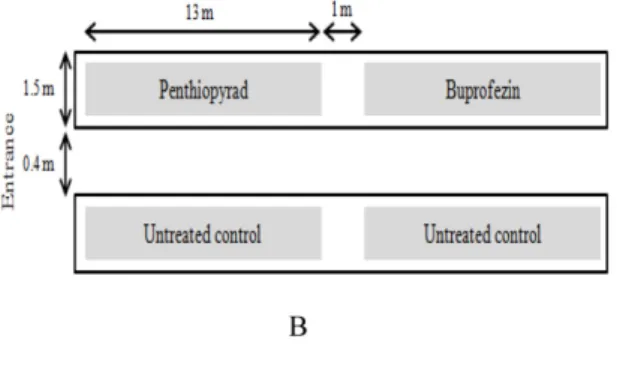
시험작물인 참외(Cucumis melon var. makuwa)는 경상북 도 상주시 낙동면 소재(시험포장 1)의 참외 하우스와 경상 북도 성주군 벽진면 소재(시험포장 2)의 참외 하우스를 임 차하여, 2014년 5월 10일부터 2014년 5월 20일까지 10일간 시험을 진행하였다. 시험포장 1의 시험 구획은 23 m
2, 시험 포장 2의 시험 구획은 19.5 m
2으로 약제처리별 3반복 배치 하여, 각각의 처리구 사이에 1 m의 완충구를 두고 시험을 수행하였다(Fig. 1).
Table 1. Physicochemical properties of buprofezin and penthiopyrad
Buprofezin Penthiopyrad
Structure
IUPAC name (Z)-2-tert-butylimino-3-isopropyl-5-phenyl-1,3,5-thiadi- azinan-4-one
(RS)-N-[2-(1,3-dimethylbutyl)-3-thienyl]-1-methyl-3- (trifluoromethyl)pyrazole-4-carboxamide
Mol. wt. 305.4 359.4
V.p. (mPa) 4.2 × 10
−2(20
oC) 6.43 × 10
−3(25
oC)
K
owLogP 4.80 4.228
Solubility
in water 0.387 mg L
−1(20
oC) 7.53 mg L
−1(20
oC)
약제처리 및 시료채취
참외에 대한 시험농약의 살포는 농약사용지침서(KCPA, 2012) 의 안전사용기준에 준하여 희석한 후 배부식분무기를 사용하여 살포하였으며, 시험 농약 살포 2시간 후를 0일차 로 하여 0, 1, 2, 3, 5, 7, 10일차에 시료를 채취(약 1.5~2 kg) 한 후 채취된 시료는 각 처리구별로 밀봉한 후 즉시 분석 장소로 운반하였으며, 처리구별로 세절하고 혼합하여 −20
o
C 이하의 냉동고에서 보관 후 분석 시 사용하였다. 본 시험 에서 참외에 살포한 약제의 안전사용기준 및 잔류허용기준 (Maximum Residue Limits, MRL) 은 Table 2에 제시하였다.
분석정량한계
Buprofezin 및 penthiopyrad의 분석정량한계는 분석기기 상의 최소검출량, 추출시료의 최종 재용해량, 기기주입량, 최초 시료량 등을 고려하여 산출하며 아래의 식 (1)과 같이 산출하였다.
표준검량선 작성
시험농약의 표준물질인 buprofezin (99.0%) 101.0 mg 및 penthiopyrad (98.2%) 101.8 mg 을 100 mL의 acetone에 녹 여 1,000 mg L
−1stock solution 을 조제한 후, 단계별로 희석 하여 0.1, 0.2, 0.5, 1.0, 2.0, 3.0, 및 5.0 mg L
−1의 working solution을 조제하였다. 그 후 각각 일정량을 GC/NPD에 주 입하여 나타난 chromatogram상의 peak면적을 기준으로 검 량선을 작성하였다.
참외 중 잔류농약 분석
참외 중 잔류된 buprofezin 및 penthiopyrad를 추출하기 위하여 세절한 시료 20 g에 acetonitrile 100 mL를 가하여 homogenizer 로 10,000 rpm에서 3분간 마쇄·추출하였다. 추 출액 중 acetonitrile을 감압여과하고, 여액을 1,000 mL 분액 여두에 옮겨 증류수 100 mL, 포화식염수 50 mL를 첨가한 뒤 dichloromethane 80, 70 mL로 2회 분배하였다. 그 후 용 매층을 sodium sulfate anhydrous층을 통과시켜 탈수 및 감 압농축하고 dichloromethane 5 mL로 재용해 하였다.
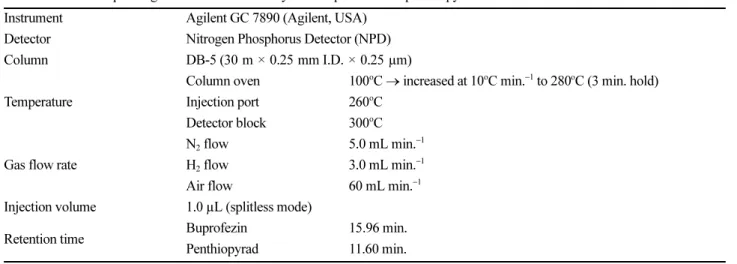
두 약제 모두 florisil SPE cartridge에 dichloromethane 5 mL 로 pre-washing한 후, 추출액 5 mL를 loading하여 버리 고, 전개용매(dichloromethane : ethyl acetate = 80 : 20, v/v) 4 mL 를 이용하여 buprofezin 및 penthiopyrad를 각각 용출 시켰다. 이 용출액을 감압농축하고 건고물을 acetone 2 mL 로 재용해한 후, GC/NPD에 주입하여 최종 분석하였으며, 두 약제에 대한 기기 분석 조건은 Table 3과 같다.
- 산출식(1) :
최소검출량(ng) × 최종재용해량(mL) × 1
= mg kg−1
기기주입량(µL) 시료량(g)
- Buprofezin 및 penthiopyrad의 MDL:
0.1 ng × 2 mL
× 1
= 0.01 mg kg
−110 µL 20 g
Fig. 1. Field design in the study area (A: Sangju, B: Sungju).
Table 2. Guidelines for the safe use of pesticides and their MRLs
Pesticide Formulation A.I.
a)(%)
MRL
b)(mg kg
−1)
Safe use guideline
PHI
c)(day) MNA
d)(time) Dilution
Buprofezin SC
e)8 1.0 3 3 2,000
Penthiopyrad EC
f)20 0.5 2 3 4,000
a)A.I.: Active ingredient d)MNA: Maximum number of application
b)MRL: Maximum residue limit e)SC: Suspension concentrate
c)PHI: Pre-harvest interval f)EC: Emulsifiable concentrate
참외 중 회수율 분석
분석과정의 적합성을 판단하기 위하여 무처리 참외 시료 20 g에 표준용액 1 mg kg
−12 mL, 10 mg kg
−11 mL 를 각각 0.1 mg kg
−1( 분석정량한계의 10배), 0.5 mg kg
−1( 분석정량한 계의 50배) 수준으로 정확히 가하고, 균일하게 혼합하여 30 분간 방치한 후, 상기의 분석과정을 수행하여 회수율을 산 출하였다.
시험농약의 생물학적 반감기 및 생산단계 농약잔류허용 기준
참외의 생산단계 중 시험약제의 잔류량은 표준검량선을 사용하여 산출하였으며, 생물학적 반감기 및 생산단계 농약 잔류허용기준(PHRL)은 식품의약품안전처에서 제공하는 잔 류성 시험성적 회귀분석 검정표를 이용하여 산출하였다.
결과 및 고찰
시험기간 중 기상조건과 참외의 중량
2014 년 5월 10일부터 2014년 5월 20일까지의 시험기간 중 시험포장 1, 2 시설 내의 평균기온 범위는 각각 26.3~
38.8
oC, 26.1~39.3
oC 이었으며, 평균습도의 범위는 34.4~
69.3%, 30.1~73.4% 이었다(Instrument: Kestrel 4500 NV, Nielsen-Kellerma, USA)(Fig. 2). 두 지역에 대한 기상조건 의 차이는 크지 않았으며, 시험약제 살포 후 시험포장 1, 2 에서 수확 한 참외의 평균무게 범위는 각각 158.2~302.1 g, 266~402.3 g이었다(Fig. 3).
Table 3. GC/NPD operating conditions for the analysis of buprofezin and penthiopyrad in Cucumis melon var. makuwa Instrument Agilent GC 7890 (Agilent, USA)
Detector Nitrogen Phosphorus Detector (NPD) Column DB-5 (30 m × 0.25 mm I.D. × 0.25 µm) Temperature
Column oven 100
oC → increased at 10
oC min.
−1to 280
oC (3 min. hold) Injection port 260
oC
Detector block 300
oC Gas flow rate
N
2flow 5.0 mL min.
−1H
2flow 3.0 mL min.
−1Air flow 60 mL min.
−1Injection volume 1.0 µL (splitless mode)
Retention time Buprofezin 15.96 min.
Penthiopyrad 11.60 min.
Fig. 2. Climatic condition during cultivation period (A: Sangju, B: Sungju).
Fig. 3. Rate of gain of Cucumis melon var. makuwa during
cultivation period.
표준검량선 작성
참외 중 잔류농약 분석을 위한 표준검량곡선을 작성한 결 과, 두 약제 모두 상관계수(R
2) 가 0.99이상으로 높은 직선성 을 확인하였다(Table 4).
분석정량한계 및 회수율
참외 중 buprofezin 및 penthiopyrad의 분석정량한계는 0.01 mg kg
−1이었으며, Buprofezin의 회수율은 91.1~98.6%, penthiopyrad 의 경우 90.0~104.6%로 두 약제 모두 식품의약 품안전처의 단성분 분석 회수율 범위인 70~120%, 변이계수 10% 이내의 기준을 만족하였다(Table 5). 상기 분석 방법에 의한 buprofezin 및 penthiopyrad의 머무름 시간은 각각 15.96, 11.60 min. 이었으며, GC/NPD로 분석한 시험약제의 무처리, 회수율 및 처리구의 대표적 크로마토그램은 Fig. 4 와 같다.
참외 생산단계 중 잔류량 변화에 따른 생물학적 반감기 참외 생산단계 중 buprofezin 및 penthiopyrad를 안전사용 기준에 준하여 시험포장 1, 2에 각각 1회 기준량 살포하여 일자별 수확한 참외 중 buprofezin 및 penthiopyrad의 잔류 량을 토대로 생물학적 반감기를 산출하였다. Buprofezin 기 준량 처리 시 시험포장 1에서의 초기 농도는 0.31 mg kg
−1, 시험포장 2에서의 초기 농도는 0.17 mg kg
−1이었으며, pen- thiopyrad의 경우 시험포장 1에서 0.13 mg kg
−1, 시험포장 2 에서 0.18 mg kg
−1으로 시험포장간의 초기 잔류량의 차이가 있는 것을 확인할 수 있었다(Fig. 4). 참외 중 buprofezin 및 penthiopyrad 의 잔류량은 약제 살포 후 경과가 지남에 따라 감소하는 경향을 나타내었으며, 두 약제의 시험포장 간의 초기 농도는 국내에 설정된 참외에 대한 두 약제의 MRL Table 4. A linear equation of calibration curve for the quantifi-
cation of the pesticide residues in Cucumis melon var. makuwa Pesticide Linear equation R
2Buprofezin y = 71.449x + 0.5371 0.9999 Penthiopyrad y = 164.73x + 2.1585 0.9970
Table 5. Recovery rate and MLOQ for buprofezin and penthiopyrad in Cucumis melon var. makuwa
Pesticide Fortification (mg kg
-1)
Recovery ± SD (%, average ± SD)
MLOQ (mg kg
-1) Buprofezin 0.1 98.1 ± 0.6
0.5 94.0 ± 2.6 0.01
Penthiopyrad 0.1 91.7 ± 2.4 0.5 103.3 ± 2.1 0.01
Fig. 4. Chromatogram of buprofezin (A: control, B: standard 5 mg kg
−1, C: recovery 0.5 mg kg
−1) and penthiopyrad (D: control, E:
standard 5 mg kg
−1, F: recovery 0.5 mg kg
−1).
(buprofezin: 1.0 mg kg
−1, penthiopyrad: 0.5 mg kg
−1) 이하 의 잔류량을 나타냈다.
Kim 등(1992)의 연구에 따르면 재배기간 중 살포된 농약 의 잔류량은 농약자체의 물리·화학적 특성, 작물의 재배조 건(하우스재배, 노지재배 등) 및 기상조건(온도, 습도, 강수 량 등)등에 의해 분해 또는 소실되는 것을 알 수 있었다. 제 제형태나 처리방법 및 조건에 의해 부착력에 영향을 주고 작물의 생육특성 및 처리 후 수확 일까지의 경과일수에 의 해 희석 또는 농축되어 잔류량에 영향을 받은 것을 확인할 수 있었다. 본 연구의 시험약제의 안전사용지침은 3회까지 살포하도록 되어져 있으나 본 연구에서는 1회 살포 후의 잔 류량이므로 비교적 초기 농도가 낮게 나온 것으로 판단된다.
식품의약품안전처에서 제공한 잔류성 시험성적 회귀분석 검정표를 통해 각각 시험포장의 잔류량에 따른 잔류감소 회 귀식을 산출한 결과, buprofezin의 경우 시험포장 1에서 y = 0.2678e
−0.178x(R
2= 0.9764), 시험포장 2에서 y = 0.163e
−0.198x
(R
2= 0.9781) 이었으며, penthiopyrad의 경우 각각 y = 0.1437e
−0.231x(R
2= 0.9210), y = 0.143e
−0.26x(R
2= 0.9370) 이었 다(Fig. 5). 이 식에 의해 산출된 buprofezin 및 penthiopyrad 의 생산단계 중 생물학적 반감기는 시험포장 1에서 3.9일, 시험포장 2에서 3.5일 이었으며, penthiopyrad의 경우 각각 3.0, 2.7일로 나타났다.
Hwang 등(2012)이 보고한 생산단계 잔류허용기준 설정을 위한 시설 재배 오이 중 살균제 Amisulbrom의 잔류특성 연 구에서 반감기가 기준량 1회 살포 시 3.6일, 2회 살포 시 2.4 일로 본 연구 결과와 유사한 짧은 반감기를 보였다. 이는 참외나 오이, 애호박과 같은 박과채소류는 덩굴을 이루며 땅에 닿아 자라는 생육특성과 표면이 매끄러운 형태 특성 상 살포된 농약에 대해 낮은 부착력을 가져 다음과 같은 결 과를 얻은 것으로 판단된다. 참외에 buprofezin 및 pen- thiopyrad의 기준량 살포 시 짧은 반감기를 나타냄으로서 안 전한 농산물의 재배가 가능하며, 약제처리 후 짧은 기간 안 에 수확이 가능 할 것으로 사료된다.
생산단계 잔류허용기준 설정
생산단계 잔류허용기준(PHRL)은 수확 시 농약의 잔류량 이 MRL을 초과하지 않도록 하는 수확 전 일정한 시점의 기 준으로서, 생산단계 참외의 일자별 잔류량을 이용하여 buprofezin 및 penthiopyrad의 생산단계 잔류허용기준을 산 출하였다. 참외에서의 Buprofezin의 MRL은 1.0 mg kg
−1이 었으며, penthiopyrad의 경우 0.5 mg kg
−1으로 buprofezin의 수확 10일 전 생산단계 잔류허용기준은 시험포장 1에서 4.24 mg kg
−1, 시험포장 2에서 5.15 mg kg
−1이었다. Pen- thiopyrad의 수확 10일 전 생산단계 잔류허용기준은 시험포
Fig. 5. Dissipation curves of buprofezin (A) and penthiopyrad (B) in Cucumis melon var. makuwa during cultivation period.
Fig. 6. Recommended PHRL of buprofezin (A) and penthiopyrad (B) in Cucumis melon var. makuwa during cultivation period.
장 1에서 2.31 mg kg
−1, 시험포장 2에서 3.10 mg kg
−1로 나 타났다. Buprofezin 및 penthiopyrad의 수확 10일 전 잔류량 이 각각 4.24 mg kg
−1, 2.31 mg kg
−1이하로 나타나면 수확 시 잔류량이 참외에서의 buprofezin의 MRL인 1.0 mg kg
−1, penthiopyrad 의 MRL인 0.5 mg kg
−1수준 이하로 잔류할 것 으로 예측된다(Fig. 6). 본 연구를 통하여 생산단계에서 MRL 을 초과할 가능성이 있는 농산물의 유통을 방지하고 안전한 농산물을 생산할 수 있는 안전관리의 기초자료로 활 용될 것으로 판단된다.
감사의 글
본 성과물은 농촌진흥청 연구사업(과제번호: PJ00921905) 및 식품의약품안전처에서 시행한 2013년 생산단계 농산물 중 농약의 잔류허용기준 설정 연구의 지원에 의해 이루어 졌으며 이에 감사드립니다.
Literature cited