Korean J Environ Agric (2012) Online ISSN: 2233-4173 Vol. 31, No. 1, pp. 45-51 http://dx.doi.org/10.5338/KJEA.2012.31.1.45 Print ISSN: 1225-3537
단감 재배기간 중 살균제 pyrimethanil과 trifloxystrobin의 생산단계 잔류허용기준 설정
이동열,1 김영진,1 이소정,1 조규성,1 김상곤,2 박민호,3 강규영1,2*
1경상대학교 응용생명과학부(BK21 농생명산업 글로벌 인재 육성 사업단) & 경상대학교 농업생명과학연구원, 2경상대학교 식물생명공학연구소, 3농산물품질관리원 경남지원
Establishment of Pre-Harvest Residue Limit of Fungicides Pyrimethanil and Trifloxystrobin during Cultivation of Persimmon
Dong Yeol Lee,
1Yeong Jin Kim,
1So Jung Lee,
1Kyu Song Cho,
1Sang Gon Kim,
2Min Ho Park
3and Kyu Young Kang
1,2*(
1Division of Applied Life Science (BK21 Program) & Institute of Agriculture and Life Science, Gyeongsang National University, Jinju, 660-701, Korea,
2Plant Molecular Biology and Biotechnology Research Center, Gyeongsang National University, Jinju, 660-701, Korea,
3Gyeongnam Provincial Office, National Agricultural Products Quality Management Service, Busan, 611-084, Korea)
Received: 12 March 2012 / Accepted: 26 March 2012
ⓒ 2012 The Korean Society of Environmental Agriculture
*교신저자(Corresponding author),
Phone: +82-55-772-1961; Fax: +82-55-772-1969;
E-mail: [email protected]
45
Abstract
BACKGROUND: This study was carried out to establish pre-harvest residue limit of fungicides pyrimethanil and trifloxystrobin in persimmon, based on dissipation and biological half-lives of two fungicides residue.
METHODS AND RESULTS: Both pyrimethanil and trifloxystrobin were extracted with acetonitrile, clean-up with NH
2SPE cartridge and residue were analyzed by HPLC/DAD. Limit of Detection was 0.01 mg/kg. Average recovery were 81 ± 1.62%, 98 ± 1.58% of pyrimethanil, and 91 ± 2.94%, 98 ± 1.25% of trifloxystrobin at fortification levels at 0.1 and 0.5 mg/kg, respectively.
CONCLUSION: The biological half-lives of pyrimethanil were 15.6 and 11.6 days at sprayed with recommended and double dosage, respectively. The biological half-lives of trifloxystrobin were 10.4 and 10.3 days at sprayed with recommended and double dosage, respectively. The pre-harvest residue limit of pyrimethanil and trifloxystrobin were recommended as 2.69 and 0.83 mg/kg for 10 days
before harvest, respectively.
Key Words: Biological half-lives, Persimmon, Pre-Harvest Pyrimethanil, Residue Limit, Trifloxystrobin
서 론
농약은 농산물 생산에 있어 매우 중요한 농자재로서 그 생 산 증가에 크게 기여하고 있다. 그러나 작물에 살포된 농약은 본래의 목적을 달성한 후 분해되어 작물에 잔류되지 않아야 하는 것이 이상적이지만 대부분의 농약은 합성유기화합물이기 때문에 각기 다른 분해 과정을 거치면서 소실되거나 토양 또는 작물에 잔류하게 된다(Lee et al ., 2009; Kim et al. , 1997).
최근 농약잔류성 문제가 농산물의 청정성을 해치는 주된 요인이라는 국민들의 선입견이 생기면서 농약을 전혀 사용하 지 않았거나, 소량을 사용하는 친환경 농법이 확산되고 있으 며, 농산물의 안전성에 많은 관심이 고조되고 있는 실정이다.
현재 국내사용 농약의 경우 일부 속효성 약제를 제외하고는 방제 목적 상 살포 후 일정기간 잔류되는 약제 특성이 있어 최종 수확 농산물에 살포농약이 잔류할 가능성이 낮으므로 살포 농약들로부터 안전성의 확보는 반드시 이루어져야 할 것이다(Lee et al. , 2010; Kwon and Lee, 2003). 농약이 지 나치게 잔류된 농작물ㆍ식품을 섭취한다면 건강상의 문제가 발생될 수 있는 가능성이 있기 때문에 농작물 중 농약잔류허
Open Access
Research Article
용기준(MRL : Maximum Residue Limit)을 설정하여 국 제적 수준에서는 물론, 국가차원에서도 관리 감독을 하고 있 다. MRL은 수확 후 소비되는 농산물에 잔류가 허용되는 최 대 농약잔류농도를 말하며, 2012년 2월 1일 현재 427종의 농 약에 대해 농산물의 농약잔류허용기준이 설정되어 있다(식품 의약품안전청, 2012). 농약 잔류허용기준을 초과한 농산물의 경우 용도전환, 출하연기, 현장계도 및 폐기 처분 등의 조치 가 이루어지고 있으며, 이러한 경우는 농산물을 생산하고 유 통하는 비용은 물론 부적합 농산물의 처리비용이 발생하여 농민은 그 손실을 감수해야 한다. 또한 수확 후 농산물의 안 전성이 판단되는 동안 유통되어진 농산물이 잔류허용기준을 초과하였더라도 수거할 방법이 없어 부적합 농산물이 유통될 가능성이 있어 생산단계에서 관리되지 않은 농산물의 경우 사회적 문제로 커질 우려가 있다. 이러한 부적합 농산물의 유 통을 차단하기 위해서는 생산단계에서의 잔류량을 예측하고 농약의 잔류허용기준을 별도로 설정할 필요성이 있다고 판단 된다(Lee et al ., 2009; Kim et al ., 2002; Ko et al ., 2003;
Ko et al ., 2004).
감은 우리나라 사람들이 즐겨먹는 과수로서 당 함량이 많 아 감미가 풍부하며, 펙틴, 카로티노이드 등이 많이 포함되어 있고, 고혈압 예방, 혈중 알코올의 상승률을 낮추는 탄닌, 비 타민 C와 A, 무기염류로는 칼륨과 마그네슘 함량이 높은 작 물로서(국립원예특작과학원, 2004), 2010년도의 재배면적은 15,346 ha, 생산량은 년간 191,846 톤이며, 재배면적이 남부 지역에 집중되어 있고, 특히 경남지역은 전체 생산량의 약 50%를 차지하고 있다(국가통계포털, 2011). 단감은 2007년 부터 2010년 사이의 생산량이 32.5%의 증가율을 보이고 있 으며 이후 재배면적 및 생산량이 증가할 것으로 예측된다(농 산물무역정보, 2011).
감나무에 발생하는 병 중에서 가장 큰 피해를 주는 것은 탄저병으로 과실에는 초기에 작은 반점이 불규칙하게 생기고 진전되면 병반이 커지고 병든 부위가 갈라져서 상품성을 잃
게 되며, 둥근무늬낙엽병은 주로 잎에 발생하는 병으로 생육 후기에 낙엽이 지게 되어 피해를 일으키는데 이 병들은 수량 감소와 품질저하를 초래하므로 조기방제가 중요하다. 본 연구 에 사용된 살균제인 pyrimethanil은 단감에서 둥근무늬낙엽 병에 대해 수확 14일전까지 4회 이내, trifloxystrobin은 단 감에서 둥근무늬낙엽병과 탄저병에 대해 수확 21일전까지 4 회 이내 사용가능한 것으로 등록되어 있다(한국작물보호협회, 2010).
본 연구에서는 단감에 등록되어 사용되고 있는 살균제인 pyrimethanil과 trifloxystrobin의 수확 전 잔류량을 예측하 기 위하여 시험 농약을 시설재배 포장에 살포하여 경시적 농 약 잔류 특성을 조사하고 생물학적 반감기를 산출(Park et al ., 2005; Yang et al ., 1995)하여 시험농약의 잔류허용기준 (MRL)과 비교 평가 후 그 결과를 생산단계에서의 농약 잔류 허용기준을 설정하기 위한 기초 자료로 활용하고자 하였다.
재료 및 방법
시약 및 기구
시험에 사용된 살균제인 pyrimethanil (순도 98.3%)과 trifloxystrobin (순도 99.5%)은 Dr. Ehrenstorfer사(독일) 로부터 구입하여 시험농약의 표준품으로 사용하였으며, 추출 및 정제를 위해 사용한 acetonitrile은 Merck 사(독일)에서 구 입하여 사용하였고, SPE 정제를 위해 사용한 amino catridge (MEGA BE-NH
2catridge 1.0 g, 6mL)와 PSA (Primary Secondary Amine)는 Agilent 사(미국)에서 구입하여 사용 하였다.
시험약제
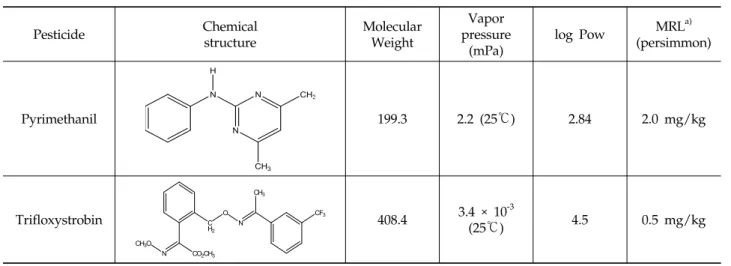
시험에 사용한 pyrimethanil과 trifloxystrobin의 물리화 학적 특성 및 안전사용기준은 각각 Table 1과 Table 2와 같다.
Pesticide Chemical
structure
Molecular Weight
Vapor pressure
(mPa)
log Pow MRLa) (persimmon)
Pyrimethanil
N
N N H
CH3
CH3
199.3 2.2 (25℃) 2.84 2.0 mg/kg
Trifloxystrobin CH
2 O
N
CO2CH3 N
CH3
CF3
CH3O
408.4 3.4 × 10⁻³
(25℃) 4.5 0.5 mg/kg
a)Maximum Residue Limit
Table 1. Characteristic properties of pyrimethanil and trifloxystrobin (Tomlin, 2006)
Pesticide Target disease Formulation A.Ia)
(%) Dilution
Safe use guidelines PHIb)
(day)
MAFc) (times)
Pyrimethanil
Mycosphaerella nawae
WPd) 30 20 g/20 L 14 4Trifloxystrobin
Mycosphaerella nawae
,Colletotrichum gloeosporioides
SCf) 22 10 mL/20 L 21 4
a)Active ingredient
b)Pre-harvest interval
c)Maximum application frequency
d)Wettable powder
f)Suspension concentrate
Table 2. Pesticides uses and safe use guidelines of pyrimethanil and trifloxystrobin on persimmon (Korea Crop Protection Association, 2010)
시험작물 및 작물재배
시험작물인 단감( Diospyros kaki Thunb , 품종 : 부유)은 경상남도 진주시 대곡면 소재 경상대학교 농업생명과학대학 부속농장에서 노지재배, 무대재배하고 있는 작물을 사용하였 다. 시험포장은 길이 36 m × 폭 6 m (216m
2) 면적에 약제처 리별 3반복으로 시험구를 배치하고, 교차오염을 방지하기 위 하여 완충지대로 단감나무 한 그루씩을 두었다. 또한 시험기간 중 시험포장의 온도를 Thermo Recoder (Model TR-72U, T&D CORP, JAPAN)를 이용하여 1시간 간격으로 측정하였 고, 실외포장의 환경적 요인을 감안하여 강수량도 조사하였다.
농약살포, 시료채취 및 증체율 조사
작물의 수확예정 18일 전인 2010년 9월 27일 배부식 분무 기를 이용하여 먼저 물을 사용하여 식물체에 액이 충분히 묻 을 정도의 약량을 결정한 후 농약별로 각각 해당 농약의 안전 사용기준에 따라 표준희석살포용액(기준량)과 표준희석살포 용액의 2배 농도로 제조한 살포용액(배량)을 균일하게 1회 살 포하였으며, 처리 후 0, 1, 2, 3, 5, 7, 10, 12, 15, 18일차에 각 처리구별로 생육정도가 균일한 작물을 1 kg이상씩 채취하 여 각각의 무게를 측정한 후 생장곡선을 작성하고 -20℃에 저장하였다.
표준검량선 작성 및 잔류농약 분석
시험농약인 pyrimethanil과 trifloxystrobin 표준물질을 acetonitrile에 녹여 1,000 mg/kg농도로 조제한 stock solution 을 acetonitrile로 희석하여 0.01, 0.05, 0.1, 0.2, 0.5, 1, 2, 5, 10 mg/kg의 농도로 희석하여 10 μL 씩 HPLC/DAD (diode array detector)에 주입하여 나타난 크로마토그램상의 피크 면적을 기준으로 표준검량선을 작성하였다. 단감 중 잔류농약 분석은 마쇄한 시료 15 g에 acetonitrile 15 mL, MgSO
46 g, CH
3COONa 1.5 g을 가하고 30분간 진탕 추출하여 원심 분리(4℃, 3000 rpm × 10min) 후 상등액 중 10 mL을 NH
2cartridge에 주입하고 acetonitrile 30 mL로 용출하였 다. 이를 질소 농축한 후 2 mL acetonitrile로 용해하여 이
중 1 mL을 PSA 50 mg과 MgSO
4150 mg이 처리된 tube 에 옮겨 정제한 후 이를 0.2 μm filter로 여과하고 HPLC/DAD에 주입하여 나타난 크로마토그램상의 피크 넓 이를 검량선에 대입하여 농약의 잔류농도를 확인하였으며 (Anastassiades et al ., 2003; Lehotay, 2007), 기기분석 조 건은 Table 3과 같다.
Instrument Agilent 1200 series HPLC with autosampler (Agilent, USA)
Column Agilent Eclipse XDB-C18, 4.6 × 150 mm Detector Diode Array Detector (DAD)
Wavelength 254 nm Injection vol. 10 μL
Condition
Flow rate : 1.0 mL/min H20 : Acetonitrile Ratio
95 : 5 → 70 : 30 (5min) → 0 : 100 (20min)
→ 0 : 100 (25min)
RㆍT : pyrimethanil : 13.8min, trifloxystrobin : 18.0 min
Table 3. HPLC conditions for the analysis of pyrimethanil and trifloxystrobin in persimmon
회수율 시험
회수율 시험은 재배기간 중에 시험약제를 처리하지 않은 시료에 acetonitrile에 녹인 pyrimethanil과 trifloxystobin 의 표준용액을 각각 0.1와 0.5 mg/kg이 되도록 처리한 후 상기 잔류분석과정을 수행하여 회수율을 산출하였다.
잔류농약의 생물학적 반감기 및 생산단계 농약잔류허용기 준의 산출
단감 중 pyrimethanil과 trifloxystrobin의 생물학적 반
감기는 Microsoft사의 Microsoft Office Excel 2007을 이
용하여 지수곡선식으로 산출하였고, 생산단계 농약잔류허용
기준은 국립농산물품질관리원의 SafeQ IN 통계패키지 SPSS
Statistics를 이용하여 설정하였다.
결과 및 고찰
검량선 작성
시험농약의 표준물질을 이용하여 얻은 검량선의 직선식과 상관계수(r)는 Table 4와 같이 모두 양호한 결과를 확인할 수 있었다.
Pesticide Linear equations r Pyrimethanil y = 39.041x + 2.5046 0.9999 Trifloxystrobin y = 27.756x - 0.1024 0.9999 Table 4. Linear equations of calibration curve for the quantification of the pesticide residues in persimmon
검출한계 및 회수율 시험
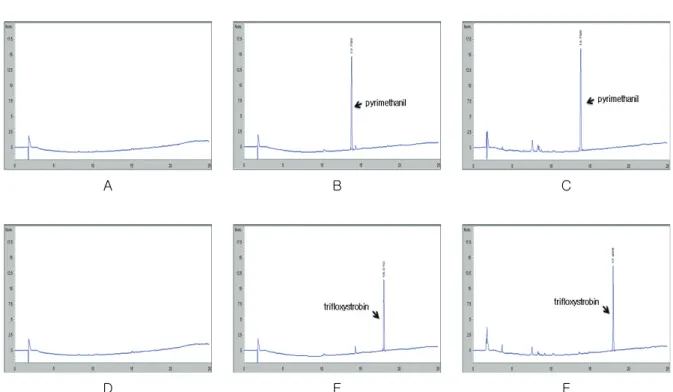
시험법의 검출한계는 두 시험약제에서 모두 0.01 mg/kg 이었고, 단감 시료에서 pyrimethanil의 머무름 시간은 13.8 min, trifloxystrobin은 18.0 min임을 확인하였으며, 크로마 토그램상에서 두 약제의 peak를 방해하는 물질은 존재하지 않았다(Fig. 1). 분석법에 의한 시험농약의 회수율 시험 결과 는 0.1 및 0.5 mg/kg 수준에서 pyrimethanil은 각각 81 ± 1.62%, 98 ± 1.58%이었으며, trifloxystrobin은 각각 91 ± 2.94%, 98 ± 1.25%이었다. 이는 식품의약품안전청에서 권고 하는 회수율 범위인 70∼120%, 반복 회수율 수치 간 변이계수 20% 이하의 기준과 잘 부합하여 본 연구에서 pyrimethanil과 trifloxystrobin의 잔류소장을 구명하기에 효율적인 분석방법 이라고 판단된다(Table 5).
A B C
D E F
Fig. 1. HPLC/DAD chromatograms of pyrimethanil (A : control, B : standard 2 mg/kg, C : recovery 2.5 mg/kg) and trifloxystrobin (D : control, E : standard 2 mg/kg, F : recovery 2.5 mg/kg).
Pesticide
Fortification level (mg/kg)
Recovery ± CVa) (%)
LODb) (mg/kg)
Pyrimethanil 0.1 81 ± 1.62 0.5 98 ± 1.58 0.01
Trifloxystrobin 0.1 91 ± 2.94 0.5 98 ± 1.25 0.01
a) Coefficient of variation=(standard deviation / average) × 100
b) Limit of detection
Table 5. Recovery rates and LOD of the analytical methods 단감의 증체율과 기상조건
약제 살포 후 경과일자별 단감의 증체율은 채취한 시료의 무게를 측정하고 그 평균무게를 이용하여 산출하였고 각 수 확일차별 평균무게는 Fig. 2와 같으며 첫 번째 수확일 대비 마지막 수확일까지 대상작물의 증체율은 135.44% 이었다. 또 한 시험기간 중 시험포장의 평균 온도의 범위는 13.6-19.4℃
였고 약제 살포 후 5일 후와 12일 후에 각각 16 mm과 6
mm의 강수량을 기록하였다(Fig. 3).
Fig. 2. Growth curve of persimmon during cultivation period.
Fig. 3. Temperature and precipitation during cultivation period.
단감의 재배기간 중 잔류량 변화
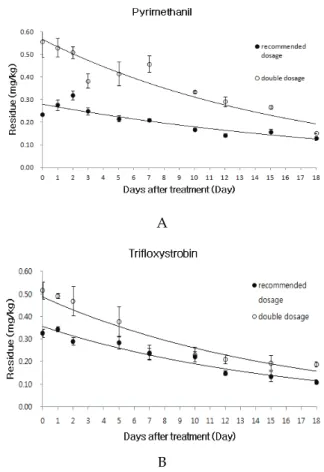
수확예정 18일 전에 pyrimethail과 trifloxystrobin 두 약제를 살포한 후 0(살포 2시간 후), 1, 2, 3, 5, 7, 10, 12, 15, 18일에 시료를 채취하여 잔류량을 계산한 결과 pyrimethanil 기준량 살포시 농도는 0.13 - 0.32 mg/kg 수준이며 배량 살 포시 잔류농도는 0.15 - 0.56 mg/kg 수준으로 기준량 살포 시와 배량 살포 시 전 구간에서 MRL (2.0 mg/kg)보다 낮 은 농도를 나타내었으며, trifloxystrobin 기준량 살포 시 잔 류 농도는 0.10 - 0.36 mg/kg 수준이며 배량 살포 시 잔류 농도는 0.19 - 0.52 mg/kg 수준의 농도를 나타내었으며, 기 준량 살포 시 전 구간에서 MRL (0.5 mg/kg)보다 낮은 농 도를, 배량 살포 시 수확 0일차에서만 MRL보다 높은 농도를 나타내었다(Fig. 4).
A
B
Fig. 4. Dissipation curves of pyrimethanil (A) and trifloxystrobin (B) in persimmon during cultivation periods.
단감의 증체율에 의한 pyrimethanil과 trifloxystrobin의 희석효과
농약의 작물잔류에 영향을 미치는 주요 인자로 과실의 비
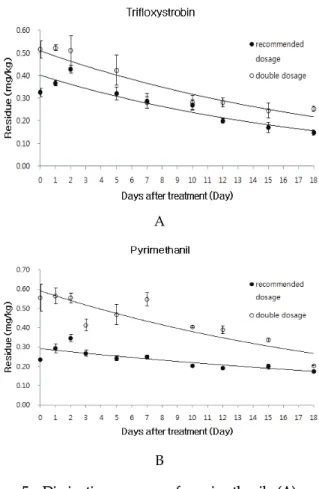
대생장에 따른 희석효과를 들 수 있다. 기준량 처리에서 과실
의 비대생장에 따른 pyrimethani과 trifloxystrobin의 희석
효과를 고려한 잔류 소실 곡선에서의 생물학적 반감기는 각
각 23.9일과 14.4일(Fig. 5)로 희석효과를 배제한 생물학적
반감기인 15.6일, 10.4일과 비교했을 때 각각 8.3일과 4.0일
이 길어진 것을 확인할 수가 있었다. 단감은 시험약제 살포일
부터 마지막 수확까지 중량 증가가 많지 않기 때문에 비대생
장에 의한 잔류농약의 희석효과가 오이(Lee et al ., 2008)와
같이 부피생장이 급격히 일어나는 작물에 비해 크지 않고, 파
프리카(Cho et al ., 2011)와 같이 수확 전 착색에 소요되는
성숙과정이 있어 과중의 변화가 거의 없는 작물에 비해 짧은
생물학적 반감기를 가지는 것으로 보여진다.
A
B
Fig. 5. Dissipation curves of pyrimethanil (A) and trifloxystrobin (B) after subtraction of dilution effect due to thickening growth of persimmon during cultivation periods.
잔류 농약의 생물학적 반감기 및 생산단계 잔류허용 기준 의 산출
pyrimethail의 소실 곡선은 기준량 살포 시 y=0.2796e
-0.0443x(R
2=0.858), 배량 살포 시 y=0.5666e
-0.0599x(R
2=0.8766)이었으 며, 이 식에 의해 산출된 pyrimethanil의 생물학적 반감기는 기준 량 처리 시 15.6일, 배량 처리 시 11.6일이었다. trifloxystrobin의 소실 곡선은 기준량 살포 시 y=0.3765e
-0.0666x(R
2=0.9167), 배 량 살포 시 y=0.5185e
-0.067x(R
2=0.8636)이었으며, 이 식에 의해 산출된 trifloxystrobin의 생물학적 반감기는 기준량 처 리 시 10.4일, 배량 처리 시 10.3일이었다.
생산단계 잔류허용 기준의 설정은 수확 시에 잔류량이 MRL을 초과하지 않도록 수확 전 일자별 잔류량을 설정한 수 치로서 이를 이용하여 생산단계 잔류허용 기준을 작성하였다 (Table 6). 이를 이용하여 생산단계 잔류허용기준을 설정한다 면 각각 수확 10일전 잔류량이 pyrimethanil은 2.69 mg/kg, trifloxystrobin은 0.83 mg/kg이면 수확 시 잔류 농도가 MRL이하로 잔류할 것으로 예측된다.
Pesticide
Pre-harvest residue limit (mg/kg) 10
day 9 day
8 day
7 day
6 day
5 day
4 day
3 day
2 day
1
day Harvesting day
Pyrimethanil 2.69 2.61 2.53 2.46 2.39 2.32 2.25 2.19 2.12 2.06 2.0
Trifloxystrobin 0.83 0.79 0.75 0.71 0.68 0.64 0.61 0.58 0.55 0.53 0.5 Table 6. Pre-harvest residue limit of pyrimethanil and trifloxystrobin in persimmon (mg/kg)
요 약
본 연구는 단감 재배 중 사용되는 살균제인 pyrimethanil 과 trifloxystrobin의 생산단계 잔류허용기준 설정을 통하여 안전한 단감 생산에 기여하고자 수행되었다. 먼저 pyrimethanil 과 trifloxystrobin을 살포하고, 살포 후 0, 1, 2, 3, 5, 7, 10, 12, 15, 18일에 단감 시료를 채취하여 각각의 농약을 분석하 고 생물학적 반감기를 산출한 다음 생산단계 잔류허용기준 (PHRL; Pre-Harvest Residue Limit)을 설정하였다. 단감 중 pyrimethanil과 trifloxystrobin은 Acetonitrile을 이용 하여 추출하고 NH
2cartridge와 PSA를 이용하여 정제하여 HPLC/DAD를 이용하여 분석하였다. 두 농약에서 검출한계 는 모두 0.01 mg/kg이었다. Pyrimethanil의 회수율은 0.1
과 0.5 mg/kg 두 수준에서 각각 81 ± 1.62%, 98 ± 1.58%
이었으며, trifloxystrobin의 회수율은 0.1과 0.5 mg/kg 두 수준에서 각각 91 ± 2.94%, 98 ± 1.25%이었다. 단감에서 pyrimethanil의 생물학적 반감기는 기준량 살포 시 15.6일, 배량 살포 시 11.6일이었고, trifloxystrobin의 생물학적 반 감기는 기준량 살포 시 10.4일, 배량 살포 시 10.3일이었다.
잔류회귀 감소식을 이용한 생산단계 잔류허용기준은 pyrimethanil과 trifloxystrobin은 각각 수확 10일 전 2.69 mg/kg과 0.83 mg/kg으로 제안하였다.
감사의 글
This study is part of the establishment of Pre-Harvest
Residue Limit in 2010. Thanks to the National Agricultural Products Quality Management Service for their research grant
참고문헌