1. 서 론
1.1 연구의 배경 및 목적
세계적으로 지구 온난화로 인한 이산화탄소 문제가 부각되면서 국가별 친환경 정책을 수립하여 이산화탄소 저감기준을 맞추기 위해 자동차 감소 방안 등을 시행하고 있다. 이 중 트램은 기존 도로의 차로 축소로 인한 자동차 감소, 대량수송가능, 중량전철보다 저렴한
* 종신회원 ․ 서울과학기술대학교 철도전문대학원 철도경영정책학과 부교수
(Seoul National University of Science and Technology․ [email protected])
** 종신회원 ․ 교신저자 ․ 대진대학교 도시부동산공학과 교수 (Corresponding Author ․ Daejin University ․ [email protected])
*** 서울과학기술대학교 철도전문대학원 철도경영정책학과 박사수료 (Seoul National University of Science and Technology ․ [email protected]) Received July 4, 2019/ revised July 8, 2019/ accepted July 11, 2019
Copyright ⓒ 2019 by the Korean Society of Civil Engineers
This is an Open Access article distributed under the terms of the Creative Commons Attribution Non-Commercial License (http://creativecommons.org/licenses/by-nc/3.0)
DOI: https://doi.org/10.12652/Ksce.2019.39.4.0551 www.kscejournal.or.kr
트램 운영 서비스 평가 기준 개발
정성봉*ㆍ김동선**ㆍ최지호***
Chung, Sung Bong*, Kim, Dong Sun**, Choi, Ji Ho***
Development of Service Evaluation Criteria in Tramway Operation
ABSTRACT
Since 2000, many local governments have been trying to introduce trams because of the government's failure to adopt environment- friendly policies and light rail. However, there is no service evaluation system that can maintain and enhance tram users' convenience, safety, and comfort during operation. In addition, the tram characteristics are not reflected in the application of the evaluation system of “management and service evaluation for public transportation operators” which is being implemented to railway operators or bus transportation operators. The purpose of this study is to develop the evaluation criteria of operating service according to tram operation model. First, we reviewed cases related to the evaluation of operating services in roads, buses, railways, and airways. And the evaluation criteria and the evaluation items are presented. This study is expected to help to secure and improve operational service in the operation phase of the tram that will be introduced in the future.
Key words : Tram, Service valuation, Tram operation model, Service assessment, Operational services 초 록
2000년대 이후 정부의 친환경 정책 및 경전철 도입 실패사례 등으로 인해 기존 경전철 대비 건설 및 운영비용이 저렴한 트램을 도입하기 위해 많 은 지자체에서 노력하고 있다. 하지만 트램 도입 이후 운영단계에서 이용자의 편의성, 안전성, 쾌적성 등을 유지하고 증대할 수 있는 서비스 평가 체계는 부재한 상황이며, 현재 철도사업자 또는 버스운송사업자에게 시행되고 있는 「대중교통운영자에 대한 경영 및 서비스평가」의 평가항목 및 평가방법을 적용하기에는 트램 특성이 반영되어 있지 않아 많은 문제가 발생할 것으로 판단된다. 본 연구는 트램 운영모델에 따른 운영 서비 스 평가 기준을 개발하기 위해 민자도로와 여객자동차, 도시철도 및 철도사업자, 항공 부분에 시행 중인 운영서비스 평가 관련 사례를 검토하고, 운영서비스 평가항목 및 평가항목별 가중치, 평가기준을 제시하였다. 본 연구를 통해 향후 도입될 트램의 운영단계에서 운영서비스 확보 및 개 선에 도움을 줄 수 있을 것으로 기대한다.
검색어 : 트램, 트램 사업자, 트램 운영모델, 서비스 평가, 운영 서비스 Railroad Engineering 철도공학
사업비 등의 효과로 인해 2000년 이후 신교통수단을 도입한 289개 도시 중 약 80 %가 트램을 도입하였을 정도로 많은 각광을 받고 있다, 국내의 경우 부산에서 운행되던 노면전차가 1968년 5월 20일 완전 폐선된 이후 2018년 기준 12개 지자체에서 22개 트램사 업을 계획구상하여 도입 추진 중에 있으며, 사업도입을 위한 평가체 계, 관련 법령 및 제도, 운영 및 유지보수 모델이 부재함에 따라 국토교통과학기술진흥원(KAIA)에서 무가선 저상 트램 실증사업 의 세부과제로 트램 안전운영 전략개발 및 체계 구축연구를 진행 중에 있다(Tables 1 and 2).
트램은 대량수송 대중교통수단으로써 지속가능한 교통수단으로 구축되기 위해 운영재정규모의 범주 내에서 이용자가 느끼는 서비 스 품질이 극대화되기 위한 노력을 하여야 한다. 1990년대 이후 도시 내 대중교통망이 형성된 국가를 위주로 대중교통 서비스에 대한 사용자 만족도를 향상시키는 중요성이 높아짐에 따라 서비스 품질 측정 및 개선을 위한 도구로 운영 서비스 평가가 시행되기 시작하였으며, 국내 또한 2008년 대중교통운영자에 대한 경영 및 서비스 평가를 시작으로 민자도로, 항공분야까지 확대되어 운영 서비스평가를 시행하고 있다.
국내의 경우 트램사업을 철도사업 중 경전철 사업의 일부로 분류하여 철도사업 추진절차를 적용해 사업을 추진하고 있으며, 트램 도입 이후 운영 서비스 평가가 시행되면 「대중교통운영자에
대한 경영 및 서비스 평가」를 통해 운영 서비스 평가가 이루어 질 것으로 예상된다. 하지만 기존 도시철도 및 광역철도, 경전철과는 달리 트램의 경우 기존 도로에 혼용선로를 추가하여 자동차와 혼용으로 운행되는 등 철도 특성과 버스 특성을 함께 지니고 있어, 분리된 노선에서 운영하는 도시 및 광역철도와 경전철, 항공분야보 다 체계적이고 표준적인 운영서비스가 필요하며, 이에 따라 운영에 대한 서비스 평가항목 및 기준 개발이 필요하다. 또한 국외사례를 검토하였을 때 트램의 경우 공공부문에서 운영하기보다는 버스와 같이 민간사업자가 운영자로 참여할 가능성이 높아짐에 따라 민간 사업자의 서비스 향상 측면에서 체계적 관리를 위한 평가기준 개발 또한 필요할 것으로 판단된다.
이에 본 연구는 트램사업 도입 이후 지속가능한 트램운영을 위해 트램사업자의 운영 서비스 평가항목 및 가중치를 설정하고, 트램 운영모델별 서비스 평가기준 및 평가등급을 제시하는 것을 목적으로 한다.
1.2 연구의 내용 및 방법
트램사업의 운영서비스 수준을 체계적으로 평가하기 위해서는 운영서비스에 대한 개념정의, 운영서비스 평가를 위한 평가항목 및 지표 도출, 평가지표 분석방법, 그리고 평가결과를 기반으로 운영서비스 수준 구분 등에 대한 연구가 필요하다.
Table 1. Korean Tram Project Type of KAIA(2018)
Purpose of introduction Tram projects
① Introduction with mega-urban development
·Seoul Wirye line, Seongnam line 1·2, Pangyo, Dongtan Line 1·2, Incheon Yeongjong inner circulation line, Siheung & Ansan, Busan Gangseo line
② Alternative to the city transportation
·Suwon, Incheon IN-Tram, Yeongjong inner circulation line, Nambu beltway, Siheung & Ansan Tram, Changwon, Daegu, Bucheon, Daejeon line 2, Busan Jeonggwan line, Wooam line, C-BAY Park line, Ulsan
③ Urban regeneration ·Bucheon, Incheon Yeongjong Inner circulation line, Daejeon, Busan Wooam line, C-BAY Park line, Ulasn
④ Tourism and regional development project ·Seoul gyeongchun line, Ulasn, Busan C-BAY Park line
Table 2. Korean Tram Operation Model of KAIA(2018)
Classification Advanced model Standard model Popular model
Project type
·Introduction with Mega-urban development
·Urban regeneration
·Alternative to the city transportation
·Introduction with Mega-urban development
·Tourism and regional development project
Applicable act ·Urban railroad act ·Urban railroad Act
·Tramway Transportation act
Operator ·Public ·Public / Mixed ·Mixed / Private (Tourism)
Level of service ·Wide area railway & urban railway ·The middle of urban railway and bus ·BRT
Hierarchy level ·Main line/Feeder line ·Feeder line/Tour line
Runway ·Exclusive road / lane ·Exclusive / Mixed lane ·Exclusive / Mixed / Abandoned Railway
우선, 운영서비스의 경우 도로, 여객자동차, 도시철도 및 철도사 업자, 항공의 운영서비스에 대한 자료를 검토하여 트램특성을 고려 한 운영서비스 정의를 마련하고자 하며, 운영서비스에 대한 평가항 목과 평가지표는 기존 대중교통시설에 대한 평가항목과 지표를 조사하여 트램 속성을 효과적으로 반영할 수 있는 항목과 지표를 도출하고자 한다. 평가지표의 경우 정성적 지표와 정량적 지표로 구분할 수 있는데 정성적 지표의 경우 객관적 분석을 위해 리커트 5점 척도를 이용하여 분석하며, 정량적 지표의 경우 평가지표에 대한 자료수집 및 분석방법에 대해 정의하도록 한다. 마지막으로 트램에 대한 운영서비스수준(TOLOS, Tram Operational Level of Service) 은 고속도로 서비스 수준과 도시철도경영평가에서 활용 하고 있는 운영서비스 지표 등을 검토하여 트램건설 유형에 부합하 는 평가기준을 제시하도록 한다.
1.3 연구의 수행절차
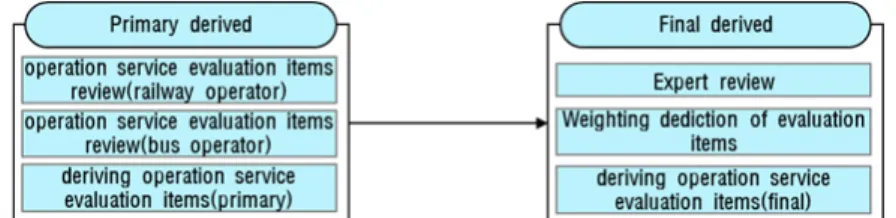
제2장에서는 민자도로 운영평가, 대중교통운영자에 대한 경영 및 서비스 평가, 항공교통서비스 평가 내용을 살펴보고, 제3장에서 는 운영서비스 평가항목 및 평가항목별 가중치를 도출하여, 제4장 에서는 트램 운영모델별 운영 서비스 평가기준 적용방안을 제시하 도록 한다(Fig. 1 참고).
2. 운영 서비스 평가 관련 사례 검토
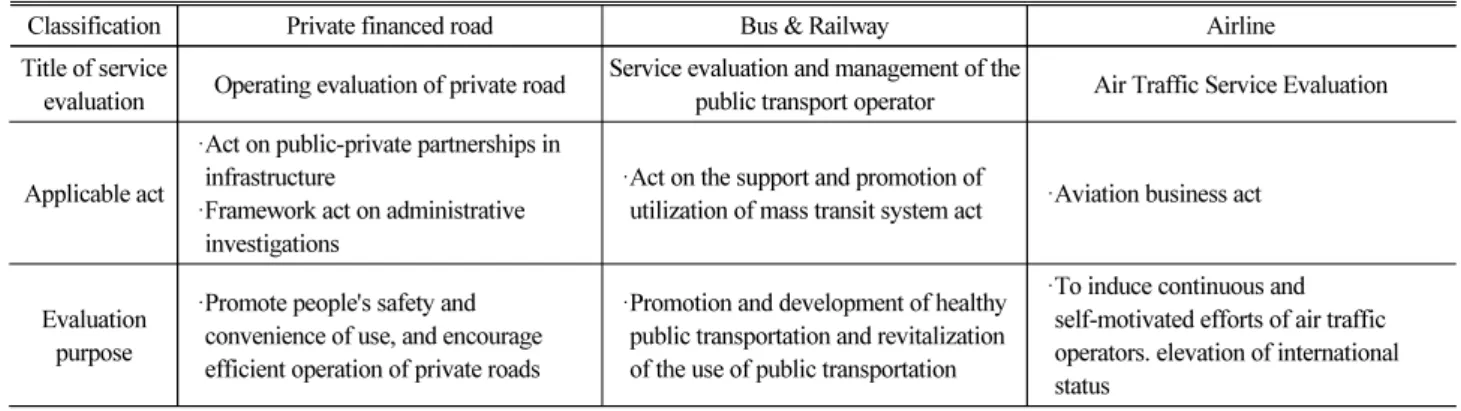
현재 국내에서는 국민의 안전 및 이용편의 증진 등의 목적으로 교통부분 중 도로, 대중교통(여객 자동차, 철도, 항공 등) 분야에서
운영에 대한 서비스 평가를 실시하고 있다. 우선 도로의 경우 MOLIT(2011)에서 민자도로의 이용 편의성과 안전성, 효율성을 저해하는 요인을 발견 및 개선하여 국민의 안전과 이용편의 증진, 민자도로의 효율적 운영을 유도하는 것으로 목표로 「사회기반시설 에 대한 민간투자법」 제45조·제51조·제51조의2와 「행정조사기본 법」 제3조·제5조에 의거하여 실시하는 「민자도로 운영평가」가 있으며, 대중교통 중 여객자동차와 철도의 경우 MOLIT·TS(2008) 에서 건전한 대중교통 육성·발전 및 대중교통의 이용 활성화를 목표로 「대중교통의 육성 및 이용촉진에 관한 법률」 제18조, 동법 시행령 제21~23조에 의거하여 실시하는 「대중교통운영자에 대한 경영 및 서비스 평가」가 있고, 항공의 경우 MOLIT·KOTI(2018) 에서 항공교통사업자의 수준비교 및 개선사항 도출과 정기적 평가 시행을 통한 항공교통사업자의 지속적·자발적 노력 유도 및 국제적 위상 제고를 목표로 「항공사업법」 제63조에 의거하여 실시하는
「항공교통서비스 평가」가 있다(Table 3).
운영서비스 평가 사례별 평가항목의 경우 공통적으로 이용자의 만족도 관련 항목이 포함되어 있으며, 그 외 민자도로의 경우 민자법인 의 공공지원 노력, 국가재정 최소화 및 효율적 활용 등으로 구성되며, 여객자동차의 경우 정시성과 안전성, 도시철도 및 철도사업자의 경우 공급성과 신뢰성, 안전성, 항공교통의 경우 항공교통이용자 보호 충실 성, 안전성 등이 서비스 평가항목으로 구성되어 있는 것으로 검토되었다.
유료도로의 경우 이용자 만족도 항목 외에 공공교통시설을 민간 사업자가 운영함에 따라 발생되는 수익성 가치와 공공성 가치간의 균형을 이루기 위한 평가항목이 주로 있는 것이 특징으로 보여지며, 여객자동차와 도시철도 및 철도사업자의 경우 대규모 운송수단을
Fig. 1. Procedure and Contents
Table 3. Case of Service Evaluation in Transportation Operation
Classification Private financed road Bus & Railway Airline
Title of service
evaluation Operating evaluation of private road Service evaluation and management of the
public transport operator Air Traffic Service Evaluation
Applicable act
·Act on public-private partnerships in infrastructure
·Framework act on administrative investigations
·Act on the support and promotion of
utilization of mass transit system act ·Aviation business act
Evaluation purpose
·Promote people's safety and convenience of use, and encourage efficient operation of private roads
·Promotion and development of healthy public transportation and revitalization of the use of public transportation
·To induce continuous and self-motivated efforts of air traffic operators. elevation of international status
운영하는 특성에 따른 이용자의 안전성 측면과 이동시간의 신뢰성 측면을 고려하여 정시성, 공급성을 평가항목으로 선정한 것으로 보이며, 항공의 경우 대규모 운송수단을 운영하는 특성을 고려한 안전성 항목 이외에 이용자 권익보호를 위한 항공교통 이용자 보호 충실성 항목이 있는 것이 특징으로 보여진다(Table 4).
3. 운영 서비스 평가항목 도출
트램사업자 운영 서비스 평가가 시행될 경우 「대중교통의 육성 및 이용촉진에 관한 법률」 제18조의 규정에 의거하여 실시되고
있는 ‘대중교통운영자에 대한 경영 및 서비스 평가’에 포함되어 평가가 이루어 질 것으로 판단된다. 다만 트램의 경우 철도의 운영특 성 및 버스의 운영특성을 포함하고 있어 기존의 철도사업자 및 버스운송사업자에게 적용되고 있는 평가항목을 적용할 경우 문제 가 발생할 것으로 예상된다. 이에 본 연구에서는 MOLIT·TS(2008) 의 철도사업자 및 버스운송사업자에게 적용되고 있는 서비스 평가 항목을 토대로 기존 평가항목의 틀을 크게 벗어나지 않되 트램의 운영특성을 모두 반영할 수 있는 항목을 추가하는 방향으로 1차 트램사업자의 운영서비스 평가항목을 도출하였으며, 1차 결과를 토대로 대중교통 운영관련 전문가 5인을 대상으로 1차 도출된
Table 4. Case of Service Evaluation Item in Transportation OperationOperating evaluation of Private road Service evaluation and management of the public transport operator
Air traffic service evaluation
Bus operator Railway operator
Evaluation item
Detailed evaluation item
Evaluation item
Detailed evaluation item
Evaluation item
Detailed evaluation item
Evaluation item
Detailed evaluation item
User satisfaction
Traffic safety and
response punctuality Headway compliance rate
Provision
Frequency of train service
Fidelity of air traffic
user protection
Damage relief
Average driving speed Administrative measure Promptness and
kindness of civil petitions treatment
Stability
Equipment and equipment standards for business vehicles
Congestion Protection measure
Survey of user
satisfaction Index of violation
Reliability
Punctuality
Stability
Aircraft accident Employee kindness
Index of traffic accident
Train service
cancellation rate Safety culture Effort to
provide public support by
private operator
Cooperation with public organization
Car failure rate Administrative
measure Casualties
Cooperation with Traffic information organization and related
organization
Stability
Casualties by train service
User satisfaction
Convenience of booking and issuance Rate of accident
compensation
insurance Site inspection for
train & facilities
Convenience of boarding procedures
Minimize national finance and
make efficient use
The execution of maintenance and operational suitability
Driver education
Rate of accident compensation
insurance
Propriety of information provision Propriey of management
organization
Sefaty facilities
installation rate Comfortability of aircraft Passenger
satisfaction
Passenger satisfaction User convenience and
social contribution
Passenger satisfaction
Passenger satisfaction
Satisfaction in flight service Effort to improve
service Response to media and
public relation effort level
Employee kindness Effort to improve
service
Satisfaction of air freight charge
평가항목의 검증과 및 가중치 도출을 위한 AHP 조사를 수행하였다.
AHP 설문지의 조사구조는 1차 평가항목 도출결과를 준용하여 1계 층에는 공급성과 신뢰성, 안전성, 고객만족 등 4가지로 구성하였으며, 2계층 항목에는 열차운행시격, 평균속도, 혼잡도, 정시성, 운행취소 율, 차량고장률, 열차운행관련 사상자수, 운전자교육, 차량/시설 현장 점검, 비상사태대비 노력, 고객만족도, 서비스 개선노력으로 구성하 였고, 가중치 도출을 위해 AHP 조사결과를 토대로 expert choice 프로그램을 이용해 최종 항목별 가중치를 도출하였다(Fig. 2).
트램 운영서비스 평가항목 도출결과 평가영역은 공급성, 신뢰성, 안전성, 고객만족 등 4가지로 구성하고 공급성의 평가항목은 열차 운행시격(첨두시, 비첨두시), 평균운행속도, 혼잡도로 구성하였으 며, 신뢰성의 평가항목은 정시성, 운행취소율, 차량고장률로 구성하 였고, 안전성의 평가항목은 열차운행관련 사상자수, 운전자교육, 차량/시설 현장점검, 비상사태대비 노력으로 구성하였으며, 고객만 족의 평가항목은 고객만족도, 서비스 개선노력으로 구성하였다.
평가영역별 가중치는 총점이 100점이 되도록 구성하였으며, 공급성의 경우 15점, 신뢰성 부분은 20점, 안전성 부분은 35점,
고객만족 부분은 30점을 부여하였다.
평가영역 중 공급성의 평가항목별 가중치는 열차운행시격을 6 점, 평균운행속도와 혼잡도는 각 5점으로 부여하였으며, 신뢰성의 평가항목별 가중치는 정시성을 8점, 운행취소율 5점, 차량고장률 7 점으로 부여하였고, 안전성의 평가항목별 가중치는 열차운행관련 사상자수와 운전자 교육, 차량/시설 현장점검을 각 10점, 비상사태대 비 노력은 5점으로 부여하였으며, 고객만족의 평가항목별 가중치는 고객만족도 25점, 서비스 개선노력 5점으로 부여하였다(Table 5).
4. 트램 운영모델별 운영 서비스 평가기준 적용방안
4.1 트램 운영모델별 운영 서비스 평가기준
한국형 트램 운영모델은 고급형(상), 표준형(중), 보급형(하)로 구분되며, 모델별 서비스 수준에 차이가 있다. 예를 들어 고급형(상) 의 경우 현재 운행 중인 경전철 수준에 맞춰 전용선로, 통신 등 각종설비의 고급화, 역사 설치 등 국외 트램 트레인의 사례를 지향하 고 있으며, 표준형(중)의 경우 도시철도와 버스의 중간개념으로
Fig. 2. Procedure for Deriving Evaluation Items in Operation ServiceTable 5. Evaluation Items & Weighting of Tram Operation Service Evaluation
area Evaluation criteria Valuation basis Weighting
(Distribution)
Provision
Operational Headway Peak ·Evaluation according to peak time by line 3
Off-peak ·Evaluation according to off-peak time by line 2
Average driving speed ·Evaluation of average driving speed between Origin-destination 5
Congestion ·Evaluation average congestion based on peak time 5
Reliability
Punctuality ·Evaluation of delayed train compared to annual total operating distance 8 Train operation cancellation rate ·Evaluate the train cancellation rate compared to the total number of planned trains 5 Car failure rate ·Valuation of number of car trouble per milion kilometer 7
Stability
Casualties by train operation ·Valuation of the number of casualities caused by traffic accidents 10
Driver education ·Driver education result 10
Car/facility site inspection ·Sight inspection and valuation about car, facility 10 Effort in case of an emergency ·Response system for emergency, safety education 5 Passenger
satisfaction
Passenger satisfaction ·Valuation of passenger satisfaction and improvemnet factor year on year
- train’s comfortability, convenience of providing information, etc 25
Effort to improvement of service ·Effort to improvement of service 5
Total 100
전용차로와 전용도로 및 일부 혼용차로, BRT 정류장 형태의 정거장 등 국외 일반적인 트램 사례를 지향하고 있고, 보급형(하)의 경우 버스 수준의 각종 설비 최소화, 도로신호체계 준용 등 미국 샌프란시 스코나 포르투칼 리스본 등과 같은 관광트램 사례를 지향하고 있다. 이와 같이 운영모델에 따라 서비스 수준에 차이가 존재하며 운영 서비스 평가 시 이를 반영한 평가가 수행되어야 한다.
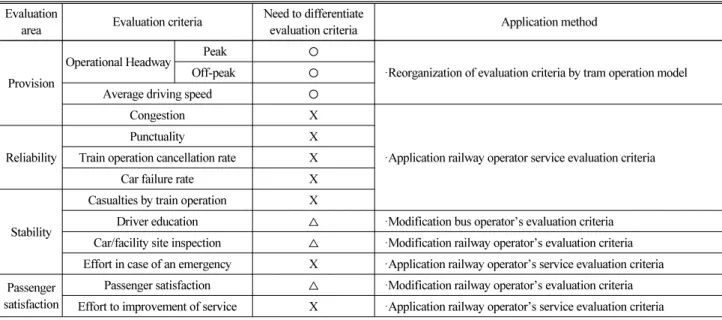
이에 본 연구에서는 앞 장에서 구성된 트램 운영서비스 평가항목 중 트램 운영모델별 서비스 수준에 따라 평가방식을 구분할 필요가 있는 항목을 선별하고, 해당항목에 대한 평가기준을 제시하였다.
트램 운영모델별 서비스 수준에 따른 평가방식 구분이 필요하지 않은 항목에 대해서는 MOLIT·TS(2008)의 철도사업자와 버스운 송사업자의 서비스 평가기준을 준용하는 것으로 설정하였다(Table 6).
4.1.1 열차운행시격
열차운행시격은 운영모델의 서비스 수준에 따라 차이가 존재한
다. KAIA(2018)에 따르면 고급형(상) 모델의 경우 열차운행시격 을 첨두시 5분 이내, 비첨두시 7분 이내로 운행계획을 수립할 필요가 있다고 제시하였으며, 표준형(중) 모델의 경우 첨두시 7분 이내, 비첨두시 10분 이내, 보급형(하) 모델의 경우 첨두시 10분 이내, 비첨두시 20분 이내로 운행계획을 수립할 필요가 있다고 제시함에 따라 본 연구에서는 열차운행시격 항목의 만점기준을 KAIA(2018) 에서 제시한 첨두 및 비첨두 운행시격으로 설정하고, 평가기준에 따른 배점분포는 1분에서 최대 5분간격으로 설정해 제시하였다(Table 7).
4.1.2 평균운행속도
KAIA(2018)에서 제시한 트램 운영모델별 평균운행속도는 고 급형(상) 모델의 경우 표정속도 30 km/h, 표준형(중) 모델의 경우 표정속도 25 km/h, 보급형(하) 모델의 경우 표정속도 18 km/h로 제시함에 따라 본 연구는 평균운행속도 항목의 만점기준을
Table 6. Necessities of Evaluation Criteria Differentiation by Tram Operation Model Evaluation
area Evaluation criteria Need to differentiate
evaluation criteria Application method
Provision
Operational Headway Peak ○
·Reorganization of evaluation criteria by tram operation model
Off-peak ○
Average driving speed ○
Congestion X
·Application railway operator service evaluation criteria Reliability
Punctuality X
Train operation cancellation rate X
Car failure rate X
Stability
Casualties by train operation X
Driver education △ ·Modification bus operator’s evaluation criteria Car/facility site inspection △ ·Modification railway operator’s evaluation criteria Effort in case of an emergency X ·Application railway operator’s service evaluation criteria Passenger
satisfaction
Passenger satisfaction △ ·Modification railway operator’s evaluation criteria Effort to improvement of service X ·Application railway operator’s service evaluation criteria
○: Need to Reorganization
△: Need some changes
X: Applying the existing evaluation criteria
Table 7. Evaluation Criteria by Operational Headway
Classification 100 point 95 point 90 point 85 point 80 point 75 point
Advanced model
Peak Within 5 min. 5~6 min. 6~7 min. 7~8 min. 8~9 min. 9 min. or more
Off-peak Within 7 min. 7~8 min. 8~9 min. 9~10 min. 10~11 min. 11 min. or more
Standard model
Peak Within 7 min. 7~8 min. 8~9 min. 9~10 min. 10~11 min. 11 min. or more
Off-peak Within 10 min. 10~13 min. 13~15 min. 15~18 min. 18~20 min. 20 min. or more Popular
model
Peak Within 10 min. 10~13 min. 13~15 min. 15~18 min. 18~20 min. 20 min. or more
Off-peak Within 20 min. 20~25 min. 25~30 min. 30~35 min. 35~40 min. 40 min. or more
KAIA(2018) 에서 제시한 운영모델별 표정속도를 준용하여 평가기 준을 제시하였다(Table 8).
4.1.3 운전자교육
운전자교육 항목의 경우 MOLIT·TS(2008)의 버스운송사업자 의 운전자교육 평가방법 및 산식을 준용하되, 버스운송사업자의 운전자교육의 경우 고객서비스 향상을 위한 안전 및 친절서비스 교육을 평가목적으로 하고 있어, 평가목적을 변경 할 필요가 있다.
트램의 경우 버스와는 달리 기존 철도차량과 동일하게 승객과 운전자를 분리할 것으로 예상됨에 따라 고객서비스 향상보다 혼용 도로 운행에 따른 공로의 타 교통수단 및 보행자 충돌 예방을 위한 안전교육에 집중할 필요가 있으며, 세부 교육내용은 트램사업
자가 운행노선 및 주변 현황 등을 고려하여 교육 프로그램이 양적·질 적 수준을 충족하도록 장려하는 것이 바람직 한 것으로 판단된다 (Table 9).
4.1.4 차량/시설 현장점검
차량/시설 현장점검 항목의 경우 MOLIT·TS(2008)의 철도사업 자의 차량/시설 현장점검 평가방법인 현장점검을 통한 점수산정방 식을 준용하되, 역사 간소화(BRT 정류장 형태) 등 트램 시설 특성을 고려해 현장점검시 실시되는 평가항목을 일부 개선 반영하였다.
정거장의 경우 기존 철도사업자에게 시행되던 역사시설 평가항목 중 승하차 시설의 평가항목을 제외한 나머지항목을 모두 제외 하였 으며, 안내시설의 경우 타 교통수단과의 연계교통안내의 적정성
Table 8. Evaluation Criteria by Average SpeedClassification Evaluation criteria
Advanced
model ·Average driving speed is perfect score for scheduled speed (30 km/h), distribution is in proportion to result of subject of evlauation.
Standard model ·Average driving speed is perfect score for scheduled speed (25 km/h), distribution is in proportion to result of subject of evlauation.
Popular model ·Average driving speed is perfect score for scheduled speed (18 km/h), distribution is in proportion to result of subject of evlauation.
Table 9. Evaluation Criteria for Training Drivers of Bus Companies
Point Total number of training sessions
Number of practical training
sessions
The average attendance rate
The average education time
Number of education by outside lecturer
Number of making textbooks by
subject
Number of measures for educational effects 2 □ Under 2 times □ Under 1 times □ Within 20 % □ Within 30 min. □ Under 1 times □ Under 1 times □ Under 1 times
4 □ 3~4 times □ 2 times □ 20~40 % □ Within 1 hours □ 2 times □ 2 times □ 2 times
6 □ 5~6 times □ 3 times □ 40~60 % □ 1~2 hours □ 3 times □ 3 times □ 3 times
8 □ 7~8 times □ 4 times □ 60~80 % □ 2~3 hours □ 4 times □ 4 times □ 4 times
10 □ Over 9 times □ Over 5 times □ Over 80 % □ 3 hours or more □ Over 5 times □ Over 5 times □ Over 5 times
Weighting 0.2 0.2 0.2 0.1 0.1 0.1 0.1
Table 10. Vehicle / Facility Site Inspection Items and Evaluation Criteria
Classification Facilities type Evaluation criteria
Vehicles
·Secure space for wheelchair users
·Guidance system for disabled accessible
·Wheelchair-only space management status
Stations Platform
·Proper installation of platform
·Convenience of the transportation vulnerable
·Appropriateness of the transportation vulnerable-induction system
Guidance facility
Braille block
·Appropriateness of braille block installation
·Appropriateness of braille block installation location
·Appropriateness of Braille Block Management State Induction &
guidance facility
·Appropriateness of passenger guidance system
·Appropriateness of traffic information related to other modes of transportation
·Appropriateness of guidance facility management status
항목을 추가하였다(Table 10).
4.1.5 고객만족도
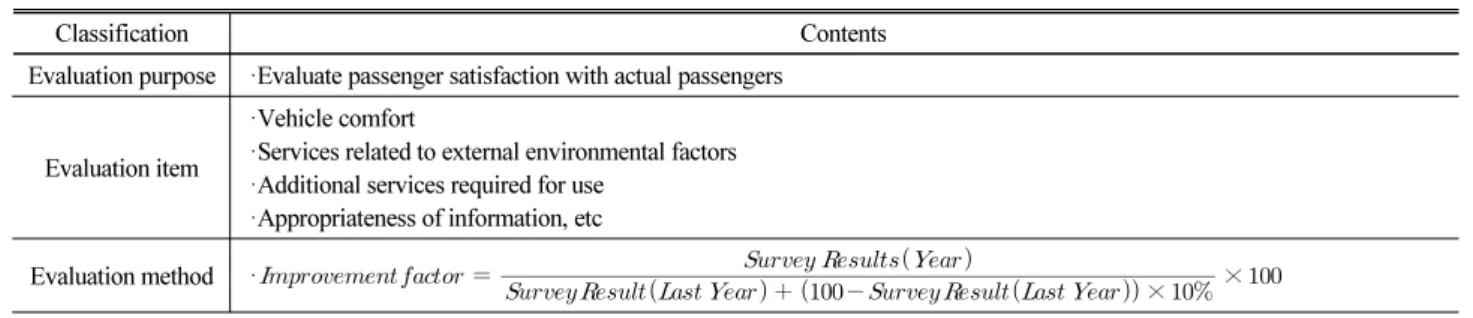
고객만족도 항목의 경우 MOLIT·TS(2008)의 철도사업자와 버스운송사업자의 고객만족도 평가방법인 고객만족도 조사를 통한 점수산정방식을 준용하되, 트램 시설특성을 고려하여 고객만족도 조사 항목을 차량 쾌적성, 외부환경 요소와 관련된 서비스, 이용에 필요한 부가서비스 관련, 정보제공 적정성 등으로 재구성하였다 (Table 11).
4.2 평가등급 적용
현재 대중교통운영자의 경우 「대중교통의 육성 및 이용촉진에 관한 법률」 제18조 및 「대중교통의 육성 및 이용촉진에 관한 법률 시행령」 제22조의 규정에 따라 경영 및 서비스평가를 시행하고 있으며, 트램사업이 추진되어 운영될 경우 트램사업자는 해당 법령 에 의거 경영 및 서비스 평가 대상으로 포함된다. 본 연구는 향후 트램사업의 운영단계에서 시행될 경영 및 서비스 평가를 트램특성 에 부합하도록 평가항목 및 평가기준을 개선하였다. 다만 평가등급 적용의 경우 현재 경영 및 서비스 평가의 대상이 되고 있는 철도사업 자 및 버스운송사업자 모두 동일한 기준의 평가등급을 준용하고 있어 트램사업자 만의 평가등급을 수립할 경우 평가주체의 혼란을 가중할 소지가 있다. 이에 본 연구는 「대중교통운영자에 대한 경영 및 서비스평가 요령」 제12조에 제시된 평가등급을 준용하여 트램 사업자의 서비스 평가등급을 산정하고자 한다(Table 12).
5. 결론 및 제언
2000년대 이후 정부의 친환경 정책 및 경전철 도입 실패사례 등으로 인해 기존 경전철 대비 건설 및 운영비용이 저렴한 트램을 도입하기 위해 많은 지자체에서 노력하고 있다. 또한 정부에서는 이러한 트램 도입계획과 더불어 합리적 사업추진판단기준을 마련 하기 위한 법령개정, 설계 및 투자평가 관련 지침개선 등을 수행하고 적용하고 있다. 하지만 트램 도입 이후 운영단계에서 이용자의 편의성, 안전성, 쾌적성 등을 확보할 수 있는 서비스 평가체계는 부재한 상황이며, 현재 시행되고 있는 「대중교통운영자에 대한 경영 및 서비스평가」의 평가항목 및 평가방법을 적용하기에는 트램 특성이 반영되어 있지 않아 많은 문제가 발생할 것으로 판단된다.
이에 본 연구에서는 현재 시행되고 있는 민자도로, 철도 및 버스운송사업자, 항공에 대한 운영서비스 평가 관련 사례를 검토하 여, 철도사업자와 버스 운송사업자에게 시행되고 있는 서비스 평가 항목을 토대로 기존 평가항목의 틀을 크게 벗어나지 않되 트램의 운영특성을 모두 반영할 수 있는 항목을 추가하는 방향으로 2차에 걸쳐 공급성, 신뢰성, 안전성, 고객만족 등 4가지 항목으로 구성된 트램사업자의 운영서비스 평가항목을 도출하였으며, 평가항목 중 KAIA(2018)에서 제시한 트램 운영모델별로 평가기준에 차별화 또는 일부 평가기준 개선이 필요한 항목을 도출해 각 항목별 서비스 평가기준을 제시하였다.
본 연구는 트램 특성을 고려한 합리적인 운영서비스 평가방법 마련을 기조로 수행되었으며, 향후 신교통수단의 도입에 맞춰 운영 서비스 평가방법 개선에 대한 필요성과 평가항목 및 평가방안
Table 11. Overview of Passenger Satisfaction SurveyClassification Contents
Evaluation purpose ·Evaluate passenger satisfaction with actual passengers
Evaluation item
·Vehicle comfort
·Services related to external environmental factors
·Additional services required for use
·Appropriateness of information, etc
Evaluation method · × ×
Table 12. Evaluation Grade in 「Service Evaluation and Management of the Public Transport Operator」
Grade State Score
1 ·The condition of facilities and equipments for services are providing the best service 91 or more 2 ·A relatively good condition in which facilities and equipment for the service are required to be mildly improved. 81 ~ 90 3 ·Facilities and equipment for the service are at least available or require partial improvement. 71 ~ 80 4 ·State that facilities and equipments for service are provided but active improvement is required due to failure of normal operation 61 ~ 70 5 ·Facilities that are equipped with facilities and equipments for services but are in need of urgent improvement 51 ~ 60 6 ·The facilities and equipments for the service are not provided and maintenance is not done. Within 50
적용방법을 제안한 것에 큰 의의가 있다. 하지만 본 연구결과가 적용되기 위해선 「대중교통운영자에 대한 경영 및 서비스평가 요령」의 별표에 제시된 서비스 평가 영역별 평가항목, 서비스평가 영역별/평가항목별 가중치를 개정할 필요가 있다. 다만 본 연구에서 도출된 서비스평가 항목 및 가중치가 전문가 5인에 의해 결정되었다 는 점은 향후 서비스평가가 시행하게 되면 여러 정책적 상황이나 운영현실 등을 감안해 변경될 소지가 있으므로, 향후 트램을 주요 운송수단으로 운영하고 있는 국외 여러 도시의 운영서비스 평가 사례 및 기준을 검토할 필요가 있을 것으로 사료된다.
References
Korea Agency for Infrastructure Technology Advancement (KAIA) (2018). Development of tram safety management strategy and system. Internal data.
Ministry of Land, Infrastructure and Transport (MOLIT) (2011).
Operating evaluation of Private road.
Ministry of Land, Infrastructure and Transport (MOLIT), Korea Transportation Safety Authority (TS) (2008). Service and mana- gement evaluation manual of the public transport operator.
Ministry of Land, Infrastructure and Transport (MOLIT), The Korea Transport Institute (KOTI) (2018). 2018 Air traffic service evaluation.