1. INTRODUCTION
1.1 Background
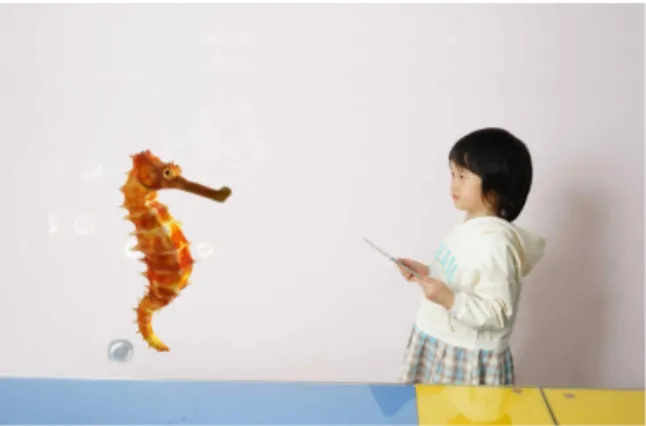
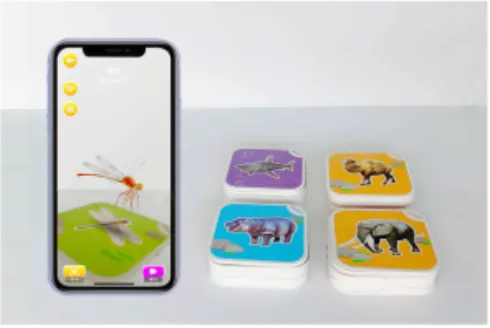
In general, educating young children can be dif- ficult because young children have different atten- tion spans than adults because they can only focus on something for a short period of time. Therefore, the introduction of interesting interactive learning can attract attention and thus improve the learning attention of preschool children. It is well known that cognitive cards are one of the ways to teach children knowledge about things. At the same time, Augmented Reality (AR for short) is seen as a powerful teaching tool[1]. The study found the po- tential of AR books as a tool, especially for pre- schoolers, to create a fun learning environment[2].
So, as for cognitive cards also have the potential
for education better with AR. It can be further im- proved by combining the sound, vision and touch of the cards with appropriate combinations to stimulate children’s several senses.
With the development of information technology, there is an increasing literature on the use of AR in education in off-campus or informal learning environments[3]. Literature also suggests that the environment in which technology is used may be related to learning outcomes[4], But AR mediated education should be considered as a whole and should take into account the wider social or cultural context, such as family and family factors[5].
Home environmental factors are an important issue affecting young children’s use of AR, and there is a widely agreed concept that students’ educational achievement is always supported by their families,
A Study on Parents’ View of the Augmented Reality Card Use for Pre-School Education
Qianrong Deng
†, Dong-min Cho
††ABSTRACT
Parents’ influence on children’s development is generally considered essential. This paper attempts to explore the role of AR in preschool education from the perspective of parents, aiming to help parents better understand the impact of children’s use of augmented reality in preschool education. The subjects were parents of children in the preschool age range (3-6 years old), and the experimental equipment was AR cognitive cards. In order to extract parents’ views on AR, five parents were invited to conduct an experiment with their children using AR cognition cards, and then an open interview survey was conducted. In the second experiment, the answers obtained from the first experiment were sorted out and formed a questionnaire to conduct a closed-book survey. It shows that parents are satisfied with the characteristics of AR to assist their children’s learning. At the same time, parents also value technology ,usage management and playing environment. AR can stimulate children's learning initiative. Children like to use AR, AR is suitable for learning, make parents satisfied. But even if AR is suitable for learning, parents will control the time their children use it.
Key words: Augmented Reality, Preschool children education, Parents’ view
※ Corresponding Author : Dong-min Cho, Address: (54896) 567 Baekje-daero, Deokjin-gu, Jeonju-si, Jeollabuk-do, Korea, TEL : FAX : +82-63-270-3755, E-mail : [email protected]
Receipt date : Apr. 12, 2021, Revision date : Jun. 4, 2021
Approval date : Jun. 28, 2021
††
Dept. of Design & Manufacturing Engineering, Jeonbuk National University
(E-mail : [email protected])
††