서 론
바리과(Family Serranidae) 어류는 수산경제적으로 중요한 고가 어종으로, 아시아 지역에서 주로 양식하고 있다(Kohno et al., 1993; Harikrishnan et al., 2012). 그중 우리나라 및 일 본 연안 암반지역에 주로 서식하고 있는 능성어, Epinephelus septemfasciatus는 높은 수요, 뛰어난 맛, 환경에 대한 강한 내 성 및 빠른 성장으로 양식 산업화를 위한 주요 어종으로, 양식
산업화의 기본이 되는 번식생물학적 연구 및 종묘생산에 대한 연구가 국내외적으로 진행되고 있다(Kohno et al., 1993; Lee and Go, 2003; Sakakura et al., 2006; Ruttanap-ornvareesakul et al., 2007; Wullur et al., 2011; Harikrishnan et al., 2012; Hong et al., 2015).
산업적으로 중요한 어류의 종묘생산에 있어 가장 중요한 요 소 중 하나는 일시에 다량의 우량 수정란을 확보해야 하는 것 이다. 하지만 능성어를 포함한 일부 바리과 어류는 어미의 사 육관리 상태와 자성선숙형의 생식·생태적 특성으로 인한 성 비 불균형과 산란기 부적합한 사육 수심과 같은 환경적 요인 등으로 자연산란 유도가 쉽지 않다(Toledo et al., 1993; Oku-
—260 — http://www.fishkorea.or.kr
* Corresponding author: Kyong Min Kim Tel: 82-61-690-8977, Fax: 82-61-685-9073, E-mail: [email protected]
ISSn: 1225-8598(Print), 2288-3371(online)
accepted: november 23, 2016
어미 크기 및 복부팽만도에 따른 능성어, Epinephelus septemfasciatus의 배란유도 효과
조재권·홍창기1·박종연·손맹현2·박재민3·한경호4·김경민1,
*
국립수산과학원 양식관리과, 1남해수산연구소 양식산업과, 2국립수산과학원 수산방역과, 3경상북도 토속어류산업화센터,
4전남대학교
Ovulation Induction Effect of Sevenband Grouper, Epinephelus septemfasciatus in Size and Abdomen Inflation Degree of Mother Fish
by Jae Kwon Cho, Chang Gi Hong1, Jong Youn Park, Maeng Hyun Son2, Jae Min Park3, Kyeong Ho Han4 and Kyong Min Kim1,* (aquaculture Management Division, aquaculture research Institute, nIfS, Busan 46083, republic of Korea; 1Southwest Sea fisheries research Institute, nIfS, yeosu 59780, republic of Korea;2aquatic Disease control Division, aquaculture research Institute, nIfS, Busan 46083, republic of Korea; 3gyeongsang- buk-Do native fish Business center, uiseong 37366, republic of Korea; 4chonnam national university, yeosu 59626, republic of Korea)
ABSTRACT We determined the morphologic characteristics (body weight and abdomen inflation degree) of the mother fish of sevenband grouper, Epinephelus septemfasciatus producing the healthy eggs. Experimental fish were chosen from the reared fish in the sea cage for 6 years. The fish were divided into four size groups by body weight: 4.0~5.0, 5.0~6.0, and 6.0~7.0 kg and four stages (I~IV) by the abdomen inflation degree. After hormone treatment, we observed the ovulation amount of induced eggs, rate of buoyant, fertilization, embryonic survival, and hatching. Egg and oil globule diameter was measured. In order to observe gonadal development, we calculated gonadosomatic index (GSI) and conducted its historical analysis. The ovulation occurred from all experimental fishes over 5.0 kg. The rate of buoyant, fertilization, and embryonic survival was the highest in 6.0~7.0 kg. Hatching rate was the highest in 5.0~6.0 kg. Stage I and II did not induce ovulation. GSI was 0.31±0.10% in stage I, 0.74±0.25% in stage II, 4.68±0.40% in stage III and 6.86±0.12% in stage IV.
The rate of buoyant, fertilization, embryonic survival and hatching was the highest in stage III.
Key words: Sevenband grouper, egg quality, hormone (LHRHa), GSI, ovulation induction
어 대량종묘생산을 위해 어미를 해상가두리 또는 육상수조에 서 관리하며 산란기에 어미를 선별하여 호르몬 처리 후 복부 를 압박하여 수정란을 생산한다. 하지만 산업체 현장에서 수 정란을 대량생산하기 위해 다수의 어미후보군에서 개체 하나 하나 삽관법으로 난의 성숙상태를 파악하는 데 많은 시간과 노동력이 소요되는 어려움이 있으며, 난의 성숙상태를 파악하 기 위하여 반복적으로 삽관 시 어미의 스트레스로 인하여 난 질이 저하될 가능성이 있다. 또한 삽관을 하지 않고 육안으로 성숙시기를 판단 시 그 기준이 명확하지 않아 호르몬 처리 시 기가 이르거나 그 시기를 놓쳐 양질의 수정란을 대량으로 생 산하는데 문제가 발생할 수 있다.
따라서 본 연구는 종묘생산 시 능성어 어미 후보군의 외부 형태로 호르몬 처리 시기 및 대상 어미의 선별기준을 설정하 고, 산업체에서 대량종묘 생산 시 이러한 기준을 쉽게 적용함 으로서 양질의 수정란을 안정적으로 생산하기 위한 기틀을 마 련하기 위하여 수행하였다. 연구를 수행하기 위하여 뒷지느러 미를 기준으로 어미의 복부가 팽만한 정도로 단계를 나누어 설 정하였으며, 단계별로 생식소 중량지수(Gonadosomatic index, GSI)를 조사하고 난소와 난을 관찰하였다(Miura et al., 2014).
단계별 수정률, 부상률, 난발생 생존율 및 부화율을 조사하여 외부형태를 통한 어미 선별 가능성을 확인하고, 난질을 비교 하였다.
재료 및 방법
1. 실험어
실험어는 2007년 6월에 전남 여수시 거문도 해역에서 채집 한 자연산 능성어 치어 약 1,000마리를 해상가두리(7×7×5 m)에서 6년 동안 어미후보군으로 육성하였으며, 그중 2013년 3월에 300마리(전장 58.6±3.9cm, 체중 3.7±0.8kg)를 1차 선 별하여 전갱이와 굴을 1회/1일, 어체중의 1~2%를 공급하였 다. 7월에 어미의 체중구간 및 뒷지느러미를 기준으로 한 복부 팽만도 단계별로 2차 선별하여 호르몬을 처리하였다.
2. 호르몬 처리 및 인공수정
능성어 어미의 난 성숙 및 배란유도를 위한 호르몬으로 LHRHa(des-Gly10, D-Ala6; Sigma Co. LLC., USA)를 사용하 였으며, 100μg/kg의 농도로(Liao and Leano, 2008) 어체 제 1 극조 하부의 등 근육에 주사하여 소형 가두리(2×2×2m)에
10개씩 측정하였다. 인공수정에 사용된 정액은 실험 전 17α- methyltestosterone(Sigma Co., USA)을 이용하여 웅성화 유도 된 어미 30마리(전장 67.1±3.9cm, 체중 5.6±0.8kg)로부터 확보하였다. 난과 정액은 건식법으로 인공수정 시킨 후 수정 률과 부상률을 조사하였고, 부화되기 전까지인 난발생 생존율 과 부화 후 12시간을 기준으로 한 부화율을 조사하였다.
3. 실험방법
난 성숙 및 배란유도를 위해 요구되는 어미의 최소 체중을 알아보기 위하여 2차 선별한 어미를 4개 체중 범위로(3.0~4.0, 4.0~5.0, 5.0~6.0, 6.0~7.0kg) 나누어 구간별로 5개체씩 선별 한 후 호르몬 처리하여 산란여부를 통하여 체중 범위별 산란 빈도와 채란량, 수정률, 부상률, 난발생 생존율 및 부화율을 조 사하였다.
외부형태를 통하여 어미 선별기준 및 호르몬 처리 시점에 대한 기준을 정립하기 위하여 어미의 뒷지느러미를 기준으로 복부가 팽만한 정도로 복부팽만도 I~IV 단계로 나눈 후(Fig.
1) 그 기준에 따라 단계별로 10개체씩 선별하여 호르몬을 처리 하였다. 단계별로 채란량, 수정률, 부상률, 난발생 생존율 및 부 화율을 조사하였고, 5개체씩 해부하여 생식소 중량을 측정 후 생식소 중량지수(GSI)를 산술하였다.
생식소 중량지수는 아래의 식을 이용하여 계산하였다. 100×ovary weight(wet weight, g) Gonadosomatic(GSI, %)=--- body weight(wet weight, g)
4. 조직학적 관찰
단계별 생식소 발달을 조직학적으로 관찰하기 위하여 10%
중성 포르말린에 고정시킨 난소를 Bouin’s solution에 재고 정하였다. 고정된 조직은 파라핀 포매법에 의해 블록을 제작 한 뒤 파라핀 절편법에 의해 4μm로 연속절편한 후 Mayer’s haematoxylin-eosin(H-E)으로 대비 염색하여 image measure- ment system(FOCUS technology, 2005)이 부착된 광학현미경 (Olympus, CX31)으로 관찰하였다.
5. 통계분석
본 실험에서 체중 범위별 수정란의 부상률, 수정률, 난발 생 생존율 및 부화율과 복부팽만도 단계별 수정란의 부상률, 수정률, 난발생 생존율 및 GSI 자료에 대한 통계학적 분석은 SPSS 통계프로그램(ver. 18.0)을 사용하여 one way-ANOVA
test를 실시하였고 Duncan’s multiple range test로 평균값 간의 유의성을 검정하였다(P<0.05).
결과 및 고찰
1. 체중 범위별 산란 빈도 및 배란유도 효과
배란을 유도할 수 있는 어미의 최소 체중을 알아보기 위하 여 체중 범위별로 구간을 나누어 배란을 유도한 결과 3.0~4.0 kg 범위에서는 1개체에서 배란이 유도되었지만, 5.0kg 이상인 모든 개체에게서 배란이 유도되어 수정란이 생산되었다. 이 결 과는 3.0kg 이하의 개체에서는 배란이 유도되지 않은 Kim et al.(1997)의 연구결과와 유사하였다. 체중 범위별 채란량을 조 사한 결과 어체중이 증가할수록 채란량도 많아져 6.0~7.0kg 구간에서 평균 833.80±59.73mL로 가장 많은 채란량을 보였 다(Table 1). 배란유도 효과는 3.0~4.0kg 구간에서는 채란된 47mL의 부상률과 수정률은 각각 1.07, 11.43%를 보였지만 부 화한 수정란은 없었고, 5.0kg 이상인 개체들이 60% 내외의 부 상률을 보였으며, 수정률 역시 90% 이상으로 높았다. 또한, 부 화 직전까지 난발생 과정의 생존율과 정상 부화율도 5.0~6.0
kg 구간에서 약 83.41, 94.51% 그리고 6.0~7.0kg 구간에서 약 85.74, 83.78%로 높았다. 그리고 5.0kg 이상인 개체들의 수정 률과 부화율이 통계적으로도 유의적으로 높은 것으로 보아 어 체의 크기가 난질에 영향을 미치는 것으로 사료된다(Fig. 2).
2. 복부팽만도 단계별 생식소 발달 상태 및 배란유도 효과
육안으로 호르몬 처리시기를 판단할 수 있는 기준을 정립하 기 위하여 뒷지느러미를 기준으로 복부가 팽만한 정도로 복부 팽만도를 I~IV 단계로 나누었으며 단계별 GSI를 조사한 결과 I 단계 GSI는 0.31±0.10%이었고, II 단계는 0.74±0.25였다.
그리고 III 단계부터는 생식소가 완숙 단계로 발달하여 GSI 가 4.68±0.40였고, IV 단계의 GSI는 6.86±0.12의 GSI였다.
Leclercq et al.(2010) GSI에 근거하여 암컷의 성숙상태를 추 산할 수 있다고 하였다. 본 연구에서 GSI가 4.68±0.40인 III 단계에서 가장 많은 개체가 부화하여 생존하였는데 이전에 연 구된 다른 농어목 어류와 비교하면, Diplodus puntazzo의 연구 결과인 Micale et al.(1996)의 4.47%와 비슷하였고, Papadaki et al.(2008)의 0.06~1.86%와 Hernandez et al.(2003)의 1.14%
보다는 높은 값을 보였다. 그리고 Perca fluviatilis(Abdulfatah et al., 2013)의 8.21%, 쏘가리(Lee et al., 2012)의 10.8%, 실양 Table 1. Ovulation rate and amount of eggs quality of spawned from females E. septemfasciatus by body weight
Body weight(kg) No. of fish Ovulation rate(%) TL(cm) BW(kg) Spawned eggs(mL) Buoyant eggs(mL) Sunken eggs(mL)
3.0~4.0 5 20 55.84±1.84 3.54±0.27 47.00 2.5 44.5
4.0~5.0 5 60 63.50±1.21 4.45±0.28 66.00±25.12 22.67±19.85 43.33±5.48
5.0~6.0 5 100 63.64±0.62 5.46±0.29 574.20±281.98 321.20±298.71 253.00±341.81
6.0~7.0 5 100 66.32±1.46 6.30±0.11 833.80±59.73 505.60±352.57 328.20±405.67
Each value represents mean±S.D. TL: total length, BW: body weight.
Fig. 1. The diagram showing the definition of the abdomen inflation degree. A: stage I, B: stage II, C: stage III, D: stage IV. Stage I: Abdomen parallel to the bottom line, Stage II: Abdomen depth from the anus by inflation was a half of anal fin depth, Stage III: Abdomen depth was the same size of anal fin depth, Stage IV: Abdomen depth was twice of anal fin depth.
A B
C D
h
h h
h
h 2h
1/2h
태(Baeck and Huh, 2004)의 12.85%, 점농어(Kim et al., 2001) 의 7.50%보다는 낮은 값을 보였다. 특히, 같은 바리과 어류인 붉바리의 경우 Hwang et al.(1998)의 연구에서는 8월에 2.42 로 최고값을 보여 이번 연구결과 중 III, IV 단계와 큰 차이를 보였고, Lee et al.(1998)의 연구에서는 7월에 7.69로 최고값을 보여 이번 연구결과의 IV 단계 GSI와 비슷한 결과를 보였다.
이런 차이는 자연에서 어미를 채집하여 측정한 개채간의 연령
및 크기의 편차가 GSI에도 영향을 미쳐 차이가 발생한 것으로 사료된다. I, II 단계에서는 배란이 유도되지 않았지만, III, IV 단계에서 각각 611.60±220.39, 835.50±31.71mL가 채란되 었고, 수정란과 유구의 크기는 III 단계가 약 859와 195μm로 약 841과 189μm인 IV 단계보가 컸다. 본 연구의 난경은 Song et al.(2008)과 Kim et al.(1997)의 연구결과인 800μm보다 큰 값을 보였다(Table 2).
Table 2. Egg qualities according to the abdomen inflation degree in spawning females E. septemfasciatus Stage TL(cm) BW(kg) Spawned eggs
(mL) Buoyant eggs
(mL) Sunken eggs
(mL) Eggs diameter
(μm) Oil globules
diameter(μm) GSI(%)
Stage I 61.18±3.79 5.30±1.19 - - - - - 0.31±0.10a
Stage II 67.55±3.83 5.57±0.81 - - - - - 0.74±0.25b
Stage III 68.75±3.81 5.89±1.15 611.60±220.39 411.39±167.28 200.21±147.18 859.02±6.93 195.58±4.88 4.68±0.40c Stage IV 67.97±3.33 6.17±1.15 835.50±31.71 80.65±30.65 754.85±44.26 841.66±9.88 189.22±6.48 6.86±0.12d Each value represents mean±S.D. TL: total length, BW: body weight, GSI: gonadosomatic index. Refer to the Fig. 1 for the definition of the stages of abdomen inflation degree. Different letters indicate the significant difference(P<0.05).
Fig. 2. Rate of buoyant, fertilization, embryonic survival, and hatching of E. septemfasciatus versus body weight range. A: buoyant rate, B: fertil- ization rate, C: embryonic survival, D: hatching rate. The bar is indicated a standard deviation. Different letters indicate the significant difference (P<0.05).
C D
Percentage(%)Percentage(%) Percentage(%)Percentage(%)
Weight range(kg)
Weight range(kg)
Weight range(kg)
Weight range(kg) 3.0~4.0 4.0~5.0 5.0~6.0 6.0~7.0
3.0~4.0 4.0~5.0 5.0~6.0 6.0~7.0
3.0~4.0 4.0~5.0 5.0~6.0 6.0~7.0
3.0~4.0 4.0~5.0 5.0~6.0 6.0~7.0 a
a ab
a a
a
a b b
60 40 20 0
100 80 60 40 20 0
60 40 20 0
100 80 60 40 20 0
생식소를 조직학적으로 관찰한 결과 I, II 단계는 대부분 난 원세포와 난모세포로 이루어져 있었다. 핵이 세포질의 상당부 분을 이루고 있었다(Fig. 3A and B). III 단계는 대부분이 난황 물질이 축적되어 있는 완숙기 상태의 난들과 일부 난모세포들 이 관찰되었으며, IV 단계는 거의 모든 난들이 완숙기 상태였 다(Fig. 3C and D).
채란 시 III 단계에서는 정상적으로 완숙 난이 대부분을 차지 하였으며, IV 단계에서는 대부분 과성숙된 난이 차지하였다.
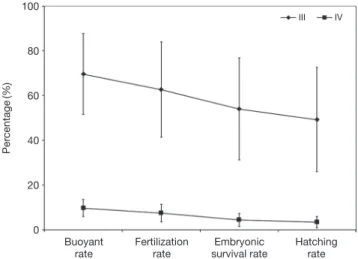
부상률은 III 단계가 약 70%로 IV 단계(약 10%)보다 매우 높 았으며, 수정률, 난발생 생존율 및 부화율 역시 III 단계가 IV 단계에 비해 우수하였다(Fig. 4).
본 연구는 능성어 종묘생산 시 기존의 cannulation을 통한 난모세포의 크기를 측정하여 호르몬 처리시기를 결정하는 대 신 어미의 복부팽만 정도를 통해 육안으로 호르몬 처리시기 결정의 적절성을 구명하기 위하여 실행하였다. 그 결과 I, II 단 계에서는 배란이 유도되지 않았다. III, IV 단계는 단계별로 난 질의 차이가 있었으며, 최종적으로 부화한 개체수를 살펴보면 III 단계에서는 약 50%가 부화한 반면 IV 단계에서는 약 3%만 이 부화해 III 단계와 약 17배 가까이 차이가 났다(Fig. 5). 따
라서 III 단계에서 난질이 우수하다고 할 수 있지만 조직학적 으로 보면 III 단계는 완숙기였고, IV 단계는 산란기에 가까운 완숙기로 III 단계보다 더 성숙한 상태였다. 따라서 III 단계와 Fig. 3. Histological observation of ovary in female E. septemfasciatus on each stage. A: stage I, B: stage II, C: stage III, D: stage IV. Refer to the Fig. 1 for the difinition of the stages. Em: egg membrane, Fl: follicle layer, N: nucleus, NO: nucleolus, OC: ovarian, Og: oogonium.
A B
C D
Fig. 4. Rate of buoyant, fertilization, embryonic survival, and hatch- ing of each stage in female E. septemfasciatus following abdomen inflation degree. The bar is indicated a standard deviation. Refer to the Fig. 1.
Percentage(%)
Stage
Buoyant rate fertilization rate embryonic survival hatching rate
III IV
100
75
50
25
0
IV 단계 사이에 보다 효과적인 시점이 있을 것으로 사료되며, 이과 관련하여 III 단계와 IV 단계 사이를 보다 세분화하거나 단계별 호르몬 주입 농도 및 호르몬 주입 후 배란유도까지 시 간 등에 관한 연구가 향후 추가적으로 필요하다고 사료된다.
결론적으로 본 연구의 결과로 볼 때 능성어의 종묘생산 시 호르몬 처리 시기와 어미 선별기준을 복부팽만도와 같은 육안 적인 판단 가능성을 확인할 수 있었고, 복부팽만도 외에도 호 르몬 처리 시기와 어미 선별기준이 될 수 있는 육안적인 지표 를 찾아낸다면, 삽관과정을 거치지 않아 어미에게 스트레스를 주지 않고 호르몬 처리시기와 어미선별을 쉽게 판단할 수 있 을 것으로 사료되며, 산업체에 이러한 기준 적용이 가능할 것 으로 사료된다.
요 약
능성어, Epinephelus septemfasciatus의 우량 수정란을 생산 할 수 있는 어미 선별기준을 설정하기 위하여 해상가두리에서 6년간 키운 시험어의 현태적 특징을 관찰하고 호르몬 처리하 여 난질을 관찰 분석하였다. 시험어는 4개의 체중 범위(3.0~
4.0, 4.0~5.0, 5.0~6.0, 6.0~7.0kg)와 뒷지느러미를 기준으로 복부팽만한 정도를 I~IV 단계로 나눈 후 산란빈도, 채란량, 부 상률, 수정률, 난발생 생존율 및 부화율을 조사하고, 수정란과 유구의 크기를 측정하였다. 또한 생식소 발달을 확인하기 위하 여 복부팽만도 단계별 생식소 중량지수(GSI)를 구하고, 조직학 적으로 관찰하였다. 그 결과 어체중이 5.0kg 이상일 때 모든 개 체에서 배란이 유도되었다. 또한 복부팽만도 I, II 단계에서는 배란이 유도되지 않고, III, IV 단계에서만 배란이 유도되었다.
난질은 III 단계가 우수하였고 그 때의 GSI는 4.68±0.40%였다.
지원으로 수행되었습니다.
REFERENCES
Abdulfatah, A., P. Fontaine, P. Kestemont, S. Milla and M. Marie.
2013. Effects of the thermal threshold and the timing of temperature reduction on the initiation and course of oocyte development in cultured female of Eurasian perch Percaflu- vi atilis. Aquaculture, 376-379: 90-96.
Baeck, G.W. and S.H. Huh. 2004. Maturation and spawning of Repomucenus valenciennei collected in Gwangyang Bay, Korea. Korean J. Ichthyol., 16: 89-93.
Harikrishnan, R., J.S. Kim, C. Balasundaram and M.S. Heo. 2012.
Immunomodulatory effects of chitin and chitosan enriched diets in Epinephelus bruneus against Vibrio alginolyticus infection. Aquaculture, 326-329: 46-52.
Hernández, M.D., M.A. Egea, F.M. Rueda, F.J. Martínez and B.
García. 2003. Seasonal condition and body composition changes in sharpsnout seabream(Diplodus puntazzo) raised in captivity. Aquaculture, 220: 569-580.
Hong, C.G., J.K. Cho, J.Y. Park, M.H. Son, J.M. Park, K.H. Han and H.W. Kang. 2015. Ovulation induction effect of sevenband grouper, Epinephelus septemfasciatus by treating hormones.
JFMSE J., 27: 981-989.
Hwang, S.I., Y.D. Lee, C.B. Song and S. Rho. 1998. Gonadal devel- opment and the effects of 17α-methyltestosterone on sex inversion of the red spotted grouper, Epinephelus akaara.
Korean J. Aquacult., 11: 173-182.
Kim, B.H., K.M. Kim, Y.D. Lee, C.B. Song and S. Rho. 1997. Re- productive biology of the sevenband grouper, Epinephelus septemfasciatus. The effect of HCG on ovulation induction.
Korean J. Aquacult., 10: 55-61.
Kim, I.S., Y. Choi and B.J. Kim. 2001. Percoidei fishes of Korea.
Korea Research Institute of Bioscience and Biotechnology Korea.
Kohno, H., S. Diani and A. Supriatna. 1993. Morphological develop- ment of larval and juvenile grouper, Epinephelus fuscogut- tatus. Jpn. J. Ichthyol., 40: 307-316.
Leclercq, E., J.F. Taylor, D. Hunter and H. Migaud. 2010. Body size dimorphism of sea-reared Atlantic salmon(Salmo salar L.):
Implications for the management of sexual maturation and harvest quality. Aquaculture, 301: 47-56.
Lee, C.K., S.B. Hur, T.S. Ko and S. Park. 1998. Maturation, sex ratio and sex-reversal of red spotted grouper, Epinephelus akaara. Korean J. Aquacult., 11: 573-580.
Lee, W.O., J.N. Baek, J.H. Lee, K.H. Kim, C.H. Kim and S.W. Yoon.
Fig. 5. Rate of hatched E. septemfasciatus larva on initial accommo- date eggs. The bar is indicated a standard deviation. Refer to the Fig. 1.
Percentage(%)
Buoyant fertilization embryonic hatching rate rate survival rate rate 60
40
20
0
2012. Sexual maturation and feeding habit of Korean man- darin fish, Siniperca scherzeri(Perciformes, Centropomidae) in the Seomjin river and Imjin river, Korea. Kor. J. Env.
Eco., 26: 57-66.
Lee, Y.D. and K.M. Go. 2003. Aquatic industrialization by develop- ment of reproductive technology of sevenband grouper, Epinephelus septemfasciatus. Jeju Univ., pp. 1-86.
Liao, I.C. and E.M. Leano. 2008. The Aquaculture of Grouper. Asian Fisheries Society, pp. 49-60.
Micale, V., F. Perdichizzi and G. Basciano. 1996. Aspects of the reproductive biology of the sharpsnout seabream Diplodus puntazzo(Cetti, 1777). I. gametogenesis and gonadal cycle in captivity during the third year of life. Aquaculture, 140:
281-291.
Miura, C., Y. Yoshihara, S.S. Yamaguchi, D. Hayashi, K. Hamada, Y.
Takeda, M. Miura and T. Miura. 2014. Controlled feeding alleviates the reduced growth associated with spawning in farmed yellowtail(Seriola quinqueradiata). Aquaculture, 424-425: 10-17.
Okumura, S., K. Okamoto, R. Oonori and A. Nakazono. 2002.
Spawning behavior and artificial fertilization in captive reared red spotted grouper, Epinephelus akaara. Aquacul- ture, 206: 165-173.
Papadaki, M., M. Papadopoulou, I. Siggelaki and C.C. Mylonas.
2008. Egg and sperm production and quality of sharpsnout sea bream(Diplodus puntazzo) in captivity. Aquaculture, 276: 187-197.
Ruttanap-ornvareesakul, Y., Y. Sakakura and A. Hagiwara. 2007.
Effect of tank proportions on survival of seven-band grouper Epinephelus septemfasciatus(Thunberg) and devil stinger Inimicus japonicus(Cuvier) larvae. Aquacult. Res., 38: 193- 200.
Sakakura, Y., S. Shiotani, H. Chuda and A. Hagiwara. 2006. Impro- vement of the survival in the seven-band grouper Epinephelus septemfasciatus larvae by optimizing aeration and water inlet in the mass-scale rearing tank. Fish. Sci., 72: 939-947.
Song, Y.B., H.J. Baek, H.B. Kim, K. Soyano, S.J. Kim and Y.D. Lee.
2008. Induction of maturation and ovulation with HCG treat- ment in the sevenband grouper Epinephelus septemfasciatus.
Korean J. Aquaculture, 2: 96-101.
Toledo, J.D., A. Nagi and D. Javellana. 1993. Successive spawning of grouper, Epinephelus suillus(Valenciennes), in a tank and a floating net cage. Aquaculture, 115: 361-367.
Wullur, S., Y. Sakakura and A. Hagiwara. 2011. Application of the minute monogonont rotifer Proales similis de Beauchamp in larval rearing of seven-band grouper Epinephelus sep- temfasciatus. Aquaculture, 315: 355-360.