서 론
명태(Gadus chalcogrammus)는 냉수성 어종으로 캄차카 반 도, 배링해와 한국과 일본 해역 및 북아메리카의 캘리포니아 중 부 해안에 분포하고 있다(Hiatt et al., 2010). 세계 명태 어획 생 산량은 1986년에 약 700만 톤으로 높은 어획량을 보였으나, 2000년대 어획량이 급격히 감소하여 2015년에는 300만 톤의 어획 생산량을 보였다(FAO FishStatJ, 2019). 특히 국내 명태 의 어획 생산량은 1980년대 약 16만톤으로 생산량을 보였으나, 1990년대부터 감소하여, 2000년대와 2010년대는 약 10톤 미만 의 어획 생산량을 보였다(KOSIS, 2019). 명태는 중국과 일본을 포함한 동아시아에서 중요한 수산 식품이며, 특히 한국에서 가 장 많이 소비되는 어종이다. 높은 수요에도 불구하고 급격한 어
획량 감소에 따라 최근 국내 연구기관에서 명태의 자원 회복을 위한 명태 양식기술 개발과 관련된 몇몇 연구가 수행된 바 있 다(Yoo et al., 2015; Kim et al., 2017; Bang et al., 2018; Park et al., 2018).
일반적으로 양식 대상어의 성공적인 종자생산을 위해서는 적 절한 환경 조성(수온, 염분, 용존산소 등)과 먹이의 질이 중요 한 요소이며, 특히 적절한 사육 수온에서 적절한 먹이 공급이 중 요하다(Wolnicki et al., 2017). 해산어류의 종자생산에 있어 수 온은 수정란의 발생 및 자어 성장에 영향을 미치는 것으로 알 려져 있으며(Yoon et al., 2007), 적정 수온이 아닌 수온에서 의 종자생산은 생존율, 성장, 성 성숙(Jobling, 1994), 배아 발달 (Eckmann and Pusch, 1989), 생식소 발달(Kamler, 1992), 부화 시기(Keinänen et al., 2003) 및 기형률(Stejskal et al., 2018)에 영향을 미치는 것으로 알려져 있으며, 수온에 대한 내성 정도는 어종마다 각각 다른 것으로 알려져 있다(Jobling, 1994; Reist et al., 2006).
최근 자연에서 어획한 명태를 이용한 수온이 친어의 생식
—78 — http://www.fishkorea.or.kr
저자 직위: 최진(해양수산연구사), 한경식(연구원), 이기욱(박사후인턴연구원), 변순규(해양수산연구관), 임현정(양식산업과장), 김희성(조교수)
* Corresponding author: Hee Sung Kim Tel: 82-55-772-9154, Fax: 82-55-772-9159, E-mail: [email protected]
명태 (Gadus chalcogrammus)의 수온별 부화 및 초기 성장
최 진·한경식1·이기욱1·변순규1·임현정1·김희성2,
*
국립수산과학원 양식관리과, 1국립수산과학원 동해수산연구소, 2경상대학교 해양식품생명의학과
Effect of Water Temperature on the Egg Hatch and Early Growth of Walleye Pollock(Gadus chalco
grammus) by Jin Choi, Gyeong Sik Han1, Ki Wook Lee1, SoonGyu Byun1, Hyun Jeong Lim1 and Hee Sung Kim2,* (Aquaculture Management Division, National Institute of Fisheries Science, Busan 46083, Republic of Korea; 1Aquaculture Industry Research Division, East Sea Fisheries Research Institute, National Institute of Fisheries Science, Gangneung 25435, Republic of Korea; 2Department of Marine Seafood and Aquaculture Science, Gyeongsang National University, Tongyeong 53064, Republic of Korea)
ABSTRACT
This study aimed to investigate the effects of different water temperature (5, 8 and 11ºC) on egg hatch and larval growth of walleye pollock Gadus chalcogrammus to improve rearing techniques for this species. Survival of eggs maintained at 5ºC was higher than that of eggs maintained at 8ºC and 11ºC. The greatest hatching rate was obtained for larvae maintained at 8ºC. However, time to first, 50% and 100% hatch of eggs maintained at 11ºC was shorter than at 5ºC and 8ºC. A higher survival was observed in larvae reared at 5ºC compared to 8ºC and 11ºC and the greatest growth was observed in larvae reared at 11ºC compared to 5ºC and 8ºC during the feeding trial. This study demonstrated the importance of water temperature, as it affects culture performance of eggs and larval pollock. The results from this study provides valuable information for further development of pollock aquaculture.
Key words: Water temperature, walleye pollock, egg hatch, survival, larval growth
(Tanaka et al., 2019), 초기 명태 자어의 생활사(Yoo et al., 2015) 및 자어의 성장(Koenker et al., 2018)에 미치는 영향에 관한 연구가 수행된 바 있다. 특히 Yoo et al.(2015)와 Koenker
et al.(2018)의 연구에서 수온 3℃ 이하에서 명태 부화 자어의
생존율이 우수하게 나타났다. 그러나 Salze et al.(2005)의 연구 에서 자연산과 양식산 대서양 대구(G. morhua)의 수정률과 부 화율은 수정란의 질에 따라 서로 다른 것으로 보고된 바 있다. 이와 같이 자연산과 양식산 명태의 종자생산에 있어서도 수온 에 따라 미치는 영향이 서로 다를 것으로 사료된다.
2016년 국내에서 명태 완전양식이 성공함에 따라 인공 1세대 명태를 이용한 안정적인 양식생산을 위한 연구가 수행되었으나 (Park et al., 2018; Choi et al., 2020a, 2020b), 수온이 인공 1세대 명태의 종자생산에 미치는 영향에 관한 연구는 이루어진 바 없 다. 따라서 본 연구에서는 수온이 인공 1세대 명태 수정란의 부 화와 자어의 성장에 미치는 영향에 대하여 조사하였다.
재료 및 방법
1. 수정란 확보 및 부화율 조사
수온별 수정란 부화율을 조사하기 위하여 2018년 12월에 국 립수산과학원 동해수산연구소에서 20ton 사각 콘크리트 수조 에서 8℃에 사육 중인 인공 1세대 명태 친어(마리당 평균 2.3 kg)의 자연 방란과 방정을 통하여 수정된 수정란을 확보하였다.
수정란은 수온별 부화율을 평가하기 위하여 300L 원형 fiber- reinforced plastic(FRP) 수조(수량: 200 L)에 히트펌프를 이용 하여 5, 8 및 11℃를 실험구로 설정하고 수온을 유지하였다. 실 험에 이용된 수온 실험구(5, 8 및 11℃)는 Yoo et al.(2015)와 Koenker et al.(2018)의 연구결과를 고려하여 국내에서 겨울철 을 제외한 다른 계절에는 3℃ 이하의 사육수로 냉각하기에는 많은 비용이 지출되는 점을 감안하여 3℃보다 높은 수온 구간 을 설정하여 실험을 진행하였다. 실험에 이용된 각 수정란은 자 외선살균기와 마이크로필터(ø 50μm)로 살균 및 여과한 자연 해수(33psu)가 담긴 실험구별 3개의 1L 비이커에 각각 600립 씩 수용한 후 수온이 유지되고 있는 원형 FRP 수조에 두고 3반 복구로 실험을 진행하였다. 수정란의 생존율 조사는 1일 1회 폐 사를 관찰하고 비이커내 사육수의 50%를 살균 및 여과한 해수 (33psu)로 환수하였으며, 총 관찰기간은 12일간이었다. 부화율 조사는 첫 부화시점부터 완전(100%) 부화시점까지 6시간 간격 으로 28일간 조사하였다.
2. 자어의 초기 성장
수온별 명태 자어의 성장을 조사하기 위하여 2019년 1월에
인공 1세대 명태가 자연 산란한 수정란을 12개의 300L FRP 원 형수조(수량: 200L)에 동일한 양(1,000립)의 수정란을 각 수조 에 수용한 후 살균 및 여과한 8℃의 해수에서 부화시켰다. 부 화 직후 자어의 설정한 수온구로의 수용은 폐사가 심하기 때문 에 부화 후 2주간 8℃에서 각 수온별(5, 8 및 11℃) 사육 수온 에 맞게끔 점차적으로 수온을 조절하여 3반복구로 실험을 진행 하였다. 사육실험 개시 전 각 수온별 실험수조의 자어의 개체 수 를 카운팅하여 동일한 사육밀도(500마리/수조)로 조절한 뒤 사 육실험을 진행하였다. 총 사육기간은 12주였으며 사육실험 개 시(부화 후 14일령)부터 8주차까지는 상업용 영양강화제인 S.
presso(INVE, Dendermonde, Belgium)로 영양강화한 rotifer 를 공급하였고, 공급 밀도는 사육이 진행됨에 따라 3개체/mL에 서 10개체/mL로 증가시키면서 모든 실험수조에 동일하게 1일 2회 공급하였다. 사육 8주차부터 12주차까지는 S. presso로 영 양강화한 rotifer와 Artemia nauplii를 각각 10개체/mL와 1.5개 체/mL의 밀도로 모든 실험수조에 1일 2회 공급하였다. 사육시 험 기간 동안의 평균 염분은 33.3±0.80psu, 용존산소는 6.94±
0.38mg/L였으며, 광주기는 형광등을 이용하여 12L(light): 12 D(dark) 조건으로 유지하였다. 자어의 사육기간 동안의 성장 정 도를 평가하기 위하여 4주 간격(4, 8 및 12주)으로 각 실험수조 당 20마리를 무작위로 샘플하여 전장(mm)과 체중(mg)을 각각 측정하였다.
3. 통계 분석
SPSS program version 25.0(SPSS Michigan Avenue, Chicago, IL, USA)를 이용하여 One-way ANOVA와 Duncan’s multiple range test(Duncan, 1955)로서 각 실험구간의 유의성을 검증하 였으며, 자어의 사육기간 간 생존율 및 성장 결과는 반복측정 분산분석(Repeated Measures ANOVA)을 실시하여 사육기간과 수온 사이의 교호작용을 검토하였다.
결 과
1. 수온별 수정란 부화 및 초기 자어의 생존율
자연산란을 통해 수정된 명태 수정란의 수온별 부화 결과는 Table 1과 같으며, 수온별 수정란의 생존율 결과는 Fig. 1에 나 타냈다. 수온별 명태 수정란의 부화율은 8℃에서 73.5%로 5℃
(69.8%)와 11℃(61.7%)에서 보다 유의적으로 높게 나타났다 (P<0.05). 그러나 수정란의 첫 부화, 50% 부화 및 100% 부화 까지 소요 시간은 11℃ 실험구에서 각각 186.0시간, 248.0시 간 및 312.0시간으로 유의적으로 가장 짧았으며(P<0.05), 다 음으로 8℃ 및 5℃ 실험구 순으로 짧게 나타났다(Table 1). 수
정란의 1일째, 생존율은 모든 수온 실험구간에 유의한 차이가 나타나지 않았으나(P>0.05), 2일째부터 6일째까지는 5℃ 실 험구가 8℃와 11℃보다 유의적으로 높은 생존율이 나타났다 (P<0.05). 이후에도 비교적 낮은 수온인 5℃ 실험구가 가장 우 수한 생존율을 보였으며(P<0.05), 다음으로 8℃와 11℃ 순으 로 높은 생존율을 보였다.
2. 자어의 생존율과 성장
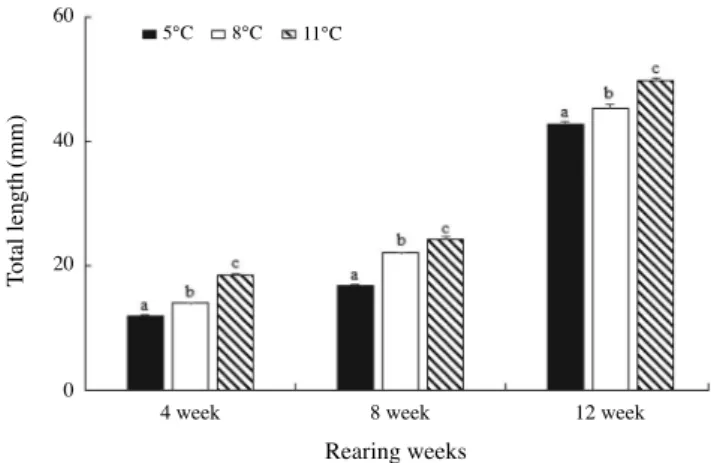
명태 부화 자어(부화 14일령, 평균 전장: 6.1mm)의 수온별 사육에 따른 생존율과 성장 결과는 Fig. 2, Fig. 3 및 Fig. 4에 나 타냈다. 자어의 생존율, 전장 및 체중은 사육기간이 진행됨에 따 라 유의하게(P<0.05) 변하는 것으로 나타났고, 수온과 사육 기간 사이(water temperature ×week)에 교호작용이 유의하게 (P<0.05) 나타났다. 사육 4주, 8주 및 12주째 수온별 자어의 생 존율은 전체 사육기간 동안 5℃ 실험구가 8℃와 11℃ 실험구 보다 유의적으로 높은 생존율을 보였다(P<0.05). 그러나 수 온별 자어의 사육실험 종료 시 전장은 11℃ 실험구가 5℃와 8℃ 실험구보다 유의적으로 길게 나타났으며(P<0.05), 전중은 11℃ 실험구가 5℃와 8℃ 실험구에 비해 유의적으로 무겁게 나타났다(P<0.05).
고 찰
일반적으로 어류 종자생산에 있어 수온은 생산성에 중요한 요소 중 하나인 것으로 알려져 있으며(Kamler, 2002), 수정란의 부화와 자어의 성장은 수온이 낮을수록 감소되고 수온이 높을 수록 증가하는 경향을 보이며, 대상어에 따른 생활사와 생태적 인 특징에 따라서 수정란의 발생과 자어 성장을 위한 적정 수온 을 가진다(Rana, 1990).
해산어류는 난 발생에 있어 적정 수온 범위를 벗어나면 부화 율이 감소하며, 자연산란 시기의 수온이 부화에 적합한 수온인 것으로 알려져 있다(Herzig and Winkler, 1986). 자연에서 명 태 수정란은 5℃ 범위에서 약 14일 내에 부화를 시작하는 것으 로 알려져 있다(Blood et al., 1994). 본 연구에서는 명태 수정란 의 생존율은 수온이 낮은 5℃에서 가장 우수한 생존율을 보였 으나, 부화율은 8℃에서 가장 높게 나타났다. 이는 명태 인공 수 정란의 부화율 향상을 위해서는 자연에서의 부화 수온보다 약 3℃ 높은 8℃가 적합한 것으로 판단된다. 이와 달리 태평양 대 구(G. macrocephalus) 수정란은 4℃에서 10일째까지는 배체 를 형성하였으나 이후 발생이 중단되거나 폐사하였고, 부화율은 Table 1. Hatch results from artificial reproduction of walleye pollock at different water temperature
Water temperature(℃) Hatch rate(%) Time to first hatch(h) Time to 50% hatch(h) Time to 100% hatch(h)
5 69.8±1.04b 382.0±5.29c 576.0±13.86c 660.0±6.93c
8 73.5±1.03c 326.0±5.29b 384.0±6.93b 540.0±6.93b
11 61.7±1.36a 186.0±3.46a 248.0±8.72a 312.0±13.86a
Values(means of triplicate±SE) in the same column sharing a common superscript are not significantly different(P>0.05).
Fig. 2. Survival(%) in walleye pollock, Gadus chalcogrammus, mea- sured at 2-week intervals during the 12 weeks feeding trial(means of triplicate±SE). [ANOVA with repeated design: week(P<0.05) and their interaction(water temperature×week)(P<0.05)]. Different letters in each week point indicate significant differences between tem- peratures within each week point.
Survival(%)
100 75 50
25
0
Rearing weeks
4 week 8 week 12 week
5℃ 8℃ 11℃
Fig.1. Survival of fertilized egg of walleye pollock reared at different temperature. Different letters in the same days of rearing indicated sig- nificant differences(P<0.05) by Duncan’s multiple range test.
Survival(%)
Rearing days 100
75
50
25
00 2 4 6 8 10 12
5℃ 8℃ 11℃
10℃에 비하여 약 2배 이상 높은 것으로 나타났다(Lee et al., 2007). 그러나 본 연구에서 명태 수정란의 생산에 있어 부화율 결과만을 바탕으로 적정 수온을 구명하기에는 다소 부족한 부 분이 있는 것으로 사료되며, 추후 기형율 등을 포함한 발생·생 리학적 분석을 바탕으로 한 적정 수온 구명 연구가 수행될 필요 가 있다.
일반적으로 plaice(Pleuronectes platessa), haddock(Melano- grammus aeglefisnus), 대서양 대구(G. morhua), 태평양 대구 및 lesser sandeel(Ammodytes marinus)과 같은 냉수성 어종의 경우 배아기(embryonic period)가 길어 부화까지의 시간이 긴 것으로 알려져 있다(Fox et al., 2003; Martell et al., 2005; Geffen et al.,
2006; Régnier et al., 2018). 본 연구에서 11℃에서 수정란의 첫 부화까지의 시간은 약 8일로 실험구 중 가장 빨랐고, 50% 부화 까지는 10일이었으며, 완전 부화까지는 약 13일인 것으로 나타 났다. 본 연구결과와 유사하게 lesser sandeel은 실험구(6, 7, 8, 9, 10℃ 및 11℃) 중 11℃에서 첫 부화까지의 시간은 19일, 50%
부화까지는 22일 및 완전 부화까지 걸리는 시간은 28일로 실험 구 중 가장 빠른 부화 시간을 보였다(Régnier et al., 2018). 그러 나 plaice(Fox et al., 2003), haddock(Martell et al., 2005) 및 대 서양 대구(Geffen et al., 2006)의 50% 부화까지 걸리는 시간은 본 연구에 비해 두 배 이상 느리게 나타났다. 이처럼 종에 따라 주어진 수온에 따른 난 발생과 부화 시간의 변이는 큰 것으로 사 료된다. 또한 본 연구에서 수온이 높아질수록 완전 부화까지의 소요시간이 짧아지는 것으로 보아 수온이 증가할수록 난 발생 속도가 짧아지는 정상관계를 가지므로, 생체 반응의 온도 의존성 에 관한 지표인 Q10의 법칙에 부합하였다(Lee et al., 1997).
해산어류 종자생산에 있어 자어의 생존과 성장은 수온, 성장 단계 및 영양적 측면과 밀접한 관계가 있다(Hurst, 2007). 본 연 구에서도 명태 자어 사육에 있어 생존율과 성장은 수온과 매우 밀접한 관계를 보였다. 본 연구 조건에서 명태 자어는 전체 사 육기간 동안 5℃에서 가장 안정적인 생존율을 보였으며, 8℃
와 11℃ 순으로 낮은 생존율을 보였다. Yoo et al.(2015) 연구 에서도 실험구(3, 5, 7.5 및 10℃) 중 10℃에서 가장 높은 폐 사율을 보였고, 수온이 낮아질수록 우수한 생존율 보였다. 그 러나 본 연구에서 부화 14일령 명태 자어의 11℃에서의 사육 은 생존에 있어 부정적인 영향을 미치는 것으로 나타났지만, 성 장(전장 및 체중)은 다른 수온 실험구에 비하여 우수하게 나타 났다. Koenker et al.(2018)의 연구에서도 마리 당 평균 전장 8.6mm의 명태 자어를 0, 2, 5, 9 및 12℃에서 26일간 사육 시 12℃ 실험구에서 가장 낮은 생존율을 보였으나, 성장은 가장 높 게 나타났다. 이와 같이 수온이 증가함에 따라 생존율은 감소되 나 성장은 증가하는 경향은 다른 어류에서도 보고된 바 있으나 (Luczynski, 1991; Matoušek et al., 2017), 이에 대한 정확한 원 인을 파악하기 위한 사육환경, 먹이의 질, 먹이공급전략 등을 고 려한 추가적인 연구가 수행되어야 한다.
이상의 결과를 고려하면 8℃ 이하에서 냉수성 어종인 명태의 안정적인 종자생산이 가능할 것으로 판단된다. 또한 본 연구는 동해 특산품종인 명태의 종자를 생산하는 데 있어 기초자료로 활용될 것으로 기대되며, 앞으로 명태 종자의 안정적인 생산성 향상을 위한 최적의 사육환경(염분, 사육밀도, 먹이생물, 광주기 등)에 대한 다양한 연구 수행이 필요하다고 판단된다.
요 약
수온은 양식 대상어의 종자생산에 영향을 미치는 중요한 환 Fig. 3. Total length(mm) in walleye pollock, Gadus chalcogrammus,
measured at 2-week intervals during the 12 weeks feeding trial(means of triplicate±SE). [ANOVA with repeated design: week(P<0.05) and their interaction(water temperature ×week)(P<0.05)]. Different letters in each week point indicate significant differences between tem- peratures within each week point.
Total length(mm)
60
40
20
0
Rearing weeks
4 week 8 week 12 week
5℃ 8℃ 11℃
Fig. 4. Weight(mg) in walleye pollock, Gadus chalcogrammus, mea- sured at 2-week intervals during the 12 weeks feeding trial(means of triplicate±SE). [ANOVA with repeated design: week(P<0.05) and their interaction(water temperature×week)(P<0.05)]. Different let- ters in each week point indicate significant differences between tem- peratures within each week point.
Weight(mg)
800 600 400 200
0
Rearing weeks
4 week 8 week 12 week
5℃ 8℃ 11℃
경 요인이다. 본 연구는 최근 급격한 자원 감소를 보이고 있는 한해성 어종인 명태의 안정적인 종자생산을 위한 기초자료로 활용하기 위해 수온이 명태의 부화 및 초기 자어 성장에 미치는 영향을 조사하였다. 수정란의 생존율은 5℃가 8℃와 11℃에 비 하여 높게 나타났으며, 부화율은 8℃에서 가장 우수하게 나타났 다. 그러나 첫 부화, 50% 부화 및 완전 부화까지의 소요 시간은 11℃가 5℃와 8℃에 비하여 빠르게 나타났다. 12주간의 사육기 간 동안 자어의 생존율은 5℃가 8℃와 11℃에 비하여 높게 나 타났으나, 성장은 11℃가 5℃와 8℃에 비하여 높게 나타났다.
사 사
이 논문은 2020년도 국립수산과학원 수산과학연구사업 주요 양식품종 모니터링(R2020004)의 지원으로 수행된 연구입니다.
REFERENCES
Bang, M., S. Kang, S. Kim and C.J. Jang. 2018. Change in the biolog- ical characteristics of walleye pollock related to demographic changes in the East sea during the late 20th century. Mar.
Coast. Fish., 10: 91-99. https://doi.org/10.1002/mcf2.10004.
Blood, D.M., A.C. Matarese and M.M. Yoklavich. 1994. Embryonic development of walleye pollock, Theragra chalcogramma, from Shelikof Strait, Gulf of Alaska. Fish. Bull., 92: 207-222.
Choi, J., S. Byun, H.J. Lim and H.S. Kim. 2020a. Determination of optimum dietary protein level for juvenile walleye pol- lock, Gadus chalcogrammus Pallas 1811. Aquac. Rep., 17:
100291. https://doi.org/10.1016/j.aqrep.2020.100291.
Choi, J., K.W. Lee, G.S. Han, S. Byun, H.J. Lim and H.S. Kim.
2020b. Dietary inclusion effect of krill meal and various fish meal sources on growth performance, feed utilization, and plasma chemistry of grower walleye pollock(Gadus chalco- grammus, Pallas 1811). Aquac. Rep., 17: 100331. https://doi.
org/10.1016/j.aqrep.2020.100331.
Duncan, D.B. 1955. Multiple range and multiple F tests. Biometrics, 11: 1-42. https://doi.org/10.2307/3001478.
Eckmann, R. and M. Pusch. 1989. The influence of temperature on growth of young coregonids(Coregonus lavaretus L.) in a large pre-alpine lake. Rapp. P.-v. R éun. Cons. Int. Explor.
Mer., 191: 201-208.
Food and Agriculture Organization of the United Nations(FAO) FishStatJ, 2019. FAOFishStatJ database: 2019 dataset. http://
www.fao.org/fishery/statistics/software/fishstatj/en.Accessed July 2019.
Fox, C.J., A.J. Geffen, R. Blyth and R.D.M. Nash. 2003. Tempera- ture-dependent development rates of plaice(Pleuronectes platessa L.) eggs from the Irish Sea. J. Plankton. Res., 25:
1319-1329. https://doi.org/10.1093/plankt/fbg099.
Geffen, A.J., C.J. Fox and R.D.M. Nash. 2006. Temperature-de- pendent development rates of cod Gadus morhua eggs. J.
Fish. Biol., 69; 1060-1080. https://doi.org/10.1111/j.1095- 8649.2006.01181.x.
Herzig, A. and H. Winkler. 1986. The influence of temperature on the embryonic development of three cyprinid fishes, Aramis brama, Chalcalburnus chalcoides mento and Vimba vimba.
J. Fish. Biol., 28: 171-181. https://doi.org/10.1111/j.1095- 8649.1986.tb05155.x.
Hiatt, T., M. Dalton, R. Felthoven, B. Fissel, B. Garber-Yonts, A.
Haynie, S. Kasperski, D. Lew, C. Package, J. Sepez and C.
Seung. 2010. Economic status of the ground fish Fisheries off Alaska, 2009. In: Stock assessment and fishery evalua- tion report for the ground fish fisheries of the Gulf of Alaska and Bering Sea/Aleutian Islands Area, 254p[Available from North Pacific Fishery Management Council, 605W. 4th Ave., Anchorage, AK 99510].
Hurst, T.P. 2007. Causes and consequences of winter mortality in fishes. J. Fish. Biol., 71: 315-345. https://doi.org/10.1111/
j.1095-8649.2007.01596.x.
Jobling, M. 1994. Biotic factors and growth performance. In: M. Job- ling(eds.), Fish Bioenergetics, Chapman & Hall, London, pp.
155-201.
Kamler, E. 1992. Gonad formation. In: Kamler, E.(ed.), Early life history of fish. An energetics approach. Chapman & Hall, London, pp. 3-30.
Kamler, E. 2002. Ontogeny of yolk-feeding fish: an ecological per- spective. Reviews Fish Biol. Fish., 12: 79-103. https://doi.
org/10.1023/A:1022603204337.
Keinänen, M., C. Tigerstedt, P. Kålax and P.J. Vuorinen. 2003. Fertil- ization and embryonic development of whitefish(Coregonus lavaretus lavaretus) in acidic ow-ionic-strength water with aluminium. Ecotoxicol. Environ. Saf., 55: 314-329. https://
doi.org/10.1016/S0147-6513(02)00128-8.
Kim, K.I., S. Byun, H.W. Kang, M. Nam, J. Choi, H. Yoo and C. Lee.
2017. Disease monitoring of Alaska pollock(Gadus chalco- grammus) based on growth stage. Korean J. Ichthyol., 29:
62-68.
Koenker, B.L., B.J. Laurel, L.A. Copeman and L. Ciannelli. 2018.
Effects of temperature and food availability on the survival and growth of larval Arctic cod(Boreogadus saida) and wall- eye pollock(Gadus chalcogrammus). ICES J. Mar. Sci., 75:
2386-2402. https://doi.org/10.1093/icesjms/fsy062.
Korean Statistical Information Service(KOSIS). 2019. Retrieved for http://kosis.kr/statisticsList/statisticsListIndex.do?menuId=
M_01_01&vwcd=MT_ZTITLE&parmTabId=M_01_01&
statId=1970004&themaId=F#SelectStatsBoxDiv on Mar 30, 2020.
Lee, J.Y., W.K. Kim and Y.J. Chang. 1997. Influence of water tem- perature and salinity on egg development of flatfish, Limanda herzensteini. J. Aquacult., 10: 357-362.
Lee, J.Y., C.S. Lee, W.K. Kim, S.U. Park and B.H. Min. 2007. Effects of water temperature on egg development, hatching and lar-
val growth rearing of the Pacific cod Gadus macrocephalus. J.
Aquaculture, 20: 260-264.
Luczynski, M. 1991. Temperature requirements for growth and surviv- al of larval vendace, Coregonus albula(L.). J. Fish. Biol., 38:
29-35. https://doi.org/10.1111/j.1095-8649.1991.tb03088.x.
Martell, D.J., J.D. Kieffer and E.A. Trippel. 2005. Effects of tempera- ture during early life history on embryonic and larval devel- opment and growth in haddock. J. Fish Biol., 66: 1558-1575.
https://doi.org/10.1111/j.0022-1112.2005.00699.x.
Matoušek, J., V. Stejskal, M. Prokešová and J. Kouřil. 2017. The ef- fect of water temperature on growth parameters of intensive- ly reared juvenile peled Coregonus peled. Aquac. Res., 48:
1877-1884. https://doi.org/10.1111/are.13025.
Park, J.C., W.S. Hong, J.Y. Seo, W.S. Nam and O.N. Kwon. 2018.
Enriched rotifer feeding efficiency in the walleye pollock Theragra chalcogramma depends on larval fatty acid com- position. Korean J. Fish. Aquat. Sci., 51: 549-555. https://doi.
org/10.5657/KFAS.2018.0549.
Rana, K.J. 1990. Influence of incubation temperature on Oreochromis niloticus(L.) egg and fry: I. Gross embryology, temperature tolerance and rates of embryonic development. Aquaculture, 87: 165-181. https://doi.org/10.1016/0044-8486(90)90273-P.
Régnier, T., F.M. Gibb and P.J. Wright. 2018. Temperature effects on egg development and larval condition in the lesser sandeel, Ammodytes marinus. J. Sea Res., 134: 34-41. https://doi.
org/10.1016/j.seares.2018.01.003.
Reist, J.D., F.J. Wrona, T.D. Prowse, M. Power, J.B. Dempson, R.J.
Beamish, J.R. King, T.J. Carmichael and C.D. Sawatzky.
2006. General effects of climate change on Arctic fish-
es and fish populations. Ambio, 35: 370-380. https://doi.
org/10.1579/0044-7447(2006)35[370:GEOCCO]2.0.CO;2.
Salze, G., D.R. Tocher, W.J. Roy and D.A. Robertson. 2005. Egg quality determinants in cod(Gadus morhua L.): egg perfor- mance and lipids in eggs from farmed and wild broodstock.
Aquac. Res., 36: 1488-1499. https://doi.org/10.1111/j.1365- 2109.2005.01367.x.
Stejskal, V., J. Matoušek, R. Šebesta, M. Prokešová, T. Vanina and P. Podhorec. 2018. Prevalence of deformities in intensively reared peled Coregonus peled and comparative morphometry with pond-reared fish. J. Fish Dis., 41: 375-381. https://doi.
org/10.1111/jfd.12695.
Tanaka, H., T. Nakagawa, T. Yokota, M. Chimura, Y. Yamashita and T. Funamoto. 2019. Effects of spawning temperature on the reproductive characteristics of walleye pollock Gadus chal- cogrammus. Fish. Sci., 85: 901-911.
Wolnicki, J., R. Kamiński and J. Sikorska. 2017. Combined effects of water temperature and food availability period on the growth and survival of tench(Tinca tinca) larvae. Aquac. Res., 48:
3809-3816. https://doi.org/10.1111/are.13207.
Yoo, H.K., S.G. Byun, J. Yamamoto and Y. Sakurai. 2015. The effect of warmer water temperature of walleye pollock(Gadus chalcogrammus) larvae. J. Korean Soc. Mar. Environ. Saf., 4:
339-346. https://doi.org/10.7837/kosomes.2015.21.4.339.
Yoon, S.J., D.H. Kim, H.G. Hwang, G.C. Song and Y.C. Kim. 2007.
Effects of water temperature, stocking density and feeding frequency on survival and growth in the oblong rockfish Se- bastes oblongus larvae. Korean J. Ichthyol., 19: 1-7.