서 언
유전자재조합은 이종의 유전자를 이용하여 본래의 형 질을 변형 특정한 기능을 갖도록 하는 기술로 작물 육, , 종에 널리 이용되고 있다 이와 같은 생명공학기술은 식. 량생산 비료절감 그리고 병해충 방제에 획기적인 기술, 로 기대되고 있지만 다른 한 편으로 유전자 재조합 작, , 물의 환경에 대한 잠재적 위해성에 대한 우려가 제기되 고 있다.
따라서 안전성 평가 일환으로 유전자변형작물에 의한 토양 생물 특히 미생물의 형질전환 가능성 평가가 요구, 되고 있는데 이는 유전자 변형 작물에 삽입된 유전자전, 이 때문이라 할 수 있다 유전자 변형 식물로부터 토양.
미생물로 유전자의 이동이 일어나는 기작 중에는 토양 미생물이 토양으로 유리된 DNA를 받아들여 자신의 유 전자에 포함시키는 자연적 전이가 가장 대표적 이다 (Stewart, 1986).
토양 속에 있는 대부분의 DNA는 분해되지만 일부분 은 토양에서 여러 달 동안 잔존하게 되는데 유전자변형, 작물의 DNA도 이러한 과정을 통해 토양으로 유출되고 존속하게 된다 따라서 토양에 노출된 유리. DNA의 지 속성 여부가 유전자 변형작물의 안정성 판단에 중요한 지표가 된다 즉 유출된 형질전환 작물의. DNA가 뉴클 레아제에 의해 신속히 분해되면 토양미생물로의 유입이 극히 희박해 지지만 반대로, DNA가 토양에 오랜 기간 남아 있다면 형질전환 가능성은 높아진다. Widmer et
및 에 따르면 토양으로 유
al. (1997) Hay et al. (2002)
리된 DNA는 4개월, Gebhard and Kornelia (1999)는 년 동안 유지되어 검출될 수 있다고 하였다 또한
2 .
혹명나방 저항성벼 재배 논토양의 미생물상
권장식*·노형준1·서장선 신공식 권순종· ·
국립농업과학원, 1국립원예특작과학원
Microbial Communities in Rice Paddy Soils Following Cultivation of Genetically Modified Leaf Folder-resistant Rice Plants
Jang-Sik Kwon*, Hyung-Jun Noh1, Jang-Sun Suh, Kong-Sik Shin, and Soon-Jong Kweon National Academy of Agricultural Science, RDA, Suwon 441-707, Korea
1National Institute of Horticultural and Herbal Science, RDA, Suwon 441-707, Korea
The study was performed to investigate the property of rhizosphere microorganisms, and community structure during GMO, and Non-GMO rice cultivation. In the dilution plate technique, there were no significant differences in microbial populations of rhizosplane with genetically modified, and non-genetically modified rice cultivation, and rhizosphere were also the same results.
Dominant bacterial genera were Afipia 12.5%, Spingomonas 10.0%, Ramlibacter 10.0%, Mycobacterium 7.5%, and Tetrasphaera 7.5% in rhizosphere soil of genetically modified rice plant, while Afipia 7.3%, Spingomonas 12.2%, Ramlibacter 7.3%, Mycobacterium 17.1%, Tetrasphaera 14.6% in non-genetically modified cultivated at Suwon test fields in 2006. Major genera isolated from root surface cultivated in Yesan fields were Arthrobacter 12.7% in rhizoplane of genetically modified plant, and Burkholderia 22.2% of non-genetically modified plant in 2007, Paucimonas 26.6%of genetically modified plant, Chryseobacterium 15.4 % of non-genetically modified plant in 2008. Also the microbial communities in rhizosphere soils of genetically modified, and non-genetically modified plants were characterized using phospholipid fatty acid, and denaturing gradient gel electrophoresis. The phospholipid fatty acid profiles of soils in this condition showed different pattern, but did not show significant differences between soils cultivated with genetically or non-genetically modified rice plants.
Key words: Soil, Microorganism, GM plant, Leaf folder-resistant
접수: 2009. 7. 29 수리: 2010. 3. 31 연락저자
* : Phone: +821062370857
E-mail: [email protected]
은 미생물이 환경으 Lorenz and Wackernagel (1994)
로부터 몇몇 종에서 유래된 외래 DNA를 흡수하는 능력 이 있다고 한 바와 같이 유전자가 변형작물로부터 토양, 미생물로의 횡적유전자이동 (horizontal gene transfer) 이 잠재적인 부작용으로 자주 거론되어 오고 있다.
생명공학의 안전성에 관한 문제는 국제적인 협약으로 맺어져 있으며 우리나라는, 2008년 월 일 부로 관련1 1 법률이 제정되어있다 따라서 유전자변형작물을 경작지. 에 재배할 경우 이러한 잠재적 위해성에 대한 문제 제 기로 재배지역 내 농업생태계의 변동 가능성 등 환경에 미칠 수 있는 영향에 관한 정보와 위해성 평가가 요구 되고 있다.
본 시험에서는 GM 벼 재배가 토양에 서식하는 미생 물에 대한 영향을 보고자 미생물 균수 세균 분리 및 동, 정, 미생물유래 인지질지방산 (phospholipid fatty acids,
및 토양 의
PLFA) DNA DGGE (Denaturing Gradient 를 이용한 군집구조를 분석하였다
Gel Electrophoresis) .
재료 및 방법
근권미생물상 조사 근권 미생물상은 경기도 수원 시에 있는 농업과학기술원 시험포의 격리포장 (2006년 수행 및 충청남도 예산군에 있는 농업기술원 시험포의) 격리포장 (2007 2008~ 년 수행 에서 재배된 유전자변형)
벼 혹명나방저항성 벼 및 유전자비변형 벼 낙동 를 재( ) ( ) 배한 토양을 대상으로 하였다 실험에 사용한 혹명나방. 저항성 벼의 계통명은 Event C7-1-9-1 (06년도),
년 년 였다 토
C7-1 -9-1-1 (07 ), C7-1-9-1-1-1 (08 ) . 양시료는 벼의 생육기중 최고분얼기에 포기 전체를 대상 으로 채취하였으며 채취한 시료는 폴리에틸렌필름 봉지, 에 넣어 운반 후 근권토양과 뿌리를 분리하여 미생물상 조사에 사용하였다.
토양미생물 분석은 토양미생물실험법 농업기술연구소( , 에 준하여 희석평판 도 1988; 土壤微生物硏究會編, 1992)
말법으로 조사하였다 세균은. TSBA배지(trypticase soy
사상균은 한
broth 30 g, agar 15 g), Rose-bengal 천배지 (KH2PO4 1.0 g, MgSO4. 7Hㆍ 2O 0.5 g, peptone 5 g, glucose 10 g, rose-bengal 0.033 g, agar 20
증류수 를 이용하여 출현한 콜로니
g, 1000 ㎖, pH 6.0)
를 계수하였다 각 시료당 미생물 수는 개의 배양접시. 3 에 나타난 콜로니를 계수한 후 평균값을 균수로 하였다.
우점세균의 동정 격리포장 수원( , 2006) 벼의 근 권에서 분리한 세균은 16S rDNA 염기서열 분석을 이용 하여 동정하였다. DNA extraction kit (Toyobo, Japan) 를 이용하여 분리균주의 DNA를 추출한 후 universal
인
primer fD1 (5'-AGAGTTTGATCCTGGCTCAG-3') 과 rP2 (5'-ACGGCTACCTTGTTACGACTT-3')를 이용 하여 16S rDNA gene을 PCR로 증폭하였다 이렇게 얻.
Table 1. Bacteria, and Fungi density in the rhizosphere soils of rice plants at maximum tillering stage.
Location (Year) Rice plant Colony forming unit (CFU g-1)
Bacteria (×106) Fungi (×103)
Suwon (2006) Leaf folder-resistant 6.0±3.6 67.0±39.0
Non-genetically modified 10.3±1.5 66.0±44.4
Yesan (2008) Leaf folder-resistant 16.3±7.3 2.9±1.2
Non-genetically modified 17.9±5.3 2.6±1.9
Table 2. Bacteria, and Fungi density in the rhizoplane of rice plants cultivated at maximum tillering stage.
Location (Year) Rice plant Colony forming unit (CFU g-1)
Bacteria Fungi
Suwon (2006) Leaf folder-resistant 102.0±32.4×10⁶ 66.7±34.0×10³
Non-genetically modified 81.7± 4.9×10⁶ 58.7±21.4×10³
Yesan (2007)
Leaf folder-resistant 39.3±5.7×10⁷ 24.7±15.0×10³
Non-genetically modified 40.7±4.0×10⁷ 26.0x15.9×103
Yesan (2008) Leaf folder-resistant 79.0±21.9×10⁷ 10.2±2.6×10³
Non-genetically modified 86.7±29.7×10⁷ 8.0±1.0×10³
어진 PCR 산물은 510R sequencing primer (5'- 와
TATTACCGCGGCTGCTGGCA-3') DNA sequencing kit (Big Dye terminator Cycle Sequencing Ready 를 사용하여 반 Reactions v3.1; Applied Biosystems)
응시킨 후, 3100 Genetic analyser (Applied Bio-
로 약 염기 서열을 분석하였다 염기
systems) 400 500~ .
서열은 EzTaxon. org Server (http://210.218.222. 43) 의BATCH 프로그램을 통해 속(genus)까지 동정하였다.
예산 격리포장 (2007 2008)∼ 에서 분리한 세균은 순 수 분리하여 TSBA배지에 재 배양한 균체를 회수하여 지방산을 추출 한 후 Gas chromatography를 이용하는 MIDI 시스템으로 동정하였다 (Microbial ID, Inc.,
Newark, DE, USA).
PLFA를 이용한 미생물 군집분석 근권토양에 서 식하는 배양성 및 비배양성 미생물의 군집분석을 위해 토양 PLFA의 조성을 분석하였다. PLFA 추출은 Bligh 가 사용한 방법에 준하여 미생물의 세포 and Dyer (1959)
벽을 구성하는 지방산을 추출한 다음 silicic acid column 로 를 분획하였다 분획된 시료는 chromatography PLFA .
Hewlett-Packard 6890A gas chromatography (Palo 로 정량하였으며 군집분석은
Alto. Calif.) , SAS (SAS 통계 패키지를 이용하였다 Institute, Cary, N.C.) .
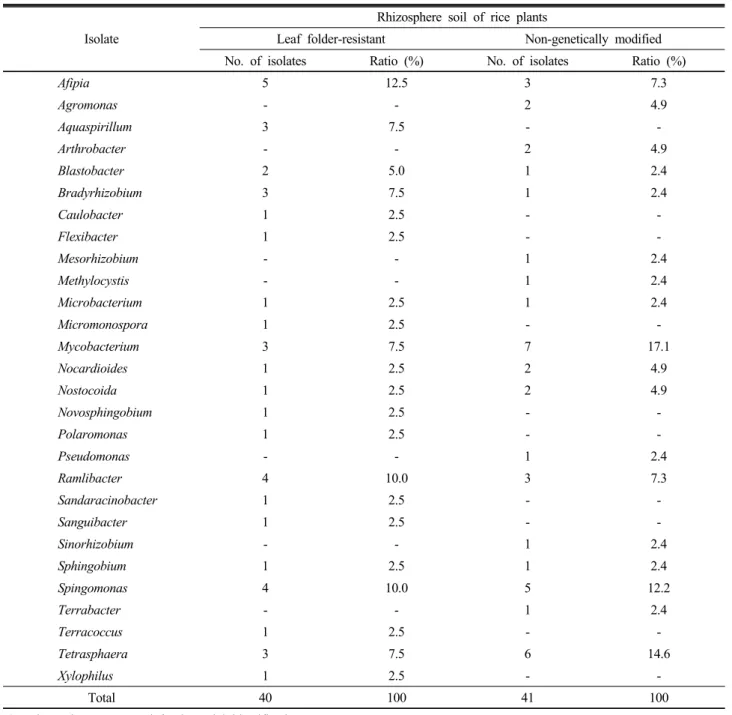
Table 3. Bacteria isolated from rhizosphere soils of rice plants in field test (Suwon, 2006).
Isolate
Rhizosphere soil of rice plants
Leaf folder-resistant Non-genetically modified
No. of isolates Ratio (%) No. of isolates Ratio (%)
Afipia 5 12.5 3 7.3
Agromonas - - 2 4.9
Aquaspirillum 3 7.5 - -
Arthrobacter - - 2 4.9
Blastobacter 2 5.0 1 2.4
Bradyrhizobium 3 7.5 1 2.4
Caulobacter 1 2.5 - -
Flexibacter 1 2.5 - -
Mesorhizobium - - 1 2.4
Methylocystis - - 1 2.4
Microbacterium 1 2.5 1 2.4
Micromonospora 1 2.5 - -
Mycobacterium 3 7.5 7 17.1
Nocardioides 1 2.5 2 4.9
Nostocoida 1 2.5 2 4.9
Novosphingobium 1 2.5 - -
Polaromonas 1 2.5 - -
Pseudomonas - - 1 2.4
Ramlibacter 4 10.0 3 7.3
Sandaracinobacter 1 2.5 - -
Sanguibacter 1 2.5 - -
Sinorhizobium - - 1 2.4
Sphingobium 1 2.5 1 2.4
Spingomonas 4 10.0 5 12.2
Terrabacter - - 1 2.4
Terracoccus 1 2.5 - -
Tetrasphaera 3 7.5 6 14.6
Xylophilus 1 2.5 - -
Total 40 100 41 100
Genetic analyzer was used for bacterial identification.
DGGE를 이용한 미생물 군집분석 토양 DNA 추출 은 Qbio-gene사의 Fast DNA SPIN kit을 이용하였으 며 추출, DNA는 -20℃에 보관하여 사용하였다 토양. 으로부터 분리한 DNA시료를 template로 하고 primer
은 와
set 1070F (5'-ATGGCTGTCGTCAGCT-3') 1392GCR (5'-CGCCCGCCGCGCCCCGCGCCCGGCCCGCCGCCC
를 이용하여 CCGCCCCACGGGCGGTGTGTAC-3') PCR 을 수행하였다. PCR은 95℃에서 5분 동안 predena-
한 후 에서 을 분
turation , 95℃ denaturation 1 , 52℃ 에서 annealing을 분1 , 72℃에서 extention을 분하는1 과정을 30회 반복하였다 최종. PCR 산물은 1% agarose 에서 로 염색하여 를 확인 한 후 사용하
gel EtBr band
였다.
산물을
PCR DcodeTM system (Bio-Rad, USA)을 이 용하여 DGGE 분석을 실시하였다. 40 70%~ 의 농도구
배를 갖는 8% (w/v) polyacrylamide gel (37.5:1)에 시료를 loading하여, 60 , 60 V℃ 조건에서 16시간 전 기영동 하였다. 전기영동한 gel을 EtBr 또는 SYBR
으로 염색한 후 상에서 를 확인하였다
green , UV band .
결과 및 고찰
벼 재배토양의 미생물상 토양미생물은 토양에 우 점하는 생물임과 동시에 유기물분해 양분무기화 식물, , , 병 제어 등의 각종 기작에 관여하는 생태학적으로 매우 중요한 생물군이다 식물 뿌리 영역인 근권 또한 토양에. 서식하는 대부분의 미생물이 존재하고 있는데 근권에서, 의 식물 미생물간의 상호작용은 식물의 건전한 생장을- 조절하는 중요한 요인들이며 뿌리 분비물은 근권 미생, 물 생태에 큰 영향을 미친다고 알려져 있다 (Lynch,
Table 4. Bacteria isolated from rhizosplane of rice plants in field test (Suwon, 2006).
Isolate
Rhizoplane of rice plants
Leaf folder-resistant Non-genetically modified
No. of isolates Ratio (%) No. of isolates Ratio (%)
Afipia 33 71.7 14 35.0
Terrabacter - - 4 10.0
Duganella 2 4.3 2 5.0
Tetrasphaera 2 4.3 1 2.5
Sphingomonas 2 4.3 1 2.5
Bradyrhizobium 1 2.2 1 2.5
Nocardioides - - 2 5.0
Mycobacterium 1 2.2 1 2.5
Caulobacter 1 2.2 1 2.5
Staphylococcus - - 2 5.0
Chelatotococcus 1 2.2 1 2.5
Arthrobacter - - 1 2.5
Novosphingobium - - 1 2.5
Sphingobium - - 1 2.5
Agromonas 1 2.2 - -
Bacillus - - 1 2.5
Paenibacillus - - 1 2.5
Pseudomonas - - 1 2.5
Terracoccus - - 1 2.5
Herbaspirillum 1 2.2 - -
Massilia - - 1 2.5
Pannonibacter - - 1 2.5
Pedobacter 1 2.2 - -
Xanthobacter - - 1 2.5
Total 46 100 40 100
Genetic analyzer was used for bacterial identification.
따라서 뿌리 분비물의 양적 질적 변화는 토양에 1994).
서식하는 미생물의 다양성과 활성을 변하게 하며 유해, 및 유용미생물 변화의 원인이 되기도 한다.
수원과 예산 격리시험포장의 최고분얼기에 혹명나방 저항성벼 및 비변형벼 근권의 세균 사상균의 균수를 조, 사한 결과는 Table 1처럼 유전자변형 벼 재배 유무에 관계없이 비슷한 수준을 유지하였다.
수원지역 포장에서 혹명나방저항성 벼 및 비변형 벼 간에 있어서 뿌리표면의 세균과 사상균수 비교하면 처럼 각각 뚜렷한 차이가 없이 비슷한 수준을 Table 2
보였다 한편 예산지역 포장에서도 비슷한 경향을 나타. 내었다 이와같은 결과는. Liu et al. (2008)의Cry1 Ab 유전자를 가진 유전자변형 벼에 대한 미생물작용 및 미 생물상군락, Saxena and Stotzky (2001)의 유전자변형 옥수수와 그 부산물에 의한 토양 간의 배양성 세균과 사상균 그리고 원생동물 및 선충의 개체수와 뚜렷한 차, 이가 없다는 보고와 유사한 결과를 나타냈다.
벼 재배 토양의 우점세균 동정 수원 격리포장의 벼 근권토양에서 분리된 세균은 Table 3과 같다 혹명.
Table 5. Bacteria isolated from rhizoplane of rice plants in field test (Yesan, 2007).
Isolate
Rhizoplane of rice plants
Leaf folder-resistant Non-genetically modified
No. of isolates Ratio (%) No. of isolates Ratio (%)
Acetobacter 1 1.6 - -
Acidovorax 1 1.6 - -
Arthrobacter 8 12.7 2 3.7
Bacillus - - 1 1.9
Bordetella - - 1 1.9
Bradyrhizobium 1 1.6 - -
Brevundimonas 5 7.9 4 7.4
Burkholderia 4 6.3 12 22.2
Chryseobacterium - - 2 3.7
Ewingella 1 1.6 - -
Flavimonas - - 1 1.9
Flavobacterium 4 6.3 - -
Kocuria 2 3.2 2 3.7
Kytococcus - - 1 1.9
Listonella - - 1 1.9
Microbacterium 2 3.2 1 1.9
Ochrobactrum 1 1.6 - -
Paenibacillus 2 3.2 - -
Paucimonas 2 3.2 - -
Photobacterium 1 1.6 - -
Pseudomonas 1 1.6 4 7.4
Raoultella 1 1.6 1 1.9
Sphingobacterium 2 3.2 - -
Sphingopyxis 1 1.6 - -
Stenotrophomonas 2 3.2 1 1.9
Variovorax 3 4.8 1 1.9
Vibrio - - 2 3.7
Weeksella 2 3.2 - -
Yersinia 1 1.6 - -
Others 15 23.8 17 31.5
Total 63 100 54 100
MIDI system was used for bacterial identification.
나방저항성 벼 재배포장의 우점세균과 점유율은 Afipia 12.5%, Ramlibacter 10%, Spingomonas 10%이었으 며 유전자비변형 벼 재배 근권토양에서는, Afipia 7.3%, Ramlibacter 7.3%, Spingomonas 12.2%로 큰 차이가 없이 비슷한 분포율을 나타내었다 한편 벼 뿌리인 근면. 에서 분리된 세균은 Table 4와 같다 혹명나방저항성. 벼 재배 근권의 우점세균과 점유율은 Afipia 71.7%, 유 전자비변형 벼에서는 Afipia 속이 35.0% 이었다 장소. 를 달리하여 예산 격리포장에서 수행된 2007~2008년 도 시험결과는 Table 5, Table 6과 같이 혹명나방저항 성 벼 및 유전자비변형 벼 근면의 우점세균과 점유율은 대부분 유사하였으며 그 외 소수의 우점세균은 서로 다, 른 분포율을 보였으나 연차간 일정한 경향이 없었다 이. 것은 동일한 토양에서도 토양서식 미생물의 미세한 군 집구조의 차이에 의해 근권에 영향을 미치는 결과라고
판단된다 위의 결과를 종합하면 미생물의 생태적 변동. 가능성을 분명하게 판단할 수 있는 우점세균의 군집특 이성과 역효과는 볼 수 없었다.
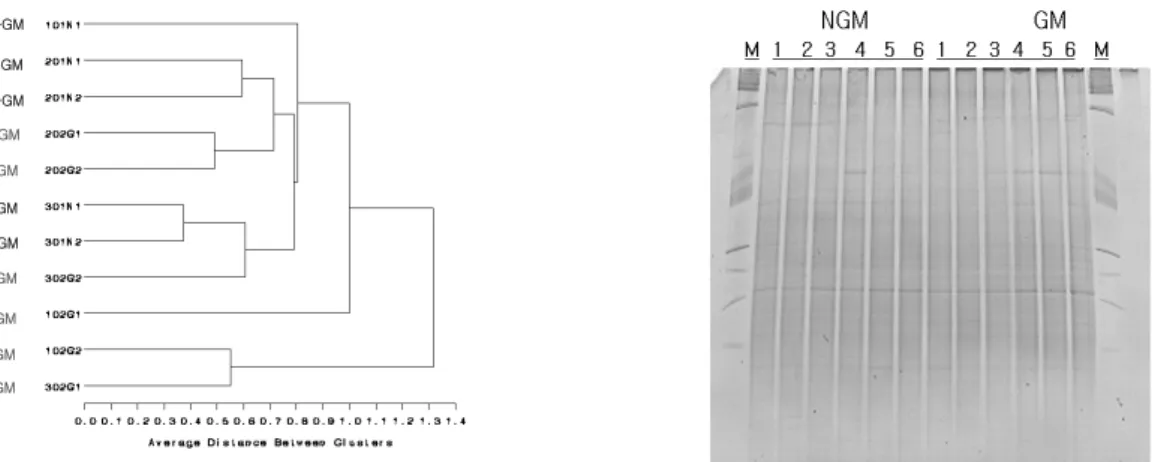
PLFA 및 DGGE를 이용한 미생물군집 분석 혹 명나방저항성 벼 및 비변형 벼 재배시 2007년도 예산 시험포장의 근권토양의 미생물 군집에 대한 인지질지방 산(PLFAs) 및 DGGE 프로파일은Fig. 1과 같다 미생. 물 군집상을 조사한 토양 종류별 프로파일은 상이한 결 과를 보였으나 유전자변형 벼 재배 유무에 따른 차이는, 뚜렷하지 않았다.
은 초지의 미생물군집 조 Steenwerth et al. (2002)
성의 차이는 총 PLFA와 밀접한 관계가 있다고 하였지 만, Liang et al. (2008)은 산림토양에서는 총 PLFA 보다는 세균과 관련된 총 세균 PLFA가 다양한 차이를
Table 6. Bacteria isolated from rhizosplane of rice plants in field test (Yesan, 2008).
Isolate
Rhizoplane of rice plants
Leaf folder-resistant Non-genetically modified
No. of isolates Ratio (%) No. of isolates Ratio (%)
Acidovorax 1 1.6 1 1.5
Aquaspirillum 4 6.3 1 1.5
Arthrobacter 5 7.8 7 10.8
Bacillus - - 1 1.5
Brevibacterium - - 2 3.1
Brevundimonas 1 1.6 1 1.5
Burkholderia 1 1.6 8 12.3
Chryseobacterium 7 10.9 10 15.4
Curtobacterium - - 4 6.2
Duganella - - 1 1.5
Empedobacter 1 1.6 - -
Enterobacter 6 9.4 - -
Microbacterium - - 1 1.5
Micrococcus 1 1.6 2 3.1
Paenibacillus 1 1.6 4 6.2
Paucimonas 17 26.6 3 4.6
Phyllobacterium 1 1.6 - -
Pseudomonas 5 7.8 1 1.5
Rhizobium 1 1.6 - -
Roseomonas - - 1 1.5
Rothia - - 2 3.1
Stenotrophomonas - - 1 1.5
Variovorax - - 1 1.5
Vibrio - - 1 1.5
Others 12 18.8 12 18.5
Total 64 100.0 65 100.0
MIDI system was used for bacterial identification.
보였다는 결과들이 보고되었다. 2008년도 시험토양의 지방산 함량을 이용한 군집 분석은 Fig. 2와 같이 시료 별 차이를 보였으나 유전자변형 벼 재배 유무에 따른 뚜렷한 차이는 본시험에서 나타나지 않았다.
벼 근권토양의 DGGE에 따른 미생물군집을 비교한
결과는 Fig. 3과 같았다. 토양의 16S rDNA 부분을
증폭하여 에 시료를
PCR polyacrylamide gel loading 하여 전기영동한 후 band를 확인한 결과 변형 및 비변 형 간에 일정한 차이를 확인 할 수 없었다.
GM GM GM
GM GM GM
Non-GM Non-GM Non-GM Non-GM Non-GM
Fig. 1. Cluster analysis on rhizosphere soils of rice plants using phospholipid fatty acid (left), and denaturing gradient gel electrophoresis (right) profiles (Yesan, 2007). M: marker, GM: genetically modified (Leaf folder-resistant), and NGM:
non-genetically modified (Primer: 1070F, 1392GCR).
Fig. 2. Cluster analysis on rhizosphere soils of rice plants using phospholipid fatty acid profiles (Yesan, 2008). GM:
genetically modified (Leaf folder-resistant), and NGM: non-genetically modified.
Fig. 3. Cluster analysis on rhizosphere soils of rice plants using denaturing gradient gel electrophoresis profiles (Yesan, 2008). M: marker, GM: genetically modified (Leaf folder-resistant), and NGM: non-genetically modified (Primer: 1070F, 1392GCR).
요 약
유전자변형 벼 및 비변형 벼 재배시 근권미생물의 특 성 및 군집변동상을 조사하였다 유전자변형 벼 재배 및. 비변형 벼 재배 근권토양 및 뿌리표면인 근면의 세균수는 큰 차이가 없었다 수원지역. 2006년도 포장시험에서 근 권토양의 세균은 유전자변형 벼의 경우 Afipia가 12.5%, Spingomonas 10.0%, Ramlibacter 10.0%, Mycoba- cterium 7.5%, Tetrasphaera 7.5%였으며, 유전자비 변형 벼는 Afipia가 7.3%, Spingomonas 12.2%, Ramlibacter 7.3%, Mycobacterium 17.1%, Tetras- phaera 속이 14.6%로 우점하였다 예산 시험포장에서. 재배한 벼 뿌리표면의 우점세균은 2007년도에는 유전자 변형 벼 시험포에서 Arthrobacter 속 12.7% 유전자비 변형 벼 시험포에서는 Burkholderia 속 22.2%였으며,
년도에는 유전자변형 벼 시험포에서
2008 Paucimonas
속이26.6%, 비변형 벼 시험포에서는 Chryseobacterium 속이 15.4 %를 점유하였다. PLFA에 의한 미생물 군집 은 유전자변형 벼 재배 유무에 따른 조건에서는 뚜렷한 경향이 없었지만 토양 간에는 다른 특성을 보였다.
사 사
위 연구는 21세기 프론티어 연구개발사업으로 과학기 술부와 농촌진흥청이 일부 지원하는 작물유전체 기능연 구사업단의 연구비 과제번호( CG2140)에 의해 수행되었 습니다.
인 용 문 헌
Bligh, E.G., and W.J. Dyer. 1959. A rapid method of total lipid extraction and purification. Can. J. Biochem.
Physiol. 37:911-917.
Gebhard, F., and S. Kornelia. 1999. Monitoring field
releases of genetically modified sugar beets for persis- tence of transgenic plant DNA and horizontal gene transfer. FEMS Microbiol. Ecol. 28:261-272.
Hay, I., M.J. Morency, and A. Séguin. 2002. Assessing the persistence of DNA in decomposing leaves of genetically modified poplar trees. Can. J. Forest Res.
32:977-982.
Liang, C., R. Fujinuma, and T.C. Balser. 2008. Com- paring PLFA and amino sugars for microbial analysis in an Upper Michigan old growth forest. Soil Biol.
Biochem. 40:2063-2065.
Liu, W., H.H. Lu, W. Wu, Q.K. Wei, Y.X. Chen, and J.
E. Thies. 2008. Transgenic Bt rice does not affect enzyme activities and microbial composition in the rhizosphere during crop development. Soil Biol. Biochem.
40:475-486.
Lorenz, M.G., and W. Wackernagel. 1994. Bacterial gene transfer by natural genetic transformation in the environment. Microbiol. Rev. 58:563-602.
Lynch, J.M. 1994. The rhizosphere - form and function.
Appl. Soil Ecol. 1:193-198.
Saxena, D., and G. Stotzky. 2001. Bacillus thuringiensis (Bt) toxin relesed from root exudates and biomass of Bt corn has no apparent effect on earthworms, nematodes, protozoa, bacteria, and fungi in soil. Soil Biol. Biochem.
33:1225-1230.
Steenwerth, K.L., L.E. Jackson, F.J. Calderon, M.R.
Stromberg, and K.M. Scow. 2002. Soil microbial com- munity composition and land use history in cultivated and grassland ecosystems of coastal California. Soil Biol. Biochem. 34:1599-1611.
Stewart, G.J., and C.A. Carlson. 1986. The biology of natural transformation. Annu. Rev. Microbiol. 40:211-235.
Widmer, F., R.J. Seidler, K.K. Donegan, and G.L. Reed.
1997. Quantification of transgenic plant marker gene persistence in the field. Mol. Ecol. 6:1-7.
농업기술연구소. 1988. 토양화학분석법. Ⅲ. 토양미생물 실험법
. 1992. . .
土壤微生物硏究會編 土壤微生物實驗法 養賢堂