Introduction
Every year, soil erosion which was generated from an upland field due to intensive precipitation and typhoon in the rainy season from June to September was one of very serious concerns at the highland agriculture area.
Especially, alpine land is vulnerable to be eroded soil by steep slope and heavy tillage. Soil erosion by water, wind and tillage affects with both agriculture practices and the natural environment. Soil loss and its associated impacts are one of the most important environmental problems at
highland agriculture area. Precipitation may also move soil indirectly, by means of runoff with forming rills (small channels) or gullies (larger channels, too big to be removed by tillage). With this soil erosion, nutrient materials such as nitrate and phosphorous could cause water quality problems in excess of eutrophication.(T.M.
Church et al., 2005).
To reduce soil erosion, several conservation practices has been studied such as no-tillage, vegetative buffers and so on. Vegetative buffer is one of conservation practices available, which have the potential to reduce agricultural non-point source pollution (Zeyuan 2003). Conservation buffers are effective on reducing sediment and nutrient loss in runoff (Daniels and Gilliam, 1996; Abu-Zreig et
Received : July 13. 2009 Accepted : August 12. 2009*Corresponding author: Phone : +8224503730, E-mail : [email protected]
Effects of Vegetative Buffers on Reducing Soil Erosion and Nutrient Loss of Highland Field in Korea
Yong-Ik Jin, Jeong-Tae Lee, Gye-Jun Lee, Seon-Woong Hwang
1, Yong-Seon Zhang
2, Chang-Young Park
3, Myung-Chul Seo
3, Jong-Soo Ryu, Jin-Cheol Jeong, Ill-Min Chung
4,*National AgricultureResearchCenter, Pyeongchang,232-955
1
Department of Rice and Winter Cereal Crop, Iksan,570-080
2
National Academy of Agricultural Science, Suwon,441-707
3
Department of Functional Crop Science, Milyang,627-803
4
KonKuk University, Seoul, 143-701
This study was carried out to investigate the effect of vegetative buffer to reduce runoff and soil and nutrient loss at highland agricultural area. The soil of experimental field was classified as Ungyo series (Fine, Humic Hapludults). An area of each field with lysimeter was 50m
2(width 2.5m× × length 20m) and was a gradient of 17%. Chinese cabbage (Brassica campestris L.) was cultivated by general management in each field. For establishing vegetative buffer, rye (Secalecereale L.), tall fescue (Festucaarundinacea Schreb) and orchard grass (Dactylis glomerata L.) were planted at the edge of field. Rye buffers were 1m, 2m and 4m wide. Both orchard grass and tall fescue buffers were 2m wide. Vegetative buffers were set up in September 2005 and chinese cabbage was planted in June 2006. Soil loss, runoff and nutrient loss were measured from June to August in 2006. Since the precipitation amount was heavy in July, amounts of runoff, soil erosion and nutrient loss were the highest in July during this study period. In comparison with control, vegetative buffers of rye 2m, orchard grass 2m and tall fescue 2m reduced runoff by 3%, 1% and 2%, respectively. In comparison among width of rye buffer, rye 1m, rye 2m, and rye 4m reduced by 1%, 4% and 13%, respectively. Vegetative buffers of rye 2m, orchard grass 2m and tall fescue 2m showed the reducing of soil loss by 59%, 46% and 28%, respectively. In comparison among width of rye buffer, the highest reducing effect of 88% was observed in 4m treatment. Additionally, vegetative buffer reduced N, P and K losses in runoff and eroded soil which were 10 to 54%, 7 to 24% and 11 to 21%, respectively. In different widths, wider vegetative buffer showed lower loss of N, P and K in runoff and eroded soil. As a result of this study, the vegetative buffer of rye was most effective for reducing runoff and soil loss in comparisons with other plants. In addition, wider range of buffers recommended for reducing runoff and soil loss, if possible.
Key words: Vegetative buffer, Soil erosion, Runoff, Nutrient loss
al., 2003).
A vegetative buffer (also referred to grass hedges) is a kind of conservation buffers. Vegetative buffers are narrow strips of stiff stemmed tall grass planted for controlling soil erosion (Humberto et al., 2004a).
Vegetative buffer may be an economical and ecological alternative to expensive terraces to control erosion.
(Humberto et al., 2004a). Vegetative buffer may have reduced performance on erosion reduction in season when runoff and soil losses are generally high and buffers are dormant (Tischler et al., 1994; Ghidey and Alberts, 1998). Vegetation buffers along contour lines present an appropriate sustainable farming practice, since they slow down runoff, build up back water, retain sediment and organic debris and still allow drainage of excess water due to their semi-permeable nature (Kiepe, 1995).
Consequently, they improve water availability both up and downstream from the buffer. Sediment trapping efficiency seems to be inversely related to flow velocity (Griffioen, 1999; Jinetal., 2000). By reducing the velocity of overland flow, sedimentation takes place. When using local available species in the buffer, such a system is a protection measure that is cheap and easy to install (Spaanetal., 2005).
Objectives of this study were to determine effectiveness of vegetative buffers in reducing runoff, soil and nutrient loss according to width and kinds of vegetative buffers.
Materials and methods
Rye(Secalecereale L.) is a cover crop of good character to cold resistance (Kim et al., 2006). The majority of pastures in Korea contain tall fescue (Festuca arundinacea Schreb) and orchard grass (Dactylis glomerata L.) (Yanget et al., 1985). These are cool- season perennial grasses and have a good character to cold resistance (Rimet et al., 2003). It was considered that
not only they were useful protecting soil erosion for winter but also they were helpful reducing soil loss for summer. For above reasons, rye, tall fescue and orchard grass were used as vegetative buffer in this study. To establish vegetative buffer zone, rye (Secale cereale L.), tall fescue(Festuca arundinacea Schreb), and orchard grass (Dactylis glomerata L.) were sowed at the edge of field on September 2005. Zone of rye buffers was designed with 1m, 2m and 4m wide, respectively. Zone of tall fescue and orchard grass was 2m wide. The experimental field, which was a gradient of 17% , was located in Pyeongchang(E 128˚44´12˝, N 37˚40´25
˝) in Korea, and have prepared as no-end lysimeter, described Fig. 1, which has 50m
2(width 2.5m×length 20m) in each treatment.
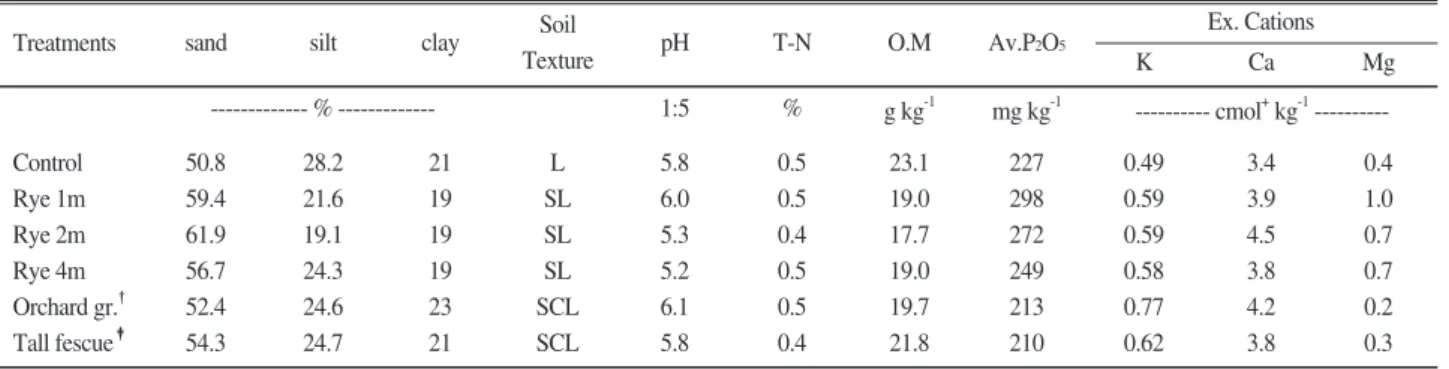
The soil of experimental field was classified as Ungyo series (Fine, Humic Hapludults) and their physical and chemical properties with treatments are presented at Table 1.
The vegetative buffers with rye, orchard grass and tall fescue were set up in September 2005 and sowed seeds as the same amount as 200 kg ha
-1.
Chinese cabbage, transplanted on 22
ndJune 2006, was
Treatments
"
Orchard grass 2m, ‡Tall fescue 2m Control
Rye 1m Rye 2m Rye 4m Orchard gr."
Tall fescue‡ 50.8 59.4 61.9 56.7 52.4 54.3
28.2 21.6 19.1 24.3 24.6 24.7
21 19 19 19 23 21
L SL SL SL SCL SCL
5.8 6.0 5.3 5.2 6.1 5.8
0.5 0.5 0.4 0.5 0.5 0.4
23.1 19.0 17.7 19.0 19.7 21.8
227 298 272 249 213 210
0.49 0.59 0.59 0.58 0.77 0.62
3.4 3.9 4.5 3.8 4.2 3.8
0.4 1.0 0.7 0.7 0.2 0.3 Mg Ex. Cations
--- cmol+kg-1--- mg kg-1
g kg-1
% 1:5
--- % ---
Ca Av.P2O5 K
O.M T-N
Soil pH Texture clay
silt sand
Table 1. Physical and chemical properties of soil before experiment.
Fig. 1.Outline of experimental treatment was installed in slope land.
cultivated with 60cm× 40cm planting distance. The total amount of fertilizers (286 kg N ha
-1, 348 kg P ha
-1and 1,040 kg K ha
-1) was applied. Same amount of fertilizer was applied in all experimental plots. The basal fertilizer (100.1 kg N ha
-1, 348 kg P ha
-1and 572kg K ha
-1) was applied 19th June. Topdressing (185.9 kg N ha
-1and 468 kg K ha
-1) was applied on July, 12
th2006.
Eroded soil and nutrient loss in runoff were measured from May to August in 2006. Analysis of nutrients ingredients in soil and runoff were carried out after precipitation. The analytical methods for nutrients in soil were as follows: Soil texture analysis by hydrometer method, soil pH (Soil : Distilled water = 1:5), T-N (Total Nitrogen) was used by vario Max CN analysis tool (Elementar Analysensystem Gmbh, Germany), organic matter was analyzed by Walkley-Black method, available phosphate was analyzed by Lancaster method, and exchangeable cations extraction by 1N-CH
3COONH
4(pH 7.0). Extracted cations were analyzed using the ICP (Inductively Coupled Plasma, Optima 2100 DV of PerkinElmer, USA.).
The analytical methods for nutrients in water were as follows; total nitrogen was analyzed by UV spectrophotometer method, total phosphate was measured by ascorbic acid reduction method and
potassium cation was analyzed by ICP(Inductively Coupled Plasma, Optima 2100 DV of PerkinElmer, USA.). A least significant difference (LSD test) was carried by using SAS 9.0.
Results and discussion
During experiment period, total amounts of precipitation were 1,097mm. Monthly precipitation of June, July and August had been recorded by 35, 958.5 and 103.5 mm, respectively.
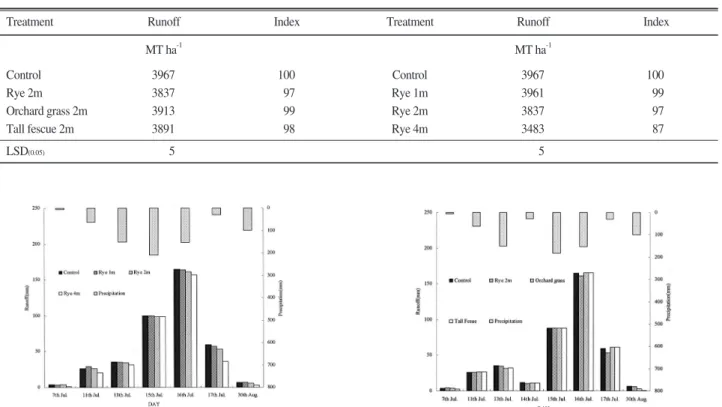
In summer, intensive precipitation was occurred in pyeongchang area from July to August, especially. A linear relationship shows between the runoff loading and precipitation amount (Cho and Han, 2001). Total amounts of water runoff presented Table 2. Table 2 shows that runoff was reduced by 2% in orchard plot, 2%
in tall fescue plot, 1% in rye 1m plot, 4% rye 2m plot and 13% rye 4m plot with respect to the control plot without vegetative buffer during the experimental period.
The effect of rye 2m in reducing runoff was similar to that of orchard grass 2m and tall fescue 2m. But in comparison among rye buffers, effect of rye 4m in reducing runoff was higher than that of rye 1m and rye 2m (Table 2). Although effect of vegetative buffers on reducing run off was not great differences, it was
Fig. 2.Periodic changes of runoff occurred during the
experiment period in Rye vegetative buffer. Fig. 3.Periodic changes of runoff occurred during the experiment period according to the kinds of vegetation.
Treatment
Control Rye 2m Orchard grass 2m Tall fescue 2m LSD(0.05)
3967 3837 3913 3891 5
100 97 99 98
Control Rye 1m Rye 2m Rye 4m
3967 3961 3837 3483 5
100 99 97 87 Index Runoff
Treatment Index
Runoff
MT ha-1 MT ha-1
Table 2. Total amounts of water runoff with vegetative treatments and differences of vegetative width during the experiment period.
considered that runoff through vegetative buffers ran down.
Thus, Fig. 2 shows that there was no great difference among the width of rye buffer in periodic changes of runoff. The result to reduce runoff of vegetative buffers was similar to control as Fig. 2 and Fig. 3.
According to Van et al. (1996), grass strips are effective on filtering sediment from surface runoff as long as concentrated flow is absent. Therefore, under condition occurred intensive runoff, it was thought that effective of vegetative buffer in reducing runoff is less. However, there are many reports about effect of conservation buffers in reducing runoff. Surface runoffs, which can cause soil erosion and sediment transport, mainly have been occurred when the precipitation exceeded the infiltration capacity of the soil. Muscutt(1993) also reported that runoff usually occurs during heavy rain in case of rising soil water contents over saturation. The vegetated zones play an important role in minimizing the soil erosion from arable land, mainly by increasing nutrients and sediment deposition prior to their export to the water bodies (Dillaha et al., 1989). Under no-till conditions, the plots with corn residue and grass hedges averaged 52% less runoff than similar plots without switch grass hedges. Under tilled conditions, the plots with corn residue and grass hedges averaged 22% less runoff than comparable plots without grass hedges.
(Gilley et al., 2000) Gadorensis and Salvia officinalis L.
was reduced 40 and 30%, respectively. (Victor et al., 2004). Humberto (2004b) reported that runoff was reduced by 11% in Fescue Filter strips when compared with control treatment. Thus, the Buffer strip, which was composed of two rows of regularly alternating trees (Platanus hybrida Brot.) and shrubs (Viburnum opulus L.), with grass (Festuca arundinacea L.) in the inter- rows, reduced total runoff by 78% compared with no- buffer strip. (Maurizio et al., 2002). Through Table 2, runoff difference between the Orchard plot vs Tall fescue
was 1% and Rye plot with same width was more reduced by 1%, 2%, respectively than they did. This shows that Rye was as effective as Orchard and Tall fescue in reducing runoff. In this study, effect of vegetative buffers in reducing runoff was not great, but vegetation at the downstream edge of disturbed areas may effectively reduce runoff volume and peak velocity primarily because of the filter's hydraulic roughness, and subsequent augmentation of infiltration (Rafael et al., 1999).
Total soil losses from all treatments are presented Table 3. Plot of rye 4m was effective in reducing soil loss was the greatest among all treatments. Table 3 shows that soil loss was reduced by 88% in rye 4m, by 62% in rye 1m, by 59% in rye 2m, by 46% in orchard grass and by 28%
in tall fescue comparing with control treatment. This result means that vegetative buffer is very useful to decrease soil erosion.
Comparisons of soil loss volume between the different kinds of vegetative buffer showed that rye 2m was more effective than orchard grass 2m and tall fescue 2m. Also, in comparisons of rye buffers according to width, rye 4m was most effective than rye 1m and rye 2m. It was speculated that the lager width of vegetative buffer, the lesser soil loss. But what rye 1m was more reduced soil loss than rye 2m is out of one's reckoning. It seems to be not different from capability in reducing soil loss between rye 1m and rye 2m under this study situation. As for this reason, it was needed more research about hydrology and physics of soil surface. There are many reports about effectiveness of vegetative buffer in abating soil loss.
Grass hedges effectively reduced soil loss on erosion plots with similar cropping practices as compared with plots without hedges. (Cullum et al., 2007). Grass hedges averaged 53% less soil loss than similar plots without grass hedges (Gilley et al., 2000). Vegetation buffers reduced soil erosion by 40-60% on plots with an effective buffer. (Spaan et al., 2005). Reductions of sediment
Treatment
Control Rye 2m Orchard grass 2m Tall fescue 2m LSD(0.05)
129 53 70 93 4
100 41 54 72
Control Rye 1m Rye 2m Rye 4m
129 49 53 16 4
100 38 41 12 Index Soil loss
Treatment Index"
Soil loss MT ha-1
"
Index: treatment/Control×100
MT ha-1 Table 3. Total amounts of soil loss from all treatments during the experiment period.
discharge varied between 50-60 and 60-90% for strips of 1 and 4-5 width, respectively. (Vandijk et al., 1996).
According to another report, the annual ratio of soil loss for conventional-till plots with grass hedges to without hedges was 0.25. (McGregor et al., 1999).
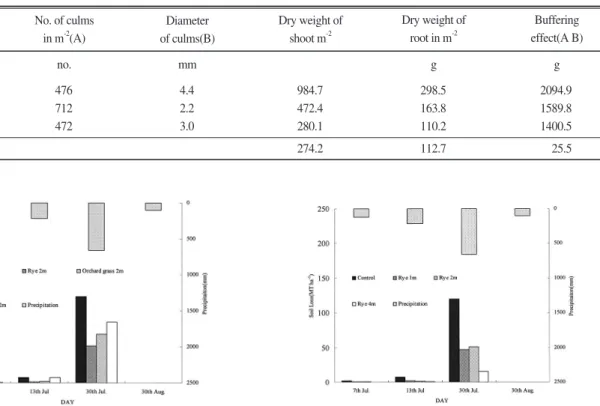
There are no researches about how vegetative buffer reduce soil erosion. To find out this reason, it was obtained the buffering effect of vegetative buffer. The buffering effect was calculated by multiplying average number of stem per m
2by average diameter of stems which values of Table 4 was measured on July 2006.
Table 4 shows that buffering effect of rye is higher than that of orchard grass and tall fescue. As the value is high, the occupancy ratio of vegetative buffer per area becomes high. The higher that value is, the higher buffering effect trapped soil sediment is. Consequently, soil loss is decreased. As Table 4 shows, what effect of rye in reducing soil loss was highly coincided with what buffering effect was high.
Soil loss, as showed in Fig. 4, was mainly occurred when the amount of precipitation was over 100 mm since 13
thJuly. When soil loss was measured on 30
thAug, it was almost not founded. During this period, runoff occurred so much and soil lossals ooccurred greatly.
Amount of soil loss was about 120 MT ha
-1in control
plot after on July 13
th. Meanwhile, amount of soil loss was 15 MT ha
-1in Rye 4m plot, which was about 12% of that of control. Figure4 shows that rye vegetative buffer plot was moree ffective in reducing soil loss than orchard grass, Tall fescue, and all vegetative buffers were effective in reducing soil loss when compared with control plot. Fig.1 presents that effect of rye 4m was higher than that of rye 1m and rye 2m. Those results demonstrated that vegetative buffer has a value as conservation practice in conserving soil loss. However, application of vegetative buffer to upland field brings out decrease of cultivation area. Under this situation, economic revenue of farm owner decreases. To solve this problem, it is required a support from policy of government. That policy has not considered yet in Korea.
But there is CRP (Conservation Reserve Program) in USA for conservation practice in agriculture. The CRP is a program designed to encourage farmers to help protect sensitive landscapes from erosion. It is managed by the United States Department of Agriculture (USDA) Farm Service Agency, and is implemented on behalf of the USDA's Commodity Credit Corporation. In effect, the CRP works by providing monetary compensation to farmers as an incentive to take agricultural land out of production, and allow natural vegetation to return.
Fig. 4.Soil loss measured from three vegetative buffer types
over the course time. Fig. 5.Soil loss measured from Rye buffers over the course
time.
Treatment
Rye Orchard grass Tall fescue LSD(0.05)
476 712 472
4.4 2.2 3.0
984.7 472.4 280.1 274.2
298.5 163.8 110.2 112.7
2094.9 1589.8 1400.5 25.5 Buffering effect(A B) Dry weight of
root in m-2 Dry weight of
shoot m-2 Diameter
of culms(B) No. of culms
in m-2(A)
no. mm g g
Table. 4. Buffering effect of vegetative buffer trapped eroded soil.
(Timothy T. Loftusand Steven E. Kraft, 2003.)
Nutrient losses in runoff of all plots are shown in Table 5. All treatments were more effective than Control in reducing T-N in runoff. In comparison among rye 2m, orchard grass 2m and tall fescue in reducing T-N loss and T-P loss in runoff, effect of rye 2m was lower than those of Orchard grass and Tall fescue. Dissolved nutrient trapping in runoff was not as efficient and sometimes an increase in nutrient losses has been reported. (Dillaha et al., 1989)
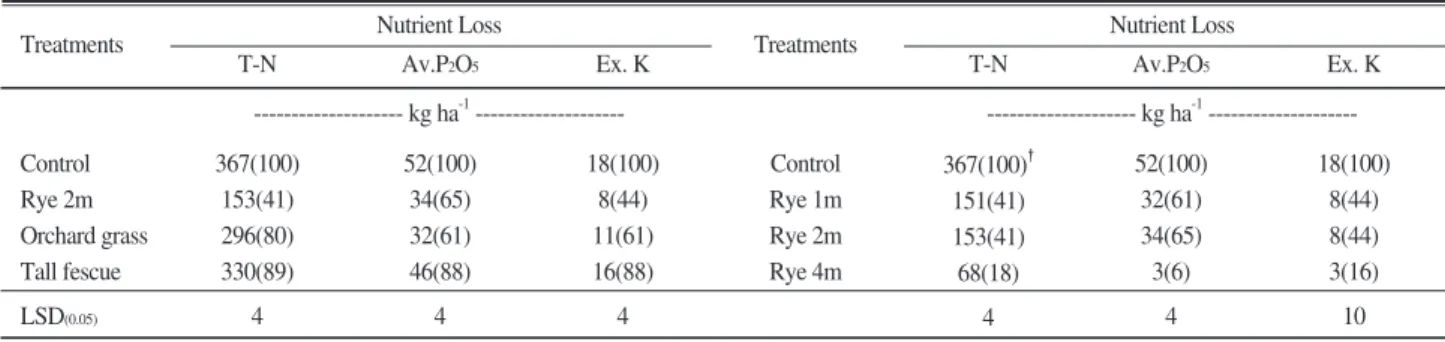
In comparison among rye buffers, effect of rye 4m in reducing T-N, T-P and K in runoff was higher than that of rye 1m and rye 2m. Comprehensively, rye 4m was the most effective than other plots in reducing nutrient loss in runoff. Table 6 shows that rye 4m reduced 63% of T-N, 28% of T-P and 30% of K in runoff when comparing with control treatment.
As above comments, soil loss occurred greatly when heavy precipitation falls after on July 13th. And then nutrient loss in soil was occurred plentifully during that period, which soil loss occurred so much. Table 6 presents that total amount of nutrient loss in soil and total soil loss amounts. Table 6 shows that Rye was the most effective in reducing T-N loss in soil when it comparing to other vegetative buffers. When control plot compared with rye 2m in T-N. rye 2m more reduced by 59%.
In comparison among rye buffers, rye 4m reduced by 82% in T-N, by 94% in Av. P
2O
5, by 84% in exchangeable cation K. This result demonstrates that rye 4m was effective both in reducing soil loss and nutrient loss. Other vegetative buffers including rye 1m, 2m were effective in reducing nutrient loss to compare with Control plot. Though the effect of vegetative buffer was not effective enough in nutrient loss in runoff, all vegetative buffers were effective in reducing nutrient loss in soil. As sediment is deposited from runoff in these vegetated zones, sediment-bound nutrients are also removed. Vegetative buffer can minimize erosion or trap sediments in surface runoff and thereby decrease nutrient leaching to outside. Meanwhile, Table 5 and Table 6 show that K
+loss was higher in runoff than in soil. Victor et al. (2003) reported that a greater proportion of K
+is transported in runoff than in soil sediment.
Conclusion
Through this study, it was investigate that vegetative buffer was effective to reduce soil erosion and outflows of nutrient material from soil. Therefore, to conserve soil at highland agriculture area, vegetative buffer must be applied. Among vegetative buffers were used in this study, rye buffers on reducing soil erosion and nutrient
Treatments
Control Rye 2m Orchard grass Tall fescue LSD(0.05)
367(100) 153(41) 296(80) 330(89)
4
52(100) 34(65) 32(61) 46(88)
4
18(100) 8(44) 11(61) 16(88)
4
Control Rye 1m Rye 2m Rye 4m
367(100)"
151(41) 153(41) 68(18)
4
52(100) 32(61) 34(65) 3(6)
4
18(100) 8(44) 8(44) 3(16) 10 Ex. K Av.P2O5
Treatments T-N Ex. K
Av.P2O5
T-N
Nutrient Loss
--- kg ha-1---
"
Index: treatment/Control×100
--- kg ha-1--- Nutrient Loss
Table 6. Nutrient loss occurred from soil during the experiment period.
Treatments
Control Rye 2m Orchard grass Tall fescue LSD(0.05)
86(100) 54(62) 58(67) 75(87) 8
51(100) 52(101) 46(90) 50(98)
5
31(100) 36(116) 28(90) 28(90)
4
Control Rye 1m Rye 2m Rye 4m
86(100)"
54(62) 54(62) 32(37)
8
51(100) 54(105) 52(101) 37(72)
5
31(100) 28(90) 36(116)
22(70) 4 K T-P
Treatments T-N K
T-P T-N
Nutrient Loss
--- kg ha-1---
"
Index: treatment/Control×100
--- kg ha-1--- Nutrient Loss
Table 5. Nutrient loss occurred from runoff during the experiment period.
loss from soil were more effective than other buffers.
Especially, as rye buffer of 4m wide could reduce by 88% soil loss, by 82% total nitrogen, by 94% Av. P
2O
5and by 84% ex. K in nutrient materials from soil in this study, it was considered that rye buffer of 4m wide is useful vegetative buffer on reducing soil and nutrient loss of highland field.
References
Abu-Zreig, M., R.P. Rudra, H.R. Whiteley, M.N. Lalonde, and N.K.
Kaushik. 2003. Phosphorous removal in vegetated filter strips.
Journal of Environmental Quality. 32:613-619.
Cho, J.Y. and K.W. Han. 2001. Nutrient losses from a paddy field plot in central Korea. Water, Air and Soil Pollution. 134:215-228.
Cullum, R.F., Wilson, G.V., McGregor, K.C., Johnson, J.R. 2007.
Runoff and soil loss from ultra-narrow row cotton plots with and without stiff-grass hedges. Soil & Tillage Research. 93(1):56-63.
Daniels, R.B., Gilliam, J.W. 1996. Sediment and chemical load reduction by grass and riparian filters. Soil Science Society of American Journal. 60:1645-1662.
Dillaha, T.A., Sherrard, J.H. and Lee, D., 1989. Long-term effectiveness and maintenance of vegetative filter strips. Bull. 153, Virginia Water Resources Research Center, Virginia Polytechnic Institute and State University, Blacksburg, 39pp.
Ghidey, F., and E.E. Alberts. 1998. Runoff and soil losses as affected by corn and soybean tillage systems. Journal of Soil Water Conservation. 53:64-70.
Gilley, J.E., B. Eghball, L.A. Kramer, and T.B. Moorman. 2000.
Narrow grass hedge effects on runoff and soil loss. Journal of Soil Water Conservation. 55:190-196.
Griffioen, F., 1999. Trapping efficiency of vegetative filter strips.
MSc thesis, Wageningen Agricultural University, Department of Environmental Sciences, Erosion and Soil and Water Conservation Group, 46pp.
Humberto Blanco-Canqui, C.J. Gantzer, S.H. Anderson, and E.E.
Alberts. 2004a. Grass barriers for reduced concentrated flow induced soil and nutrient loss. Soil Science Society of American Journal. 68:1963-1972.
Humberto Blanco-Canqui, C.J. Gantzer, S.H. Anderson, E.E.
Alberts, and A.L. Thompson. 2004b. Grass barrier and vegetative filter strip effectiveness in reducing runoff, sediment, nitrogen, and phosphorus loss. Soil Science Society of American Journal.
68:1670-1678.
Jin, C.X., Romkens, M.J.M., Griffioen, F., 2000. Estimating manning's roughness coefficient for shallow overland flow in non- submerged vegetative filter strips. Transactions of The American
Society of Agricultural Engineers. 43:1459-1466.
Kiepe, P., 1995. No runoff, no soil loss: soil and water conservation in hedgerow barrier systems. Tropical Resource Management Papers No. 24, Wageningen, 184 pp.
McGregor, K.C., Dabney, S.M., Johnson, J.R. 1999. Runoff and soil loss from cotton plots with and without stiff-grass hedges.
Transactions of The American Society of Agricultural Engineers.
42:361-368.
Maurizio Borin and Elisa Bigon. 2002. Abatement of NO3-N concentration in agricultural waters by narrow bufferstrips.
Environmental Pollution. 117:165-168.
Rafael Munoz-Carpena, John E. Parsons, J. Wendell Gilliam. 1999.
Modeling hydrology and sediment transport in vegetative filter strips. Journal of Hydrology. 214:111-129
Rim, Y.W., G. J. Choi, B. R. Sung, Y. C. Lim, M. J. Kim, G. J.
Park, K. Y. Kim, J. W. Chung and N. G. Park. 2003. Growth Characeristics and Productivity of New Orchardgrass Variety
"Jangbeol 101". Korean Grassl. 23(3):203-206.
Kim, S. G., J. D. Kim, C. Ho. Kwon, J. K. Ha and D. A. Kim. 2006.
Forage Perfomance Evaluation of Rye Cultivars with Different Sowing Dates. Korean Grassl. 26(1):31-38
Spaan, W.P., A.F.S. Sikking, and W.B. Hoogmoe. 2005. Vegetation barrier and tillage effects on runoff and sediment in an alley crop system on a Luvisol in Burkina Faso. Soil & Tillage Research.
83:194-203.
T.M. Church, C.K. Sommerfield, D.J. Venlinsky, D. Point, C.
Benoit, D.Amouroux, D.Plaa and O.F.X. Donard. 2005. March sediments as records of sedimentation, eutrophication and metal pollution in the urban Delaware Estuary. Marine Chemistry.
102:72-95
Timothy. T. Loftus and Steven E. Kraft, 2003. Enrolling conservation buffers in the CRP. Land Use Policy. 20(1):73-84.
Tischler, C.R., B.A. Young, and M.A. Sanderson. 1994. Techniques for reducing seed dormancy in swithgrass. Seed Science and Technology. 22:19-26.
Van Dijk, P.M., Kwaad, F.J.P.M., Klapwijk, M., 1996. Retention of water and sediment by grass strips. Hydrological Processes.
10:1069-1080.
Victor Hugo Dur´an Zuazo, Armando Marti nez Raya and Jos´e Aguilar Ruiz. 2004. Nutrient losses by runoff and sediment from the taluses of orchard terraces. Water, Air, and Soil Pollution.
153:355-373.
Yang. J.S., G. J. Park, D. J. Kwon and J. Y. Lee. 1985. Studies on the Seed Production of Festuca arudinacea Schreb. Korean Grassl. 5(2):106-110.
Zeyuan Qiu. 2003. A VSA-Based strategy for placing conservation buffers in agricultural watersheds. Environmental management.
32:299-311.
본 연구는 고랭지 경사밭에서 발생하는 유거수량, 토양유실, 영양물질 유출량을 감소시키는 완충식생대의 효과 를 연구하기 위하여 수행하였다. 시험에 사용된 포장의 토양은 운교통이고, 가로 2.5m, 세로 20m인 무저 lysimeter에서 시험하였다. 연구포장은 경사율 17%를 가진 경사밭이며, 배추를 재배하였다. 완충식생대로 이용 된 초종은 Rye(Secale cereale L.), Tallfescue(Festuca arundinacea Schreb) Orchardgrass(Dactylis glomerata L.) 이다. 이들은 경사밭 아래 부분에 조성되었다. 호밀 식생대의 폭은 1m, 2m, 4m를 두었고, Orchard grass와 Tall fescue는 2m로 설정하였다. 완충식생대를 조성하기 위해 각 초종을 2005년 9월에 파종하였고, 배추는 2006년 6 월에 정식하였다. 토양유실량, 유거수량, 영양물질 유출량의 측정은 2006년 6월부터 8월까지 수행하였다. 유거수 량, 토양유실량 및 영양물질 유실량은 강우가 집중된 7월에 가장 높았다. 유거수를 감소시키는 완충식생대의 효 과를 대조구와 비교해 볼 때, 2m로 폭이 같은 완충식생대에서 호밀은 3%, Orchard grass는 1%, Tall fescue는 2% 저감 효과가 있었다. 폭이 다른 호밀 완충식생대간의 비교에서, 1m는 1%, Rye 2m는 3%, Rye 4m는 13%
의 저감효과가 나타나 Rye 4m의 효과가 가장 좋았다. 토양유실저감측면에서 대조구와 비교할 때, 2m 완충식생 대 중 호밀식생대는 59%, Orchard grass 46%, Tall fescue 28% 토양유실을 줄이는 것으로 나타나 같은 폭에서 호밀식생대의 효과가 가장 좋았다. 폭이 다른 호밀 식생대의 비교에서 1m는 62%, 2m는 60%, 4m는 88%의 토 양유실 저감 효과가 나타나, 4m의 효과가 토양유실을 저감하는데 가장 좋은 효과를 보였다. 한편, 유거수와 토 양에서 발생한 N, P, K 유출 저감에서는 호밀 2m완충식생대에서 각각 54%, 16%, 11%, Orchard grass는 각각 22%, 24%, 22%를, Tall fescue는 10%, 7%, 12% 영양물질유출을 줄였다. 호밀완충식생 중에서 폭이 큰 4m에서 영양물질 유출저감효과가 가장 좋았다. 이 연구의 결과, 유거수량, 토양유실 저감효과는 호밀완충식생대가 다른 초종의 식생대보다 좋아서 유거수, 토양유실 그리고 영양물질 유출 저감을 위해 폭이 큰 호밀완충식생대의 설 치가 효과적이라 생각된다.
고랭지밭의 토양침식 저감을 위한 완충식생대의 효과
진용익·이정태·이계준·황선웅1·장용선2·박창영3·서명철3·류종수·정진철·정일민4,*
농촌진흥청 국립식량과학원 고령지농업연구센터, 1국립식량과학원 벼맥류부, 2국립농업과학원
3국립식량과학원 기능성작물부, 4건국대학교