Printed in the Republic of Korea
불꽃원자 흡수 분광법으로 활성탄소에 흡착된 메틸티몰 블루로 납 (II) 의 예비농축 , 분리 및 측정
Ali A. Ensafi * and Ali R. Ghaderi
College of Chemistry, Isfahan University of Technology, Isfahan 84156-83111, Iran (2007. 7. 19 접수)
Preconcentration, Separation and Determination of lead(II) with Methyl Thymol Blue Adsorbed on Activated Carbon Using Flame Atomic
Absorption Spectrometry
Ali A. Ensafi * and Ali R. Ghaderi
College of Chemistry, Isfahan University of Technology, Isfahan 84156-83111, Iran (Received July 19, 2007)
요 약.
납(II)의 예비농축
및 분리를위한온라인 시스템을
소개하였다.
이방법은
활성탄소에흡착된
메틸티몰블
루로납(II)의 착체형성을 기저로 한다.
간섭이온의효과는 물론 수용액상의
산성도, 고상의 용량,
흐름변수와 같은희석 용액으로부터 납(II의
정량회수와고상
시약의 준비상태에
대해 연구되었다. 예비농축 후에
금속이온은0.5 M HNO
용액의 5 ml
에 자동적으로용출되고 납이온의 양은 불꽃원자
흡수분광법로측정하였다. 최적조건하에서, 수용액시료의
납이온은
컬럼에 의해
약1000
배분리 및농축되었다.
검출한계는0.001 昭 mL 였다.
납은 강과 수돗물시료에서98
에서102%
회수율을보였다.
주제어:
납,
메틸티몰 블루,
온라인예비농축, FAAS
ABSTRACT. An on-line system for preconcentration and separation of lead(II) is presented. The method is based on
the complex formation of Pb(II) with adsorbed Methyl thymol blue on activated carbon. The conditions of preparing the solid phase reagent and of quantitative recovery of Pb(II) from diluted solutions, such as acidity of aqueous phase, solid phase capacity, and flow variables were studied as well as effect of potential interfering ions. After preconcentration step, the metal ions are eluted automatically by 5 ml of 0.5 M HNO; solution and the lead ions content was determined by flame atomic absorption spectrometry. Under the optimum conditions, the lead ions in aqueous samples were separated and preconcentrated about 1000-fold by the column. The detection limit was 0.001 gg mL'. Lead has been determined in river and tap water samples, with recovery of 98 to 102%.
Keywords: Lead, Methyl Thymol Blue, On-Line Preconcentration, FAAS
INTRODUCTION
Lead, even at very low concentrations, is a well- known toxic element for animal and human. The determination of trace amount lead in environmen
tal samples is currently of great importance due to the high toxicity, accumulative, and persistent char
acter in living organisms. Flame atomic absorption spectrometry (FAAS) is a simple and very avail
able technique for the determination of lead(II) ions in water samples. However the main problem is a low sensitivity. The limitation can be overcome by using preconcentration methods. Solid phase extrac
tion procedures based on the sorption of metal com
plexes on modified activated carbon have been widely applied.
1-4
In all of the reported papers except ref. 3, 4, a ligand solution was needed for each experiment, because the chelating agent was used to wash metal ions from the surface of sorbent.O.A. Zaporozhets et al.
5
have been introduced a new solid phase based on XO adsorbed on silica for preconcentration of lead(II) and then determined by diffuse reflectance spectroscopy. The method is a batch method, has higher limit of detection (>2 ng mL-1
Pb(II)) and suffer from many interfering ions such as Fe(II), Mn(II), Cd(II), Zn(II) and phosphate.In addition, Amberlite XAD-16 loaded with XO,
6
Amberlite XAD-20007
and Amberlite XAD-11808
have been reported by M. Soylak et al. as suitable solid phases for preconcentration of heavy metalsincluding Cr, Cu, Ni, Zn and Pb. However, those methods are not selective fr Pb(II).We have reported a new sorbed solid phase preconcentration for lead(II).
3
The separated from the solution was 0.001 gg mL-1
. The aim of this work was to develop a solid phase reagent on the base of activated carbon loaded with Methyl thymol blue (MTB). Activated carbon tightly adsorbed MTB and thus the adsorbed MTB did not wash away with the washing solution that was used to remove lead(II) ions from the solid phase. Automation of the procedure can possibly reduce the risk of operational errors, increase the precision of the method and accelerate the sample throughput.
According to Table 1, the proposed method has higher sorption capacity and preconcentration fac
tor and also is highly selective for Pb(II) ions.
Parameter Table 1. Comparison of sorption capacity, preconcentration factor, detection limit and interferences.
Immobilized ligand Sorption capacity
(卩gg)
Preconcentration factor
Detection limi
(ng/mL) Interferences Support: Amberlite XAD-2
Chromotropic acid [19] 186.3 200 --- Fe,Cu
Thiosalicylic acid [20] 89.3 100 ---- ----
Pyrocatechol [21] 104.7 100 ---- Na,PQ
Salicylic acid [25] 2.22 140 5.5 F, Cl, NO」, Zn
Pyrocatechol violet [26] 6.56 23 44 Cd, Cu, Ni, Zn
o-Vanillinthiosemicarbazone [27] 9.65 100 50 Cu, Zn Zn, Cu, Co, Cd. Ni
o-Aminophenol [28] 16.02 40 25 Cu, Cd, Co, Ni, Zn, Mn
Tiron [29] 60.3 25 24 Cd, Co, Cu, Fe, Ni, Zn
Dithiocarbamate [3이 ---- 20 10 Ng
Alizarin Red S [31] 1.5 40 10 Zn, Cd, Ni
Pyrocatechol violet [32] 6.5 500 8 Cd, Cu, Ni, Zn
Support: Amberlite XAD-4
7-Dodecenyl-8-quinolinol [37] 52 500 ---- Ti, Ni, Mn, Fe, Cr, Co, Cu
Support: Amberlite XAD-7
Xylenol orange [22] 16.9 100 10 ----
Dimethylglyoxalbis(4-phenyl-3-thiosemicarbazone) [38] 19.7 100 ---- Hg, Cd, Cu, Pd Support: Polyacrylonitrile
Amino phosphoric and dithiocarbamate[24]
27.16 200 ---- Cu, Cd, Co, Ni, Zn, Mn
Support: Silica gel
Acid Red 88 [36] 12.1 ---- 10 Cd, Cu, Co, Mn, Ni, Zn
5-Amino-1,3,4-thiadiazole-2-thiol [34] 130 80 ---- Cd, Cu, Co, Zn
Other resins
Chelex-100 [23] ---- 1000 20 Cd, Cu, Co, Mn, Ni, Zn
Metalfix chelamine resin [35] ---- 25 ---- ----
Support: Activated carbon
8-Hydroxyquinoline and Cupferron [33] ---- 100 2.4 Cd
Methyl thymol blue (Present work) 6000 1000 1.0 No interferences
EXPERIMENTAL
Reagents
All chemicals used were of analytical reagent grade. Doubly distilled water was used throughout.
Activated carbon, 40-60 mesh (Merck) was soaked in hydrochloric acid for 1 day; it was then washed with water and dried at 110
o
C for 1 day.Methyl thymol blue (MTB) solution, 0.01% (w/v), was prepared by dissolving 0.01 g of the reagent in water. Samples were filtered through a cellulose membrane of pore size <2 pm.
Universal buffer was made of mixture of acetic acid, boric acid and phosphoric acid (0.04 M).
Apparatus
A Perkin-Elmer® (USA), Model 2380 atomic absorption spectrometer furnished with a lead hol
low-cathode lamp was used. The instrument was set at a wavelength of 217.0 nm and the air-acetylene flame was adjusted according to standard recom
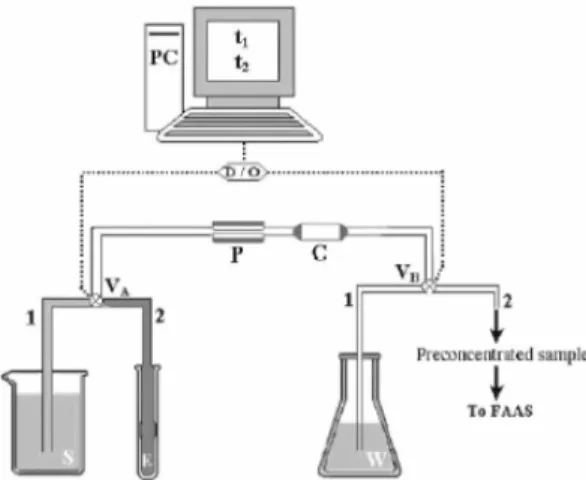
mendation. The schematic diagram of the on-line preconcentration is shown in Fig. 1. The hardware of the system was composed of a 32 channel I/O card (PCL-720, Advantech®, Taiwan) which has a power relay module to convert the output of I/O card to 220 V AC, a peristaltic pump (Ismatec®, ISM 404, Switzerland), three 220v AC electrical valves, a silicon rubber tubing pump (2.06 mm i.d.) and a PC computer, Pentium II (233 MHz). A program was written in Borland C
++
by the authors to monitor and to control the system. The mini-column was made by packing Teflon tubes (7 mm i.d.) with MTB loaded activated carbon. Small glass wool plugs at the ends of each column prevented material loss. A WPA Lightwave® (UK), Model S2000 Diode Array UV-Vis spectrophotometer was used to measure the absorbance of the MTB solution. The pH of aqueous solutions was checked using a Metrohm® (Switzer
land), Model 827 pH meter with a glass electrode.
In the on-line preconcentration procedure, the sample was pumped through the mini-column via position 1 of valve A (Fig. 1). Lead(II) ions were retained in the column by forming a complex with MTB. In this case, valve B was in the waste posi-
Fig. 1. Automatic manifold system used for preconcentration of Pb(II). (P, pump; C, Microcolumn; D/O: Analog to digital converter; S, Sample solution; V, valves A; VB, valves B; E, Eluent solution, HNO 0.5 M; and PC, Computer).
tion. When the sample was eluted completely, position 1 of valve A was closed automatically, valve B was switched to the preconcentration sample and position 2 of valve A was opened when 0.5 M nitric acid was passed through the mini-column to elute the Pb(II) ions by breaking the complex. When the nitric acid was eluted, the preconcentrated sample was analyzed by flame atomic absorption spectrometer.
Preparation of the Modified Activated Carbon
In a 2000 mL beaker, 10.0 g activated carbon was added to 1.7 g of MTB and mixed well at pH 2.0 (universal buffer, 1.8 L). After 45 hours, the mixture was filtered and washed with water three times, each time with 10 mL water, and then dried out.
Then a Teflon column (5.2 cm length and 1.8 cm in diameter) was packed with 0.25 g of the modified activated carbon. The bed height in the column was 1.5 cm.
Procedure
The method was tested with model solutions before its application to real samples. A 100 mL 1.0 pg mL
-1
Pb(II) solution, buffered at pH 7.0, was passed through the column at a flow rate of 3.0 mL min-1
by opening the position 1 of electrical valves19
A and B (Fig. 1). After finishing the solution, posi
tion 1 of valves A and B is closed automatically, and position 2 of valves A and B is opened. There
fore, 5.0 mL of 0.5 M nitric acid was passed through the column at a flow rate of 2.0 mL min
-1
to elute the Pb(II) ions. The eluent was collected and analyzed for Pb(II) by flame atomic absorption spec
trometry. The percent of metal ions adsorbed on the column for the known concentration of Pb(II) was calculated from the amount of Pb(II) ions in the starting sample and the amount of Pb(II) eluted from the column.
RESULTS AND DISCUSSION
Activated carbon has been used as a sorbent for metal ions and organic compounds separation. The capacity is low and the selectivity is poor for sepa
ration. Methyl thymol blue (MTB) is a dye that is used for analytical determination.
10-18
This ligand interact well with Pb(II) at pH=7 to make a stable complex. MTB can be adsorbed onto activated carbon, due to the similarity of its structure with the activated carbon. This may be due to the similarity of MTB structure with activated carbon, producing a n
- n interaction. After the adsorption of MTB
onto the activated carbon, it is completely stable and does not wash off when using an HNO3 solution as a washing solvent for lead(II). This means that the modified activated carbon can be used sev
eral times for the separation and preconcentration of lead(II) without decreasing the enrichment factor of the solid phase.
In order to obtain quantitative recoveries of Pb(II) ions on the modified activated carbon, the precon
centration procedure was optimized for various analytical parameters such as pH of adsorption of MTB on the activated carbon, pH of sample solu
tion containing lead(II) adsorbed on the column, type and volume and concentration of elution solu
tion, velocity of sample solution through the column, capacity of modified activated carbon for adsorp
tion of lead(II) and the effect of matrix. In all opti
mization steps (except for some mentioned steps), 0.25 g activated carbon was used.
First of all, we should optimize the variables af^ct on preparation of modified activated carbon. To find the best pH for the adsorption of MTB on the activated carbon, different buffer solution was used.
For this purpose, 1.0 mL of 0.01% (w/v) MTB solu
tion was added into a 10 mL volumetric flask, and the solution was diluted to 10 mL with buffer solu
tion (pH 1.0-11.0). The absorbance of the solution was measured spectrophotometrically at the appro
priate wavelength (at the 為蔚 to find the molar absorption coefficient of MTB at the different pH.
Then 15.0 mg of MTB plus 0.10 g activated carbon were mixed into a 100 mL volumetric flask, and the mixture was diluted to 100 mL with buffer solution (pH 1.0-11.0). After 24 hours, the mixture was fil
tered, and the absorbance of the filtered solution was measured spectrophotometrically. The results are given in Table 2. The results show that the best pH for adsorption of MTB on activated carbon is between 1.0-3.0. Therefore, a buffer solution of pH 2.0 (universal buffer) was used to prepare the mod
ified activated carbon.
The influence of time on the modification of acti
vated carbon was studied by treating 100 mg acti
vated carbon in the presence of 25.0 mg MTB at pH 2.0 for different amounts of time. The results showed that maximum adsorption of MTB on the surface of activated carbon takes place after 45 hours (Fig. 2).
The capacity of activated carbon for MTB was
^Corrected
formolar
absorptioncoefficient of
MTBat
the differentpHs.
Table 2. Influence of pH on adsorption of MTB on activated carbon.
pH \ii.ax Absorbance*
1.0 438 0.005
2.0 438 0.004
3.0 438 0.016
4.0 438 0.065
5.0 438 0.065
6.0 438 0.080
7.0 438 0.097
8.0 606 0.229
9.0 606 0.375
10.0 606 0.387
11.0 606 0.566
9 8 7 6 5 4 3 2 1 0 00 00 00 00 0
畧u
MQSqv흐
6 12 18 24 30 36 42 48 Time/(hour)
Fig. 2. The influence of time on the modification of activated carbon with MTB. Conditions: 100 mg activated carbon; 25 mg MTB; diluted to 100 mL at pH=2.
also checked. In order to measure the capacity of activated carbon for adsorption of MTB at pH 2.0, 15.0 to 25.0 mg MTB was added into a series of 100 mL volumetric flask and mixed with 0.10 g activated carbon and the mixture was diluted to 100 mL with the buffer solution. After 45 hours, the mixture was filtered, and the absorbance of the solution was measured spectrophotometrically. The results are shown in Fig. 3. From the results, we can calculate that one gram of activated carbon can adsorb 17 mg MTB.
The stability of adsorbed MTB on activated car
bon was checked by elution of the column (contain
ing the modified activated carbon) with water and also with 10 mL of 2.0 M HNQ. The results showed that the ligand did not wash out with water, the buffer at pH 7.0 and/or with 2.0 M nitric acid and is stable on the surface of activated carbon. The experi
ment was repeated by washing the column with 5 L of a 0.2 M HNO solution. The results showed that the ligand (MTB) did not wash away during this
long-time elution by the mobile phase. In addition, the stability of the modified column was checked after optimization of all experimental variables, using twenty separate solutions (100 mL) of 1.0 pg mL
-1
Pb(II). Then these solutions were preconcentrated with the column and analyzed by FAAS. The results showed that the recovery was at least 95.8%. This result shows a good stability of the modified column.The influence of pH of sample solution on the separation and preconcentration of Pb(II) step was also studied. For this purpose, 100 mL of 1.0 pg mL
-1
Pb(II) at different pH values was passed through the modified solid phase. Then the eluent solution was checked for Pb(II) concentration by FAAS (Fig. 4).The results show that the most suitable pH range for adsorption of Pb(II) on the modified activated carbon was about 6-8, and that pH 7.0 was the best.
This is due to the fact that, in acidic solution, the formation constant of the Pb(II)-MTB complex decreases due to the protonation of MTB. There
fore, acetic-boric acid buffer (0.04 M) with pH 7.0 was used for the preconcentration step.
Different acid concentrations of HNO (5 mL) in the interval range of 0.1 to 1.0 M were tested for the quantitative elution of the separation and precon
centration of lead(II) ions from the column. The results showed that 0.5 M HNO is suitable to remove 100% of Pb(II) from the solid sorbent. In order to optimize the volume of 0.5 M HNO, 100 mL of 0.40 pg mL
-1
Pb(II) was passed through the modified activated carbon under the optimum conditions.
Then the solid phase was washed with different vol
umes of 0.5 M HNO (2-10 mL). The results showed
멋>u w q』
° qs v
Amount of MTB/(mg) 0 -
13 15
Fig. 3. The capacity of activated carbon for MTB. Conditions:
100 mg activated carbon; diluted to 100 mL at pH=2; mixed for 45 hours.
96A財
19 21 23 25 27
00 80 60 40 20
0123456789 10
PH
Fig. 4. Influence of pH on recovery of Pb(II) on modified activated carbon. Conditions: Initial lead(II) value, 100 mL of 1.0 pg mU1; Washing solution, 5 mL of 0.5 M HNO3.
that 2 mL 0.5 M HNQ is suitable to remove (100±1.9)% of Pb(II) from the solid phase. There
fore, 2 mL of 0.5 M HNO3 was used as a washing solution to remove Pb(II) from the column.
The influence of the sample flow rate for adsorp
tion of lead(II) to the column was also investigated.
For this purpose, 100 mL of 1.0 gg mL
-1
Pb(II) solutions was passed through the modified column at various flow rates between 1-9 mL min-1
. Then the adsorbed lead(II) was washed with 2 mL of a 0.5 M HNO3 solution, and then the lead(II) content was measured with FAAS. The results showed that increasing the flow rate of sample up to 3 mL min-1
does not affect the recovery of Pb(II) from the modified activated carbon, and the recovery is (100±2.0)%.
Therefore, a flow rate of 3 mL min
-1
was used for further study. The effect of eluent flow rate (HNQ, 0.5 M) was also checked in the range of 1-5 mL min-1
. The results showed that the recovery of lead is maximized when using elution rates up to 2 mL min
-1
. The capacity of modified activated carbon for separation and adsorption of Pb(II) was checked by passing a series of 100 mL solutions containing 5002000 卩g Pb(II) through the column (containing 0.25 g modified activated carbon). From the results, the capacity of the solid adsorbent is equal to 6.0 mg of lead per one gram of the modified activated carbon.
The influence of matrix ions in water samples on the recovery of lead(II) ions was also investigated.
The results are given in Table 3. The method was used for two different water samples for Pb(II) determination: Zayandeh Roud river water (Isfa
han) and tap water. The river water samples were directly measured by the proposed method after fil
tering with a Hlter paper (Schleicher & Schuell No.
589
3
, Blue ribbon). For each sample, 250 mL was passed through the column as explained by the recommended procedure. Then the lead(II) contents in the washed solution were determined by FAAS.
The results are given in Table 4.
CONCLUSIONS
The new developed method is both a selective and a repeatable method for separation and precon-
Table 3. Effect of the matrix ions
Metal ion Tolerance ratio
Cd% Fe% Sn% Na*, NO j, CHQOO, BO/' 1000*
Hg*, Mn% Zn七 Co七 Ni孕 500
Cu사 250
*Maximum
concentrationof
iontested.
Condition:initial lead(II)
value,100 mL of
0.20 卩gmL_|
Table 4. Determination of Pb(II) in water samples Sample Pb(II) Added
(ng mL)
Pb(II) Found (n=4) (ng mL)
Recovery (%)
— 4.0 土 0.3 —
40.0 43.5 ±1.4 99
Tap watere
80.0 85.6 ±2.4 102
120.0 123.7 ± 2.6 100
— 13.0 ± 1.0 —
Zayandeh Roud 40.0 53.7 ± 1.4 101
river water 80.0 91.3 ±2.7 98
120.0 130.8 ± 3.1 98
centration and determination of ultra trace amounts of lead(II). The modified activated carbon phase is stable for several treatments of sample solutions without the need for using any chemical reagents.
The method can be used for preconcentration of lead(II) down to 0.001 卩g mL
-1
. Under the optimum conditions, lead in aqueous samples was con
centrated about 1000-fold. The relative standard deviation for ten independent determinations reached values of 4.2, 4.4 and 4.3% for lead solutions of 0.2, 1.0 and 5.0 卩g mL
-1
concentration, respectively. The recovery of spiked lead(II) was in the range of 98-102%.Acknowledgements.
The authors are thankful to the Isfahan University of Technology Research Council and Centre of Excellency in Sensors (IUT) for the support of this work.REFERENCES
1. Soylak, M.;
Akkaya, Y; Elci, L.Fresenius
Environ.Bull.,
1999,435,
8-14.2. Narin, I.; Soylak,
M.Fresenius
Environ. Bull., 1999, 24, 8-14.
3.
Ensafi,A. A.;
Khayamian,T.;
Karbasi, M. H.Anal.
Sci., 2003, 19, 953-956.
4.
Ensafi,A.A.;
Khayamian,T.;
Eatemadi,H.
Can.J.
ofAnal Sci. & Spectrosc.,
2004,37, 49-55.
5. Zaporo
가lets
, O.A.; Tsyukalo
,L. Y Taianta,
2002,58,
861-865.6. Soylak, M.; Akkaya, Y
J. Trace and Microprobe Tech., 2005,21, 455-466.
7. Narin, I.; Soylak, M.; Elci,
L.;Dogan, M. Anal. Lett.,
2001, 34,1935-1947.
8.
Soylak, M.;Karatepe,A. U.;Elci,
L.;Dogan,
M.TurkishJ. Chem.,
2003, 27,235-242.
9. Yaman, M.;
G返er, S. Analyst,
1995, 120, 101-105.10.
Narin,
I.;Soylak, M.;
Elci, L.;Dogan, M.; Taianta,
2000,52,
1041-1046.11.
Korbel,J.; Pribil, R.Coll. Czech. Chem. Comms.,
1985, 23
, 873-885.12.Bracza,L.;Koros,
E. Chemist
Analyst, 1995,94,48-52.13.
Gattow,
G;Schott,
D.ZAnal Chem.,
1962,10, 188- 194.
14.
Bele
사ier,R.; Close,
R.A.;West,T.S.; Taianta,
1958,1, 238-234.
15.
Buben, F.;
Korbel,J.;
Pribil,R.Coll. Czech.
Chem.Comms., 1958,
23
,881-894.
16.Koros,E.;Bracza,
L. Chemist
Analyst, 1959,69,
48-54.17.
Dubsky, I.
Coll. Czech.Chem. Comms.,
1959,24, 4045- 4051.
18.
Pribil,R.
Talanta, 1959, 3,200-201.
19.
Strelow,F. W. E.;Toerien, F. V. S. Anal. Chim. Acta,
1966,36, 189-195.20.Kantipuly, C.; Katragadda,
S.; Chow, A.;
Gresser,H.
D.Talanta,1990, 37,
491-517.
21.
Bilba,D.; Bejan,
D.;Tofan, L. Croat.Chim. Acta,
1998,
71, 155-178.22. Garg, B. S.; Sharma,
R. K.; Bhojak,N.; Mittal,
S.Microchem.
J., 1999,61,
94-114.23. Sahni, S. K.;
Reedijk,J. Coord. Chem.
Rev., 1984,59,
1-139.24.
Pai,S. C.
Anal.Chim.
Acta, 1988,211
,271-280.
25.
Wen,B.; Shan, X.
Q.;Liu, R.
X.; Tang,H.X. Fresenius' J. Anal
Chem., 1999,363,251-255.
26. Saxena, R.; Singh,
A. K.; Rathore,D. P. S.
Analyst, 1995,120
,403-405.27. Saxena, R.; Singh,
A.K. Anal.Chim.
Acta, 1997, 340,
285-290.28. Jain, V. K.; Sait,
S.S.;
Shrivastav, P; Agrawal,Y
K.Talanta, 1997,