• 검색 결과가 없습니다.

Phase Evolution, Thermal Expansion, and Microwave Dielectric Properties of Cordierite-Al<sub>2</sub>O<sub>3</sub> Composite

N/A
N/A
Protected

Academic year: 2021

Share "Phase Evolution, Thermal Expansion, and Microwave Dielectric Properties of Cordierite-Al<sub>2</sub>O<sub>3</sub> Composite"

Copied!
5
0
0

로드 중.... (전체 텍스트 보기)

전체 글

(1)

Phase Evolution, Thermal Expansion, and Microwave Dielectric Properties of Cordierite-Al 2 O 3 Composite

Shin Kim 1 , Eun-Doe Song 2 , Hae-Jin Hwang 2 , Joo-sung Lee 3 , and Sang-Ok Yoon 1

1 Department of Advanced Ceramic Materials Engineering, Gangneung-Wonju National University, Gangneung 25457, Korea

2 Department of Materials Science and Engineering, Graduate School, Inha University, Incheon 22212, Korea

3 Department of Materials Engineering, Graduate School, Gangneung-Wonju National University, Gangneung 25457, Korea

(Received June 14, 2021; Revised June 24, 2021; Accepted June 24, 2021)

Abstract: Phase evolution, thermal and microwave dielectric properties of cordierite-Al 2 O 3 composite were investigated. As the content of Al 2 O 3 increased, mullite, sapphirine, and spinel were formed as secondary phases, implying that cordierite may be decomposed by the reaction with Al 2 O 3 . All sintered specimens exhibited dense microstructures. The densification occurred through liquid phase sintering. As the content of Al 2 O 3 increased, the thermal expansion coefficient and the dielectric constant increased, whereas the quality factor decreased. The thermal expansion coefficient, the dielectric constant, and the quality factor of the 90 wt% cordierite 10 wt% Al 2 O 3 composite sintered at 1,425℃ were 2.9×10 -6 K -1 , 5.1, and 34,844 GHz, respectively.

Keywords: Cordierite, Liquid phase sintering, Thermal expansion, Microwave dielectric properties

1. INTRODUCTION

Cordierite (Mg 2 Al 4 Si 5 O 18 ), which was studied by the French mining engineer and geologist Cordier, has many applications in various fields because of its unique thermal and electrical properties [1]. Cordierite typically has a very low thermal expansion coefficient (0.9~2.5×10 -6 K -1 ) [2] and can withstand repeated heating and cooling cycles. Therefore, cordierite is used as an electrical heater supports a heat exchanger for gas turbine engines, and a catalyst carrier to purify the exhaust gas of automobiles [3-5]. Cordierite also possesses superior microwave dielectric properties, as the range of the dielectric constant ( r ) is low (5.3~6.2), and that of the quality factor (Q×f 0 ) is high (39,900~59,682 GHz) [6-8], which is expected of a good candidate for microwave dielectrics. The primary

characteristics required for microwave dielectric materials are the low dielectric constant and the high quality factor, i.e., the inverse of the dielectric loss tangent [9].

However, cordierite shows a relatively poor mechanical strength [2]. Thus, studies on cordierite-based composites, such as cordierite-mullite and cordierite-ZrO 2 composites, have been performed to improve the mechanical properties of cordierite [10,11]. Lee et al. reported that the mechanical strength of cordierite was improved by the addition of alumina platelet [6]. However, they discussed the improvement of the properties from the viewpoint of the microstructure. The aims of this study were to prepare a cordierite-Al 2 O 3 composite and to investigate the phase evolution, microstructure, and thermal expansion and microwave dielectric properties of the composite.

2. EXPERIMENTAL PROCEDURE

MgO (purity 2N, High Purity Chemicals Co., Ltd., Japan), Al 2 O 3 (purity 2N, Sumitomo Co., Ltd., Japan), and SiO 2

✉ Sang-Ok Yoon; [email protected] Copyright ©2021 KIEEME. All rights reserved.

This is an Open-Access article distributed under the terms of the Creative Commons Attribution Non-Commercial License (http://creativecommons.org/licenses/by-nc/3.0) which permits unrestricted non-commercial use, distribution, and reproduction in any medium, provided the original work is properly cited.

J. Korean Inst. Electr. Electron. Mater. Eng.

Vol. 34, No. 5, pp. 337-341 September 2021 DOI: https://doi.org/10.4313/JKEM.2021.34.5.337 ISSN 1226-7945(Print), 2288-3258(Online)

Regular Paper

(2)

338

전 J. Korean Inst. Electr. Electron. Mater. Eng., Vol. 34, No. 5, pp. 337-341, September 2021: Kim et al.

(purity 2N, Tokyo Electronic Materials Co., Ltd., Japan) raw powders were mixed to synthesize cordierite powder. The calcination was carried out at 1,300℃ or 1,325℃ for 2 or 5 h.

The synthesized cordierite powder and Al 2 O 3 were mixed to prepare a series of different (100-x) cordierite-x Al 2 O 3

composites, where x corresponds to 10 (hereafter referred to as A10), 30 (A30), 50 (A50), or 70 (A70) wt%. Each composite was mixed by adding the mixture to a polyethylene- based container with zirconia balls and an ethanol medium and allowing it to set for 12 h. The sintering was carried out at temperatures ranging between 1,400℃ and 1,500℃ for 2 h in ambient air after uniaxial pressing at 100 MPa. The crystalline phases of the sintered specimen were identified by using a powder X-ray diffractometer (D/MAX-2500V/PC, Rigaku, Japan). The microstructure of the sintered specimens was characterized by performing a field-emission scanning electron microscope (FE-SEM, S-4200, Hitachi, Japan) after thermal etching. The thermal expansion coefficient of the sintered specimens was measured using a dilatometer (DIL 402C, NETZSCH, German) between room temperature and 400℃

with the heating rate of was 5℃/min. in N 2 gas. The microwave dielectric properties of the sintered specimens were measured by employing a network analyzer (HP8720ES, Agilent, USA) with the Hakki-Coleman fixture configuration [12].

3. RESULTS AND DISCUSSION

The powder diffraction patterns of the cordierite-Al 2 O 3

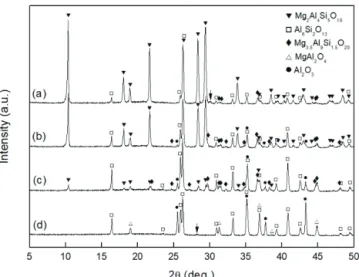
composites sintered at 1,450℃ are shown in Fig. 1. As the content of Al 2 O 3 increased, mullite (Al 6 Si 2 O 13 , ICDD #15- 0776), sapphirine ((Mg 3.5 Al 4.5 )(Al 4.5 Si 1.5 )O 20 , #71-2398), and spinel (MgAl 2 O 4 , #21-1152) were observed as the secondary phases. Mullite and sapphirine formed in the A10 composite, implying that cordierite may have been decomposed by the reaction with Al 2 O 3 . Cordierite remained the major phase until the content increased beyond 30 wt% (i.e., the A30 composite).

Although Al 2 O 3 started to appear at this point, it is not considered to have been in an equilibrium state. It has been reported that the tie line exists in the cordierite-Al 2 O 3 binary system below 1,386℃ in the MgO-Al 2 O 3 -SiO 2 ternary system;

however, there is another tie line in the mullite-sapphirine binary system at higher temperatures [13]. Further increasing the content to 50 wt% (i.e., A50) significantly reduced the

Fig. 1. Powder X-ray diffraction patterns of cordierite-Al

2

O

3

composite;

(a) A10, (b) A30, (c) A50, and (d) A70.

intensity of the diffraction peaks corresponding to cordierite, and resulted in mullite becoming the major phase. Cordierite and sapphirine were not present in the A70 composite and spinel was observed, implying that a tie line existed in the mullite- spinel binary system. The unidentified peaks of 2~30.0º [Fig.

1(a)] and 2~28.2 [Fig. 1(d)] indicated by arrow do not match the peaks of the MgO-Al 2 O 3 -SiO 2 ternary compounds. The further study on unidentified compounds is necessary.

The microstructures of the cordierite-Al 2 O 3 composites observed using FE-SEM are shown in Fig. 2. Sintering was carried out at 1,425℃ for the composites ranging from A10 to

Fig. 2. FE-SEM photographs of cordierite-Al

2

O

3

composite; (a) A10, (b)

(3)

J. Korean Inst. Electr. Electron. Mater. Eng., Vol. 34, No. 5, pp. 337-341, September 2021: Kim et al. 339

A30, (c) A50, and (d) A70.

A50, and at 1,500℃ for the A70 composite. All composites possessed dense microstructures. Moreover, flat-faced grains were observed, implying that the grain growth was determined by a solution-reprecipitation process that occurred during liquid phase sintering. According to the theory of liquid phase sintering, the dissolved solid diffuses through the liquid and precipitates onto solid surfaces with lower energies during the solution-reprecipitation process [14]. Furthermore, the formation of large and irregularly shaped grains is consistent with the occurrence of liquid phase sintering.

Fig. 3. Linear shrinkage of cordierite-Al

2

O

3

composite as a function of Al

2

O

3

content.

Fig. 4. Thermal expansion coefficient of cordierite-Al

2

O

3

composite as a function of Al

2

O

3

content.

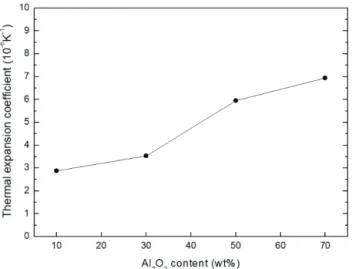
The linear shrinkage of cordierite-Al 2 O 3 composites sintered between 1,400℃ and 1,500℃ is shown in Fig. 3. The linear shrinkage of the specimens sintered at 1,400℃ was approximately 18%, whereas that of the specimens sintered above 1,425℃ exceeded 20%. As the Al 2 O 3 content increased, the linear shrinkage increased, which is considered to be due to the formation of liquid phase as mentioned above. The thermal expansion coefficient results for cordierite-Al 2 O 3

composites sintered between room temperature and 400℃ are shown in Fig. 4. As the content of Al 2 O 3 increased, the value of the thermal expansion coefficient increased. The increase in the thermal expansion coefficient is considered to be due to the formation of mullite and spinel, and/or the presence of Al 2 O 3 , as each of these compounds has a higher thermal expansion coefficient value than cordierite. The thermal expansion coefficient values for cordierite, mullite, spinel, and Al 2 O 3 are reported to be 0.9~2.5×10 -6 K -1 (20~1,000℃) [2], 4.4~5.3×10 -6 K -1 (20~1,000℃) [2,15], 5.6~7.9×10 -6 K -1 (25~200℃ and 25 ~1,000℃) [16], and 7.1~8.3×10 -6 K -1 [17], respectively.

The dielectric constant ( r ) results for cordierite-Al 2 O 3

composites sintered between 1,425℃ and 1,500℃ are shown in Fig. 5. As the content of Al 2 O 3 increased, the value of the dielectric constant increased. The increase of the dielectric constant is also considered to be due to the formation of mullite and spinel, and/or the presence of Al 2 O 3 , as each of these compounds has a higher dielectric constant value than cordierite. The dielectric constant values for cordierite, mullite, spinel, and Al 2 O 3 are reported to be 5.3~6.2 [6-8], 6.7~7.5 [18],

~8.3 [16,19], and 9.3~11.5 [17], respectively. Furthermore,

the dielectric constant of all specimens exhibited minimal

change, regardless of the sintering temperature. The quality

factor (Q×f 0 ) results for cordierite-Al 2 O 3 composites sintered

between 1,425℃ and 1,475℃ are shown in Fig. 6. The value

of the quality factor for the A10 specimen with mullite and

sapphirine as the secondary phases was measured to be 34,844

GHz; this value is reasonable because, as previously

mentioned, the quality factor of cordierite was reported to

range between 39,900 and 59,682 GHz [6-8]. As the content

of Al 2 O 3 and sintering temperature were further increased, the

value of the quality factor decreased. As shown in Figs. 1 and

2, the formation of the secondary phases and the presence of

the liquid phase may have reduced the quality factor of the

cordierite-Al 2 O 3 composite. The quality factor, i.e., the inverse

of the dielectric loss tangent, is associated with imperfections

(4)

340

전 J. Korean Inst. Electr. Electron. Mater. Eng., Vol. 34, No. 5, pp. 337-341, September 2021: Kim et al.

Fig. 5. Dielectric constant of cordierite-Al

2

O

3

composite as a function of Al

2

O

3

content.

Fig. 6. Quality factor of cordierite- Al

2

O

3

composite as a function of Al

2

O

3

content.

in the crystal structure, e.g., impurities, microstructural defects, grain boundaries, pores, microcracks, and random crystallite orientation [20,21]. As the Al 2 O 3 content increased, the linear shrinkage, thermal expansion coefficient, and dielectric constant increased but the quality factor decreased. The A10 composite (i.e., the 90 wt% cordierite and 10 wt% Al 2 O 3

composite) sintered at 1,425℃ showed a dense and pore-free microstructure, superior thermal expansion coefficient of 2.9×10 -6 K -1 , and the following microwave dielectric properties:  r =5.1 and Q×f 0 =34,844 GHz. It is expected that the A10 composite, which exhibits a low thermal expansion coefficient, can be applied as a ceramic heater.

4. CONCLUSIONS

The phase evolution, microstructure, microwave dielectric properties, and thermal expansion of cordierite-alumina composites were investigated. Increasing the Al 2 O 3 content caused mullite, sapphirine, and spinel to occur as the secondary phases, implying that cordierite may have been decomposed by the reaction with Al 2 O 3 . Cordierite and sapphirine were not observed in the 30 wt% cordierite and 70 wt%

Al 2 O 3 composite, and all specimens possessed dense microstructures. Additionally, flat-faced grains were observed, implying that the grain growth was determined by a solution- reprecipitation process that occurred during liquid phase sintering. Furthermore, the thermal expansion coefficient and dielectric constant increased as the Al 2 O 3 content increased, whereas the quality factor decreased. The thermal expansion coefficient, dielectric constant, and quality factor of the 90 wt%

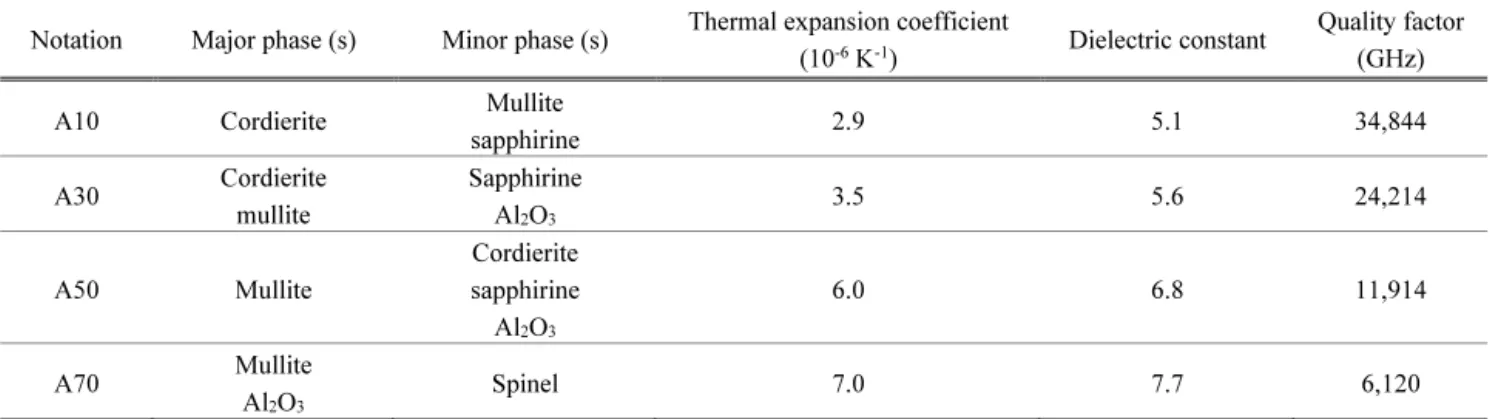
Table 1. Phase evolution, thermal expansion coefficient, dielectric constant and quality factor of cordierite-Al

2

O

3

composite.

Notation Major phase (s) Minor phase (s) Thermal expansion coefficient

(10

-6

K

-1

) Dielectric constant Quality factor (GHz)

A10 Cordierite Mullite

sapphirine 2.9 5.1 34,844

A30 Cordierite

mullite

Sapphirine

Al

2

O

3

3.5 5.6 24,214

A50 Mullite

Cordierite sapphirine

Al

2

O

3

6.0 6.8 11,914

A70 Mullite

Al

2

O

3

Spinel 7.0 7.7 6,120

(5)

J. Korean Inst. Electr. Electron. Mater. Eng., Vol. 34, No. 5, pp. 337-341, September 2021: Kim et al. 341

cordierite and 10 wt% Al 2 O 3 composite sintered at 1,425℃

were 2.9×10 -6 K -1 , 5.1, and 34,844 GHz, respectively. It is expected that the A10 composite, which exhibits a low thermal expansion coefficient, can be applied as a ceramic heater.

ORCID

Sang-Ok Yoon https://orcid.org/0000-0002-1175-3994

REFERENCES

[1] M. E. Tyrrell, G. V. Gibbs, and H. R. Shell, U.S. Bureau of Mines, Bulletin 594 (1961).

[2] J. Adler, Int. J. Appl. Ceram. Technol., 2, 429 (2005). [DOI:

https://doi.org/10.1111/j.1744-7402.2005.02044.x]

[3] D. J. Janackovic, V. Jokanovic, L. J. Kostic-Gvozdenovic, S.

Zec, and D. Uskokovic, J. Mater. Sci., 32, 163 (1997). [DOI:

https://doi.org/10.1023/A:1018595720313]

[4] A. Sommers, Q. Wang, X. Han, C. T’Joen, Y. Park, and A.

Jacobi, Appl. Therm. Eng., 30, 1277 (2010). [DOI: https://doi.

org/10.1016/j.applthermaleng.2010.02.018]

[5] M. Valásková, Ceram.-Silik., 59, 331 (2015).

[6] S. J. Lee and W. M. Kriven, J. Ceram. Process. Res., 4, 118 (2003).

[7] H. Ohsato, M. Terada, I. Kagomiya, K. Kawamura, K. I.

Kakimoto, and E. S. Kim, IEEE Trans. Ultrason. Eng., 55, 1081 (2008). [DOI: https://doi.org/10.1109/TUFFC.2008.760]

[8] H. Ohsato, I. Kagomiya, M. Terada, and K. Kakimoto, J. Eur.

Ceram. Soc., 30, 315 (2010). [DOI: https://doi.org/10.1016/

j.jeurceramsoc.2009.05.024]

[9] H. Ohsato, M. Ando, and T. Tsunooka, J. Korean Ceram. Soc., 44, 597 (2007). [DOI: https://doi.org/10.4191/kcers.2007.44.

1.597]

[10] M. N. Khezrabadi, R. Naghizadeh, P. Assadollahpour, and S. H.

Mirhosseini, J. Ceram. Process. Res., 8, 431 (2007).

[11] E. Sun, Y. H. Choa, T. Sekino, and K. Niihara, J. Ceram.

Process. Res., 1, 9 (2000).

[12] B. W. Hakki and P. D. Coleman, IEEE Trans. Microwave Theory Tech., 8, 402 (1960). [DOI: https://doi.org/10.1109/

TMTT. 1960.1124749]

[13] R. M. Smart and F. P. Glasser, J. Mater. Sci., 11, 1459 (1976).

[DOI: https://doi.org/10.1007/BF00540878]

[14] R. M. German, P. Suri, and S. J. Park, J. Mater. Sci., 44, 1 (2009).

[DOI: https://doi.org/10.1007/s10853-008-3008-0]

[15] Z. Chlup, D. N. Boccaccini, C. Leonelli, M. Romagnoli, and A.

R. Boccaccini, Ceram.-Silik., 50, 245 (2006).

[16] I. Ganesh, Int. Mater. Rev., 58, 63 (2013). [DOI: https://doi.org/

10.1179/1743280412Y.0000000001]

[17] A. M. Abyzov, Refract. Ind. Ceram., 60, 24 (2019). [DOI:

https://doi.org/10.1007/s11148-019-00304-2]

[18] K. Okada and H. Schneider, in “Mullite” (WILEY-VCH Verlag GmbH & Co. KGaA, Weinheim, 2005) p. 323.

[19] R. D. Shannon and G. R. Rossman, J. Phys. Chem. Solids, 52, 1055 (1991). [DOI: https://doi.org/10.1016/0022-3697(91)90038-2]

[20] S. J. Penn, N. M. Alford, A. Templeton, X. Wang, M. Xu, M.

Reece, and K. Schrapel, J. Am. Ceram. Soc., 80, 1885 (1997).

[DOI: https://doi.org/10.1111/j.1151-2916.1997.tb03066.x]

[21] N. M. Alford and S. J. Penn, J. Appl. Phys., 80, 5895 (1996).

[DOI: https://doi.org/10.1063/1.363584]

수치

Fig. 1. Powder X-ray diffraction patterns of cordierite-Al 2 O 3  composite;
Fig. 4. Thermal expansion coefficient of cordierite-Al 2 O 3  composite as a  function of Al 2 O 3  content
Table 1. Phase evolution, thermal expansion coefficient, dielectric constant and quality factor of cordierite-Al 2 O 3  composite

참조

관련 문서

This is because that the thermal conductivity and solar weighted absorption fraction of MWCNT/Fe 3 O 4 hybrid nanofluid is lower than those of MWCNT

Among the five sub-content categories, only in the communication domain 'listening and speaking', the social relations domain 'living together' and the

판단되는 경우에는 즉시 의사의 의료지도에 따를 것 다만 통신장애 등으로 인해 의사의 의료지도가 불.. 사람 외국에 있는 교육기관에서

The results of this study are as follows: ⑴ 4 basic directions, 16 themes, and 64 sub-themes of the vocational high school development are established, and

Eighth, the difference in life satisfaction according to the grade level of junior high school is a sub-factor of friendship, relationship a teacher,

§ Null-path-length balancing: comparing the null-path-length of each of the two sub-trees (the length to the closest null sub- tree/empty node). § Weight balancing:

* (2) reduction in height and formation of shrinkage cavity caused by solidification shrinkage; (3) further reduction in height and diameter due to thermal contraction

* (2) reduction in height and formation of shrinkage cavity caused by solidification shrinkage; (3) further reduction in height and diameter due to thermal contraction