[논 문] 한국재료학회지 DOI: 10.3740/MRSK.2008.18.6.298 Kor. J. Mater. Res.
Vol. 18, No. 6 (2008)
298
†
Corresponding author
E-Mail : [email protected] (D. S. Bae)
Synthesis and Characterization of Ni x Mn 1-x Fe 2 O 4 Nanoparticles by a Reverse Micelle Process
Sun-Woog Kim, Hyeon-Cheol Kim, Jun-Seop Kim, Hyun-Ju Kim, and Dong-Sik Bae
†School of Nano & Advanced Materials Science Engineering., Changwon National Univ., Gyeongnam, 641-773, Korea
(Received March 24, 2008 : Accepted May 30, 2008)
Abstract A preparation of Ni
xMn
1-xFe
2O
4nanoparticles produced via the reduction of Nickel nitrate hexahydrate, Manganese (II) nitrate hexahydrate and Iron nitrate nonahydrate with hydrazine in Igepal CO- 520/cyclohexane reverse micelle solutions was investigated. Transmission Electron Microscope (TEM), X-ray Diffraction (XRD) and Vibration Sample Magnetometer (VSM) analyses showed that the resultant nanoparticles increased the molar ration of water to Igepal CO-520 as the concentrations of Nickel nitrate hexahyrate, Manganese (II) nitrate hexahydrate and Iron nitrate nonahydrate increased. The average size of the synthesized particles calcined at 600
oC for 2hrs was in the range of 20 nm to 30 nm, and the particle distribution was broadened. The phase of the synthesized particles was crystalline, and the magnetic behavior of the synthesized particles was superparamagnetism. The effect of the synthesis parameters of the molar ratio of water to surfactant and the calcination temperature was discussed.
Key words Ni
xMn
1-xFe
2O
4nanoparticles, reverse micelle and superparamagnetism.
1. Introduction
Ferrites are important magnetic materials, which are widely used in many electronic and magnetic applications, such as in transformers, choke coils, high frequency application, data storage, noise filters and recording heads, due to their high magnetic perm abilities and low magnetic losses. Recently, the Magnetic Carrier Technology (MCT) was developed by using magnetic bead coated with bioactive materials for the selective extraction of biological components or delivery of medicine to intended body parts.
1,2)The small sizes and single domain natures of the nanosize ferrite powders give them superparamagnetic properties.
3)As a result of this property, magnetic fluids have been prepared from these ferrites.
The magnetic fluids can be used as material separation systems, dynamic loud speakers and acoustic devices.
4)In addition to the magnetic fluid applications such particles can be also used as Giant Magneto Resistant (GMR) materials in magnetic recording heads due to their single particle nature.
5)Many different ways of producing ferrite nanoparticles are described in the literature such as, hydrothermal processing, glycolthermal processing, Sol-Gel processing
and ion exchange resin manufacture methods.
6-10)Compared to other method, the reverse micelle method is one of the most promising wet chemistry syntheses. This method provides a favorable microenvironment for controlling the chemical reaction. So we can easily control the reaction rate in this method, compared to other method, and we are able to obtain a narrow size distribution of nanoparticles.
11)Reverse micelle solutions are transparent, isotropic, thermodynamically stable water-in-oil micro- emulsion in which the aqueous phase is dispersed as nanosized droplets surrounded by a monolayer of molecules in the continuous a polar organic phase.
12,13)The surfactant stabilized water pools provide a micro- environment for the preparation of ultrafin particles by exchanging their contents via the fusion redispersion process and by preventing the excess aggregation of particles.
14,15)Therefore, the particles obtained in such a medium are very fine and monodispersed.
The objective of this study is to prepare the Ni
xMn
1-xFe
2O
4nanoparticles with superparamagnetic property by reverse micelle method and to investigate the effects of the processing conditions on the formation, morphology and phase of the powders.
2. Experimental Procedure
Fig. 1 shows the schematic illustration of the reverse
Synthesis and Characterization NixMn1-xFe2O4 Nanoparticles by a Reverse Micelle process 299
micelle method. Microemulsions were prepared from cyclohexane (Sigma-Aldrich, HPLC grades), poly (oxyethylene) nonylphenyl ether (Aldrich Chemical Co.
LTD), generally known as Igepal CO 520 (Aldrich Chemical, 98% used without further purification), aqueous solutions of 1.4M Fe(NO
3)
3· 9H
2O, 1.4M Mn(NO
3)
3· 6H
2O and 1.4M Ni(NO
3)
3· 6H
2O (Aldrich Chemical, 99.9%). Microemulsion having a total volume 100ml was prepared at ambient temperature in a 250 ml vial with rapid stirring. The microemulsion were comprised of 20.05 g of Igepal CO 520, 50 ml of cyclohexane, 3.25-6.5 ml 10
−1M mixed aqueous solution (Mn : Ni : Fe = 1 : 1 : 4), deionizer water and 0.75-1.5 ml
NH
4OH. The average size of the synthesized powders was controlled by the R = [water] / [surfactant] ratio. The microemulsion was mixed rapidly, and after 5 min of equilibration. Reverse micelles were prepared from a nonionic surfactant Igepal CO-520. The microemulsion was then centrifuged to extract the particles, which were subsequently washed by ethanol to remove any residual surfactant and water. The structure, size and morphology of the resulting particles were examined by Transmission Electron Microscopy (TEM). The recovered powders were analyzed for phase composition using X-ray diffraction and magnetic property of the powder was measured by Vibrating Sample Magnetometer (VSM) at 298K.
3. Results and Discussion
Ternary systems of Cyclohexane / Igepal CO 520/water offer certain advantages: they are spheroid and mono- disperse aggregates where water is readily solubilized in the polar core, forming a ‘water pool’ characterized by the ratio of water to surfactant concentration. Another important property of reverse micelles is their dynamics character; the water pools can exchange their contents by a collision process. The aggregation and self assembly of the silver / surfactant / water species was complex and very little is known about the cluster growth and final nanostructure as a function of synthesis conditions. The molar ratio of water to surfactant can determine the size of the microemulsion water core.
16)Because of this hydrazine as a reducing agent is added to micellar solution containing metal ions in aerated solution. A change in the water content of the micelle, R, is obtained
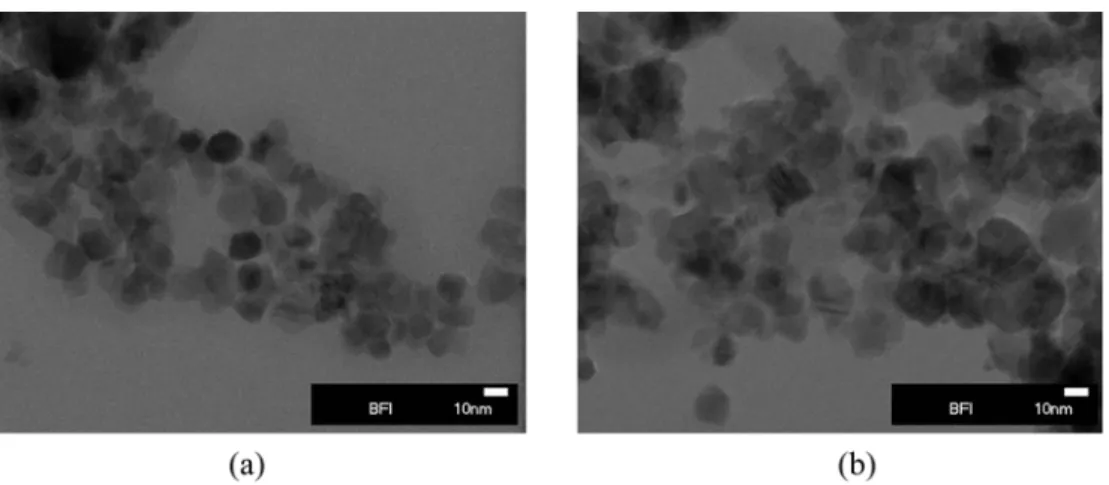
Fig. 2. TEM micrographs of the synthesized Ni
xMn
1-xFe
2O
4nanoparticles calcined at 600
oC for 2 hrs as a function of R by a reverse micelle process: a) R = 4 and b) R = 8.
Fig. 1. Experimental flow chart of synthesis of the Ni
xMn
1-xFe
2O
4nanoparticles by a reverse micelle process.
300 Sun-Woog Kim, Hyeon-Cheol Kim, Jun-Seop Kim, Hyun-Ju Kim and Dong-Sik Bae
by adding H
2O to the micellar solution before the reaction takes place. So that, it increased in the water content inducing an increase in the number of metal ions which react with the reducing agent. This favors the growth of the average size of particles. At relatively high water content (above R = 10), metal ions are totally hydrated and free water molecules are present. This favors diffusion of metal ions inside the droplet.
Electrostatic interactions between the head polar groups of the surfactant and metal ions oppose the hydration energy. The difference in these energies remains constant upon increasing the water content which keeps the particle size constant
17)and magnetic properties increase with increased particle size. Therefore, the diameter of the nanoparticles in the microemulsion can be controlled by the R value. Fig. 2 shows the transmission electron microscopy of the synthesized Ni
xMn
1-xFe
2O
4nano- particles calcined at 600
oC for 2 hrs as a function of water / surfactants molar ratio. It has been shown that the average size of the synthesized Ni
xMn
1-xFe
2O
4nano- particles was about 20 nm and synthesized Ni
xMn
1-xFe
2O
4particles size and distribution increased with increasing R from 4 to 8.
Fig. 3 shows the X-ray diffraction patterns of the Ni
xMn
1-xFe
2O
4particles as function of R. The X-ray powder diffraction patterns have shown that the synthesized magnetic particles had a single phase of Ni
xMn
1-xFe
2O
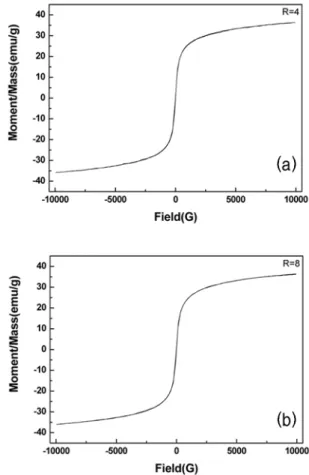
4. Fig. 4 shows magnetic property of the Ni
xMn
1-xFe
2O
4particles as a function of R (water / surfactants molar ratio). From the VSM analysis, the synthesized nanosize crystalline powder has exhibiting superparamagnetic property. As the single domain size of ferrite is reported to be around 70nm, the magnetization for particles below and above the single domain size will be different.
18)Samples which were synthesized by reverse micelle process with an average size of about 10 to 20 nm which are much smaller than the critical size of single domain ferrite estimated at about 70 nm giving more evidence for superparamagnetism assembly of single domain particles.
19)It might be possible that the magnetic nanoparticle could be applicable for drug delivery as nanoparticulate magnetic carrier.
4. Conclusion
Ni
xMn
1-xFe
2O
4nanoparticles have been prepared using a reverse micelle process. The water / surfactant molar
ratio influenced the average size and distribution of the synthesized particles. The average size of the synthesized particles increased with increasing R. The average size of synthesized particles was in the range of 20 nm to 30 nm and particle distribution was broadened. Reverse micelle Fig. 3. X-ray diffraction patterns of the synthesized Ni
xMn
1-xFe
2O
4nanoparticles calcined at 600
oC for 2 hrs as a function of R (water / surfactants molar ratio).
Fig. 4. Magnetic properties of the synthesized Ni
xMn
1-xFe
2O
4nanoparticles calcined at 600
oC for 2 hrs as a function of R
(water / surfactants molar ratio); a) R = 4 and b) R = 8.
Synthesis and Characterization NixMn1-xFe2O4 Nanoparticles by a Reverse Micelle process 301