• 검색 결과가 없습니다.

Fabrication and characterization of Zr<sub>x</sub>Ce<sub>1-x</sub>O<sub>2</sub> catalytic powder by a hydrothermal process

N/A
N/A
Protected

Academic year: 2021

Share "Fabrication and characterization of Zr<sub>x</sub>Ce<sub>1-x</sub>O<sub>2</sub> catalytic powder by a hydrothermal process"

Copied!
4
0
0

로드 중.... (전체 텍스트 보기)

전체 글

(1)

Journal of the Korean Crystal Growth and Crystal Technology Vol. 27, No. 6 (2017) 309-312

https://doi.org/10.6111/JKCGCT.2017.27.6.309

p-ISSN 1225-1429 e-ISSN 2234-5078

Fabrication and characterization of Zr x Ce 1−x O 2 catalytic powder by a hydrothermal process

Yeon-Bin Choi, Jeong-hun Son, Jeong Ho Sohn* and Dong-Sik Bae

Department of Advanced Materials Science and Engineering, Changwon National University, Changwon 51140, Korea

*School of Port and Logistics, Kaya University, Gimhae 50830, Korea (Received August 30, 2017)

(Revised November 7, 2017) (Accepted November 13, 2017)

Abstract The ceria powder is excellent in oxygen storage capacity (OSC) through the oxidation and reduction reaction of Ce ions and is used as a typical material for a three-way catalyst of an automobile which purifies the exhaust gas. However, since ceria generally has poor thermal stability at high temperatures, it is doped with metal ions to improve thermal stability. Therefore, in this study, Zr ions were doped into ceria powder, and their characteristics were further improved due to the increase of specific surface area with decreasing particle size due to doping. In this study, the synthesis of zirconium doped ceria nanopowder was synthesized by hydrothermal process. In order to synthesis Zr ion doped ceria nanopowder, the precursor reaction at was 200

o

C for 6 hours. The average particle size of synthesized Zr doped CeO

2

nanopowder was below 20 nm. The specific surface area of synthesized Zr ion doped ceria nanopowder increased from 52.03 m

2

/g to 132.27 m

2

/g with Zr increased 30 %.

Key words Zr doped CeO

2

, Hydrothermal process, Nanopowder, High surface area

수열합성공정에 의한 Zr

x

Ce

1−x

O

2

촉매 분말의 제조 및 특성

최연빈, 손정훈, 손정호*, 배동식

창원대학교 신소재공학부, 창원, 51140

*가야대학교 항만물류학과, 김해, 50830 (2017 년 8월 30일 접수)

(2017 년 11월 7일 심사완료) (2017년 11월 13일 게재확정)

요 약 세리아 분말은 Ce 이온의 산화, 환원 반응을 통한 산소저장능력(OSC)이 뛰어나 배기가스를 정화하는 자동차의 삼원촉매에 대표적인 재료로 사용된다. 그러나 일반적으로 세리아는 고온에서 열적 안정성이 떨어지기 때문에 금속이온을 도핑시켜 열적 안정성을 향상시켜 사용한다. 따라서 본 연구에서는 Zr 이온을 세리아 분말에 도핑시켰고, 도핑으로 인해 입자크기가 감소하면서 비 표면적 증가로 인해 그 특성은 더욱 향상되었다. 그리고 본 연구에서는 세리아 및 Zr 이온이 도 핑된 세리아를 나노 크기로 합성하기 위해 수열반응법을 이용하여 합성하였다. 수열합성 조건은 pH = 11, 반응온도는 200

o

C 에서 6시간 동안 합성하였다. 수열합성법을 이용하여 합성된 세리아 및 Zr 도핑 CeO

2

나노 분말의 평균 입자 크기는 약 20 nm 이하였다. 합성된 세리아 나노분말의 비표면적은 52.03 m

2

/g, Zr 이온이 도핑된 CeO

2

분말의 비 표면적은 132.27 m

2

/g 이었다.

1. 서 론

산업이 발달하여 에너지 소비의 증가로 인해 대기오염 이 심각해지고 있는 상황이다. 여러 가지 대기오염의 원 인 중에서 자동차 배기가스에 대한 규제가 세계적으로

특히 강화되고 있는 추세이다[1-7]. 그래서 최근 자동차 배기가스의 유해물질을 제거하기 위한 각종 연구가 활발 히 진행 중이다[8]. 세리아(CeO

2

) 는 산화/환원 반응성이 우수한 특성으로 인해 자동차 배기 가스를 정화시킬 수 있는 삼원 촉매로 널리 알려져 있는데, 세리아의 우수한 산화 환원 반응은 4f-5d 궤도의 전자가 비슷한 에너지를 가지는 상태여서 상대적으로 전자의 교환이 쉽게 일어날 수 있다고 알려져 있다[9-18]. 세리아 입자를 합성하는

Corresponding author

E-mail: [email protected]

(2)

310 Yeon-Bin Choi, Jeong-hun Son, Jeong Ho Sohn and Dong-Sik Bae

방법은 고상법, 공침법, 에멀젼법, 졸-겔법, 수열 합성법 등 다양한 공정이 있는데, 여러 가지 공정 중에서 수열 합성법은 임계점 이상의 온도 및 압력 조건에서 반응물 간의 반응 속도를 촉진하여 합성하는 방법으로 반응온도, 반응시간, pH 등의 공정 변수를 제어하여 형상 및 크기 를 제어할 수 있다고 알려져 있고, 특히 합성되는 입자 의 크기를 나노 크기로 합성할 수 있기 때문에 입자크기 를 미세화 함으로써 비표면적의 증가로 인한 촉매 활성 도를 높일 수 있는 장점이 있다[19-21]. 최근에는 순수 세리아에 금속이온을 도핑 시킴으로써 미세구조의 형상 제어를 통해 비표면적을 더욱 증가시켜 촉매 활성도를 더욱 향상시키는 연구들이 진행 중이다[22].

본 연구에서는 수열합성법을 이용하여 순수세리아 나 노 분말을 합성하였고, 더욱 우수한 비표면적을 가지는 세리아 나노분말을 합성하기 위해 Zr 이온을 도핑하여 나노 분말을 합성하는 연구를 진행하였다.

2. 실 험

수열합성법을 이용하여 Zr

x

Ce

1−x

O

2

나노 분말을 합성하 는 실험 공정도를 Fig. 1에 도식화하여 나타내었다. 실 험에 사용된 전구체는 Cerium nitrate[Ce(NO

3

)

3

· 6H

2

O, 99 %, 9SIGMA-ALDRICH] 와 Zirconium(IV) oxychroride octahydrate[ZrOCl

2

· 8H

2

O, 99 %, SIGMA-ALDRICH] 이 다. 각 전구체를 증류수에 용해시킨 뒤 300 rpm으로 1시 간 동안 교반하였다. 용해도적(Ksp)을 고려하여 촉매인 Ammonium hydroxide[NH

4

OH, 25.0~28.0 %, DAEJUNG]

를 이용해 용액의 pH를 11로 제어한 뒤 충분히 교반 후 고온반응용기(Autoclave)에 용액을 넣고 밀봉시킨 뒤 반 응온도를 200

o

C 에서 6시간 동안 반응을 진행하였다. 얻

어진 반응물은 원심분리기를 이용하여 Ethyl alcohol [C

2

H

5

OH, 95.0 %, SAMCHUN] 로 5회 세척한 뒤, 건조 기에서 100

o

C 로 하루 동안 건조하여 나노 분말을 회수 하였다. 합성된 세리아 분말 및 Zr

0.3

Ce

0.7

O

2

분말의 입자 형상과 크기는 전계 방사형 투과전자현미경(FE-TEM, JEM 2100F, JEOL) 을 이용하여 관찰하였고, 결정 구조는 X-ray diffraction(XRD, MiniFlex II, Rigaku) 을 이용하여 분석하였다. 합성된 분말의 비표면적은 BET(Autosorb- iQ, Quantachrome Instrement) 를 이용하여 분석하였다.

3. 결과 및 고찰

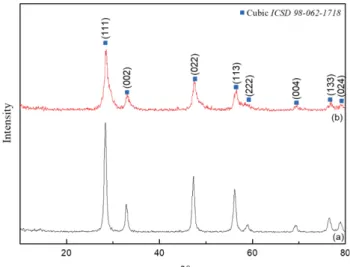
Fig. 2 는 수열합성법을 이용하여 합성된 세리아 나노 분말 및 Zr

0.3

Ce

0.7

O

2

나노 분말의 결정성을 알아보기 위 한 XRD 분석 결과를 나타내었다. 분석결과, 이차상이 없는 우수한 결정성을 가지는 Cubic상의 세리아 peak가 관찰되었다. Fig. 3은 세리아 나노분말 및 Zr

0.3

Ce

0.7

O

2

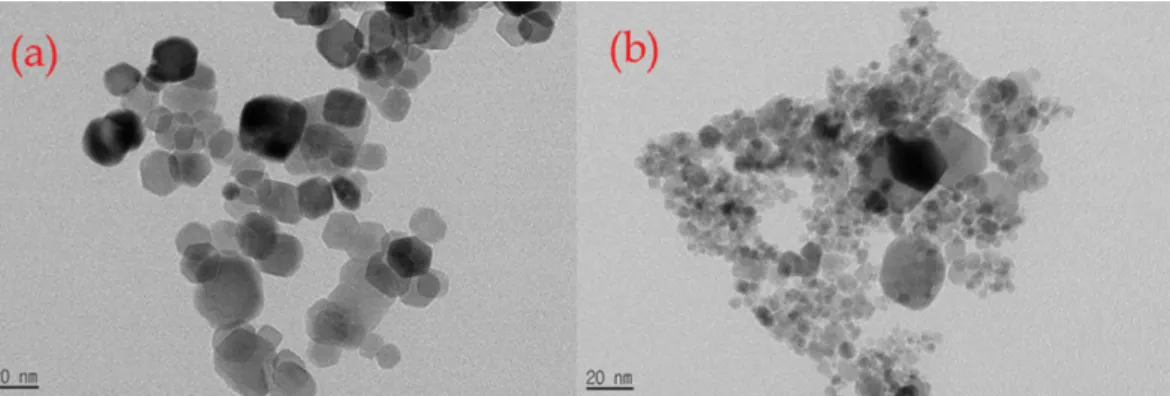
나노분말의 미세구조를 확인하기 위해 전계 방사형 투과 전자 현미경 분석(FE-TEM) 결과이다. 전체적으로 구형 의 아주 미세한 입자들이 합성된 것을 관찰할 수 있었으 며, Fig. 3(a)에 나타나듯이 합성된 세리아는 대략 20 nm 정도의 크기로 확인되었으며, Fig. 3(b)를 보면 Zr 이온 이 30 mol% 첨가된 경우 10 nm 이하의 더욱 미세한 크 기를 가지는 세리아 분말이 합성된 것을 관찰할 수 있었 다. Table 1은 Scherrer 공식을 이용하여 세리아 나노분 말과 Zr

0.3

Ce

0.7

O

2

의 평균 입자 크기를 계산한 결과와 비 표면적을 확인하기 위한 BET 측정결과를 나타내었다.

계산된 입자들의 평균 크기는 순수 세리아일 때는 대략 14 nm 였고, Zr 이온이 30 mol% 첨가된 경우 계산된 입

Fig. 1. Experimental procedure of the synthesis of Zr

x

Ce

1−x

O

2

nanoparticles by a hydrothermal process.

Fig. 2. X-ray diffraction pattern of the Zr

x

Ce

1−x

O

2

nanoparticles by hydrothermal method at pH = 11 and 200

o

C for 6 h with

various x; (a) x = 0 and (b) x = 0.3.

(3)

Fabrication and characterization of Zr

x

Ce

1−x

O

2

catalytic powder by a hydrothermal process 311

자의 크기는 대략 8 nm 정도로 계산되었다. 측정된 비 표면적은 순수 세리아일 때는 52.03 m

2

/g 였고 Zr 이온이 30 mol% 첨가된 경우 132.27 m

2

/g 의 우수한 비표면적을 보였다. 순수 세리아 나노분말과 비교하여 Zr 이온이 첨 가된 경우 합성된 입자의 크기가 작아지면서 비표면적이 상대적으로 증가한 결과로 판단된다[23, 24].

4. 결 론

수열합성법을 이용하여 세리아 및 Zr

0.3

Ce

0.7

O

2

나노 분 말을 합성하였다. 합성된 세리아 나노 분말 및 Zr

0.3

Ce

0.7

O

2

나노 분말는 우수한 결정성을 가지는 cubic상을 가지는 것을 확인하였다. 합성된 세리아는 대략 20 nm 정도의 크기로 관찰되었고, Zr이 도핑된 경우 10 nm 이하의 크 기로 관찰되었다. 세리아 나노분말의 비표면적은 52.03 m

2

/g 였고 Zr이 도핑된 경우 132.27 m

2

/g 의 우수한 비표 면적을 나타내었다.

감사의 글

This work was supported by the Human Resource Training Program for Regional Innovation and Creativity through the Ministry of Education and National Research Foundation of Korea (2015H1C1A1035600).

References
[ 1 ] N. Phonthammachai, M. Rumruangwong, E. Gulari, A.M. Jamieson, S. Jitkarnka and S. Wongkasemjit,

“Synthesis and rheological properties of mesoporous nanocrystalline CeO

2

via sol-gel process”, Colloids Surf.

A 247 (2004) 61.

[ 2 ] L. Liu and L. Hong, “Ceria-supported nickel borate as a sulfur-tolerant catalyst for autothermal reforming of a proxy jet fuel”, Catal. Today 263 (2016) 52.

[ 3 ] L. Ilieva, G. Pantaleo, I. Ivanov, R. Nedyalkova, A.M.

Venezia and D. Andreeva, “NO reduction by CO over gold based on ceria, doped by rare earth metals”, Catal.

Today 139 (2008) 168.

[ 4 ] Q. Fu, S. Kudriavtseva, H. Saltsburg and M.F. Stepha- nopoulos, “Gold-ceria catalysts for low-temperature water-gas shift reaction”, Chem. Eng. J. 93 (2003) 41.

[ 5 ] H.C. Yao and Y.F.Y. Yao, “Ceria in automotive exhaust catalysts: 1. oxygen storage”, J. Catal. 86 (1984) 254.

[ 6 ] T. Bunluesin, R.J. Gorte and G.W. Graham, “Studies of the water-gas-shift reaction on ceria-supported Pt, Pd, and Rh: implications for oxygen-storage properties”, Appl. Catal. B. 15 (1998) 107.

[ 7 ] G. Panzera, V. Modafferi, S. Candamano, A. Donato, F.

Frusteri and P.L. Antonucci, “CO selective oxidation on ceria-supported Au catalysts for fuel cell application”, J.

Power Sources 135 (2004) 177.

[ 8 ] A.V. Thorat, T. Ghoshal, P. Carolan, J.D. Holmes and M.A. Morris, “Defect chemistry and vacancy concentra- tion of luminescent europium doped ceria nanoparticles by the solvothermal method”, J. Phys. Chem. C. 118 (2014) 10700.

[ 9 ] P. Bera, A. Gayen, M.S. Hegde, N.P. Lalla, L. Spadaro, F. Frusteri and F. Arena, “Promoting effect of CeO

2

in combustion synthesized Pt/CeO

2

catalyst for CO oxida- tion”, J. Phys. Chem. B. 107 (2003) 6122.

[10] R. Li, S. Yabe, M. Yamashita, S. Momose, S. Yoshida, S. Yin and T. Sato, ”Synthesis and UV-shielding proper- ties of ZnO- and CaO-doped CeO

2

via soft solution chemical process”, Solid State Ionics 151 (2002) 235.

[11] K. Tanwar, N. Jaiswal, D. Kumar and O. Parkash, “Syn- thesis & characterization of Dy and Ca Co-doped ceria based solid electrolytes for IT-SOFCs”, J. Alloys Compd. 684 (2016) 683.

Fig. 3. FE-TEM images of the Zr

x

Ce

1−x

O

2

nanoparticles by hydrothermal method at pH = 11 and 200

o

C for 6 h with various x;

(a) x = 0 and (b) x = 0.3.

Table 1

Crystal size and Specific surface area of the Zr

x

Ce

1−x

O

2

nano- particles by hydrothermal method at pH = 11 and 200

o

C for 6 h with various x; (a) x = 0 and (b) x = 0.3

Zr

x

Ce

1−x

O

2

(a) (b)

Crystal size (nm) 14.49 8.04

FWHM (

o

) 0.56 1.01

BET (m

2

/g) 52.03 132.27

(4)

312 Yeon-Bin Choi, Jeong-hun Son, Jeong Ho Sohn and Dong-Sik Bae

[12] P. Jasinski, T. Suzuki and H.U. Anderson, “Nanocrystal- line undoped ceria oxygen sensor”, Sensor Actuator B Chem. 95 (2003) 73.

[13] O.P. Rodríguez, C.F. Valdés, M. Garriga, M.I. Alonso, X. Obradors and T. Puig, “Optical properties of ceria- zirconia epitaxial films grown from chemical solu- tions”, Mater. Chem. Phys. 138 (2013) 462.

[14] B. Choudhury and A. Choudhury, “Ce

3+

and oxygen vacancy mediated tuning of structural and optical prop- erties of CeO

2

nanoparticles”, Mater. Chem. Phys. 131 (2012) 666.

[15] Z. Fang, K.S. Thanthiriwatte, D.A. Dixon, L. Andrews and X. Wang, “Properties of cerium hydroxides from matrix infrared spectra and electronic structure calcula- tions”, Inorg. Chem. 55 (2016) 1702.

[16] A.G. Macedo, S.E.M. Fernandes, A.A. Valente, R.A.S.

Ferreira, L.D. Carlos and J. Rocha, “Catalytic perfor- mance of ceria nanorods in liquid-phase oxidations of hydrocarbons with tert-butyl hydroperoxide”, Mole- cules. 15 (2010) 747.

[17] S.A. Tabrizi, “Optimization of the synthesis parameters of high surface area ceria nanopowder prepared by sur- factant assisted precipitation method”, Appl. Surf. Sci.

257 (2011) 10595.

[18] C.M.Y. Yeung, F. Meunier, R. Burch, D. Thompsett and S.C. Tsang, “Comparison of new microemulsion pre- pared “Pt-in-ceria catalyst with conventional Pt-on-ceria catalyst for water-gas shift reaction”, J. Phys. Chem. B.

110 (2006) 8540.

[19] K. Higashi, K. Sonoda, H. Ono, S. Sameshima and Y.

Hirata, “Synthesis and sintering of rare-earth-doped ceria powder by the oxalate coprecipitation method”, J.

Mater. Res. 14 (1999) 957.

[20] X. Gao, Y. Jiang, Y. Zhong, Z. Luo and K. Cen, “The activity and characterization of CeO

2

-TiO

2

catalysts pre- pared by the sol-gel method for selective catalytic reduc- tion of NO with NH

3

”, J. Hazard. Mater. 174 (2010) 734.

[21] T. Karaca, T.G. Altıncekic and M.F. Oksuzomer, “Syn- thesis of nanocrystalline samarium-doped CeO

2

(SDC) powders as a solid electrolyte by using a simple solvo- thermal route”, Ceram. Int. 36 (2010) 1101.

[22] W. Yuejuan, M. Jingmeng, L. Mengfei, F. Ping and H.

Mai, “Preparation of high-surface area nano- CeO

2

by template-assisted precipitation method”, J. Rare Earth.

25 (2007) 58.

[23] H. Wang, X. Gong, Y.L. Guo, Y. Guo, G. Lu and P. Hu,

“A model to understand the oxygen vacancy formation in Zr-doped CeO

2

: electrostatic interaction and struc- tural relaxation”, J. Phys. Chem. 113 (2009) 10229.

[24] P. Singh and M. S. Hegde, “Controlled synthesis of nanocrystalline CeO

2

and Ce

1−x

M

x

O

2−d

(M = Zr, Y, Ti, Pr and Fe) solid solutions by the hydrothermal method:

Structure and oxygen storage capacity”, J. Solid State

Chem. 181 (2008) 3248.

수치

Fig. 1. Experimental procedure of the synthesis of Zr x Ce 1−x O 2 nanoparticles by a hydrothermal process.
Fig. 3. FE-TEM images of the Zr x Ce 1−x O 2  nanoparticles by hydrothermal method at pH = 11 and 200 o C for 6 h with various x;

참조

관련 문서

Among the sub-factors, confidence, The factors of setting, team harmony, image and will power were higher in the group with national representative

Third, looking at the sub-factors in terms of textbooks and software by priority, they were in the order of development of textbooks and learning tools

For the gender, while training and direction, democratic direction, positive regard, and autocratic direction of leadership type sub-factors were perceived as high in

Fourth, for the sub-factors of personality traits according to weight lifters’ education, while there was a high difference in neuroticism and agreeableness

For the sub-factors of selection attributes and customer value according to screen golf course handicap, convenience, professionality, facilities, price,

The results of this study are as follows: ⑴ 4 basic directions, 16 themes, and 64 sub-themes of the vocational high school development are established, and

&#34;Relationship between variations of 7Be, 210Pb and 212Pb concentrations and sub-regional atmospheric transport: simultane- ous observation at distant

• Inertial sub-layer, viscosity plays a minor role. • Main turbulent