계층적 이동 IP 네트워크에서의 비용 효율적인 IP 페이징 기법
공 기 식* 정회원
A Cost-Effective IP Paging Scheme for Hierarchical Mobile IP Networks
Ki-Sik Kong* Regular Members
요 약
IP 기반의 이동 네트워크에서 페이징 메커니즘을 IP 계층에서 처리하는 기술(즉, IP 페이징)은 이동 단말의 전력 소모와 위치 등록 시 그널링 부하를 감소시켜주며, 이기종 무선 액세스 기술들을 지원하는 것을 가능하게 한다. 그러나, 통신이 매우 빈번한 환경 하에서는 증가하는 페이징 시그널링 부하와 잦은 페이징 지연으로 인하여 오히려 IP 페이징의 사용은 역효과를 초래할 수도 있다. 따라서, 본 논 문에서는, 이러한 IP 페이징의 문제점을 해결하고자, 이동 단말이 자신의 프로파일 정보에 기반하여 선택적인 위치 등록 및 페이징을 수 행할 수 있도록 하는 비용 효율적인 IP 페이징 기법을 제안한다. 성능 평가 결과, 제안 기법은 IP 기반의 계층적 이동 네트워크에서 상 당한 정도의 페이징 시그널링 부하와 잦은 페이징 지연을 감소시킬 수 있다는 것을 보여준다.
Key Words : IP paging; hierarchical mobile IP; mobility management; paging signaling cost; paging delay
ABSTRACT
Handling paging mechanism at the IP layer (i.e., IP paging) makes it possible to support heterogeneous wireless access technologies, providing energy-saving and reduced location registration signaling overhead over IP-based mobile networks. However, IP paging may rather cause adverse effects under active communication environments because of significant paging signaling overhead and frequent paging delay. Therefore, in order to solve these problems, a cost-effective IP paging scheme is proposed in this paper, which enables a mobile node to perform selective registration and paging based on its profile information. Numerical results indicate that the proposed scheme has apparent potential to mitigate considerable paging signaling overhead and frequent paging delay in IP-based hierarchical mobile networks.
*남서울대학교 멀티미디어학과([email protected])
※ 이 논문은 2011학년도 남서울대학교 학술연구비 지원에 의하여 연구되었음.
접수일자 : 2011년 11월 1일, 수정완료일자 : 2011년 11월 21일, 최종게재확정일자 : 2011년 12월 2일
I. Introduction
Unlike access technology-specific paging, handling paging mechanism at the IP layer (i.e., IP paging) can offer paging functionality independent of underlying access technology, and thus provide an IP-based common infrastructure to support heterogeneous wireless networks, which avoids the duplication of the functions between different wireless networks and interoperability issues that exist today [1]. In order to reduce the unnecessary signaling load and to improve the scalability in
IP-based mobile networks, various works on IP paging have been proposed in the literature [2-7].
The notion of active state and idle (i.e., dormant) state have been defined in [1, 2]. In active state, a mobile node (MN) is tracked at the finest granularity possible such as its current cell, which results in no need for paging. When there is not any traffic to/from a MN for an active state timer, the MN should be in idle state. In idle state, a MN is tracked at much coarser granularity such as a paging area (PA) composed of a group of cells. Hence, a MN updates its location to the network less frequently in idle state than in active state.
However, when there is any traffic destined to the MN, the paging procedure should be performed to find the exact location of the MN.
In [3], a paging extension to Mobile IP (PMIP) has been proposed. Although PMIP as well as the work in [1] are efficient and scalable IP paging protocols, they may not be good choice for the MNs with low mobility and high paging rate. That is, adverse effects can rather arise under active communication environments because of significant paging signaling overhead and frequent paging delay. In [4, 5], the adaptive IP paging schemes, in which a MN continuously calculates its optimal paging areas to minimize the signaling load in the network, were proposed. However, by considering various kinds of a MN-specific and time-varying parameters, their operations seem to be difficult to implement, and they can also adversely impact the processing load on the MNs. Moreover, it seems difficult that the MN determines some of the input parameters required for its paging area optimization process [4].
Considering the real implementation issue, therefore, quasi-optimal approach can be more preferable than more optimal ones such as adaptive and dynamic schemes. In [6], user independent paging scheme for Mobile IP was proposed. However, this scheme has some drawbacks that whenever an idle MN finds that it is in a foreign agent (FA) cell other than its registered FA (RFA), it should reply to agent advertisement messages via wireless link to provide some basic information to its current FAs cells.
Considering several problems revealed in the previous works [1, 3, 4, 5, 6], we claim that i) an IP paging scheme should be able to solve the adverse effects under active communication environments.
However, ii) it should not be so sophisticated as to be easily implementable. Moreover, iii) additional overhead due to IP paging should be as minimal as possible and it should be scalable scheme. Therefore, in this paper, we propose a lightweight, but cost-effective IP paging scheme, which enables a MN to perform selective registration and paging in hierarchical Mobile IP networks.
Ⅱ. System Architecture
The next generation wireless cellular networks are envisioned as pure IP-based networks where base
stations (BSs) are IP routers [3]. Hierarchical architecture employing Mobile IP regional registration (MIPR) [8] is assumed to be the reference architecture for the proposed scheme. A domain consists of a number of FAs and a gateway FA (GFA), where a FA is integrated with exactly one BS and a subnet consists of only one FA. For simplicity, we assume that each FA assigns only one network prefix per wireless interface. The FAs within a GFA domain can be grouped into a single PA. For simplicity, a GFA domain is assumed to be equal to a PA. We assume that a MN knows the current FA's PA identifier by listening to the agent advertisement periodically broadcasted by the FA. In [2], the functional architecture for IP paging such as tracking agent, paging agent, and dormant monitoring agent was defined. Thus, all these agents are assumed to be integrated into the GFA in this paper.
Ⅲ. The Proposed Scheme
The basic idea of the proposed scheme is that the traffic distributions for most of the MNs are usually concentrated in several specific regions (hereafter, we call home cells) such as their homes and workplaces as compared with other regions (hereafter, we call foreign cells) [9]. Thus, for the idle MN residing in its foreign cell, it is tracked at coarse granularity (i.e., a PA). However, for the MN residing in its home cell, it is tracked at the finest granularity possible (i.e., a cell) although it is in idle state. Therefore, when a MN moves into/out of its home cell regardless of its state, an explicit registration is performed based on its profile that the MN maintains, which contains its home cell addresses. Instead, a packet forwarding without any paging signaling overhead and paging delay can be directly performed for the frequent incoming sessions which occur during a MN's home cell residence time. In contrast, with relatively infrequent incoming sessions for the idle MN residing in its foreign cell, a packet forwarding is performed after carrying out paging procedure.
1. Extended Regional Registration Request Message In order to support the differentiated mobility/
traffic handling in the proposed scheme, the meanings of r and x bits are extended in the
regional registration request message of MIPR [8]1). If r bit is set to 1, it indicates that the MN supports the proposed scheme. If x bit is 0, it implies that the MN is currently in its foreign cell, and thus, on receiving future incoming sessions, paging procedure is performed to find the exact location of the MN.
However, if x bit set to 1, it implies that the MN is currently in its home cell. In other words, in this case, just like in MIPR, on receiving future incoming sessions, the GFA forwards the packets directly to the MN without initiating paging. According to whether or not r and x bits being set, the following three cases of the bit combination can be possible.
(a) (r, x) = (0, 0): This case implies that a MN does not support the proposed scheme (i.e., in this case, it operates just like MIPR).
(b) (r, x) = (1, 0): This case implies that a MN supports the proposed scheme and it is currently in its foreign cell (i.e., in this case, it operates just like PMIPR2)).
(c) (r, x) = (1, 1): This case implies that a MN supports the proposed scheme and it is currently in its home cell (i.e., in this case, it operates just like MIPR).
Note here that the bit combination (r, x) = (0, 1) is not defined and meaningful.
2. Location Registration
Whenever a MN changes the GFA domains, it checks its profile to see if there is any home cell address which belongs to the addresses within the visited GFA domain. If found, the MN performs home registration3) with additional extensions containing those home cell addresses. In EPMIPR, in case of an active MN (regardless of whether it is currently in its home cell or not), it operates exactly in the same way as in MIPR except for the inter-GFA domain movement mentioned above. Basically, in case of an idle MN, no registration is performed within the
1) We extend the meanings of r and x bits in the regional registration request message defined in [8].
2) Basically, the proposed scheme operates based on MIPR, while PMIP operates based on MIP. In this paper, we call "an application of PMIP based on MIPR" as "PMIPR". Also, The proposed scheme, which is called EPMIPR, is an Enhanced version of PMIPR that enables a MN to perform selective registration and paging/packet delivery.
3) After this procedure, the GFA records those home cell addresses for selective paging without its home cells being included for future incoming sessions.
same PA when a idle MN crosses between the foreign cells. However, in case of the idle MN entering (or leaving) its home cell, it performs regional registration with r and x bits set to 1 (or r bit set to 1 and x bit set to 0 in case of leaving its home cell) to explicitly inform whether it is currently in its home cell or not. Whether a new cell is its home cell or not can be determined by the MN by checking if there is any match between a new care-of-address (CoA) and the home cell addresses stored in a MN's profile. If a match is found, the MN concludes that the new cell is its home cell.
3. Paging and Packet Delivery
When the GFA receives the incoming sessions destined to the MN, it first determines whether it has a record for the MN. If a record exists, then the GFA determines if both the MN supports EPMIPR and it is currently in its home cell by checking r and x bits. Then, in case the MN is in its foreign cell, the GFA checks the MN's state. If the MN does not support EPMIPR (i.e., case (a) in Sect.III.1) or if it is in its home cell regardless of its state (i.e., case (c) in Sect.III.1) or if the MN residing in its foreign cell is in active state, the GFA decapsulates the packets and forwards them directly to the MN without initiating paging. On the other hand, if the MN residing in its foreign cell is in idle state (i.e., case (b) in Sect.III.1), the GFA starts buffering the packets for the MN and sends the paging request messages to all FAs which do not include the MN's home cells within a PA. Then, if the MN receives the paging request message, it performs a regional registration to the GFA, and the GFA forwards buffered packets to the MN.
4. Determination of Home Cells
In order to determine the home cells for a particular MN, its movements and traffic throughout the days or weeks may be observed over a long period of time. For example, each MN may measure the number of session arrivals and cell crossings, in order to calculate its session-to-mobility ratio (SMR) at every cell that the MN resides, which implies that the larger the SMR of a MN is at specific cell, the more incoming sessions for the MN can occur at that cell. Then, based on aforementioned observations and the actual trace data [9]-[11],
Mobility
protocol Notation Derived Signaling cost
MIP
≠
MIPR
≠
PMIP
≠
PMIPR
≠
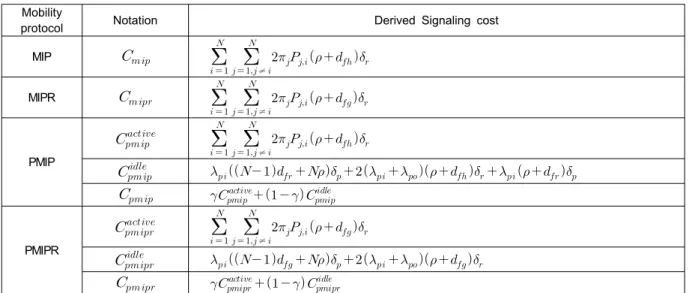
Table I. The derived signaling costs of each mobility management protocol
choosing only a few cells4) as each MN's home cells would be sufficient. Otherwise, home cells can be manually configured according to the MN's willingness to get a higher quality of service. How to manage each MN's profile and how to determine it home cell is an important research issue by itself, and is beyond the scope of this paper. For simplicity, we assume that the home cell addresses are already preconfigured in the MN's profile.
IV. Analytical Model
Let and be the location probability of a MN in a cell j and the set of neighbors in a cell j, respectively. Let be the transition probability for a MN to reach any neighboring cell i in or to stay in a cell j itself. Let , , and be the average hop distance between FA and RFA/GFA/HA, respectively. In addition, the followings are assumed: a PA is composed of N cells (i.e., N FAs), and there exist m ≤ ≤ home cells in a PA. The signaling cost in the air is assumed to be
times higher than the wireline unit hop distance signaling cost. The registration and paging costs are assumed to be proportional to the product of the hop distance and the weighting factors of registration and paging costs: and . For analysis, we consider the average signaling cost composed of registration and paging costs, which is generated by a MN while
4) It was observed that i) about 80% of the mobile users visit fewer than 20 cells [10], and ii) a few cells have a high level of packet call activity, while many cells have a relatively low level of activity [11].
it resides within a PA. For simplicity, we assume that the MN has just completed home registration.
1. Signaling Cost Analysis
Similar as in MIPR, the average signaling cost of EPMIPR in active state is composed of only regional registration costs. Therefore, it can be expressed as
≠
(1)
On the other hand, the average signaling cost of EPMIPR in idle state is composed of regional registration cost and paging cost. Let and
denote the average number of the incoming and outgoing sessions during a MN's foreign cell residence time, respectively. Let us label all home cells of a MN within a PA from to . The other cells (i.e., foreign cells) are labeled from
to (Refer to the network model shown in Fig.1). Thus, the average signaling cost of EPMIPR in idle state is calculated as
≠
≠
(2) where the first and second terms represent the average registration cost generated when an idle MN
Figure 1. Interconnections of all cells within a PA
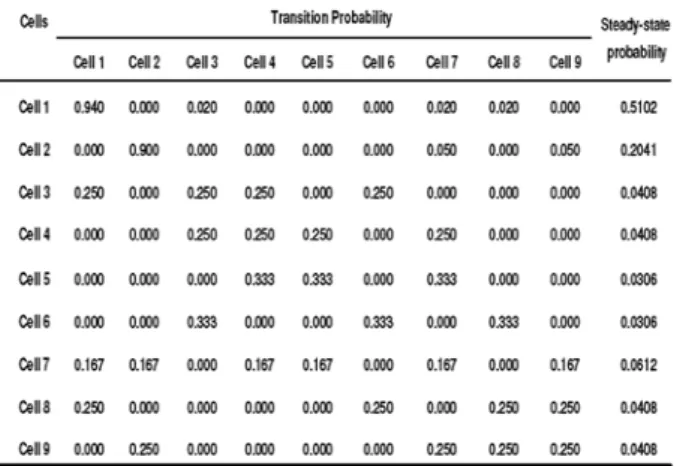
Figure 2. Transition probability matrix and steady-state probabilities
moves into/out of its home cells during its PA residence time. Note that in the third and fourth terms, the paging and its subsequent registration procedures are performed only for the foreign cells, and the fourth term in Eq.(2) indicates the registration cost generated by the incoming and outgoing sessions which occur while an idle MN resides in its foreign cells.
Note here that similar to PMIP, in case of the idle state, the MN that is about to send the outgoing packets should also register with the GFA before it sends the packets. Let be the ratio of a MN's active time to its PA residence time. Then, the average signaling cost in EPMIPR can be finally expressed as
(3)
Basically, the basic operation of EPMIPR is somewhat similar to that of PMIP [3]. However, EPMIPR integrates MIPR with IP paging, reflecting a MN's locality characteristics in traffic/mobility patterns. Therefore, in order to investigate comparative performance study among EPMIPR and other related protocols, the average signaling costs of MIP, MIPR, PMIP, and PMIPR are also derived similar to Eq.(1)-(3), and summarized in Table I, respectively.
2. Paging Delay Analysis
In this paper, paging delay is defined as the time interval between when a paging request is sent from the RFA/GFA and when the MN receives the registration reply message from the HA/GFA. In case of MIP and MIPR, the paging delay is not generated because they do not support paging.
However, in case of PMIP and PMIPR, paging delay is generated. Based on their paging procedures, the
paging delays in PMIP and PMIPR are derived as
and , respectively (Here, and denote the transmission delay in wireless link and the unit delay proportional to wireline unit hop distance, respectively). In case of EPMIPR, the paging delay during a MN's home cell residence time in EPMIPR is 0, while the paging delay during a MN's foreign cell residence time in EPMIPR is , which is the same as that of PMIPR.
V. Performance Evaluation
In this section, the performance evaluation among EPMIPR and other related protocols is investigated based on the various signaling cost functions of each protocol derived in Sect.IV. Also, the IP-based cellular network is modeled as a connected graph whose nodes represent the cells. Since a connected graph model does not assume any particular geometry for a cell, it is more realistic and applicable to modeling of the real cellular networks.
From the network model shown in Fig.1, the transition probability matrix and the steady-state probability vector are calculated in Fig.2. For analysis, N = 9 and m = 2
are assumed. For the home cells,
if ∈ (j = 1, 2), and zero otherwise. Here, for , high values of (=
0.940) and (= 0.900) were set to induce the MN's mobility pattern indicating strong locality characteristics, which results in large steady-state probabilities (= 0.5102) and (= 0.2041). For the
foreign cells, for
∈ ( ≠ ), and zero otherwise. As a result,
can be obtained by solving .
Figure 3. Effect of (under non-active communication case)
Figure 4. Effect of (under active communication case)
Figure 5. Effect of ( )
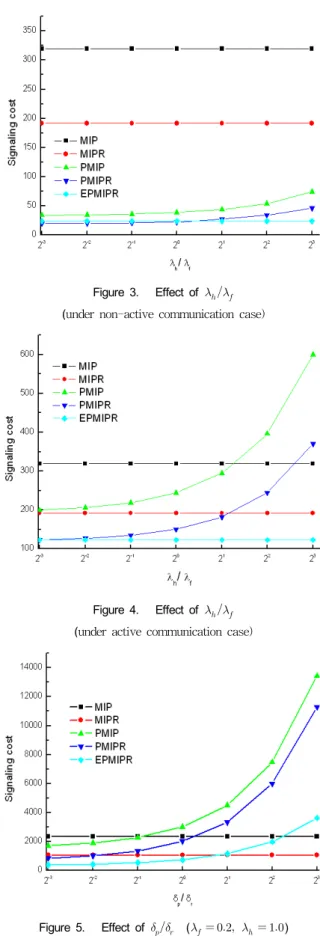
Figure 3 and 4 show how the average signaling
costs of each protocol can be changed according to increase of traffic locality in the home cells. For analysis, we adopt the following parameters:
and [3]. Also, and
are assumed, where and
denote the average number of the incoming and outgoing sessions during a MN's home cell residence time. In order to study the effects of the communication ratio of the home cells to the foreign cells under non-active communication case (e.g.,
session/cell) and active communication case (e.g., session/cell), respectively, the signaling cost according to the variation of is investigated in Fig.3 and 4. In Fig.3 and 4, the increase in means the increase in the degree of traffic locality in a MN's home cell, which indicates that a MN's home cell has a higher level of packet call activity compared with foreign cells.
In Fig.3 and 4, even if increases (i.e., dominates), the signaling cost of EPMIPR is constant while those of PMIP and PMIPR get larger. This is due to the fact that even if the frequent incoming/outgoing sessions occur in the home cells, there is no paging signaling overhead incurred in EPMIPR while an idle MN resides in its home cells.
In contrast, the signaling costs of PMIP and PMIPR get larger because the paging signaling overhead in its home cells gets dominated as increases.
Figure 5 shows the effect of for . Basically, MIP and MIPR does not support paging.
Thus, varying does not affect them. However, the signaling costs of EPMIPR as well as PMIP and PMIPR get larger because the paging cost dominates as increases. However, note that EPMIPR is the least sensitive to the change of as compared with PMIP and PMIPR because the foreign cells except the home cells are only paged in EPMIPR. In addition to the benefit in terms of the signaling cost, EPMIPR can also have the benefit in terms of paging delay. Unlike PMIP and PMIPR, as already mentioned in Sect.IV.2, the paging delays in case of a MN's home cell residence time in EPMIPR as well as in MIP and MIPR are all 0.
The benefit of EPMIPR can be chiefly achieved by the following operations: the direct packet
forwarding (i.e., no paging signaling overhead and no paging delay) during an idle MN's home cell residence time and the selective paging without its home cells being included during an idle MN's foreign cell residence time. It can be expected that which cells and how many cells should be chosen as home cell is a critical factor to show the good efficacy of EPMIPR. However, considering most MN's real-life pattern and the results from actual trace data [10, 11], it is expected that it is not so difficult to solve such issues. Future work will be directed into further study for such issues.
V. Conclusion
A cost-effective IP paging scheme for hierarchical Mobile IP networks was proposed in this paper, which can be suitable solution when considering real-life patterns for most of the MNs. As compared with PMIP and PMIPR, our study has revealed that the proposed scheme totally eliminates the significant paging signaling load which could be generated while an idle MN stays in its home cells, at the expense of the slight additional location registration costs occurred when moving into/out of its home cells. In addition, such savings become much more significant especially when the MN has strong traffic locality characteristics in its home cells.
References
[1] R. Ramjee, L. Li, T. Porta, and S. Kasera, "IP paging service for mobile hosts," in Proc. ACM MOBICOM'01, pp.332-345 , July. 2001.
[2] J. Kempf, C. Castelluccia, N. Nakajima, Y. Ohba, R. Ramjee, Y. Saifullah, B. Sarikaya, and X. Xu,
"Requirements and functional architecture for an IP host alerting protocol," IETF RFC 3154, Aug. 2001.
[3] X. Zhang, G. Castellanos, and A. Campbell,
`"P-MIP: paging extensions for mobile IP," ACM Mobile Netw. Appl. (MONET), vol. 7, no. 2, pp.
127-141, Mar. 2002.
[4] Castelluccia, C., "Extending mobile IP with adaptive individual paging: a performance analysis," ACM SIGMOBILE Mobile Comput. Commun. Rev., vol. 5, no. 2, pp. 14-26, Apr. 2001.
[5] H. Do and Y. Onozato, "A comparison of different
paging mechanisms for mobile IP," ACM Wireless Netw. (WINET), vol. 13, no. 3, pp. 379-395, Jun.
2007.
[6] J. Xie, "User independent paging scheme for mobile IP," ACM Wireless Netw. (WINET), vol. 12, no. 2, pp. 145-158, Mar. 2006.
[7] D. Lee, "IP-paging based resource management and task migration in mobile grid environment,"
International Journal of Grid and Distributed Computing, vol. 3, no. 3, pp. 29-40, Sept., 2010.
[8] E. Fogelstroem, A. Jonsson, and C. Perkins,
"Mobile IPv4 regional registration," IETF RFC 4857, Jun. 2007.
[9] A. Quintero, "A user pattern learning strategy for managing users' mobility in UMTS networks," IEEE Trans. Mobile Comput., vol. 4, no. 6, pp.
552-566, Nov.-Dec. 2005.
[10] H. Zang and J. Bolot, ``"Mining call and mobility data to improve paging efficiency in cellular networks," in Proc. ACM MOBICOM'07, pp.
123-134, 2007.
[11] C. Williamson, E. Halepovic, H. Sun, and Y. Wu,
"Characterization of CDMA2000 cellular data network traffic," in Proc. IEEE LCN'05, pp.
712-719, 2005.
저 자 공 기 식(Ki-Sik Kong) 정회원
1999년 2월:고려대학교 컴퓨터학과 (이학사)
2001년 8월:고려대학교 컴퓨터학과 (이학석사)
2005년 8월:고려대학교 컴퓨터학과 (이학박사)
2005년~2007년:고려대학교 컴퓨터정보통신연구소 연구교수
2007년~2008년:고려대학교 BK21소프트웨어사업단 연구교수
2009년~현 재:남서울대학교 멀티미디어학과 조교수
<관심분야> 무선 이동 네트워크, IP 이동성 관리, 광대역통합망(BcN)