1. Introduction
The Industry 4.0 or the fourth industrial revolution is widely discussed throughout the world. ICT essential
to the Industry 3.0 plays crucial roles in the Industry 4.0. Businesses are faced with an unprecedented invisible competition with the advent of the Industry 4.0. The key technology of the Industry 4.0 is ICBMA.
Effects of Absorptive Capacity on Technology Innovation and Commercialization Capacities and Management Performance
Young-Ki, Kim
1, Seong-Taek, Park
2*1
Department of Management Information Systems, Chungbuk National University
2
SKK Business School, Sungkyunkwan University
흡수역량이 기술혁신역량 및 기술사업화 역량과 경영성과에 미치는 영향
김영기1, 박성택2*
1충북대학교 경영정보학과, 2성균관대학교 경영학과
Abstract This study analyzes the effects of the absorptive capacity on the technology innovation and commercialization capacities and the management performance. Based on previous studies, the absorptive capacity is sub-classified into the exploratory absorptive capacity and the exploitative absorptive capacity, which are set as independent variables, to analyze their effects on the technology innovation and commercialization capacities. In short, the absorptive capacity has positive effects on the technology innovation and commercialization capacities. In addition, the technology innovation capacity and the technology commercialization capacity have positive effects on the management performance. The findings confirm that the absorptive capacity is an important factor impacting on the corporate innovation, and suggest that businesses should recognize the importance of the absorptive capacity as a guideline for developing their strategies for technological innovation.
Key Words : Absorptive Capacity, Technology Innovation Capacity, Commercialization Capacity, Technology Innovation, Management Performance
요 약 본 연구는 흡수역량이 기술혁신역량과 기술사업화역량과 경영성과에 미치는 영향요인을 파악한 연구이다. 본 연구 에서는 선행연구를 통해 흡수역량을 탐색적 흡수역량과 활용적 흡수역량으로 구분하고 이를 독립변수 설정하고 기술혁신 역량, 기술사업화 역량에 미치는 영향에 대한 분석을 수행하였다. 분석결과, 흡수역량은 기술혁신역량과 기술사업화역량에 긍정적인 영향을 미치는 것으로 나타났다. 또한 기술혁신역량과 기술사업화역량도 경영성과에 긍정적인 영향을 치미는 것 으로 나타났다. 본 연구의 결과는 흡수역량이 기업의 혁신에 영향을 미치는 중요 변인임을 확인하였으며, 기업은 본 연구결 과를 통해 흡수능력의 중요성을 인식하고 기술혁신전략 수립시에 가이드라인으로 활용이 가능할 것으로 보인다.
주제어 : 흡수역량, 기술혁신역량, 사업화 역량, 기술혁신, 경영성과
*Corresponding Author : Seong-Taek, Park ([email protected]) Received October 16, 2018
Accepted December 20, 2018
Revised November 30, 2018 Published December 28, 2018
Global companies are rushing to invest in ICBMA.
After all, it is innovation that emerges as an option to survive the ever-tougher competition. Innovation is the driving force for corporate growth and the foundation for national growth.
Although companies make massive investment in R&D, the ROI is influenced by a range of resources they have. Most of all, capacity is important. Capacity refers to the capabilities and activities of a company. In particular, absorptive capacity, technology innovation capacity and technology commercialization capacity are important.
The absorptive capacity refers to a company’s capabilities to reset its organizational business process in order to obtain its organizational capabilities via the acquisition, assimilation, transformation and exploitation of knowledge. Zahra & George (2002) subdivide the absorptive capacity into potential absorptive capacity and realized absorptive capacity [1].
A company’s innovative capacity and performance increase with its absorptive capacity. Metcalfe (1995) defines the technology innovation capacity as the relation between the inputs and outputs of innovation [2]. The high technology innovation capacity refers to the innovative performance or outputs outweighing the resources allocated for innovation.
A company continues to invest in innovation activities with intent to create profits through the commercialization of technologies it develops, not to secure the technologies.
That is, ultimately a company proceeds with innovative activities with a view to the commercialization of technology. Thus, in that the capacity for technology commercialization involves the commercialization of internally developed or externally obtained new technologies, it is conducive to the corporate competitive advantage by creating the technology-related demand in the market and successfully entering the market [3].
Previous studies on technology innovation are mostly focused on the determinants of the performance
of technology innovation. In comparison to other management activities, innovation influences the business performance via indirect paths. Although technological innovation is directly influenced by relevant factors, it is also germane to the interactions with other factors [4, 5]. Therefore, to formulate a successful innovation strategy, it is highly important to combine a range of corporate resources with capacities [6].
Hence, this study analyzes the effects of the absorptive capacity on the technology innovation capacity and technology commercialization capacity, and the effects of the technology innovation capacity and technology commercialization capacity on the management performance in Korean manufacturers.
2. Theoretical Background
2.1 Absorptive Capacity
Cohen& Levinthal (1990) define the technology commercialization capacity as the “capability to recognize, assimilate and commercialize the value of new information”[7], and state that a firm efficiently appreciates and accepts any new information it acquires and easily comes up with new products or ideas if it holds prior knowledge relevant to the information. Liao et al. (2003) define the absorptive capacity as “an organization’s ability to acquire, transmit and absorb external information or knowledge” [8].
Also, the absorptive capacity is perceived as the
“process of understanding and learning new knowledge
to transform it into specific knowledge applicable to an
organization”. Also, the “activities to develop and
advance the absorptive capacity are specifically
implemented in the form of corporate knowledge
creation and lay the foundation for the long-term
competitive advantage” [9,10].
2.2 Technology Innovation Capacity
Businesses draw on technological innovation to apply new ideas gained from R&D to the production process of products and services ultimately to solve problems or find new technological solutions [11].
The technology innovation capacity refers to the ability to implement new technological potential leading to economic activities, and is sub-classified into the fundamental research capacity for obtaining knowledge as needed, the applied research capacity for obtaining knowledge related to specific marketization, and the development capacity for transforming the technological and scientific knowledge into specific new products, processes and services [12].
Yam et al. (2004) subcategorize the technology innovation capacity into strategic planning capacity, technology commercialization capacity, and R&D capacity [13]. Zahra & George (2002) define the capacity for exploration, acquisition and assimilation of external knowledge or information to add to an organization’s internal knowledge as the potential absorptive capabilities. Also, they define the knowledge transformation and exploitation following the acquisition and assimilation of knowledge as the realized absorptive capabilities [1].
2.3 Technology Commercialization Capacity Nevens et al. (1990) describe the technology commercialization capacity as the capability to secure the competitive advantage through the cost reduction, quality improvement and acquisition of new technology [14].
They regard the technology commercialization capacity as the unparalleled competitive advantage, and analyze it in light of the rate of commercialization, the market size and the range of technology [15,16].
Chen (2008) argues businesses rely on their capacity for technology commercialization to retain their competitive advantage, which should be underpinned by the rate of commercialization, market size, range of technology, human resources, tangible and intangible
resources, and capacity for innovation [17].
2.4 Management Performance
Mansfield (1972) demonstrates when the competitive pressure is high in the market, businesses seek for innovation, which increases their financial performance [18]. Acha (2000) subdivides the capacity for technology innovation into R&D expenditure and patents and suggests their relations to the management performance [19].
In general, as the variables of management performance, either the financial performance indicators such as revenue growth and gross profits, or the non-financial performance indicators such as employment, export, market share and shareholder value are used [20, 21]. The financial management performance can be measured based on profitability, productivity, market share, revenue growth rates and ROI [22-24].
3. Research Model and Hypothesis
3.1 Research Model
Most previous studies focus on the moderating effects of the absorptive capacity and the factors involved in the effects of the technology innovation capacity and technology commercialization capacity on the management performance. By contrast, the causality between the absorptive capacity, the technology innovation capacity and the technology commercialization capacity has been hardly documented.
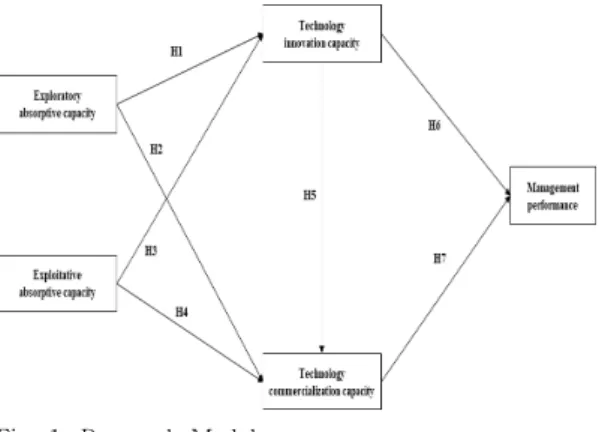
Hence, this study sets up the absorptive capacity
directly related to the technology innovation capacity
and the technology commercialization capacity as the
independent variable, and adopts the management
performance as the dependent variable for statistical
hypothesis testing. <Figure 1> shows the model for
this study.
Fig. 1. Research Model
3.2 Research Hypothesis
Lots of previous studies on innovation emphasize the innovation activities as the ability to exploit external knowledge [25-27], and assert the organizational capacity to absorb external knowledge is the factor exerting significant effects on the organizational innovation and R&D capacities and on their patent activities [28], and is significantly associated with the innovation performance [29].
The corporate absorptive capacity affects the innovation capacity and the patent capacity, and is the essential component that enables businesses to survive the tough competition without being left behind [3,30].
This study forms the hypotheses based on Cohen et al. (2002) and Chesbrough (2003) emphasizing the exploitation of external knowledge with the innovative capacity, and Cohen & Levinthal (1990) and Phene et al.
(2006) stressing the significant effects of the organizational capacity to absorb external knowledge on the organizational capacity for innovation.
That is, the exploratory absorptive capacity and the exploitative absorptive capacity seem to exert significant effects on the technology innovation capacity and closely related to the technology commercialization capacity, which underlies the following hypotheses.
H1. The exploratory absorptive capacity will have positive effects on the technology innovation capacity.
H2. The exploratory absorptive capacity will have positive effects on the technology commercialization capacity.
H3. The exploitative absorptive capacity will have positive effects on the technology innovation capacity.
H4. The exploitative absorptive capacity will have positive effects on the technology commercialization capacity.
According to Camison and Lopez (2010), the technology innovation capacity is an important means of securing the competitive advantage [15], and always results in the performance improvement, which seems attributable to the direct effects of the technology innovation capacity on the technology commercialization capacity.
Therefore, to establish the relationship between the technology innovation capacity and technology commercialization capacity, the following hypothesis is set and tested.
H5. The technology innovation capacity will have positive effects on the technology commercialization capacity.
Booz et al. (1982) empirically prove the technology innovation capacity and technology commercialization capacity influence the management performance [31].
Also, Yam et al. (2004) subdivide the commercialization capacity into production and marketing capacities and empirically demonstrate the significant effects of the commercialization capacity on the commercialization performance [13].
In addition, Kim et al. (2009) empirically prove the innovation performance varies with the technology commercialization capacity [32]. The foregoing results indicate that the technology commercialization capacity is a factor exerting significant effects on the business performance.
Hence, this study sets the following hypothesis to
establish the relationship between the technology commercialization capacity, the new product performance and the management performance.
H6. The technology innovation capacity will have positive effects on the management performance.
H7. The technology commercialization capacity will have positive effects on the management performance.
3.3 Operationalization of Variables
This study adopts the following operational definitions. The variable used in previous research were adapted for the purpose of study Table 1.
Oerational Dfinitions exploratory
absorptive capacity
The exploratory absorptive capacity is defined as the ability to explore and acquire external knowledge or information and transform it into internal knowledge
exploitative absorptive capacity
The exploitative absorptive capacity is defined as the exploitation of knowledge following the acquisition and assimilation of it
technology innovation capacity
The technology innovation capacity is defined as the ability to include technology resources and integrate and distribute diverse tangible and intangible resources of a business organization
technology commercializati on capacity
The technology commercialization capacity is defined as the ability to outpace competitors in launching new products in the market, and obtain and integrate the technologies needed to improve the existing products and create new products
Table 1. Operationalization of Variables
4. Research Methods
4.1 Data Collection and Sample Characteristics For statistical analysis, the PLS (Partial Least Square) is used. The PLS is less strict than other SEM analysis tools in terms of the required sample size and residual distribution [33].
Also, the PLS is good for reflecting the relations between measurement items and constructs and analyzing the formative indicator model. The PLS is a useful method for estimating the scale loadings for
constructs and then analyzing the causality between constructs.
This study analyzes the data from 127 out of 130 copies collected with an online questionnaire survey conducted for August, 2018, with 3 copies excluded for insincere responses. Males (n=94, 74%) outnumber females (n=33, 26%).
4.2 Measure Models
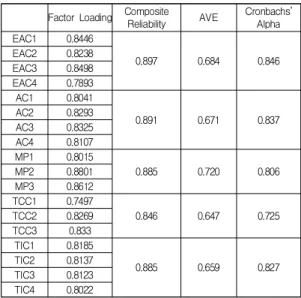
The PLS analysis requires the verification of measurement items and constructs in terms of three aspects, i.e. internal consistency, convergent validity and discriminant validity (Table 2).
Factor Loading Composite
Reliability AVE Cronbachs’
Alpha
EAC1 0.8446
0.897 0.684 0.846
EAC2 0.8238
EAC3 0.8498
EAC4 0.7893
AC1 0.8041
0.891 0.671 0.837
AC2 0.8293
AC3 0.8325
AC4 0.8107
MP1 0.8015
0.885 0.720 0.806
MP2 0.8801
MP3 0.8612
TCC1 0.7497
0.846 0.647 0.725
TCC2 0.8269
TCC3 0.833
TIC1 0.8185
0.885 0.659 0.827
TIC2 0.8137
TIC3 0.8123
TIC4 0.8022
Table 2. Discriminant Validity Analysis
Here, the verification results are as follows. The composite reliability exceeds the reference value 0.7 [34, 35], while the Cronbach’s α widely used for the reliability verification is greater than the reference value 0.7 [34], indicating that the reliability is good enough. Thus, the internal consistency is established.
The convergent validity is also verified. The AVE is
greater than the reference value 0.5 [33, 36], while the
factor loadings of constructs exceed the reference value
0.7 [36]. Therefore, the convergent validity is
established.
EAC AC MP TCC TIC
EAC 0.827
AC 0.765 0.819
MP 0.629 0.693 0.848
TCC 0.801 0.773 0.713 0.804
TIC 0.711 0.788 0.735 0.793 0.812
Table 3. Correlation between Latent Variable
The discriminant validity is determined based on whether the square root of AVE marked on a diagonal axis of correlation coefficients is greater or smaller than other correlation coefficients [36].
Here, the smallest square root of AVE (0.804) is greater than the largest correlation coefficient (0.801).
Therefore, the discriminant validity is established (Table 3).
4.3 Hypothesis Verification Results
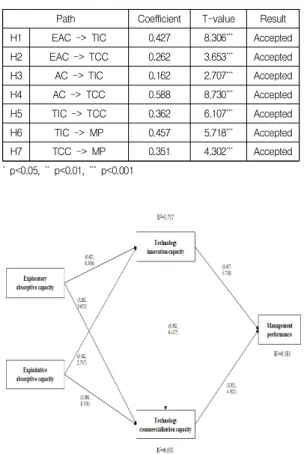
The PLS analysis indicates the following. Based on the analysis of R² in PLS [37, 38], the exploratory absorptive capacity and exploitative absorptive capacity explained 75.7% of the technology innovation capacity and 65.0% of the technology commercialization capacity, whilst the technology innovation capacity and technology commercialization capacity accounted for 58.5% of the management performance(Table 4, Figure 2).
The findings far exceed the optimal statistical power 10% suggested by Falk & Miller (1992) [39], indicating the high explained variance.
As a result, the absorptive capacity has positive effects on the technology innovation and commercialization capacities. In addition, the technology innovation capacity and the technology commercialization capacity have positive effects on the management performance.
Path Coefficient T-value Result
H1 EAC -> TIC 0.427 8.306
***Accepted H2 EAC -> TCC 0.262 3.653
***Accepted
H3 AC -> TIC 0.162 2.707
***Accepted
H4 AC -> TCC 0.588 8.730
***Accepted
H5 TIC -> TCC 0.362 6.107
***Accepted
H6 TIC -> MP 0.457 5.718
***Accepted
H7 TCC -> MP 0.351 4.302
***Accepted
*
p<0.05,
**p<0.01,
***p<0.001 Table 4. Hypotheses Testing
Fig. 2. Result of Hypotheses Testing
The verification result is the absorptive capacity has positive effects on the technology innovation and commercialization capacities. In addition, the technology innovation capacity and the technology commercialization capacity have positive effects on the management performance. The mediation path analysis shows partial mediating effects (Table 5).
Mediated pathway Coefficient Z-statistic Result EAC-> TIC-> MP 0.096 2.579
**Accepted EAC-> TCC-> MP 0.049 3.393
***Accepted AC-> TIC-> MP 0.214 3.406
***Accepted AC-> TCC-> MP 0.043 2.583
**Accepted
*