www.kjlm.org 95
Effects of Long-term Use of Depo-medroxyprogesterone Acetate on Lipid Metabolism in Nepalese Women
Binod Kumar Yadav, M.Sc., Rajesh Kumar Gupta, B.Sc., Prajwal Gyawali, B.Sc., Rojeet Shrestha, M.Sc., Bibek Poudel, M.Sc., Manoj Sigdel, B.Sc., and Bharat Jha, M.Sc.
Department of Biochemistry, Institute of Medicine, Tribhuvan University Teaching Hospital, Kathmandu, Nepal
Various synthetic progestogens that are used as contraceptives have been reported to influence lipid and lipoprotein fractions dif- ferently. Depo-medroxyprogesterone acetate (DMPA), a synthetic progestogen, is used by Nepalese women as a contraceptive agent. Our study aims to determine the effects of long-term use of DMPA on lipid metabolism. We performed this study on 60 healthy Nepalese women who had been using DMPA for more than 2 yr and age- and weight-matched control subjects who were not using hormonal contraceptives. Fasting blood samples were collected from the subjects for the estimation of total cholesterol (TC) and triglyceride (TG) levels, and the levels of high-density lipoprotein cholesterol (HDL-C) and low-density lipoprotein choles- terol (LDL-C) were estimated using the Friedewald’s equation. TC and LDL-C levels in DMPA users were significantly higher than those in non-users. Our study concluded that DMPA use induces lipid metabolism changes that can increase the risk of cardiovas- cular diseases.
Key Words: Depo-medroxyprogesterone acetate, Lipid metabolism, Nepalese women
Received: May 9, 2010 Manuscript No: KJLM-10-095 Revision received: February 14, 2011
Accepted: February 19, 2011
Corresponding author: Binod Kumar Yadav, M.Sc.
Department of Biochemistry, Institute of Medicine, Tribhuvan University Teaching Hospital, P.O.B. No. 1524, Kathmandu, Nepal
Tel: +977-9841511207, E-mail: [email protected] ISSN 1598-6535 © The Korean Society for Laboratory Medicine.
This is an Open Access article distributed under the terms of the Creative Commons Attribution Non-Commercial License (http://creativecommons.org/licenses/by-nc/3.0) which permits unrestricted non-commercial use, distribution, and reproduction in any medium, provided the original work is properly cited.
Korean J Lab Med 2011;31:95-97 DOI 10.3343/kjlm.2011.31.2.95
Brief Communication
Clinical Chemistry
KJLM
Depo-medroxyprogesterone acetate (DMPA, Depo-Pro- vera®) is a highly effective contraceptive with a very low failure rate [1]; however, women who use this contraceptive may experience some adverse effects. DMPA is a weak an- drogenic progestin that is administered as a single 150-mg intramuscular (i.m.) injection every 3 months. The contra- ceptive appears to be a potent inhibitor of gonadotrophins [2, 3].
There has been considerable debate about the effect of DMPA on lipid metabolism; studies have reported both in- crease and decrease in the levels of total cholesterol (TC), triglyceride (TG), and low-density lipoprotein cholesterol (LDL-C) in DMPA users. Many studies have also shown a decrease in high-density lipoprotein cholesterol (HDL-C)
levels in long- and short-term DMPA users [4, 5]. Some studies have reported that DMPA does not exert any effect on various lipoproteins and lipid components [6, 7]. These DMPA-induced alterations in lipid metabolism can cause serious cardiovascular adverse effects in women. In this study, we aimed to identify the effects of DMPA use on the lipid profile of Nepalese women.
This study was performed at Tribhuvan University Teach- ing Hospital, Institute of Medicine (TUTH, IOM), Kath- mandu, Nepal, from February to October 2008. We selected 60 women (25-35 yr of age) who weighed less than 75 kg, did not have any known diseases, and have not received any medication other than DMPA; these women were selected when they visited the family planning department of the hospital. They were regularly taking DMPA (150-mg (i.m.) injection) at 3-month intervals for more than 2 yr. We also recruited a control group of 100 age- and weight-matched healthy women (among the staff and students of TUTH, IOM) who were not using any hormonal contraceptives.
Participants using lipid-lowering drugs were excluded from the study. After obtaining verbal consent from the subjects, fasting blood samples (5 mL) were collected from each sub- ject to determine the plasma lipid and lipoprotein levels.
This study was approved by our institutional review board.
Human cholesterol liquicolor and triglyceride liquicolor
96 www.kjlm.org
Yadav BK, et al. • Effect of DMPA on Lipid Metabolism
DOI 10.3343/kjlm.2011.31.2.95
KJLM
mono kits were used for the enzymatic determination of TC [8] and TG [9] levels, respectively, in the Evolution 3000 (Biochemical Systems International, Arezzo, Italy) chemical analyzer. HDL-C was measured indirectly by using a pre- cipitating reagent (Human HDL cholesterol; Wiesbaden, Germany) [10]. We strictly followed the reagent instruction manuals for all the assays. Concentrations of LDL-C were estimated using Friedewald’s equation [11]. Both normal and high-level control sera were used in each run, and CV of imprecision was 4.1% for TC, 4.7% for TG, and 3.8% for HDL-C. Data were analyzed using SPSS software (SPSS 11.5 version Inc., Chicago, IL, USA). The means of the 2 groups were compared using the Student’s t test, and the results were considered insignificant when P >0.05. All results are expressed as mean±SD.
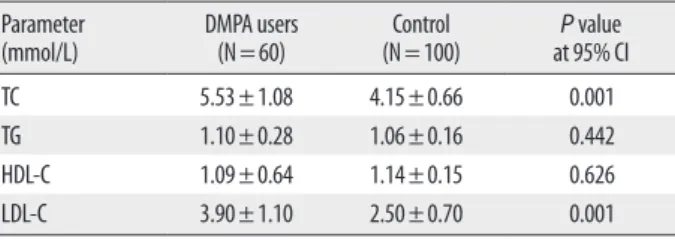
There were no significant differences in the age and weight of the control subjects and DMPA users. TC and LDL-C lev- els in DMPA users were significantly higher than those in the control group (Table 1). The HDL-C and TG levels were not significantly different from the previously reported levels.
The adverse effects of DMPA on lipid metabolism are re- lated to its weak androgenic effect [12]. The studies on the effect of DMPA on plasma lipids have yielded inconsistent findings. In our study, the LDL-C and TC levels in DMPA users were significantly higher than those in the control sub- jects. This finding is in agreement with the previous studies [6, 13, 14]. Unlike our study, the studies by Grönroos and Lehtonen [3] and Fajumi [15] showed a decrease in TC lev- els, whereas those by Faddah et al. [6] and Garza-Flores et al. [5] did not show any changes in TC levels in DMPA us- ers. Neither HDL-C nor TG levels were affected in DMPA users. However, many conflicting results have been reported [6, 12, 16]. Estrogens increase serum HDL-C levels and de- crease serum TC and LDL-C levels, whereas progesterone has the opposite effect. DMPA, an weak synthetic progester- one, opposes the effect of estrogens. The level of HDL-C is
inversely related to the incidence of cardiovascular diseases [17]. Although there was no significant decrease in the HDL-C levels of DMPA users in our study, there was an in- crease in the LDL-C levels. Our study concluded that DMPA induces lipid metabolism changes that can increase the risk of cardiovascular diseases.
Authors’ Disclosures of Potential Conflicts of Interest No potential conflict of interest relevant to this article was reported.
REFERENCES
1. Kupperman HS and Epstein JA. Medroxyprogesterone acetate in the treatment of constitutional sexual precocity. J Clin Endocrinol Metab 1962;22:456-8.
2. Laron Z, Rumney G, Rat L, Naji N. Effects of 17 alpha hydroxy-6al- pha-methylprogesterone acetate (Depo-Provera) on urinary go- nadotrophins and oestrogens in man. Acta Endocrinol (Copenh) 1963;44:75-80.
3. Grönroos M and Lehtonen A. Effect of high dose progestin on se- rum lipids. Atherosclerosis 1983;47:101-5.
4. Fahmy K, Khairy M, Allam G, Gobran F, Alloush M. Effect of depo-medroxyprogesterone acetate on coagulation factors and se- rum lipids in Egyptian women. Contraception 1991;44:431-44.
5. Garza-Flores J, De la Cruz DL, Valles de Bourges V, Sanchez-Nun- cio R, Martinez M, Fuziwara JL, et al. Long-term effects of depot- medroxyprogesterone acetate on lipoprotein metabolism. Contra- ception 1991;44:61-71.
6. Faddah LM, Al-Rehany MA, Abdel-Hamid NM, Bakeet AA. Oxi- dative stress, lipid profile and liver functions in average Egyptian long term depo medroxy progesterone acetate (DMPA) users.
Molecules 2005;10:1145-52.
7. Kaunitz AM. Long-acting injectable contraception with depot me- droxyprogesterone acetate. Am J Obstet Gynecol 1994;170:1543-9.
8. Deeg R and Ziegenhorn J. Kinetic enzymic method for automated determination of total cholesterol in serum. Clin Chem 1983;29:
1798-802.
9. Bucolo G and David H. Quantitative determination of serum tri- glycerides by the use of enzymes. Clin Chem 1973;19:476-82.
10. Assmann G, Schriewer H, Schmitz G, Hägele EO. Quantification of high-density-lipoprotein cholesterol by precipitation with phos- photungstic acid/MgCl2. Clin Chem 1983;29:2026-30.
11. Friedewald WT, Levy RI, Fredrickson DS. Estimation of the con- centration of low-density lipoprotein cholesterol in plasma, with- out use of the preparative ultracentrifuge. Clin Chem 1972;18:499- 502.
12. Godsland IF, Crook D, Simpson R, Proudler T, Felton C, Lees B, et al. The effects of different formulations of oral contraceptive agents on lipid and carbohydrate metabolism. N Engl J Med 1990;323:
1375-81.
13. Kongsayreepong R, Chutivongse S, George P, Joyce S, McCone JM, Garza-Flores J, et al. A multicentre comparative study of serum lipids and apolipoproteins in long-term users of DMPA and a con- trol group of IUD users. World Health Organization. Task Force
Table 1. Comparison of the lipid profiles of the DMPA users and control group
Parameter
(mmol/L) DMPA users
(N=60) Control
(N=100) P value
at 95% CI
TC 5.53±1.08 4.15±0.66 0.001
TG 1.10±0.28 1.06±0.16 0.442
HDL-C 1.09±0.64 1.14±0.15 0.626
LDL-C 3.90±1.10 2.50±0.70 0.001
Results are expressed as mean±SD.
Abbreviations: DMPA, depo-medroxy progesterone acetate; CI, confidence interval;
TC, total cholesterol; TG, triglyceride; HDL-C, high density lipoprotein cholesterol; LDL- C, low density lipoprotein cholesterol.
Yadav BK, et al. • Effect of DMPA on Lipid Metabolism
www.kjlm.org 97
DOI 10.3343/kjlm.2011.31.2.95
KJLM
on Long-Acting Systemic Agents for Fertility Regulation Special Programme of Research, Development and Research Training in Human Reproduction. Contraception 1993;47:177-91.
14. Mostafavi H, Abdali K, Zare N, Rezaian GR, Ziyadlou S, Parsane- jad ME. A comparative analysis of three methods of contracep- tion: Effects on blood glucose and serum lipid profiles. Ann Saudi Med 1999;19:8-11.
15. Fajumi JO. Alterations in blood lipids and side effects induced by depo-provera in Nigerian women. Contraception 1983;27:161-75.
16. Enk L, Landgren BM, Lindberg UB, Silfverstolpe G, Crona N. A prospective, one-year study on the effects of two long acting in- jectable contraceptives (depot-medroxyprogesterone acetate and norethisterone oenanthate) on serum and lipoprotein lipids.
Horm Metab Res 1992;24:85-9.
17. Miller NE, Thelle DS, Forde OH, Mjos OD. The Tromso heart- study. High-density lipoprotein and coronary heart-disease: a pro- spective case-control study. Lancet 1977;1:965-8.