Received February 9, 2010, Revised December 21, 2010, Accepted for publication December 21, 2010
*This study was supported by a grant of the Korean Health Technology R&D Project, Ministry of Health & Welfare, Republic of Korea (A091121).
Corresponding author: Seong Jun Seo, M.D., Department of Derma- tology, College of Medicine, Chung-Ang University, 224-1 Heukseok- dong, Dongjak-gu, Seoul 156-755, Korea. Tel: 82-2-6299-1525, Fax:
82-2-823-1049, E-mail: [email protected]
ORIGINAL ARTICLE
Genetic Polymorphism of FLG in Korean Ichthyosis Vulgaris Patients
Eun Joo Kim, Ph.D., Mi Sook Jeong, M.S., Kapsok Li, M.D.1, Mi Kyung Park, M.D.1, Mi-Kyung Lee, M.D.2, Yoosik Yoon, M.D.3, Dae-Yeon Cho, Ph.D.4, Seong Jun Seo, M.D.1
Chung-Ang Medical Research Center, Departments of 1Dermatology, 2Laboratory Medicine, and 3Microbiology, College of Medicine, Chung-Ang University, 4Labgenomics Clinical Research Institute, Seoul, Korea
Background: Filaggrin is a key protein that facilitates the formation of skin barrier by forming a stratum corneum.
Mutations in the gene encoding filaggrin (FLG) have recently been reported in patients with ichthyosis vulgaris (IV).
Interestingly, there are ethnic differences between FLG mutations identified in Asians and Europeans, and few FLG mutations are overlapping between Chinese and Japanese IV patients. Objective: The aim of this study was to investigative the genetic polymorphism of FLG in Korean IV patients.
Methods: Genomic DNA was extracted from whole venous blood specimen of Korean patients with IV and a control group, and the full sequence of FLG was determined via overlapping long-range polymerase chain reaction method.
Results: Analysis of base sequence previously unreported reveal new nonsense mutation p.Y1767X in a Korean IV patient, and additional new single nucleotide polymor- phisms. Conclusion: On the basis of this study, it is anti- cipated that analysis of FLG gene sequence be extended to other dermatoses associated with FLG, such as atopic dermatitis. (Ann Dermatol 23(2) 170∼176, 2011)
-Keywords-
Filaggrin, Genetics, Ichthyosis vulgaris, Mutation, Poly- morphisms
INTRODUCTION
Filaggrin is a key protein involved in the terminal differentiation of the epidermis and formation of skin barrier. The filaggrin gene (FLG) is located on human chromosome 1q21.3. It encodes the polyprotein profil- aggrin, which is consisted of 10∼12 tandemly repeated filaggrin subunits1,2. The aforementioned repeat number polymorphism is rarely found in other genes - a unique phenomenon in FLG. Of the 10 FLG repeat units, the eighth and tenth may possess one more repeat unit with similar base sequence, in contrast to the other repeat units, resulting 10, 11, or 12 repeat unit variants in FLG3. Skin diseases that are attributable to the functional defects of FLG include ichthyosis vulgaris (IV; Online Mendelian Inheritance in Man (OMIM) #146700). It has long been known that IV patients have significantly reduced granular layer according to hematoxylin-eosin (H&E) staining of the patient tissue specimens. Such decrease in granular layer is due to decrease in keratohyaline granule, a key com- ponent of the granular layer. At the same time, immuno- histological stain revealed reduced expression of fil- aggrin4.
Recently, efficient method to determine the base sequence of FLG has been developed, and some patients with IV were found to have loss-of-function mutation in FLG, indicating that FLG abnormality is involved in the pathogenesis of IV5. Based on the fact that FLG plays an important role as a skin-barrier, studies have been extended to patients with atopic dermatitis (AD), and FLG mutation was found in some cases of AD6. In addition, several studies based on European population suggested that FLG null mutations (R501X and 2282del4) predispose to other atopic disorders (asthma and allergic rhinitis).
These mutations also predispose to atopic march7, early-
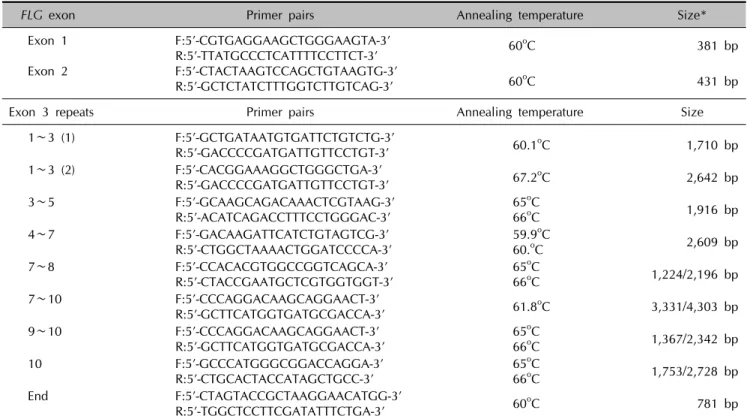
Table 1. PCR primers used for FLG mutation analysis
FLG exon Primer pairs Annealing temperature Size*
Exon 1 F:5’-CGTGAGGAAGCTGGGAAGTA-3’
R:5’-TTATGCCCTCATTTTCCTTCT-3’
Exon 2 F:5’-CTACTAAGTCCAGCTGTAAGTG-3’
R:5’-GCTCTATCTTTGGTCTTGTCAG-3’
60oC 381 bp
60oC 431 bp
Exon 3 repeats Primer pairs Annealing temperature Size
1∼3 (1) F:5’-GCTGATAATGTGATTCTGTCTG-3’
R:5’-GACCCCGATGATTGTTCCTGT-3’ 60.1oC 1,710 bp
1∼3 (2) F:5’-CACGGAAAGGCTGGGCTGA-3’
R:5’-GACCCCGATGATTGTTCCTGT-3’ 67.2oC 2,642 bp
3∼5 F:5’-GCAAGCAGACAAACTCGTAAG-3’
R:5’-ACATCAGACCTTTCCTGGGAC-3’ 65oC
66oC 1,916 bp
4∼7 F:5’-GACAAGATTCATCTGTAGTCG-3’
R:5’-CTGGCTAAAACTGGATCCCCA-3’
59.9oC
60.oC 2,609 bp
7∼8 F:5’-CCACACGTGGCCGGTCAGCA-3’
R:5’-CTACCGAATGCTCGTGGTGGT-3’ 65oC
66oC 1,224/2,196 bp
7∼10 F:5’-CCCAGGACAAGCAGGAACT-3’
R:5’-GCTTCATGGTGATGCGACCA-3’ 61.8oC 3,331/4,303 bp
9∼10 F:5’-CCCAGGACAAGCAGGAACT-3’
R:5’-GCTTCATGGTGATGCGACCA-3’ 65oC
66oC 1,367/2,342 bp
10 F:5’-GCCCATGGGCGGACCAGGA-3’
R:5’-CTGCACTACCATAGCTGCC-3’
65oC
66oC 1,753/2,728 bp
End F:5’-CTAGTACCGCTAAGGAACATGG-3’
R:5’-TGGCTCCTTCGATATTTCTGA-3’ 60oC 781 bp
*Additional repeat(s) after repeat 8 and 10, respectively repeat 8.2 and repeat 10.2, make two PCR products in exon 3 (7∼8), (7∼10), (9∼10), (10).
onset AD that persists into adulthood as well as more severe asthma2,8,9.
Interestingly, distinctive differences have been found in FLG mutation between ethnic groups. Studies on FLG mutation showed that of the 27 FLG mutations reported, only two are common to Europeans and Asians10. Genetic polymorphisms (including FLG mutation) in the Koreans could be different from that in the other nations; Japanese and Chinese have more differences than similarities between them, even though they are both Asians. A recent study by Akiyama10 which examined the relationship between FLG mutation and population genetics, con- firmed certain genetic variations to be unique to Euro- peans and Asians. FLG variations differed even between Asians. Specifically, FLG varied among Chinese11, Japanese12-14, and Taiwanese15. Only 3321delA was found to be common among Asians10.
To date, a genetic study on Korean patient was conducted that included only one subject, and the patient was demonstrated to have 3321delA, a mutation that com- monly occurs in Asians16. The aim of this study was to investigate genetic polymorphisms, including FLG muta- tion, in Korean IV patients.
MATERIALS AND METHODS
Study population
Blood samples were obtained from 7 patients with IV (<60 years of age) from independent Korean families. The diagnosis of IV was performed clinically by experienced dermatologists on the basis of clinical manifestation.
Autosomal dominant pattern of inheritance was confirmed by careful history taking. The normal control group was consisted of 13 subjects who neither experienced IV nor AD. This study was approved by the Institutional Review Board of the Chung-Ang university hospital, and written informed consent was obtained from each participant prior to study entry.
Filaggrin genotyping
Polymerase chain reaction (PCR) and sequencing analysis was performed using a protocol described in a previous study17 with some modifications. Briefly, genomic DNA from IV patients was extracted from peripheral blood samples using the G-DEXTM Genomic DNA Extraction Kit (iNtRON Biotechnology, Sungnam, South Korea). The purity of their DNA was determined using a Nanodrop ND-1000R spectrophotometer (Thermo Fisher Scientific, Wilminton, DE, USA). DNA with an optical-density ratio
Table 2. Primers for sequencing reaction Exon region Primer pairs
Exon 1 1F:5’-CGTGAGGAAGCTGGGAAGTA-3’
1R:5’-TTATGCCCTCATTTTCCTTCT-3’
Exon 2 1F:5’-CTACTAAGTCCAGCTGTAAGTG-3’
1R:5’-GCTCTATCTTTGGTCTTGTCAG-3’
Exon 3 (1-3)-(1) 1F:5’-GCTGATAATGTGATTCTGTCTG-3’
1R:5’-TCAGCCCAGCCTTTCCGTG-3’
2F:5’-CACGGAAAGGCTGGGCTGA-3’
2R:5’ACCTGAGTGTCCAGACCTATT-3’
Exon 3 (1-3)-(2) 1F:5’-CACGGAAAGGCTGGGCTGA-3’
1R:5’-GCAAGCAGACAAACTCGTAAG-3’
2F:5’-CCAGACAATCAGGAACTCC-3’
2R:5’-GGAGTTCCTGATTGTCTGG-3’
Exon 3 (3-5) 1F:5’-GCA AGCAGACAAACTCGTAAG-3’
1R:5’-ACATCAGACCTTTCCTGGGAC-3’
2F:5’-GGATCCTACCACGAGCAATCA-3’
2R:5’-GGACCTTGACCTTGCCTGTTC-3’
3F:5’-CAG AAGTGCAAGCAGGCAAACAA-3’
3R:5’-ACTGTGTGTCTGACTCTTCTGAG-3’
Exon 3 (4-7) 1F:5’-GACAAGATTCATCTGTAGTGC-3’
1R:5’-CTGGCTAAAACTGGATCCCCA-3’
2F:5’-AATGAGAAACAATCAGGAGACG-3’
2R:5’-GCTGTCTTGTGCCTGATCATAA-3’
3F:5’-CACAGTCAGTGTCAGCACAG-3’
4F:5’-CAGAAGTGCAAGCAGAAAAACATA-3’
5F:5’-AGAGGCGGTCTGGGTCTGCG-3’
Exon 3 (7-8) 1F:5’-CCACACGTGGCCGGTCAGCA-3’
1R:5’-CTAGGCAATGCTCGTGGTGGT-3’
Exon 3 (7-10) 1F:5’-CCCAGGACAAGCAGGAACT-3’
1R:5’-GCTTCATGGTGATGCGACCA-3’
Exon 3 (9-10) 1F:5’-GAA ACGTCTGGACATTCAGGA-3’
1R:5’-GCT TCATGGTGATGCGACCA-3’
2F:5’-AATGAGGAACAATCAGGAGACA-3’
2R:5’-GAAGCTTCATGGTGACGTGACA-3’
3F:5’-AGA AACCATCGTGGATCTGT-3’
3R:5’-GTGCCTTGACTGCTCCTGAA-3’
4F:5’-ACGGGCACTCTGCAGACC-3’
Exon 3 (10) 1F:5’-GCCCATGGGCGGACCAGGA-3’
1R:5’-CTGCACTACCATAGCTGCC-3’
2F:5’-ACCATGAAGCTTCCACTCAGGCG-3’
FLG end 1F:5’-CTAGTACCGCTAAGGAACATGG-3’
1R:5’-TGGCTCCTTCGATATTTCTGA-3’
260/280 of 1.8 or more was used.
PCR amplifications were performed in 40μl reaction volumes containing 200 ng genomic DNA, 2.5 mmol/L MgCl2, 200μmol/L for each deoxynucleotide tripho- sphate, 10 pmol for each primer, 5xBD (Solgent Co. Ltd., Daejeon, Korea), and 2 U Taq DNA polymerase (TaKaRa Bio Inc, Otsu, Japan) using a GeneAmp PCR system 2700 (Applied Biosystems, Princeton, NJ, USA). Each genomic DNA was amplified using the primers listed in Table 1.
The amplified PCR products were separated by electro- phoresis in 0.8% agarose gel.
Sequencing
DNA sequencing was performed using Applied Bio-
systems 3100/3700 DNA sequencers Applied Biosystems, Princeton, NJ, USA) after conducting purification with QIAquick PCR purification kits (Qiagen, Valencia, CA, USA). Sequencing conditions were as follows: 96oC for 1 min followed by 25 cycles of 96oC for 10s, 50oC for 5 sec and 60oC for 4 min and a final extension at 10oC for 10 min. Several sets of forward and reverse sequencing primers were used depending on the size of the PCR product fragment, as follows (Table 2).
A statistical-analysis
χ2 test was performed to investigate if there was any difference in the frequency of the genotype and allele between the IV patient group and the normal control group. A p-value of less than 0.05 (p<0.05) was con- sidered statistically significant.
RESULTS
This study was performed to determine genetic diversity (including mutation) of FLG in Korean IV patients. For the exon 1 and 2 regions, the obtained sequences were compared to the reference sequence, but no meaningful result was found. The extremely large size of exon 3, in which most of the reported mutations were found, was challenging for PCR-based sequencing method. Thus the exon 3 region was divided into 9 overlapping fragments, and PCR and sequencing analysis were carried out. Of the IV patients participated in this study, one patients had a personal and family history of AD and allergic asthma.
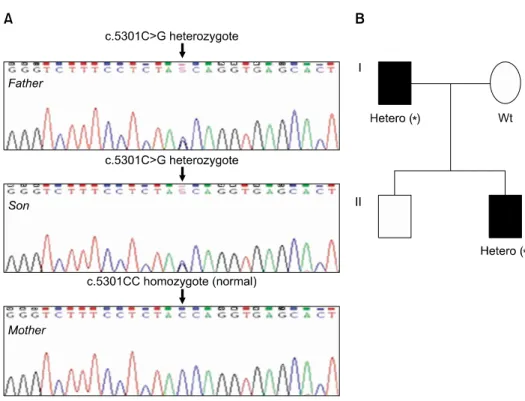
After the full sequencing, nonsense mutation p.Y1767X (=c.5301C>G), which had never been reported in literature for IV or AD patients, was found. Later, it was revealed that his father, who had concomitant AD and asthma, carried the same mutation, in contrast to his mother who did not experience IV or AD (Fig. 1).
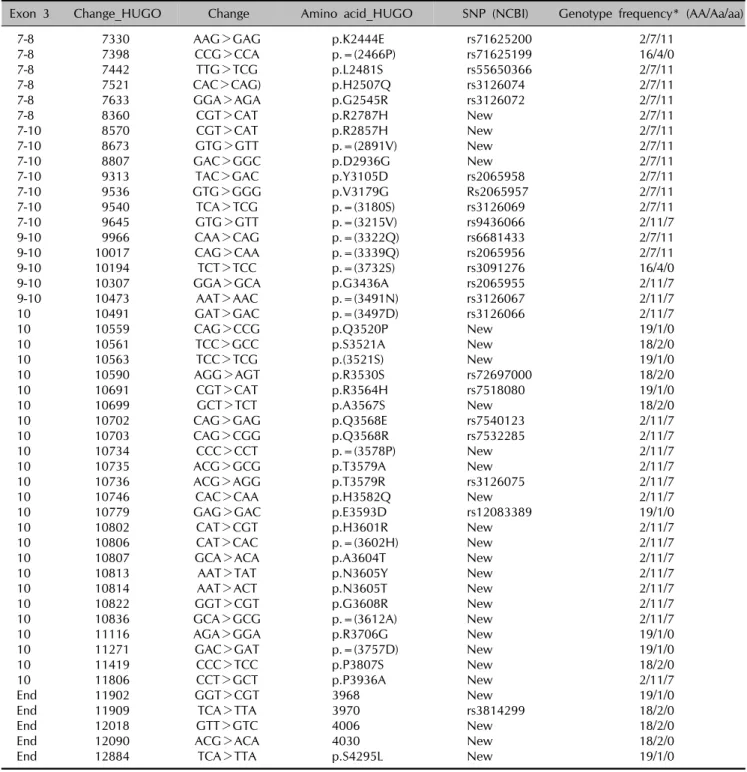
In patients from the other families, additional mutations were not found. However, 81 single nucleotide poly- morphisms (SNPs) were found, more than that in the reference sequence of FLG (NG_016190.RefSeqGene).
Out of 81 SNPs, 30 SNPs were new and had never been reported (Table 3). The pattern of genetic polymorphism (including repeat number polymorphism) shown by the 7 patients with IV, and by the 13 subjects in the normal control group, were compared. The chi-square test of the alleles showed no significant difference (data not shown).
DISCUSSION
After the full sequencing of FLGs in Korean IV patients and normal control, a unique diversity of the FLG gene is
Fig. 1. Detection of filaggrin (FLG) mutation, Y1767X. (A) Direct DNA sequencing of specific FLG poly- merase chain reaction products.
Normal control sequence from fila- ggrin repeat 5 in exon3, correspond- ing to codons 5299-5301. Upper panels show identification of the novel Y1767X (=c.5301C>G) hete- rozygous mutation of the family. (B) A pedigree of IV family, showing semidominant inheritance pattern.
Filled symbols refer to the IV pre- sentation. Hetero (*): heterozygous for Y1767X, Wt: wild type for Y1767X.
Table 3. Detection of SNP in Korean ichthyosis vulgaris patients
Exon 3 Change_HUGO Change Amino acid_HUGO SNP (NCBI) Genotype frequency* (AA/Aa/aa)
1-3 995 GGC>GTC p.G332V rs41267154 2/7/11
1-3 1236 CGT>CGC p.=(412R) rs11582620 16/3/1
1-3 1330 GGG>AGG p.G444R rs11588170 2/7/11
1-3 1360 ACA>GCA p.T454A rs2011331 2/11/7
1-3 1432 CCT>TCT p.P478S rs11584340 2/7/11
1-3 1555 CAC>AAC p.H519N rs12036682 18/2/0
1-3 2181 CAC>CAA p.H727Q rs35904544 2/11/7
1-3 2263 GAA>AAA p.E755K rs74129461 2/7/11
1-3 2508 GAT>GAC p.=(836D) rs3120653 2/11/7
1-3 2938 CAT>GAT p.H980D rs12756586 2/7/11
1-3 3387 TCT>TCC p.=(1129S) rs9436067 2/7/11
1-3 3397 CGG>TGG p.R1133W New 19/1/0
1-3 3500 GCA>GGA p.A1167G rs7530018 2/7/11
3-5 4079 CGC>CAC p.R1360H rs11586631 16/4/0
3-5 4126 AGA>GGA p.R1376G rs11581433 2/7/11
3-5 4410 CAT>CAC p.=(1470H) rs12732920 16/4/0
3-5 4445 TCC>TAC p.S1482Y rs11204978 16/4/0
3-5 4452 GAC>GAG p.D1484E rs71626706 2/7/11
3-5 4568 ACA>ATA p.T1523I rs12750081 16/4/0
3-5 5051 CGC>CAC p.R1684H rs12407807 2/7/11
3-5 5095 CGC>TGC p.R1699C rs12405278 2/7/11
3-5 5301 TAC>TAG p.Y1767X Nonsense mutation 19/1/0
4-7 5414 GCG>GTG p.A1805V rs12405241 2/7/11
4-7 5672 GGG>TGG p.R1891Q rs12407748 2/11/7
4-7 5883 CAC>CAA p.H1961Q rs3126079 2/7/11
4-7 6045 GAC>GAA p.D2015E rs71626704 2/7/11
4-7 6498 TCT>TCC p.=(2166S) rs2184954 18/2/0
4-7 6574 AAA>CAA p.K2192Q New 19/1/0
4-7 6580 TAT>CAT p.Y2194H rs2184953 2/7/11
4-7 6990 CAC>CAT p.=(2330H) rs71626703 2/7/11
4-7 7015 GAC>AAC p.D2339N New 2/7/11
4-7 7097 AGT>ACT p.S2366T rs71625202 2/7/11
4-7 7192 GAG>CAG p.E2398Q rs71625201 2/7/11
Table 3. Continued
Exon 3 Change_HUGO Change Amino acid_HUGO SNP (NCBI) Genotype frequency* (AA/Aa/aa)
7-8 7330 AAG>GAG p.K2444E rs71625200 2/7/11
7-8 7398 CCG>CCA p.=(2466P) rs71625199 16/4/0
7-8 7442 TTG>TCG p.L2481S rs55650366 2/7/11
7-8 7521 CAC>CAG) p.H2507Q rs3126074 2/7/11
7-8 7633 GGA>AGA p.G2545R rs3126072 2/7/11
7-8 8360 CGT>CAT p.R2787H New 2/7/11
7-10 8570 CGT>CAT p.R2857H New 2/7/11
7-10 8673 GTG>GTT p.=(2891V) New 2/7/11
7-10 8807 GAC>GGC p.D2936G New 2/7/11
7-10 9313 TAC>GAC p.Y3105D rs2065958 2/7/11
7-10 9536 GTG>GGG p.V3179G Rs2065957 2/7/11
7-10 9540 TCA>TCG p.=(3180S) rs3126069 2/7/11
7-10 9645 GTG>GTT p.=(3215V) rs9436066 2/11/7
9-10 9966 CAA>CAG p.=(3322Q) rs6681433 2/7/11
9-10 10017 CAG>CAA p.=(3339Q) rs2065956 2/7/11
9-10 10194 TCT>TCC p.=(3732S) rs3091276 16/4/0
9-10 10307 GGA>GCA p.G3436A rs2065955 2/11/7
9-10 10473 AAT>AAC p.=(3491N) rs3126067 2/11/7
10 10491 GAT>GAC p.=(3497D) rs3126066 2/11/7
10 10559 CAG>CCG p.Q3520P New 19/1/0
10 10561 TCC>GCC p.S3521A New 18/2/0
10 10563 TCC>TCG p.(3521S) New 19/1/0
10 10590 AGG>AGT p.R3530S rs72697000 18/2/0
10 10691 CGT>CAT p.R3564H rs7518080 19/1/0
10 10699 GCT>TCT p.A3567S New 18/2/0
10 10702 CAG>GAG p.Q3568E rs7540123 2/11/7
10 10703 CAG>CGG p.Q3568R rs7532285 2/11/7
10 10734 CCC>CCT p.=(3578P) New 2/11/7
10 10735 ACG>GCG p.T3579A New 2/11/7
10 10736 ACG>AGG p.T3579R rs3126075 2/11/7
10 10746 CAC>CAA p.H3582Q New 2/11/7
10 10779 GAG>GAC p.E3593D rs12083389 19/1/0
10 10802 CAT>CGT p.H3601R New 2/11/7
10 10806 CAT>CAC p.=(3602H) New 2/11/7
10 10807 GCA>ACA p.A3604T New 2/11/7
10 10813 AAT>TAT p.N3605Y New 2/11/7
10 10814 AAT>ACT p.N3605T New 2/11/7
10 10822 GGT>CGT p.G3608R New 2/11/7
10 10836 GCA>GCG p.=(3612A) New 2/11/7
10 11116 AGA>GGA p.R3706G New 19/1/0
10 11271 GAC>GAT p.=(3757D) New 19/1/0
10 11419 CCC>TCC p.P3807S New 18/2/0
10 11806 CCT>GCT p.P3936A New 2/11/7
End 11902 GGT>CGT 3968 New 19/1/0
End 11909 TCA>TTA 3970 rs3814299 18/2/0
End 12018 GTT>GTC 4006 New 18/2/0
End 12090 ACG>ACA 4030 New 18/2/0
End 12884 TCA>TTA p.S4295L New 19/1/0
*Difference of genotype (or allele) frequency between IV and normal control group was not observed. Thus, combined genotype frequency of 20 subjects (7 IV and 13 normal control) was presented. SNP: single nucleotide polymorphism, AA: wild, Aa: hetero, aa: homo.
confirmed to exist in the Koreans. Nonsense mutation, p.Y1767X, which had never been reported, was found, and numerous SNPs that are not in the registry were observed. In some SNPs (e.g., 7th base (A>G), 310th base (C>T) of repeat 10.2, i.e. repeat after repeat 10), a homozygote of a minor allele was found in all of the
subjects. This is considered to be attributable to the fact that the reference base sequence (NG_016190.1) of FLG was obtained from European populations. This justifies the necessity for the reference sequence for the Korean population.
FLG is a histidine-rich cation protein that is produced in
the proteolytic degradation of profilaggrin, a large protein mass with a significant molecular weight comprised of keratohyaline granule, which exists in keratinocyte of granular layer15. In IV patients, keratohyaline granule considerably decreases or disappears, and filaggrin also decreases5,10. Filaggrin, via degradation, changes into molecules that contain urocanic acid (UCA) and pyrroli- done carboxylic acid, which block ultraviolet rays and moisturize the keratin layer15,17.
R501X and 2282del4 - mutations in the FLG genes - were first found in pediatric patients with IV who skin barrier showed abnormal functioning18. Among patients harbor- ed either one of the two mutations, 44% of their family members have had AD, whereas among patients harbored both mutations, 76% of their family members have had AD. Among patients without any of the two mutations, no family member had AD6. A previous study showed that mutation in the FLG gene was correlated with AD of onset before the age of 2. Other studies indicate that mutations in the FLG gene that cause functional abnormality are markers of poor prognosis, and predictive that AD in an infant may manifest into adulthood19. In addition, it was also shown that the two mutations (R501X and 2282del4) that cause functional abnormalities are significantly cor- related to AD (p=0.0001), asthma (p=0.006), and atopic allergy (p=0.002)12,20. Consistent with the above literature review, we could find nonsense mutation only in IV patients with concomitant personal history of AD and family history of atopic disease. This result is consistent with the previous finding for a Korean IV patient, who also experienced concomitant AD11. We found relatively lower frequency of FLG nonsense mutation in this study. One out of 7 IV patients, compared to European (ca. 50%) and other Asian populations (ca. 20%)10. We think that IV patients with personal or family history of AD should undergo investigations for FLG nonsense mutation.
The focus of previous studies was on the detection of FLG mutation in patients with IV or AD. Interestingly, how- ever, in most of the AD patients and in a considerably large number of IV patients, loss-of-function FLG mutation did not exist. Meanwhile, reduced expression of FLG was observed in AD patients in whom such mutation was not observed21. Previous studies reported that mediators, such as sphigosylphosphorulcholine, which is involved in the inflammatory reaction of the skin, or Th2 cytokine, which is associated with pathophysiology of AD, reduced the expression of FLG22. This means that another mechanism other than FLG nonsense mutation is involved in the pathogenesis of IV or AD. Given the study finding that repeat number polymorphism can be associated with xeroderma23, we conjectured FLG length polymorphism
could be an alternative explanation for most cases of IV that cannot be explalind by mutation. However, after we compared the frequency of repeat number variants between IV patients and the control group, no significant difference can not be found in the repeat number polymorphism. As for other SNPs, we could not find significant difference between IV patients and the control group. We think the so called “filaggrin-processing”
(proteolytic degradation of progilaggrin to filaggrin finally leading to NMF or UCA) is another candidate to be investigated for the large portion of IV or AD patients not attributable to FLG mutations.
In summary, we established FLG full sequencing protocols applicable to the Korean population and established the Korean reference sequence for FLG. Applying these methods, we revealed previously unknown mutation in Korean IV patients and their family members. Although we could not find additional mutation or SNPs specific for Korean IV patients, we confirmed the fact that FLG nonsense mutation is likely to be found in patients with personal or family history of IV, AD, or other respiratory atopy. In the future, we hope to extend this study to Korean patients with AD, and compare the genetic diversity of FLG with other ethnic groups.
REFERENCES
1. Sandilands A, Terron-Kwiatkowski A, Hull PR, O’Regan GM, Clayton TH, Watson RM, et al. Comprehensive analysis of the gene encoding filaggrin uncovers prevalent and rare mutations in ichthyosis vulgaris and atopic eczema. Nat Genet 2007;39:650-654.
2. Barker JN, Palmer CN, Zhao Y, Liao H, Hull PR, Lee SP, et al. Null mutations in the filaggrin gene (FLG) determine major susceptibility to early-onset atopic dermatitis that persists into adulthood. J Invest Dermatol 2007;127:564- 567.
3. Gan SQ, McBride OW, Idler WW, Markova N, Steinert PM.
Organization, structure, and polymorphisms of the human profilaggrin gene. Biochemistry 1990;29:9432-9440.
4. McGrath JA, Uitto J. The filaggrin story: novel insights into skin-barrier function and disease. Trends Mol Med 2008;
14:20-27.
5. Smith FJ, Irvine AD, Terron-Kwiatkowski A, Sandilands A, Campbell LE, Zhao Y, et al. Loss-of-function mutations in the gene encoding filaggrin cause ichthyosis vulgaris. Nat Genet 2006;38:337-342.
6. Palmer CN, Irvine AD, Terron-Kwiatkowski A, Zhao Y, Liao H, Lee SP, et al. Common loss-of-function variants of the epidermal barrier protein filaggrin are a major predisposing factor for atopic dermatitis. Nat Genet 2006;38:441-446.
7. Marenholz I, Nickel R, Rüschendorf F, Schulz F, Esparza- Gordillo J, Kerscher T, et al. Filaggrin loss-of-function muta- tions predispose to phenotypes involved in the atopic
march. J Allergy Clin Immunol 2006;118:866-871.
8. Weidinger S, Rodríguez E, Stahl C, Wagenpfeil S, Klopp N, Illig T, et al. Filaggrin mutations strongly predispose to early-onset and extrinsic atopic dermatitis. J Invest Dermatol 2007;127:724-726.
9. Weidinger S, Illig T, Baurecht H, Irvine AD, Rodriguez E, Diaz-Lacava A, et al. Loss-of-function variations within the filaggrin gene predispose for atopic dermatitis with allergic sensitizations. J Allergy Clin Immunol 2006;118:214-219.
10. Akiyama M. FLG mutations in ichthyosis vulgaris and atopic eczema: spectrum of mutations and population genetics. Br J Dermatol 2010;162:472-477.
11. Ma L, Zhang L, Di ZH, Zhao LP, Lu YN, Xu J, et al.
Association analysis of filaggrin gene mutations and atopic dermatitis in Northern China. Br J Dermatol 2010;162:225- 227.
12. Nomura T, Sandilands A, Akiyama M, Liao H, Evans AT, Sakai K, et al. Unique mutations in the filaggrin gene in Japanese patients with ichthyosis vulgaris and atopic der- matitis. J Allergy Clin Immunol 2007;119:434-440.
13. Nomura T, Akiyama M, Sandilands A, Nemoto-Hasebe I, Sakai K, Nagasaki A, et al. Specific filaggrin mutations cause ichthyosis vulgaris and are significantly associated with atopic dermatitis in Japan. J Invest Dermatol 2008;128:1436- 1441.
14. Nemoto-Hasebe I, Akiyama M, Nomura T, Sandilands A, McLean WH, Shimizu H. FLG mutation p.Lys4021X in the C-terminal imperfect filaggrin repeat in Japanese patients with atopic eczema. Br J Dermatol 2009;161:1387-1390.
15. Chen H, Ho JC, Sandilands A, Chan YC, Giam YC, Evans AT, et al. Unique and recurrent mutations in the filaggrin
gene in Singaporean Chinese patients with ichthyosis vulgaris. J Invest Dermatol 2008;128:1669-1675.
16. Kang TW, Lee JS, Oh SW, Kim SC. Filaggrin mutation c.3321delA in a Korean patient with ichthyosis vulgaris and atopic dermatitis. Dermatology 2009;218:186-187.
17. O’Regan GM, Sandilands A, McLean WH, Irvine AD.
Filaggrin in atopic dermatitis. J Allergy Clin Immunol 2008;122:689-693.
18. Sandilands A, O’Regan GM, Liao H, Zhao Y, Terron- Kwiatkowski A, Watson RM, et al. Prevalent and rare mutations in the gene encoding filaggrin cause ichthyosis vulgaris and predispose individuals to atopic dermatitis. J Invest Dermatol 2006;126:1770-1775.
19. Stemmler S, Parwez Q, Petrasch-Parwez E, Epplen JT, Hoffjan S. Two common loss-of-function mutations within the filaggrin gene predispose for early onset of atopic dermatitis. J Invest Dermatol 2007;127:722-724.
20. Weidinger S, O’Sullivan M, Illig T, Baurecht H, Depner M, Rodriguez E, et al. Filaggrin mutations, atopic eczema, hay fever, and asthma in children. J Allergy Clin Immunol 2008;
121:1203-1209.
21. Seguchi T, Cui CY, Kusuda S, Takahashi M, Aisu K, Tezuka T. Decreased expression of filaggrin in atopic skin. Arch Dermatol Res 1996;288:442-446.
22. Howell MD, Kim BE, Gao P, Grant AV, Boguniewicz M, Debenedetto A, et al. Cytokine modulation of atopic der- matitis filaggrin skin expression. J Allergy Clin Immunol 2007;120:150-155.
23. Ginger RS, Blachford S, Rowland J, Rowson M, Harding CR.
Filaggrin repeat number polymorphism is associated with a dry skin phenotype. Arch Dermatol Res 2005;297:235-241.