INTRODUCTION
Sarcomatoid carcinoma is a extremely rare biphasic tumor characterized by a combination of malignant epithelial and mesenchymal cells. To date, our search by computer (MED- LINE search) revealed only six cases of the colonic sarcoma- toid carcinomas reported (1-6). As a result, the natural his- tory of these unusual tumors and the best methods of treat- ment thereof are uncertain. These tumors occur in various anatomical locations such as the upper aerodigestive tract (7, 8), small intestine (9, 10), bladder (11), prostate (12), and many other sites.
We present a case of sarcomatoid carcinoma arising from colonic mucosa with findings from both morphological and immunohistochemical studies.
CASE REPORT
A 41-yr-old woman was admitted to the hospital because of change in bowel habit and melena of one month’s dura- tion. She had a history of hysterectomy due to uterine leio- myoma two years before with an uneventful postoperative course. The endoscopic examination at admission revealed
moderately differentiated adenocarcinoma in the sigmoid colon. Low anterior resection was done and resected colonic specimen showed 5×3.3 cm-sized ulcero-fungating mass in sigmoid colon with tumor cells invading extraserosal adi- pose tissue. There were 4 lymph nodes metastasized out of 8 examined regional lymph nodes.
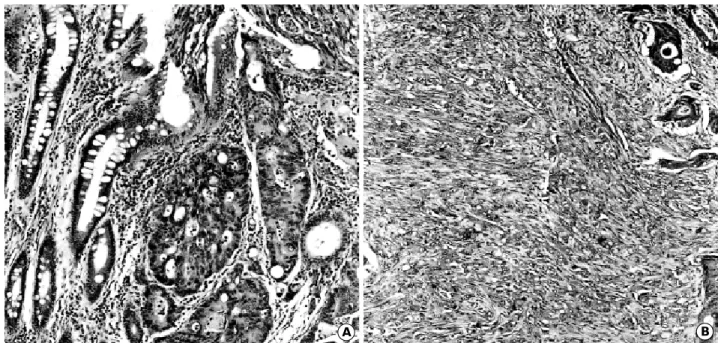
Histologically, the tumor consisted of a mixture of carci- nomatous and sarcomatous areas, being the former major.
Carcinomatous lesion was composed of moderately differen- tiated adenocarcinoma and located on superficial portion of the colon. Sarcomatous area was located in deeper portion, and mostly composed of a mixture of spindle-shaped undif- ferentiated cells and anaplastic bizarre giant cells. There were transitional areas between carcinomatous and sarcomatous areas. On immunohistochemical study, strong immunoreac- tivities for cytokeratin (DAKO, Glostrup, Denmark), epi- thelial membrane antigen (DAKO, Glostrup, Denmark) in differentiated adenocarcinomatous areas were detected. The sarcomatous spindle cell component of the tumor was large- ly vimentin (DAKO, Glostrup, Denmark)-positive with co- expression of cytokeratin. The immunoreactivities were negative against the other antibodies, such as myoglobin, smooth muscle actin (DAKO, Glostrup, Denmark), chro- mogranin (DAKO, Glostrup, Denmark) and p53 protein
Joo Heon Kim, Woo Sung Moon*, Myoung Jae Kang*, Mee Ja Park, Dong Geun Lee*
Department of Pathology, Eulji University, School of Medicine, Taejeon; Department of Pathology, Chonbuk National University, Medical School, Institute for Medical Science*, Jeonju, Korea
Received : 5 October 2000 Accepted : 18 December 2000
Address for correspondence Joo Heon Kim, M.D.
Department of Pathology, Eulji University, School of Medicine, 24-14 Mok-dong, Jung-gu, Taejeon 301-070, Korea
Tel : +82.42-259-1477, Fax : +82.42-259-1495 E-mail : [email protected]
*This work was partly supported by grants from Chonbuk National University Hospital.
657 J Korean Med Sci 2001; 16: 657-60
ISSN 1011-8934
Copyright � The Korean Academy of Medical Sciences
Sarcomatoid Carcinoma of the Colon
: A Case Report
Sarcomatoid carcinoma is a rare biphasic tumor characterized by a combination of malignant epithelial and mesenchymal cells. We report a rare case of sarco- matoid carcinoma of the colon. A 41-yr-old woman was hospitalized with a histo- ry of melena. Total colectomy was performed under the impression of colonic carcinoma. Histologically, the tumor was composed of differentiated adenocarci- noma in superficial portion and sarcomatoid spindle cells in deeper portion with a transitional area between the two portions. The sarcomatous areas revealed polygonal and spindle-shaped anaplastic malignant cells arranged in sheet, short fascicular or haphazard pattern. Immunohistochemically, tumor cells showed a positive immunoreaction for cytokeratin, epithelial membrane antigen, and vimentin. The histopathological and immunohistochemical transitions between the adenocarcinoma area and the spindle cell area suggested that the sarcoma- tous elements originated from the adenocarcinoma during tumor progression.
Key Words : Carcinosarcoma; Colon; Immunohistochemistry
658 J.H. Kim, W.S. Moon, M.J. Kang, et al.
(DAKO, Glostrup, Denmark).
She received 2 cycles of 5-fluorouracil/leucovorin chemo- therapy after the operation. Follow-up radiologic examina- tion showed multiple organ metastases, including liver, lung, and brain. The patient was placed in supportive care without any further treatment and died four months after the diagnosis.
DISCUSSION
Malignant tumor with a mixed phenotype is a controver- sial field of pathology. The rare sarcomatoid carcinomas of the colon have been described hitherto under a variety of names causing a great uncertainty about their classification and histogenesis (1-6). They can occur in various anatomical
A B
Fig. 1.Photomicrographs show moderately differentiated adenocarcinoma on superficial portion of the colon (A) and a proliferation of polygonal or spindle-shaped anaplastic tumor cells in sheet or short fascicular pattern, intermixed with differentiated adenocarcinoma (B) (H&E, ×100).
A B
Fig. 2.Immunohistochemical stainings for cytokeratin (A) and vimentin (B) reveal diffuse cytoplasmic positivity in tumor cells of the sarcomatoid area (ABC method, ×200).
Sarcomatoid Carcinoma of the Colon 659
sites and exhibit a wide range of microscopic appearances (7-12).
The pathogenesis of mesenchymal differentiation in the sarcomatoid carcinoma is uncertain. Various hypotheses have been proposed to explain the biphasic appearance of sarco- matoid carcinomas. Briefly, the explanations include the collision theory of independent neoplastic growths from multipotent stem cell origins, epithelial to mesenchymal conversion by epithelial-stromal interaction, and combina- tion of the two (11, 13). The salient features in our case are presence of dysplasia and adenocarcinoma in situ, morpho- logical“transition”between carcinomatous and sarcomatous tissue in relation to depth of invasion, and the detection of epithelial characteristics by immunohistochemistry in the sarcomatous component, which strongly support the histo- genesis of epithelial to mesenchymal conversion. Gentile et al. (14) reported that the presence of productive retroviral infection in the sarcomatous cells was related with tumor progression from the carcinomatous to the sarcomatous phase. Delahunt et al. (12) described that the phenotypic conversion of carcinoma into sarcomatoid tissue was associ- ated with progressive accumulation of p53 proteins, thus indicating that they had increasing clonal dominance of dedifferentiated tumor cells carrying p53 mutations. But, immunohistochemistry for p53 protein showed negative results on either carcinomatous or sarcomatous area in our case.
The six cases of the colonic sarcomatoid carcinoma previ- ously reported in detail occurred in patients from 43 to 77 yr of age. Six patients were male and one was female. Three patients died of the tumor within a year. The best predic- tors of outcome in sarcomatoid carcinoma seem to be tumor location, size, invasion depth, and the clinical stage of the disease (1, 11-13). The majority of tumors in upper aerodi- gestive tract including esophagus and stomach have poly- poid growth patterns and can be diagnosed early in their course, and accordingly, are associated with a relatively favo- rable prognosis. On the other hand, sarcomatoid carcinomas involving lower intestinal tract have an aggressive clinical course, often present with symptoms or signs related to dis- tant metastasis. Thus, it is important to make a correct di- agnosis by distinguishing them from other spindle cell pro- liferations of the intestine.
The diagnosis of sarcomatoid carcinoma by light micros- copy alone can be difficult, especially with the small frag- ments of biopsied specimen or undifferentiated spindle cell tumor without obvious glandular differentiation. Sarcoma- toid carcinoma should be distinguished from sarcomas that have more frequently spindle cell areas including carcinosar- coma, leiomyosarcoma, malignant fibrous histiocytoma, and malignant melanoma. To establish a diagnosis of sarcoma- toid carcinoma, the sarcomatous component should show obvious epithelial differentiateion without heterogeneous mesenchymal components. Then, immunohistochemistry
and electron microscopy may confirm the diagnosis, as epi- thelial characteristics in sarcomatous component could be demonstrated in all cases studied.
In summary, sarcomatoid carcinoma of the colon is extre- mely rare tumor composed of mixed malignant epithelial and mesenchymal cells, with only six cases reported up to date. Despite postoperative chemotherapy, the patient in our case died of liver failure resulting from extensive metas- tatic growth. The histologic features, stage, and outcome of the reported cases indicate that this neoplasm generally per- sues an highly aggressive and malignant biological course with rapid growth and wide local infiltration, leading to a poor prognosis. Radical surgery with adjuvant chemothera- py, and close follow-up are necessary for the management of this disease.
REFERENCES
1. Nakao A, Sakagami K, Uda M, Mitsuoka S, Ito H. Carcinosarcoma of the colon: report of a case and review of the literature. J Gastroen- terol 1998; 33: 276-9.
2. Isimbaldi G, Sironi M, Assi A. Sarcomatoid carcinoma of the colon.
Report of the second case with immunohistochemical study. Pathol Res Pract 1996; 192: 483-7.
3. Roncaroli F, Montironi R, Feliciotti F, Losi L, Eusebi V. Sarcoma- toid carcinoma of the anorectal junction with neuroendocrine and rhabdomyoblastic features. Am J Surg Pathol 1995; 19: 217-23.
4. Weidner N, Zekan P. Carcinosarcoma of the colon. Report of a uni- que case with light and immunohistochemical studies. Cancer 1986;
58: 1126-30.
5. Chetty R, Bhathal PS. Caecal adenocarcinoma with rhabdoid phe- notype: an immunohistochemical and ultrastructural analysis. Vir- chows Arch A Pathol Anat Histopathol 1993; 422: 179-82.
6. Shoji M, Dobashi Y, Iwabuchi K, Kuwao S, Mikami T, Kameya T.
Sarcomatoid carcinoma of the descending colon--a histological, im- munohistochemical and ultrastructural analysis. Acta Oncol 1998;
37: 765-8.
7. Leventon GS, Evans HL. Sarcomatoid squamous cell carcinoma of the mucous membranes of the head and neck: a clinicopathologic study of 20 cases. Cancer 1981; 48: 994-1003.
8. Goellner JR, Devine KD, Weiland LH. Pseudosarcoma of the lar- ynx. Am J Clin Pathol 1973; 59: 312-26.
9. Fukuda T, Kamishima T, Ohnishi Y, Suzuki T. Sarcomatoid carci- noma of the small intestine: histologic, immunohistochemical and ultrastructural features of three cases and its differential diagnosis.
Pathol Int 1996; 46: 682-8.
10. Robey-Cafferty SS, Silva EG, Cleary KR. Anaplastic and sarcoma- toid carcinoma of the small intestine: a clinicopathologic study.
Hum Pathol 1989; 20: 858-63.
11. Lopez-Beltran A, Pacelli A, Rothenberg HJ, Wollan PC, Zincke H, Blute ML, Bostwick DG. Carcinosarcoma and sarcomatoid carci- noma of the bladder: clinicopathological study of 41 cases. J Urol 1998; 159: 1497-503.
660 J.H. Kim, W.S. Moon, M.J. Kang, et al.
12. Delahunt B, Eble JN, Nacey JN, Grebe SK. Sarcomatoid carcino- ma of the prostate: progression from adenocarcinoma is associated with p53 over-expression. Anticancer Res 1999; 19: 4279-83.
13. Guarino M, Tricomi P, Giordano F, Cristofori E. Sarcomatoid car-
cinomas: pathological and histopathogenetic considerations.
Pathology 1996; 28: 298-305.
14. Gentile R, Castellaneta A. Carcinosarcoma of the colon, one or two tumors? Pathologica 1997; 89: 62-8.