c Korean Medical Association
This is an Open Access article distributed under the terms of the Creative Commons Attribution Non-Commercial License (http://creativecommons.
공중보건의사의 실태조사 연구
서 경 화1·임 선 미1·박 광 선2·기 동 훈2·박 윤 형1,3* | 1대한의사협회 의료정책연구소, 2대한공중보건의사협의회, 3순천향대학교 의과대학 예방의학교실
A study on the current state of public health doctors
Kyung Hwa Seo, MBA1·Sun Mi Lim, PhD1·Kwang Sun Park, MD2·Dong Hune Key, MD2·Yoon Hyung Park, MD1,3*
1Research Institute of Healthcare Policy, Korean Medical Association, Seoul, 2Korean Association of Public Health Doctor, Seoul,
3Department of Preventive Medicine, Soonchunhyang University College of Medicine, Cheonan, Korea
*Corresponding author: Yoon Hyung Park, E-mail: [email protected] Received Decomber 15, 2011·Accepted December 25, 2011
A
s the healthcare environment has changed both socially and politically importance of public health doctors' roles has increased and ongoing revision of their roles is also needed in Korea. However, many problems have decreased the job satisfaction of public health doctors.This study aims to determine the factors that influence public health doctors' satisfaction. The survey was conducted over the course of 2 months by questionnaire methodology. A total of 881 respondents (response rate, 90.1%) participated and 778 valid responses were analyzed using SAS version 9.1. Items about arranged organization, work task, employee welfare and services, education, public health doctor’s system, and the role of public health doctors were included in the questionnaire. It was found that the satisfaction of many respondents was not high and they had negative perceptions of arranged organization, work, environment, employee welfare and services, education, system, and their own role. Although the public health doctors have professional knowledge of healthcare, they were not satisfied with their role because they were required to do inappropriate work, improperly arranged and found performing work difficult when treated unfairly or not paid fairly. Therefore, policies focused on financial compensation or system improvement must be established to increase the satisfaction of public health doctors.
This study’s limitation was that the survey was done through two modalities. However, it is meaningful that issues related to the public health doctors were dealt with more comprehen- sively in this study than other studies.
Keywords: Public health doctor; Job satisfaction; Public health doctor’s system
서 론
공 중보건의사는 ‘공중보건업무에 종사하기 위하여 「병역 법 제34조 제1항의 규정에 의하여 공중보건의사에 편
입된 의사·치과의사 또는 한의사로서 보건복지부장관으로
부터 공중보건업무에 종사할 것을 명령받은 자[1]’로, 병역의
무 대신 3년 동안 농어촌 등 보건의료 취약지역에서 근무하
는 의료인력을 일컫는다. 공중보건의사제도는 「국민보건의
료를 위한 특별조치법」에 의거하여 1978년도부터 시행되었 고, 1980년부터는 「농어촌 보건의료를 위한 특별조치법」에 따라 의료취약지역을 중심으로 공중보건의사를 배치하기 시 작하였다[2]. 공중보건의사 파견의 초기 목적은 의료에 대한 접근성이 낮은 지역주민에게 형평하고 효율성 있는 보건의료 를 제공함으로써 무의촌을 해소하고, 우리나라 보건의료의 균 점과 국민 건강증진에 이바지하기 위함이었다. 이에 따라 공 중보건의사들은 보건소나 보건지소 등의 공공보건의료기관에 파견되어 일차의료 제공자로서의 역할을 수행해 왔다.
현재에는 과거의 의료환경과 달리, 점차 교통 및 정보통 신의 발달로 의료에 대한 접근성이 향상되었고, 지역 주민들 의 의료서비스에 대한 요구도가 다양해졌을 뿐 아니라, 만성 질환 증가 등 질병구조의 변화로 인해 치료 중심에서 사전예 방 및 건강증진으로 의료에 대한 패러다임이 전환되었다[3].
또한 국가보건의료체계의 공공성 강화 및 필수 보건의료서 비스 접근성 향상을 위한 의료정책의 변화로 인해 질 높은 공공보건의료 서비스에 대한 기대 또한 높아지고 있는 추세 이다. 이와 같은 사회적, 정치적 의료 환경의 변화를 통해 공 중보건의사 역할의 중요성이 확대됨과 동시에 역할에 대한 변화의 필요성이 제기되었다[4,5].
본 연구에서는 공중보건의사들의 만족도 향상을 위한 요 인을 파악하고자 공중보건의사들을 대상으로 배치, 업무, 후 생복지환경, 제도 등을 포함한 전반적인 실태를 조사하였 다. 연구결과는 공중보건의사의 역할을 재정립하여 향후 일 차보건의료의 근간을 마련하는 데 도움이 될 것이며, 궁극적 으로 지역사회 보건의료의 질 향상을 위한 방안 마련에 기초 자료로 활용될 수 있을 것이다.
Table 1. Respondents' characteristics
Variables General characteristics No. (%) Age (yr,
31.01±2.35) 26-29 230 (30.4)
30-34 494 (65.3)
Over 35 32 (4.2)
Marital status Single 421 (54.2)
Married 356 (45.8)
Length of working year (yr)
1 118 (15.2)
2 329 (42.3)
3 330 (42.5)
Training course General physician 408 (52.4) Specialist physician 370 (47.6)
Specialty Internal medicine 164 (46.3)
Surgical medicine 176 (49.7)
Medical assistant specialty 14 (4.0)
Work form Nine-to-fiver 715 (91.9)
Overtime work 63 (8.1)
Region Seoul 13 (1.7)
Busan 11 (1.4)
Daegu 15 (1.9)
Daejeon 4 (0.5)
Incheon 17 (2.2)
Kwangju 9 (1.2)
Ulsan 8 (1.0)
Chungcheongbuk-do 80 (10.3)
Chungcheongnam-do 66 (8.5)
Gyeonggi-do 74 (9.5)
Gyeongsangbuk-do 118 (15.2)
Gyeongsangnam-do 87 (11.2)
Jeju-do 24 (3.1)
Jeollabuk-do 72 (9.3)
Jeollanam-do 125 (16.1)
Kangwon-do 55 (7.1)
Arranged
organizations Health center 99 (12.7)
Health subcenter 377 (48.5)
Health center & county
hospital 46 (5.9)
Hospital ship & mobile clinic 2 (0.3) National/public hospital 52 (6.7)
Private hospital 108 (13.9)
Table 1. (Continued)
Variables General characteristics No. (%) Institutions related to the
Ministry of Health & Welfare 27 (3.5) Social welfare organization 15 (1.9) Public health organization 18 (2.3) Correctional institution 8 (1.0) Other central governments 26 (3.3) The cases not answered in questions are rejected in analysis.
연구방법
1. 조사대상 및 방법
본 연구에서는 2010년 10월 말 조사시점에 우리나라 전 지역에서 공중보건의사로 근무하고 있는 의사(치과의사, 한 의사 제외)를 조사대상으로 하였다. 표본추출틀(sampling frame)로 대한공중보건의사협의회를 통해 확보한 모집단 명부를 사용하였고, 층화확률비례추출법(stratified proba- bility sampling)으로 모집단의 각 지역별 분포 비중에 따라 지역별 조사대상 인원수를 산출하였다. 이때 모집단 명부 상 조사대상자에 대한 다양한 정보가 포함되어 있지 않아 배 치 지역으로만 층을 구분하였다.
설문조사는 대한공중보건의사협의회의 웹진으로 조사실
시에 대해 사전홍보를 여러 차례 하였 고, offline과 online방법으로 총 2차례 실시되었다. 1차 조사는 시도별 추계직 무교육 시 설문조사표를 배포하여 조 사한 offline방법을 통해 진행되었으 나, 조사시점과 교육시점의 차이로 일부 공중보건의사들은 조사에 참여하지 못 하였거나 지역별 무응답이 많았다. 이에 따라 추가적으로 2차 조사에서는 웹 설 문을 링크한 전자우편을 발송하는 on- line방법을 이용하였다. 조사기간은 각 2010년 11월 4일-12월 10일(offline방 법), 2011년 2월 8일-3월 7일(online방 법)로 각 1개월씩 소요되었다. 배포된 조사표는 총 900부였고, 811부가 회수 되어 응답률은 90.1%였다.
2. 조사도구
공중보건의사 제도/법 관련 사항, 공 중보건의사 대상 조사연구, 의료분야 종 사자 대상 만족도 조사연구 등에 관한 문헌검토 내용과 함께, 대한공중보건의 사협의회 자문위원들의 의견을 수렴하 여 도출된 핵심 이슈를 바탕으로 질문문항을 구성하였다[3, 5-10]. 주요 조사내용은 응답자 특성을 비롯하여 인력배치, 업무현황, 후생복지환경, 직무교육, 제도에 관한 것이었다.
3. 분석방법
회수된 조사표는 총 811부였고, 분석에 유효한 설문지는 불성실한 답변 또는 무응답이 많은 조사표 33부를 제외한 총 778부였다. 통계분석은 SAS ver 9.1 (SAS Inc., Cary, NC, USA)을 이용하여 주로 빈도분석(frequency analy- sis), 기술 분석(descriptive analysis)을 수행하였다. 이때 배치기관은 응답자 특성 항목으로 고려하여 분석결과를 산 출하였고, 항목별 무응답이 있는 경우 이를 다른 값으로 대 체하지 않고 결과 산출 시 분석대상에서 제외하였다.
Table 2. Appropriateness of the number of public health doctors assigned to public health- related organizaions
Variables No. Never be appro-
priate
Not appr- opriate Mode-
rate Appro-
priate Very appro-
priate Mean Health center 96 13 (13.5) 32 (33.3) 29 (30.2) 11 (11.5) 11 (11.5) 2.7 Health subcenter 373 114 (30.6) 106 (28.4) 84 (22.5) 45 (12.1) 24 (6.4) 2.4 Health center &
county hospital 45 4 (8.9) 13 (28.9) 17 (37.8) 8 (17.8) 3 (6.7) 2.8 Hospital ship &
mobile clinic 2 0 (0.0) 0 (0.0) 1 (50.0) 1 (50.0) 0 (0.0) 3.5 National/public
hospital 52 5 (9.6) 16 (30.8) 14 (26.9) 16 (30.8) 1 (1.9) 3.9 Private hospital 107 25 (23.4) 22 (20.6) 37 (34.6) 17 (15.9) 6 (5.6) 2.6 Institutions
related to the Ministry of Health
& Welfare
27 7 (25.9) 7 (25.9) 6 (22.2) 5 (18.5) 2 (7.4) 2.6
Social welfare
organization 15 3 (20.0) 6 (40.0) 5 (33.3) 0 (0.0) 1 (6.7) 2.3 Public health
organization 17 7 (41.2) 4 (23.5) 1 (5.9) 5 (29.4) 0 (0.0) 2.2 Correctional
institution 8 2 (25.0) 0 (0.0) 3 (37.5) 3 (37.5) 0 (0.0) 2.9 Other central
governments 26 7 (26.9) 6 (23.1) 7 (26.9) 3 (11.5) 3 (11.5) 2.6 Total 768 187 (24.3) 212 (27.6) 204 (26.6) 114 (14.8) 51 (6.6) 2.5 Unit: n (%), score.
The cases not answered in questions are rejected in analysis.
Likert 5-point scale is used to measure.
Table 3. Appropriateness of arrangement by organization
Variables Health
center Health centersub-
Health center &
county hospital
Hospi- tal ship/
mobile clinic
Natio- nal/
public hos-pital
Private hos-pital
Institu- tions related
to the Ministry of Health
& Welfare Social welfare organi-
zation Public health organi- zation
Correc- tional institu- tion
Other central govern- ment related organi-
zation Total 3.7 (1.1) 4.0 (1.0) 3.3 (1.2) 3.7 (1.1) 2.5 (1.2) 1.7 (1.0) 2.8 (1.2) 2.8 (1.2) 2.4 (1.2) 2.7 (1.2) 2.6 (1.2) Length of
working year
1 3.7 (1.2) 4.1 (1.1) 3.3 (1.3) 3.8 (1.0) 2.7 (1.3) 1.8 (1.1) 2.8 (1.1) 2.7 (1.2) 2.4 (1.2) 2.9 (1.1) 2.6 (1.2) 2 3.7 (1.1) 4.0 (1.0) 3.3 (1.2) 3.6 (1.1) 2.6 (1.3) 1.7 (1.1) 2.9 (1.2) 2.8 (1.2) 2.4 (1.2) 2.7 (1.2) 2.6 (1.2) 3 3.6 (1.1) 3.9 (1.0) 3.3 (1.2) 3.6 (1.1) 2.4 (1.2) 1.6 (1.0) 2.8 (1.2) 2.7 (1.2) 2.3 (1.2) 2.7 (1.2) 2.5 (1.1) Marital
status
Single 3.7 (1.2) 4.1 (1.0) 3.3 (1.2) 3.6 (1.2) 2.6 (1.3) 1.9 (1.2) 2.9 (1.2) 2.8 (1.2) 2.5 (1.3) 2.8 (1.2) 2.7 (1.2) Married 3.6 (1.1) 3.9 (1.0) 3.3 (1.2) 3.7 (1.0) 2.5 (1.2) 1.5 (0.8) 2.8 (1.1) 2.7 (1.2) 2.2 (1.1) 2.7 (1.1) 2.5 (1.2) Training
course General
physician 3.7 (1.1) 4.0 (1.0) 3.3 (1.2) 3.6 (1.2) 2.6 (1.3) 1.9 (1.1) 3.0 (1.2) 2.8 (1.2) 2.5 (1.3) 2.8 (1.2) 2.8 (1.2) Special
physician 3.6 (1.1) 4.0 (1.0) 3.3 (1.2) 3.7 (1.0) 2.5 (1.2) 1.5 (0.8) 2.7 (1.1) 2.7 (1.1) 2.2 (1.1) 2.6 (1.1) 2.4 (1.1) Workform Nine-to-fiver 3.7 (1.1) 4.0 (1.0) 3.3 (1.2) 3.6 (1.1) 2.6 (1.3) 1.7 (1.1) 2.9 (1.2) 2.8 (1.2) 2.4 (1.2) 2.8 (1.2) 2.6 (1.2)
Overtime
worker 3.3 (1.3) 4.1 (1.0) 3.3 (1.3) 3.9 (1.0) 2.5 (1.2) 1.5 (0.8) 2.8 (1.2) 2.8 (1.2) 2.2 (1.1) 2.6 (1.1) 2.5 (1.2) Arranged
organiza- tions
Health center 3.7 (1.1) 4.0 (0.9) 3.1 (1.1) 3.5 (1.1) 2.3 (1.2) 1.7 (1.1) 2.9 (1.1) 2.7 (1.1) 2.3 (1.1) 2.6 (1.1) 2.5 (1.1) Health
subcenter 3.7 (1.2) 3.9 (1.0) 3.3 (1.3) 3.6 (1.1) 2.5 (1.3) 1.8 (1.1) 3.0 (1.3) 2.7 (1.2) 2.5 (1.3) 2.8 (1.3) 2.7 (1.2) Health center
& county hospital
3.3 (1.2) 3.7 (1.1) 3.2 (1.2) 3.6 (1.0) 2.5 (1.3) 1.5 (0.8) 2.7 (1.2) 3.0 (1.2) 2.4 (1.2) 2.9 (1.2) 2.6 (1.2)
Hospital ship
& mobile clinic 3.5 (0.7) 3.5 (0.7) 2.5 (0.7) 3.0 (0.0) 3.5 (0.7) 1.5 (0.7) 2.0 (1.4) 2.5 (0.7) 1.5 (0.7) 3.0 (0.0) 1.5 (0.7) National/public
hospital 3.5 (1.2) 4.1 (0.9) 3.4 (1.3) 4.0 (0.8) 2.7 (1.0) 1.3 (0.7) 2.6 (1.1) 2.9 (1.1) 2.2 (1.2) 2.8 (1.1) 2.3 (1.1) Private
hospital 3.8 (1.1) 4.2 (0.9) 3.6 (1.1) 3.7 (1.1) 2.6 (1.2) 1.7 (1.0) 2.7 (1.2) 2.7 (1.2) 2.3 (1.2) 2.7 (1.2) 2.4 (1.2) Institutions
related to the Ministry of Health &
Welfare
3.2 (1.3) 4.2 (1.1) 3.2 (1.3) 3.9 (1.1) 2.5 (1.1) 1.3 (0.7) 2.6 (1.0) 2.7 (1.1) 1.8 (0.9) 2.6 (1.2) 2.3 (1.0)
Social welfare
organization 3.2 (1.1) 3.9 (1.3) 2.9 (1.4) 3.9 (1.1) 2.4 (1.2) 1.5 (1.1) 2.7 (1.3) 2.9 (1.2) 2.2 (1.3) 3.1 (1.2) 2.2 (1.3) Public health
organization 3.8 (0.9) 4.2 (0.9) 3.4 (1.0) 3.7 (1.1) 2.6 (1.0) 1.4 (0.8) 2.7 (0.9) 2.8 (0.9) 1.7 (0.8) 2.9 (0.9) 2.6 (1.1) Correctional
institution 3.5 (0.9) 4.0 (0.8) 3.0 (1.4) 3.4 (1.2) 2.8 (1.3) 1.9 (1.5) 2.5 (0.9) 2.4 (1.1) 1.5 (0.9) 2.4 (1.2) 2.6 (0.7) Other central
government related organization
3.9 (1.0) 4.3 (0.8) 3.6 (0.9) 3.7 (1.1) 2.9 (1.2) 1.4 (0.7) 2.9 (0.9) 2.8 (0.8) 2.3 (1.0) 2.7 (1.0) 2.8 (1.1)
Unit: score.
The cases not answered in questions are rejected in analysis.
The standard deviation is given in parentheses.
Likert 5-point scale is used to measure.
연구결과
1. 응답자 특성
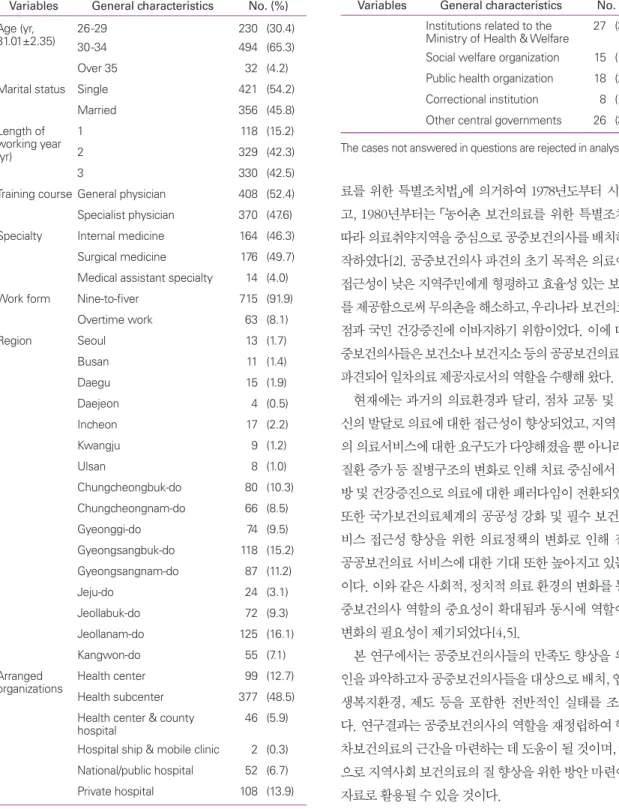
조사표에 응답한 총 778명의 응답자 특성은 Table 1과 같 다. 이들의 평균 연령은 31세로 주로 30-34세 연령대의 응답 자들이 65.3%로 가장 많았고, 미혼자(54.2%)가 기혼자
(45.8%)보다 더 많았다. 수료과정에 따라 일반의는 52.4%, 전문의는 47.6%의 비중을 차지하고 있었으며, 전문의의 전 문 과목으로 외과계열 전공자(49.7%)가 내과계열(46.3%)보 다 조금 더 많았고 진단검사의학과나 영상의학과 등의 임상 지원계열 전공자는 4.0%에 불과하였다. 근무연차별로는 2년차와 3년차의 비중이 각 42% 정도로 유사한 비중이었다.
근무형태는 응답자의 91.9%에 해당하는 대부분이 공무 원과 같이 정시근무를 하고 있었으나, 8.1%에 해당하는 자 는 2교대나 3교대 등의 형태로 근무를 하고 있었다. 또한 배 치기관으로는 보건지소(48.5%)가 가장 많았고, 민간병원 (13.9%)과 보건소(12.7%)의 순이었다. 근무지역은 서울이 나 6대 광역시에 근무 중인 응답자 비중은 10%였고, 나머지 9개 도 지역 중 전남(16.1%), 경북(15.2%), 경남(11.2%), 충 북(10.3%)지역에 배치된 응답자의 비중이 높았다.
2. 배치인원수 및 배치기관의 적정성
배치인원수의 적정성 평가 결과, 전체 응답자의 평균은 2.5점으로서 국공립병원에 배치된 응답집단(3.9점)을 제외 한 다수의 응답자들은 전반적으로 근무하고 있는 기관에 배 치된 공중보건의사 인원수가 적정하지 않다고 평가하였다 (Table 2).
배치기관 적정성에 대해서 보건지소(4.0점)/보건소(3.7 점)/보건의료원(3.3점)과 같은 공공보건의료기관에 배치하 는 것은 적정하지만, 그 외 민간병원(1.7점)/보건단체(2.4 점) 등에 배치되는 것은 적정하지 않다고 평가하였다. 응답 자 특성별로는 근무연차가 낮고 미혼, 일반의인 경우 보건지 소, 보건소, 보건의료원에 대한 배치적정성을 상대적으로 높 게 평가하는 경향을 보였다(Table 3).
공중보건의사가 배치된 기관 주변(5 km 이내)에 의원의 분포 비율이 79.5%, 병원의 분포 비율이 58.4%로 병의원이 없는 비율보다 있는 비율이 더 많았고, 특히 병원보다 의원 이 더 많이 분포되어 있었다.
3. 업무현황
1) 주요 업무종류 및 업무의 타당성
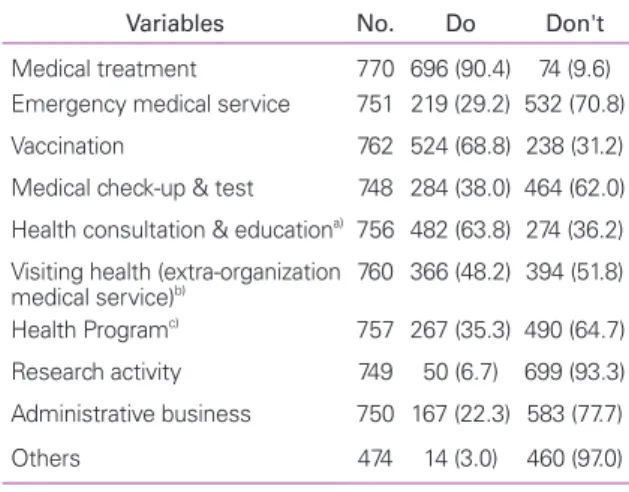
공중보건의사의 업무로서 진료(90.4%), 예방접종
100.0
62.2
15.2 14.7
6.5 0.8 0.7
%
80.0 60.0 40.0 20.0
0.0 1 2 3 4 5 6
Figure 1. The elements required to work. 1. Specialty knowledge.
2. Experience of and knowledge about performing health services. 3. Personal relations. 4. Administrative expe- riences and knowledge. 5. No other skills or knowledge required. 6. Other. The cases not answered in questions are rejected in analysis.
Table 4. Nature of current work
Variables No. Do Don't
Medical treatment 770 696 (90.4) 74 (9.6) Emergency medical service 751 219 (29.2) 532 (70.8)
Vaccination 762 524 (68.8) 238 (31.2)
Medical check-up & test 748 284 (38.0) 464 (62.0) Health consultation & educationa) 756 482 (63.8) 274 (36.2) Visiting health (extra-organization
medical service)b) 760 366 (48.2) 394 (51.8) Health Programc) 757 267 (35.3) 490 (64.7) Research activity 749 50 (6.7) 699 (93.3) Administrative business 750 167 (22.3) 583 (77.7)
Others 474 14 (3.0) 460 (97.0)
Unit: n (%).
The cases not answered in questions are rejected in analysis.
a) First-aid Counseling & Hospital Transfer Service conducted by the 1339 Emergency Medical Service Information Center.
b) Dispatched medical service at other organizations including a mo- bile clinic unit.
c) Family health programs for health management of infants & preg- nant women, and health promotion program for non-smoking/
obesity/temperance, mental health program, etc.
(68.8%), 건강상담 및 교육(63.8%) 등 일차 의료와 관련된 업무를 주로 수행한다고 응답한 비중이 높았다(Table 4).
이와 더불어 수행하고 있는 업무와 관계없이 업무의 타당성
을 측정한 결과, 전반적으로 진료(3.7점) 업무의 타당성이 가장 높은 것으로 나타났고 행정업무(2.0점)는 가장 낮게 평 가되었다. Table 5에서 보는 바와 같이 수료과정, 배치기관
Table 5. Validity of public health doctors' workVariables Medical
treat- ment
Emer- gency medical service
Vacci- nation
Medical check-up
& test
Health consulta- tion/edu- cation
Visiting health care
Health
programResearch activity
Admini- strative businessOther Total 3.7 (1.2) 2.8 (1.3) 3.3 (1.1) 2.9 (1.2) 3.5 (1.1) 2.9 (1.2) 3.0 (1.2) 2.6 (1.2) 2.0 (1.1) 2.7 (1.3) Length of
working year
1 3.9 (1.2) 2.9 (1.4) 3.3 (1.2) 3.1 (1.2) 3.6 (1.1) 2.9 (1.2) 2.9 (1.2) 2.4 (1.2) 1.7 (1.0) 1.8 (1.0) 2 3.7 (1.2) 2.8 (1.4) 3.3 (1.1) 2.8 (1.2) 3.5 (1.1) 2.9 (1.3) 3.0 (1.2) 2.6 (1.2) 2.0 (1.2) 3.0 (1.3) 3 3.5 (1.2) 2.8 (1.3) 3.4 (1.1) 2.9 (1.2) 3.6 (1.1) 3.0 (1.2) 3.1 (1.2) 2.7 (1.1) 2.1 (1.2) 2.7 (1.3) Marital
status Single 3.7 (1.2) 2.7 (1.3) 3.5 (1.2) 2.9 (1.2) 3.7 (1.1) 3.0 (1.2) 3.1 (1.2) 2.7 (1.2) 2.1 (1.2) 2.8 (1.3) Married 3.7 (1.2) 3.0 (1.3) 3.2 (1.1) 2.9 (1.2) 3.4 (1.1) 2.9 (1.2) 3.0 (1.2) 2.6 (1.1) 1.9 (1.1) 2.7 (1.3) Training
course General
physician 3.6 (1.2) 2.6 (1.3) 3.5 (1.1) 2.9 (1.2) 3.7 (1.1) 3.1 (1.2) 3.1 (1.2) 2.7 (1.2) 2.2 (1.2) 2.7 (1.3) Special
physician 3.8 (1.2) 3.0 (1.3) 3.1 (1.1) 2.9 (1.2) 3.3 (1.1) 2.8 (1.2) 2.9 (1.2) 2.5 (1.1) 1.8 (1.0) 2.8 (1.4) Workform Nine-to-fiver 3.7 (1.2) 2.8 (1.3) 3.4 (1.1) 2.9 (1.2) 3.6 (1.1) 3.0 (1.2) 3.0 (1.2) 2.6 (1.2) 2.0 (1.2) 2.8 (1.3)
Overtime
worker 3.6 (1.3) 2.9 (1.4) 2.9 (1.2) 2.7 (1.1) 3.1 (1.3) 2.8 (1.3) 2.9 (1.2) 2.5 (1.2) 1.7 (1.0) 2.3 (1.9) Arranged
organiza- tions
Health center 3.3 (1.1) 2.2 (1.1) 3.2 (1.1) 2.9 (1.1) 3.4 (1.0) 2.9 (1.2) 2.9 (1.2) 2.3 (1.0) 1.8 (1.0) 2.9 (1.2) Health
subcenter 3.5 (1.3) 2.5 (1.3) 3.6 (1.1) 2.8 (1.2) 3.7 (1.1) 3.1 (1.2) 3.2 (1.2) 2.7 (1.2) 2.3 (1.2) 2.7 (1.2) Health center &
county hospital 3.7 (1.2) 3.2 (1.1) 3.1 (1.1) 3.1 (1.1) 3.2 (1.1) 2.8 (1.0) 3.0 (1.0) 2.3 (1.1) 1.8 (1.0) 3.0 (0.0) Hospital ship &
mobile clinic 4.5 (0.7) 4.5 (0.7) 2.0 (0.0) 2.5 (0.7) 3.0 (0.0) 3.5 (0.7) 3.5 (0.7) 3.5 (0.7) 3.0 (1.4) - National/public
hospital 4.3 (0.9) 3.5 (1.2) 3.2 (1.0) 2.9 (1.1) 3.4 (0.9) 2.8 (1.2) 2.7 (1.1) 2.7 (1.1) 1.7 (1.0) 2.0 (1.0) Private hospital 3.9 (1.1) 3.2 (1.2) 3.0 (1.1) 2.9 (1.2) 3.2 (1.2) 2.6 (1.3) 2.8 (1.3) 2.6 (1.2) 1.8 (1.1) 2.6 (1.5) Institutions
related to the Ministry of Health &
Welfare
4.1 (1.2) 3.9 (1.2) 3.2 (1.2) 3.0 (1.3) 3.4 (1.4) 3.1 (1.2) 3.0 (1.0) 2.8 (1.1) 1.8 (1.0) 5.0 (0.0)
Social welfare
organization 3.9 (1.2) 3.4 (1.0) 3.1 (1.1) 3.1 (1.0) 4.0 (1.0) 3.0 (1.0) 3.1 (1.1) 2.8 (1.3) 1.8 (1.1) 3.5 (0.5) Public health
organization 4.0 (0.8) 3.4 (1.2) 2.6 (1.2) 3.2 (1.0) 3.6 (1.0) 2.6 (1.2) 3.0 (1.1) 2.9 (1.0) 1.9 (1.0) - Correctional
institution 3.8 (0.7) 3.1 (0.8) 2.5 (0.9) 2.8 (0.9) 3.1 (0.8) 2.4 (1.5) 2.4 (1.5) 2.6 (1.4) 1.6 (1.1) - Other central
governments 4.0 (1.2) 3.6 (1.3) 3.1 (0.9) 3.2 (1.0) 3.2 (1.2) 2.9 (1.0) 2.8 (1.2) 2.4 (1.0) 1.6 (1.1) 2.8 (1.5) Unit: score.
The cases not answered in questions are rejected in analysis.
The standard deviation is given in parentheses.
Likert 5-point scale is used to measure.
에 따라 업무 타당성 평가결과에 다소 차이가 있었다.
2) 업무수행 시 필요요소
공중보건의사로서 주요 업무를 수행하는 데 있어서 필요한
요소는, 전문과목에 대한 지식(62.2%), 보건사업수행 경험과 지식(15.2%), 대 인관계(14.7%)의 순으로 나타났다 (Figure 1).
3) 근무시간
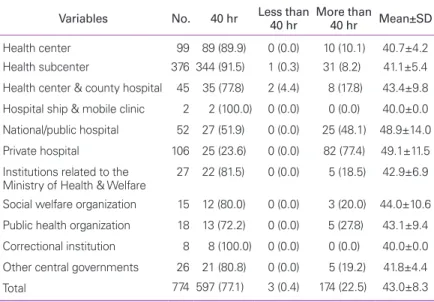
조사에 응답한 공중보건의사들의 총 근무시간은 1주일 동안의 정규근무시 간(40시간)과 시간 외 근무시간(주말, 초과)을 모두 합산한 시간으로 평균 43.0시간이었다. 초과 근무하는 공중 보건의사는 민간병원이 77.4%로 가장 높았고, 국공립병원 48.1%, 보건단체 27.8%, 사회복지시설 20.0%, 보건복 지부 관련기관이 18.5%의 순으로 나타 났다(Table 6).
4) 진료환자 수
1주일 동안 평균적으로 진료하는 환 자 수는 110.8명으로 조사되었다. 보 건복지부 관련기관/기타 중앙정부 관 련기관/보건지소를 제외한 모든 기관 에서 주 평균 100명 이상의 환자를 진 료하고 있었고, 보건소는 197.6명으로 가장 많은 환자를 진료하고 있었다. 이 어서 보건단체(167.5명), 교정시설 (157.5명), 민간병원(148.5명)의 순으 로 많은 환자들을 진료하고 있었다. 배 치기관 및 수행업무의 종류에 따라 주 말 및 초과근무를 하거나 환자를 전혀 보지 않는 경우도 있었다(Table 7).
5) 업무 및 업무환경에 대한 인식 수행업무에 대한 인식을 조사한 결 과 ‘지루하고 싫증난다’, ‘열심히 일하거 나 대충하거나 별 차이가 없다’, ‘좌절 감을 느끼게 한다’와 같이 부정적인 경향이 보통수준(평균 3 점)으로 나타났다. 반면, ‘새로운 지식이나 기술을 습득할 기 회가 많다’의 경우 2.1점으로 가장 낮게 나타났으며, ‘자신의
Table 6. The length of working timeVariables No. 40 hr Less than
40 hr More than
40 hr Mean±SD
Health center 99 89 (89.9) 0 (0.0) 10 (10.1) 40.7±4.2 Health subcenter 376 344 (91.5) 1 (0.3) 31 (8.2) 41.1±5.4 Health center & county hospital 45 35 (77.8) 2 (4.4) 8 (17.8) 43.4±9.8 Hospital ship & mobile clinic 2 2 (100.0) 0 (0.0) 0 (0.0) 40.0±0.0 National/public hospital 52 27 (51.9) 0 (0.0) 25 (48.1) 48.9±14.0 Private hospital 106 25 (23.6) 0 (0.0) 82 (77.4) 49.1±11.5 Institutions related to the
Ministry of Health & Welfare 27 22 (81.5) 0 (0.0) 5 (18.5) 42.9±6.9 Social welfare organization 15 12 (80.0) 0 (0.0) 3 (20.0) 44.0±10.6 Public health organization 18 13 (72.2) 0 (0.0) 5 (27.8) 43.1±9.4 Correctional institution 8 8 (100.0) 0 (0.0) 0 (0.0) 40.0±0.0 Other central governments 26 21 (80.8) 0 (0.0) 5 (19.2) 41.8±4.4
Total 774 597 (77.1) 3 (0.4) 174 (22.5) 43.0±8.3
Unit: n (%), hour.
The cases not answered in questions are rejected in analysis.
Table 7. The number of patients treated per 1 week
Variables No. Mean SD Maximum Minimum
Health center 96 197.6 199.2 1,500 0
Health subcenter 375 79.6 60.4 600 4
Health center & county hospital 45 126.5 112.8 600 20 Hospital ship & mobile clinic 2 170.0 70.0 240 100
National/public hospital 52 122.7 107.1 420 0
Private hospital 108 148.5 118.2 550 0
Institutions related to the Ministry
of Health & Welfare 27 27.8 68.2 300 0
Social welfare organization 15 133.8 91.0 300 7
Public health organization 18 167.5 138.3 500 0
Correctional institution 8 157.5 96.9 350 50
Other central governments 23 40.9 91.9 400 0
Total 769 110.8 116.2 1,500 0
The cases not answered in questions are rejected in analysis.
Likert 5-point scale is used to measure.
SD, standard deviation.
Table 8. The perception of the work itself
Variables 1 2 3 4 5 6 7 8 9 10
Health center 3.3 (1.3) 3.4 (1.3) 3.2 (1.4) 3.2 (1.2) 3.1 (1.1) 2.5 (1.0) 2.4 (1.1) 2.2 (1.1) 2.1 (1.0) 1.9 (0.9) Health subcenter 3.0 (1.1) 3.1 (1.1) 2.9 (1.3) 2.9 (1.0) 3.0 (1.0) 2.7 (1.1) 2.5 (1.1) 2.5 (1.1) 2.3 (1.1) 2.1 (1.1) Health center & county hospital 3.1 (1.1) 3.1 (1.2) 3.2 (1.3) 3.3 (1.2) 2.7 (1.1) 2.7 (1.1) 2.8 (0.9) 2.4 (1.2) 2.4 (1.1) 1.9 (1.0) Hospital ship & mobile clinic 3.5 (0.7) 1.5 (0.7) 2.5 (0.7) 3.0 (0.0) 1.5 (0.7) 3.0 (0.0) 3.0 (0.0) 3.0 (0.0) 3.0 (1.4) 2.5 (0.7) National/public hospital 3.2 (1.0) 3.0 (1.1) 3.5 (1.2) 3.3 (0.9) 2.7 (1.1) 3.1 (1.0) 2.9 (1.1) 2.8 (0.9) 2.7 (1.2) 2.2 (1.0) Private hospital 3.2 (1.0) 3.2 (1.1) 3.1 (1.2) 3.2 (1.1) 3.0 (1.2) 2.8 (1.1) 2.7 (1.1) 2.9 (1.1) 2.9 (1.1) 2.3 (1.1) Institutions related to the
Ministry of Health & Welfare 3.8 (1.1) 3.2 (1.1) 3.7 (1.3) 3.6 (1.2) 3.4 (1.3) 2.2 (1.4) 2.3 (1.5) 1.9 (1.1) 2.2 (1.3) 2.5 (1.3) Social welfare organization 3.1 (1.1) 3.2 (1.3) 3.3 (1.5) 3.1 (1.3) 3.1 (1.2) 3.1 (1.1) 2.9 (1.2) 2.9 (1.3) 2.9 (1.4) 2.7 (1.2) Public health organization 3.5 (1.2) 3.3 (1.3) 3.9 (1.4) 3.4 (1.1) 3.4 (1.0) 2.3 (1.1) 2.2 (1.2) 2.2 (1.1) 2.2 (1.2) 1.9 (0.9) Correctional institution 4.4 (0.7) 3.9 (0.6) 3.9 (1.4) 4.4 (0.7) 2.6 (1.2) 1.9 (0.8) 2.0 (0.9) 1.9 (1.0) 2.1 (0.6) 2.1 (0.8) Other central governments 3.3 (1.2) 3.1 (1.1) 3.4 (1.3) 3.2 (1.0) 3.2 (1.1) 2.4 (1.1) 2.4 (1.2) 2.3 (1.0) 2.3 (1.1) 2.2 (1.1) Total 3.1 (1.1) 3.1 (1.2) 3.1 (1.3) 3.1 (1.1) 3.0 (1.1) 2.7 (1.1) 2.6 (1.1) 2.5 (1.1) 2.4 (1.1) 2.1 (1.1) Unit: score.
1. It's boring and get me fed up. 2. It makes me frustrated. 3. There is no specific difference whether doing hard on it or doing sloppily. 4. It gives me stress. 5. It requires a lot of time in clerical (administrative) transactions. 6. It's pleasant and rewarding. 7. It gives me an intellectual stimulus and a sense of achievement. 8. It's a acknowledged and socially respected job. 9. It affords a lot of opportunity to display one's own ability. 10. It gives a lot of opportunity to acquire new knowledges or techniques.
The cases not answered in questions are rejected in analysis.
The standard deviation is given in parentheses.
Likert 5-point scale is used to measure.
Table 9. The perception of the work environment
Variables 1 2 3 4 5 6 7
Health center 3.3 (0.9) 3.0 (1.2) 2.9 (1.0) 2.9 (1.1) 2.7 (1.1) 2.3 (1.1) 2.1 (1.0)
Health subcenter 3.6 (0.9) 3.6 (1.0) 3.2 (1.1) 3.1 (1.1) 3.0 (1.2) 2.4 (1.1) 2.2 (1.1)
Health center & county hospital 3.3 (1.0) 3.1 (1.0) 2.8 (1.2) 2.9 (1.1) 3.0 (1.0) 2.6 (1.1) 2.5 (1.2) Hospital ship & mobile clinic 3.5 (0.7) 3.0 (1.4) 3.0 (1.4) 3.5 (0.7) 2.5 (0.7) 2.5 (0.7) 3.0 (1.4) National/public hospital 3.5 (0.7) 3.3 (1.0) 2.8 (1.1) 2.7 (1.0) 3.1 (1.0) 2.5 (1.2) 2.6 (0.9)
Private hospital 3.4 (0.8) 3.5 (0.8) 3.0 (1.0) 2.7 (1.1) 3.1 (1.0) 2.5 (1.1) 2.6 (1.1)
Institutions related to the Ministry of Health & Welfare 3.4 (0.9) 2.8 (1.2) 2.9 (1.2) 3.0 (1.3) 2.9 (1.3) 2.0 (1.3) 2.6 (1.0) Social welfare organization 3.5 (0.8) 3.6 (1.1) 3.2 (1.2) 3.1 (0.6) 3.1 (1.3) 2.8 (1.2) 2.3 (1.0) Public health organization 3.4 (0.9) 3.4 (1.0) 2.7 (1.2) 2.6 (1.0) 2.6 (1.3) 2.5 (0.9) 2.4 (1.2) Correctional institution 3.0 (0.9) 2.9 (1.1) 2.8 (0.9) 2.5 (1.2) 2.3 (0.9) 2.3 (1.0) 2.0 (0.5) Other central governments 3.5 (0.8) 3.4 (1.1) 3.2 (1.0) 2.7 (1.2) 2.8 (1.0) 2.3 (1.1) 2.9 (0.8)
Total 3.5 (0.9) 3.4 (1.1) 3.1 (1.1) 3.0 (1.1) 3.0 (1.1) 2.4 (1.1) 2.3 (1.0)
Unit: score.
1. There is sufficient time for business activities. 2. There is a sufficient space for business activities. 3. There is a sufficient workforce for busi- ness activities. 4. Immediately after I was assigned to an organization, I received the education &orientation from the relevant organization. 5.
Working conditions such as noise, lighting, and indoor temperature are pleasant. 6. The opinions suggested by public health doctors are nicely embraced by the arranged organization. 7. Medical appliances or medical equipment are sufficient enough to do medical service.
The cases not answered in questions are rejected in analysis.
The standard deviation is given in parentheses.
Likert 5-point scale is used to measure.
능력을 발휘할 기회가 많다’, ‘사회적으로 인정받고 존경받는 업무이다’ 등의 긍정적인 특성에 대해서는 3점 미만으로 평가
하였다. 특히, 교정시설에서 근무하는 공중보건의사들은 지 루하고 싫증나거나 스트레스를 준다는 부정적인 문항에서 4 점 이상의 높은 점수를 보임으로써 업무 전반에 대하여 매우 부정적인 시각을 가지고 있었다(Table 8).
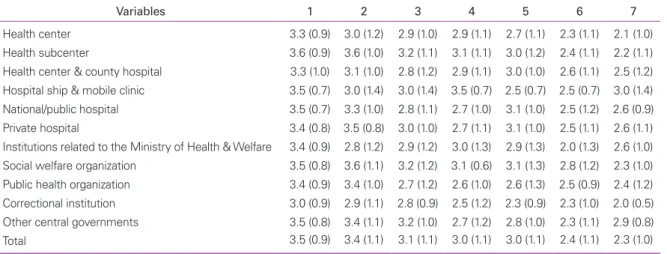
업무환경에 대한 인식 문항에서는 업무 공간, 인력, 시간 등에 전반적으로 긍정적인 인식을 가지고 있었으나, 의견수 렴 정도나 의료도구/장비 등에는 부정적인 인식을 가지고 있었다. 배치기관별로 의료도구나 장비 등이 가장 불충분하 다고 평가한 곳은 교정시설(2.0점)이었고, 보건복지부 관련 기관(2.0점)/보건소(2.3점)/교정시설이(2.3점)/기타 중앙정 부 관련기관(2.3점)에서는 공중보건의사의 의견 수렴이 가 장 잘 반영되지 않는 곳으로 평가되었다(Table 9).
업무나 환경적인 측면을 고려했을 때 업무만족도 향상을 위해 무엇보다 경제적 보상(1순위, 45.5%; 1-3 통합순위,
Table 10. Relationship and experience of conflict between public health doctors' arranged organization and private health care institutionVariables
Relationship Experience of conflict
No. ← Very
competitive Neither competitive nor
cooperative relations Very →
cooperative Mean No. Yes No
① ② ③ ④ ⑤ ⑥ ⑦
Health center 98 24 (24.5) 16 (16.3) 14 (14.3) 38 (38.8) 5 (5.1) 1 (1.0) 0 (0.0) 2.9 99 33 (33.3) 66 (66.7) Health subcenter 375 78 (20.8) 56 (14.9) 49 (13.1) 163 (43.5) 17 (4.5) 8 (2.1) 4 (1.1) 3.1 375 118 (31.5) 257 (68.5) Health center &
county hospital 46 10 (21.7) 5 (10.9) 11 (23.9) 16 (34.8) 4 (8.7) 0 (0.0) 0 (0.0) 3.0 46 14 (30.4) 32 (69.6) Hospital ship & mobile
clinic 2 0 (0.0) 0 (0.0) 2 (100.0) 0 (0.0) 0 (0.0) 0 (0.0) 0 (0.0) 3.0 2 0 (0.0) 2 (100.0) National/public hospital 51 4 (7.8) 19 (37.3) 7 (13.7) 15 (29.4) 5 (9.8) 1 (2.0) 0 (0.0) 3.0 50 8 (16.0) 42 (84.0) Private hospital 106 27 (25.5) 17 (16.0) 17 (16.0) 35 (33.0) 7 (6.6) 2 (1.9) 1 (0.9) 2.9 106 29 (27.4) 77 (72.6) Institutions related to
the Ministry of Health
& Welfare
27 3 (11.1) 3 (11.1) 1 (3.7) 18 (66.7) 1 (3.7) 0 (0.0) 1 (3.7) 3.6 27 5 (18.5) 22 (81.5)
Social welfare
organization 15 1 (6.7) 2 (13.3) 0 (0.0) 8 (53.3) 1 (6.7) 1 (6.7) 2 (13.3) 4.1 15 1 (6.7) 14 (93.3) Public health
organization 18 12 (66.7) 2 (11.1) 0 (0.0) 2 (11.1) 1 (5.6) 1 (5.6) 0 (0.0) 1.9 18 10 (55.6) 8 (44.4) Correctional institution 8 1 (12.5) 0 (0.0) 1 (12.5) 6 (75.0) 0 (0.0) 0 (0.0) 0 (0.0) 3.5 8 3 (37.5) 5 (62.5) Other entral
governments 25 2 (8.0) 1 (4.0) 3 (12.0) 19 (76.0) 0 (0.0) 0 (0.0) 0 (0.0) 3.6 25 3 (12.0) 22 (88.0) Total 771 162 (21.0) 121 (15.7) 105 (13.6) 320 (41.5) 41 (5.3) 14 (1.8) 8 (1.0) 3.0 771 224 (29.1) 547 (71.0) Unit: n (%), score.
The cases not answered in questions are rejected in analysis.
Likert 5-point scale is used to measure.
88.8
45.5 28.8
81.3
33.5
10.2 7.6
53.2 26.6
3.9 2.3
10.6 1.7 2.7 1st rank Sum of rank 1-3
%
1 2 3 4 5 6 7
100.0 80.0 60.0 40.0 20.0 0.0
Figure 2. Institutional measure for improvement of satisfaction.
1. Financial compensation. 2. Empowerment and rein- forcement of autonomy. 3. Expansion of medical facili- ties. 4. Deregulation related to public health doctors.
5. Education/research support. 6. Reduction of number of tasks. 7. Others. The cases not answered in questions are rejected in analysis.
88.8%)이 가장 필요하다고 응답하였고, 공중보건의사의 자 율성 및 권한 강화 그리고 의료시설 확충이나 각종 규제완화 등의 순으로 제도적 장치가 마련되어야 한다고 응답하였다 (Figure 2).
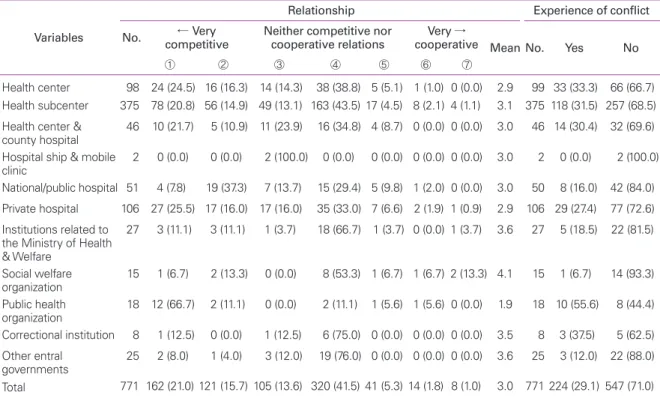
4. 일차 의료기관(민간의료기관)과의 관계 및 마찰 경험 공중보건의사들이 배치된 기관과 일차 의료기관(민간의 료기관)이 경쟁적인 관계라고 응답한 비중이 높았으며, 보 건단체의 경우 77.8%로 다른 기관에 비해 경쟁적인 관계라
Table 11. Satisfaction comcerning working conditions (employee welfare and services)Variables Appropria-
teness of time in service
Free use of vacation
time
Relationship with organization
Equality with other
workers
Amount of
salary Amount of bonuses
Total 3.3 (1.0) 2.9 (1.2) 2.9 (1.0) 2.7 (1.1) 2.1 (1.0) 2.1 (1.0)
Length of working year
1 3.1 (1.1) 2.9( 1.2) 2.9 (1.1) 2.7 (1.2) 1.9 (1.0) 2.0 (1.1)
2 3.2 (1.0) 2.9 (1.2) 2.9 (1.0) 2.7 (1.1) 2.1 (1.1) 2.1 (1.1)
3 3.3 (0.9) 3.0 (1.1) 2.9 (1.0) 2.7 (1.0) 2.2 (1.0) 2.2 (1.0)
Arranged
organization Health center 3.2 (0.9) 3.1 (1.0) 2.9 (1.0) 2.5 (1.1) 1.9 (1.0) 2.0 (1.0)
Health subcenter 3.4 (0.9) 2.9 (1.2) 2.9 (1.0) 2.6 (0.8) 2.1 (1.0) 2.2 (1.1)
Health center & county hospital 3.3 (0.9) 2.9 (1.2) 3.0 (1.1) 2.8 (1.1) 1.8 (0.9) 1.9 (1.0) Hospital ship & mobile clinic 4.0 (0.0) 3.5 (0.6) 3.5 (0.6) 3.0 (0.0) 3.0 (1.1) 3.0 (1.1) National/public hospital 3.3 (1.0) 3.3 (0.9) 2.8 (0.9) 2.7 (0.9) 2.4 (1.0) 2.3 (1.1)
Private hospital 2.8 (1.1) 2.4 (1.3) 2.9 (1.1) 2.9 (1.1) 2.4 (1.0) 2.2 (1.0)
Institutions related to the
Ministry of Health & Welfare 2.7 (1.1) 2.9 (1.5) 2.8 (1.2) 2.6 (1.4) 1.9 (1.3) 1.9 (1.3) Social welfare organization 3.5 (1.0) 3.5 (0.8) 3.4 (1.0) 3.2 (1.2) 2.4 (1.2) 2.3 (1.1) Public health organization 3.5 (1.0) 2.8 (1.2) 3.0 (0.9) 2.9 (1.1) 2.9 (1.0) 2.7 (1.0) Correctional institution 3.1 (0.8) 3.6 (0.7) 2.1 (1.0) 2.3 (0.9) 1.6 (0.7) 1.9 (0.8) Other central governments 3.1 (1.0) 3.4 (1.1) 2.9 (1.1) 2.8 (1.0) 2.2 (1.2) 2.3 (1.2) Unit: score.
The cases not answered in questions are rejected in analysis.
The standard deviation is given in parentheses.
Likert 5-point scale is used to measure.
2.9 Score
1 2 3
2.9 2.9
5.0 4.0 3.0 2.0 1.0 0.0
Figure 3. Satisfaction on the specific details of salary. 1. The level of pay is reasonable for the performance expected. 2. It is proper relative to other related work like public-service advocates. 3. I'm satisfied overall with current pay level.
The cases not answered in questions are rejected in analysis. Likert 5-point scale is used to measure.
2.2 Score
1 2
2.0 5.0
4.0 3.0 2.0 1.0 0.0
Figure 4. Satisfaction on the specific details of bonuses. 1. The level of pay is reasonable for the performance expected.
2. I'm satisfied overall with current bonus level. The cases not answered in questions are rejected in analysis.
Likert 5-point scale is used to measure.
고 응답한 비율이 높았다. 반면, 사회복지시설에 있는 공중 보건의사들은 일차 의료기관(민간의료기관)과 경쟁적인 관 계(20.0%)보다는 협력적인 관계(26.7%)라고 응답한 경우 가 더 많았다(Table 10). 공중보건의사가 근무하는 기관의 낮은 진료비로 인해 주변의 일차 의료기관(민간의료기관)과 마찰경험이 있는지 조사한 결과, 대부분 마찰경험이 없다 (71.0%)고 응답하였으나 보건단체(55.6%)에 있는 공중보 건의사는 마찰경험이 있다고 응답한 비중이 더 높았다.
5. 후생복지환경
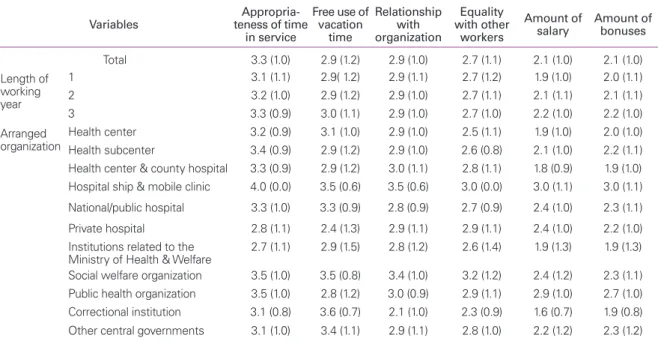
응답자들이 근무하고 있는 기관의 후생복지환경(근무시 간의 적절성, 휴가 사용의 자율성, 소속기관과의 관계, 타직 원과의 처우에 대한 평등성, 급여지급 수준, 인센티브지급 수준)에 대한 전반적인 만족도를 5점 척도로 평가한 결과는 Table 11과 같다. 근무시간(일평균)의 적절성(3.3점)을 제 외한 5가지 후생복지환경에 대해서는 보통 수준(3점)보다 낮은 점수 분포를 보임으로써 전반적인 만족도 수준이 낮 았다.
전체 만족도 수준이 가장 낮은 급여 (2.1점)나 진료활동장려금 등 인센티 브지급 수준(2.1점) 항목에서는 보건 복지부 관련 기관, 보건소, 보건의료원, 교정시설에 배치된 응답자의 만족도가 낮았고, 그 중 교정시설에 근무하는 응 답자가 가장 낮은 점수 분포를 보였다.
급여와 인센티브지급 수준, 관사제 공에 대해 세부 항목별로 만족도 수준 을 조사하였다. 급여와 인센티브지급 수준에 대한 분석 결과는 Figures 3, 4 와 같다. 급여의 세부 항목별 평균점수 는 모두 2.9점인 반면, 인센티브의 세 부 항목별 평균점수는 2.0-2.2점 수준 으로 인센티브에 대한 만족도가 상대 적으로 낮았다. 인센티브 지급액은 진 료활동장려금의 경우 평균 79.9만원, 기타 수당의 경우 27.4만원을 받고 있 는 것으로 확인되었다.
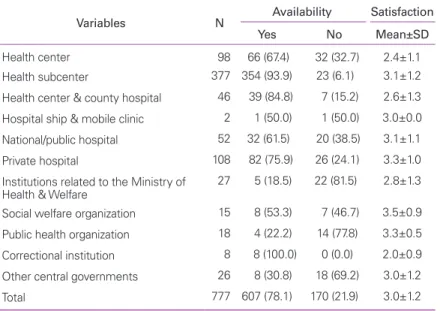
배치기관으로부터 관사를 제공받고 있는 응답자는 전체 의 78.1%로서 교정시설 (100.0%)/보건지소(93.9%)가 다른 기관에 비해 관사제공 비율이 높았고, 중앙정부 관련기관 (30.8%)/보건단체(22.2%)/보건복지부 관련기관(18.5%)의 경우 관사제공 비율이 낮았다(Table 12).
해당 기관의 관계자로부터 불합리한 사항을 요청받았다 거나(37.3%), 보복성 행정처분을 받은 경우(5.6%) 혹은 근 무 중 폭행, 폭언을 받은 경험(27.4%)이 있었고, 배치기관 중 교정시설, 보건단체, 기타 정부관련기관 등의 배치된 응 답자들이 다른 집단에 비해 상기와 같은 경험을 더 많이 하 는 것으로 파악되었다.
6. 직무교육
직무교육은 신규 중앙직무교육과 시도별 추계직무교육으 로 구분되는데, 교육에 대한 전반적인 활용도와 유용성은 평 균 2.7-2.8점으로 높지 않은 편이었다(Table 13). 신규 중 앙직무교육의 경우 근무연차가 높을수록 활용도가 높았다.
Table 12. Availability of and satisfaction with official residence
Variables N Availability Satisfaction
Yes No Mean±SD
Health center 98 66 (67.4) 32 (32.7) 2.4±1.1
Health subcenter 377 354 (93.9) 23 (6.1) 3.1±1.2
Health center & county hospital 46 39 (84.8) 7 (15.2) 2.6±1.3 Hospital ship & mobile clinic 2 1 (50.0) 1 (50.0) 3.0±0.0 National/public hospital 52 32 (61.5) 20 (38.5) 3.1±1.1
Private hospital 108 82 (75.9) 26 (24.1) 3.3±1.0
Institutions related to the Ministry of
Health & Welfare 27 5 (18.5) 22 (81.5) 2.8±1.3
Social welfare organization 15 8 (53.3) 7 (46.7) 3.5±0.9 Public health organization 18 4 (22.2) 14 (77.8) 3.3±0.5 Correctional institution 8 8 (100.0) 0 (0.0) 2.0±0.9 Other central governments 26 8 (30.8) 18 (69.2) 3.0±1.2
Total 777 607 (78.1) 170 (21.9) 3.0±1.2
Unit: n (%), score.
The cases not answered in questions are rejected in analysis.
Likert 5-point scale is used to measure the satisfaction.
유용성 측면에서는 보건의료원, 보건복지부 관련기관 그리 고 교정시설에 배치된 응답자의 경우 유용하지 않다는 견해 가 더 많았다. 시도별 추계직무교육에서는 응답자 간 차이 는 신규 중앙직무교육의 활용도 수준과 유사하게 나타났고, 보건단체를 제외한 대부분의 기관에 파견된 응답자들의 교 육 활용도가 상대적으로 낮았다. 시도별 추계직무교육의 유 용성에 대한 응답 추이는 신규 중앙직무교육의 유용성과 유 사하게 나타났다.
직무교육과 관련된 7가지 항목에 대한 만족도를 측정한 결과, 교육시기의 적절성에 대해서는 다른 항목에 비해 상대 적으로 만족도 수준이 높았다(Table 14). 두 가지 교육프로 그램 모두 응답자 특성별로는 근무연차가 낮을수록 낮은 점 수 분포를 나타내고 있었고, 보건소와 보건지소에 배치된 응 답자는 7가지 항목 모두에 대해 전체 평균보다 높거나 같은 점수 분포를 나타내고 있었다.
7. 제도
공중보건의사제도와 관련하여 가장 개선되어야 할 사항 을 파악하기 위해 총 7개 항목(기타 포함)에 대해 우선순위 를 평가한 결과, 1순위 및 1-3순위 합계 모두 ‘처우(급여, 수 당, 지위 등) 관련(1순위, 33.4%; 1-3순위, 88.0%)사항’을 선 택한 비중이 높았다(Figure 5). 직무교육 관련 사항은 응답 비중이 5% 미만으로 응답자들 사이에서 직무교육에 대한 중요성 및 개선에 대한 시급성이 가장 낮게 평가되고 있었 다. 즉, 모든 응답자들 사이에서 처우에 관한 문제를 가장 중 요하게 개선되어야 할 사항으로, 직무교육 관련 문제는 개선 시급성이 낮은 사항으로 응답하고 있었다.
공중보건의사제도와 관련하여 총 10가지 항목에 대해 변 화 필요성을 평가한 결과는 Table 15와 같다. 3가지 항목 (공보의 개개인의 인식 변화, 교육개선, 재정지원)을 제외한 모든 항목에 대해 4점 이상으로 평가함으로써 대다수 응답
Table 13. Availability of and usefulness of job training programVariables
New job training programs
by central government Job training programs by regional groups Availability Usefulness Availability Usefulness
Total 2.7 (1.0) 2.8 (1.0) 2.7 (1.0) 2.8 (1.0)
Length of
working year 1 2.6 (1.0) 2.5 (1.0) 2.6 (1.0) 2.6 (1.0)
2 2.7 (1.0) 2.8 (1.0) 2.7 (1.0) 2.8 (1.0)
3 2.8 (1.0) 2.9 (1.0) 2.7 (1.0) 2.9 (1.0)
Arranged
organizations Health center 2.9 (0.9) 3.0 (1.0) 2.8 (0.9) 2.9 (0.9)
Health subcenter 2.8 (1.0) 2.9 (1.0) 2.9 (1.0) 2.9 (1.0)
Health center & county hospital 2.4 (1.0) 2.4 (1.0) 2.5 (1.0) 2.5 (1.1) Hospital ship & mobile clinic 3.5 (0.5) 3.0 (0.0) 3.5 (0.5) 3.5 (0.5)
National/public hospital 2.8 (1.0) 2.9 (1.0) 2.6 (1.0) 2.8 (0.9)
Private hospital 2.5 (1.1) 2.5 (1.1) 2.4 (1.1) 2.5 (1.1)
Institutions related to the Ministry of Health &
Welfare 2.2 (1.0) 2.3 (0.9) 2.1 (1.1) 2.3 (1.1)
Social welfare organization 2.3 (0.9) 2.4 (1.1) 2.5 (1.0) 2.6 (1.1)
Public health organization 2.9 (0.9) 2.9 (1.1) 3.1 (0.9) 3.2 (1.1)
Correctional institution 2.1 (0.8) 2.3 (0.7) 2.3 (1.2) 2.5 (1.1)
Other central governments 2.4 (0.9) 2.6 (0.9) 2.5 (1.0) 2.6 (0.9)
Unit: score.
The cases not answered in questions are rejected in analysis.
The standard deviation is given in parentheses.
Likert 5-point scale is used to measure.
자들은 현재 공중보건의사와 관련된 제도에 대해 변화가 필 요하다고 인식하고 있었다. 배치기관이 보건복지부 관련기 관(4.6점), 사회복지시설(4.3점)인 경우 ‘중앙정부의 정책변 화’를, 보건단체(4.9점)의 경우 공중보건의사의 운영지침 개 선에 대한 필요성을 다른 항목에 비해 상대적으로 높게 평가 하였다.
8. 역할인식
1) 직무수행 시 어려운 문제
응답자들이 직무를 수행할 때 가장 어렵게 생각하는 문제 에 대해 우선순위를 평가해 본결과 1순위뿐 아니라 1-3순위 통합 결과에서 응답빈도가 가장 높은 문제는 부족한 급여와 처우에 대한 부분이었고, 그 다음으로 보건사업이나 임상지
Table 14. Satisfaction with job training programVariables 1 2 3 4 5 6 7
New job training programs by central govern- ment
Health center 3.2 (0.8) 3.0 (0.7) 3.0 (0.9) 3.0 (0.7) 2.8 (0.9) 2.7 (1.0) 2.6( 1.0) Health subcenter 3.3 (0.9) 3.1 (0.9) 2.9 (0.9) 3.0 (0.9) 2.8 (0.9) 2.6 (1.0) 2.6 (1.0) Health center & county hospital 3.0 (1.0) 2.8 (0.9) 2.7 (0.9) 2.7 (0.9) 2.7 (0.8) 2.6 (1.0) 2.3 (0.9) Hospital ship & mobile clinic 3.5 (0.7) 3.0 (0.0) 3.0 (1.4) 3.0 (0.0) 2.5 (0.7) 3.0 (0.0) 3.5 (0.7) National/public hospital 3.3 (0.8) 3.0 (0.9) 2.8 (0.9) 2.8 (0.9) 2.7 (0.9) 2.6 (1.0) 2.4 (1.0) Private hospital 3.0 (1.0) 2.8 (1.0) 2.7 (1.1) 2.7 (1.0) 2.6 (1.0) 2.4 (1.0) 2.4 (1.0) Institutions related to the Ministry of Health &
Welfare 2.8 (0.9) 2.9 (0.8) 2.6 (0.7) 2.5 (0.8) 2.6 (0.7) 2.5 (1.1) 2.5 (0.9)
Social welfare organization 2.9 (0.8) 2.6 (0.6) 2.9 (0.9) 2.7 (0.8) 2.4 (0.8) 2.5 (1.0) 2.5 (1.0) Public health organization 3.3 (0.8) 3.1 (0.7) 3.0 (0.7) 3.0 (0.8) 2.8 (0.9) 2.7 (0.8) 2.4 (0.9) Correctional institution 3.0 (0.5) 2.8 (0.5) 2.5 (0.5) 2.8 (0.7) 2.5 (0.5) 2.3 (0.9) 2.1 (0.6) Other central governments 3.0 (0.9) 2.9 (0.9) 2.9 (0.9) 2.6 (0.8) 2.6 (0.9) 2.8 (1.0) 2.5 (1.0)
Total 3.2 (0.9) 3.0 (0.9) 2.9 (0.9) 2.9 (0.9) 2.7 (0.9) 2.6 (1.0) 2.5 (1.0)
Job training programs by regional groups
Health center 3.2 (0.8) 3.0 (0.9) 3.0 (0.7) 3.0 (0.7) 2.9 (0.8) 2.9 (1.0) 2.9 (0.9) Health subcenter 3.2 (0.9) 3.2 (0.9) 3.1 (0.9) 3.1 (0.9) 3.0 (0.9) 2.9 (1.0) 2.9 (1.0) Health center & county hospital 3.0 (0.9) 2.8 (0.9) 2.7 (1.0) 2.7 (0.9) 2.7 (0.9) 2.7 (0.9) 2.4 (1.0) Hospital ship & mobile clinic 3.0 (0.0) 3.0 (0.0) 3.5 (0.7) 3.0 (1.4) 3.0 (0.0) 2.5 (0.7) 3.0 (0.0) National/public hospital 3.1 (0.9) 3.1 (0.9) 3.0 (0.8) 3.0 (0.8) 2.9 (0.8) 2.9 (0.8) 2.9 (1.0) Private hospital 3.0 (1.1) 2.9 (1.1) 2.8 (1.0) 2.7 (1.0) 2.7 (1.0) 2.6 (1.1) 2.6 (1.0) Institutions related to the Ministry of Health &
Welfare 2.6 (0.9) 2.8 (0.9) 2.7 (0.9) 2.6 (1.0) 2.7 (0.8) 2.7 (1.0) 2.7 (1.0)
Social welfare organization 3.1 (0.8) 3.1 (0.7) 3.0 (0.7) 2.9 (0.9) 2.7 (0.8) 2.8 (1.1) 2.7 (1.1) Public health organization 3.5 (0.7) 3.2 (0.8) 3.4 (0.7) 3.4 (0.9) 3.5 (0.8) 3.1 (0.8) 3.2 (0.9) Correctional institution 2.8 (0.9) 2.5 (0.8) 2.4 (1.1) 2.3 (1.0) 2.3 (0.7) 2.3 (0.9) 2.4 (0.9) Other central governments 2.8 (1.0) 3.0 (1.0) 2.9 (1.0) 2.8 (0.9) 2.8 (1.0) 2.9 (1.1) 2.6 (1.0)
Total 3.1 (0.9) 3.1 (1.0) 3.0 (0.9) 3.0 (0.9) 2.9 (0.9) 2.8 (1.0) 2.8 (1.0)
Unit: score.
1. Appropriateness of period of time for education. 2. Suitability of educational purpose and contents. 3. Educational environment (lecture room etc.). 4. Educational contents. 5. Length of training period and lecture time. 6. Accessibility of the educational facility. 7. Room and board during education.
The cases not answered in questions are rejected in analysis.
The standard deviation is given in parentheses.
Likert 5-point scale is used to measure.
식/기술에 대한 부족에 대해 어려움을 느낀다고 응답하였다 (Figure 6). 그러나 다른 공중보건의사와의 갈등에 관한 부 분은 응답자들이 직무 수행 시 어려움을 덜 느끼고 있는 것 으로 확인되었다.
2) 공중보건의사들의 역할에 대한 인식
공중보건의사들의 역할에 대한 인식을 평가한 결과 충실 한 직무수행(4.0점)에 대해서는 긍정적인 인식수준이 높은 반면, 역할에 대한 만족도(2.7점)는 가장 낮았다. 근무연차가 1년차(4.1점)인 경우 또는 배치기관이 보건의료원(4.3점) 또 는 국공립병원(4.2점)인 경우 다른 집단에 비해 공중보건의 사로서 직무 충실도에 대한 인식이 높은 것으로 파악되었다.
응답자들은 ‘현재 역할에 만족한다’라는 항목에 대해서는 점수를 가장 낮게 평가함에 따라 대부분의 응답자들은 현재 역할에 만족하지 않음을 알 수 있다. 특히 ‘교정시설’에 근무 하는 응답자들의 평가 결과는 2.1점으로 공중보건의사로서 의 역할에 대한 인식이 긍정적이지 않은 것으로 확인되었다.
‘사회복지시설’에 근무하는 응답자들의 평가결과는 10가지 의 모든 항목에 대해 전체 평균 점수를 상회하는 수준이었다 (Table 16).
9. 직무만족도에 영향을 주는 요인
직무만족도에 영향을 주는 요인에 대한 우선순위(1-3순
위)를 질문한 후, 1순위에 대한 단수 응답결과와 1-3순위 통 합결과를 비교분석해 보았다. 이 때 1-3순위 통합결과는 1, 2, 3순위에 응답한 항목의 응답빈도 및 비중을 합계로 산출 한 것으로 중복 응답결과와 같은 의미를 가진다.
만족도에 가장 영향을 많이 주는 1순위 요인은 급여수준 이었으나, 순위와 무관하게 가장 응답이 많았던 요인은 근무 환경이었다(Figure 7). 즉, 급여수준이 가장 우선적으로 직 무만족도에 영향을 주는 요인이라면 근무환경은 전반적인 사항을 모두 고려했을 때 직무만족도에 가장 큰 영향을 주는 요인이라고 볼 수 있다. 반대로 직무만족도에 미치는 영향 력이 가장 적은 1순위 요인은 후생복지였고, 1-3순위 통합 결과 인간관계가 만족도에 미치는 영향력이 적은 것으로 나 타났다. 따라서 응답자들은 후생복지 요인을 만족도에 영향 을 주는 최우선순위로 고려하지 않으며, 다수의 응답자들에 게 만족도에 가장 적은 영향을 주는 요인은 인간관계 요인임 을 알 수 있다.
결 론
치료중심에서 예방중심으로 의료의 패러다임 전환, 의료 에 대한 접근성 향상, 지역 주민들의 의료서비스에 대한 다 양한 요구뿐 아니라, 공공보건의료에 대한 중요성을 부각시 키는 국가 의료정책의 변화로 인해 질 높은 공공보건의료 서 비스에 대한 기대가 점차 높아지고 있는 추세이다. 이 같은 의료환경의 변화 속에서 공중보건의사 역할의 중요성이 확 대되었고, 동시에 공중보건의사의 역할에 대한 변화 필요성 이 제기되었다. 그러나 공중보건의사들의 업무범위에 대한 기준의 불명확성, 업무수행에 대한 자율성 축소, 근무기관 배치의 부적정성 또는 직무교육의 비효율적 운영 등으로 인 해 공중보건의사들의 전반적인 만족도가 저하되고 있는 실 정이다.
연구결과를 종합해볼 때, 공중보건의사들은 현재 처해 있 는 환경에 대해 전반적으로 만족도 수준이 떨어져있으며 배 치, 수행업무 및 환경, 후생복지, 교육, 제도, 역할에 대한 문 제에 있어서 긍정적인 인식보다 부정적인 인식이 더 크게 나 타나고 있었다. 공중보건의사들은 전문적인 능력을 갖추었
88.0
33.4 26.3
58.6 42.5
19.7 12.0
63.4 42.7
7.4 0.3 2.1 0.9 1.3
1st rank Sum of rank 1-3
%
1 2 3 4 5 6 7
100.0 80.0 60.0 40.0 20.0 0.0
Figure 5. Area for improvement among the public health doctor's system. 1. Working conditions (salary, bonuses, status etc.). 2. Selection and arrangement related matters. 3.
Breaks from a treatment-oriented role: shift to the role focused on health service of research. 4. Improvement of working conditions. 5. Issues about service regulation of public health doctor. 6. Educational program. 7. Other.
The cases not answered in questions are rejected in analysis.
Table 15. Necessity for public health doctor' system change
Variables
Local govern-
ment's percep- tion change
Central govern- ment's policy change
Guaran- tee of a status safety
Improve- ment of public health doctor operation guidelines
Reestabli- shment of public health
related organi- zations' function
Prepa- ring alterna-
tive laws
Assign- ment of responsi- bility and empower-
ment
Improve- ment of public health doctor operation guidelines
Enlarge- ment of funding
Educa- tional improve-
ment
Total 4.4 (0.7) 4.4 (0.7) 4.3 (0.8) 4.3 (0.8) 4.2 (0.8) 4.1 (0.9) 4.0 (0.8) 3.9 (0.9) 3.9 (0.9) 3.7 (0.9) Length
of working year
1 4.5 (0.6) 4.4 (0.6) 4.4 (0.7) 4.4 (0.7) 4.3 (0.7) 4.0 (0.8) 4.1 (0.7) 4.0 (0.9) 4.2 (0.8) 3.9 (0.8) 2 4.4 (0.7) 4.4 (0.8) 4.3 (0.8) 4.2 (0.8) 4.2 (0.8) 4.0 (0.9) 4.0 (0.8) 3.9 (0.9) 3.9 (0.9) 3.7 (0.9) 3 4.5 (0.7) 4.4 (0.7) 4.3 (0.7) 4.3 (0.8) 4.3 (0.8) 4.1 (0.8) 4.0 (0.8) 3.9 (0.9) 3.8 (1.0) 3.6 (0.9) Arran-
ged organi- zations
Health
center 4.4 (0.6) 4.3 (0.8) 4.2 (0.8) 4.1 (0.7) 4.2 (0.8) 4.0 (0.8) 4.2 (0.8) 4.0 (0.9) 3.9 (0.8) 3.6 (0.9) Health
subcenter 4.4 (0.7) 4.4 (0.8) 4.3 (0.8) 4.2 (0.8) 4.2 (0.8) 4.1 (0.9) 3.9 (0.8) 3.9 (0.9) 3.8 (0.9) 3.6 (0.9) Health
center &
county hospital
4.4 (0.5) 4.4 (0.9) 4.5 (0.7) 4.3 (0.9) 4.4 (0.7) 4.2 (0.9) 4.1 (0.8) 4.0 (0.9) 4.2 (1.0) 3.7 (1.0)
Hospital ship &
mobile clinic
4.5 (0.8) 4.5 (0.7) 4.5 (0.7) 4.5 (0.7) 4.5 (0.7) 4.0 (1.4) 4.5 (0.7) 4.5 (0.7) 3.5 (0.7) 4.0 (0.0)
National/
public hospital
4.6 (0.5) 4.5 (0.6) 4.5 (0.7) 4.4 (0.6) 4.3 (0.8) 4. 3 (0.8) 4.1 (0.7) 3.9 (0.9) 4.2 (0.8) 3.6 (0.8)
Private
hospital 4.4 (0.8) 4.4 (0.7) 4.3 (0.8) 4.3 (0.7) 4.3 (0.8) 4.0 (0.9) 4.0 (0.9) 3.8 (0.9) 3.9 (1.0) 3.7 (1.0) Institutions
related to the Ministry of Health &
Welfare
4.5 (0.6) 4.6 (0.6) 4.4 (0.7) 4.4 (0.7) 4.4 (0.7) 4.0 (1.0) 4.3 (0.7) 4.3 (0.7) 3.8 (1.2) 3.9 (1.0)
Social welfare organiza- tion
4.2 (1.0) 4.3 (1.0) 3.9 (0.9) 3.9 (1.0) 4.2 (0.8) 4.0 (0.8) 3.7 (0.6) 3.7 (0.9) 3.5 (1.1) 3.7 (0.6)
Public health organi- zation
4.6 (0.7) 4.8 (0.4) 4.3 (0.8) 4.9 (0.3) 4.5 (0.7) 4.2 (0.8) 4.1 (0.9) 4.1 (0.9) 4.2 (0.8) 3.9 (0.9)
Correc- tional institution
4.4 (0.7) 4.3 (0.7) 4.4 (0.9) 4.4 (0.9) 4.4 (0.7) 4.0 (0.8) 4.0 (0.9) 3.6 (0.7) 4.1 (0.8) 4.0 (0.8)
Other central govern- ments
4.6 (0.6) 4.5 (0.6) 4.3 (0.7) 4.4 (0.6) 4.4 (0.8) 4.1 (0.8) 4.2 (0.7) 3.9 (0.6) 4.1 (0.8) 3.7 (0.8)
Unit: score.
The cases not answered in questions are rejected in analysis.
The standard deviation is given in parentheses.
Likert 5-point scale is used to measure.
음에도 불구하고 부적절한 배치와 타당하지 않은 업무를 수 행함으로써 그들의 역할에 전반적으로 만족하지 않고 있으 며, 업무적인 요인뿐 아니라 후생복지환경을 포함한 비업무 적인 요인들은 공중보건의사들이 역할을 수행하는 데 있어 부정적인 요소로 작용하고 있다. 응답자들이 충실히 업무를 수행하고 있음에도 불구하고 현재 역할에 대해 만족하지 않 고 있다는 결과는 제도변화에 대한 필요성이 높다는 결과를 뒷받침한다고 볼 수 있다. 이는 중앙정부나 해당 근무기관 에서 공공보건의료인력들이 역할을 수행하는 데 있어 적절 한 역할범위나 권한 부여, 제도의 취지에 적합한 배치와 업 무 배분 등과 같은 제도적 장치를 충분히 마련하지 않았기 때문에 발생한 자연적인 결과라고 볼 수 있다. 또한 이러한 문제점들을 꾸준히 제기해 왔음에도 불구하고 만족도 수준 이 제고되지 못했다는 점을 고려할 때, 의견 반영 및 수용이 용이하게 이루어지지 못했음을 미루어 짐작할 수 있다.
본 연구에서 확인된 공중보건의사들의 배치 문제를 포함 하여 수행업무, 직무에 대한 만족도 수준, 제도개선의 필요 성에 관한 결과들은 공중보건의사를 대상으로 한 기존 연구 결과에 의해서도 지지된다고 볼 수 있다. Yi [3]의 연구에서 현재 수행업무 중 진료업무의 비중이 높고, 제도변화 필요성 의 평균점수가 4.2점(5점 만점)이었으며, Kang [7]의 연구 에서는 배치기관, 직무교육의 문제와 더불어 낮은 보수수준
만족도를 지적하고 있었다. 또한 Jeong 등[5]의 연구에서도 공중보건의사들을 대상으로 조사한 결과, 체계적인 교육훈 련의 부족, 수행할 업무의 범위가 지나치게 광범위하고 모호 하다는 점과 공중보건의사 대부분이 진료활동에만 참여하고 있으며, 직무만족도가 매우 낮다는 점을 제시하고 있었다.
결론적으로 공중보건의사들이 의료취약지역 등을 포함하 여 지역사회의 보건의료에서 중요한 역할을 담당하고 있는 것을 감안한다면, 정부당국 및 관할부서에서는 공중보건의 사들의 배치, 수행업무, 직무교육 등에 관한 문제점을 파악 함으로써, 향후 공중보건의사들의 만족도 향상을 위한 변화 를 시도해야하며, 특히 급여 등에 관한 처우 및 제도의 개선 측면에 중점을 두어 정책을 수립해야 할 것이다. 따라서 정 부에서는 공공보건의료에 대한 중요성을 인지하고 이를 의 료정책에 반영하고 있는 것과 일관성 있게 공중보건의료인 력에 대한 실질적인 정책개발 및 제도개선 방안을 마련해야 할 것이다.
본 연구에서는 조사를 수행할 때 2가지 조사방법체계를 이용함으로써 조사기간이 다르게 진행되어 조사 시기에 대 한 차이가 발생한 점을 한계점으로 보았다. 그러나 이러한 한계점에도 불구하고 공중보건의사에 대한 선행 연구에서 는 주로 공중보건의사제도의 문제점과 개선방안 제시[11], 공중보건의사제도 운영 실태와 문제점 조사[7] 연구를 비롯 하여 배치현황 및 문제점 개선 방안 마련[9], 배치적정성 평 가 모형 개발 및 배치기준 재정립[6]에 관한 사항만을 중점 적으로 다루었다는 점과 달리, 본 연구에서는 공중보건의
29.8
Amount of pay Sense of accomplish ment at work Work envlronme nt Personal relations Employee welfare and service None Other
72.8
28.8 57.1
21.5 73.7
11.2 36.2
7.7 52.5
0.4 0.5 0.7 0.9
% 100.0 80.0 60.0 40.0 20.0 0.0
1st rank Sum of rank 1-3 1st rank
Sum of rank 1-3
1 2 3 4 5 6 7 8 9 10
% 100.0 80.0 60.0 40.0 20.0 0.0
52.0
11.6 93.2
30.8
9.2 32.5
6.9 30.8
6.6 34.2
5.9 20.5
5.1 27.4
0.56.0
0.3 1.7 2.0 2.6
Figure 7. Factors related to job satisfaction.
Figure 6. Challenges public health doctors face. 1. Lack of pay and unfair treatment. 2. Lack of clinical knowledge and skills.
3. Lack of experience and knowledge in health service.
4. Conflict with other workers. 5. Medical malpractice.
6. Conflict with the local residents. 7. Excessive work- load. 8. Conflict with other public health doctors. 9.
None. 10. Other. The cases not answered in questions are rejected in analysis.
Table 16. Public health doctors' awareness of their own role
Variables Loyalty toward work
Good relation-
ships with co- workers
Good relation- ship with
the local resi- dents
Commu- nity's perception
of public doctors' role as an important
one
Satisfy with local resi-
dents' demands for health
care
Well esta- blished coordina-
tion in perfor- ming work
Orgoing contribu- tion to commu- nity health
Active partici- pation in
neces- sary health service
Suppor- ted by local resi- dents
Satis- faction in one's current role
Total 4.0 (0.8) 3.7 (0.9) 3.5 (0.9) 3.4 (1.1) 3.3 (0.9) 3.1 (0.9) 3.0 (1.1) 3.0 (1.0) 2.9 (1.0) 2.7 (1.0) Length
of working year
1st 4.1 (0.8) 3.6 (1.0) 3.4 (1.0) 3.4 (1.1) 3.4 (1.0) 3.0 (0.9) 3.0 (1.1) 3.1 (1.1) 2.8 (1.0) 2.4 (1.0) 2nd 4.0 (0.8) 3.8 (0.9) 3.6 (0.8) 3.5 (1.1) 3.4 (1.0) 3.2 (0.9) 3.1 (1.1) 3.0 (1.0) 3.1 (1.0) 2.9 (1.0) 3rd 3.9 (0.8) 3.7 (0.8) 3.5 (0.8) 3.3 (1.1) 3.2 (0.8) 3.0 (0.8) 3.0 (1.0) 3.0 (0.9) 2.9 (1.0) 2.7 (1.0) Marital
status Single 4.0 (0.8) 3.8 (0.9) 3.6 (0.8) 3.5 (1.1) 3.4 (0.9) 3.2 (0.9) 3.1 (1.0) 3.0 (1.0) 3.0 (1.0) 2.9 (1.0) Married 4.0 (0.8) 3.7 (0.9) 3.5 (0.9) 3.3 (1.1) 3.3 (0.9) 3.1 (0.9) 3.0 (1.1) 3.0 (1.0) 2.9 (1.0) 2.6 (1.0) Training
course General
physician 4.0 (0.8) 3.8 (0.9) 3.6 (0.8) 3.5 (1.1) 3.4 (0.9) 3.2 (0.9) 3.1 (1.0) 3.1 (1.0) 3.1 (1.0) 2.9 (1.0) Special
physician 4.0 (0.8) 3.7 (0.9) 3.4 (0.9) 3.3 (1.1) 3.2 (0.9) 3.0 (0.9) 2.9 (1.1) 3.0 (0.9) 2.8 (1.0) 2.6 (1.0) Workform Nine-to-fiver 4.0 (0.8) 3.7 (0.9) 3.6 (0.8) 3.4 (1.1) 3.3 (0.9) 3.1 (0.9) 3.1 (1.0) 3.0 (1.0) 3.0 (1.0) 2.8 (1.0)
Overtime
worker 3.9 (0.9) 3.7 (1.0) 3.3 (1.1) 3.6 (1.2) 3.2 (1.1) 2.9 (1.0) 2.8 (1.3) 2.9 (1.1) 2.6 (1.0) 2.5 (1.2) Arranged
organi- zations
Health center 4.1 (0.8) 3.6 (0.9) 3.4 (0.9) 3.3 (1.1) 3.1 (0.9) 3.1 (0.8) 3.0 (1.1) 2.8 (0.9) 2.6 (0.9) 2.7 (1.1) Health
subcenter 4.0 (0.8) 3.8 (0.9) 3.7 (0.8) 3.4 (1.1) 3.4 (0.9) 3.2 (0.9) 3.1 (1.0) 3.0 (1.0) 3.1 (1.0) 2.8 (1.0) Health cen-
ter & county hospital
4.3 (0.8) 3.9 (0.9) 3.7 (1.0) 3.4 (1.2) 3.6 (1.0) 3.1 (1.2) 3.0 (1.2) 2.9 (1.2) 3.0 (1.2) 2.6 (1.1)
Hospital ship
& mobile clinic
4.5 (0.7) 4.5 (0.7) 4.5 (0.7) 3.0 (0.0) 3.5 (0.7) 3.0 (0.0) 4.0 (0.0) 3.5 (0.7) 3.0 (0.0) 2.5 (0.7)
National/pu-
blic hospital 4.2 (0.6) 3.8 (0.8) 3.4 (0.8) 3.6 (0.8) 3.4 (0.9) 3.2 (0.8) 3.1 (1.1) 3.3 (0.9) 2.8 (1.0) 2.9 (0.9) Private
hospital 3.7 (1.0) 3.6 (0.9) 3.4 (1.0) 3.3 (1.1) 3.2 (1.0) 3.0 (0.8) 2.7 (1.1) 2.9 (0.9) 2.8 (1.0) 2.7 (1.0) Institutions
related to the Ministry of Health &
Welfare
3.9 (0.9) 3.4 (1.0) 3.1 (0.9) 3.6 (1.2) 2.9 (1.0) 3.0 (1.1) 3.1 (1.4) 3.1 (1.2) 2.7 (1.0) 2.4 (1.2)
Social welfare organization
4.1 (0.8) 3.9 (0.6) 3.7 (0.7) 3.5 (0.8) 3.5 (0.7) 3.1 (0.9) 3.5 (0.8) 3.3(1.0) 3.1(0.9) 3.1 (1.1)
Public health
organization 3.7 (0.8) 3.6 (0.8) 3.4 (0.9) 3.4 (1.1) 3.0 (0.8) 2.9 (0.7) 3.1 (0.8) 2.9 (1.0) 2.4 (0.9) 2.2 (1.1) Correctional
institution 3.5 (0.8) 2.9 (0.8) 3.1 (0.4) 2.9 (1.1) 3.1 (0.4) 2.8 (0.7) 3.0 (1.1) 3.0 (0.9) 2.9 (0.6) 2.1 (0.8) Other central
governments 4.0 (0.8) 3.7 (0.9) 3.2 (0.9) 3.5 (1.0) 3.0 (1.0) 3.2 (1.0) 3.2 (1.1) 3.2 (1.0) 2.9 (1.0) 2.6 (1.0) Unit: score.
The cases not answered in questions are rejected in analysis.
The standard deviation is given in parentheses.
Likert 5-point scale is used to measure.
사들의 수행업무 및 업무 타당성, 업무자체 및 환경에 대한 인식, 후생복지환경에 대한 만족도 그리고 제도 변화 필요 성 등에 관한 사항을 광범위하게 포괄하고 있다. 후속 연구 에서는 본 연구의 한계점을 개선하여 공중보건의사의 실태 를 조사할 뿐 아니라, 법제도 측면을 비롯하여 공중보건의 사와 관련된 정책적인 사항에 초점을 두어 연구를 수행하 는 것 또한 의미 있는 결과를 도출할 수 있을 것이라 판단 된다.
핵심용어: 공중보건의사; 직무만족도; 공중보건의사제도
REFERENCES
21. Act on special measures for the health and medical service in the areas including farming and fishing villages. Article 1-2, Act No. 10653 (May 19, 2011).
22. Yoon SJ. A study on the branch of public health center’s sta- tus and approaches for reorganization. The 20th anniversary symposium of Korean Association for Public Health Doctor.
Seoul: Korean Association for Public Health Doctor; 1998.
23. Yi JR. Study on public health doctors: job satisfaction rate and demand for changes [dissertation]. Seoul: Yonsei University;
2000.
24. Song HS. The system of public health doctors and family
doctor. J Korean Acad Fam Med 2000;21:S296-S299.
25. Jeong HJ, Jo HS, Bae SS. A study on job satisfaction and strategies to improve the system of public health doctors in charge of community health programmes. Korean J Health Policy Adm 2004;14:1-23.
26. Kim SY, Kang YH, Lee SJ, Hwang JY, Kang HT, Han IH.
Establishment of disposition standards for the appropriate dis- position of public health doctors. Cheongwon: Korea Health Industry Development Institute; 2009.
27. Kang HS. A study on improvement methods of public doctor system in public health institution [dissertation]. Anseong:
Hankyong National University; 2004.
28. Kim ES, Han GC, Lee DH. A study on the current utility and policy task of public health doctors' manpower in branch of public health center. Seoul: Korea Institute for Health and Social Affairs; 1996.
29. Moon JJ, Kim CW, Lee JH, Seo JW, Kim DH, Song EC, Lee JW. A study on development of assessment tool and strate- gies to improve the arrange system for public health doctors.
Cheongwon: Korea Health Industry Development Institute;
2005.
10. Moon JJ, Seo JW, Seon JH, Nam HJ, Park HG. A study on the utilization of manpower for efficient management of pu- blic health services. Cheongwon: Korea Health Industry Deve- lopment Institute; 2007.
11. Kim YI, Kim CB, Yoon SJ, Kim JY, Choi BY. A study on the strategies to improve system for public health doctor system.
Seoul: Presidential Commission on Policy Planning; 2002.
공중보건의사는 군복무대신에 농어촌지역 보건기관, 의료기관과 기타 공공보건기관에서 근무하는 의사이다. 현재 약 3,000명의 의사가 근무하고 있다. 현재도 농어촌지역의 중추적인 의료인력인데도 불구하고 정부와 사회의 관심은 높지 않 다. 이 조사는 공중보건의사의 실태와 근무와 관련한 현황과 만족도 등을 통계방법에 따라 조사한 내용이다. 앞으로 공중보 건의사의 정책개발과 관련연구에 기초자료로 활용될 것으로 기대한다.
[정리:편집위원회]