
I. 서론
치주질환은 구강질환 중 성인에서 가장 빈발 하는 감염성 질환으로 원인은 치태, 그 중에서도 치은연하치태세균에 의한 것으로 알려져 있다1-4). 따라서 치주질환 치료에 대한 관심은 이 세균들을 효과적으로 제거하는 데 맞추어져 왔다. 크게 두 가지로 나누어 볼 수 있는데, 첫째는 기계적 즉 외 과적인 방법에 의한 치태세균 조절인데, 이것이 치료의 기본이 되어 왔다. 그 다음으로는 화학적 인 방법인데, 이 방법은 기계적인 방법을 보조하 는 수준으로 사용되어 지고 있다.
이런 화학적인 제제로는 항균구강용제와 항생 제, 항염제 그리고 일부 경구용 생약제제들이 사 용되어 지고 있다. 대표적으로 chlorhexidine이 사 용되는 데 강력한 항균 및 정균작용을 보이나5), 부 작용으로는 치아에 착색을 일으키고, 구강내 조직 에 독성에 의한 상피탈락과 궤양, 미각장애, 치은 연상에 석회화된 침착물의 침착 등이 있으므로 장 기간 고농도의 사용은 하지 못하고 있는 실정이다
6-11). 항염제로는 Indomethacin, Flurbiprofen,
Naproxen등의 비스테로이드계가 사용되어지고 있는데 이것은 PGE2생산억제에 의한 항염효과와 저농도의 장기투여로 골재생도 확인된 바 있다12-
16). 항생제로는 Tetracycline 계열이 연구되고 사 용되어 지고 있는데 항균효과 및 collagenase의 작 용을 차단하는 등의 효과가 있지만17-19), 이러한 악 제의 사용은 내성균의 발현, 소화기 장애 및 과민 반응 등의 부작용을 나타내고 있다12).
생약제제로서는 Sanguinaria extract20) 등이 치 주질환제의 치료 및 예방이 가능한 약물로 알려져 있다. in vitro 실험에서는 항균효과와 치태형성 억 제 효과를 보이지만 임상실험 결과는 일정한 임상 효과를 나타내고 있지 못한데 이는 이 물질이 구강 내의 철분성분을 포함한 타액 및 체액과 결합시 치 태억제 효과가 약화되기 때문이다21). 또한 후박 (Magnoliae cortex)와 대조(Zizyphi fructus) 추출물 인 magnolol과 honokiol 등도 관심을 끌고 있다.
이 들 은 충 치 와 관 련 된 세 균 으 로 알 려 진 Streptococcus mutans에 대해 강한 항균효과가 있 다고 알려져 있으며22,23), 치은섬유아세포에서 교원 질분해효소의 생산억제효과, 치은섬유아세포에 대한 교원질 합성과 총단백질합성 증가효과, IL-1β 및 PGE2의 생산차단효과 등이 보고된 바 있다23-27). 최근의 보고에 의하면 후박과 대조의 추출혼 합물을 백서의 두개골 결손부의 골재생에 적용한 결과 옥수수불검화추출물보다 더 우수한 골재생 을 보임이 밝혀졌다28). 또한 비글견실험에서 이
관중의 항균작용 및 세포독성에 관한 연구
김승남1·구 영1·류인철1·함병도1·배기환2·한수부1·정종평1·최상묵1
1서울대학교 치과대학 치주과학교실
2충남대학교 약학대학
대한치주과학회지 : Vol. 30, No. 1, 2000
* 이 연구는 1997년도 서울대학교 병원 지정연구비(02-1997-248-0) 지원에 의한 결과임.
추출혼합물을 경구투여한 결과 임상지수의 개선 및 치조골 흡수 억제의 효과가 있다고 보고된 바 있다29).
관 중 (Crassirhizomae rhizoma)은 관 중 (Dryopteris crassirhizoma)의 뿌리줄기와 엽기이 다. 동의보감에 의하면“상충과 촌백충을 죽이니 공복에 달여먹거나 또는 가루로 하여 먹는다”라 고 소개되어 있다. 주성분은 aspidin과 albaspidin 이며 이 성분들은 기생충의 근육을 마비시키는 근 육독으로 신경계를 침범한다. 이 들 phlorogluci- nol 유도체들은 산, 산소, 온도에 의해 쉽게 변화 되며 구충성분이 강한 것으로 알려져 있다30-31).
본 연구는 관중이라는 생약을 이용한 in vitro study 이다. 치주질환을 일으킨다고 알려진 세균 들에 대한 관중의 항염작용과 치은섬유아세포와 조골세포에 대한 세포활성도 및 독성을 살펴보는 데 본 연구의 목적이 있다.
II. 재료 및 방법
1. 항균효과의 검정Actinobacillus. actiomycetemcomitans., Capnocytophaga ochracea, Streptococcus mutans, Porphyromonas gingivalis, Prevotella intermedia, Actinomyces viscosus, Fusobacterium nucleatum 등의 7종의 세균을 대상으로 관중과 chlorohexidine을 증류수로 각 0.2, 0.15, 0.1, 0.05%로 희석시켜 실험하였다.
Stab culture method32)를 변형하여 평판배지 에 리터당 17g tryptone, 3g yeast extract, 2.5g glu- cose, 5g NaCl, 2.5g K2SO4, 0.5g sodium thiogly- colate, 5㎖ hemin, 0.5mg menadion, 12g bacta agar를 혼합하여 배지를 만든 후 이 위에 위의 세 균들을 도말하고 직경 9mm 정도의 팁을 세우고 위의 현탁액을 다시 부어 굳혀서 직경 9mm, 높이 5mm 정도의 홈을 만들어서 각 농도의 관중과 chlorohexidine을 200㎕씩 부었다. 그 후 37oC에 서 3-7일간 혐기성배양기 및 CO2배양기에서 배
양하였다. 배양 후 vernier caliper를 사용하여 장 축과 단축에서 1mm 단위까지로 세균성장억제부 위의 직경을 측정하고 그 평균을 산출하였다.
2. 치은섬유아세포와 조골세포의 세포활성도에 미치는 효과 측정
각 약제의 세포성장 및 생존에 미치는 영향을 관찰하고자 계대배양한 인체의 치은섬유아세포 와 rat의 조골세포를 0.25% trypsin-EDTA용액으로 처리한 후 원심분리하여 배양액으로부터 세포부 유액을 만들고 표준혈구계산기로 well당 1X10⁵개 의 세포수가 되게하여 접종 후 배양하였다. 다음 날 배양액을 교환하고 이틀째 되는 날 배양액을 제거한 후 Hank’s balanced salt solution(HBSS)로 세척하였다.
관중과 chlorohexidine을 증류수를 용매로 하 여 녹인 다음 각 추출물과 배양액이 200㎕가 되게 하였다. 이들을 습도는 95%, 온도는 37oC를 유지 하면서 24시간 배양하고 배양이 끝난 후 생리식염 수에 용해한 MTT(methyl thiazol-2-YL-2, 5- diphenyl tetrazolium bormide)용액 50㎕를 각 well에 넣고 4시간동안 배양한 후 MTT용액을 제 거 하 고 formazon결 정 을 용 해 시 키 기 위 해 dimethyl sulfonide(DMSO)를 50㎕씩 첨가하였다.
plate를 잘 흔든 후 ELISA reader(THERMO max, Molecular devices, U.S.A.)로 570nm에서 흡광도 를 측정하였다. 대조군으로는 매실험마다 실험용 액이 들어있지 않은 α-minimum essential medi- um(MEM) 배양액 well을 사용하였다. 모든 실험 결과는 대조군에 대한 백분율로 계산하였다.
3. 치은섬유아세포와 조골세포의 DNA 합성
세포가 합류하게되면 세포를 trypsinization시 켜 24-well당 1X10⁴개의 세포를 접종하였다. α- MEM으로 3일간 배양하여 세포가 약 70%합류되 면 일정농도의 관중과 chlorohexidine, PDGF가 첨가된α-MEM으로 24시간 더 세포배양을 실시하
였고, 세포배양이 끝나기 2시간 전에 well당 5μCi 의 [3H]thymidine을 세포배양액에 첨가하였다. 그 후 배양액을 조심스럽게 제거하고, 각 well에 3㎖
의 냉 5% trichloroacetic acid(이하 TCA로 표기)를 첨가하여 4에서 10분간 세포를 고정하였다. 5%
TCA를 제거하고 다시 냉 5% TCA로 4회 세척한 다음 1㎖의 0.5N NaOH를 첨가하여 37oC에서 30
분간 세포를 용해시켰다. 100㎕의 세포용해물을 취하여 liquid scintillation counter(Beckamn)로 radioactivity를 측정하여 DNA합성을 측정하였다.
III. 결과
1. 관중과 chlorhexidine의 항균력 비교
Table 1. Antibacterial effect to A. actinomycetemcomitans of chlorhexidine & Crassirhizomae rhi- zoma
sample Cone.(%) inhibition zone(mm)
Crassirhizomae 0.2 22.7±2.36
rhizoma 0.15 18±0.82
0.1 15.7±0.47
0.05 15±1.63
Chlorohexidine 0.2 24±4.90
0.15 21.8±4.10
0.1 21.7±2.05
0.05 18±4.08
Table 2. Antibacterial effect to C. ochracea of chlorhexidine & Crassirhizomae rhizoma
sample Cone.(%) inhibition zone(mm)
Crassirhizomae 0.2 21.3±2.05
rhizoma 0.15 18±0.82
0.1 17±4.08
0.05 15±3.26
Chlorohexidine 0.2 31±0.82
0.15 28.7±0.47
0.1 26.3±1.25
0.05 24.7±1.25
Table 3. Antibacterial effect toS. mutans of chlorhexidine & Crassirhizomae rhizoma
sample Cone.(%) inhibition zone(mm)
Crassirhizomae 0.2 28±0.82
rhizoma 0.15 25±2.45
0.1 24±1.63
0.05 20.7±0.94
Chlorohexidine 0.2 31±2.45
0.15 30±1.63
0.1 28.6±2.49
0.05 25±3.26
관중과 Chlorohexidine을 각각 0.2, 0.15, 0.1, 0.05%로 희석하여 A.actinomycetemcomitans, C.ochracea, P.gingivalis, P.intermedia, F.nuclea- tum, S.mutans, A.viscosus등 7종의 치주병유발가 능세균을 대상으로 항균실험을 하였다. A.visco- sus외의 다른 6종의 세균의 경우엔 같은 농도에서
비교하여 보면 chlorhexidine이 관중보다 항균력 이 더 높게 나타났다. 하지만 이 차이는 미미한 것 으로 나타났다. 관중과 chlorhexidine 모두에서 고 농도에서 보다 항균력이 높게 나타남을 알 수 있 었다(Table 1-7)
Table 6. Antibacterial effect to A. viscosus of chlorhexidine & Crassirhizomae rhizoma
sample Cone.(%) inhibition zone(mm)
Crassirhizomae 0.2 28±0.82
rhizoma 0.15 23.7±1.25
0.1 21.7±1.69
0.05 19.7±0.47
Chlorohexidine 0.2 27.3±1.25
0.15 24.3±2.05
0.1 21±2.16
0.05 16.3±1.70
Table 4. Antibacterial effect to P. gingivalis of chlorhexidine & Crassirhizomae rhizoma
sample Cone.(%) inhibition zone(mm)
Crassirhizomae 0.2 33.3±1.25
rhizoma 0.15 31±0.82
0.1 27.3±0.94
0.05 23.7±2.05
Chlorohexidine 0.2 41±4.90
0.15 36.3±2.87
0.1 33.3±1.70
0.05 29±0.82
Table 5. Antibacterial effect to P. intermedia of chlorhexidine & Crassirhizomae rhizoma
sample Cone.(%) inhibition zone(mm)
Crassirhizomae 0.2 30±3.26
rhizoma 0.15 27±2.45
0.1 25.3±0.47
0.05 20.7±2.05
Chlorohexidine 0.2 32.3±2.05
0.15 27.7±0.94
0.1 24.7±4.50
0.05 21.7±3.40
2. 관중과 Chlorhexidine이 치은섬유아세포와 조골세포의 세포활성도에 미치는 영향
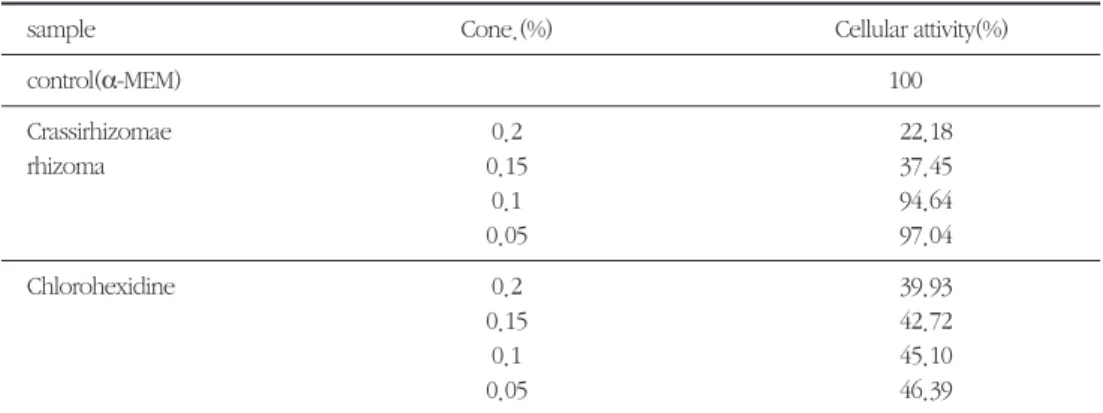
치은섬유아세포의 경우α-MEM을 대조군으로 하여 비교해보면 0.2%와 0.15% 관중의 경우 세포 활성도가 22.18%, 37.45%로 현저히 낮게나타났
다. 하지만 0.1%, 0.05%의 경우엔 세포활성도가 94.64%, 97.04%로 치은섬유아세포의 활성에 거의 영향을 주지 않는 것으로 나타났다. Chlorhexidine 의 경우엔 0.2%, 0.15%, 0.1%, 0.05%에 각각 39.93%, 42.72%, 45.10%, 46.39%를 나타내 치은섬 유아세포의 활성을 현저히 떨어지게 하는 것을 알 Table 7. Antibacterial effect to F. nucleatum of chlorhexidine & Crassirhizomae rhizoma
sample Cone.(%) inhibition zone(mm)
Crassirhizomae 0.2 20±0.82
rhizoma 0.15 16.7±0.94
0.1 14.3±0.47
0.05 10.7±1.70
Chlorohexidine 0.2 32±3.26
0.15 28±1.63
0.1 27±2.45
0.05 24.7±2.05
Table 8. Cellular activity of gingival fibroblast of Crassirhizomae rhizoma & Chlorhexine
sample Cone.(%) Cellular attivity(%)
control(α-MEM) 100
Crassirhizomae 0.2 22.18
rhizoma 0.15 37.45
0.1 94.64
0.05 97.04
Chlorohexidine 0.2 39.93
0.15 42.72
0.1 45.10
0.05 46.39
Table 9. Cellular effect of osteoblast of Crassirhizomae rhizoma & Chlorhexidine
sample Cone.(%) Cellular activity(%)
control(α-MEM) 100
Crassirhizomae 0.2 33.28
rhizoma 0.15 61.27
0.1 120.93
0.05 111.45
Chlorohexidine 0.2 42.93
0.15 43.97
0.1 45.34
0.05 45.98
수 있다(Table 8).
조골세포의 경우 α-MEM을 대조군으로 하여 비교해보면 0.2%와 0.15% 관중의 경우 세포활성 도가 33.28%, 61.275%로 현저히 낮게나타났다.
하지만 0.1%, 0.05%의 경우엔 세포활성도가 120.93%, 111.45%로 치은섬유아세포의 활성을 오 히려 증가시키는 것을 알 수 있다. Chlorhexidine 의 경우엔 0.2%, 0.15%, 0.1%, 0.05%에 각각 42.93%, 43.97%, 45.34%, 45.98%를 나타내 치은 섬유아세포의 활성을 현저히 떨어지게 하는 것을 알 수 있다(Table 9).
3. 관중과 Chlorhexidine이 치은섬유아세포와 조골세포의 DNA합성에 미치는 효과
α-MEM을 대조군으로, PDGF를 양성대조군으 로 사용했다. 치은섬유아세포에서는 관중은 0.2%
와 0.15%에서는 DNA의 합성이 현저히 감소되었 으나, 0.1%와 0.05%에서는 대조군보다는 다소 높 게, 양성대조군보다는 다소 낮게 나타났다. 하지 만, Chlorhexidine은 오든 농도에서 현저히 DNA 의 합성이 낮게 나타났다(Table 10).
조골세포에서는 관중은 0.2%와 0.15%에서는 DNA의 합성이 현저히 감소되었으나, 0.1%와
Table 10. Effect of Crassirhizomae rhizoma & Chlorhexidine on the [3H] thymidine incorpora- tion into DNA of gingival fibroblast
sample Conc.(%) [3H] thymidine incorporation(CPM)
control(α-MEM) 623
PDGF 650
관중 0.2 385
0.15 430
0.1 620
0.05 632
Chlorohexidine 0.2 245
0.15 275
0.1 300
0.05 310
Table 11. Effect of Crassirhizomae rhizoma & Chlorhexidine on the [3H] thymidine incorporation into DNA of osteoblast
sample Cone.(%) [3H] thymidine incorporation(CPM)
control(α-MEM) 2025
PDGF 2305
Crassirhizomae 0.2 668
rhizoma 0.15 1435
0.1 2178
0.05 2145
Chlorohexidine 0.2 440
0.15 445
0.1 448
0.05 510
0.05%에서는 대조군보다는 다소 높게, 양성대조군 보 다 는 다 소 낮 게 나 타 났 다 . 하 지 만 , Chlorhexidine은 오든 농도에서 현저히 DNA의 합 성이 낮게 나타났다(Table 11).
IV. 총괄 및 고안
치주질환을 일으키는 주된 요인은 치태내의 세균임은 이미 주지의 사실이다. 치주질환이 생기 면 치주낭이 형성되게 되고 여기에 치태가 쌓이고 이 치태는 구강내 세균의 서식처가 된다. 여기에 서식하는 세균은 점차 조성이 변화하게 되는데 호 기성, 통기성 그람양성 세균에서 점차로 혐기성 그람음성세균으로 전환되고, 이어서 이 혐기성 그 람음성 세균으로부터 독소 및 산물이 직접 주위조 직을 파괴하거나 다양한 면역반응을 통해서 치주 질환을 진행시켜 나간다. 따라서 이런 세균을 조 절하는 것은 치주치료의 좋은 방법 중의 하나이 다.
Chlorhexidine은 낮은 농도에서는 세포막의 투과성을 증대시켜 칼륨을 포함한 세포내 구성성 분들을 과도하게 누출시킴으로써, 고농도에서는 세균의 세포질의 침착을 유발시킴으로써 정균 및 항균작용을 나타내게 된다5).
본 연구에서는 Actinobacillus. actiomycetem- comitans., Capnocytophaga ochracea, Strepto- coccus mutans, Porphyromonas gingivalis, Prevotella intermedia, Actinomyces viscosus, Fusobacterium nucleatum 등의 세균을 대상으로 관중과 Chlorhexidine의 항균력을 비교하였다.
Actinomyces viscosus의 모 든 농 도 에 서 , Prevotella intermedia의 0.1%에서는 관중이 다소 chlorhexidine 보다 우수한 항균력을 나타냈지만, 나머지들의 경우에 있어서는 chlorhexidine이 더 나은 결과를 나타냈다. 하지만, 기존의 항균제제 인 chlorhexidine보다 강력하지는 않지만 상당한 정도의 항균효과를 나타냈다.
과거엔 치주질환을 치료하기 위하여 많은 약 제들에 대한 연구가 있어왔지만, 최근에는 치주치
료의 궁극적인 목표인 상실된 치주조직의 재생에 관한 부분으로 관심이 옮겨왔다. 이러한 치주조직 의 재생을 위하여 growth factor가 관심을 끌고 있 는데 PDGF-BB, IGF 등은 치주인대 세포나 치은 섬유아세포의 이주나 분열을 촉진시킨다는 보고 가 있으며36,37), BMP는 골유도성이 있슴이 알려졌 다38).
Chlorhexidine의 세포독성에 관한 연구를 살 펴보면, Gabler등은 chlorhexidine의 농도가 100
㎍/㎖이상이 되면 세포의 용해가 일어난다고 보고 하였으며33), Helgeland등은 25㎍/㎖이상이 되면 상피 세포의 성장이 억제된다고 보고하였고34), Mobacken등은 40㎍/㎖이상이 되면 치은섬유아 세포의 세포 기능이상이나 세포의 용해가 일어난 다고 보고하였다35). 본 연구에서도 관중이 Chlorhexidine보다 세포활성도가 높고 세포독성 이 낮은 것으로 나타났다.
또한 생약제제들을 이용해서 치주질환의 치료 제로 사용하고자 하는 연구들이 있어왔는데 장26) 등은 생약제제중 magnolol이나 holokiol등이 염 증의 매개물질인 cytokine생성 억제효과를 보고 하였으며, 류39)등도 생약제제의 cytokine생성 억 제에 대하여 비슷한 효과를 보고하였고, 이40)등은 Sanguinarine, listerin,몰약, 인삼사포닌 등도 항균 효과가 있음을 보고하였다.
결론적으로 관중은 Chlorhexidine 보다는 다 소 떨어지는 항균효과를 나타내지만 세포독성이 강하게 나타나는 chlorhexidien에 비해 세포독성 이 낮고 세포성장촉진효과가 있다고 생각된다. 하 지만 이는 관중의 일면일 뿐이고 항염작용, 돌연 변이유발가능성 및 cytokine 과의 관계에 대한 일 련의 연구가 필요하다고 생각된다.
V. 결론
시중에서 사용되고 있는 항균구강용제인 chlorhexidine과 생약인 관중을 주요치주병유발 가능세균에 대하여 항균작용을 비교하고 치은섬 유아세포와 조골세포에 대하여 세포활성도 및 세
포독성을 비교하여 다음과 같은 결론을 얻었다.
1. 관중과 Chlorohexidine의 비교에서 항균력은 Chlorohexidine이 다소 앞서지만 그 차이는 미미한 것으로 나타났다.
2.세포활성도 및 [3H] thymidine incorporation 연구에서는 0.1, 0.05%의 관중이 세포독성이 적은 것으로 나타났다.
VI. 참고문헌
1.Gemmell E, Seymour GJ : Modulation of immune response to periodontopathic bacte- ria. Curr Opin Periodontol 1994:28-38
2.Carranza FA : Glickman's clinical periodontol- ogy. 6th ed., The WB Saunders Co. 1894:361- 390
3.Scransky SS : Microbiology of periodontal dis- ease-present status and future consideration. J Periodontol 1977 48:497-504
4.Newman MG : Current concepts of the patho- genesis of periodontal disease. Microbiology emphsis. J Periodontal 1985 734-739
5.Gjermo P : Chlorhexidine and related com- pounds J Dent Res 1989 68:1602
6.Greenstein G, Berman C, Jaffin R : Chlorhexidine. An adjunct to periodontal ther- apy. J Periodontol 1986:57:370-377
7.Goldschmidt P, Cogen R Taubman S : Cytopathlogic effects of chlorhexidine on human cells. J Periodontol 1977 48:212-215 8.Paunio K, Knuttia M, Lielityinen H : The effect
of chlorhexidine gluconate on the formation of experimental granulation tissue. J Periodontol 1978 49:92-97
9.Bassetti C, Tallenburger A : Influencesof chlorhexidine rinsing on the healing of oral mucosa and osseous loseion J Clin Periodontol 1980 7:443-451
10. Gabler W, Bulolock W, Creamer H : the influ- ence of chlorhexidine on superoxide genera- tion by induced human neutrophils J Periodont Res 1987 22:445-458
11. Watts T, Addisson T, Johlson B : Effects do chlorhexidine solution on neutrophil locomo- tion in vitro J Dent Res 1989 17:287-295 12. Micheal B, Carol NB : Antimicrobial agents in
prevention and treatment of periodontal dis- ease Dent Clin North America 1988:217-241 13. Williams RC, Jefcoat MK, Howell TH, Rolla A,
Goldhaber P : Altering the progression of human alveolar bone loss with the non- steroidal anti-inflammatory drug flurbipropen.
J Periodontol 1989 60:485-490
14. Jeffcoat MK, Williams RC, Reddy MS, English R, Goldhaber P : Flurbipropen treatment of human periodontitis; Effect of alveolar bone height and metabolism. J Periodont Res 1988 23:381-385
15. Howell TH, Jeffcoat MK, Goldhaber P, Reddy MS, Kaplan ML, Johnson HG, Hall CM, Williams RC : Inhibition of alveolar bone loss in beagles with the NSAID naproxen. J Periodont Res 1991 26:498-501
16. Williams RC, Jeffcoat MK, Howell TH, Reddy MS, Johnson HG, Hall CM, Goldhaber P : Ibupropen; An inhibition of alveolar bone resorption inbeagles. J Periodont Res 1988 23:225-229
17. Vernillo AT, Ramamurthy NS, Golub LM, Rifkin BR : The nonantimicrobial properties of tetracycline for the treatment of periodontal disease. Curr Opin Periodontol 1994 1:111- 118
18. Rifkin BR, Vermillo AT, Golub LM : Blocking periodontal disease pregression by inhibition tissue destructive enzyme : A potential thera- peutic role for tetracycline and their chemical-
ly modified aanalogs J Periodontol 1993 64:819-827
19. Terranova VP, Franzetti LC, Hic S : A bio- chemical approach to periodontal regenera- tion; Tetracycline treatment pf dentin pro- motes fibroblast adhesion and growth. J Periodont Res 1986 21:330-337
20. Kopczyk RA, Abramas H, Brown AT, Mateny JL, Kaplan AL : clinical and microbiological effects of a sanguinaria-containing mouthrinse and dentifrice with and without fluoride dur- ing 6 months of use. J Periodontol 1991 62:612-622
21. Dzink JL, Socransky SS : Comparative in vitro activity of sanguinarine against oral microbial isolates. Antimicro Agents Chemother 1985 27:663-665
22. Bae KH and Oh HR : Synergistic effect of lysozyme on bacterial activity of magnolol and honokiol against a cariogenic bacterium, Streptococcus mutans OMZ 176. Arch Pharm Res 1990 13:117-119
23. Namba T, Tsunezuka M, Bae KH, Hattori M : Studies on dental caries prevention by tradi- tional chinese medicines. Shoykugaku Zasshi 1981 35:295-302
24. Osawa K, Matsumoto T, Yasuda H, Kato T, Naito Y, Yukna K : The inhibitory effect of plant extracts on the collagenolytic activity and cytotoxicity of human gingival fibroblasts by Porphyromonas gingivalis crude enzyme.
The bulletin of Tokyo Dental College 1991 32:1-7
25. 이승렬, 정종평, 최상묵, 배기환 : 천연물추출 물의 치주병인균에 대한 항균효과 및 세포독 성에 관한 연구. 대한치주과학회지 1992 22:515-526
26. 장범석, 손성희, 정종평, 배기환 : Magnolol 과 Honokiol이 항균, 교원질분해효소, 세포독성
및 cytokine 생산에 미치는 영향. 대한치주과 학회지 1993 23:145-158
27. Chang BS, Lee YM, Ku Y, Bae KH, Chung CP : The antibacterial activities of magnolol and honokiol gainst periodontopathic microorgan- ism. Planta Med 1998 64:367-369
28. 이용무, 구영, 배기환, 정종평 : 후박 및 대조초 촐 혼합물이 골조직 재생에 미치는 영향. 대한 치주과학회지 1997 27:165-178
29. 신승윤 : 후박 및 대조 추출혼합물이 치주질환 유발 성견의 치주질환억제에 미치는 효과 30. 한덕룡외. 현대생약학 학창사 1987 500-501 31. 한 대석외 생약학 연지사 1983 138-139 32. Yamada M, Takazoe I, Okuda K :
Bacteriocinogenicity of oral Bacteroids species Bull Tokyo Dent Coll 1987 28:55-61
33. Gabler WL, Roberts D, Harold W : The effects of chlorhexidine on blood cells J Periodont Res 1987 22:150-155
34. Helgeland K, Heyden G, Rolla G : The effect of chlorhexidien on animal cells in vitro Scand J Dent Res 1971 79:209-215
35 Mobaken H, Wengstrom C : Interference with healing of rat skin incisions treated with chlorhexidine Acta Dematovener 1974 54:29- 34
36. Lynch SE, Castilla GR, Williams RC, Kiritsy CP, Howell H, Reddy MS, Antoniades HN : The effects of short-term application of a combina- tion of platelet-derived and insulin-like growth factors on periodontal wound healing J Periodontol 1991 62:458-467
37. Rutherford RB, Niekrash CE, Kennedy MF : Platelet-derived and insulin-like growth factors stimulate regeneration of periodontal attach- ment in monkeys J Periodont Res 1992 27:285-290
38. Sigurdsson TJ, Lee MB, Kubota K, Wikesjo UME : Periodontal repair in dogs: recombinat
human bone morphgenic protein-2 sifnificant- ly enhances periodontal regeneration J Periodonol 1995 66:131-138
39. 류인철, 손성희, 정종평, 배기환 : 생약추출물 이 세포성장 및 cytokine 생산에 미치는 영향
대한치주과학회지 1993 23:37-47
40. 이승렬, 정종평, 최상묵, 배기환 : 천연물 추출 물의 치주병인균에 대한 항균효과 및 세포독 성에 관한 연구 대한치주과학회지 1992 22:1- 12
- Abstract-
Antibacterial Effects and Cytotoxicity of Crassirhizomae Rhizoma
Seung-Nam Kim1, Young Ku1, In-Cheol Rhyu1, Byung-Do Hahm1, Ki-Hwan Bae2, Soo-Boo Han1, Chong-Pyoung Chung1, Sang-Mook Choi1
1Department of Periodontology, College of Dentintry, Seoul National University
2College of Pharmacy, Chungnam National University
The purpose of this study was to evaluate the antimicrobial activity of Crassirhzimae rhizoma and its possible use as an oral antiseptics for prevention of periodontitis. Its antibacterial activity against peri- odontopathic microorganisms including Actinobacillus actiomycetemcomitans, Capnocytophaga ochracea, Streptococcus mutans, Porphyromonas gingivalis, Prevotella intermedia, Actinomyces viscosus, Fusobacterium nucleatumwas evaluated via modified stab culture method. The cytotoxicity against gingi- val fibroblasts and rat osteoblasts was investigated via [3H]thymidine incorporation and cellular activity was investigated via MTT assay. Chlorhexidine was used as control group. Crassirhizomae rhizoma was prepared at concentrations of 0.2, 0.15, 0.1, 0.05%. Chlorhexidine was also prepared at the same concen- tration. Crassirhizomae rhizoma showed lower antimicrobial antivity against these microorganism than chlorhexidine, but this difference was not significant. And, Crassirhzomae rhizoma showed more cellular activity and less cytotoxicity than chlorhexidine on human gingival fibrablast and rat osteoblast. This study suggests that Crassirhzomae rhizoma might be a candidate for a safe oral antiseptic for the preven- tion and treatment of periodontal disease.
Key Words : natural extract, Chassizomae rhizoma, antibacterial effect, cytotoxicity, cellular activity


![Table 11. Effect of Crassirhizomae rhizoma & Chlorhexidine on the [ 3 H] thymidine incorporation into DNA of osteoblast](https://thumb-ap.123doks.com/thumbv2/123dokinfo/5318685.166529/6.790.76.713.739.971/table-effect-crassirhizomae-rhizoma-chlorhexidine-thymidine-incorporation-osteoblast.webp)
