Ⅰ. Introduction
Parkinson’s disease is very common in the old age group. If it is not detected in the early stage it can lead to severe gait related problem as well as problems in upper limbs as well as lower limbs[1].
Detection of Parkinson’s disease as well as continuous monitoring was a challenge few years ago because of expensive monitoring devices such as sensors as well as difficult to perform the pattern analysis because of unavailability of proper data analysis technique as well as unavailability of sufficient data. In recent years the wearable devices are easily available and it is easier to collect huge amount of data and with combination of powerful machine learning technique it is easier to draw
patterns that help to monitor the patients in real time. Aich et al., used wearable sensors and machine learning technique for prediction of freezing of gait in Parkinson’s disease [2].Aich et al., using wearable sensor data to distinguish shuffling of gait patients from other Parkinson’s disease patients and automated using machine learning techniques [3]. Jeon et al. used wearable sensors based approach to measure the tremor severity and automatic classification of patients using machine learning techniques [4]. In this paper we have proposed a wearable sensor based approach to detect and classify the ON/OFF state of Parkinson’s disease patients and automate the classification of ON/OFF state using machine learning techniques.
Wearable Sensor based Gait Pattern Analysis for detection of ON/OFF State in Parkinson’s Disease
Satyabrata Aich · Jinse Park · Moon-il Joo · Jong Seong Sim · Hee-Cheol Kim Institute of Digital Anti-aging Healthcare, Inje University
E-mail : [email protected], [email protected]
ABSTRACT
In the last decades patient’s suffering with Parkinson’s disease is increasing at a rapid rate and as per prediction it will grow more rapidly as old age population is increasing at a rapid rate through out the world. As the performance of wearable sensor based approach reached to a new height as well as powerful machine learning technique provides more accurate result these combination has been widely used for assessment of various neurological diseases. ON state is the state where the effect of medicine is present and OFF state the effect of medicine is reduced or not present at all. Classification of ON/OFF state for the Parkinson’s disease is important because the patients could injure them self due to freezing of gait and gait related problems in the OFF state. in this paper wearable sensor based approach has been used to collect the data in ON and OFF state and machine learning techniques are used to automate the classification based on the gait pattern. Supervised machine learning techniques able to provide 97.6%
accuracy while classifying the ON/OFF state.
Keywords
Wearable sensors, gait, pattern analysis, classification, Parkinson’s disease
283
한국정보통신학회 2019년 춘계 종합학술대회 논문집
Ⅱ. Methodology
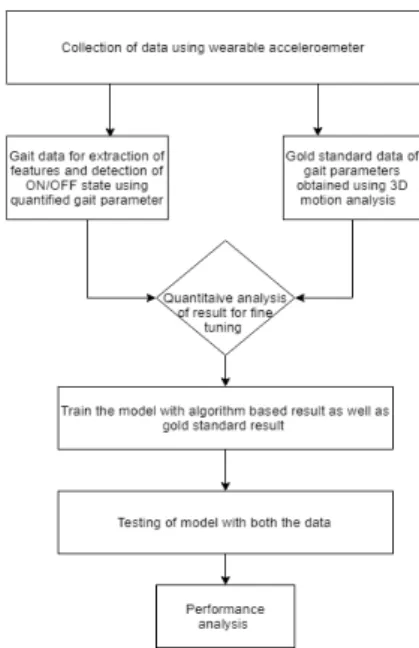
The framework of the methodology planned for this project is mentioned below in Figure 1. The data has been collected using wearable inertial sensors 3D motion analysis system. The data recorded in the 3D motion analysis system is the gold standard, where the data recorded using wearable accelerometers are used to extract the features and quantify the gait parameters and after fine tuning the quantified gait parameters and god standard data were fed to supervised machine learning model and also validated to check the performance of the model.
Figure 1. Framework of Methodology
Ⅲ. Data Analysis and Results In this paper supervised machine learning techniques are used and among them random forest provides highest accuracy of 97.6% shown in the figure 2.
Figure 2. Comparison of Accuracy
Ⅳ. Conclusion
In this paper we have analyzed the accelerometer data of the patients which undergone ON/OFF state and then gait parameters were quantified from the data and compared to the gold standard data obtained using 3D motion analysis and then based on difference of the results fine tuning is performed in the algorithm and then these data’s were fed to different supervised machine learning technique such as Bagging CART, Random forest, Boosted C5.0, Naive Bayes, and SVM and we found highest accuracy of 97.6% on random forest classifiers. This model will help the clinician to distinguish the ON and OFF state more accurately compared to manual methods.
Acknowledgment
This research was supported by the Ministry of Trade, Industry and Energy (MOTIE), KOREA, through the Education program for Creative and Industrial Convergence (Grant number N0000717).
References
[1] S. Aich, K.W.Choi, P. Pradhan, J. Park, H.C. Kim,
“Prediction of Neurodegenerative Diseases Based on Gait Signals Using Supervised Machine Learning Techniques,” Advanced Science Letters, Vol. 24, No.
3,pp.1974-1978, 2018.
[2] S. Aich, P. Pradhan, J. Park, N. Sethi, V.
Vathsa and H.C. Kim, “A Validation Study of Freezing of Gait (FoG) Detection and Machine-Learning-Based FoG Prediction Using Estimated Gait Characteristics with a Wearable Accelerometer,” Sensors, Vol. 17, No. 10, pp.
3287, Sep. 2018.
[3] S. Aich, P. Pradhan, J. Park, H.C. Kim, “A machine learning approach to distinguish Parkinson’s disease (PD) patient’s with shuffling gait from older adults based on gait signals using 3D motion analysis,” International Journal of Engineering and Technology, Vol. 7, No. 3.29, pp. 153-156, 2018.
[4] H. Jeon, W. Lee, H. Park, H. Lee, S. Kim, H.
Kim B. Jeon, and K. Park, “Automatic classification of tremor severity in Parkinson’s disease using a wearable device,” Sensors, Vol.
17, No. 9, p.2067, 2017.
284