Printed in the Republic of Korea
http://dx.doi.org/10.5012/jkcs.2013.57.4.461
Theoretical Study of the N-(2,5-Methylphenyl)salicylaldimine Schiff Base Ligand:
Atomic Charges, Molecular Electrostatic Potential, Nonlinear Optical (NLO) Effects and Thermodynamic Properties
Tugrul C. Zeyrek*
Ankara Nuclear Research and Training Center, Turkish Atomic Energy Authority, 06100 Besevler-Ankara, Turkey
*E-mail: [email protected]
(Received February 14, 2013; Accepted June 28, 2013)
ABSTRACT. Optimized geometrical structure, atomic charges, molecular electrostatic potential, nonlinear optical (NLO) effects and thermodynamic properties of the title compound N-(2,5-methylphenyl)salicylaldimine (I) have been investigated by using ab initio quantum chemical computational studies. Calculated results showed that the enol form of (I) is more stable than keto form. The solvent effect was investigated for obtained molecular energies, hardneses and the atomic charge distributions of (I).
Natural bond orbital and frontier molecular orbital analysis of the title compound were also performed. The total molecular dipole moment (µ), linear polarizability (α), and first-order hyperpolarizability (β) were calculated by B3LYP method with 6- 31G(d), 6-31+G(d,p), 6-31++G(d,p), 6-311+G(d) and 6-311++G(d,p) basis sets to investigate the NLO properties of the com- pound (I). The standard thermodynamic functions were obtained for the title compound with the temperature ranging from 200 to 450 K.
Key words: Density functional theory, Molecular orbitals, Schiff base, Ab initio calculations, Nonlinear optical effects
INTRODUCTION
Azomethines are known as Schiff bases which having a double C=N bond and usually synthesized from the con- densation of primary amines and active carbonyl groups.
Schiff bases exhibit mainly interest as corrosion inhibi- tors, catalyst carriers, thermo-stable materials, metal com- plexion agents and in biological systems and they have a wide range of applications, such as dyes and pigments.1–9 They can be classified in terms of display interesting pho- tochromic and thermochromic features in the solid state.
This features arise via H-atom transfer from the hydroxy O atom to the imine N atom.10,11 This H-atom transfer can be utilized for the design of several molecule based elec- tronic devices such as measurement radiation intensity, optical computers and display systems.12–14 Mainly, the enol- imine (OH) and the keto-amine (NH) forms of tautomeric forms are display in O-hydroxy Schiff bases (Scheme 1). Two types of intramolecular hydrogen bonds are observed in Schiff bases: O–H...N in enol-imine14,15 and N–H...O in keto- amine tautomers depending on the tautomeric forms.16,17
Several Schiff base compounds have nonlinear optical (NLO) behaviour.18,19 They have been under investigation the last years, since their potential applicability in optical communications. The nonlinear optical effect is based on molecular units containing highly delocalized π-electron
moieties and extra electron donor and electron acceptor groups on opposite sides of the molecule at appropriate positions on the ring to enhance the conjugation. In gen- eral, Schiff base ligands consist of a variety of substituent with different electron-donating or electron withdrawing groups. Electron donor/acceptor substituent is effect on the first hyperpolarizability of Schiff base molecules.20,21 Density functional theory (DFT) is widely used meth- ods in the computational quantum chemistry by using ab initio calculation of electronic structures of many particle systems. Many molecular properties calculated and revealed according to the development of better and better exchange- correlation functional method.22 In the literature, the DFT has a great accuracy in reproducing the experimental val- ues in geometry, dipole moment, vibrational frequency, excited states of organic compounds.23−25
Recently, we studied the crystal structure and confor- mational study by X-ray structure analysis and determined the conformational energy profiles by using AM1 semiem- pirical quantum mechanical method of N-(2,5-meth- ylphenyl)salicylaldimine Schiff base ligand (I).26 In this study, we have studied the DFT calculations for the title compound by ab initio quantum chemical calculations to investigate the molecular structural, energetic, molecular electrostatic potential, NLO and thermodynamic proper- ties of the Schiff base compound (I).
CALCULATION DETAILS
The molecular geometry of the compound (I) is directly taken from the X-ray diffraction experimental result. This result were used at the Gaussian 03 software package and Gauss-view visualization program27,28 for the DFT calcula- tions with Becke’s Three-parameter Hybrid Functional Using the LYP Correlation Functional B3LYP at 6-31G(d) basis set by using the Berny method.29,30 The calculations were performed on a PC with an Intel(R) Core(TM)2 Duo CPU E4500 2.20GHz processor, 2GB RAM memory under the Microsoft Windows as the operating system.
To investigate the tautomeric stability, in gas-phase some properties such as total energy, HOMO and LUMO ener- gies and the chemical hardness31 of the title compound were obtained at B3LYP/6-31G(d) level. These properties were also examined in three kinds of solvent media (chlo- roform, ethanol and water) by using a Polarized Contin- uum (PCM) model.32
To investigate the reactive sites and to identify sites of intra- and inter-molecular interactions of the compound (I), molecular electrostatic potential surface was evalu- ated by using B3LYP/6-31G(d) method.
The total molecular dipole moment (µ), linear polariz- ability (α), and the first-order hyperpolarizability (β) by B3LYP method with different base sets [6-31G(d), 6- 31+G(d,p), 6-31++G(d,p), 6-311+G(d) and 6-311++G(d,p)]
for investigate the effects of basis sets on the NLO properties.
The natural bond orbital (NBO) analysis of the title compound (I) was fulfilled at the B3LYP/6-31G(d) level by means of the NBO 3.1 program within the Gaussian 03W package.33
Finally, the standard thermodynamic functions were obtained from statistical thermodynamics based on the vibrational frequencies analysis at B3LYP/6-31G(d) level at the Gaussian 03 software package program.
RESULTS AND DISCUSSION Optimized Geometry
The molecular geometry of N-(2,5-methylphenyl)sali-
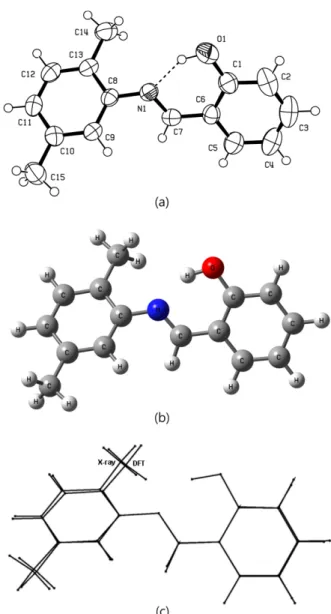
cylaldimine (I) have been experimentally determined.26 The crystallographic data of (I) has been seen orthorhom- bic, space group P212121, with the cell dimensions a = 6.839(1), b = 7.720(4), c = 23.183(3) Å and V = 1224.1(2) Å3. ORTEP view of the molecular structure of (I) is given in Fig. 1(a). The optimized parameters (bond lengths, bond angles, and dihedral angles) of the title compound (I) were obtained by using the B3LYP/6-31G(d) method (see Fig.
1(b)). The experimental and calculated bond distances and bond angles results are listed in Table 1.
The aniline ring is rotated relatively to the salicylaldi- Scheme 1. Tautomeric forms of the title compound.
Figure 1. (a) The experimental molecular structure of the title compound taken from ref 26. Displacement ellipsoids are plotted at the 50% probability level. (b) The theoretical optimized geo- metric structure of the title compound. (c) Superimposition of the X-ray structure of the title compound and its DFT optimized counterpart.
mino-part. The aniline ring and the salicylaldimino-part are planar with a maximum deviation 0.028(2) Å. The angle of between two part is 43.3(1)o. In the structure of the title compound (I), the most important torsion angles between the aniline ring with the salicylaldimino-part are [θ1(C8− N1−C7−C6)], [θ2(C9−C8−N1−C7)] and [θ3(N1−C7−C6−C5)].
From their X-ray structure determination, [θ1(C8−N1−C7−
C6)], [θ2(C9−C8−N1−C7)] and [θ3(N1−C7−C6−C5)]
values were obtained −174.4(2)o, 42.6(3)o and 177.8(2)o, respectively. This angles have been calculated at −176.9o, 39.0o and −179.7o for the B3LYP/6-31G(d) level in the opti- mized structure. The conformational discrepancies between the X-ray structure and optimized counterparts can be seen from Fig. 1(c). The orientation of methoxy group for C14 is remarkable discrepancy between this counterparts and the orientation of this methoxy group is defined by torsion angle N1−C8−C13−C14 with value 3.0(3)o for X-ray, respectively. This torsion angle has been calculated at 1.52o for the B3LYP/6-31G(d) base sets. In the title compound (I), a strong intramolecular hydrogen bonding occurs between the hydroxyl oxygen atom and the azomethine nitrogen atom. The O1...N1 distance of 2.604(2) Å is indicative of strong intramolecular hydrogen bonding.
The O1−H1 and H1...N1 distances are 0.95(3) and 1.73(3) Å, and the O1−H1...N1 angle is 150.0(2)o respectively.26 The existence of the H-bond appears as an important property of the molecule for stabilizing its conformation in the crystal; as shown in the molecular modelling part, this is also visible in the model, obtained for the molecule discussed.
The geometry of hydrogen bond in the optimized struc- tures is examined for B3LYP. The proton donor group O1–H1 forms an intramolecular interaction with nitrogen atom N1, with a bond length of 1.75 Å and a bond angle of 147.6o.The bond length N1–C7 for X-ray structure and optimized structure at B3LYP is 1.276(2) and 1.292o Å which corresponds to a double bond, indicating an eno- limine character of the title compound. The biggest dif- ference of bond lengths between the experimental and the optimized values is found at C3–C4 bond with the dif- ference being 0.032 Å, and the biggest differences for the bond angles are found as 0.80o at O1–C1–C6, C3–C4–C5 and C4–C5–C6. The intramolecular and intermolecular hydrogen bond interactions present in the compound (I) are very important for formation of the structure, according to mentioned comparisons, which the biggest differences of bond lengths and bond angles mainly occur in the groups involved in the hydrogen bonds.
As seen from Table 1, most of the optimized bond lengths are slightly longer than the experimental values. It Table 1. Optimized and experimental geometries of the title com-
pound in the groundstate. Bond distances (Å) and angles (o) with e.s.d.s in parentheses
Parameters Experimental
[26]
Calculated 6-31G(d) B3LYP
N(1)−C(7) 1.276(2) 1.292
N(1)−C(8) 1.423(2) 1.410
O(1)−C(1) 1.346(3) 1.342
C(1)−C(2) 1.386(3) 1.403
C(1)−C(6) 1.403(3) 1.423
C(2)−C(3) 1.370(4) 1.389
C(3)−C(4) 1.372(4) 1.404
C(4)−C(5) 1.374(3) 1.386
C(5)−C(6) 1.398(3) 1.409
C(6)−C(7) 1.446(3) 1.450
C(8)−C(9) 1.393(3) 1.405
C(8)−C(13) 1.395(3) 1.411
C(9)−C(10) 1.384(3) 1.395
C(10)−C(11) 1.388(3) 1.401
C(10)−C(15) 1.503(3) 1.512
C(11)−C(12) 1.381(3) 1.394
C(12)−C(13) 1.381(3) 1.398
C(13)−C(14) 1.501(3) 1.509
Max. difference 0.032
Bond angles (o)
C(7)−N(1)−C(8) 121.1(2) 121.1
O(1)−C(1)−C(2) 119.3(2) 118.6
O(1)−C(1)−C(6) 121.2(2) 122.0
C(2)−C(1)−C(6) 119.5(2) 119.4
C(3)−C(2)−C(1) 120.4(2) 120.2
C(2)−C(3)−C(4) 120.8(2) 121.0
C(3)−C(4)−C(5) 119.9(2) 119.1
C(4)−C(5)−C(6) 120.6(2) 121.4
C(5)−C(6)−C(1) 118.8(2) 118.9
C(5)−C(6)−C(7) 119.7(2) 119.7
C(1)−C(6)−C(7) 121.4(2) 121.4
N(1)−C(7)−C(6) 122.5(2) 122.6
C(9)−C(8)−C(13) 120.6(2) 120.1
C(9)−C(8)−N(1) 121.2(2) 121.7
C(13)−C(8)−N(1) 118.0(2) 118.1
C(10)−C(9)−C(8) 121.4(2) 121.7
C(9)−C(10)−C(11) 117.8(2) 117.9
C(9)−C(10)−C(15) 120.8(2) 121.1
C(11)−C(10)−C(15) 121.4(2) 121.0
C(12)−C(11)−C(10) 120.6(2) 120.7
C(13)−C(12)−C(11) 122.3(2) 121.9
C(12)−C(13)−C(8) 117.3(2) 117.7
C(12)−C(13)−C(14) 121.3(2) 121.2
C(8)−C(13)−C(14) 121.4(2) 121.1
Max. difference 0.8
Torsion angles (o)
C(8)−N(1)−C(7)−C(6) −174.4(2) −176.9
C(9)−C(8)−N(1)−C(7) 42.6(3) 38.96
N(1)−C(7)−C(6)−C(5) 177.8(2) 179.7
C(13)−C(8)−N(1)−C(7) −142.0(3) −143.4
C(7)−C(6)−C(1)−O(1) −3.0(3) −0.2
C(3)−C(2)−C(1)−O(1) 179.9(2) −179.8
N(1)−C(8)−C(13)−C(14) 3.0(3) 1.5
C(8)−C(9)−C(10)−C(15) −178.7(2) −179.5
can be that the experimental results belong to the solid phase whereas theoretical calculations belong to the gas-phase.
The result in the differences of bond parameters between the calculated and experimental values depend on the exist- ence of the crystal field along with the inter-molecular interactions connects the molecules together in the solid state.34 The calculated geometric parameters by using the B3LYP/6-31G(d) method are in good agreement with the X-ray structure, in spite of the observed differences, in general.
MEP, frontier molecular orbitals, NLO and thermo- chemical properties of (I) based on the optimized geom- etry are discussed as follows.
Energetic and Stability
Optimization calculations at B3LYP/6-31G(d) level were performed for both of the enol and keto forms of (I) to investigate the tautomeric stability. For each form, total energies, HOMO and LUMO energies, and chemical hard- ness (η) are also calculated with the same level of theory and the results are given in Table 2. As seen from Table 2, in gas-phase, the total energy of the enol form is lower than the keto form, whereas chemical hardness of the enol form is greater than the keto one. This indicates that the enol form of (I) is more stable than its keto form in gas- phase. Furthermore, calculations executed in three kinds of solvent (ε = 78.39, water; ε = 24.55, ethanol; ε = 4.9, chlo- roform) with the B3LYP/6-31G(d) level using the Polar- ized Continuum Model (PCM). Again as seen from Table 2, it can conclude that the total molecular energies obtained by PCM method decrease with the increasing polarity of the solvent.
Relation between the HOMOs–LUMOs Gap and the Chemical Hardness
The chemical hardness is useful to rationalize the relative stability and reactivity of chemical compounds. There are large HOMO–LUMO gap in the hard compounds and more stable and less reactive than soft compounds having small HOMO–LUMO gap.35 The definitions of universal con-
cepts of molecular structure stability and reactivity can be provided by using DFT method.36 For definition of hard- ness η, following equation developed;37,38
(1) In the equation (1) I is the vertical ionization energy and A stands for the vertical electron affinity. According to the Koopman theorem,39 the ionization energy and electron affinity can be equalized through HOMO and LUMO orbital energies:
(2) According to the equation (2), the hardness corre- sponds to the gap between the HOMO and LUMO orbit- als. Hence, the larger the HOMO-LUMO energy gaps the harder molecule.
(3) For enol and keto forms of the title compound (I), the chemical hardness (η) were calculated with the B3LYP/6- 31G(d) base sets. The results are given in Table 2. The energy separation between the HOMO and LUMO is 4.0815 eV for enol form and 3.2924 eV for keto form.
This large HOMO–LUMO gap for enol form suggests that high excitation energies for many of excited states, a good stability and high chemical hardness for the title compound (I). Indeed as seen from Table 2 the chemical hardness of the enol form (ηenol= 2.0408 eV) is greater than the keto one (ηketo= 1.6462 eV), which once again indicates that the enol form of (I) is more stable than its keto form in gas-phase, respectively.
Atomic Charge Distributions in Gas-Phase and in Solution-Phase
The Mulliken atomic charges for the non-H atoms of the compound (I) were calculated at B3LYP/6-31G(d) level in
η 1=2--- I A( – )
EA=–εHOMO
IP=–εLUMO
η 1=2---(εLUMO–εHOMO)
Table 2. Calculated total energies, frontier orbital energies and hardnesses NH form gas-phase
(ε = 1)
OH form
Gas-phase (ε = 1) Chloroform (ε = 4.9) Ethanol (ε = 24.55) Water (ε = 78.39)
ETOTAL (Hartree) −710.61404593 −710.61963817 −710.62348068 −710.62491519 −710.62520565
EHOMO (eV) −5.2243 −5.7141 −5.5770 −5.5508 −5.5508
ELUMO (eV) −1.9319 −1.6326 −1.4421 −1.4149 −1.4149
|EHOMO − ELUMO| (eV) 3.2924 4.0815 4.1349 4.1359 4.1359
η (eV) 1.6462 2.0408 2.0675 2.0680 2.0680
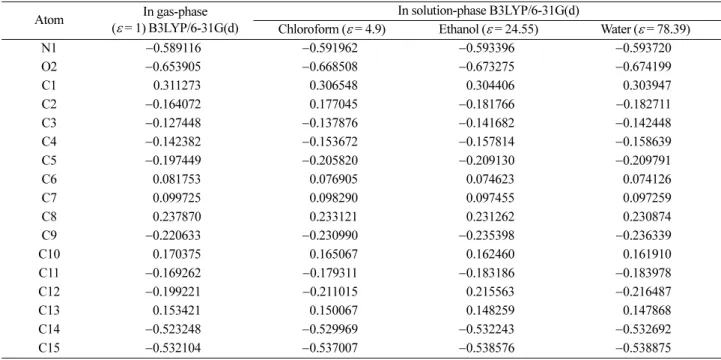
gas-phase. In order to investigate the solvent effect selected three kinds of solvent (ε = 78.39, water; ε = 24.55, etha- nol; ε = 4.9, chloroform), the atomic charge distributions of (I) were also calculated at B3LYP/6-31G(d) level. The calculated values of atomic charges of the title compound in gas-phase and solution-phase listed as shown in Table 3.
According to the calculated Mulliken atomic charges, the N1 and O1 atoms have bigger negative atomic charges in gas-phase. On the other hand, as shown in Table 3, the atomic charge values of the N1 and O1 atoms in solution-phase are bigger than those in gas-phase and while their atomic charges are becoming more negative with the increase of the polarity of the solvent.
Molecular Electrostatic Potential
To investigate reactive sites for electrophilic and nucleo- philic attack, the regions of the MEP for the (I) was com- posed by DFT calculation using the optimized geometry at the B3LYP/6-31G(d). As shown Fig. 2, red and yellow colours indicated for the negative regions of the MEP are related to electrophilic reactivity, while blue colours indi- cated for positive regions to nucleophilic reactivity. As can be seen from Fig. 2, compound (I) has one possible site for electrophilic attack. The oxygen atom (O1) of hydroxy group has negative region. The negative molecular elec- trostatic potential value is 0.042 a.u. for the mainly region of the O1 atom. The C7–H7 bond indicating a possible site for nucleophilic attack with a maximum value of 0.030
a.u. and around of this bond has maximum positive regions, respectively. According to these calculated results, the region of MEP shows that the negative potential sites are on elec- tronegative atoms as well as the positive potential sites are around the hydrogen atoms. The determining of MEP region is best suit for identifying sites for intra- and inter-molec- ular interactions.40 According to the MEP surface of the compound (I), the weak negative region associated with N1 atom and also the weak positive region by the nearby H1 atom. It can be indicative of an intramolecular (O1–
H1...N1) hydrogen bonding in the compound (I).
Table 3. Atomic charges (e) of the title compound in gas-phase and solution-phase
Atom In gas-phase
(ε = 1) B3LYP/6-31G(d)
In solution-phase B3LYP/6-31G(d)
Chloroform (ε = 4.9) Ethanol (ε = 24.55) Water (ε = 78.39)
N1 −0.589116 −0.591962 −0.593396 −0.593720
O2 −0.653905 −0.668508 −0.673275 −0.674199
C1 0.311273 0.306548 0.304406 0.303947
C2 −0.164072 0.177045 −0.181766 −0.182711
C3 −0.127448 −0.137876 −0.141682 −0.142448
C4 −0.142382 −0.153672 −0.157814 −0.158639
C5 −0.197449 −0.205820 −0.209130 −0.209791
C6 0.081753 0.076905 0.074623 0.074126
C7 0.099725 0.098290 0.097455 0.097259
C8 0.237870 0.233121 0.231262 0.230874
C9 −0.220633 −0.230990 −0.235398 −0.236339
C10 0.170375 0.165067 0.162460 0.161910
C11 −0.169262 −0.179311 −0.183186 −0.183978
C12 −0.199221 −0.211015 0.215563 −0.216487
C13 0.153421 0.150067 0.148259 0.147868
C14 −0.523248 −0.529969 −0.532243 −0.532692
C15 −0.532104 −0.537007 −0.538576 −0.538875
Figure 2. Molecular electrostatic potential (MEP) map.
Frontier Molecular Orbitals
To provide a reasonable qualitative indication of the exci- tation properties, the highest occupied molecular orbital (HOMO) and the lowest unoccupied molecular orbital (LUMO) for the title compound were investigated. The frontier molecular orbital distributions and energy levels of the HOMO–1, HOMO, LUMO, and LUMO+1 which computed at B3LYP/6-31G(d) level of the title compound are showed in Fig. 3. The frontier molecular orbital shows π molecular orbital characteristics and visualized in Fig. 3.
Except for methyl atoms of methoxy groups in the struc- ture, the HOMO and LUMO are mainly localized on the whole structure, as seen from Fig. 3. The LUMO+1 is local- ized on 2,5-methylphenyl fragment, whereas the HOMO–1 is localized on phenol rings, the C=N atoms bond and partly methyl of methoxy groups. As seen from Fig. 3, both the highest occupied molecular orbitals (HOMOs) and the lowest-lying unoccupied molecular orbitals (LUMOs) are mostly the π-antibonding type molecular orbitals in the structure.
Natural Bond Orbital (NBO) Analysis
The stabilization energies of the title compound (I) were computed by using second-order perturbation theory for examined the intra and inter-molecular interactions. The stabilization energy E(2) connected with electron delocal- ization between donor NBO(i) and acceptor NBO(j) were estimated as41
(4) where qi is the donor orbital occupancy, εi, εj are diagonal elements (orbital energies) and Fij is the off-diagonal
NBO Fock matrix element. B3LYP/6-31G(d) level was used for Second-order perturbation theory analysis of the Fock matrix. Selected natural bond orbital occupancies of the title compound are listed in Table 4. The double bond N1=C7 of the structure has revealed by the NBO analysis.
In aniline ring, consist of C1, C2, C3, C4, C5, C6 atoms and ring of the salicylaldimino part, consist of C9, C10, C11, C12, C13, C14 atoms are typical single-double arrangement that form the conjugate structure. Also, as seen from Table 4, the NBO occupancies of single C–C bonds in the ring are same level in C10–C15 and C13–
C14 single bonds of methoxy groups.
The results of second-order perturbation theory analy- sis of the Fock matrix and the stabilization energies larger than 3 kcal mol−1 are presented in Table 5. Some strong intramolecular interactions, which are formed by the over- lap between σ(C–C), σ*(C–C) and π(C–C), π*(C–C) bond orbital in the aromatic ring, which leads intramolecular E( )2 qi( )Fij 2
εj–εi --- –
=
Figure 3. Molecular orbital surfaces and energy levels given in parentheses for the HOMO–1, HOMO, LUMO, and LUMO+1 of the title compound computed at B3LYP/6-31G(d) level.
Table 4. Selected natural bond orbital occupancies of the title com- pound. BD for 2-center bond and BD* for 2-center antibond, a serial number (1, 2, ... if there is a single, double, ... bond between the pair of atoms), and the atom(s) to which the NBO is affixed
NBO Occupancies
(a.u.) NBO Occupancies
(a.u.) BD(1)N1 – C7 1.98738 BD*(1)N1 – C7 0.01132 BD(2)N 1 – C7 1.91674 BD*(2)N 1 – C7 0.20452 BD(1)N1 – C8 1.98234 BD*(1)N1 – C8 0.02756 BD(1)O1 – C1 1.99452 BD*(1)O1 – C1 0.01897 BD(1)C1 – C2 1.97770 BD*(1)C1 – C2 0.02382 BD(1)C1 – C6 1.97508 BD*(1)C1 – C6 0.03712 BD(2)C1 – C6 1.57294 BD*(2)C1 – C6 0.45081 BD(1)C2 – C3 1.97892 BD*(1)C2 – C3 0.01335 BD(2)C2 – C3 1.69859 BD*(2)C2 – C3 0.31271 BD(1)C3 – C4 1.98051 BD*(1)C3 – C4 0.01579 BD(1)C4 – C5 1.98060 BD*(1)C4 – C5 0.01368 BD(2)C4 – C5 1.70749 BD*(2)C4 – C5 0.31333 BD(1)C5 – C6 1.97283 BD*(1)C5 – C6 0.01965 BD(1)C6 – C7 1.97557 BD*(1)C6 – C7 0.02624 BD(1)C8 – C9 1.97342 BD*(1)C8 – C9 0.02621 BD(1)C8 – C13 1.96905 BD*(1)C8 – C13 0.03141 BD(2)C8 – C13 1.61252 BD*(2)C8 – C13 0.39403 BD(1)C9 – C10 1.97389 BD*(1)C9 – C10 0.02112 BD(2)C9 – C10 1.67191 BD*(2)C9 – C10 0.34921 BD(1)C10 – C11 1.97530 BD*(1)C10 – C11 0.02290 BD(1)C10 – C15 1.98374 BD*(1)C10 – C15 0.01553 BD(1)C11 – C12 1.97874 BD*(1)C11 – C12 0.01377 BD(2)C11 – C12 1.67358 BD*(2)C11 – C12 0.34028 BD(1)C12 – C13 1.97475 BD*(1)C12 – C13 0.02001 BD(1)C13 – C14 1.98292 BD*(1)C13 – C14 0.01503
charge transfer (ICT) causing stabilization of the system have revealed by the NBO analysis.
The strong intramolecular hyperconjugative interaction of the σ and π electrons of C–C to the anti C–C bond of the aromatic rings results to stabilization of some part of the rings as evident from Table 5. Such as, the intramolecular hyperconjugative interaction of the σ(C1–C6) distribute to σ*(C5–C6) stabilization of 3.31 kcal mol−1. This enhanced further conjugate with antibonding orbital π* (N1–C7), (C2–C3) and (C4–C5) which results to strong delocalization of 22.01, 14.52 and 22.54 kcal mol−1, respec- tively. The same kind interaction is calculated in the (C2–
C3), (C4– 5), (C8–C13), (C9–C10) and (C11–C12) bonds for (I) as shown in Table 5. The lone pair of O1 donates its electrons to the π-type anti bonding orbital for (C1–C6).
This interaction gives the strong stabilization to the sys- tem of (I) by 38.28 kcal mol−1.
The NBO analysis has revealed the strongest stabiliza- tion was determined the NBO analysis in the compound (I).
The strongest stabilization energy is 43.90 kcal mol−1 for the N1(O1)→σ(O1–H1) interaction. The electron donat- ing from N1 LP(1) to antibonding (O1–H1) is the most important interaction energy resulting stabilization of 43.90 kcal mol−1, and this interaction implies the exist- Table 5. Second-order perturbation theory analysis of the Fock matrix in NBO basis, calculated at B3LYP/6-31G(d) level. LP for 1 center valence lone pair
Donor orbital (i) Type Acceptor orbital (i) Type E(2) (kcal/mol)a εj −εj (a.u.)b Fij (a.u.)c
C1 – C6 σ C5 – C6 σ* 3.31 1.25 0.058
π N1 – C7 π* 22.01 0.26 0.072
π C2 – C3 π* 14.52 0.28 0.059
π C4 – C5 π* 22.54 0.28 0.073
C5 – C6 σ O1 – C1 σ* 3.48 1.09 0.055
σ C1 – C6 σ* 3.32 1.22 0.057
C6 – C7 σ N1 – C8 σ* 4.17 1.13 0.061
C1 – C2 σ C1 – C6 σ* 3.07 1.23 0.055
σ C6 – C7 σ* 3.01 1.19 0.054
C2 – C3 σ O1 – C1 σ* 3.53 1.09 0.056
C4 – C5 σ C6 – C7 σ* 3.06 1.20 0.054
π C1 – C6 π* 14.93 0.27 0.060
π C2 – C3 π* 21.86 0.29 0.071
C8 – C13 σ C8 – C9 σ* 3.58 1.25 0.060
C8 – C9 σ C8 – C13 σ* 4.17 1.26 0.065
σ C9 – C10 σ* 3.27 1.28 0.058
C12 – C13 σ C8 – C13 σ* 3.31 1.25 0.058
C11 – C12 σ C10 – C11 σ* 3.01 1.27 0.055
σ C10 – C11 σ* 3.40 1.11 0.055
σ C12 – C13 σ* 3.06 1.27 0.056
σ C13 – C14 σ* 3.30 1.11 0.054
π C8 – C13 π* 19.76 0.28 0.068
π C9 – C10 π* 21.08 0.28 0.070
C9 – C10 π C8 – C13 π* 20.59 0.28 0.070
π C11 – C12 π* 18.80 0.28 0.065
C10 – C11 σ C9 – C10 σ* 3.32 1.27 0.058
O1 LP(1) C1 – C6 σ* 7.76 1.09 0.082
LP(2) C1 – C6 π* 38.28 0.32 0.106
N1 LP(1) O1 – H1 σ* 43.90 0.50 0.145
LP(1) C8 – C13 π* 4.65 0.40 0.041
LP(1) C7 – H7 σ* 11.41 0.78 0.087
LP(1) C8 – C9 σ* 5.48 0.92 0.066
aE(2) means energy of hyper conjugative interactions.
bEnergy difference between donor and acceptor i and j NBO orbitals.
cFij is the Fock matrix element between i and j NBO orbitals.
ence of intramolecular hydrogen bond, this was observed experimentally. The same N1 LP (1) with antibonding orbital of σ*(C7–H7), σ*(C8–C9) and π*(C8–C13) leads to moderate stabilization of 11.41, 5.48 and 4.65 kcal mol−1, respectively.
Nonlinear Optical (NLO) Effects
To investigate the nonlinear optical properties of the molecules is very importance because of the key functions of frequency shifting, optical modulation, optical switching, optical logic and optical memory for the emerging tech- nologies in eras such as in telecommunications, signal pro- cessing and optical interconnections.42
Thanthiriwatte, and Nalin de Silva were explained in detail previously that how is the calculations of the total dipole moment (µtot), linear polarizability (αij), and the first-order hyperpolarizability (βijk) from the Gaussian output file.43
The total molecular dipole moment (µ), linear polariz- ability (α), and the first-order hyperpolarizability (β) were calculated by B3LYP method with each of 6-31G(d), 6- 31+G(d,p), 6-31++G(d,p), 6-311+G(d) and 6-311++G(d,p) basis sets to investigate the effects of basis sets on the NLO properties. The calculated values of the µtot, αtot and βtot are listed in Table 6. From the Table 6, we can see that calculated values of the µtot, αtot and βtot slightly depend on the size of basis sets. Obtained values of the µtot, αtot and βtot with 6-31G(d) basis set are smaller than those obtained with large size of basis sets. It was found that the calculated results for the basis sets from 6-31+G(d) to 6-311++G(d,p) have minor differences from each other.
It can be seen from the Table 6, the calculated values of
βtot for the title compound (I) are greater than urea (the βtot
of urea is 0.3728×10⁻³⁰cm5/esu obtained by 6-31G(d) method). When it is compared with the similar Schiff base compounds in literature, the calculated values of βtot of (I) are smaller than that of 2-methyl-6-[2-(trifluoromethyl)phe- nyliminomethyl]phenol (βtot= 8.256×10⁻³⁰ cm5/esu),44 4-(2,3- dichlorobenzylideneamino)antipyrine (βtot= 25.191×10⁻³⁰ cm5/esu)45 and N-2-Methoxyphenyl-2-oxo-5-nitro-1-benzy- lidenemethylamine (βtot = 35.072×10⁻³⁰ cm5/esu)46 calcu- lated with B3LYP/6-31G(d) method.
The calculated values of βtot andHOMO–LUMO gap for (I) and similar Schiff base compounds44−46 are given in Table 7. From the Table 7, as seen from the βtot values for these compounds, there is an inverse relationship between the first hyperpolarizability and HOMO–LUMO gap, allowing the molecular orbitals to overlap to have a proper electronic communication conjugation, which is a marker of the intramolecular charge transfer from the electron donating group through the π-conjugation system to the electron accepting group.47,48
Thermodynamic Properties
The standard thermodynamic functions: heat capacity ( ), entropy ( ) and enthalpy ( ) based on the vibrational analysis using the B3LYP/6-31G(d) level to investigate thermodynamical properties of the title com- pound were calculated and listed in Table 8. The standard heat capacities, entropies, and enthalpies increase at any temperatures from 200.00 to 450.00 K for the compound (I),
Cp m0, Sm0 Hm0
Table 6. Total dipole moment (µ), polarizability (α), and first hyperpolarizability (β) of the title compound
Basis set µ (Debye) α (Å3) β (cm5/esu)×10−30
6-31G(d) 1.776 27.525 3.752
6-31+G(d,p) 1.830 31.407 5.824
6-31++G(d,p) 1.821 31.496 5.879
6-311+G(d) 1.839 31.305 5.751
6-311++G(d,p) 1.809 31.594 5.814
Table 7. The comparison of the values of HOMO–LUMO gap and first hyperpolarizability (β) for similar Schiff base compounds (at B3LYP/6-31G(d) level)
Compound Gap (eV) β (cm5/esu) × 10−30
The title compound (I) 4.082 3.752
2-methyl-6-[2-(trifluoromethyl)phenyliminomethyl]phenol46 4.010 8.256
4-(2,3-dichlorobenzylideneamino)antipyrine47 3.903 25.191
N-2-Methoxyphenyl-2-oxo-5-nitro-1-benzylidenemethylamine48 3.253 35.072
Table 8. Thermodynamic parameters of the title compound: heat capacity ( ), entropy ( ) and enthalpy ( ) based on the vibrational analysis at different temperatures at the B3LYP/6–
31G(d) level
T(K) (kcal/mol) (cal/mol K) (cal/mol K)
200 5.09 40.46 106.96
250 7.44 49.65 117.42
298.15 10.15 58.71 127.29
300 10.26 59.06 127.66
350 13.55 68.31 137.77
400 17.28 77.12 147.74
450 21.45 85.29 157.54
Cp m0, Sm0 Hm0
Hm0 Cp m0, Sm0
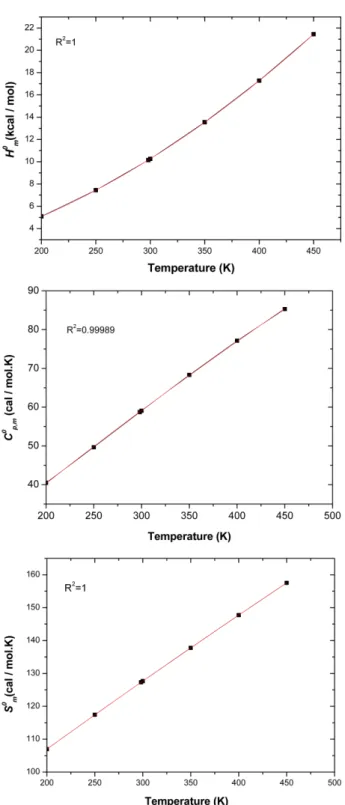
by reason of the intensities of the molecular vibration increase with increasing temperature. The correlations between the thermodynamic properties , entropy and enthalpy and temperatures T are described and shown in Fig. 4, according to the data in Table 8.
The correlation equations between these thermodynamic properties and temperature T are as follows:
= (R2=0.99989)
(5)
= (R2=1) (6)
= (R2=1) (7)
The values of , and can easily be obtained at any temperatures using these relationships and these results will be helpful for the further studies of the title compound.
CONCLUSION
Density functional calculations have been successfully performed for the title compound of N-(2,5-methylphe- nyl)salicylaldimine (I) and the calculated results show that B3LYP/6-31G(d) method can reproduce the title compound very well.
In conclusion, following results can be summarized: (i) The optimized parameters (bond lengths, bond angles, and dihedral angles) of the title compound (I) have been obtained by using the B3LYP/6-31G(d) method. The cal- culated geometric parameters are, in general, in good agreement with the X-ray structure. (ii) To investigate the tautomeric stability of (I), as seen from calculations, the total energy of the enol form is lower than the keto form, whereas chemical hardness of the enol form is greater than the keto one, which indicates that the enol form of (I) is more stable than its keto form in gas-phase. Also, the total molecular energies obtained by PCM method decrease with the increasing polarity of the solvent and the stability of the title compound increase in going from the gas-phase to the solution-phase. (iii) The MEP map shows that the negative potential sites are on electronegative atoms as well as positive potential sites are around the hydrogen atoms. These sites give intramolecular interactions. For the MEP surface in the studied molecule the weak nega- tive region associated with N1 atom and also the weak positive region by the nearby H1 atom are indicative of an intramolecular (O1–H1...N1) hydrogen bonding. (iv) The NBO analysis is more compatible with the crystal struc- ture of the title compound and it’s a very useful method for molecular modelling. In the compound (I), the NBO anal- ysis revealed that the N1(O1)→σ(O1–H1) interaction gives the strongest stabilization to the system by 43.90 kcal mol−1. Electron donating from N1 LP(1) to antibond- ing (O1–H1) is the most important interaction energy Cp m0, Sm0
Hm0
Cp m0, –0.40732+0.21384T 5T– 2×10⁻⁵ Sm0 63.70069 0.22261T 3T+ – 2×10⁻⁵ Hm0 0.19506 0.00623T 9T+ + 2×10⁻⁵
Cp m0, Sm0 Hm0
Figure 4. Correlation graphics of thermodynamic properties and temperatures of the title compound.
resulting stabilization of 43.90 kcal mol−1, and this inter- action implies the existence of intramolecular hydrogen bond, which was observed experimentally. (v) Computa- tional approach allows the determination of molecular non-linear optical (NLO) properties as an inexpensive way to design molecules by analyzing their potential before syn- thesis. In addition to the well known empirical rules to estimate qualitatively, the microscopic nonlinear response in organic molecules, especially ab initio B3LYP calcu- lations allow a more accurate prediction of the NLO activ- ity. Our computational results yield that βtot for the title compound (I) is greater than those of urea. It is also com- pared with the similar Schiff base compounds in litera- ture, the calculated values of βtot of (I). There is an inverse relationship between first hyperpolarizability and HOMO–
LUMO gap. (vi) The thermodynamic properties, , and and temperatures T were also obtained. The results show that the standard thermodynamic functions increase at any temperatures from 200 to 450 K, because the intensities of the molecular vibration increase with increasing temperature.
Our density functional calculations for the title com- pound of N-(2,5-methylphenyl)salicylaldimine (I) and the calculated results will be helpful for the design and syn- thesis of new materials.
Acknowledgments. I thank Dr. Hamit ALYAR (Çanklrl
Karatekin University, Faculty of Science, Department of Physics, Çanklrl-Turkey) for access to the Gaussian 03 program package. And the publication cost of this paper was supported by the Korean Chemical Society.
REFERENCES
1. Emregul, K. C.; Duzgun, E.; Atakol, O. Corros. Sci. 2006, 48, 3243.
2. Drozdzak, R.; Allaert, B.; Ledoux, N.; Dragutan, I.; Dra- gutan, V.; Verpoort, R. Coord. Chem. Rev. 2005, 249, 3055.
3. Yang, C. J.; Jenekhe, S. A. Macromolecules 1995, 28, 1180.
4. Destri, S.; Khotina, I. A.; Porzio, W. Macromolecules 1998, 3, 1079.
5. Zeyrek, C. T.; Elmali, A.; Elerman, Y. Z. Naturforsch. 2005, 60b, 520.
6. Larkin, D. R. J. Org. Chem. 1990, 55, 1563.
7. Vanco, J.; Svajlenova, O.; Racanska, E.; Muselik, J.; Valen- tova, J. J. Trace Elem. Med. Biol. 2004, 18, 155.
8. Taggi, A. E.; Hafez, A. M.; Wack, H.; Young, B.; Ferraris, D.; Lectka, T. J. Am. Chem. Soc. 2002, 124, 6626.
9. Ramnauth, R.; Al-Juaid, S.; Motevalli, M.; Parkin, B. C.;
Sullivan, A. C. Inorg. Chem. 2004, 43, 4072.
10. Hadjoudis, E.; Vitterakisp, M.; Mavridis, I. M. Tetrahe-
dron 1987, 43, 1345.
11. Xu, X. X.; You, X. Z.; Sun, Z. F.; Wang, X.; Liu, H. X.
Acta Crystallogr. 1994, C50, 1169.
12. Dürr, H. Angew. Chem. Int. Ed. Engl. 1989, 28, 413.
13. Dür, H.; Bouas-Laurent, H. Photochromism: Molecules and Systems; Elsevier: Amsterdam, 1990.
14. Schaumburg, K. et al. In Nanostructure Based on Molecular Materials; Göpel, W., Ziegler, C., Eds.;Willey-VCH: Wein- heim, German, 1992.
15. Özek, A.; Albayrak, Ç.; Odaba o lu, M.; Büyükgüngör, O. Acta Crystallogr. 2007, C63, 177.
16. Elmali, A.; Kabak, K.; Kavlakoglu, E.; Elerman, Y.; Durlu, T. N. J. Mol. Struct. 1999, 510, 207.
17. Ünver, H.; Kabak, M.; Zengin, M.; Durlu, T. N. J. Chem.
Crystallogr. 2001, 31, 203.
18. Ünver, H.; Karakas¸, A.; Elmali, A. J. Mol. Struct. 2004, 702, 49.
19. Karakas¸, A.; Elmali, A.; Ünver, H.; Svoboda, I. J. Mol.
Struct. 2004, 702,103.
20. Blanchard-Desce, M.; Runser, C.; Fort, A.; Barzoukas, M.;
Lehn, J. M.; Bloy, V.; Alain, V. Chem. Phys. 1995, 199, 253.
21. Karakas¸, A.; Elmali, A.; Ünver, H. J. Nonlinear Optic.
Phys. Mat. 2007, 16, 91.
22. Sebastian, S.; Sundaraganesan, N.; Karthikeiyan, B.; Srini- vasan,V. Spectrochim. Acta, Part A 2001, 78, 590.
23. Kavitha, E.; Sundaraganesan, N.; Sebastian, S.; Kurt, M.
Spectrochim. Acta, Part A 2010, 77, 612.
24. Sun, Y. X.; Hao, Q. L.; Yu, Z.X.; Wei, W. X.; Lu, L. D.;
Wang, X. Mol. Phys. 2009, 107, 223.
25. Seiji, I.; Hiroo, F.; Hidetoshi, K.; Makoto, I.; Nobuaki, K.
Bull. Chem. Soc. Jpn. 2003, 76(4), 733.
26. Elmali, A.; Elerman, Y.; Zeyrek, C. T. J. Mol. Struct. 1998, 443, 123.
27. Frisch, M. J.; et al. GAUSSIAN 03, revision E.01; Gaus- sian, Inc.: Wallingford, CT, 2004.
28. Dennington, R.; Keith, T.; Millam, J. GaussView, version 4.1.2; Semichem, Inc.: Shawnee Mission, KS, 2007.
29. Schlegel, H. B. J. Comput. Chem. 1982, 3, 214.
30. Peng, C.; Ayala, P. Y.; Schlegel, H. B.; Frisch, M. J. J.
Comput. Chem. 1996, 17, 49.
31. Parr, R. G.; Pearson, R. G. J. Am. Chem. Soc. 1983, 105, 7512.
32. Foresman, J. B.; Keith, T. A.; Wiberg, K. B.; Snoonian, J.; Frisch, M. J. J. Phys. Chem. 1996, 100, 6098.
33. Glendening, E. D.; Badenhoop, J. K.; Reed, A. E.; Car- penter, J. E.; Weinhold, F. NBO, version 3.1; Theoretical Chemistry Institute: University of Wisconsin, Madison, 1995.
34. Jian, F. F.; Zhao, P. S.; Bai, Z. S.; Zhang, L. Struct. Chem.
2005, 16, 635.
35. Özbek, N.; Kavak, G.; Özcan, Y.; de, S.; Karacan, N. J.
Mol. Struct. 2009, 919, 154.
36. Geerlings, P.; De Proft, F.; Langenaeker, W. Chem. Rev.
2003, 103, 1793.
37. Pearson, R. G. J. Chem. Ed. 1987, 64, 561.
38. Parr, R. G.; Chattaraj, P. K. J. Am. Chem. Soc. 1991, 113, Cp m0,
Sm0 Hm0
s¸ gˇ
I·
1854.
39. Koopmans, T. Physica 1933, 1, 104.
40. Politzer, P.; Concha, M. C.; Murray, J. S. Int. J. Quantum Chem. 2000, 80, 184.
41. Schwenke, D. W.; Truhlar, D. H. J. Chem. Phys. 1985, 82, 2418.
42. Andraud, C.; Brotin, T.; Garcia, C.; Pelle, F.; Goldner, P.;
Bigot, B.; Collet, A. J. Am. Chem. Soc. 1994, 116, 2094.
43. Thanthiriwatte, K. S.; Nalin de Silva, K. M. J. Mol. Struct.
(Theochem) 2002, 617, 169.
44. Tanak, H. J. Mol. Struct. (Theochem) 2010, 950, 5.
45. Sun, Y. X.; Hao, Q. L.; Wei, W. X.; Yu, Z. X.; Lu, L. D.;
Wang, X.; Wang, Y. S. J. Mol. Struct. 2009, 929, 10.
46. Yavuz, M.; Tanak, H. J. Mol. Struct. (Theochem) 2010, 961, 9.
47. Ruiz Delgado, M. C.; Hernandez, V.; Casado, J.; Lopez Navarre, J. T.; Raimundo, J. M.; Blanchard, P.; Roncali, J. J. Mol. Struct. (Theochem) 2004, 709, 187.
48. Abraham, J. P.; Sajan, D.; Shettigar, V.; Dharmaprakash, S. M.; Nemec, I.; Hubert Joe, I.; Jayakumar, V. S. J. Mol.
Struct. 2009, 917, 27.