RESEARCH ARTICLE
Received: September 27, 2019, Revised: October 14, 2019, Accepted: October 22, 2019 eISSN 2233-7679
†Correspondence to: Chang-Suk Kim, https://orcid.org/0000-0001-6991-5338
Department of Dental Hygiene, Ulsan College, 101 Bongsu-ro, Dong-gu, Ulsan 44022, Korea Tel: +82-52-230-0793, Fax: +82-52-230-0790, E-mail: [email protected]
Copyright © The Korean Society of Dental Hygiene Science.
Effect of Allergic Rhinitis and Asthma on Oral Health
Chang-Suk Kim
1,†and Kyeong-Soo Lee
21
Department of Dental Hygiene, Ulsan College, Ulsan 44022,
2
Department of Preventive Medicine and Public Health, Yeungnam University, Daegu 42415, Korea
Background: This study aimed to investigate allergic rhinitis and the relationship between allergic diseases, such as asthma and
allergic rhinitis, and dental caries and periodontal disease using the raw data from third year of the 6th Korean National Health and Nutrition Examination Survey.
Methods: A total of 3,729 subjects aged over 30 years who underwent examination for allergic diseases and an oral health checkup
were selected. The data were analyzed using SPSS IBM SPSS ver. 25.0 (IBM Corp., USA). Composite sample cross correlation and composite sample logistic regression analyses were performed using the composite sample general linear model.
Results:
On examining the socioeconomic characteristics of the subjects suffering from allergic disease and the relationship between allergic disease and oral health, allergic rhinitis was more frequently found in younger subjects with a higher level of education. Periodontal disease and dental caries were more frequent among female, older age groups, lower income earners, and subjects with a lower level of education (p<0.05). On examining the relationship between the oral health characteristics of the subject and allergic diseases and oral health, allergic rhinitis was more common in subjects with a good oral health status perception than those who answered “bad” to the oral health status question. The community periodontal index of treatment needs (CPITN) score was higher in subjects who answered “poor” to the oral health status question, lower frequency of brushing, and higher in subjects using secondary oral hygiene products; the decayed, missing and filled teeth (DMFT) index was higher in subjects with a perception of poor oral health status (p<0.05). The DMFT index was high in the asthma group, and the CPITN score was high in the group who answered “no” to allergic rhinitis.
Conclusion: There is a relationship between asthma and allergic rhinitis and the DFMT index and CPITN score. Corresponding oral
programs for allergic patients need to be developed.
Key Words: Allergic rhinitis, Asthma, Oral health, Oral hygiene
Introduction
Allergic rhinitis and asthma are typical allergic diseases
1), and their prevalence is increasing every year worldwide
2). According to the International Study of Asthma and Allergy in Childhood, the prevalence of the diagnosis of allergic rhinitis has increased to 20.4% in 2000, 28.5% in 2006, and 29.9% in 2010
3). Allergic rhinitis is associated with bronchial asthma, which is a lower airway inflammatory disease, and develops with a time lag or at the same time
4). 70∼90% of asthma patients have allergic rhinitis, 20∼50% of allergic rhinitis patients have
asthma
5). Allergic diseases are not only caused by genetic factors, but also environmental factors such as change of diet, change in lifestyle and living environment, and increase in air pollution.
Previous studies have shown that beta-2 agonists
(2-agonists), which are used as therapeutic agents in
asthmatic patients, affect salivary glands and decrease the
salivary secretion and change the salivary components to
increase dental caries activity
6). It induces oral dryness,
which causes malocclusion, and results in an oral
environment that is susceptible to various oral diseases
7).
In patients with allergic rhinitis, the typical symptom of
nasal obstruction increases the total airway resistance and induces oral respiration
8), causing oral dryness. These two diseases have commonalities in causing oral and respiratory dryness and have been linked to oral health disorders. In studies using allergic rhinitis as a dependent variable
3,8,9)there are no studies on the relevance of oral health.
This study aimed to classify allergic rhinitis, which is the most prevalent among the allergic diseases, and asthma, which is a comorbid disease, as allergic diseases, and to confirm the relationship between periodontal disease and dental caries.
Materials and Methods
1. Study population
This study used raw data from the third year (2015) of the 6th Korean National Health and Nutrition Examination Survey (KNHANES) as research data, and the analysis data were provided after deliberation according to the procedure of using raw data. The subjects were 5,189 adults aged 30 years or older out of the 7,390 who answered a health questionnaire and underwent oral examination. Among these, 3,729 people who did not have any missing values to be included in the analysis were selected as the final study subjects. The health questionnaire of the KNHANES was conducted by the interview method, and the oral examination was conducted by a dentist, based on the World Health Organization criteria.
2. Research method
The socioeconomic characteristics of the subjects composed of six items including sex, age, income, educational level, and diagnosis of asthma or allergic rhinitis. The items related to health behavior consisted of smoking, drinking, aerobic exercises, and walking practice.
The items related to oral health behavior included lower frequency of brushing, use of auxiliary oral hygiene products, and decayed, missing and filled teeth (DMFT) and community periodontal index of treatment needs (CPITN) indices for oral health. The group with CPITN score of “0” was defined as not having (“No”) periodontal disease, and the group with scores “1∼3” as having
periodontal disease (“Yes”).
3. Analysis method
The sample design of the KNHANES was extracted using a two-stage stratified cluster sampling design, and a composite sample planning file was generated to estimate the mean and ratio. The composite sample cross correlation and composite sample logistic regression analyses were performed using the composite sample general linear model. Data analysis was performed using IBM SPSS ver.
25.0 (IBM Corp., Armonk, NY, USA).
Results
1. Relationship between socioeconomic characteristics of all subjects, allergic diseases, and oral health
As a result of examining the socioeconomic character- istics of the subjects and the relationship between allergic disease and oral health, asthma was found to be more frequent in female, older subjects, and those with a lower level of education; allergic rhinitis was more frequent in younger subjects, those with above middle class income, and higher level of education. In the CPITN group, periodontal disease was more frequent in males, older subjects, and those with lower income and lower level of education, while in the DMFT group, dental caries was more frequent in women, older subjects, and those with lower income level and lower level of education (Table 1).
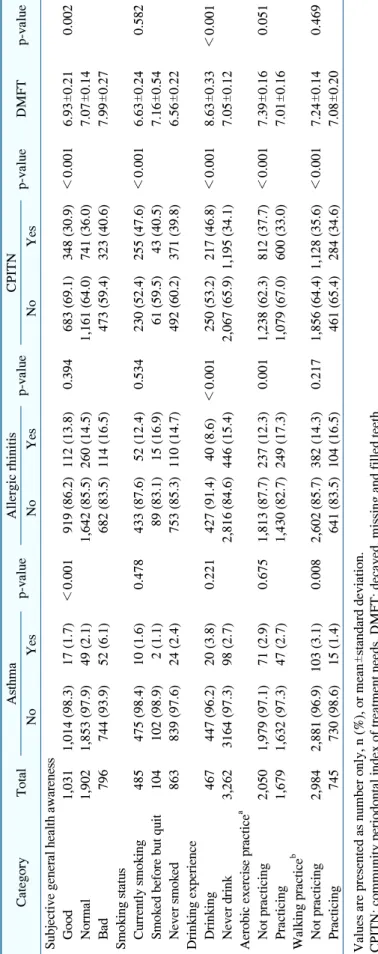
2. Relevance of allergic disease and oral health according to the health behavior of the subject
As a result of examining the relationship between the
health behavior of the subjects and allergic diseases and
oral health, asthma was found more commonly in the in
the walking practice group, the group that “does not-
practice” group, and allergic rhinitis was more common in
the “non-alcoholic” group and in the groups that practiced
aerobic exercise. The CPITN score was high in the group
that subjectively answered “bad” to subjective general
health awareness and in the group that currently smoked,
drink, and did not practicing exercise, aerobics, nor
Table 1. Relationship between Socioeconomic Characteristics of All Subjects and Allergic Diseases and Oral Health
Category Total As th ma p- val ue A lle rg ic rhinitis p- valu e CPITN p- val ue DM F T p- val ue No Yes No Yes No Ye s Se x M ale 1, 57 4 (4 8. 4) 1, 53 6 (9 7. 9) 38 ( 2. 1) 0. 02 8 1, 39 4 (8 6. 7) 18 0 (1 3. 3) 0. 056 86 2 (5 9. 3) 71 2 (4 0. 7) < 0.00 1 6.4 5± 0.17 < 0.00 1 Fe m ale 2, 15 5 (5 1. 6) 2, 07 5 (9 6. 5) 80 ( 3. 5) 1, 84 9 (8 3. 9) 30 6 (1 6. 1) 1, 45 5 (6 9. 6) 70 0 (3 0. 4) 7. 90 ± 0.14 T ot al 3,7 29 (100 .0 ) 3, 61 1 (9 7. 2) 118 ( 2. 8) 3, 243 (85. 3) 486 (14. 7) 2, 31 7 (6 2. 1) 1, 41 2 (3 7. 9) Age 3 0 ∼ 39 604 (23. 3) 58 6 (9 7. 2) 18 ( 2. 8) 0. 01 1 475 (77. 0) 129 (23. 0) < 0. 001 50 6 (8 3. 9) 98 (1 6. 1) < 0.00 1 6.8 8± 0.19 < 0.00 1 4 0 ∼ 49 785 (26. 2) 77 1 (9 8. 2) 14 ( 1. 8) 646 (82. 7) 139 (17. 3) 55 8 (6 9. 7) 22 7 ( 30 .3 ) 6.0 7± 0.18 5 0 ∼ 59 918 (25. 0) 89 8 (9 7. 6) 20 ( 2. 4) 816 (88. 9) 102 (11. 1) 50 0 (5 4. 0) 41 8 ( 46 .0 ) 6.7 4± 0.20 6 0 ∼ 69 808 (14. 8) 78 1 (9 6. 9) 27 ( 3. 1) 738 (91. 0) 70 (9. 0) 42 6 (5 2. 1) 38 2 (47 .9 ) 8.0 5± 0.28 7 0 ≤ 614 (10. 8) 57 5 (9 4. 3) 39 ( 5. 7) 568 (93. 2) 46 (6. 8) 32 7 (5 2. 2) 28 7 (4 7. 8) 10. 58 ± 0. 37 H ouseho ld inc om e Lo w 70 2 (1 5. 3) 66 8 (9 6. 2) 34 ( 3. 8) 0. 39 9 63 6 (9 0. 9) 66 ( 9.1 ) 0.0 04 350 ( 48 .3 ) 352 ( 51 .7 ) < 0.00 1 8.8 9± 0.36 < 0.00 1 Lo w er than m iddle 91 6 (2 3. 0) 89 2 (9 7. 8) 24 ( 2. 2) 81 1 (8 6. 3) 10 5 (13. 7) 52 4 (5 9. 7) 39 2 (4 0. 3) 7. 01 ± 0.22 A bove m iddle 1, 00 4 (2 9. 5) 97 4 (9 7. 0) 30 ( 3. 0) 84 9 (8 2. 0) 15 5 (1 8. 0) 66 6 (6 8. 6) 33 8 (3 1. 4) 6. 88 ± 0.19 H ig h 1, 10 7 (3 2. 2) 1, 07 7 (9 7. 4) 30 ( 2. 6) 94 7 (8 5. 0) 16 0 (1 5. 0) 77 7 (7 2. 2) 33 0 (2 7. 8) 6. 85 ± 0.16 Ed uca tiona l leve l Fin is hed elem en tary scho ol 90 6 (1 8. 2) 85 5 (9 5. 3) 51 ( 4. 7) 0. 02 5 833 (92. 0) 73 (8. 0) < 0. 001 47 7 (5 2. 6) 42 9 (4 7. 4) < 0.00 1 9.0 5± 0.32 < 0.00 1 Fin is hed m id dle sch ool 46 4 (1 0. 4) 45 4 (9 6. 8) 10 ( 3. 2) 41 6 (8 9. 2) 48 (10. 8) 23 8 (5 0. 6) 22 6 (4 9. 4) 7. 13 ± 0.27 Fin is he d h igh sch ool 1, 13 7 (3 2. 5) 1, 10 6 (9 7. 5) 31 ( 2. 5) 1, 00 0 (8 6. 3) 137 (13. 7) 70 1 (6 2. 8) 43 6 (3 7. 2) 6. 76 ± 0.18 Fin is hed u nive rsity 1, 22 2 (3 9. 0) 1, 19 6 (9 8. 0) 26 ( 2. 0) 99 4 (8 0. 2) 228 (19. 8) 90 1 (7 5. 5) 32 1 (2 4. 5) 6. 74 ± 0.16 Valu es ar e p resen ted as n (%) o r mean ± stand ard de viatio n. CPITN : com m unity p eriodo ntal in dex of tre atm en t nee ds, D MFT: d eca yed , m is sing and fille d tee th.
Table 2. Relevance of Allergy Disease and Oral Health according to Health Behavior of Subjects
Cate gor y Total As th ma p- valu e A lle rg ic rhinitis p- val ue CP IT N p- val ue DMF T p- va lue No Yes No Ye s No Ye s Subj ective general heal th awarenes s G oo d 1,0 31 1,0 14 ( 98 .3) 17 ( 1.7 ) < 0.0 01 919 ( 86 .2) 112 ( 13 .8) 0.39 4 68 3 (69.1) 348 (30 .9 ) < 0.0 01 6.93 ± 0.2 1 0. 002 N or m al 1,9 02 1,8 53 ( 97 .9) 49 ( 2.1 ) 1,64 2 (85 .5) 260 ( 14 .5) 1,16 1 (64.0) 741 (36 .0 ) 7.07 ± 0.1 4 B ad 796 744 ( 93 .9) 52 ( 6.1 ) 682 ( 83 .5) 114 ( 16 .5) 47 3 (59.4) 323 (4 0. 6) 7. 99 ± 0.2 7 Sm oking st atus C ur re nt ly s m ok in g 48 5 475 ( 98 .4) 10 ( 1.6 ) 0.4 78 433 ( 87 .6) 52 ( 12 .4) 0.53 4 23 0 (52.4) 255 (47 .6 ) < 0.0 01 6.63 ± 0.2 4 0. 582 S m ok ed b ef or e bu t qu it 104 102 ( 98 .9) 2 ( 1.1 ) 89 ( 83 .1) 15 ( 16 .9) 61 (59.5) 43 (40 .5 ) 7.16 ± 0.5 4 N ev er sm ok ed 863 839 ( 97 .6) 24 ( 2.4 ) 753 ( 85 .3) 110 ( 14 .7) 49 2 (60 .2) 371 (39 .8 ) 6.56 ± 0.2 2 Dr inking experience D ri nk in g 46 7 447 ( 96 .2) 20 ( 3.8 ) 0.2 21 427 ( 91 .4) 40 ( 8.6 ) < 0.00 1 25 0 (53.2) 217 (46 .8 ) < 0.0 01 8.63 ± 0.3 3 < 0. 001 N ev er dri nk 3,2 62 31 64 ( 97 .3) 98 ( 2.7 ) 2,81 6 (84 .6) 446 ( 15 .4) 2,0 67 (65.9) 1, 195 (34 .1 ) 7.05 ± 0.1 2 A erobi c exercis e practice
aN ot p ract ic in g 2,0 50 1,9 79 ( 97 .1) 71 ( 2.9 ) 0.6 75 1,81 3 (87 .7) 237 (12 .3) 0.00 1 1,23 8 (62.3) 812 (37 .7 ) < 0.0 01 7.39 ± 0.1 6 0. 051 P ract ic in g 1,6 79 1,6 32 ( 97 .3) 47 ( 2.7 ) 1,43 0 (82 .7) 249 ( 17 .3) 1,0 79 (67.0) 600 (33 .0 ) 7.01 ± 0.1 6 Walki ng practice
bN ot p ract ic in g 2,9 84 2,8 81 ( 96 .9) 103 ( 3.1 ) 0.0 08 2,60 2 (8 5. 7) 38 2 ( 14 .3) 0.21 7 1,85 6 (64.4) 1, 128 (35 .6 ) < 0.0 01 7.24 ± 0.1 4 0. 469 P ract ic in g 745 730 ( 98 .6) 15 ( 1.4 ) 641 ( 83 .5) 104 ( 16 .5) 46 1 (65.4 ) 284 (34 .6 ) 7.08 ± 0.2 0 Valu es ar e p resen ted as n umb er o nly , n (%), o r mean ± stand ard de viatio n. CPITN : com m unity p eriodo ntal in dex of tre atm en t nee ds, D MFT: d eca yed , m is sing and fille d tee th.
aN um ber o f peo ple w ho tak e 2 hour s 30 m in utes or m or e of m id -le ve l p hy si ca l a ct iv it y o n w ee kd ay s o r 1 h ou r 1 5 m in ut es o r m or e o f hig h-inten sity phy sic al ac tivity (2 m in utes of m iddle inten sity equ als to 1 m in utes of hig h inte nsity).
bN um ber of pe ople w ho w alk m or e th an 1 0 m inu tes at on ce, m or e th an 30 mi nu te s a day fo r mo re than 5 da ys a w eek.
Table 3. Relationship between Oral Health Characteristics and Allergy Diseases and Oral Health of Subjects
Cate gor y Total As th ma p- va lue A llergic rh initis p- va lue CP IT N p- va lue DM F T p- va lue No Yes No Ye s No Yes Or al h eal th s ta tu s awar en es s G ood 54 0 532 (98 .4) 8 (1.6 ) 0.2 90 479 (88 .7) 61 (1 1.3) 0.00 8 381 (7 3.9) 159 ( 26 .1) < 0.0 01 5.48 ± 0.29 < 0. 001 N orm al 1,4 49 1,4 03 (97 .2) 46 (2.8 ) 1,2 27 (83 .0) 222 (1 7.0) 1,000 ( 72 .8) 449 ( 27 .2) 6. 69 ± 0.15 Bad 1,7 40 1,6 76 (96 .8) 64 (3.2 ) 1,5 37 (86 .2) 203 (1 3.8) 936 (5 4.7) 804 ( 45 .3) 8. 19 ± 0.19 Nu mb er o f br us hi ng Less th an 1 tim e 358 344 (97 .1) 14 (2.9 ) 0.5 42 323 (88 .5) 35 (1 1.5 ) 0.31 4 181 (5 3.4) 177 ( 46 .6) < 0.0 01 7.65 ± 0.43 0. 089 Less th an tw ic e 1,4 52 1,4 04 (96 .8) 48 (3.2 ) 1,2 77 (85 .8) 175 (1 4. 2) 864 (6 1.8) 588 ( 38 .2) 7. 41 ± 0.18 Mo re than 3 tim es 1,9 19 1,8 63 (97 .5) 56 (2.5 ) 1,6 43 (84 .4) 276 (1 5.6) 1, 272 (6 8.4) 647 ( 31 .6) 6. 99 ± 0.14 U se of extr a o ra l hyg iene pr odu cts Y es 1,7 38 1,6 76 (96 .9) 62 (3.1 ) 0.3 44 1,5 83 (88 .9) 155 (1 1.1) < 0.00 1 958 (5 7.9) 780 ( 42 .1) < 0.0 01 7.09 ± 0.18 0. 277 N o 1,9 91 1,9 35 (97 .5) 56 (2.5 ) 1,6 60 (82 .4) 331 (1 7.6) 1,359 (6 9.9 ) 632 ( 30 .1) 7. 30 ± 0.14 U nm et m edica l tre atm en t s ta tus Y es 1,1 76 1,1 30 (96 .4) 46 (3.6 ) 0.0 69 1,0 28 (85 .7) 148 (1 4.3) 0.65 4 693 (6 1.7) 483 ( 38 .3) 0.0 37 7.61 ± 0.19 0. 003 N o 2,5 52 2,4 80 (97 .6) 72 (2.4 ) 2,2 14 (85 .1) 338 (1 4.9) 1,624 (6 6.0 ) 928 ( 34 .0) 7. 02 ± 0.14 1 ye ar oral exam ina tion status Y es 2,4 90 2,4 12 (97 .2) 78 (2.8 ) 0.8 31 2,2 00 (86 .3) 290 (1 3.7) 0.05 0 1, 508 (6 3.3) 982 ( 36 .7) 0.0 55 7.14 ± 0.14 0. 320 N o 1,2 39 1,1 99 (97 .3) 40 (2.7 ) 1,0 43 (83 .3) 196 (1 6.7) 809 (6 7.1) 430 ( 32 .9) 7. 33 ± 0.17 Valu es ar e p resen ted as n umb er o nly , n (%), o r mean ± stand ard de viatio n. CPITN : com m unity p eriodo ntal in dex of tre atm en t nee ds, D MFT: d eca yed , m is sing and fille d tee th.
Table 4. Relevance of Oral Health to Allergic Disease
Category Total CPITN
p-value DMFT p-value
No Yes
Asthma
No 3,611 2,242 (64.6) 1,369 (35.4) 0.842 7.18±0.12 0.028
Yes 118 75 (65.7) 43 (34.3) 8.23±0.60
Allergic rhinitis
No 3,243 1,967 (63.1) 1,276 (36.9) <0.001 7.26±0.13 0.138
Yes 486 350 (73.5) 136 (26.5) 6.88±0.26
Values are presented as number only, n (%), or mean±standard deviation.
CPITN: community periodontal index of treatment needs, DMFT: decayed, missing and filled teeth.
walking. The DMFT index was significantly higher in the group who answered “bad” to subjective general health awareness, and in the group with the habit of alcohol consumption (Table 2).
3. Relationship between oral health characteristics and allergic diseases and oral health of subjects
As a result of examining the relationship between the oral health characteristics of the subjects and allergic diseases and oral health, allergic rhinitis was more common in the subjects who answered “bad” to subjective oral health status perception, and in many of the respondents who used oral hygiene products and did not receive a yearly oral examination. The CPITN score was higher in subjects who answered “poor” to subjective oral health status perception, lower frequency of brushing, higher in subjects using secondary oral hygiene products, and the DMFT index was higher in those who considered their oral health status to be poor (Table 3).
4. Relevance of oral health in allergic disease Asthma is associated with the DMFT index (p<0.05).
That is, asthma patients had a high DMFT of 8.23.
Allergic rhinitis and CPITN scores were significantly related (p<0.001). That is, 26.5% of the patients with allergic rhinitis presented with periodontal disease, and 36.9% of the patients who answered “no” to allergic rhinitis presented with periodontal disease (Table 4).
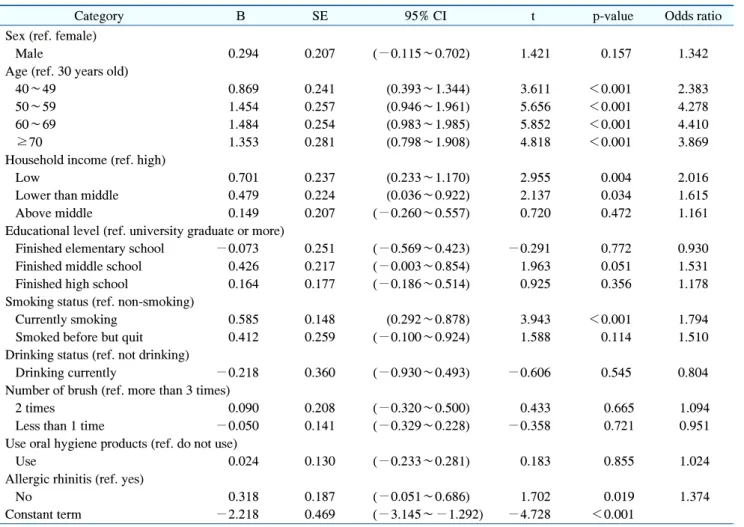
5. Logistic regression analysis of factors affecting periodontal disease
In order to analyze the factors affecting periodontal disease, composite sample logistic regression analysis was performed with statistically significant items as independent variables and periodontal disease as the dependent variable. As a result, it was found that the variables affecting periodontal disease were related to the groups that were older in age, lower in income level, with current smoking habits, and with allergic rhinitis (Table 5).
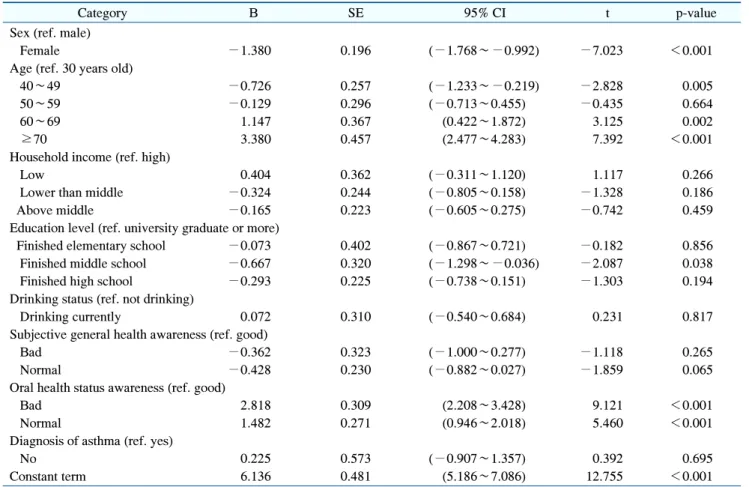
6. General linear regression analysis of factors affecting dental caries
In order to analyze the factors affecting asthma, composite sample general linear regression analysis was performed with statistically significant items as independent variables and asthma as the dependent variable. As a result, it was found that the variables affecting asthma were related to the group that was higher in age and the group that subjectively opined that their oral health is bad (Table 6).
Discussion
The purpose of this study was to evaluate the relation- ship between allergic rhinitis and asthma, and periodontal disease and dental caries using the 2015 KNHANES.
Results of the study showed that allergic rhinitis and
asthma were more prevalent in female, and allergic rhinitis
was more prevalent in the younger subjects, while asthma
in the older subjects. The results were in line with the
research reported by Chala et al.
10). On the contrary, Song
and Cho
11)found a higher number of male in a study on
Table 5. Logistic Regression Analysis of Factors Affecting Periodontal Disease
Category B SE 95% CI t p-value Odds ratio
Sex (ref. female)
Male 0.294 0.207 (−0.115∼0.702) 1.421 0.157 1.342
Age (ref. 30 years old)
40∼49 0.869 0.241 (0.393∼1.344) 3.611 <0.001 2.383
50∼59 1.454 0.257 (0.946∼1.961) 5.656 <0.001 4.278
60∼69 1.484 0.254 (0.983∼1.985) 5.852 <0.001 4.410
≥70 1.353 0.281 (0.798∼1.908) 4.818 <0.001 3.869
Household income (ref. high)
Low 0.701 0.237 (0.233∼1.170) 2.955 0.004 2.016
Lower than middle 0.479 0.224 (0.036∼0.922) 2.137 0.034 1.615
Above middle 0.149 0.207 (−0.260∼0.557) 0.720 0.472 1.161
Educational level (ref. university graduate or more)
Finished elementary school −0.073 0.251 (−0.569∼0.423) −0.291 0.772 0.930
Finished middle school 0.426 0.217 (−0.003∼0.854) 1.963 0.051 1.531
Finished high school 0.164 0.177 (−0.186∼0.514) 0.925 0.356 1.178
Smoking status (ref. non-smoking)
Currently smoking 0.585 0.148 (0.292∼0.878) 3.943 <0.001 1.794
Smoked before but quit 0.412 0.259 (−0.100∼0.924) 1.588 0.114 1.510
Drinking status (ref. not drinking)
Drinking currently −0.218 0.360 (−0.930∼0.493) −0.606 0.545 0.804
Number of brush (ref. more than 3 times)
2 times 0.090 0.208 (−0.320∼0.500) 0.433 0.665 1.094
Less than 1 time −0.050 0.141 (−0.329∼0.228) −0.358 0.721 0.951
Use oral hygiene products (ref. do not use)
Use 0.024 0.130 (−0.233∼0.281) 0.183 0.855 1.024
Allergic rhinitis (ref. yes)
No 0.318 0.187 (−0.051∼0.686) 1.702 0.019 1.374
Constant term −2.218 0.469 (−3.145∼−1.292) −4.728 <0.001
SE: standard error, CI: confidence inteval.
domestic elderly asthma patients. In a cohort study including elderly asthma patients. Suggested that about 90% of the patients developed the disease beyond the age of 40 years, and about 50% of the patients developed it beyond the age of 60 years. Hence, pediatric asthma symptoms were different from those of the older subjects.
Greiner et al.
12)suggested that allergic rhinitis is a common disease affecting all age groups, which can be a source of many complications that could affect their quality of life. The prevalence of allergic rhinitis was higher with higher income and education levels, and that of asthma was higher with a lower level of education.
Although allergic diseases are highly related to demographic sociological factors, most domestic studies related to allergic rhinitis are aimed at children. Existing studies on asthma also do not include overall age and demographic
factors. The increasing prevalence of asthma in Korea, the aging population, lifestyle changes, and the worsening of air pollution will increase the number of patients with allergic diseases. The CPITN scored and DMFT index were noted to be higher with age and lower household income and education level, which is consistent with the results of a study by Shin et al.
13). As age increases, the prevalence of alveolar bone increases with an increase in plaque or calculus, which in turn increases the prevalence of periodontal disease and poor oral environment due to the lack of nutritional intake and systemic diseases. As a result of the lack of preventive consciousness for oral disease and the burden of treatment costs, the treatment time is thought to be missed, but further research is needed to provide more clarity of evidence.
As for health behavior, the prevalence of asthma was
Table 6. General Linear Regression Analysis of Factors Affecting Dental Caries