공정개발을 위한 다중규모 모사 Multiscale simulation
for process development [General introduction]
Major: Interdisciplinary program of the integrated biotechnology
Graduate school of bio- & information technology Youngil Lim (N110), Lab. FACS
Youngil Lim (N110), Lab. FACS phone: +82 31 670 5207 (direct) phone: +82 31 670 5207 (direct)
Fax: +82 31 670 5445, mobile phone: +82 10 7665 5207 Fax: +82 31 670 5445, mobile phone: +82 10 7665 5207 Email:
Email: [email protected][email protected], homepage:, homepage: http://facs.maru.nethttp://facs.maru.net
Some key words
- Multi-scale ?
- Multi-phase ?
- Multi-component ?
- Multi-physics ?
- Multi-scale simulation for process development?
Some examples
- Micro- and macro-transport in porous media of adsorption column
- CFD, PBE, and CKM in fluidized-bed for solar-grade poly-silicon production
- Cells, proteins, peptides, amino acid, molecules, atoms and electrons
- Multiscale modeling in product engineering
Preface 1
In recent years we have seen an explosive growth of activities in multiscale modeling and computation, with applications in many areas including material science, fluid mechanics, chemistry, and biology. Relevant examples of practical interest include: structural analysis of materials, flow through porous media, turbulent transport in high Reynolds number flows, large-scale molecular dynamic simulations, ab-initio physics and chemistry, and a multitude of others.
Though multiple scale models are not new, the topic has recently taken on a new sense of urgency. A number of hybrid approaches are now created in which ideas coming from distinct disciplines or modeling approaches are unified to produce new and computationally efficient techniques.
M. O. Steinhauser, Computational multiscale modeling of fluids and solids, Springer, 2008.
Preface 2
Traditional approaches to modeling focus on one scale. If our interest is the macroscale behavior of a system in an engineering application, we model the effect of the smaller scales by some constitutive relations. If our interest is in the detailed microscopic mechanism of a process. We assume that there is nothing ineresting happening at the larger scales. For example, that the process is homogeneous at larger scales.
Take the example of solids. Engineers have long been interested in the macroscale behavior of solids.
They use continuum models and represent atomistic effects by constitutive relations. Solids state physicists, however, are more interested in the behavior of solids at the atomic or electronic level, often working under the assumption that the relevant processes are homogenous at the macroscopic scale. As a result, engineers are able to design structures and bridges without acquiring much understanding about the origins of the cohesion between the atoms in the material.
Solid state physicists can provide such an understanding at a fundamental level. But they are often quite helpless when faced with a real engineering problem.
E. Weinan, Principles of multiscale modeling, Cambridge Univ. Press, 2011.
Multiscale Modeling and its Application to Catalyst Design and Portable Power Generation, Prof. Dion G. Vlachos
(University of Delaware, [email protected], www.che.udel.edu/vlachos)
Multiscale simulation is emerging as a new scientific field in chemical, materials, and biological sciences. The idea of multiscale modeling is straightforward: one computes information at a smaller (finer) scale and passes it to a model at a larger (coarser) scale by leaving out degrees of freedom as one moves from finer to coarser scales.
The obvious goal of multiscale modeling is to predict macroscopic behavior of an engineering process from first principles (bottom-up approach). However, the emerging fields of nanotechnology and biotechnology impose new challenges and opportunities (top-down approach). For example, the miniaturization of microchemical systems for portable and distributed power generation imposes new challenges and opportunities than the conventional scaling up chemical engineers have worked on.
Course # Course name Time Room #
Multiscale simulation for process development Thu. 9-12 시 N116
Overview
Multiscale simulation is emerging as a new scientific field in chemical, materials, and biological sciences. The idea of multiscale modeling is straightforward: one computes information at a smaller (finer) scale and passes it to a model at a larger (coarser) scale by leaving out degrees of freedom as one moves from finer to coarser scales.
In recent years we have seen an explosive growth of activities in multiscale modeling and computation, with applications in many areas including material science, fluid mechanics, chemistry, and biology.
Relevant examples of practical interest include: structural analysis of materials, flow through porous media, turbulent transport in high Reynolds number flows, large-scale molecular dynamic simulations, ab-initio physics and chemistry, and a multitude of others.
In this lecture, we learn a multiscale simulation (MSS) approach which includes MLS (molecular-level simulation), mFLS (micro-fluid-level simulation) as well as FLS (fluid-level simulation), describing how to obtain model parameters and design factors required for process development from FLS, mFLS, and MLS. Specifically, the MSS approach is applied to process modeling and development, especially, adsorption process and fluidized-bed process.
Method Lecture(O), Seminar (O), Computational practice (O), Factory tour (-), Beam projector(O) Evaluation Attendance: 8%, homework: 22%, Mid-exam: 30%, Final-exam: 40%, Presentation: 0%
Textbook
- Principles of multiscale modeling, E. Weinan, Cambridge Univ. Press, 2011.
- Computational multiscale modeling of fluids and solids, M. O. Steinhauser , Springer, 2008.
Outline
Objectives of this lecture
We learn a multiscale simulation (MSS) approach which includes MLS (molecular-level simulation), mFLS (micro-fluid-level simulation) as well as FLS (fluid-level simulation), describing how to obtain model parameters and design factors required for process development from FLS, mFLS, and MLS.
Specifically, the MSS approach is applied to process modeling and development of adsorption and fluidized-bed.
Lecture contents
A MSS approach is applied for process modeling and development to adsorption and fluidized-bed processes. MSS for process development is classified into MLS, mFLS, FLS, and PLS and connectivity between them is identified.
-PLS (Process-level simulation)
For adsorption process, adsorption isotherms are obtained from MLS, and it will be found whether axial dispersion coefficient and mass transfer coefficient can be predicted from mFLS. CFD (computational fluid dynamics) in FLS is performed to understand flow dynamics inside adsorption columns and to identify optimal design parameters for process.
For fluidized-bed processes such as BFB (bubbling fluidized-bed) and DFB (dual fluidized bed), process modeling and CFD simulation are carried out and it will be investigated how to get their model parameters from MLS and mFLS.
-FLS (Fluid-level simulation)
CFD simulation is performed for adsorption and fluidized-bed processes to identify optimal design factors and operating conditions. Connectivity of FLS to PLS, MLS, and mFLS is studied.
-mFLS (Micro-fluid-level simulation)
Using LBM (lattice-Boltzmann method) for fluid dynamics in micro-pore networks, we will examine the effects of pore mouth, and predict effective diffusivity and effective mass transfer rate of an absorbate.
-MLS (Molecular-level simulation)
Adsorption isotherms on zeolite or an adsorbent is predicted at a high pressure and temperature, combining GCMC (grand canonical Monte Carlo) often used for molecular simulation of adsorption
Week Contents Remarks
1 Introduction (Multiscale simulation for process development) Two text books.
2 Example 1: Multiscale modeling in fluidized-bed for solar-grade poly-silicon
production Balaji et al. (Powder Technol., 2010)
3 Example 2: Micro- and Macro- transport in porous media of adsorption column
(Lattice-Boltzmann approach) Verma et al., (Chem. Eng. Sci., 2007)
4 Example 3: Multiscale simulation in product engineering Jaworski and Zakrzewska (Comput. Chem. Eng., 2011) 5 Ch1. Introduction
(Computational multiscale modeling of fluids and solids) Steinhauser (2008) 6 Ch2. Multiscale computational material science
(Computational multiscale modeling of fluids and solids) Steinhauser (2008) 7 Ch7. Computational methods on mesoscopic/macroscopic scale
(Computational multiscale modeling of fluids and solids) Steinhauser (2008) 8 Mid-term exam.
9 Ch1. Introduction (Principles of multiscale modeling) Weinane (2011) 10 Ch2. Analytical methods (Principles of multiscale modeling) Weinane (2011) 11 Ch4. The hierarchy of physical models 1 (Principles of multiscale modeling) Weinane (2011) 12 Ch4. The hierarchy of physical models 2 (Principles of multiscale modeling) Weinane (2011) 13 LBM (lattice-Boltzmann method) for mFLS
14 Overview of MLS, mFLS, FLS and PLS 15 Final exam.
Weekly Lecture Plan
Fluid dynamics in pores
Baralla et al (2001), A computer-aided model to simulate membrane fouling processes, Sep. & Pur. Tech., 22-23, 489-498.
25 Å,
~10
-9m
300 m,
~10
-4m
Unit cell Macro-pore Resin particle Column
100 1000 1000
1000 Å,
~10
-7m
10 cm,
~0.1 m
Multiscale simulation in adsorption process
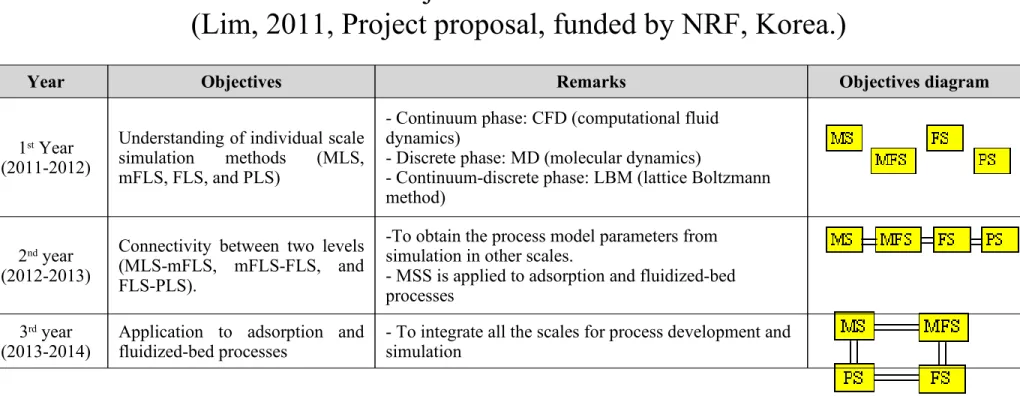
Table 1.2. Annual research objectives
(Lim, 2011, Project proposal, funded by NRF, Korea.)
Year Objectives Remarks Objectives diagram
1st Year (2011-2012)
Understanding of individual scale simulation methods (MLS, mFLS, FLS, and PLS)
- Continuum phase: CFD (computational fluid dynamics)
- Discrete phase: MD (molecular dynamics)
- Continuum-discrete phase: LBM (lattice Boltzmann method)
2nd year (2012-2013)
Connectivity between two levels (MLS-mFLS, mFLS-FLS, and FLS-PLS).
-To obtain the process model parameters from simulation in other scales.
- MSS is applied to adsorption and fluidized-bed processes
3rd year
(2013-2014) Application to adsorption and
fluidized-bed processes - To integrate all the scales for process development and
simulation
MLS (molecular level simulation), mFLS (micro-fluid level simulation), FLS (fluid level simulation),
PLS (process level simulation).
Table 3.1 Outline of research subjects and methods
Subjects MLS mFLS FLS PLS
Dimension 3D 2D or 3D 2D or 3D 1D
Spatial scale 2×10⁻⁹ m 100×10-6 m 1×10⁻³~2×100 m 2×100 m
Physical/thermodynamic properties
adsorption isotherms heat of adsorption pore diffusivity particle density pore size distibution total pore volume pore wall surface Connolly surface area porosity
axial diffusivity radial diffusivity fluid density heat capacity
adsorption isotherms
mass transfer coefficient axial diffusivity
adsorption isotherms bed voidage
Zeolites (adsorbents)
Molecular structure MS* Forcite
Physical properties MS Forcite
Adsorption isotherms MS Sorption
Diffusion coefficient MS Forcite Plus
Zeolite-Fluid interaction
High-pressure effects micro-flow dynamics
Fluid flow in pore micro-flow dynamics
Fluid-Process interaction
Fluid dynamics in column Fluent/ComSol
Column geometry effects Fluent/ComSol
mass transfer effects Fluent/ComSol
Pressure drop Fluent/ComSol
Process
Dead-zone treatment FAST-Chrom/SMB
Operating condition
optimization FAST-Chrom/SMB
Design parameter
optimization FAST-Chrom/SMB
Process design ASPEN Chromatography