Effects of 6 Months of Dapagliflozin Treatment on Metabolic Profile and Endothelial Cell Dysfunction for Obese Type 2 Diabetes Mellitus Patients without
Atherosclerotic Cardiovascular Disease
Ju-Young Hong
1, Keun-Young Park
1, Jong-Dai Kim
1, Won-Min Hwang
2, Dong-Mee Lim
1,3,*
Divisions of
1Endocrinology and
2Nephrology, Department of Internal Medicine, College of Medicine, Konyang University, Daejeon;
3Konyang University Myunggok Medical Research Institute, Daejeon, Korea
Background: Sodium-glucose cotransporter 2 inhibitors reduce the risk of cardiovascular death in individuals with type 2 diabetes mellitus (T2DM) and cardiovascular disease, but the effect of these inhibitors on early car- diovascular disease remains unknown. This study evaluated the effect of dapagliflozin on the metabolic profiles and endothelial cell function in obese patients with T2DM without established cardiovascular disease.
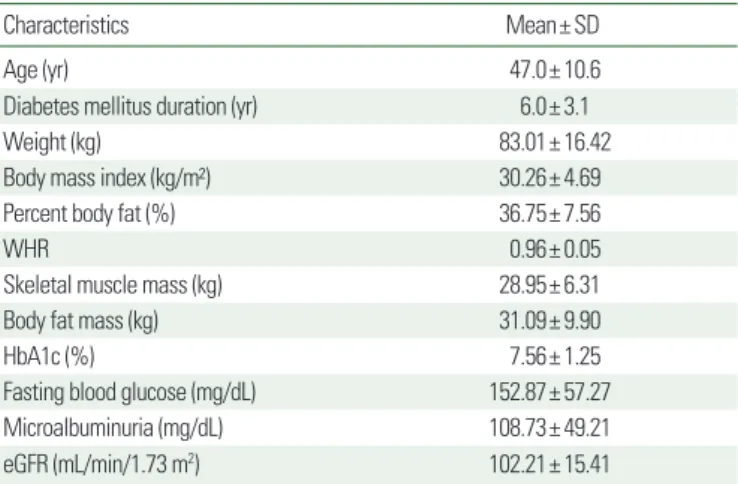
Methods: We enrolled 140 patients with a mean age, weight, and body mass index (BMI) of 47 years, 83 kg, and 30.3 kg/m
2, respectively. Dapagliflozin (10 mg daily for 6 months) was administered to obese patients with T2DM without established cardiovascular disease. Participants’ weight, BMI, body fat mass (BFM), muscle mass, glycosylated hemoglobin (HbA1c), lipid profile, waist to hip ratio (WHR), and pulse wave velocity (PWV) were measured at baseline and after 6 months.
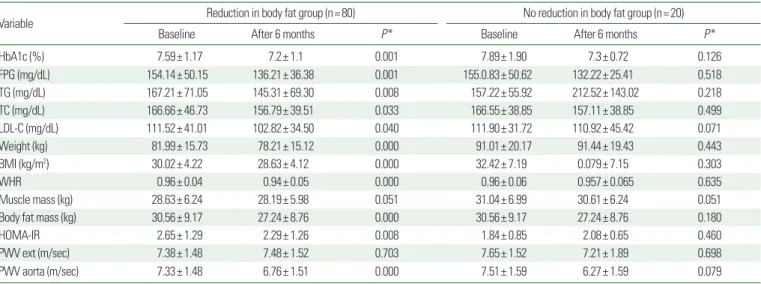
Results: Participants experienced statistically significant reductions in their HbA1c, fasting plasma glucose, low- density lipoprotein cholesterol, total cholesterol, body weight, BMI, WHR, BFM, and aortic PWV, without a signifi- cant change in their muscle mass, extracellular fluid, or intracellular volume. Statistically significant reductions in aortic PWV were associated with a decrease in BFM, visceral fat, WHR, and homeostatic model assessment of in- sulin resistance.
Conclusion: Dapagliflozin may be beneficial in preventing early cardiovascular disease in obese patients with T2DM without established cardiovascular disease.
Key words: Sodium-glucose transporter 2 inhibitors, Body composition, Pulse wave velocity
Received April 30, 2020 Reviewed June 8, 2020 Accepted August 10, 2020
* Corresponding author Dong-Mee Lim
https://orcid.org/0000-0001-9073-0872 Division of Endocrinology, Department of Internal Medicine, College of Medicine, Konyang University, 158 Gwanjeodong-ro, Seo-gu, Daejeon 35365, Korea Tel: +82-42-600-9169 Fax: +82-42-600-9090 E-mail: [email protected]
INTRODUCTION
Type 2 diabetes mellitus (T2DM) patients are at a high risk for cardiovascular diseases. Atherosclerotic cardiovascular disease (AS- CVD) is the major cause of morbidity and mortality in T2DM pa- tients.
1Although diabetes poses a substantial independent risk for ASCVD, most people with T2DM have numerous additional risk factors for ASCVD such as hypertension, dyslipidemia, obesity,
chronic kidney disease, and smoking.
2Body mass index (BMI) is a known predictor of all-cause mortality. A population-based co- hort study of 3.6 million adults in the United Kingdom showed that life expectancy from 40 years of age was 4.2 years shorter in obese men (BMI ≥ 30.0 kg/m
2) and 3.5 years shorter in obese women (BMI ≥ 30.0 kg/m
2) than in individuals with a healthy weight (BMI, 18.5–24.9 kg/m
2).
3Patients with T2DM who are overweight or have a high BMI have an increased risk of cardiovas-
Copyright © 2020 Korean Society for the Study of Obesity
This is an Open Access article distributed under the terms of the Creative Commons Attribution Non-Commercial License (https://creativecommons.org/licenses/by-nc/4.0/) which permits unrestricted non-commercial use, distribution, and reproduction in any medium, provided the original work is properly cited.
2017-03-16 https://crossmark-cdn.crossref.org/widget/v2.0/logos/CROSSMARK_Color_square.svg