• 검색 결과가 없습니다.

Data Analytic Process of a Nationwide Population-Based Study on Obesity Using the National Health Information Database Presented by the National Health Insurance Service 2006-2015

N/A
N/A
Protected

Academic year: 2021

Share "Data Analytic Process of a Nationwide Population-Based Study on Obesity Using the National Health Information Database Presented by the National Health Insurance Service 2006-2015"

Copied!
5
0
0

로드 중.... (전체 텍스트 보기)

전체 글

(1)

Data Analytic Process of a Nationwide Population- Based Study on Obesity Using the National Health Information Database Presented by the National Health Insurance Service 2006-2015

Yang-Hyun Kim

1

, Kyungdo Han

2

, Jang-Won Son

3

, Seong-Su Lee

3

, Sang Woo Oh

4

, Hyuk-Sang Kwon

5

, Soon-Ae Shin

6

, Yeon-Yong Kim

6

, Won-Young Lee

7,

*, Soon Jib Yoo

3,

*; on Behalf of the Taskforce Team of the Obesity Fact Sheet of the Korean Society for the Study of Obesity

1

Department of Family Medicine, Korea University College of Medicine, Seoul;

2

Department of Biostatistics, The Catholic University of Korea, Seoul;

3

Division of Endocrinology and Metabolism, Department of Internal Medicine, Bucheon St. Mary’s Hospital, College of Medicine, The Catholic University of Korea, Bucheon;

4

Department of Family Medicine, Center for Obesity, Metabolism and Nutrition, Dongguk University Ilsan Hospital, Dongguk University College of Medicine, Goyang;

5
Division of Endocrinology and Metabolism, Department of Internal Medicine, Yeouido St. Mary’s Hospital, College of Medicine, The Catholic University of Korea, Seoul;

6

Big Data Steering Department, National Health Insurance Service, Wonju;

7

Division of Endocrinology and Metabolism, Department of Internal Medicine, Kangbuk Samsung Hospital, Sungkyunkwan University School of Medicine, Seoul, Korea

Background: In Korea, the prevalence of obesity has steadily increased, and the socioeconomic burden of obesity has increased along with it. In 2015, the National Health Insurance Service (NHIS) signed a memoran- dum of understanding with the Korean Society for the Study of Obesity (KSSO), providing limited open access to its databases so that the status of obesity and obesity management could be investigated.

Methods: Using NHIS databases, we analyzed nationwide population-based studies for obesity using the defi- nition of obesity (body mass index ≥25 kg/m

2

) in subjects over the age of 20. Age and sex standardization were used for all data.

Results: The KSSO released the ‘Obesity Fact Sheet 2016’ using the 2006-2015 NHIS Health Checkup database.

The prevalence of obesity steadily increased from 28.7% in 2006 to 32.4% in 2015, and the prevalence of ab- dominal obesity also steadily increased from 18.4% in 2009 to 20.8% in 2015. The prevalence of class II obesity steadily increased from 2006 to 2015, such that the total prevalence was 4.8% in 2015 (5.6% in men and 4.0% in women). The highest prevalence of obesity was found in Jeju Island, while the lowest prevalence was found in Daegu City. The highest prevalence of abdominal obesity was also found in Jeju Island, while the lowest preva- lence was found in Gwangju City.

Conclusion: Based on the Obesity Fact Sheet 2016, a strategy for reducing the prevalence of obesity is needed, especially in Korean men.

Key words: Obesity, Abdominal obesity, Fact sheet, National Health Insurance Service

* Corresponding author Won-Young Lee

http://orcid.org/0000-0002-1082-7592 Division of Endocrinology and Metabolism, Department of Internal Medicine, Kangbuk Samsung Hospital, Sungkyunkwan University School of Medicine, 29 Saemunan-ro, Jongno-gu, Seoul 03181, Korea

Tel: +82-2-2001-2579 Fax: +82-2-2001-1588 E-mail: [email protected]

* Co-Corresponding author Soon Jib Yoo

http://orcid.org/0000-0002-9932-4130 Division of Endocrinology and Metabolism, Department of Internal Medicine, Bucheon St. Mary’s Hospital, College of Medicine, The Catholic University of Korea, 327 Sosa-ro, Wonmi-gu, Bucheon 14647, Korea Tel: +82-32-340-7011

Fax: +82-32-340-2669 E-mail: [email protected]

Copyright © 2017 Korean Society for the Study of Obesity

This is an Open Access article distributed under the terms of the Creative Commons Attribution Non-Commercial License (http://creativecommons.org/licenses/by-nc/4.0/) which per-

mits unrestricted non-commercial use, distribution, and reproduction in any medium, provided the original work is properly cited.

(2)

INTRODUCTION

In Korea, the prevalence of obesity has steadily increased, along with the accompanying socioeconomic burden.

1

Both obesity and abdominal obesity are risk factors for several cardiovascular diseas- es

2

, so obesity prevention and management are important. In an ef- fort to reduce the prevalence of obesity and examine the risk factors and comorbidities of obesity, the National Health Insurance Ser- vice (NHIS) signed a memorandum of understanding with the Korean Society for the Study of Obesity (KSSO) in 2015, provid- ing limited open access to its databases so that the status of obesity and obesity management could be investigated. In this manuscript, we introduce the NHIS database and the 2016 Obesity Fact Sheet based on NHIS data from 2006 to 2015.

METHODS The NHIS database

The NHIS is a nonprofit organization and a single-payer organi- zation in Korea, and all Koreans must join the NHI.

3,4

The NHIS provides universal coverage for all residents of Korea and pays healthcare providers based on a fee-for-service system. The NHIS obtains patients’ demographic information, such as age, sex, region, insurers’ payment coverage, medical utilization/transaction infor- mation, and deductions and claims data. This database can be used for a population-based cohort study, according to the operational definition of some diseases.

5

National Health Checkup program and database

The NHI provides regular health checkups and cancer screenings biannually at no cost for all insured Koreans over the age of 40, as a way to discover and treat diseases in their early stages and improve the health status of the population. Employee subscribers over the age of 20 should have their health status checked annually. The health checkup program has four areas: general health checkups, cancer checkups, baby/infant health checkups, and lifetime transi- tion period health checkups.

4

In the NHI Health Checkup program, height, weight, and blood pressure have been measured since 2002, and waist circumference (WC) has been measured since 2009.

Hearing and visual acuity, along with fasting glucose levels, total

cholesterol, high-density lipoprotein cholesterol, low-density lipo- protein cholesterol and triglyceride levels, are also checked. In addi- tion, health behaviors such as alcohol consumption, smoking histo- ry, and regular exercise are surveyed, along with family, medical and surgical history. In the cancer program, specific cancers are screened: stomach and breast cancer for those ≥40 years old, colon cancer for those ≥50 years old, liver cancer for those ≥40 years old with high risk for hepatic cancer, and cervical cancer for women

≥30 years old. Each person pays only 10% of the cost.

Database population

Since 2006, information about Medical Aid (MA) beneficiaries has been included in a single database. Thus, we used the NHIS database from 2006 to 2015. In 2015, 14,049,447 Koreans partici- pated in the National Health Checkup. Among these participants, we only included those who were over the age of 20. The protocol of this study was reviewed and approved by the institutional review board of the Korea National Institute for Bioethics Policy (P01- 201603-21-005).

Data assessment and contents of the database

We used the Claim database, Qualification database, Health Checkup database, and death information in this study. The Claim database included general information on payment specifications (20 tables), consultation statements (30 tables), diagnosis state- ments [as defined by the International Classification of Diseases 10th revision (ICD-10)] (40 tables), and detailed prescription statements (60 tables). The Qualification database included infor- mation such as age, sex, region, income, and qualification type. For the Health Checkup database, we used the general health checkup database: (1) MA beneficiaries who are householders 20 to 64 years old and household members 41 to 64 years old, (2) employee subscribers’ dependents and household members over the age of 40, and (3) regional insurance subscribers and employee subscrib- ers who are regional householders.

Definition of obesity, abdominal obesity, and class II obesity

We were able to use body mass index (BMI) data to obtain the

prevalence of obesity from 2006 onwards, but the prevalence of ab-

(3)

dominal obesity could only be determined after 2009, when WC began to be measured. Obesity was defined as a BMI (weight in ki- lograms divided by the square of height in meters) ≥ 25.0 kg/m

2

in adults, in accordance with the Asia-Pacific criteria of the World Health Organization guidelines.

6

Abdominal obesity was defined as a WC ≥ 90 cm in men and ≥ 85 cm in women, in accordance with the definition by the KSSO. A BMI ≥ 30.0 kg/m

2

was defined as class II obesity.

7

Data presentation

Age and sex standardization (based on the 2010 Census Korean population) were used to present all data. We calculated the preva- lence of obesity (%) by dividing the number of patients who were obese by the total number of subjects with NHI Health Checkup data.

RESULTS

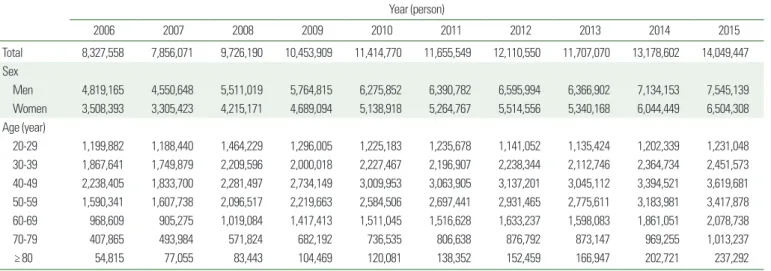
Table 1 shows the total number of subjects and the distribution of the population from the NHIS database from 2006 to 2015 by sex and age group. Over time, the total number of National Health Checkup participants increased, especially in the elderly population.

Obesity Fact Sheet 2016

The prevalence trends of obesity, abdominal obesity, and class II obesity from 2006 to 2015

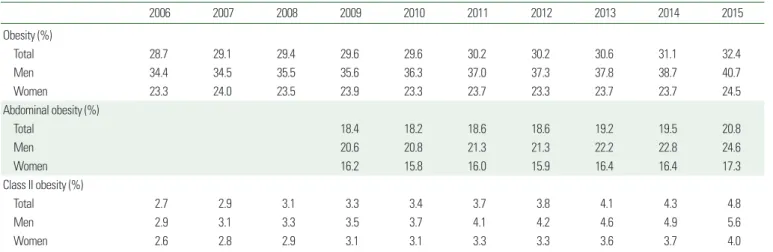
The prevalence of obesity steadily increased from 28.7% in 2006

to 32.4% in 2015, and the prevalence of abdominal obesity also steadily increased from 18.4% in 2009 to 20.8% in 2015. In 2015, the prevalence of obesity was 40.7% in men and 24.5% in women, while the prevalence of abdominal obesity was 24.6% in men and 17.3% in women. The prevalence of class II obesity has steadily in- creased since 2006. In 2015, the prevalence of class II obesity was 4.8% overall, 5.6% in men and 4.0% in women (Table 2).

Regional prevalence of obesity and abdominal obesity in 2015 The highest obesity prevalence was found in Jeju Island (41.1%), while the lowest prevalence was found in Daegu City (30.3%). The highest abdominal obesity prevalence was found in Jeju Island (30.0%), while the lowest prevalence was found in Gwangju City (18.4%) (Table 3).

DISCUSSION

In this study, we found that the prevalence of obesity steadily in- creased from 2006 to 2015, as did the prevalence of class II obesity.

The prevalence of abdominal obesity also steadily increased from 2009 to 2015. Jeju Island was the region with the highest preva- lence of both obesity and abdominal obesity.

As the NHIS database represents the entire Korean population, we can apply this result to the creation of a policy to reduce the prevalence of obesity, especially in a specific group or region. The NHIS database will be updated continuously, so we can use this Table 1. Distribution of Korean National Health Insurance beneficiaries aged ≥ 20 years by sex and age group

Year (person)

2006 2007 2008 2009 2010 2011 2012 2013 2014 2015

Total 8,327,558 7,856,071 9,726,190 10,453,909 11,414,770 11,655,549 12,110,550 11,707,070 13,178,602 14,049,447 Sex

Men 4,819,165 4,550,648 5,511,019 5,764,815 6,275,852 6,390,782 6,595,994 6,366,902 7,134,153 7,545,139 Women 3,508,393 3,305,423 4,215,171 4,689,094 5,138,918 5,264,767 5,514,556 5,340,168 6,044,449 6,504,308 Age (year)

20-29 1,199,882 1,188,440 1,464,229 1,296,005 1,225,183 1,235,678 1,141,052 1,135,424 1,202,339 1,231,048 30-39 1,867,641 1,749,879 2,209,596 2,000,018 2,227,467 2,196,907 2,238,344 2,112,746 2,364,734 2,451,573 40-49 2,238,405 1,833,700 2,281,497 2,734,149 3,009,953 3,063,905 3,137,201 3,045,112 3,394,521 3,619,681 50-59 1,590,341 1,607,738 2,096,517 2,219,663 2,584,506 2,697,441 2,931,465 2,775,611 3,183,981 3,417,878 60-69 968,609 905,275 1,019,084 1,417,413 1,511,045 1,516,628 1,633,237 1,598,083 1,861,051 2,078,738

70-79 407,865 493,984 571,824 682,192 736,535 806,638 876,792 873,147 969,255 1,013,237

≥ 80 54,815 77,055 83,443 104,469 120,081 138,352 152,459 166,947 202,721 237,292

(4)

database in a prospective longitudinal nationwide cohort study to reveal the causal relationships between variables. Other laboratory measurements, medications, procedures, surgeries, and survey data can also be used in various studies. Moreover, since the NHIS data- base contains mortality data, we can determine disease-related mortality and discover the causal risk factors that increase or reduce mortality. As in this study, combining laboratory and survey data from the Health Checkup database with information from the

Table 2. The prevalence trends for obesity, abdominal obesity, and class II obesity from 2006 to 2015

2006 2007 2008 2009 2010 2011 2012 2013 2014 2015

Obesity (%)

Total 28.7 29.1 29.4 29.6 29.6 30.2 30.2 30.6 31.1 32.4

Men 34.4 34.5 35.5 35.6 36.3 37.0 37.3 37.8 38.7 40.7

Women 23.3 24.0 23.5 23.9 23.3 23.7 23.3 23.7 23.7 24.5

Abdominal obesity (%)

Total 18.4 18.2 18.6 18.6 19.2 19.5 20.8

Men 20.6 20.8 21.3 21.3 22.2 22.8 24.6

Women 16.2 15.8 16.0 15.9 16.4 16.4 17.3

Class II obesity (%)

Total 2.7 2.9 3.1 3.3 3.4 3.7 3.8 4.1 4.3 4.8

Men 2.9 3.1 3.3 3.5 3.7 4.1 4.2 4.6 4.9 5.6

Women 2.6 2.8 2.9 3.1 3.1 3.3 3.3 3.6 3.7 4.0

Age and sex standardization (based on the 2010 Census Korean population) were used for all data.

Table 3. Regional prevalence of obesity and abdominal obesity in 2015

Region Prevalence (%)

Obesity Abdominal obesity

Seoul 31.6 21.6

Busan 31.6 18.9

Daegu 30.3 18.9

Incheon 34.3 22.4

Gwangju 31.8 18.4

Daejeon 32.0 20.3

Ulsan 31.4 19.6

Sejong 32.1 20.2

Gyeonggi 33.2 22.0

Gangwon 36.8 21.4

Chungbuk 33.1 20.8

Chungnam 33.6 23.1

Jeonbuk 33.3 20.1

Jeonnam 33.8 20.4

Gyeongbuk 31.8 20.6

Gyeongnam 30.8 18.6

Jeju Island 41.1 30.0

Age and sex standardization (based on the 2010 Census Korean population) were used for all data.

Claim database will allow researchers to overcome the limitations of the Claim database.

The limitation of the NHIS database is the discrepancy between the disease diagnoses from the Claim database and from real prac- tice. This discrepancy was observed more often in outpatient clin- ics, primary care clinics, and less-severe illness cases than in inpa- tient hospitals, general or tertiary hospitals, and severe illness cases, respectively. Therefore, the NHIS database might not reflect the real utilization pattern of healthcare institutions.

8

To minimize this discrepancy, therefore, an appropriate operational definition of each disease is needed. Second, this NHIS database only includes in- sured benefits; thus, uninsured payments for services such as esthet- ics clinic visits, over-the-counter drugs and obesity medications could not be estimated. It has been reported that approximately 28% of total healthcare payments in Korea occur in the uninsured healthcare area.

9

Third, the interval between health checkups de- pends on the participant’s employment status and health checkup program, and the completeness of the health checkup differs each year; therefore, researchers should consider various situations dur- ing their study design. Fourth, we only included subjects ≥20 years old, so we cannot report the exact prevalence of obesity in children and adolescents.

In conclusion, based on information from the Obesity Fact Sheet

2016, a strategy for reducing the prevalence of obesity and class II

obesity is needed, especially in Korean men. An obesity reduction

policy and an analysis of the risk factors for obesity will be needed,

especially in Jeju Island. As the NHIS database is based on manda-

(5)

tory and serial population data, we can predict the disease incidence or the progress for disease prevention after data mining. Further studies would be better to consider this trend and the status of obe- sity in the next studies.

CONFLICTS OF INTEREST

There was no conflict of interest relevant to this article.

ACKNOWLEDGMENTS

We all thank the National Health Insurance Service and Korean Society for the Study of Obesity.

This study was supported by a grant of the Korean Health Tech- nology and R&D project, Ministry of Health & Welfare, Republic of Korea (HC16C2285).

REFERENCES

1. Wyatt SB, Winters KP, Dubbert PM. Overweight and obesity:

prevalence, consequences, and causes of a growing public health problem. Am J Med Sci 2006;331:166-74.

2. Asia Pacific Cohort Studies Collaboration. Central obesity and risk of cardiovascular disease in the Asia Pacific Region.

Asia Pac J Clin Nutr 2006;15:287-92.

3. Kwon SM. Healthcare financing reform and the new single payer system in the Republic of Korea: social solidarity or effi- ciency. Int Soc Secur Rev 2003;56:75-94.

4. NHIS. National Health Insurance Service: Health Checkup.

Available from: URL: http://www.nhis.or.kr/static/html/wbd/

g/a/wbdga0606.html

5. Song SO, Jung CH, Song YD, Park CY, Kwon HS, Cha BS, et al. Background and data configuration process of a nationwide population-based study using the korean national health insur- ance system. Diabetes Metab J 2014;38:395-403.

6. World Health Organization. The Asia-Pacific perspective: re- defining obesity and its treatment: International Association for the Study of Obesity; 2000.

7. Lee SY, Park HS, Kim DJ, Han JH, Kim SM, Cho GJ, et al.

Appropriate waist circumference cutoff points for central obe- sity in Korean adults. Diabetes Res Clin Pract 2007;75:72-80.

8. Aljunid SM, Srithamrongsawat S, Chen W, Bae SJ, Pwu RF, Ikeda S, et al. Health-care data collecting, sharing, and using in Thailand, China mainland, South Korea, Taiwan, Japan, and Malaysia. Value Health 2012;15(Suppl 1):S132-8.

9. Jeong HS, Lee JH, Shin JW, Song YM. Scale and structure of

2006 total health expenditure in Korea Constructed Accord-

ing to OECD/WHO/EUROSTAT᾿s SHA (System of Health

Accounts). Korean J Health Econ Policy 2008;14:151-69.

수치

Table 1 shows the total number of subjects and the distribution  of the population from the NHIS database from 2006 to 2015 by  sex and age group
Table 2. The prevalence trends for obesity, abdominal obesity, and class II obesity from 2006 to 2015

참조

관련 문서

Age-related changes in the prevalence of osteoporosis according to gender and skeletal site: The Korea National Health and Nutrition Examination Survey 2008-2010..

Objective: The purpose of this study is to investigate the relationship between depression and evening meals for adult women by using the National Health and Nutrition Survey

socioeconomic status and thyroid cancer prevalence; Based on the korean National Health and Nutrition Examination Survey2010-2011. Jung YI, Kim

This study aims to identify whether socioeconomic level of parents affects obesity of adolescents and whether the relations between adolescent's obesity

Prevalence of Undiagnosed Diabetes and Related Factors in Korean Postmenopausal Women:.. The 2011-2012 Korean National Health and

If we think the principle of self-determination and responsibility as principal, we should be oriented to the solution system of making private insurance contract against the

This study was conducted to analyze the effects of obesity on the core stability and metabolic syndrome risk factors of middle - aged women.. The effect

The first public medical insurance act enacted in 1963 and according to the Amendment in 1976 became the health care insurance compulsorily.. The national