• 검색 결과가 없습니다.

High Resolution Manometry versus Video Fluorography for Evaluating Dysphagia in Patients with Inflammatory Myopathy: A Pilot Study

N/A
N/A
Protected

Academic year: 2021

Share "High Resolution Manometry versus Video Fluorography for Evaluating Dysphagia in Patients with Inflammatory Myopathy: A Pilot Study"

Copied!
6
0
0

로드 중.... (전체 텍스트 보기)

전체 글

(1)

Received: August 26 2019, Revised: August 29 2019, Accepted: September 26 2019

Corresponding author: Kyoung Hyo Choi, Department of Rehabilitation Medicine, Asan Medical Center, University of Ulsan College of Medicine, 88 Olympic-ro 43-gil, Songpa-gu, Seoul 05505, Korea

Tel: +82-2-3010-3800, Fax: +82-2-3010-6964 E-mail: [email protected]

Copyrights ⓒ The Korean Dysphagia Society, 2020.

High Resolution Manometry versus Video

Fluorography for Evaluating Dysphagia in Patients with Inflammatory Myopathy: A Pilot Study

Minji Jung, M.D.

1

, Kyoung Hyo Choi, M.D., Ph.D.

1

, Kyeong Joo Song, M.D.

1

, Kee Wook Jeong, M.D., Ph.D.

2

, Yong-Gil Kim, M.D., Ph.D.

3

1

Department of Rehabilitation Medicine, Asan Medical Center, University of Ulsan College of Medicine, Seoul,

2

Division of Gastroenterology, Department of Internal Medicine, Asan Medical Center, University of Ulsan College of Medicine, Seoul,

3

Division of Rheumatology, Department of Internal Medicine, Asan Medical Center, University of Ulsan College of Medicine, Seoul, Korea

Objective: Dysphagia has been reported to occur in patients with inflammatory myopathy (IM). Although high-reso- lution impedance manometry (HRIM) provides precise information regarding the pharyngeal pressure, it has not yet been used for assessing dysphagia in routine clinical practice. This study determined whether the results of HRIM for evaluating deglutition disorders in patients with IM could reflect an abnormality that can’t be identified by a video fluoroscopic swallowing study (VFSS).

Methods: We reviewed both VFSS and HRIM results of nine patients with IM, four of whom presented with globus sensation.

Results: Cricopharyngeal muscle dysfunction was noted in all four patients with globus sensation, and the upper esophageal sphincter residual pressure (UESRP) was higher (≥8 mmHg) in the patients with pharyngeal residue.

Using VFSS and HRIM, we demonstrated that dysphagia in patients with IM may arise owing to failed relaxation of UES or decreased hyolaryngeal excursion.

Conclusion: In conclusion, UES-RP values of ≥8 mmHg indicate the presence of pharyngeal residue and globus sensation in patients with IM. HRIM provided a comprehensive assessment of the mechanisms of dysphagia, and HRIM facilitated recognizing subtle abnormalities in pharyngeal contraction and UES function. HRIM can overcome the limitations of VFSS by allowing clinicians to perform objective measurements in patients with IM. (JKDS 2019;10:107-112) Keywords: Deglutition disorders, Dysphagia, VFSS, Myositis, Manometry

INTRODUCTION

Inflammatory myopathy (IM) is a triad of rare autoimmune diseases, including inclusion body myo-

sitis, dermatomyositis, and polymyositis, character-

ized by muscle weakness

1

. Dysphagia has been

previously reported in patients with IM. On instru-

mental evaluation, such as manometry or videoflu-

(2)

oroscopic swallowing study (VFSS), patients with IM were found to experience the following deglutition disorders: pharyngeal pooling, impaired tongue base retraction, impaired laryngeal excursion, impaired upper esophageal sphincter (UES) relaxation, and abnormal cricopharyngeal function

2

.

VFSS is the primary assessment tool employed in clinical practice and has been considered the gold standard for dysphagia evaluation. However, fluoro- scopy cannot quantify the swallowing function. VFSS only provide descriptive information on laryngeal traction disorders, UES relaxation, and abnormal pha- ryngeal function

3

. Additionally, VFSS requires con- siderably experienced examiners and is a compli- cated technique for interpreting the swallow onset timing, velopharyngeal apposition adequacy, laryngeal elevation, epiglottic tilt, pharyngeal contraction, and UES opening

4

. Therefore, it is challenging to deter- mine whether the cause of pharyngeal retention is decreased pharyngeal contraction, decreased UES relaxation, or reduced laryngeal motion using VFSS alone

5

.

Recently, dynamic swallowing methods have been developed to digitally analyze swallowing functions.

Pharyngeal manometry is the current standard for evaluating pharyngeal contraction and UES relax- ation. In particular, high-resolution impedance mano- metry (HRIM) has been successfully used for evalu- ating swallowing function of the pharynx

6

.

There are several studies using HRIM and VFSS.

According to the study which investigate UES opening by making a comparison between HRIM and kine- matic analysis of VFSS, HRIM appears to be more sensitive to the detection of UES opening than kine- matic analysis of VFSS

7

. The other study which aimed to develop new parameters of HRIM and to applicate these to quantify the effect of bolus volume and texture on pharyngeal swallowing, revealed the bolus volume was shown to have significant effect on pharyngeal pressure and timing, and the parameters of HRM were more sensitive than those of VFSS

8

. However, the subjects of those two studies were based on ten healthy people. Lan, Yue et al. studied

the correlation between HRIM and VFSS measure- ments of the swallowing function in 24 brainstem stroke survivors with dysphagia. The increase in the pharyngeal maximum pressure wave amplitude was significantly correlated with a decrease in the pha- ryngeal constriction ratio and the increase in the UES opening diameter was significantly correlated with a decrease in the UES residual pressure

9

. Till now, few studies were performed to evaluate the correlation between HRIM and VFSS in the patients with IMs.

In this study, we aimed to compare HRIM para- meters corresponding to VFSS results among patients with both IM and swallowing disorders. HRIM can provide various valuable pressure and timing para- meters. HRIM parameters of UES maximum pressure and UES residual pressure (UES RP) were compared with VFSS findings of pharyngeal residues, pene- tration, and aspiration. Moreover, we aimed to deter- mine whether HRIM-based qualitative impedance as- sessment is a viable alternative to VFSS evaluation of patients with both IM and dysphagia.

MATERIALS AND METHODS

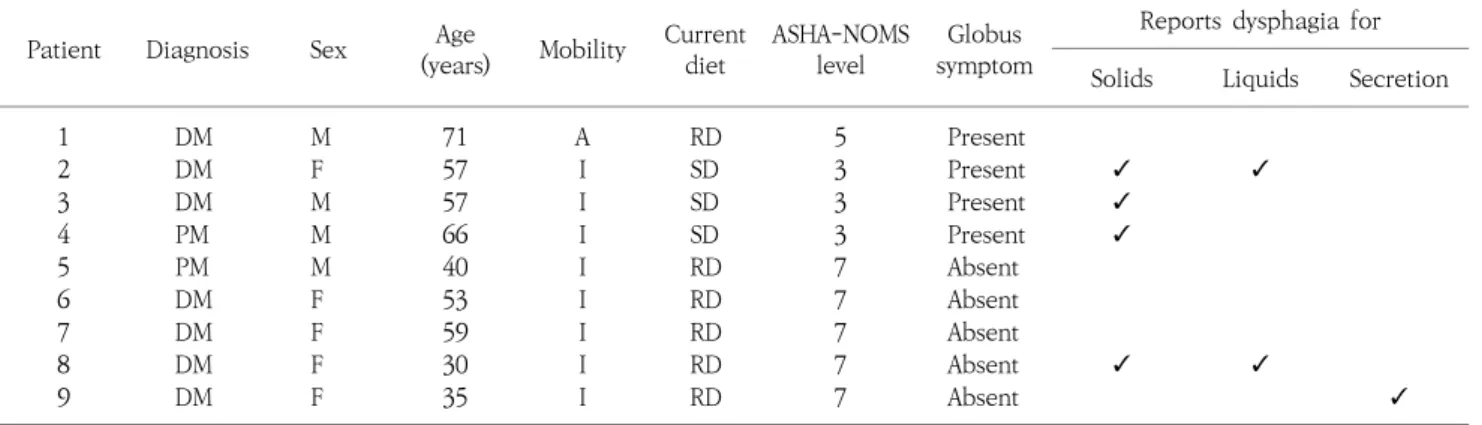
We identified nine patients with IM who had been referred to the Department of Rehabilitation Medi- cine of Asan Medical Center, Seoul, Korea, from September 2016 to May 2018 and who had undergone both VFSS and HRIM within a span of 10 days. The medical records of these nine patients who had dys- phagia (seven having dermatomyositis and two having polymyositis; median age, 52.0 years; age range, 30- 71 years) were reviewed; four patients presented with globus sensation and five patients showed no symp- toms of dysphagia.(Table 1) In order to rule out globus symptoms caused by GERD or esophagitis, the results of esophagogastroscopy were confirmed, but there was no specific problem except atrophic gastritis (patient 4, 6, and 7). Drugs such as gastrointestinal motility regulators, H2 blocker and proton pump inhibitors that had been administered by the patients were discontinued three days before the HRIM test.

We evaluated pharyngeal contraction and UES func-

(3)

Table 1. Demographics of patients with inflammatory myositis and their symptom presentation.

Patient Diagnosis Sex Age

(years) Mobility Current diet

ASHA-NOMS level

Globus symptom

Reports dysphagia for Solids Liquids Secretion

1 DM M 71 A RD 5 Present

2 DM F 57 I SD 3 Present ✓ ✓

3 DM M 57 I SD 3 Present ✓

4 PM M 66 I SD 3 Present ✓

5 PM M 40 I RD 7 Absent

6 DM F 53 I RD 7 Absent

7 DM F 59 I RD 7 Absent

8 DM F 30 I RD 7 Absent ✓ ✓

9 DM F 35 I RD 7 Absent ✓

ASHA-NOMS: American Speech-Language-Hearing Association National Outcomes Measurement System, DM: dermatomyositis, PM:

polymyositis, M: male, F: female, I: independent, A: uses a mobility aid, RD: regular diet, SD: soft diet.

tion using videofluorography and compared the consequent findings with measurements of mano- metric parameters. VFSS and HRIM tests were not simultaneously performed; however, we confirmed that the patients exhibited no significant changes in symptoms between the two examinations performed within a 10-day period.

1. HRIM study protocol

All subjects underwent HRIM evaluation after fasting for at least 6 h. A solid-state HRIM manometer assembly (Sandhill Scientific Instruments Inc., High- lands Ranch, CO, USA) was used. HRIM catheter had a 4-mm diameter, 32 solid pressure sensors, and 6 impedance sensors. All of the pressure sensors served to evaluate swallowing activity regulated by the lower esophageal sphincter (LES) via closure of LES across the esophagus from UES. UES relaxation parameters, including UES pressure, UES RP, and peak pharyngeal amplitude

10

, were measured using the standard HRIM protocol

11

. The participants were instructed to assume a neutral head and sitting position in order to perform HRIM test. The manometric catheter was lubricated with 2% lidocaine jelly, which was easily passed through the pharynx. HRIM catheter was transcutaneously introduced into the esophagus up to a depth of 60 cm, and the catheter was taped to the nose of the participant and fixed. After placement of the catheter in the pharynx, the participants rested

for 5-10 min before swallowing

11

. After 5-min adap- tation in the sitting position, the participants were asked to perform four saline swallows (5 mL each) at intervals of 20 s. Peristalsis and bolus transit of the pharyngoesophageal segment could not be assessed using the standard HRIM protocol. Therefore, we used a modified HRIM protocol

12

in which the catheter was pulled back by 10 cm, and the participants were subsequently asked to perform four thick-fluid swal- lows (5 mL each) and four thin-fluid swallows (5 mL each).

2. VFSS protocol

Each VFSS was performed with the participant sitting upright. VFSS was performed in a fluoroscopic laboratory under the supervision of a skilled phy- sician with the assistance of a radiologist. Data from the procedure were video recorded (Sonialvision G4;

Shimadzu, Tokyo, Japan). When the food material entered the airway either below or above the vocal folds, the condition was referred to as subglottic aspiration or supraglottic penetration, respectively.

We also recorded abnormalities, scores on the Ameri-

can Speech-Language-Hearing Association National

Outcomes Measurement System (ASHA-NOMS)

13

, and

scores in the Penetration-Aspiration Scale (PAS)

14

.

ASHA-NOMS is based on a 7-point scale depending

on the level of the patient’s dietary restriction. Level

1 indicates that the patient could not eat safely th-

(4)

Table 2. VFSS and HRIM findings in patients with inflammatory myositis.

Patient PAS Aspiration (VFSS)

Penetration (VFSS)

Pharyngeal residue (VFSS) UES pressure (mmHg)*

UES RP (mmHg)*

Vallecular pouch Pyriform sinus

1 1 Absent Absent ✓ ✓ Normal Abnormal (increased)

2 6 Present Absent ✓ ✓ Normal Abnormal (increased)

3 7 Present Present ✓ ✓ Normal Abnormal (increased)

4 6 Present Absent ✓ Normal Abnormal (increased)

5 1 Absent Absent Normal Normal

6 1 Absent Absent Decreased Normal

7 1 Absent Absent Normal Normal

8 1 Absent Absent Normal Normal

9 1 Absent Absent Normal Normal

*UES pressure and UES RP: According to HRIM readings of the Department of Internal Medicine, Asan Medical Center, UES pressure and UES RP of 30–118 mmHg and <8 mmHg, respectively were defined as normal.

PAS: Penetration-Aspiration Scale, VFSS: videofluoroscopic study, HRIM: high-resolution impedance manometry, UES: upper esophageal sphincter, UES RP: upper esophageal sphincter residual pressure.

rough the mouth (i.e., the patient required a non-oral diet), and level 7 indicates that the patient could swallow without limitation

13

. PAS is an 8-point scale that evaluates penetration and aspiration events during VFSS. If the food material does not enter the airway, the condition was designated to be grade 1.

The grade increases as the material enters the airway below the vocal cords. Subglottic aspiration in this study, designated with a PAS score of ≥6, was defined as aspiration in VFSS

14

.

RESULTS

The demographics of the patients with IM and their symptom presentations are shown in Table 1. Crico- pharyngeal muscle dysfunction, including pharyngeal residue, in the vallecular pouch or pyriform sinus was noted in all four patients with globus sensation who underwent barium swallowing studies.(Table 2) Of the four patients with globus sensation, three patients presented with aspiration events. No patients were diagnosed with GERD or esophagitis.

1. HRIM variables according to VFSS parameters The five patients without dysphagia symptoms show- ed no abnormality in VFSS.(Table 2) A difference was observed between the manometric measurements of patients with and without pharyngeal residue; in

patients with pharyngeal residue, UES‐RP was >8 mmHg.(Table 2) According to HRIM readings of the Department of Internal Medicine, Asan Medical Center, UES pressure and UES RP of 30-118 mmHg and <8 mmHg, respectively, were defined as normal.

*Details of UES pressure: Patient (Pt) 1, 111.8 mmHg;

Pt 2, 108.0 mmHg; Pt 3, 58.0 mmHg; Pt 4, 34.0 mmHg;

Pt 5, 86.0 mmHg; Pt 6, 25.0 mmHg; Pt 7, 55.6 mmHg;

Pt 8, 46.9 mmHg; Pt 9, 136.0 mmHg. Details of UES RP: Pt 1, 9.9 mmHg; Pt 2, 24 mmHg; Pt 3, 12 mmHg;

Pt 4, 11.8 mmHg; Pt 5, 7.1 mmHg; Pt 6, 6 mmHg; Pt 7, 6 mmHg; Pt 8, 7.1 mmHg; Pt 9, 7.9 mmHg.

DISCUSSION

Our study demonstrated that combining HRIM data with VFSS data provided more detailed information regarding the mechanisms underlying oropharyngeal dysphagia in patients with IM, even when VFSS and HRIM tests were not performed simultaneously. Using VFSS and manometry, we demonstrated that dyspha- gia in IM may be caused by failed relaxation of UES or reduced hyolaryngeal excursion.

Certain VFSS measures are correlated with mea-

sures of pressure obtained using HRIM. According to

this study, UES‐RP values of ≥8 mmHg could indicate

the presence of pharyngeal residue and globus sen-

sation in patients with IM.

(5)

Clinical assessment alone underestimates the risk of aspiration by 50%

15

. VFSS allows the assessment of bolus transit through the pharynx, and thereby pro- vides an accurate estimation of the risk of aspiration.

The risk of aspiration after deglutition is negligible in patients without pharyngeal retention, but it is very high in patients with moderate-to-severe pharyngeal residue

16

. Therefore, the presence of residue after swallowing is an indicator of interest while evaluating patients with oropharyngeal dysphagia. Few studies have examined the relationship between the maxi- mum opening of UES and UES RP. VFSS provides in- formation on the opening of UES, whereas mano- metry measures the relaxation of UES

17

. The opening and relaxation of UES are related to events that are not synonymous. The maximum sagittal UES opening diameter (a parameter for UES opening) has a high curvilinear correlation with UES RP (a UES relaxation parameter). In a previous study, the UES remained closed, and no significant changes were observed in VFSS images; however, UES pressure fluctuated during the observation period

18

.

Although we are not the first investigators to sug- gest the existence of significant relationships be- tween manometric and fluoroscopic variables, we suggest some surrogate measures that could potenti- ally indicate pressure deficits, which usually remain undetected with VFSS alone, in patients with IM

19

.

This study has several limitations. First, although HRIM could provide a diverse array of valuable pres- sure and timing variables, this study compared only UES maximum pressure and UES RP (HRIM para- meters) with pharyngeal residue, penetration, and aspiration (VFSS parameters). Pharyngeal maximum pressure and UES RP are not sufficient to completely explain the pathophysiology of dysphagia. Therefore, it may be necessary to measure pressure parameters, time parameters, and velocity parameters of addi- tional anatomic parts using HRIM. Second, we adapt- ed normal values of UES pressure and UES RP ac- cording to HRIM readings of the Department of In- ternal Medicine, Asan Medical Center. It may be de- batable whether the same values could apply to IMs

especially on chronic myopathy.

Third, VFSS and HRIM tests were not performed simultaneously. Fourth, although inclusion body myo- sitis is the most common form of IM, this study did not include patients with this condition.

In conclusion, higher values of UES‐RP (≥8 mmHg) could indicate the presence of pharyngeal residue and globus sensation in patients with IM. A com- parison between diverse HRIM parameters and VFSS findings could yield more comprehensive and precise information about the pathophysiology of dysphagia in patients with IM, and the results could be useful for evaluating and diagnosing dysphagia. Further- more, HRIM facilitates a comprehensive assessment of dysphagia mechanisms and recognition of subtle abnormalities, which are not discernable using VFSS.

HRIM can supplement the information obtained about pharyngeal contraction and UES function and can overcome the drawbacks of VFSS by providing objective measurements.

CONFLICT OF INTEREST

The authors declare that they have no conflict of interest.

COMPLIANCE WITH ETHICAL STANDARDS

Research Involving Human Participants: the study was reviewed and approved by the appropriate ethics committee(s).

Informed Consent: This is a retrospective study with chart review.

REFERENCES

1. Pagnini I, Vitale A, Selmi C, Cimaz R, Cantarini L. Idio- pathic Inflammatory Myopathies: an Update on Classifi- cation and Treatment with Special Focus on Juvenile Forms. Clin Rev Allergy Immunol. 2017 Feb;52(1):34-44.

2. Langdon PC, Mulcahy K, Shepherd KL, Low VH, Mastaglia FL. Pharyngeal dysphagia in inflammatory muscle dis- eases resulting from impaired suprahyoid musculature.

Dysphagia. 2012 Sep;27(3):408-17.

3. Bonnie Martin-Harris, Bronwyn Jones, The Videofluoro-

(6)

graphic Swallowing Study. Phys Med Rehabil Clin N Am.

2008 Nov; 19(4):769-785.

4. Lee TH, Lee JS, Hong SJ, Lee JS, Jeon SR, Kim WJ, et al.

High-resolution manometry: Reliability of automated ana- lysis of upper esophageal sphincter relaxation parameters.

Turk J Gastroenterol 2014;25:473-80.

5. Rhee WI, Won SJ, Ko SB. Diagnosis With Manometry and Treatment With Repetitive Transcranial Magnetic Stimulation in Dysphagia. Ann Rehabil Med. 2013 Dec;

37(6):907-912.

6. Lee TH, Lee JS. High-resolution Manometry for Oropha- ryngeal Dysphagia in a Patient With Large Cervical Os- teophytes. J Neurogastroenterol Motil. 2012 Jul;18(3):338- 339.

7. Park D, Lee HH, Lee ST, Oh Y, Lee JC, Nam KW, Ryu JS. Normal contractile algorithm of swallowing related muscles revealed by needle EMG and its comparison to videofluoroscopic swallowing study and high resolution manometry studies: A preliminary study. J Electromyogr Kinesiol. 2017 Oct;36:81-89.

8. Ryu JS, Park D, Oh Y, Lee ST, Kang JY. The Effects of Bolus Volume and Texture on Pharyngeal Pressure Events Using High-resolution Manometry and Its Com- parison with Videofluoroscopic Swallowing Study. J Neuro- gastroenterol Motil. 2016 Apr 30;22(2):231-9.

9. Lan Y, Xu G, Dou Z, Lin T, Yu F, Jiang L. The correla- tion between manometric and videofluoroscopic meas- urements of the swallowing function in brainstem stroke patients with Dysphagia. J Clin Gastroenterol. 2015 Jan;

49(1):24-30.

10. Ghosh SK, Pandolfino JE, Zhang Q, Jarosz A, Kahrilas PJ. Deglutitive upper esophageal sphincter relaxation: a study of 75 volunteer subjects using solid-state high-res- olution manometry. Am J Physiol Gastrointest Liver Physiol.

2006 Sep;291(3):G525-31.

11. Shobna J Bhatia, Chirag Shah. How to Perform and In- terpret Upper Esophageal Sphincter Manometry. J Neuro- gastroenterol Motil. 2013 Jan;19(1):99-103.

12. Lee T H, Lee J S, Kim W J. High resolution impedance manometric findings in dysphagia of Huntington’s dis- ease. World J Gastroenterol 2012;18(14):1695-9.

13. Adult speech-language pathology training manual. Rock- ville, MD: American Speech-Language Hearing Associa- tion; 1998. American Speech-Language Hearing Association National Outcome Measurement System (NOMS).

14. Rosenbek JC, Robbins JA, Roecker EB, Coyle JL, Wood JL. A penetration-aspiration scale. Dysphagia. 1996;11:93- 8.

15. MG Rugiu. Acta Otorhinolaryngol Ital. 2007 Dec;27(6):

306-316.

16. Eisenhuber E, Schima W, Schober E, Pokieser P, Stadler A, Scharitzer M et al. Videofluoroscopic assessment of patients with dysphagia: pharyngeal retention is a pre- dictive factor for aspiration. AJR Am J Roentgenol. 2002 Feb;178(2):393-8.

17. Taher I. Omari, Lukasz Wiklendt, Philip Dinning, Mar- cello Costa, Nathalie Rommel, Charles Cock. Upper eso- phageal sphincter mechanical states analysis: a novel me- thodology to describe UES relaxation and opening. Front Syst Neurosci. 2014;8:241.

18. Omari TI, Ferris L, Dejaeger E, Tack J, Vanbeckevoort D, Rommel N. Upper esophageal sphincter impedance as a marker of sphincter opening diameter. Am J Physiol Gastrointest Liver Physiol. 2012 May 1;302(9):G909-13.

19. Sudip K. Ghosh, John E. Pandolfino, Qing Zhang, Andrew

Jarosz, Peter J. Kahrilas. Deglutitive Upper Esophageal

Sphincter Relaxation: a study of 75 Volunteer Subjects

Using Solid-State High-Resolution Manometry. Am J

Physiol Gastrointest Liver Physiol (April 27, 2006).

수치

Table  1.  Demographics  of  patients  with  inflammatory  myositis  and  their  symptom  presentation.
Table  2.  VFSS  and  HRIM  findings  in  patients  with  inflammatory  myositis.

참조

관련 문서

The Incomplete diffuse type PVD found primarily in patients with diabetic retinopathy and retinal detachment and complete diifuse type PVD found primarily in patients

(2002) Blinded, randomized, multicenter study to evaluate single administration pegfilgrastim once per cycle versus daily filgrastim as an adjunct to chemotherapy in

The aim of this study was not only to compare the differences of ego-resilience between students with high experience and students with low experience in

For my study, this being diagnosed with prostate cancer receiving treatment in patients with complementary and alternative therapies for their experience

In conclusion, as the TDRD7 gene expression levels of the cataract patients found in the test conducted for 70 objects living in local region in this

The aim of this study was to develop a training program for swallowing and to test its effect on swallowing capacity and nutritional status in stroke

In this group of high-risk patients with severe COVID-19 pneumonia, treatment with lenzilumab was associated with a significantly shorter time to clinical improvement compared

Analysing this research material, The present study were examined that extravasated blood and cancer had interrelationship by comparing cancer patients