The Effects of a Horseback Riding Simulation Exercise on the Spinal Alignment of Children with Cerebral Palsy
Purpose: The purpose of this study is to examine the effects of postural control training using a horseback riding simulation on the spinal alignment of children with cerebral palsy.
Methods: This study was conducted with 30 children with cerebral palsy at levels Ι∼ IV in the Gross Motor Function Classification System (GMFCS), and they were randomly divided into a control group and a hippotherapy group. Both the control group and the experimental group received NDT for 30 minutes per session, four times per week for ten weeks, while the experimental group also received hippotherapy 15 minutes per session, four times per week for ten weeks, after the neurodevelopmental treatment (NDT). The horseback riding simulators (JOBA, EU7805, Panasonic) used in this study simulated actual horse movements. Trunk imbalance, pelvic torsion, and pelvic tilt were measured in each group before the exercise and five weeks and ten weeks after the beginning of the exercise using a spinal structure analysis system (ABW Mapper).
Results: The Intra-group effects on trunk imbalance, pelvic torsion, and pelvic tilt according to the exercise periods after the hippotherapy were tested, and the results showed significant interaction effects between the groups and the periods (p<0.05).
Conclusion: The horseback riding simulation exercise was shown to be effective for the spinal alignment of children with cerebral palsy. Therefore, additional studies should be conducted with more children with CP divided by type.
Key Words:Cerebral palsy, Horseback riding simulator, Spine alignment Hyun-Jin Choi1, Ki-Jong Kim2, Ki-Won Nam3
1Department of Physical Therapy Suncheon Pyungwha Hospital, 2Department of Physical Therapy, Cheongam College, 3Department of Physical Therapy, College of Public Health Welfare, Dongshin University
The Journal of Korean Society of Physical Therapy Original articles
I. Introduction
Cerebral Palsy (CP) is a syndrome that affects movements and postural development due to non-progressive damage occurring in the brain of a growing fetus or infant that restricts movements and functional activities.1 CP’s motor disturbance is accompanied by sensory, perceptual, cognitive, communicative, and learning disorders as well as behavioral disturbances, and it can cause seizure disorders
Copylight ⓒ 2014 The Korea Society of Physical Therapy
This is an Open Access article distribute under the terms of the Creative Commons Attribution Non-commercial License (Http:// creativecommons.org/license/by-nc/3.0.) which permits unrestricted non-commercial use, distribution,and reproduction in any medium, provided the original work is properly cited.
Received May 21, 2014 Revised Jun 13, 2014 Accepted Jun 13, 2014
Corresponding author Ki-Jong Kim, [email protected]
and muscle weakening and contracture due to secondary musculoskeletal system problems.2-4 In addition, movement and postural disorders occur due to damage to the motor cortex, and deformations increase with growth as a result of chronic muscle imbalance.5,6
One of the biggest problems that children with CP face is defective postural control, as the ability to maintain postural control is a very important element with regard to activities of daily living (ADL) and independent living.7 Although balance maintenance and posture control are automatic responses, these are challenging for children with CP.8 In particular, harmony between the diaphragm, the pelvis, the abdominal wall, and the spinal extensor is essential for the stability of the lower thoracic vertebrae and the lumbar vertebrae. The harmony of the afferent activities of the diaphragm and the
pelvis is achieved by the efferent contraction of the abdominal wall muscles, and this muscular harmony increases pressure on the internal abdominal wall to enhance trunk stability.9,10 Therefore, spinal posture is very important for children with CP.
Hippotherapy provides repeated balance responses and postural adjustments to patients with problems with rhythmical gait patterns to help enhance kinematic interactions and Postural control.11 Horseback riding is a form of hippotherapy, and it provides alignment and balance to the pelvis, the hip, the trunk, and the head through the horse’s movements.12,13 Horseback riding simulation of common purpose to improve physical balance the effect of these various treatment United States physical therapy Association, the United States occupational therapy Association and reported by many medical professionals.14 Therefore, while the patient is sitting on a horse and spreading his or her legs, horseback riding provides diverse sensory stimuli to the pelvis and the entire body, develops equilibrium responses, enhances spinal postural control, increases the activity of the hips and the hip joints, and normalizes muscle tension.15
Although hippotherapy has many advantages, there are diverse restrictions to utilizing live horses, such as the high cost.16 Currently, popular access to hippotherapy is in the early stages in Korea, and those with disabilities have little access to horseback riding. Therefore, the number of attempts to utilize horseback riding for treatment is extremely low.17 In addition, abnormal muscle contraction and strengthen cooperation in the stability of motion in patients with poor or limited effect, promotes pathological movement patterns, and the patient may cause pain in the cause.18
Therefore, studies that test the effects of horseback riding simulators, which can be easily utilized in hospitals, treatment centers, schools, and even the home, are necessary. This study intends to examine the effects of a horseback riding simulation exercise on the spinal alignment of children with CP.
II. Subjects and Method
1. Subjects
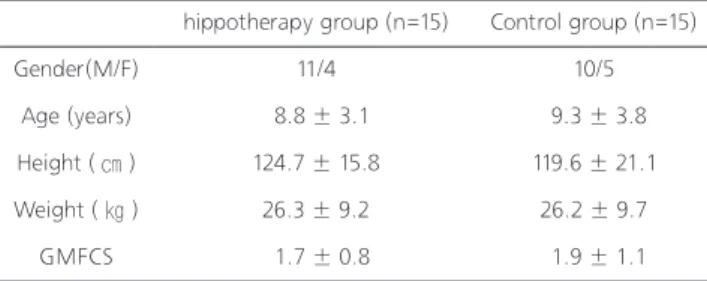
This study was conducted with 30 children with CP aged between 6∼15 years and diagnosed with spasticity diplegia CP at levels Ι∼IV in the Gross Motor Function Classification System (GMFCS),19 who were receiving physical therapy at a rehabilitation hospital located in S city furthermore, they could walk independently or with assistance (walker or protector’s assistance), and could stand while holding a walker. All the children with CP and their protectors received sufficient explanations regarding the purpose and method of the study and voluntarily agreed to participate in the experiment. The subjects’ general characteristics are provided in Table 1.
2. Method
1) Experimental design
This study was conducted to examine the effects of postural control training using horseback riding simulation on children with CP, and a spinal structure analysis system was used to compare a group that conducted the horseback riding simulation exercise and a group that did not conduct the horseback riding simulation exercise.
Both the control group and the hippotherapy group received neurodevelopmental treatment (NDT) for 30 minutes per session, four times per week for ten weeks, while the experimental group also received hippotherapy for 15 minutes per session, four times per week for ten weeks, after the NDT.
The horseback riding simulators (JOBA, EU7805, Panasonic) used in this study simulated actual horse movements. The 30 selected subjects were randomly assigned to the control group or the hippotherapy group. All the subjects were treated by therapists with at least five years of experience in physical therapy and who had completed an NDT course.
hippotherapy group (n=15) Control group (n=15)
Gender(M/F) 11/4 10/5
Age (years) 8.8 ± 3.1 9.3 ± 3.8
Height ( ㎝ ) 124.7 ± 15.8 119.6 ± 21.1
Weight ( ㎏ ) 26.3 ± 9.2 26.2 ± 9.7
GMFCS 1.7 ± 0.8 1.9 ± 1.1
Table 1. General characteristics of subjects
Mean ± Standard Deviation
2) Experimental tool
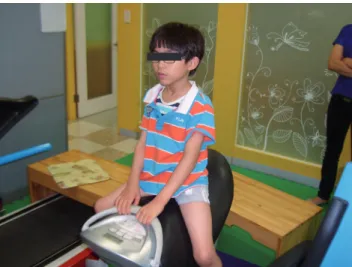
The horseback riding simulator JOBA was designed so that diverse three dimensional movements (forward/backward, leftward/rightward, and upward/downward), similar to the movements of a live horse, could be experienced through figure eight shaped movements using five axes. In this study, exercises that fit the children’s characteristics, such as side- to-side, waist, and hips, were implemented for 15 minutes according to the program loaded in the JOBA simulator. The children were allowed to control their posture, were instructed to maintain tension in their cervical spine so that they could keep their back accurately upright when they were sitting on the saddle, and were instructed to hold the handles using their upper extremities while they were sitting on the horseback riding simulator.
During the horseback riding simulation treatment, for the safety of the participating children, the exercise was implemented with one physical therapist and one volunteer or protector assisting each child. The level of difficulty for the exercise was increased with regard to each child’s adaptation capacity and the intensity of the exercise by gradually increasing the speed of the seat movements up to level 4 (Figure 1).
3) Measuring tools
Spinal posture was examined using a four-dimensional image processor (ABW Mapper, ABW. Inc, Germany) developed by the Institute of Bioengineering at the Münster Medical College in Germany, and it was used to conduct anatomical calculations of trunk imbalance, pelvic torsion, and pelvic tilt.20 After taking off his or her top, each subject was instructed to completely expose his or her back to the camera and stand on the foot plate. While taking the images, errors due to movements were prevented and the measurement was conducted in an indoor location, in postures at normal times after designating the positions of the feet.
A photo was taken, in a short time of 0.04 sec, and only the necessary part was left in each subject’s photo and recorded in the computer. The photo was automatically analyzed to find a symmetric line by analyzing the curve of the surface of the back. This line is quite similar to the line that connects
the spinous processes. Thereafter, the surface of the back was analyzed to find the four anatomical peaks that is, the vertebra prominens C7 (VP), the sacrum point (SP), two dimples (DM, DR), and the condition of the pelvis were analyzed based on the four anatomical peaks.21 The criteria for diagnosis after measurement were those established in Germany after examining 400 children and youths aged 11∼16 years, and the normal criteria ranges are shown in Table 2.
3. Data analysis
All the data values from the spinal posture tests conducted in this study were analyzed using the SPSS (ver. 12.0 for Windows) statistical program. Individual data showed normal distributions in normality tests conducted using the Kolmogorov-Smirnov (K-S) Goodness-of-Fit Test, and thus parametric tests were conducted. Two-way repeated ANOVAs were conducted to test the significance of the changes over time in each group and the significance of the differences between the two groups, and a significance level of α=0.05 was set for the tests.
Figure1. Horseback riding simulator
Measurement range Normal reference range
Trunk imbalance ( ㎜ ) -7 ∼ 7
Pelvic torsion (°) -2 ∼ 2
Pelvic tilt ( ㎜ ) -4 ∼ 4
Table 2. Measurement range and normal reference range
III. Results
The Intragroup effects on trunk imbalance over the exercise period were tested, and the results showed significant differences in the effects of interactions between the groups and the period (p<0.05)(Figure 2).
The Intragroup effects on pelvic torsion over the exercise period were tested, and the results showed significant differences in the effects of interactions between the groups and the period (p<0.05)(Figure 3).
The Intragroup effects on pelvic tilt over the exercise period were tested, and the results showed significant differences in the effects of interactions between the groups and the period (p<0.05)(Figure 4).
IV. Discussion
In the spinal structure analysis, the intragroup effects on trunk imbalance over the exercise period were tested, and the results showed significant differences in the effects of interactions between the groups and the period (p<0.05).
The trunk imbalance and the back slope of the human spine when viewed been tilted to the left or to the right shows how.21 Trunk imbalance used to measure the slope of the four points of the VP (vertebra prominence: the seventh cervical vertebra), SP (Sacrum Point), both PSIS (Posterior Superior Iliac spine). DL is also left lumbar dimple, DR is right lumbar dimple, DM lumbar dimple in the center of the left and right means trunk imbalance of the VP trunk length or angle of deviation from the DM. According to Oh et al.21 a group treated with rehabilitation exercises for 18 weeks showed improvement in the trunk inclination and trunk balance, which gradually became closer to the normal state. Kim et al.22 analyzed the curve of the surface of the back using an ABW Mapper to determine the symmetric line and measured and analyzed the inclination of the trunk based on the four anatomical peaks. They found that the angles of trunk imbalance decreased in the exercise group that participated in an 18 week spinal rehabilitation program, and the difference was significant. Therefore, the results were consistent with the results of this study (p<0.05). These results are considered attributable to the fact that body alignment was improved during horseback riding activities because the convulsion necessary to get on/off the horse decreased, the range of movement increased, and the abnormal movements decreased during the activities.23 The results are also related Figure2. The comparison of trunk imbalance among groups
Period: P<0.01 period × Group : P<0.1 Group: p>0.05
Figure3. The comparison of pelvic torsion among groups Period: p<0.001
period × Group : p<0.01 Group: p>0.05
Figure4. The comparison of pelvic tilt among groups Period: p<0.001
Period × Group : p<0.001 Group: p>0.05
to changes in the scoliosis and curvature of the back due to the symmetry and balance of the lateral tilting and forward/
backward tilting postures achieved by the activities, as shown in a study conducted by Im and Han.24
PSIS on both sides of the pelvis torsion at the pelvic rotation is made at right angles to the line, refers to both the degree of twisting of the pelvis, 0° is the ideal figure, and the large deviation is abnormal.21 The Intragroup effects on pelvic torsion over the exercise period were tested, and the results showed significant differences in the effects of interactions between the groups and the period (p<0.05). This is because the adductor muscles of the lower extremities were relaxed and the lumbar and abdominal muscles were reinforced while the subject was sitting on the horseback riding simulator Jeong et al.25 advised that the three-dimensional dynamic exercises that occur when the horse is walking can induce the same movements in the pelvis of the person riding the horse and forces the person to use muscles that are not used at normal times.
Pelvic tilt on the horizon tilted downward or upward with respect to this cross-section of both pelvic height (left / right the line connect PSIS) by comparing the difference in leg length write (paired legs) means the 0° is the ideal figure, and the large deviation is abnormal.21
The Intragroup effects on pelvic tilt over the exercise period were tested, and the results showed significant differences in the effects of interactions between the groups and the period (p<0.05). As presented in RDA-Samsung26 this is considered to be attributable to the effort to maintain correct posture while relaxing the body, which improved the ability to maintain posture and balance.25 Fleck27 advised that the movements of the pelvis during horseback riding exercises stimulate balance and postural control because they are similar to the movements of the pelvis of the humans during walking, and the three-dimensional movements and the changes in the center of gravity help children with CP to experience normal movements for the first time, which affects the pelvic torsion. A study conducted by Jeong28 reported increases in symmetry in the shoulder, scapular, spinal, and pelvic postures on the Posture Assessment Scale (PAS), which was used to measure the quality of postural control
and symmetry after applying hippotherapy to children with CP. As with previous studies, the horseback riding simulation exercise program used in this study led to significant differences in spinal structure analyses. Therefore, horseback riding simulation exercise programs that show increases in symmetry are considered to be useful for children with CP regarding the improvement of spinal structures characterized by asymmetry.
In this study, balance increased in order to maintain the balance of the body on the horseback simulator, and the movements of the body were remembered. The memories of the movements were used to make movements to control posture. That is, when the four extremities were moved swiftly, the center of gravity moved and a repulsive force was generated and caused postural sways in the entire body, including the vertebral column.29 Then, the basal ganglia, the supplementary motor area, and the primary motor area on the opposite side of the agonistic muscles proactively activate the posture controlling muscles and provide timing signals for agonistic muscle contraction.30 When this proactive postural control has been learned, stable kinesthetic memories are constructed in the central nervous system so that posture can be controlled for movements even without any afferent input.31 In this study showed that, a horseback riding simulation exercise is considered to be a very useful treatment tool for children with CP.
Therefore, what is the difference between horseback riding simulation exercise NDT treatment and lack of movement of the pelvis with cerebral palsy before and after side-to-side movements of the pelvis for children ambulatory movements and then at regular intervals. Scapular, spine and pelvis also induces the alignment of children with CP, asymmetrical posture control and can bring an increase in the balance.
However, the child's age or mechanical difficulties in the movement of children and do not use your hands to hold can falling children risk of disadvantage, and movements can be somewhat tedious to many children.
The limitations of this study include the fact that the type and personal characteristics of the children with CP were not sufficiently considered; furthermore, the information obtained in this study cannot be generalized to all children with CP
because the number of children who participated in this study was small. In future studies, a larger number of children with CP should be divided by type and studied further. In conclusion, the horseback riding simulation exercise was found to be effective for improving the spinal alignment of children with CP. Therefore, additional studies should be conducted with more children with CP divided by type. According to the results of this study, a horseback riding simulation exercise, it can help improve the children’s spinal alignment and enhance clinical applicability.
References
1. Rosenbaum P, Paneth N, Leviton A et al. A report; the definition and classification of cerebral palsy April 2006. Developmental Medicine & Child Neurology. 2007;49(109):8-14.
2. Choi HJ, Nam KW. The effect of weight-support treadmill training on the balance and activity of daily living of children with spastic diplegia. J Korean Soc Phys Ther. 2012;24(6):398- 404.
3. Nam KS, Lee HY. Differences of chest and waist circumferences in spastic diplegia and hemiplegic cerebral palsy. J Korean Soc Phys Ther. 2013;25(3):155-9.
4. Lee HY. K K. Cha YJ. A survey on stress and coping style in mothers of cerebral palsied children. J Korean Soc Phys Ther.
2012;24(2):98-106.
5. Massion J, Alexandrov A, Frolov A. Why and how are posture and movement coordinated? Prog Brain Res. 2004;143:13-27.
6. Benda W, McGibbon NH, Grant KL. Improvements in muscle symmetry in children with cerebral palsy after equine-assisted therapy(hippotherapy). Journal of Alternative Complement Med.
2003;9(6):817-25.
7. Van der Heide JC, Fock JM, Otten B et al. Kinematic characteristics of postural control during reaching in preterm children with cerebral palsy. Pediatric Res. 2005;58(3):586-93.
8. Ferdjallah M, Harris GF, Smith P et al. Analysis of postural control synergies during quiet standing in healthy children and children with cerebral palsy. Clin Biomech. 2002;17(3):203-10.
9. Kolar P, Neuwirth J, Sanda J et al. Analysis of diaphragm movement during tidal breathing and during its activation while breath holding using MRI synchronized with spirometry. Physiol Res. 2009;58(3):383-92.
10. Kang HK, Chang SK. The effect of robo-horseback riding exercise on trunk muscle activity ratios in patients with low back pain. J Korean Soc Phys Ther. 2012;24(6):393-7.
11. Cho WS, Kim YN, Park JS et al. The effects of ability to balance
posture and proprioception by horse riding simulator and galvanic vestibular stimulation. Phys Ther Kor. 2012;19(2):39- 47.
12. McGee M, Reese NB. Immediate effects of a hippotherapy session on gait parameters in children with spastic cerebral palsy. Pediatr Phys Ther. 2009;21(2):212-18.
13. Lee KS, Kim CS. The effects on medio-lateral balance to head rotation in stroke patient. J Korean Soc Phys Ther.
2012;24(5)334-9.
14. McGibbon NH, Benda W, Duncan BR et al. Immediate and long- term effects of hippotherapy on symmetry of adductor muscle activity and functional ability in children with spastic cerebral palsy. Arch Phys Med Rehabil 2009;90(6); 966-974.
15. Bertoti DB. Effect of therapeutic horseback riding on posture in children with cerebral palsy. Physical Therapy. 1988;68(10):1505- 12.
16. Lim JH, Park JS, Cho WS. The effect of mechanical horseback- riding training velocity on vestibular functions and static postural balance in healthy adults. J Korean Soc Phys Ther.
2013;25(5):288-96.
17. Kang KY, Song BH. Effects of horseback riding simulation machine training on gross motor function for the children with cerebral palsy. J. of Contents Association. 2010;10(5):277-84.
18. Kolar P, Sulc J Kyncl M et al. Postural function of the diaphragm in persons with and without chronic low back pain.
J Orthop Sports Phys Ther. 2011;42(4); 352-362.
19. Jung JW, Ko JY. Development of the chest wall in children with cerebral palsy according to GMFCS levels. J Korean Soc Phys Ther. 2013;25(5):246-51.
20. Lim JH. Correlation of symmetry on the trunk muscle thickness by gender with the spinal alignment in healthy adults. J Korean Soc Phys Ther. 2013;25(6):405-10.
21. Oh YP. The effects of vertebra rehabilitation exercise on vertebra posture and function of motion in the cerebral palsy. Kook Min University. Dissertation of Doctorate Degree. 2003.
22. Kim NI, Oh YP. Youn SH. The effects of the vertebra rehabilitation exercise program on vertebra posture and flexibility in the individuals with cerebral palsy. Korea J of Sports Science. 2006;15(1):557-68.
23. Kim MK. Effects of horseback riding simulation exercise on gross motor function and balance in children with cerebral palsy. Catholic University. Dissertation of Master’s Degree.
2012.
24. Lim SG, Han SH. The Effects of Horse Riding on Posture and Figure in Children with Mental Retardation. Journal of special physical education, Youngin University. 2004;(2):97-106.
25. Jung SH. The effects of handicapped horse racing activities to equilibrium and back bone posture of the children in cerebral palsy. Yong-In University, Dissertation of Master’s Degree.
2010.
26. RDA-samsung. Riding for the disabled. Samsung Equestrian Team. 2002.
27. Fleck CA. Hippotherapy mechanics of human walking and horseback riding. In: Engel BT, ed. Rehabilitation with the Aid of the Horse: A Collection of Studies. Durango, CO: Barbara Engel Therapy Services. 1992.
28. Jung JH, Yu JH. The effects of hippotherapy over 8 weeks ontrunk proprioception, stability and posture in cerebral palsy patients. J Korean Soc Phys Ther. 2010;22(5):63-70.
29. Bouisset S, Zattara M. Biomechanical study of the programming of anticipatory postural adjustments associated with voluntary movement. J Biomech. 1987;20(8):735-42.
30. Massion J, Ioffe M, Schmitz C et al. Acquisition of anticipatory postural adjustments in a bimanual load-lifting task: normal and pathological aspects. Exp Brain Res. 1999;128(1-2):229-35.
31. Forget R, Lamarre Y. Postural adjustments associated with different unloadings of the forearm: effects of proprioceptive and cutaneous afferent deprivation. Can J Physio Pharmacol.
1995;73(2):285-94.