Changes in Serum Concentrations of Insulin-like Growth Factor Binding Protein-3 after General Anesthesia Using Propofol or Isoflurane
Jae Hee Woo, Jong Hak Kim, Hee Jung Baik, Minjin Lee, Youn Jin Kim
Department of Anesthesiology and Pain Medicine, Ewha Womans University College of Medicine, Seoul, Korea
Introduction
To determine the risk associated with anesthesia and surgery, anesthesiologists have focused on the issues of mortality and major morbidity such as myocardiac infarction, pneumonia and renal failure. Recently several studies have suggested that anes- thesia itself can affect the endocrine and immunologic system, which has been underestimated traditionally. The alteration of
endocrine and/or immunologic system occurs during periopera- tive period and affects the prognosis of the patients’ chronic underlying disease including malignant conditions [1-3]. Also, the excessive protein catabolism following major surgery is a main cause of morbidity and can lead to delay in recovery.
The insulin-like growth factors (IGFs) circulate in high con- centrations bound to insulin-like growth factor binding proteins (IGFBPs). The IGFs, as a major regulating factor of cell dif-
Article
eISSN 2234-2591Objectives: The insulin-like growth factor binding proteins (IGFBP) regulate the bio- availability and bioactivity of insulin-like growth factor. We aimed to evaluate whether the IGFBP-3 level undergo major changes during perioperative periods according to the different kind of anesthetic agents.
Methods: Eighteen adults scheduled for elective total abdominal hysterectomy were enrolled. The patients were randomly assigned to have either propofol or isoflurane for maintenance of general anesthesia. A venous sample was taken for analysis of IGFBP-3 at the following time points: before induction, at the time of peritoneal closure, 1 hour after extubation at recovery room, and 2 and 5 postoperative days. The samples were analyzed by enzyme linked immunosolvent assay.
Results: Demographic data were similar between groups. In the both groups, the IGFBP-3 concentration decreased after anesthesia induction, reaching a nadir at the time of peritoneal closure without a significant difference between groups. In analysis between groups, the IGFBP-3 concentration in the isoflurane group on the postopera- tive 5th day was recovered to preoperative value and significantly higher than that in the propofol group (P<0.05).
Conclusion: This is the first study to show that the anesthetics used for general anes- thesia affect the IGFBP-3 level during perioperative periods. The decrease of IGFBP-3 level following anesthesia induction in the isoflurane group was recovered to preop- erative value, whereas that observed in the propofol group was not recovered on the postoperative 5th day. Further study is needed to establish the definitive effect of gen- eral anesthetics on IGFBP-3 and provide a comprehensive interpretation. (Ewha Med J 2018;41(1):8-12)
Received December 18, 2017 Revised January 17, 2018 Accepted January 22, 2018 Corresponding author Youn Jin Kim
Department of Anesthesiology and Pain Medicine, Ewha Womans University College of Medicine, 1071 Anyangcheon-ro, Yangcheon- gu, Seoul 07985, Korea
Tel: 82-2-2650-5285, Fax: 82-2-2655-2924 Email: [email protected]
Key Words
Anesthesia, general; Insulin-like growth factor binding protein 3; Isoflurane;
Propofol
This is an Open Access article distributed under the terms of the Creative Commons Attribution Non-Commercial License (http://creativecommons.org/licenses/by-nc/4.0) which permits unrestricted non-commercial use, distribution, and reproduction in any medium, provided the original work is properly cited.
ferentiation, play a role to improve nitrogen retention, induce a wound recovery and is closely associated with a variety of con- ditions [4-7]. The IGFBPs transport IGFs and regulate the bio- availability and bioactivity of IGF, although the role of IGFBPs has not been fully understood. IGFBPs may either inhibit or potentiate IGF-mediated cell growth and metabolism depending on its concentration, cellular environment and post-translation modifications. To date, six different IGFBPs have been recog- nized. Because more than 95% of plasma IGFs are bound by IGFBP-3 together with the acid-labile subunit, many studies have focused on mainly IGFBP-3 [8,9].
Previous studies [10,11] suggested that the surgery could af- fect IGF and IGFBP profiles, however, no study has assessed the effect of the anesthetics used during surgery on the IGFBP.
Therefore, in this study, we aimed to evaluate whether the IGFBP-3 level undergo major changes during perioperative pe- riods according to the different anesthetic agents (propofol or isoflurane).
Methods
Eighteen adult American Society of Anesthesiologists physical status I–II patients scheduled for elective total abdominal hyster- ectomy due to uterine myoma were enrolled. The patients who had a history of renal, hepatic, endocrine, metabolic disturbanc- es, malnutrition, receiving hormone medication, known allergies to any anesthetic drugs and pregnancy women were excluded.
Patients were assigned randomly to have either propofol (n=9) or isoflurane (n=9) for maintenance of general anesthe- sia using a computer-generated randomization table. All patients were fasted for 8 hours before surgery and were premedicated with midazolam 0.05 mg/kg, glycopyrrolate 0.2 mg 1 hour be- fore surgery. On arrival in operation room, standard American Society of Anesthesiologists monitors were used throughout the surgery. In the propofol group, general anesthesia was induced with intravenous propofol (Fresofol MCT 2%, 20 mg/mL;
Fresenius KABI, Graz, Austria), which was also used for intra- operative maintenance as a continuous infusion with a bolus of fentanyl 1 to 2 μg/kg. In the Isoflurane group, anesthesia was induced with 250 mg of thiopental sodium, fentanyl 1 to 2 μg/kg and maintained with inhalation of isoflurane. Tracheal intuba- tion was facilitated with 0.5 mg/kg of vecuronium, which was also administered as subsequent incremental doses according to
the requirements of the surgical procedure in the both groups.
After tracheal intubation, ventilation was controlled to maintain end-tidal concentration of CO2 kept between 35 and 45 mmHg by adjusting the tidal volume with 50% nitrous oxide in oxygen using a fresh gas flow of 3 L/min. During an operation, the propofol and isoflurane were titrated to achieve bispectral index value between 40 and 60. Patients were extubated in the oper- ating room after reversal of the residual muscle relaxation and transferred to the recovery room.
A 5 mL venous sample was taken for analysis of IGFBP-3 at the following time points: before induction, at the time of peritoneal closure, 1 hour after extubation at recovery room, and 2 and 5 postoperative days. The samples were collected and immediately centrifuged at 400 g for 15 minutes, and the serum was stored at -70oC until analyzed. The IGFBP-3 was determined by commercial ELISA (enzyme-linked immuno- sorbent assay) kit supplied by Diagnostic Systems Laboratories (Webster, TX, USA). Its detection limit was 0.04 ng/mL. Intra- and inter-assay coefficients of variation were 9.6% and 11.4%, respectively.
PASW Statistics ver. 18.0 (SPSS Inc., Chicago, IL, USA) was used for statistical analysis. The Kolmogorov-Smirnov was used to test a normal distribution of data. Discrete variables were analyzed with Fisher’s exact test. The Student’s t-test was used for comparing the IGFBP-3 concentration between groups. The repeated measures of analysis of variance was used for analyzing the IGFBP-3 concentration within each group. All results are presented as mean±standard deviation. Statistical significance was considered when the P-value was less than 0.05.
Results
Demographic and perioperative data including age, weight, body mass index, operation and anesthesia time and baseline blood sugar level were similar between groups (Table 1).
The levels of IGFBP-3 before induction were 4,070.00±
773.48 μg/L in the propofol group and 4,341.22±791.70 μg/L in the isoflurane group, which were similar between groups. The average concentration of IGFBP-3 in all patients was 4,205.61
±771.99 μg/L (range, 2,619 to 5,331 μg/L). In analysis within the propofol group, the IGFBP-3 concentration decreased throughout the study period, however, there was no statistically significance. In the isoflurane group, the IGFBP-3 concentra-
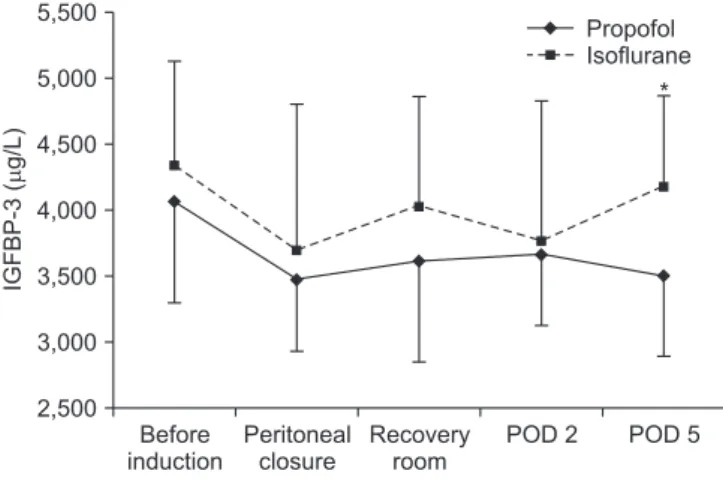
tion decreased after anesthesia induction, which also has no statistically significance. In both groups, the IGFBP-3 reached a nadir at the time of peritoneal closure. On the postoperative 5th day, the decreased concentration of IGFBP-3 in the isoflurane group was returned to preoperative value, whereas that in the propofol group was not recovered. There was a significant dif- ference of the IGFBP-3 concentration between groups on the postoperative 5th day (P<0.05) (Fig. 1).
Discussion
A decreasing tendency of IGFBP-3 after anesthesia induc- tion was observed without a statistically significant difference.
Our study suggests that a different kind of general anesthesia agents can induce different effects on the IGFBP-3 level judg- ing from the results that the decreased level of IGFBP-3 in the isoflurane group was recovered to preoperative value, whereas that observed in the propofol group was not recovered on the postoperative 5th day.
It has known that the IGFBP-3 level is not affected by the short-term fasting, circadian patterns or menstrual cycles [12- 14]. It shows a steady age-dependent increase, peaking in the puberty, then declining slowly throughout adult life [15]. The different range of age of the both groups is considered to affect minimal effects on our results because the demographic data was similar in both groups.
In the previous study comparing the effects of surgery with those of fasting alone without surgery on the IGFBP-3 pro-
files, Davenport et al. [10] reported that the level of IGFBP-3 decreased markedly 2 days postoperatively and surgical factors other than nutritional factors were the principal regulators of the postoperative changes of IGFBP-3. The present study was designed to conduct in patients undergoing hysterectomy due to uterine myoma. Noh and Kim [16] described that the level of IGFBP-3 during perioperative periods did not differ between the healthy women and myoma patients. In that sense, it is thought that our results can be extended to that in the healthy women populations. The results by Noh and Kim [16] showed that the concentration of IGFBP-3 decreased 2 days postop- eratively and returned to preoperative value on 6 days postop- eratively, which is consistent with our results in the isoflurane group and previous data [10]. The study conducting in aged 30 to 70 years old patients, undergoing colorectal surgery by Cot- terill et al. [11] showed that the IGFBP-3 level fell from the anesthesia induction and recovered to preoperative valued at 6 weeks. The discrepancy in the time of recovery to preopera- tive values may be attributable to surgical invasiveness, inclusion of old age populations and the anesthetics used for their study.
The enflurane was used for anesthesia in their study by Cotterill et al. [11] and the others [10,16] did not indicate the anesthet- ics used for their study. It has been suggested that a decrease of the IGFBP-3 might make IGF more available for tissue up- Table 1. Demographic and perioperative data
Propofol (n=9) Isoflurane (n=9)
Age (yr) 46.56±3.00
(42–49)
42.78±6.24 (34–51)
Weight (kg) 61.3±6.72 62.01±9.66
Height (cm) 157.94±7.12 154.41±2.82
BMI (kg/m2) 24.57±2.10 25.94±3.41
ASA (I/II) 7/2 8/1
Operation time (min) 150.00±33.63 128.89±22.88 Anesthetic time (min) 168.89±31.20 150.00±26.69 Blood glucose (mg/dL) 100.44±17.59 96.67±11.47 Values are presented as mean±standard deviation (range), mean±
standard deviation, or number. No significant differences were noted between groups.
BMI, body mass index; ASA, American Society of Anesthesiologists.
Fig. 1. The changes in serum insulin-like growth factor binding pro- tein (IGFBP)-3 concentrations in propofol and isoflurane group before induction, at the closure of peritoneum, 1 hour, 2 and 5 days follow- ing surgery. The IGFBP-3 concentration did not change significantly throughout the study period within each group, however, there was a significant difference of the IGFBP-3 concentration on the postopera- tive 5th day between groups. POD, postoperative day. *P<0.05 com- pared between groups.
IGFBP-3(g/L)
Before induction 5,500
5,000 4,500 4,000 3,500 3,000
2,500
Peritoneal closure
Recovery room
POD 2 POD 5
* Propofol Isoflurane
take and help to counteract the catabolic state induced during perioperative periods by enhancing tissue uptake of IGF-1. It is probably related to specific circulating protease activity directed against IGFBP-3 [17,18]. The decrease in the IGFBP-3 is also observed in critically ill patients [19]. Although we measured the IGFBP-3 level only until 5 days postoperatively, it could be speculated that the use of propofol during operation made the patients adapt better to the catabolic state than the use of iso- flurane. There is also a possibility that isoflurane might affect the proteolysis of IGFBP-3, which is observed in postoperative periods.
There are several limitations in our study. First, we designed the study in the relatively healthy patient population who does not have systemic disease besides uterine myoma. The pattern of IGFBP during severe illness is known to have major alterations when compared with that seen in the healthy patients [19]. The effect on endocrine system, which is associated with postopera- tive recovery and the progress of disease may be more impor- tant in critically ill patients than the healthy people. Second, we evaluated the effect on only IGFBP-3 and did not assess a cor- relation with the IGF. The IGFBP-3 is the major factor deter- mining circulating IGF levels and closely related to IGF. An IGF and IGFBP-3 complex was found to accelerate wound healing better than IGF alone [20]. Third, it has been suggested that enzymatic proteolysis of IGFBP-3 by an IGFBP-3 specific pro- tease after surgery might facilitate release of IGF and play a role to meet the extra demands. Additional evaluation about specific protease activity for IGFBP-3 may be valuable to understand the regulatory mechanism in the bioavailability of circulating IGF [17]. Fourthly, this study included a relatively small number of patients. Further study is needed to expand our results and provide a comprehensive interpretation.
In conclusion, this is the first study to show that the anesthet- ics used for general anesthesia can affect the IGFBP-3 level during perioperative periods. We have observed different pat- terns of perioperative IGFBP change when general anesthesia was maintained with propofol or isoflurane. Our results provide a basis for a randomized controlled trial in future investigations.
References
1. Hall GM, Peerbhoy D, Shenkin A, Parker CJ, Salmon P. Rela- tionship of the functional recovery after hip arthroplasty to the
neuroendocrine and inflammatory responses. Br J Anaesth 2001;87:537-542.
2. Cata JP, Bauer M, Sokari T, Ramirez MF, Mason D, Plautz G, et al.
Effects of surgery, general anesthesia, and perioperative epidural analgesia on the immune function of patients with non-small cell lung cancer. J Clin Anesth 2013;25:255-262.
3. Exadaktylos AK, Buggy DJ, Moriarty DC, Mascha E, Sessler DI.
Can anesthetic technique for primary breast cancer surgery af- fect recurrence or metastasis? Anesthesiology 2006;105:660-664.
4. Jones JI, Clemmons DR. Insulin-like growth factors and their binding proteins: biological actions. Endocr Rev 1995;16:3-34.
5. Duan C, Ren H, Gao S. Insulin-like growth factors (IGFs), IGF receptors, and IGF-binding proteins: roles in skeletal muscle growth and differentiation. Gen Comp Endocrinol 2010;167:344- 351.
6. Li C, Harada A, Oh Y. IGFBP-3 sensitizes antiestrogen-resistant breast cancer cells through interaction with GRP78. Cancer Lett 2012;325:200-206.
7. Galasso O, De Gori M, Nocera A, Brunetti A, Gasparini G. Regu- latory functions of insulin-like growth factor binding proteins in osteoarthritis. Int J Immunopathol Pharmacol 2011;24(1 Suppl 2):55-59.
8. Ranke MB, Elmlinger M. Functional role of insulin-like growth factor binding proteins. Horm Res 1997;48 Suppl 4:9-15.
9. Ooi GT, Herington AC. The biological and structural character- ization of specific serum binding proteins for the insulin-like growth factors. J Endocrinol 1988;118:7-18.
10. Davenport ML, Isley WL, Pucilowska JB, Pemberton LB, Lyman B, Underwood LE, et al. Insulin-like growth factor-binding pro- tein-3 proteolysis is induced after elective surgery. J Clin Endo- crinol Metab 1992;75:590-595.
11. Cotterill AM, Mendel P, Holly JM, Timmins AG, Camacho-Hub- ner C, Hughes SC, et al. The differential regulation of the circu- lating levels of the insulin-like growth factors and their binding proteins (IGFBP) 1, 2 and 3 after elective abdominal surgery.
Clin Endocrinol (Oxf) 1996;44:91-101.
12. Bereket A, Wilson TA, Blethen SL, Fan J, Frost RA, Gelato MC, et al. Effect of short-term fasting on free/dissociable insulin-like growth factor I concentrations in normal human serum. J Clin Endocrinol Metab 1996;81:4379-4384.
13. Jorgensen JO, Blum WF, Moller N, Ranke MB, Christiansen JS.
Circadian patterns of serum insulin-like growth factor (IGF) II and IGF binding protein 3 in growth hormone-deficient patients and age- and sex-matched normal subjects. Acta Endocrinol (Copenh) 1990;123:257-262.
14. Wang HS, Lee JD, Soong YK. Serum levels of insulin-like growth factor I and insulin-like growth factor-binding protein-1 and -3 in women with regular menstrual cycles. Fertil Steril 1995;63:1204- 1209.
15. Baxter RC, Martin JL. Radioimmunoassay of growth hormone- dependent insulinlike growth factor binding protein in human plasma. J Clin Invest 1986;78:1504-1512.
16. Noh KR, Kim JK. Insulin-like growth factor binding proteins
profiles in sera of patients with uterine myoma before and after hystrectomy. Korean J Obstet Gynecol 1998;41:1273-1283.
17. Cwyfan Hughes SC, Cotterill AM, Molloy AR, Cassell TB, Braude N, Hinds CJ, et al. The induction of specific proteases for insulin- like growth factor-binding proteins following major heart sur- gery. J Endocrinol 1992;135:135-145.
18. Miell JP, Taylor AM, Jones J, Buchanan CR, Rennie J, Sherwood R, et al. Administration of human recombinant insulin-like growth factor-I to patients following major gastrointestinal surgery. Clin
Endocrinol (Oxf) 1992;37:542-551.
19. Davies SC, Wass JA, Ross RJ, Cotterill AM, Buchanan CR, Coul- son VJ, et al. The induction of a specific protease for insulin-like growth factor binding protein-3 in the circulation during severe illness. J Endocrinol 1991;130:469-473.
20. Mueller RV, Spencer EM, Sommer A. The role of IGF-1 and IGFBP-3 in wound healing. In: Spencer EM, editor. Modern con- cepts of insulin-like growth factors. New York: Elsevier Science;
1991. p.185-192.