Evaluation of biogeneric design techniques with CEREC CAD/CAM system
Yeliz Arslan, Seçil Karakoca Nemli*, Merve Bankoğlu Güngör, Evşen Tamam, Handan Yılmaz
Department of Prosthodontics, Faculty of Dentistry, Gazi University, Ankara, Turkey
PURPOSE. The aim of this study was to evaluate occlusal contacts generated by 3 different biogeneric design modes (individual (BI), copy (BC), reference (BR)) of CEREC software and to assess the designs subjectively.
MATERIALS AND METHODS. Ten pairs of maxillary and mandibular casts were obtained from full dentate individuals. Gypsum cast contacts were quantified with articulating paper and digital impressions were taken.
Then, all ceramic crown preparation was performed on the left first molar teeth and digital impressions of prepared teeth were made. BI, BC, and BR crowns were designed. Occlusal images of designs including occlusal contacts were superimposed on the gypsum cast images and corresponding contacts were determined. Three designs were evaluated by the students. RESULTS. The results of the study revealed that there was significant difference among the number of contacts of gypsum cast and digital models (P<.05). The comparison of the percentage of virtual contacts of three crown designs which were identical to the contacts of original gypsum cast revealed that BI and BR designs showed significantly higher percentages of identical contacts compared with BC design (P<.05). Subjective assessment revealed that students generally found BI designs and BR designs natural regarding naturalness of fissure morphology and cusp shape and cusp tip position. For general occlusal morphology, student groups generally found BI design “too strong” or “perfect”, BC design ”too weak”, and BR design “perfect”. CONCLUSION. On a prepared tooth, three different biogeneric design modes of a CAD/CAM software reveals different crown designs regarding occlusal contacts and morphology. [J Adv Prosthodont 2015;7:431-6]
KEY WORDS: Crowns; Dental prosthesis design; Dental occlusion
INTRODUCTION
When restoring the occlusal surfaces of the posterior teeth, the common consensus include that the occlusal design of restorations should stay in harmonic relation to adjacent teeth, interference-free functioning occlusal contacts should be established, and natural looking morphology of the occclusal surface with functional fissures and cusps should
be provided.1-3 In fabrication of conventional cast or ceramic restorations, the accomplishment of these goals are expected from dental technician whereas occlusal design of computer-aided designed and computer-aided manufactured (CAD/CAM) restorations are generated by CAD software systems.1,2
At the beginning of development of CAD/CAM sys- tems, the software was based on designing a standard mor- phology, which needed individual adaptation.4-7 Then soft- ware systems were developed using algorithms to adjust the occlusal surface to the bite registrations.8,9 The most recent way to generate tooth morphology in CAD/CAM is the
“biogeneric tooth model”.1,2 This model is based on 3D data library of hundreds of scans of intact posterior human teeth.3 The biogeneric tooth model was first used to mathe- matically construct a missing surface of a tooth by analyz- ing remaining tooth substance for production of partial crowns, and inlays. The software developments led to reconstruct complete occlusal surface for crown restora-
Corresponding author:
Seçil Karakoca Nemli
Department of Prosthodontics, Faculty of Dentistry, Gazi University, Emek 8.cad. 82.sok, Ankara 06510, Turkey
Tel. 90 31 2203 4196: e-mail, [email protected]
Received April 22, 2015 / Last Revision September 28, 2015 / Accepted October 20, 2015
© 2015 The Korean Academy of Prosthodontics
This is an Open Access article distributed under the terms of the Creative Commons Attribution Non-Commercial License (http://creativecommons.
org/licenses/by-nc/3.0) which permits unrestricted non-commercial use, distribution, and reproduction in any medium, provided the original work is properly cited.
tions. In this case, the data for biogeneric reconstruction are gathered from the distal adjacent, antagonist, or contra- lateral teeth.2 While the efficiency of biogeneric tooth mod- el in generating CAD/CAM partial crowns with natural tooth morphology has been shown by previous studies1,3 limited knowledge still exists on the design and occlusal contacts of biogeneric mode even when the whole occlusal surface has been lost.
In restorative dentistry, understanding the nature of occlusal contacts of the natural dentition and reproducing the contacts on the restoration is important for durability of teeth as well for stabilization of mandible.10,11 From the clinical point of view, the goal is achieving a restoration which is optimally integrated into the stomatognathic sys- tem, biologically compatible, esthetically pleasant, and requiring reduced time expenditure in insertion of the res- toration without clinical adjustments. Therefore, designing a restoration with natural occlusal morphology as well as accurately reproducing clinical contacts is expected from CAD/CAM software.
The aim of this study was to evaluate the accuracy of digital occlusal contacts virtually generated by 3 different biogeneric design modes - biogeneric individual (BI), bioge- neric copy (BC), biogeneric reference (BR) - of Cerec (Cerec, Sirona Dental Systems, Bensheim, Germany) CAD/
CAM system and to subjectively assess their efficiency in designing natural morphology of a crown.
MATERIALS AND METHODS
Ten pairs of maxillary and mandibular stone casts (Die Keen, HeraeusKulzer, Armonk, NY, USA) with full denti- tion, representing clinically stable interocclusal relation- ships, no prosthetic or orthodontic appliances and minimal or no occlusal wear were obtained from subjects ranging in age from 18 to 29. All participants agreed to participate in the study by written informed consent. The study was approved by the Ethics Committee of the University of Ankara. The casts were mounted in semi-adjustable articu- lators (Stratos 100, IvoclarVivadent, Schaan, Liechtenstein) in maximum intercuspal position to serve as patient simula- tion models. One articulator was provided for each pair of casts and the casts were not removed during the study.
Identification of occlusal contacts of casts in maximum intercuspal position was performed with 8 µm articulating paper (Arti-Fol BK 25 Red, Dr. Jean Baush, Cologne, Germany). All ceramic crown preparation was performed on the left man- dibular first molar tooth of each casts. All teeth were pre- pared with an occlusal reduction of 2 mm, an axial reduc- tion of 1 mm, and a finish line located below the supragin- gival field. Three digital impressions were taken from each cast using an intraoral scanner (CEREC Omnicam, Sirona Dental Systems, Bensheim, Germany). First digital impres- sions were taken from left one-half the mandibular casts to obtain unprepared tooth morphology and original occlusal contacts of the left first molar teeth. Screenshot images of the virtual casts with the indicated occlusal contacts were
saved as JPEG files. Second digital impressions were taken from left one-half the mandibular and maxillary casts, and buccal bite image was taken covering the second premolars and first molars when the articulator was closed into maxi- mum intercuspal position. Virtual 3D models of each cast pair were generated by the CAD software (inLab SW 4.2, Sirona Dental Systems, Bensheim, Germany) on the com- puter screen. Using the buccal image, the software calculat- ed maximum intercuspal position. The virtual contacts cal- culated by the software were visualized on the screen.
Screenshot images of the virtual casts with the virtual occlusal contacts were saved as JPEG files.
Third digital impressions were taken from left one-half the mandibular casts including prepared first molar, left one-half the maxillary casts, and buccal side of the casts when they were set into maximum intercuspal position.
After virtual 3D models of each cast pair were generated by the CAD software, their maximum intercuspal position were calculated using buccal images, the model axis were set, and restoration margins were determined. For each vir- tual model, three crowns were designed using biogeneric individual (BI), biogeneric copy (BC), biogeneric reference (BR) design modes of the software. Manual adjustments were not made on the designs which were suggested by the software. Screenshot images of the virtual casts with the virtual occlusal contacts were saved as JPEG files. Also, screenshot images of the virtual casts without the virtual occlusal contacts were saved as JPEG files.
In order to analyze the congruence of the indicated contacts of the gypsum casts with the virtual occlusal con- tacts of the virtual casts aligned into maximum intercuspal position by the CAD software before tooth preparation, the screenshot images of the virtual casts were superimposed onto the screenshot images of the casts with the indicated occlusal contacts in a transparent manner using the an image processing program (Adobe Photoshop CS4, Adobe systems, San Cos, CA, USA) as described previously.12 The number of the contacts of the virtual mandibular first molar that were identical with the contacts of the gypsum casts was determined. Also, in order to analyze the congru- ence of virtual occlusal contacts of the designed crowns using BI, BR, and BC design modes with the contacts of unprepared tooth, the screenshot images of the virtual crown was superimposed onto the screenshot images of the virtual casts with the indicated occlusal contacts. The number of the contacts of the designed mandibular first molar crowns that were identical with the contacts of the gypsum casts was determined and calculated as percentages in relation to the gypsum cast contacts to analyze the con- gruence.
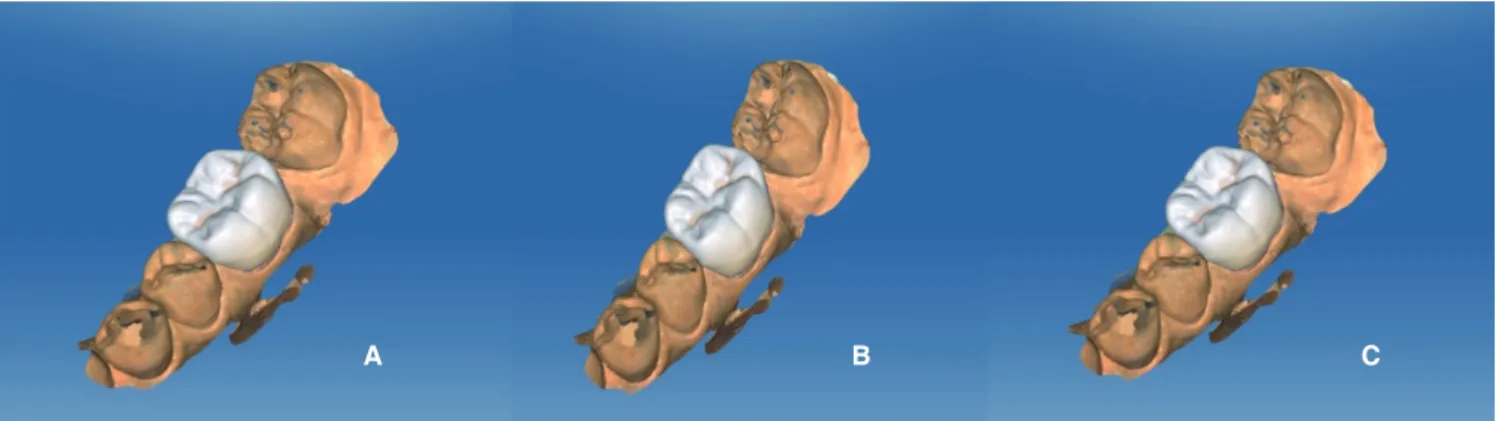
After obtaining the screenshot images of the designed crowns with occlusal contacts, the occlusal contacts were made imperceptible using “display object” tool of the soft- ware and screenshot images were saved as JPEG files. Three designs of each prepared tooth were displayed on the screen. To assess naturalness of the morphology, three designs were evaluated by visual judgment in a double-blind
test. For this purpose, three crown designs were displayed in one monitor adjacently (A, B, and C) (Fig. 1). Each crown design was presented with all three designs. No exte- rior clue was given with respect to the type of design as seen in Fig. 1. Twenty one postgraduate students and 50 final year undergraduate students of dental school com- pared the naturalness of the morphology of each restora- tion by answering the questionnaire shown in Fig. 2.
Spearman rank correlation coefficient were estimated to determine the relationship between number of occlusal contacts identified on original gypsum cast and occlusal contacts of virtual models for the left mandibular first molar tooth.
Repeated measurements of Analysis of Variance (ANOVA) test was used to compare the number of virtual contacts of BI, BR, and BC crowns which were identical to the contacts of original gypsum cast. Duncan multiple range test was used to determine any significant differences among the groups. P values less than 0.05 were considered to be statis- tically significant in all tests.
The frequency distribution of the responses to the questionnaires for naturalness of fissure morphology, cusp shape and cusp tip position, and overall occlusal morpholo-
gy was calculated. For all statistical tests, SPSS Statistics for Windows Version 19.0 (IBM Corp., Armonk, NY, USA) was used.
RESULTS
There was a significant difference between the number of occlusal contacts identified on original gypsum cast and occlusal contacts of virtual models of the left mandibular first molar tooth (P < 0.05). The occlusal contacts of virtu- al models which were determined by CAD software showed
%66 similarities with the contacts of original gypsum casts before tooth preparation.
The comparison of the percentage of virtual contacts of three crown designs performed by means of BI, BR, and BC design modes which were identical to the contacts of original gypsum cast revealed that BC group showed sta- tistically significantly lower percentage of identical contacts compared with BI and BR groups (P < 0.05). The differ- ence was not significant between BI and BR groups (P >
0.05). The mean and standard deviation for each design are shown in Table 1.
Table 2 and Table 3 present the results of the visual
A B C
Fig. 1. Crown designs for each design mode. (A) Biogeneric individual (BI), (B) Biogeneric copy (BC), (C) Biogeneric reference (BR).
Fig. 2. Questionnaire to assess the naturalness of occlusal morphology of the restoration designs.
assessment of morphology of three crown designs by post- graduate and undergraduate students. In terms of natural- ness of fissure morphology, postgraduate students general- ly found BI designs the most natural design and followed by BR designs, while undergraduate students generally indi- cated BR design as the most natural followed by BI design (Table 2). Fissure morphology of BC design was not found natural both student groups.
For the question regarding naturalness of cusp shape and cusp tip position, postgraduate students found both BI and BR designs natural. Undergraduate students also report- ed similar results for naturalness of cusp shape and cusp tip position. BC design was not found natural by both student groups.
The results of assessment of occlusal morphology are shown in Table 3. Postgraduate students generally found BI design “too strong” or “perfect”, BC design “too weak”, and BR design “perfect”. Most of undergraduate students found BI design “too strong”, BC design “too weak”, and BR design “perfect”.
DISCUSSION
An essential step in CAD/CAM fabrication of posterior full crowns is occlusal design including harmonious con- tacts with natural dentition and natural looking morpholo- gy. Designing such a crown in a short time is also important in a chairside treatment approach.13 Therefore, this study evaluated occlusal contacts and naturalness and morpholo- gy of crown designs made by CAD software before any manual modification.
In the present study the number of occlusal contacts identified on original gypsum cast and occlusal contacts of virtual models of the left mandibular first molar tooth were compared to find out the ability of the software to align virtual casts into maximum intercuspal position. The occlu- sal contacts of virtual models showed 66% similarities with the contacts of original gypsum casts before tooth prepara- tion. This finding suggests that algorithms for matching virtual models into maximum intercuspal position might be Table 1. The mean and standard deviation for each
design of percent similarity with original cast
Design N Mean ± SD
BI 10 0.55 ± 0.26A
BC 10 0.14 ± 0.21B
BR 10 0.54 ± 0.22A
Different capital letters indicate significant differences (P<.05).
Table 2. The results of the naturalness of fissure morphology and cusp shape and cusp tip position
Question 1 (Naturalness of fissure morphology) Question 2 (Naturalness of cusp shape and cusp tip position) Design Postgraduate
students (%)
Undergraduate
students (%) Total (%) Postgraduate
students (%)
Undergraduate
students (%) Total (%)
BI 0.0 - 81.0 10.0 - 66.0 7.0 - 70.4 0.0 - 81.0 16.0 - 66.0 11.3 - 70.4
BC 0.0 - 52.4 0.0 - 28.0 0.0 - 35.2 0.0 - 38.1 2.0 - 28.0 1.4 - 26.8
BR 14.3 - 90.5 28.0 - 78.0 25.4 - 81.7 19.0 - 81.0 26.0 - 76.0 25.4 - 76.1
Table 3. The results of assessment of occlusal morphology
Question 3 (Assessment of occlusal morphology)
Design Too strong (%) Too weak (%) Perfect (%)
Postgraduate students 4.8 - 66.7 0.0 - 81.0 4.8 - 66.7
BI Undergraduate students 12.0 - 72.0 6.0 - 70.0 12.0 - 64.0
Total 9.9 - 69.0 4.2 - 73.2 9.9 - 59.2
Postgraduate students 0.0 - 76.2 9.5 - 100.0 0.0 - 23.8
BC Undergraduate students 0.0 - 66.0 24.0 - 96.0 4.0 - 16.0
Total 0.0 - 67.6 22.5 - 97.2 2.8 - 16.9
Postgraduate students 0.0 - 42.9 4.8 - 66.7 19.0 - 81.0
BR Undergraduate students 4.0 - 28.0 10.0 - 44.0 30.0 - 86.0
Total 8.5 - 29.6 8.5 - 49.3 32.4 - 83.1
improved. However, comparing occlusal contacts of origi- nal cast and virtual cast was performed on a limited area (mandibular first molar) in this study. Further studies are needed to evaluate virtual casts generated from optical impressions and aligned into maximum intercuspal position by the matching algorithms of software in terms of simu- lating real contacts. The literature include limited studies on the accuracy of occlusal contacts of virtual models.12,14,15
One requirement for using a chair-side CAD/CAM sys- tem is fabricating the restoration in a reasonable time.
Through the fabrication process, design phase can be time consuming, resulting from the provided standard morphol- ogy, which has to be adapted to the individual tooth with manual interactive design tools.1 The tested CAD software used 3 different modes to design a restoration including BI, BR, and BC modes, each of which uses different data. BI design mode uses the data of distal, mesial and antagonist teeth to restoration to design a crown harmonious with remaining dentition, BR design mode allows the operator to copy the contralateral tooth and creates a mirror image of it on the preparation, permitting symmetrical design through the use of the mirrored twin, and BC design mode provides a design which is the same of unprepared tooth morphology.16 In the literature, case reports which used these design modes have been published.17,18 However, no evaluation of the crown designs performed in different ways has yet been reported. Probst and Mehl19 reported that CAD reconstruction using the morphology of mir- rored contralateral tooth is a suitable concept for CAD of anterior restorations. In the present study, three full crown designs offered by different design modes of the software which received no manual modifications were compared in terms of occlusal contacts and naturalness.
Comparison of similarity of occlusal contacts of three design modes with the original contacts revealed that the occlusal contacts of BI and BR designs had higher similari- ty with original cast contacts than BC design. Similarly, sub- jective assessment of the designs in terms of naturalness of occlusal morphology revealed BC designs the least favor- able. These findings are in contrast to the expectations of the authors, because copying the existing morphology was thought to originally restore the tooth in terms occlusal contacts and morphology. The occlusal contact characteris- tic of the CAD design might be affected by selected restor- ative material in the software and occlusal reduction amount during preparation. To provide standardization, 2 mm occlusal reduction was generated in tooth preparation and a standard restorative material was chosen in the CAD software.
The subjective assessment of three different crown designs revealed that “fissure morphology” and “cusp shape and position” generally found more natural for BI and BR designs by both postgraduate and undergraduate students. Although some differences were noted after assessment of occlusal morphology, generally BI design was found “too strong”, BC design was found “too weak”, and BR design was found “perfect”. These results may indi-
cate that education and experience have limited effect on the results of subjective visual ratings of three different crown designs. On the contrary, Litzenburger et al.3 stated that their visual comparison of CAD generated crown designs were dependent upon experience and imagination.
The previous studies on evaluation of CAD generated tooth morphology were performed by comparing CAD res- torations with conventional restorations waxed up by dental technicians.1-3 These studies revealed that CAD/CAM sys- tems can effectively produce natural tooth morphology for partial crowns.1,3 Kollmuss et al.2 evaluated CAD-constructed and waxed-up full occlusal surfaces of partial crowns and they reported that CAD software enables to design an occlusal surface that is closer to original morphology than wax-ups.
The limitations of the present study include that con- tact point and subjective assessments of naturalness of crown designs were performed on virtual restorations. The milled restorations might represent difference from virtual restorations; therefore further studies are needed on the milled restorations. A further limitation of this study is that proximal, buccal and lingual surfaces were not taken into consideration. An objective measurement of CAD/CAM designed and manufactured restorations to display similari- ties with original tooth morphology might be evaluated in a further study.
CONCLUSION
Three different biogeneric design modes (Biogeneric indi- vidual-BI, Biogeneric copy-BC, Biogeneric reference-BR) of a CAD/CAM software which were done on the same prepared tooth revealed different crown designs regarding occlusal contacts and occlusal morphology. Objective assessment of occlusal contacts revealed that BI and BR designs showed higher percentages of identical virtual con- tacts with the contacts of the gypsum casts compared with BC design. The subjective assessment of three different crown designs by both postgraduate and undergraduate stu- dents revealed that “fissure morphology” and “cusp shape and position” generally found more natural for BI and BR designs and “occlusal morphology” was generally found
“too strong” or “perfect” for BI design, ”too weak” for BC design, and “perfect” for BR design.
ORCID
Yeliz Arslan http://orcid.org/0000-0002-0688-0745
Seçil Karakoca Nemli http://orcid.org/0000-0001-8836-0673 Merve Bankoğlu Güngör http://orcid.org/0000-0002-4002-6390 Evşen Tamam http://orcid.org/0000-0002-3696-6734 Handan Yılmaz http://orcid.org/0000-0001-5809-7018 REFERENCES
1. Ender A, Mörmann WH, Mehl A. Efficiency of a mathemat- ical model in generating CAD/CAM-partial crowns with nat-
ural tooth morphology. Clin Oral Investig 2011;15:283-9.
2. Kollmuss M, Jakob FM, Kirchner HG, Ilie N, Hickel R, Huth KC. Comparison of biogenerically reconstructed and waxed- up complete occlusal surfaces with respect to the original tooth morphology. Clin Oral Investig 2013;17:851-7.
3. Litzenburger AP, Hickel R, Richter MJ, Mehl AC, Probst FA.
Fully automatic CAD design of the occlusal morphology of partial crowns compared to dental technicians’ design. Clin Oral Investig 2013;17:491-6.
4. Mattiola A, Mörmann WH, Lutz F. The computer-generated occlusion of Cerec-2 inlays and onlays. Schweiz Monatsschr Zahnmed 1995;105:1284-90.
5. De Nisco S, Mormann WH. Computer-generated occlusion of Cerec2 inlays and overlays. In: Mormann WH, eds. Cad/
Cam in aesthetic dentistry, Cerec 10 year anniversary sympo- sium. Berlin; Quintessence; 1996. p. 391-407.
6. Jedynakiewicz NM, Martin N. Functionally-generated path- way theory, application and development in Cerec restora- tions. Int J Comput Dent 2001;4:25-36.
7. Mormann WH, Brandestini G. Die CEREC Computer Reconstruction Inlays, Onlays und Veneers. Berlin; Quintessenz;
1989. p. 75-97.
8. Reich S, Wichmann M, Bürgel P. The self-adjusting crown (SAC). Int J Comput Dent 2005;8:47-58.
9. Hartung F, Kordass B. Comparison of the contact surface pattern between virtual and milled Cerec 3D full-ceramic crowns. Int J Comput Dent 2006;9:129-36.
10. Türp JC, Greene CS, Strub JR. Dental occlusion: a critical re- flection on past, present and future concepts. J Oral Rehabil 2008;35:446-53.
11. Christensen GJ. Is occlusion becoming more confusing? A plea for simplicity. J Am Dent Assoc 2004;135:767-8, 770.
12. Nemli SK, Wolfart S, Reich S. InLab and Cerec Connect: vir- tual contacts in maximum intercuspation compared with original contacts--an in vitro study. Int J Comput Dent 2012;
15:23-31.
13. Miyazaki T, Hotta Y, Kunii J, Kuriyama S, Tamaki Y. A re- view of dental CAD/CAM: current status and future per- spectives from 20 years of experience. Dent Mater J 2009;28:
44-56.
14. DeLong R, Knorr S, Anderson GC, Hodges J, Pintado MR.
Accuracy of contacts calculated from 3D images of occlusal surfaces. J Dent 2007;35:528-34.
15. Delong R, Ko CC, Anderson GC, Hodges JS, Douglas WH.
Comparing maximum intercuspal contacts of virtual dental patients and mounted dental casts. J Prosthet Dent 2002;88:
622-30.
16. Schenk O. Biogeneric-another step closer to nature. V3.8:
largest update since introduction of the 3D software. Int J Comput Dent 2010;13:169-74.
17. Akgungor G, Kilincaslan N, Sen D. Anterior single laminate veneer restoration using CEREC biogeneric reference design mode: case report. Key Eng Mater 2012;493-4:599-603.
18. Akgungor G, Sen D, Bal E, Ozcan M. Simultaneous Replacement of Maxillary Central Incisors with CEREC Biogeneric Reference Technique: A Case Report. J Dent Res Dent Clin Dent Prospects 2013;7:112-8.
19. Probst FA, Mehl A. CAD reconstruction using contralateral mirrored anterior teeth: a 3-dimensional metric and visual evaluation. Int J Prosthodont 2008;21:521-3.