137
INTRODUCTION
Lung cancer is major cause of cancer death. Non-small cell lung cancer (NSCLC) accounts for about 80% of all lung can- cers [1]. Traditionally, surgical resection with or without adju- vant chemotherapy is major treatment choice for lung cancer.
However, due to poor therapeutic response and high mortali- ty rate, research has focused on understanding molecular mechanism of cancer [1]. Due to development of molecular biology, molecular targeted agent such as epidermal growth
Discordance of Epidermal Growth Factor Receptor Mutation between Brain Metastasis and Primary
Non-Small Cell Lung Cancer
Kyung-Min Kim1*, Seung-Hoon Lee2*, Seung-Min Kim2, Nae-Yu Kim3, Ho-Shin Gwak4, Sang-Hoon Shin5, Ji-Woong Kwon5, Heon Yoo5
1Department of Neurosurgery, Seoul National University Hospital, Seoul, Korea
Departments of 2Neurosurgery, 3Internal Medicine, Eulji University Hospital, Daejeon, Korea
4Department of Cancer Control, National Cancer Center Hospital, Goyang, Korea
5Neuro-Oncology Clinic, National Cancer Center Hospital, Goyang, Korea
Received September 20, 2019 Revised September 27, 2019 Accepted October 8, 2019 Correspondence Heon Yoo
Neuro-Oncology Clinic, National Cancer Center Hospital, 323 Ilsan-ro, Ilsandong-gu, Goyang 10408, Korea Tel: +82-31-920-1666 Fax: +82-31-920-2798 E-mail: [email protected]
*These authors contributed equally to this work.
Background The aim of this study was to compare epidermal growth factor receptor (EGFR) mutations between non-small cell lung cancer (NSCLC) and corresponding brain metastases (BMs) in Korea society.
Methods From 2011 to 2016, a total of 74 patients underwent surgical resection of a meta- static brain tumor from NSCLC. Among them, we performed retrospective analysis for 46 patients who underwent EGFR sequencing of primary NSCLC tissues.
Results Among these 46 cases, 18 (39.1%) cases showed EGFR mutation in primary lung cancer. Detected mutation sites were exon 19 (8 cases), exon 21 (6 cases), exon 18 (1 cases), and multiple mutations (3 cases). In 18 cases of BM, EGFR mutation studies were done. Among them, 8 (25.6%) cases showed mutation on exon 19 (5 cases) or exon 21 (3 cases). To compare EGFR muta- tion status between primary lung cancer and BM, 18 paired tissues from both NSCLC and matched BM were collected. Four (22.5%) patients were discordant for the status of EGFR between primary and metastatic sites.
Conclusion EGFR mutations were significantly discordant between primary tumors and corre- sponding metastases in a significant portion of NSCLC. In treatment of BM of EGFR mutant metastatic NSCLC, due to possibility of discordance, pathologic confirming through brain biopsy is recommended.
Key Words Metastasis; Lung cancer; Mutation; Epidermal growth factor receptor.
factor receptor (EGFR) tyrosine kinase inhibitors (TKI) is used significantly in the treatment of NSCLC. Some patients have shown dramatic response to TKI [2,3]. Patients with EGFR mutation have longer median progression free survival than those with wild-type EGFR disease (15.2 months versus 4.4 months, p<0.05) [4].
For patients with brain metastasis (BM), prognosis remains poor, with a median survival time of 4.5–6.0 months despite standard treatment of whole-brain radiation therapy (WBRT) [5-9]. About 50% patients of NSCLC have BM. However, characteristics of BM are not well established yet [9].
In Korea society, EGFR mutation rate in NSCLC has been reported to be about 48.6% to 60% in BM [2]. Patients who receive an EGFR TKI therapy after diagnosis of BM are known to survive longer than those who do not [9], suggest- ORIGINAL ARTICLE Brain Tumor Res Treat 2019;7(2):137-140 / pISSN 2288-2405 / eISSN 2288-2413
https://doi.org/10.14791/btrt.2019.7.e44
This is an Open Access article distributed under the terms of the Creative Commons Attribution Non-Commercial License (https://creativecommons.org/licenses/by-nc/4.0) which permits unrestricted non-commercial use, distribution, and reproduction in any medium, provided the original work is properly cited.
Copyright © 2019 The Korean Brain Tumor Society, The Korean Society for Neuro- Oncology, and The Korean Society for Pediatric Neuro-Oncology
138 Brain Tumor Res Treat 2019;7(2):137-140
Discordance of EFGR Mutation between Brain Metastasis and NSCLC
ing that TKI therapy might be also effective in metastatic brain lesion. However, TKI therapy in BM did not always re- veal good treatment results. This might be due to different EGFR mutational status between BM and primary NSCLC.
Thus, the objective of this study was to determine EGFR mu- tational status in BM and primary NSCLC and compare the discordance rate of paired EGFR mutation status. This is the first report to analyze the discordance rate between metastat- ic brain tumors and NSCLC in Korea society.
MATERIALS AND METHODS
Records of patients who underwent craniotomy for meta- static brain tumors arising from NSCLC at the Neuro-Oncol- ogy Clinic of the National Cancer Center of Korea between 2011 and 2016 were retrospectively reviewed. A total of 74 patients underwent surgical resection of a metastatic brain tumor from NSCLC. Among them, retrospective clinical re- view was performed for 46 patients who underwent EGFR sequencing analysis for primary NSCLC tissues or metastatic brain tissue. Status of EGFR mutations was determined by us- ing peptide nucleic acid mediated real-time PCR clamping method. Pathologic data were collected from electronic medi- cal records, including patient demographics, histological type, grade, tumor stage, and biomarker status.
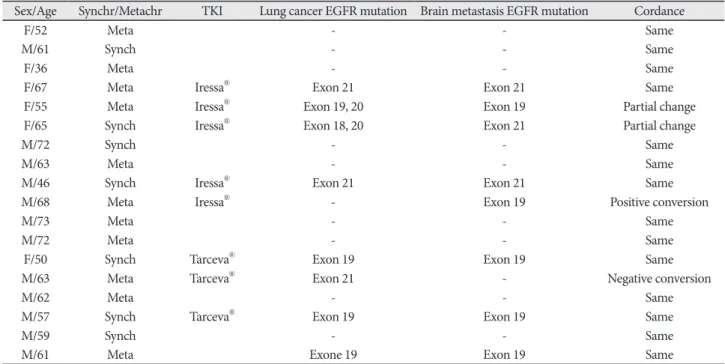
We compared the EGFR mutation frequencies in both pri- mary lung cancer and metastatic brain lesion and analyzed the mutational change of metastatic brain tumor. Based on the mutational change, we classified change in preexisting mutation as partial change, newly developed mutation as positive conversion, absence of mutation as negative conver- sion, respectively.
RESULTS
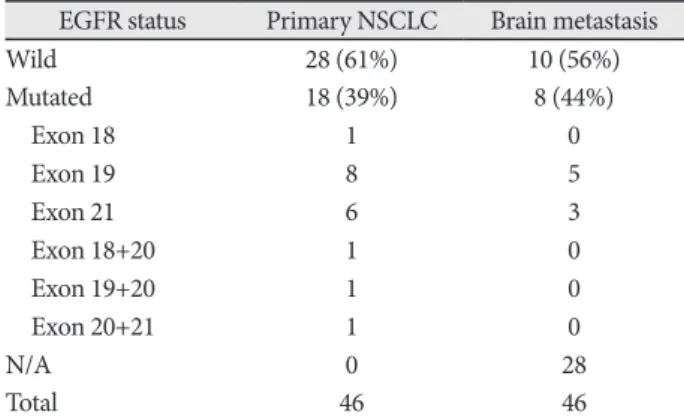
A total of 46 patients (28 males and 18 females) were in- cluded in this study. Their mean age was 62.2 (range, 36–83) years. Among these 46 cases, 18 (39.1%) cases showed EGFR mutation in primary lung cancer. Detected mutation sites were exon 19 (8 cases), exon 21 (6 cases), exon 18 (1 cases), and multiple mutations (3 cases) (Table 1). About 61.1%
(11/18) of female patients and 25% (7/28) of male patients showed EGFR mutation. All female patients were never smokers. About 66.7% of male non-smokers showed EGFR mutation. In 18 cases of BM, EGFR mutation studies were done. Among them, 8 (25.6%) cases showed mutation on exon 19 (5 cases) or exon 21 (3 cases). To compare EGFR mu- tation status between primary lung cancer and BM, 18 paired tissues from both NSCLC and matched BM were collected (Table 2). Four (22.5%) patients were discordant for the status
of EGFR between primary and metastatic sites. There were two partial changes, positive conversion and negative conver- sion were one case each (Table 3).
DISCUSSION
Molecular targeted agents are becoming important treat- ment choice for cancer because they can lead to good prog- nosis. Several studies have shown that patients with EGFR mutations have better response to EGFR TKI therapy than those without such mutations [10,11]. In a prior study, Gow et al. [12] have retrospectively analyzed 63 NSCLC patients with BM who are treated with WBRT and found that 46 pa- tients who have EGFR mutation have a median survival of 17.3 months while wild-type patients only have a median survival of 6.6 months [12]. A recent study has revealed that patients with EGFR-mutant metastatic lung adenocarcinoma have longer overall survival than wild type patients (30.9 months versus 12.1 months, p<0.05) [13]. Therefore, it is im- portant to identify EGFR mutation status of metastatic lesion for anticipating prognosis. However, previous studies have shown that mutational status of metastatic lesion does not al- Table 1. Result of EGFR mutation analysis: comparison between 46 patients who underwent EGFR sequencing
EGFR status Primary NSCLC Brain metastasis
Wild 28 (61%) 10 (56%)
Mutated 18 (39%) 8 (44%)
Exon 18 1 0
Exon 19 8 5
Exon 21 6 3
Exon 18+20 1 0
Exon 19+20 1 0
Exon 20+21 1 0
N/A 0 28
Total 46 46
EGFR, epidermal growth factor receptor; NSCLC, non-small cell lung cancer
Table 2. Result of EGFR mutation analysis: comparison of paired 18 cases
EGFR status Primary NSCLC Brain metastasis
Wild 10 (56%) 10 (56%)
Mutated 8 (44%) 8 (44%)
Exon 19 3 5
Exon 21 3 3
Exon 18+20 1 0
Exon 19+20 1 0
Total 18 18
EGFR, epidermal growth factor receptor; NSCLC, non-small cell lung cancer
KM Kim et al.
139 This study has some limitations. First, we used retrospective methods that might have selection bias. Biopsy and molecular analysis of primary site and metastatic lesion were not per- formed at the same time. Moreover, subjects of this study were patients who underwent craniotomy. Surgeons usually recom- mend this surgery only for patients with favorable prognostic factors. Second, the total number of patients was small. Al- though treatment choice for BM was WBRT, many lung can- cer patients were unsuitable for surgery. Thus, interpretation of our results should be done with these considerations.
For effective systemic therapy, molecular diagnosis of met- astatic lesion is recommended. However, biopsy of brain metastatic lesion is not always performed due to limited ac- cess to metastatic lesion. Our results suggest that discordant ways coincide with primary site. Through the literature review,
discordance rate between primary tumor and corresponding metastasis is about 16.2% or 30% by immunohistochemistry analysis [9,14]. Many studies have revealed heterogeneity of cancer cells and different metastasis site [15-18]. In many stud- ies conducted in other countries, mean discordance rate of EGFR mutation status between primary NSCLC and BM is 20% (Table 4). Masumoto et al. [19] have analyzed 21 meta- static brain tumor tissues from 19 patients treated for lung cancers from 1986 to 2001. They found that all 6 cases with EGFR mutations in their metastatic brain tissues had the same mutational status in the corresponding primary lung cancers. In another study, Rau et al. [1] have analyzed 49 paired tissues with both primary adenocarcinoma of lung and metastatic brain lesion. Their results revealed a discor- dance rate of 26.5% between primary lung cancer and BM.
In our case, in Korea, the discordant rate between primary NSCLC and metastatic brain lesion was 22.5%, similar to that in the previous study [1]. It is known that EGFR muta- tions in lung cancer occur more frequently in East Asian pa- tients than in Caucasian patients [19]. Therefore, we antici- pated that the discordance rate of EGFR mutations would be higher in Asian patients. However, our study revealed that the discordance rate was not higher in Asian patients.
In univariate analysis, EGFR mutation has been found more frequently in female and never smokers [20]. In our study, female accounted for 61.1%. All female patients were never smokers.
Table 3. Summarized results of paired 18 cases of EGFR mutation status
Sex/Age Synchr/Metachr TKI Lung cancer EGFR mutation Brain metastasis EGFR mutation Cordance
F/52 Meta - - Same
M/61 Synch - - Same
F/36 Meta - - Same
F/67 Meta Iressa® Exon 21 Exon 21 Same
F/55 Meta Iressa® Exon 19, 20 Exon 19 Partial change
F/65 Synch Iressa® Exon 18, 20 Exon 21 Partial change
M/72 Synch - - Same
M/63 Meta - - Same
M/46 Synch Iressa® Exon 21 Exon 21 Same
M/68 Meta Iressa® - Exon 19 Positive conversion
M/73 Meta - - Same
M/72 Meta - - Same
F/50 Synch Tarceva® Exon 19 Exon 19 Same
M/63 Meta Tarceva® Exon 21 - Negative conversion
M/62 Meta - - Same
M/57 Synch Tarceva® Exon 19 Exon 19 Same
M/59 Synch - - Same
M/61 Meta Exone 19 Exon 19 Same
EGFR, epidermal growth factor receptor; Synchr, synchronous metastasis; Metachr, metachronous metastasis; TKI, tyrosine kinase inhibitor;
Iressa®, gefitinib; Tarceva®, erlotinib
Table 4. Mean discordance rate of EGFR mutation status be- tween primary NSCLS and BM in other studies
Study Matched
cases EGFR mutation
in BM, n (%) Discordance rate (%) Matsumoto et al. [19] 8 6 (75.0) 0.0 (0) Kalikaki et al. [21] 3 1 (33.3) 66.7 (2 cases) Gow et al. [3] 25 11 (44.0) 16.0 (4 cases) Han et al. [2] 5 3 (60.0) 20.0 (1 case) Luo et al. [22] 15 8 (53.3) 6.7 (1 case) Rau et al. [1] 49 30 (61.2) 26.5 (13 cases)
Total 105 59 (56.1) 20.0 (21 cases)
EGFR, epidermal growth factor receptor; NSCLC, non-small cell lung cancer; BM, brain metastasis
140 Brain Tumor Res Treat 2019;7(2):137-140
Discordance of EFGR Mutation between Brain Metastasis and NSCLC
rate between primary NSCLC and metastatic brain lesion is significant. Therefore, if EGFR-mutant NSCLC patients show no response to optimal treatment, we strongly recommend biopsy of metastatic brain lesion.
To the best of our knowledge, this is the first report to ana- lyze a considerable number of metastatic brain tumors of lung adenocarcinoma for EGFR mutations and compare the discordance rate in South Korea.
Conflicts of Interest
The authors have no potential conflicts of interest.
Acknowledgments
This research was supported by National Cancer Center 1910110-1.
REFERENCES
1. Rau KM, Chen HK, Shiu LY, et al. Discordance of mutation statuses of epidermal growth factor receptor and K-ras between primary adeno- carcinoma of lung and brain metastasis. Int J Mol Sci 2016;17:524.
2. Han HS, Eom DW, Kim JH, et al. EGFR mutation status in primary lung adenocarcinomas and corresponding metastatic lesions: discor- dance in pleural metastases. Clin Lung Cancer 2011;12:380-6.
3. Gow CH, Chang YL, Hsu YC, et al. Comparison of epidermal growth factor receptor mutations between primary and corresponding meta- static tumors in tyrosine kinase inhibitor-naive non-small-cell lung cancer. Ann Oncol 2009;20:696-702.
4. Wu YL, Zhou C, Cheng Y, et al. Erlotinib as second-line treatment in pa- tients with advanced non-small-cell lung cancer and asymptomatic brain metastases: a phase II study (CTONG-0803). Ann Oncol 2013;24:993-9.
5. Weissman DE. Glucocorticoid treatment for brain metastases and epi- dural spinal cord compression: a review. J Clin Oncol 1988;6:543-51.
6. Diener-West M, Dobbins TW, Phillips TL, Nelson DF. Identification of an optimal subgroup for treatment evaluation of patients with brain me- tastases using RTOG study 7916. Int J Radiat Oncol Biol Phys 1989;16:
669-73.
7. Borgelt B, Gelber R, Kramer S, et al. The palliation of brain metastases:
final results of the first two studies by the Radiation Therapy Oncology Group. Int J Radiat Oncol Biol Phys 1980;6:1-9.
8. Mehta MP, Rodrigus P, Terhaard CH, et al. Survival and neurologic out- comes in a randomized trial of motexafin gadolinium and whole-brain radiation therapy in brain metastases. J Clin Oncol 2003;21:2529-36.
9. Eichler AF, Kahle KT, Wang DL, et al. EGFR mutation status and sur- vival after diagnosis of brain metastasis in nonsmall cell lung cancer.
Neuro Oncol 2010;12:1193-9.
10. Pao W, Miller V, Zakowski M, et al. EGF receptor gene mutations are common in lung cancers from “never smokers” and are associated with sensitivity of tumors to gefitinib and erlotinib. Proc Natl Acad Sci U S A 2004;101:13306-11.
11. Han SW, Kim TY, Hwang PG, et al. Predictive and prognostic impact of epidermal growth factor receptor mutation in non-small-cell lung cancer patients treated with gefitinib. J Clin Oncol 2005;23:2493-501.
12. Gow CH, Chien CR, Chang YL, et al. Radiotherapy in lung adenocarci- noma with brain metastases: effects of activating epidermal growth factor receptor mutations on clinical response. Clin Cancer Res 2008;14:162-8.
13. Lin JJ, Cardarella S, Lydon CA, et al. Five-year survival in EGFR-mu- tant metastatic lung adenocarcinoma treated with EGFR-TKIs. J Tho- rac Oncol 2016;11:556-65.
14. Italiano A, Vandenbos FB, Otto J, et al. Comparison of the epidermal growth factor receptor gene and protein in primary non-small-cell- lung cancer and metastatic sites: implications for treatment with EG- FR-inhibitors. Ann Oncol 2006;17:981-5.
15. Kuukasjärvi T, Karhu R, Tanner M, et al. Genetic heterogeneity and clonal evolution underlying development of asynchronous metastasis in human breast cancer. Cancer Res 1997;57:1597-604.
16. Takahashi K, Kohno T, Matsumoto S, et al. Clonality and heterogene- ity of pulmonary blastoma from the viewpoint of genetic alterations: a case report. Lung Cancer 2007;57:103-8.
17. Gallegos Ruiz MI, van Cruijsen H, Smit EF, et al. Genetic heterogene- ity in patients with multiple neoplastic lung lesions: a report of three cases. J Thorac Oncol 2007;2:12-21.
18. Rao UN, Jones MW, Finkelstein SD. Genotypic analysis of primary and metastatic cutaneous melanoma. Cancer Genet Cytogenet 2003;
140:37-44.
19. Matsumoto S, Takahashi K, Iwakawa R, et al. Frequent EGFR mutations in brain metastases of lung adenocarcinoma. Int J Cancer 2006;119:1491-4.
20. Shin DY, Na II, Kim CH, Park S, Baek H, Yang SH. EGFR mutation and brain metastasis in pulmonary adenocarcinomas. J Thorac Oncol 2014;9:195-9.
21. Kalikaki A, Koutsopoulos A, Trypaki M, et al. Comparison of EGFR and K-RAS gene status between primary tumours and corresponding metastases in NSCLC. Br J Cancer 2008;99:923-9.
22. Luo D, Ye X, Hu Z, et al. EGFR mutation status and its impact on sur- vival of Chinese non-small cell lung cancer patients with brain metas- tases. Tumour Biol 2014;35:2437-44.