INTRODUCTION
Malignant brain tumors are accompanied by hypercoagula- bility. Glioblastoma multiforme (GBM), the most common primary tumor of the central nervous system (CNS), is asso- ciated with heightened coagulation and venous thromboem-
von Willebrand Factor Gene Expression in Primary Lower Grade Glioma: Mutually Co-Occurring Mutations
in von Willebrand Factor, ATRX, and TP53
Steven Lehrer1, Peter H. Rheinstein2, Sheryl Green1, Kenneth E. Rosenzweig1
1Department of Radiation Oncology, Icahn School of Medicine at Mount Sinai, New York, NY, USA
2Severn Health Solutions, Severna Park, MD, USA
Received August 3, 2018 Revised September 30, 2018 Accepted December 10, 2018 Correspondence
Steven Lehrer
Box 1236 Radiation Oncology, Mount Sinai Medical Center, 1 Gustave L. Levy Place, New York, NY 10029, USA Tel: +1-212-765-7132 Fax: +1-212-245-9708 E-mail: [email protected]
Background Venous thromboembolism is a common complication in patients with glioma. The clotting factor von Willebrand factor (VWF) is a highly adhesive procoagulant molecule that mediates platelet adhesion to endothelial and subendothelial surfaces. In the current analysis, we examined The Cancer Genome Atlas (TCGA) data to assess the VWF gene in patients with lower grade gliomas.
Methods For newly diagnosed gliomas, we evaluated the association between VWF and over- all survival in the Genomic Data Commons TCGA Lower Grade Glioma (LGG) dataset in TCGA. Simple statistics were calculated to identify patterns of mutual exclusivity or co-occurrence of VWF mutations.
For each pair of query genes an odds ratio was calculated that indicates the likelihood that the muta- tions in the two genes are mutually exclusive or co-occurrent across the selected cases. To determine whether the identified relationship was significant for a gene pair, Fisher’s exact test was performed.
Results Lower grade gliomas with less VWF gene expression had significantly better survival than those with more VWF gene expression (hazard ratio 0.64, 95% confidence interval 0.44 to 0.92, p=0.015 log rank test). When we analyzed the data with Cox regression, VWF expression had a sig- nificant effect on survival (p=0.02) that was unrelated to the effect of IDH1 expression (p=0.062), TP53 expression (p=0.135), independent of ATRX expression (p=0.021) and histology (astrocytoma versus oligoastrocytoma and oligodendroglioma, p=0.002). VWF mutations significantly co-occur with mutations in TP53 and ATRX (p<0.001).
Conclusion The deleterious prognostic effect of VWF expression and its co-occurrent mutations with TP53 and ATRX in lower grade gliomas are not surprising, given VWF’s role in other cancers.
Therefore, VWF gene expression may be a clinically important risk marker in lower grade glioma.
Key Words Glioma; Glioblastoma; Survival; von Willebrand factor; The Cancer Genome Atlas.
bolism (VTE). The circulating substance inducing the hy- percoagulability is uncertain. Anticoagulants are frequently administered to GBM patients, although these agents increase the risk of intracerebral hemorrhage [1].
VTE is a common complication in patients with glioma [2].
VTE may be a prognostic factor for these patients [3].
Thrombin, an enzyme in blood plasma, causes the clotting of blood by converting fibrinogen to fibrin. In lower grade gliomas, thrombin has multiple effects. Intracerebral infusion of argatroban, a specific thrombin inhibitor, reduces brain ede- ma and neurologic deficits in a rat glioma model. Thrombin im-
This is an Open Access article distributed under the terms of the Creative Commons Attribution Non-Commercial License (https://creativecommons.org/licenses/by-nc/4.0) which permits unrestricted non-commercial use, distribution, and reproduction in any medium, provided the original work is properly cited.
Copyright © 2019 The Korean Brain Tumor Society, The Korean Society for Neuro- Oncology, and The Korean Society for Pediatric Neuro-Oncology
munoreactivity is found in cultured rat glioma cells and human glioblastoma. In addition, thrombin induces glioma cell prolif- eration in vitro; whereas argatroban reduces glioma mass [4].
Another clotting factor, von Willebrand factor (VWF), is a highly adhesive procoagulant molecule that mediates platelet adhesion to endothelial and subendothelial surfaces. Normally VWF is expressed exclusively in endothelial cells and mega- karyocytes. However, a few studies have reported VWF detec- tion in cancer cells of non-endothelial origin, including osteo- sarcoma and glioma [5]; and VWF is a prognostic factor in GBM [6].
In the current analysis, we examined The Cancer Genome Atlas (TCGA) data to assess the VWF gene in patients with lower grade gliomas.
MATERIALS AND METHODS
For newly diagnosed gliomas, we evaluated the association between VWF and overall survival in the Genomic Data Com- mons (GDC) TCGA Lower Grade Glioma (LGG) dataset in TCGA. To access and analyze the data we used:
• GDC Data Portal (https://portal.gdc.cancer.gov/);
• UCSC Xena browser (https://xenabrowser.net);
• Oncomine (https://oncomine.org);
• cBioPortal (http://cbioportal.org).
Survival data of the glioma subgroup were extracted for anal- ysis and generation of Kaplan-Meier curves for overall survival.
The optimal cutoff was identified by methods described in the R2 web-based application (http://r2.amc.nl); the method divides the sample, ascending order gene expression, into equal-sized groups. Further details have been published [7].
Gene expression is quantitated as Fragments Per Kilobase of transcript per Million mapped reads upper quartile (fpkm- uq), which is an RNA-Seq-based expression normalization method [8].
Simple statistics were calculated to identify patterns of mu- tual exclusivity or co-occurrence of mutations. For each pair of query genes (e.g., VWF and ATRX), an odds ratio (OR) is calculated (Equation 1) that indicates the likelihood that the mutations in the two genes are mutually exclusive or co-oc- current across the selected cases:
OR = (A*D)/(B*C), (1) where A=number of cases altered in both genes; B=number of cases altered in VWF but not ATRX; C=number of cases al- tered in ATRX but not VWF; and D=number of cases altered in neither gene. Each pair was then assigned to one of five cat- egories indicative of a tendency toward mutual exclusivity, of a tendency toward co-occurrence, or of no association. To de- termine whether the identified relationship is significant for a gene pair, Fisher’s exact test was performed [9].
RESULTS
We analyzed data from 513 patients with primary lower grade glioma. The patients’ mean age was 43±14 years (mean±
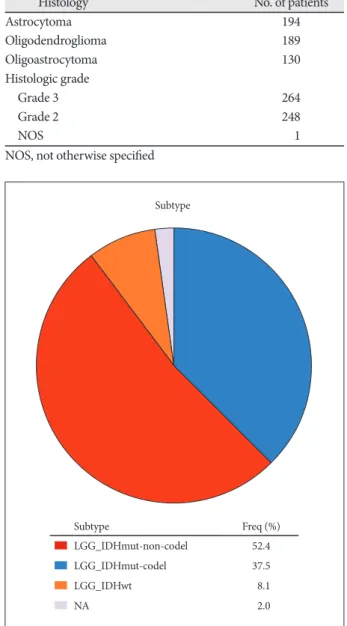
SD). 55% of the patients were male, 45% female. 92.1% were white, 4.1% African-American, 1.6% Asian, 0.2% American In- dian or Alaska native, 1.9% unclassified. Mean survival was 7.8 years. Histology and histologic grade are shown in Table 1.
Molecular subtype information [10] is in Fig. 1.
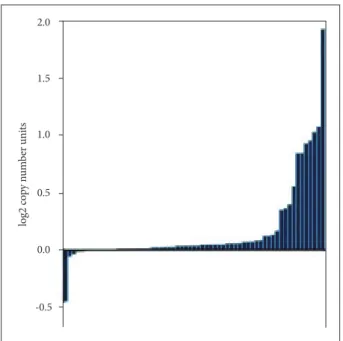
VWF was significantly overexpressed in lower grade glio- mas, especially in astrocytomas (p=0.008, t=2.471, Fold Change: 1.084, data from RefSeq Genes, UCSC refGene, July 2009, hg18, NCBI 36.1, March 2006) (Fig. 2).
Histology of tumors and VWF expression in the current Table 1. Histology and histologic grade of patients studied
Histology No. of patients
Astrocytoma 194
Oligodendroglioma 189
Oligoastrocytoma 130
Histologic grade
Grade 3 264
Grade 2 248
NOS 1
NOS, not otherwise specified Subtype
Subtype Freq (%)
LGG_IDHmut-non-codel 52.4
LGG_IDHmut-codel 37.5
LGG_IDHwt 8.1
NA 2.0
Fig. 1. Molecular subtypes of tumors studied. LGG, Lower Grade Glioma; IDH, isocitrate dehydrogenase; NA, not analyzed.
Survival versus VWF gene expression is shown in Fig. 5.
Lower grade gliomas with less VWF gene expression had sig- nificantly better survival than those with more VWF gene ex- pression (hazard ratio 0.64, 95% confidence interval 0.44 to 0.92, p=0.015 log rank test). The effect of VWF gene expres- sion on survival was even more evident when the sample was analyzed as three groups (p=0.00019).
IDH1, TP53 and ATRX mutations are present in 40% or more adult lower grade gliomas [14-16]. Among these tumors, as noted above, patients with astrocytomas have poorer surviv- al than patients with oligoastrocytomas or oligodendrogliomas;
prognosis of oligoastrocytomas or oligodendrogliomas is ap- proximately equivalent. When we analyzed the data with Cox regression, VWF expression had a significant effect on survival (p=0.02) that was unrelated to the effect of IDH1 expression analysis are listed in Table 2. There was significant variability
of VWF expression in astrocytomas, oligodendrogliomas and oligoastrocytomas (p=0.045, one way analysis of variance).
VWF was most often mutated and amplified in diffuse gliomas (grade II gliomas, also known as diffuse low-grade glioma) (Fig. 3) [11]. A previous study suggested that percentage of VWF expressing tumor cells is higher in GBM and osteosarco- ma than astrocytic tumors [5].
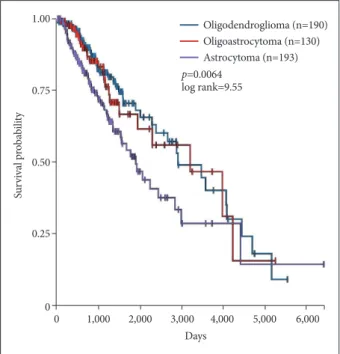
Survival of patients with astrocytomas was significantly worse than survival of patients with oligodendroglioma or oli- goastrocytoma (p=0.0064, log rank test) (Fig. 4). Note that in the 2016 CNS WHO classifications, oligodendrogliomas must carry both an isocitrate dehydrogenase (IDH) mutation and a 1p/19q codeletion. Gliomas with an IDH mutation but intact 1p/19q genomic regions are classified as astrocytomas, as are those that lack an IDH mutation [12,13]. Much of the TCGA data we present and analyze here was collected before the 2016 WHO classification change.
2.0
1.5
1.0
0.5
0.0
-0.5
log2 copy number units
Table 2. Histology and VWF gene expression (fpkm-uq) of 510 pri- mary tumors in this study
n VWF
Astrocytoma 192 17.8±0.07
Oligoastrocytoma 128 17.5±1.00
Oligodendroglioma 190 17.6±1.00
Variability of gene expression was significant (p=0.045, one way analysis of variance). VWF, von Willebrand factor; fpkm-uq, Frag- ments Per Kilobase of transcript per Million mapped reads upper quartile
Fig. 2. Expression of VWF in 63 astrocytomas (TCGA-DU-7299- 01A-21D-2023-01). VWF is significantly overexpressed (p=0.008, t=2.471, Fold Change: 1.084). RefSeq Genes, UCSC refGene, July 2009, hg18, NCBI 36.1, March 2006. The horizontal axis in- dicates specimen number (1–63). VWF, von Willebrand factor.
Fig. 3. VWF was most often mutated and amplified in diffuse glio- mas (http://cbioportal.org). Diffuse gliomas are classified accord- ing to the 2016 WHO system by both histologic and molecular characteristics as IDH-mutant or IDH-wildtype astrocytomas; IDH- mutant and 1p19q-codeleted oligodendrogliomas; and IDH-mutant or IDH-wildtype glioblastomas. VWF, von Willebrand factor; WHO, World Health Organization; IDH, isocitrate dehydrogenase.
Diffuse glioma Oligoastrocytoma Oligodendroglioms Low-grade glioma, NOS
Alteration frequency (%)
10
8
6
4
2
Mutation Amplification
(p=0.062), TP53 expression (p=0.135), independent of ATRX expression (p=0.021) and histology (astrocytoma versus oli- goastrocytoma and oligodendroglioma, p=0.002).
VWF mutations significantly co-occur with mutations in TP53 and ATRX (p<0.001) (Table 3, Fig. 6). The gene pair
TP53/ATRX had 191 significantly co-occurrent alterations; the pair VWF/TP53 had 26 significantly co-occurrent alterations;
the pair VWF/ATRX had 23 significantly co-occurrent altera- tions.
VWF is not an enzyme and its primary function is binding to other proteins, in particular Factor VIII. In addition, the de- struction of VWF is largely mediated by the enzyme ADAMTS 13. Therefore, to address the effects of elevated VWF expres- sion on the pathogenesis of thrombosis in lower grade glioma, we examined the expression of the related genes for Factor VIII and ADAMTS13. We found no correlation with VWF.
Lower grade gliomas include various types of tumors. IDH1 is the most frequently mutated gene, in about 80% of cases.
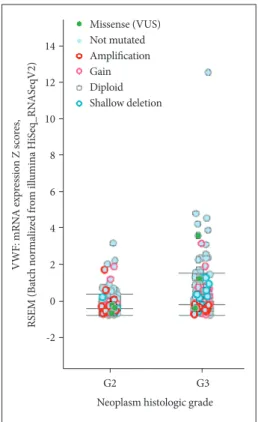
IDH1 versus VWF mRNA expression by mutation status is shown in Fig. 7. The correlation is significant. Tumor grade and VWF mRNA expression by mutation status is shown in Fig. 8; grade 3 tumors have more mutations than grade 2.
DISCUSSION
Lower grade glioma is a uniformly fatal disease of young adults with survival averaging approximately 7 years [17]. Al- though lower grade glioma patients have better survival than patients with high grade (WHO grade III/IV) glioma, almost all lower grade gliomas eventually progress to high grade glio- ma and death. Data from the Surveillance, Epidemiology and End Results (SEER) program of the National Cancer Institute Fig. 4. Survival of lower grade glioma by histology in 513 pa-
tients. Survival of astrocytomas was significantly worse than oli- godendroglioma or oligoastrocytoma (p=0.0064, log rank test).
0 1,000 2,000 3,000 4,000 5,000 6,000 0 1,000 2,000 3,000 4,000 5,000 6,000
Days Days
Survival probability Survival probability
1.00
0.75
0.50
0.25
0
1.00
0.75
0.50
0.25
0 p=0.015
log rank=5.9 p=0.00019
log rank=17.1 <17.51 (n=255)
≥17.51 (n=253) <17.15 (n=169)
17.15 to 17.91 (n=171) ≥17.91 (n=168)
B A
Fig. 5. Survival versus VWF gene expression in 508 patients. A: Lower grade gliomas with less VWF gene expression had significantly bet- ter survival than those with more VWF gene expression (hazard ratio 0.64, 95% confidence interval 0.44 to 0.92, p=0.015 log rank test). B:
The effect of VWF gene expression on survival was even more evident when the sample was analyzed as three groups (p=0.00019). No VWF expression data were available for 5 of 513 patients analyzed in Fig. 3. VWF, von Willebrand factor.
Color
0 1,000 2,000 3,000 4,000 5,000 6,000 Days
Survival probability
1.00
0.75
0.50
0.25
0
p=0.0064 log rank=9.55
Oligodendroglioma (n=190) Oligoastrocytoma (n=130) Astrocytoma (n=193)
suggest that for the majority of lower grade glioma patients, overall survival has not significantly improved over the past three decades [17].
Multiple prognostic factors have been described: Tumor his- tology, grade, location, contrast enhancement, patient age, per- formance status, and seizure history [18]. Survival probability in patients with a glioma having a high median Tumor Blood Flow (mTBF) has been shown to be lower than in patients with a glioma having a low mTBF [19]. Recently, tumor genome has proven to be a prognostic factor [14,15], as well as F13A1 copy number segments [20].
Armand Trousseau first reported the relationship of malig-
nant tumors and coagulation in 1865. Trousseau diagnosed the syndrome in himself two years later, dying soon afterward of gastric cancer. Recent findings suggest that genetic pathways within tumor cells might trigger thrombotic phenomena, worsening prognosis [21].
Biological processes or pathways in cancer are often dereg- ulated through different genes or by multiple different mech- anisms. But cancer gene mutations usually do not occur at Table 3. The gene pair TP53/ATRX had 191 significantly co-occurrent alterations; the pair VWF/TP53 had 26 significantly co-occurrent al- terations; the pair VWF/ATRX had 23 significantly co-occurrent alterations
Gene A Gene B Neither A Not B B Not A Both Log odds ratio p-value Adjusted p-value Tendency
TP53 ATRX 243 58 15 191 >3 <0.001 <0.001 Co-occurrence
VWF TP53 255 3 223 26 2.294 <0.001 <0.001 Co-occurrence
VWF ATRX 295 6 183 23 1.821 <0.001 <0.001 Co-occurrence
p value was Bonferroni adjusted. VWF, von Willebrand factor
VWF TP53 ATRX
6%
49%
41%
Genetic alteration Inframe mutation (unknown significance) Missense mutation (unknown significance) Truncating mutation (unknown significance) Fusion Amplification Deep deletion No alterations
Fig. 6. Diagrammatic representation of significantly co-occurring mutations in VWF/ATRX, VWF/TP53 and TP53/ATRX. cDNA was altered in 266 (52%) of 507 sequenced cases/patients (507 total) (cBioportal.org). VWF, von Willebrand factor.
-2 -1 0 1 2 3 4 5 6 IDH1: mRNA expression Z scores,
RSEM (Batch normalized from illumina HiSeq_RNASeqV2) VWF: mRNA expression Z scores, RSEM (Batch normalized from illumina HiSeq_RNASeqV2)
12 10 8 6 4 2 0 -2
Pearson: 0.18 Spearman: 0.11
Both mutated One gene mutated Neither mutated
G2 G3 Neoplasm histologic grade 14
12 10 8 6 4 2 0 -2 VWF: mRNA expression Z scores, RSEM (Batch normalized from illumina HiSeq_RNASeqV2)
Missense (VUS) Not mutated Amplification Gain Diploid Shallow deletion
Fig. 7. IDH1 versus VWF mRNA expression by mutation status.
The correlation is significant (p<0.05). VWF, von Willebrand factor;
IDH, isocitrate dehydrogenase.
Fig. 8. Histologic grade and VWF mRNA expression by VWF mu- tation status. VWF, von Willebrand factor; VUS, variants of uncer- tain significance.
random. Mutations of certain cancer genes tend to co-occur, indicating that they may work in tandem to drive tumor for- mation and development [9]. This appears to be the case with the co-occurring VWF, ATRX, and TP53 mutations.
The deleterious prognostic effect of VWF expression in low- er grade gliomas is not surprising, given its role in other can- cers. VWF fibers promote cancer-associated platelet aggrega- tion in malignant melanoma of mice and humans [22]; and cancer cell-derived VWF enhances metastasis of gastric ade- nocarcinoma [23].
An analysis of lower grade glioma in TCGA has shown IDH, 1p/19q, and TP53 status to be more indicative of prognosis than histologic class. Moreover, lower-grade gliomas with an IDH mutation either had 1p/19q codeletion or carried a TP53 mutation. Most lower-grade gliomas without an IDH mutation were molecularly and clinically similar to glioblastoma [16].
VWF gene expression may be another clinically important prognostic marker in lower grade glioma. The risk of VTE in glioma patients is high, and extends beyond the postoperative period. The procoagulant molecule tissue factor appears to play an important role, but other markers are needed [24].
VWF may represent a new marker. Though thromboembolic events lead to worse outcomes, risks of anticoagulant admin- istration should be better defined. Further studies of VWF would be worthwhile.
Conflicts of Interest
The authors have no potential conflicts of interest.
REFERENCES
1. Norden AD, Bartolomeo J, Tanaka S, et al. Safety of concurrent bevaci- zumab therapy and anticoagulation in glioma patients. J Neurooncol 2012;106:121-5.
2. Al Megren M, De Wit C, Al Qahtani M, Le Gal G, Carrier M. Manage- ment of venous thromboembolism in patients with glioma. Thromb Res 2017;156:105-8.
3. Simanek R, Vormittag R, Hassler M, et al. Venous thromboembolism and survival in patients with high-grade glioma. Neuro Oncol 2007;9:
89-95.
4. Hua Y, Tang L, Keep RF, et al. The role of thrombin in gliomas. J Thromb Haemost 2005;3:1917-23.
5. Mojiri A, Stoletov K, Carrillo MA, et al. Functional assessment of von Willebrand factor expression by cancer cells of non-endothelial origin.
Oncotarget 2017;8:13015-29.
6. Marfia G, Navone SE, Fanizzi C, et al. Prognostic value of preoperative
von Willebrand factor plasma levels in patients with glioblastoma. Can- cer Med 2016;5:1783-90.
7. R2 Support Team. Working with Kaplan Meier. In: R2 Tutorials. Re- lease 3.1.2. Amsterdam: Jan Koster (Academic Medical Center);2017.
p.73-82.
8. Shahriyari L. Effect of normalization methods on the performance of supervised learning algorithms applied to HTSeq-FPKM-UQ data sets: 7SK RNA expression as a predictor of survival in patients with colon adenocarcinoma. Brief Bioinform 2017 Nov 3 [Epub]. https://
doi.org/10.1093/bib/bbx153.
9. Gao J, Aksoy BA, Dogrusoz U, et al. Integrative analysis of complex cancer genomics and clinical profiles using the cBioPortal. Sci Signal 2013;6:pl1.
10. Ceccarelli M, Barthel FP, Malta TM, et al. Molecular profiling reveals biologically discrete subsets and pathways of progression in diffuse gli- oma. Cell 2016;164:550-63.
11. Wang S, Jin F, Fan W, et al. Gene expression meta-analysis in diffuse low-grade glioma and the corresponding histological subtypes. Sci Rep 2017;7:11741.
12. Louis DN, Perry A, Reifenberger G, et al. The 2016 World Health Or- ganization Classification of Tumors of the Central Nervous System: a summary. Acta Neuropathol 2016;131:803-20.
13. DeWeerdt S. The genomics of brain cancer. Nature 2018;561:S54-5.
14. Venneti S, Huse JT. The evolving molecular genetics of low-grade glio- ma. Adv Anat Pathol 2015;22:94-101.
15. Buckner J, Giannini C, Eckel-Passow J, et al. Management of diffuse low- grade gliomas in adults - use of molecular diagnostics. Nat Rev Neurol 2017;13:340-51.
16. Cancer Genome Atlas Research Network, Brat DJ, Verhaak RG, Alda- pe KD, et al. Comprehensive, integrative genomic analysis of diffuse lower-grade gliomas. N Engl J Med 2015;372:2481-98.
17. Claus EB, Walsh KM, Wiencke JK, et al. Survival and low-grade glioma:
the emergence of genetic information. Neurosurg Focus 2015;38:E6.
18. Stupp R, Janzer RC, Hegi ME, Villemure JG, Mirimanoff RO. Prog- nostic factors for low-grade gliomas. Semin Oncol 2003;30(6 Suppl 19):
23-8.
19. Furtner J, Bender B, Braun C, et al. Prognostic value of blood flow mea- surements using arterial spin labeling in gliomas. PLoS One 2014;9:
e99616.
20. Lehrer S, Dembitzer FR, Rheinstein PH, Rosenzweig KE. In primary glioblastoma fewer tumor copy number segments of the F13A1 gene are associated with poorer survival. Thromb Res 2018;167:12-14.
21. Varki A. Trousseau’s syndrome: multiple definitions and multiple mech- anisms. Blood 2007;110:1723-9.
22. Bauer AT, Suckau J, Frank K, et al. von Willebrand factor fibers pro- mote cancer-associated platelet aggregation in malignant melanoma of mice and humans. Blood 2015;125:3153-63.
23. Yang AJ, Wang M, Wang Y, et al. Cancer cell-derived von Willebrand factor enhanced metastasis of gastric adenocarcinoma. Oncogenesis 2018;7:12.
24. Jenkins EO, Schiff D, Mackman N, Key NS. Venous thromboembo- lism in malignant gliomas. J Thromb Haemost 2010;8:221-7.